
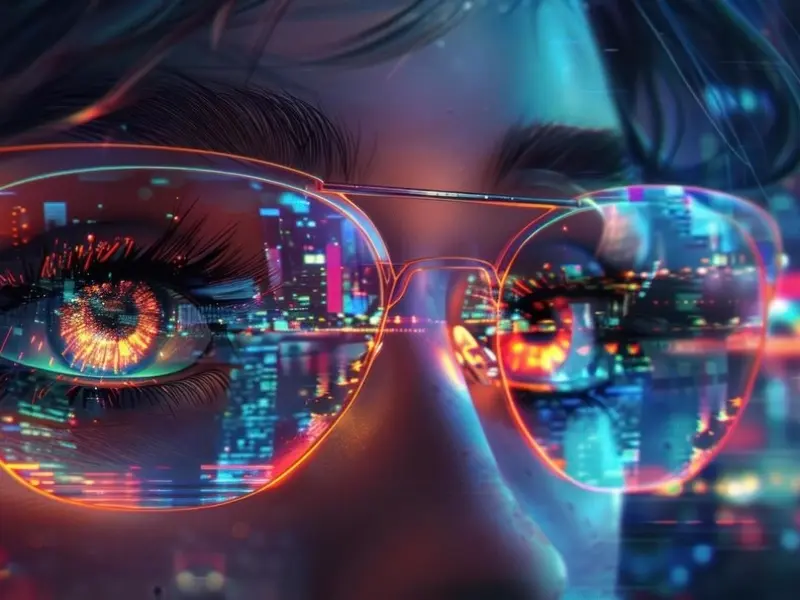
A camera can tell you what a chair looks like. It cannot tell you how far away the chair is, whether it will fit through the door, or whether the robot arm is about to knock it over. Closing that gap — from what to where, how big, and how far — is the entire job of 3D computer vision, and it is the reason machines are finally leaving the flat world behind.
3D computer vision is the branch of computer science that teaches machines to capture, reconstruct and reason about the geometry of the physical world — depth, shape, volume and the spatial relationships between entities. Where classical computer vision reads a two-dimensional image, 3D vision builds a model of the scene itself. That single upgrade, from picture to place, is what makes warehouse robots, self-driving cars, surgical planning and mixed-reality headsets possible.
The short version:
- 3D computer vision enables machines to capture, reconstruct and interpret three-dimensional data about the physical world.
- Three sensing routes dominate: stereoscopic imaging, depth sensors such as LiDAR and time-of-flight cameras, and structured light.
- It already earns its keep in robotics, healthcare, entertainment, autonomous vehicles and manufacturing — and the hard problems left are cost, complexity, weather and privacy.
What is 3D computer vision? The fundamentals
3D computer vision revolves around the ability to capture, process and interpret three-dimensional data. A 2D image tells you how something looks; 3D data tells you how something is shaped and where it sits. That geometric layer is what turns a photograph into a navigable world, and it can be gathered in three main ways.
Stereoscopic imaging: two eyes beat one
Two cameras, offset by a known distance, mimic human binocular vision. The system compares the two views, measures the disparity between them, and infers depth — then reconstructs a 3D model of the scene. It is cheap, elegant, and the reason depth from stereo remains the workhorse of consumer-grade spatial sensing.
Depth sensors: LiDAR and time-of-flight
Depth sensors such as LiDAR and time-of-flight cameras fire a signal — light or sound — and time how long it takes to bounce back off a surface. That delay converts directly into distance, giving dense, accurate depth measurements. It is the approach that made the spinning LiDAR puck the signature accessory of the autonomous-vehicle era.
Structured light: project a pattern, read the distortion
Here a known pattern — stripes, grids, dots — is projected onto the scene. When the pattern lands on a curved or angled surface it warps, and analysing that warp reveals the 3D shape of whatever it hit. Fast, precise at short range, and the reason face-unlock sensors work in the dark.
Also read: Google and HP to launch 3D video conferencing platform Project Starline
Key techniques: from raw points to recognised entities
Capturing depth is the easy half. Turning a cloud of measurements into something a machine can act on is where the engineering lives.
Feature extraction
The system identifies and isolates the significant parts of the data — edges, corners, surfaces, curvature. These features are what let an algorithm recognise and separate one entity from another inside a cluttered 3D scene.
Point cloud processing
A point cloud is a set of data points in space, typically produced by 3D scanners. Processing it means filtering noise, segmenting the scene into meaningful parts, and reconstructing surfaces until the cloud becomes a coherent model of the environment.
3D reconstruction
Reconstruction fills in what the sensor never saw. Volumetric reconstruction and surface fitting stitch partial views into a complete model, producing a detailed and geometrically accurate representation of the scene.
Entity recognition in three dimensions
Recognition classifies what is in the scene. Machine-learning models trained on 3D data learn to identify entities from their shape and spatial relationships — not just their pixels — which is why a 3D system can tell a pallet from a person even when both are the same shade of grey.
Applications of 3D computer vision
Robotics
In robotics, 3D vision is the difference between a machine that moves and a machine that understands where it is moving. Autonomous robots use it to map surroundings, dodge obstacles and manipulate entities with precision — warehouse robots reading aisles, picking items and placing them in designated slots are running 3D vision every shift.
Healthcare and medical imaging
Medical imaging techniques such as CT scans and MRIs produce 3D volumes that let clinicians examine anatomy in detail. Surgeons use them for preoperative planning and intraoperative guidance in complex procedures, and the same data drives prosthetics and orthotics tailored to a patient's unique geometry.
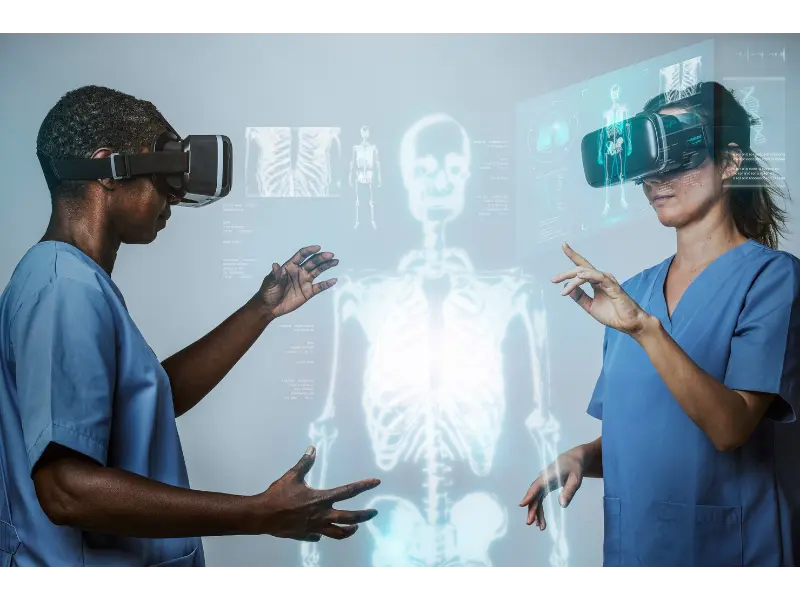
Doctors are wearing VR simulation with hologram medical technology.
Entertainment, film and games
Motion capture is 3D vision in costume: cameras record an actor's movement in three dimensions and translate it into a digital character. The same capability underpins visual effects, video games and virtual-reality experiences, where believable immersion depends on geometry that behaves like the real thing.
Autonomous vehicles
Self-driving cars lean on 3D vision to build a live map of the world around them. Cameras, LiDAR and radar combine into a single spatial picture used to detect obstacles and make real-time driving decisions — the safety case for autonomous transport rests on how well that picture holds up.
Manufacturing and quality control
On the factory floor, 3D vision inspects products for defects, measures dimensions to high precision and guides robotic arms along assembly lines. It is one of the clearest returns on investment in the field: fewer errors, faster throughput, less scrap.
Future trends in 3D computer vision
Artificial intelligence integration
AI is the accelerant. Learned models sharpen the accuracy and speed of 3D data processing, enabling recognition in cluttered, messy, real-world environments where hand-written geometry rules fall apart. The result is autonomous systems that degrade gracefully instead of failing outright.
Augmented reality and virtual reality
AR overlays digital content onto the physical world; VR builds a world from nothing. Both depend on precise 3D vision to place entities convincingly, track a user's head and hands, and keep the illusion from breaking — which is why spatial computing hardware and 3D vision research are effectively the same industry now.
Advanced medical applications
Personalised medicine is the next frontier: custom implants and prosthetics fitted to an individual's anatomy, and AI-driven 3D analysis of medical images aimed at earlier, more precise detection of disease.
Smart cities
Embedded in urban infrastructure, 3D vision can monitor traffic flow, detect incidents in real time and feed detailed spatial maps into planning decisions — the sensor layer beneath the smart-city pitch.
Also read: Dawn of a new VR era: Apple Vision Pro now available to buy
Challenges in 3D computer vision
Data complexity and compute cost
One more dimension means dramatically more data. Accurate 3D interpretation is computationally intensive, and doing it in real time — on a robot, in a car, on a headset — remains the binding constraint on what ships.
Environmental factors
Lighting, weather and occlusion all bite. LiDAR accuracy drops in fog and rain; reflective or transparent surfaces confuse structured light. Making these systems reliable outside the lab is the difference between a demo and a product.
Cost and accessibility
High-resolution cameras and depth sensors are still expensive enough to limit mass adoption. Economies of scale and cheaper silicon are steadily pushing costs down, but the price of the sensing stack still shapes which applications make commercial sense today.
Privacy concerns
A system that reconstructs a space reconstructs everything in it, including people who did not consent to being measured. Surveillance and data collection are the live battlegrounds, and ethical deployment is as much an engineering requirement as an accuracy target.
The bottom line
2D vision taught machines to recognise the world. 3D vision is teaching them to inhabit it — and the industries that master depth first will be the ones whose robots, vehicles and interfaces stop guessing and start knowing where things are.




