
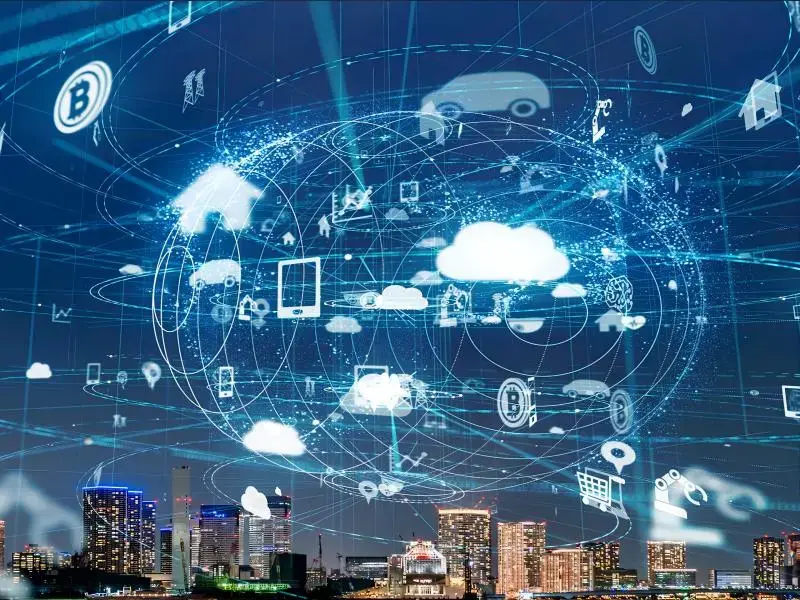
- Internet of Things (IoT) refers to the network of physical entities connected via sensors, software and other technologies.
- With automation, the Internet of Things (IoT) makes it easier to collect and access data to save our costs and improve efficiency which culminates in our improved quality of life.
- Every coin has two sides, the Internet of Things could bring us some disadvantages like security and privacy risks, heavy dependency on technology, system complexity, unemployment and expensive costs.
The term “Internet of Things” (IoT) describes a network of real-world entities, such as cars, appliances, and other machinery, that are integrated with software, sensors, and network connectivity to enable data collection and sharing.
The fundamental function of the Internet of Things is to enable data sharing and interaction between hitherto unconnected entities. This interconnectivity makes possible a wide range of applications, such as the industrial Internet of Things (IIoT), which uses real-time data analysis to optimise supply chain management and manufacturing processes, smart cities with improved public services and energy efficiency, and smart homes with remotely controlled and communicative appliances. The physical and digital worlds meet, but they work together. Let’s explore the most significant advantages and disadvantages of the Internet of Things (IoT).
Advantages of IoT (Internet of Things)
By fusing the digital and physical realms, IoT enhances the capabilities and responsiveness of the entities surrounding us. In our daily lives, IoT provides several advantages. Here are a few of its advantages:
1. Automation
Many IoT advantages can not come into play without automation, which is made easier and possible thanks to the so-called machine-to-machine communication. Multiple levels of automation exist with IoT, allowing you to focus on other, more important jobs. For example, a humidifier can be integrated with Google, allowing you not only to simply turn on or off but also to automate its schedules.
2. Data collection and access
Once your IoT devices are connected, they will collect information from the physical world and exchange such data with each other, likely storing a massive amount of them on cloud storage. In addition, you can access data and information from everywhere at any time on any internet-connected smart device such as a smartphone.
3. Improved efficiency
The IoT devices work rapidly and data that may have taken a long time to move now be transferred more quickly. Staff no longer spend more valuable time collecting and processing information. Data packets are transmitted through the connected network and communicated and shared between IoT devices to make your systems efficient.
4. Cost savings
IoT provides more opportunities with cost savings and it fundamentally proves to be very helpful to people who are in charge of monitoring and maintaining systems. For example, IoT devices can issue proactive alerts about their status, allowing people to plan for repair in advance. IoT mostly helps people live easier by enabling efficient device communication to save people’s time and money.
5. Improved quality of life
All IoT applications are fighting for increased comfort, convenience, and better management, finally improving the quality of life. For instance, in medicine, smart pills can deliver data along the way of the gastrointestinal tract and share the information with blood pressure monitors with an IoT system in real-time.
Also read: How did the internet start?
Also read: Qualcomm unveils AI-Ready IoT platform at Embedded World 2024
Disadvantages of IoT
IoT offers many benefits, but it also poses several risks and challenges. Here are some of the most significant ones:
1. Security and privacy risks:
As IoT devices become more widespread, security and privacy become increasingly important. Many IoT devices are vulnerable to hackers and other cyber threats, which can gain access to the system and steal personal information. Since we add so many devices to the internet, there is a risk that our information can be misused.
2. Heavy dependency on technology:
The most important prerequisite for IoT is an internet connection. Internet connectivity is essential to IoT. If we don’t get our desired outcome right away, we may become agitated by even the most irrelevant information. Importantly, IoT is making it harder for us to focus.
3. System complexity
The designing, developing, maintaining, and enabling of a large IoT system is quite complicated because it is a diversified network connecting various devices that make complex operations behind the scenes. The remaining steps of the process will be wrong results if the program accidentally performs an improper computation. Not to mention that it might be challenging to determine where the fault originated.
4. Unemployment
As IoT brings in more consistent automation, it is quite obvious that the need for human labour will reduce drastically, thus prompting the unemployability of workers in society. Any technology can cause this problem, but mastering new ways of working with optimum education and skill training will increase or stabilise the chances of a person’s employability. However, it is also to be tough for labourers and less-educated staff.
5. Costs
An IoT system’s deployment frequently requires significant time and financial commitment. IoT devices need to be bought, staff-installed, network-integrated, and eventually configured, with support calls to the manufacturer for assistance.
Conclusion
In conclusion, IoT offers significant advantages like automation, data collection and access, improved efficiency, cost saving and improved quality of life. However, it comes with notable drawbacks, including security and privacy risks, heavy dependency on technology, system complexity, unemployment and expensive costs. Striking a balance between innovation and security is vital as we navigate the IoT landscape. Clear understanding and decisions about the advantages and disadvantages of IoT are essential for us to build a brighter future.