
Summary
- Vertiv agreed to pay approximately US$1.45 billion in cash at closing for UtilityInnovation Group, subject to working-capital, indebtedness and transaction-expense adjustments. It may pay up to US$1.15 billion more in two cash earnout tranches.
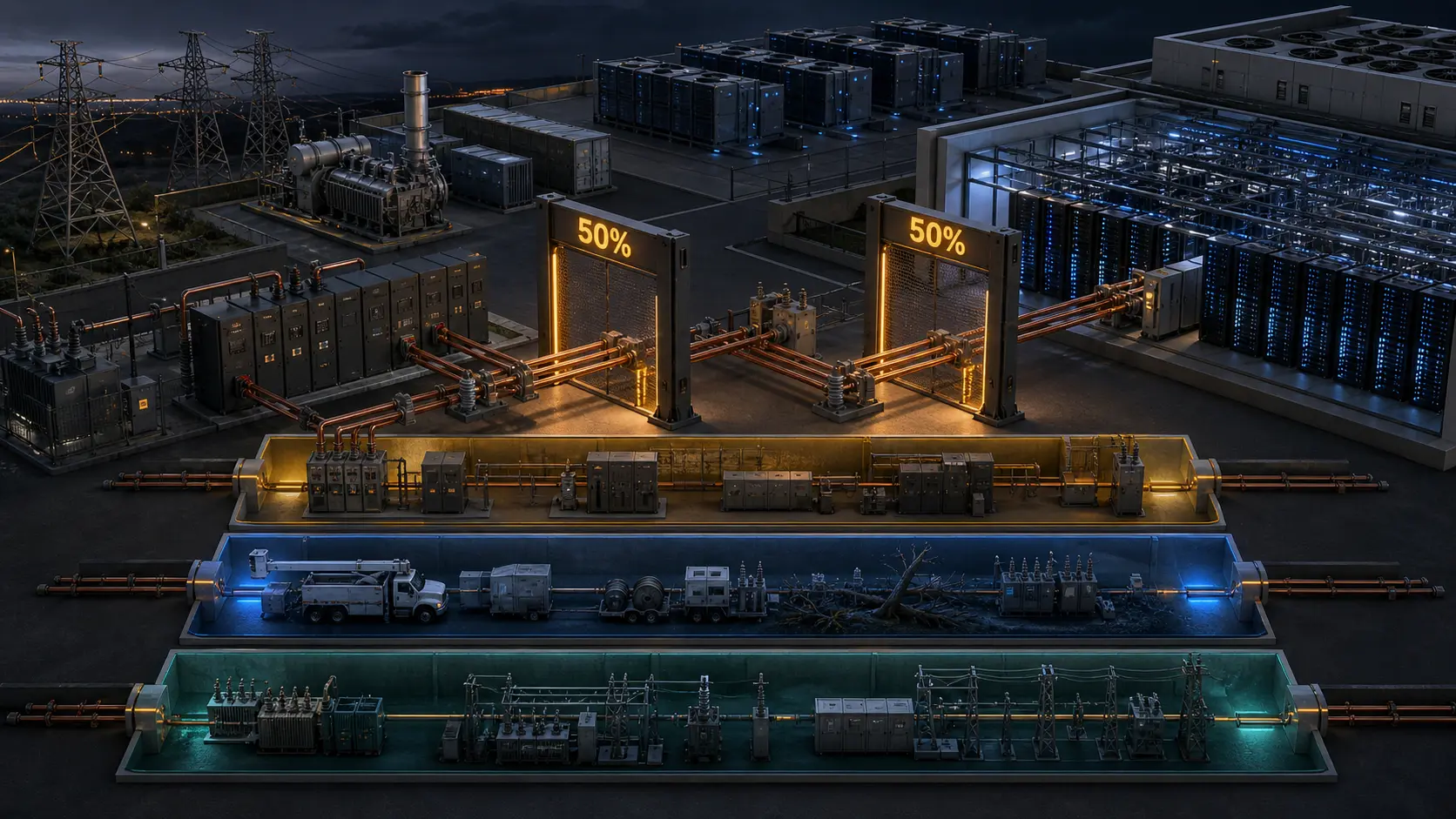
- Each tranche is capped at US$575 million. Below 50% of its applicable EBITDA target, it pays zero; at exactly 50%, the filed formula produces US$287.5 million; at target or above, it reaches the cap.
- The first test covers the twelve months to 30 September 2027. The second starts on the same 1 October 2026 date and ends two years later, so its Adjusted EBITDA is cumulative across both periods.
- The public agreement does not disclose either target or the detailed Schedule 2.09 accounting rules. It does disclose which operations count, and expressly removes the historical Storm and UtilityInfrastructure businesses from the earnout perimeter.
- Vertiv must preserve separate records, a quarterly project-review cadence and segment reporting across the three businesses. Founder Sidney Hinton is to run day-to-day operations, while Vertiv generally retains consent over material actions.
- Vertiv’s June balance sheet showed enough stated liquidity to make “existing resources” credible, but it is not a closing sources-and-uses statement. The deal remains subject to regulatory approval and other conditions.
Most acquisition announcements ask investors to look at a price and then imagine synergies. Vertiv’s filed merger agreement asks for a different order. It makes the reader define the business before valuing the consideration.
The Form 8-K divides the bargain into cash now and cash that may become due later. Approximately US$1.45 billion is payable at closing, adjusted for working capital, indebtedness and transaction expenses. Up to US$1.15 billion may follow if the acquired business meets specified EBITDA tests. The legal maximum is therefore about US$2.6 billion, but only the base belongs to the closing receipt, and even that base remains adjustable.
That distinction is not pedantry. The contingent layer is 44.2% of the maximum nominal consideration and 79.3% of the unadjusted base price. Calling US$2.6 billion “the price” silently assigns a 100% probability to two future tests. Calling US$1.45 billion the whole price ignores an obligation large enough to change the economics of the acquisition. The useful number is not one headline. It is a distribution governed by a contract.
The first dollar arrives as US$287.5 million
Section 2.09 creates two tranches, each with the same shape. The 2027 amount equals US$575 million multiplied by actual Adjusted EBITDA divided by the 2027 target. If performance is below 50% of target, however, the amount is zero. At or above target, the payment cannot exceed US$575 million.
The result is a cliff. At 49.9% of target, the contract says zero. At exactly 50%, ordinary multiplication gives US$287.5 million. Above the threshold, the amount scales with performance until it reaches the cap. The second tranche repeats that architecture against its own target.
This matters more than the familiar phrase “up to.” A smooth earnout might make each incremental dollar of EBITDA worth a proportionate amount from the beginning. Vertiv’s contract instead concentrates value at the halfway mark. Near that point, classification, timing and adjustments can determine whether hundreds of millions of dollars exist at all, not merely whether a modest marginal payment changes.
The public cannot locate the cliff in dollars. Both EBITDA targets are assigned to Schedule 2.09(a), and the detailed accounting principles for Adjusted EBITDA also sit in Schedule 2.09. That schedule is not part of the filed exhibit. The public agreement discloses the function, threshold and cap but withholds the denominator and many measurement rules.
That information gap sets a hard limit. Vertiv’s filed release says the US$1.45 billion base represents approximately 13 times expected UIG 2027 EBITDA. A mechanical inversion is about US$111.5 million. It would be wrong to rename that implied estimate the 2027 earnout target. One comes from an approximate public valuation statement; the other is a private contractual denominator defined in an omitted schedule.
The second clock restarts nothing
The periods are easy to misread. The first begins at 12:01 a.m. Eastern Time on 1 October 2026 and ends on 30 September 2027. The second begins on precisely the same date and ends on 30 September 2028. The agreement then removes doubt: 2028-period Adjusted EBITDA includes all Adjusted EBITDA from both the 2027 and 2028 periods.
The second test is therefore cumulative over 24 months, not a clean examination of the second twelve months. Early performance can affect both measurements, though against different undisclosed targets. That design may reward a strong launch twice in the sense that the first year contributes to each test, but it does not mean the same target or the same dollars are counted twice. Each tranche has its own denominator and cap.
Vertiv says the transaction multiple would be significantly lower if the full earnout were paid. That can be economically coherent only if EBITDA grows enough to outrun the additional consideration in the relevant comparison. The filing does not give readers the targets or actual future EBITDA needed to reproduce the claim. The statement should therefore remain what it is: management’s expectation, conditional on performance, not a solved valuation identity.
The payment timetable also trails the operating periods. Vertiv is to deliver the first earnout statement within 90 days after the 2027 period ends and the second within 60 days after the 2028 period ends. Sellers then receive a 45-day review window. An unresolved dispute can proceed to an independent accountant, with final payment due within five business days after the amount is settled. Economic performance, measurement and cash settlement are separate dates.
The earnout buys a bordered business
The most revealing paragraph is not the price formula. It is the definition of “Included Business.” It covers design, sale, delivery, installation, operation and maintenance for power-system load and frequency balancing, behind-the-meter systems, utility grids, distribution and transmission infrastructure, substations, distributed-energy integration, interconnection, grid resilience, microgrids, AI and related activities conducted or contemplated by the target at closing.
Then the agreement cuts two lines out. Damage assessment and storm-restoration services historically reported as the Storm segment are excluded. A separate line supporting grid reliability, expansion and modernisation across various infrastructures, historically reported as UtilityInfrastructure, is also excluded.
Those exclusions concern the earnout calculation. They do not prove that the operations sit outside the acquired legal group. Indeed, the need to separate them after closing suggests a single corporate acquisition can contain several economic perimeters. Vertiv acquires the target; sellers earn contingent consideration only on the defined slice.
This is where integration becomes price. A data-centre microgrid project may combine controls, switchgear, engineering, installation and long-term services. A broader utility project may use overlapping people, suppliers or capabilities. Revenue assignment, shared cost, project timing, internal transfers and the boundary between contemplated and newly developed work can all affect Adjusted EBITDA. Schedule 2.09 presumably supplies important accounting detail, but public readers cannot see it.
The contract responds by creating a temporary reporting institution. Vertiv must maintain records that separately account for each component of Adjusted EBITDA, continue the target’s pre-closing quarterly project-review cadence and issue segment-level reporting that separates Included Business, Storm and UtilityInfrastructure. The earnout is not simply a cheque formula. It is a requirement to preserve organisational legibility during integration.
Sellers have 45 days to inspect work papers and object to an earnout statement. If negotiation fails, an independent accountant decides only the disputed measurement issues using the agreement and submissions; the accountant acts as an expert, not as an arbitrator. The process recognises that the border is valuable enough to litigate in numbers even when the companies do not litigate in court.
Two managers inhabit the same perimeter
The operating covenants split authority. Sidney Hinton, UIG’s founder and chief executive, is to become vice president and general manager and oversee day-to-day operations during the earnout periods. His remit includes personnel decisions and approval of supplier and customer contracts under Vertiv’s generally applicable policies.
Material actions generally need Vertiv’s prior consent, which may not be unreasonably withheld, delayed or conditioned, unless an agreed exception applies. Vertiv also promises good faith and must not act with the purpose or intent of frustrating Adjusted EBITDA or reducing a payment. Beyond those express limits, however, the buyer retains sole discretion over the business and owes sellers no fiduciary duty to maximise the earnout.
That arrangement gives the founder operational continuity without leaving the buyer as a passive owner. It also maps the central incentive conflict. Sellers benefit from earnings that cross thresholds; Vertiv owns the business, bears integration risk and may owe the resulting cash. The same decision can improve the combined enterprise while depressing Included Business EBITDA, or protect the earnout while delaying integration. The contract does not eliminate that conflict. It names authority, evidence and dispute procedures around it.
If Hinton leaves, the specific management covenant falls away. Vertiv must then operate the Included Business in a commercially reasonable manner and provide quarterly Adjusted EBITDA reports through the remaining period. Founder continuity is thus part of the earnout architecture, not a biographical detail.
Existing resources is not a funding table
Vertiv says it expects to fund the acquisition from existing resources. Its June-quarter 10-Q gives the last public balance-sheet snapshot before the announcement: US$2.8106 billion of cash, US$300 million of short-term investments and US$2.4836 billion of availability under a US$2.5 billion unsecured revolver, net of letters of credit. Long-term debt, net, was US$2.9398 billion. First-half operating cash flow was US$1.8666 billion.
Those numbers support capacity. They do not identify the closing wallet. The snapshot predates announcement, expected fourth-quarter closing, capital spending, working-capital movements and other corporate uses. The 8-K does not allocate the base consideration among domestic cash, repatriated cash, maturing investments or revolving borrowings. Nor does it say how Vertiv would fund an earnout that becomes payable years later.
The correct sequence is conditional. First comes antitrust clearance and satisfaction of closing conditions. Then comes an adjusted closing payment and acquisition accounting. Only after the business operates across the measurement periods can either contingent tranche be determined. A liquid balance sheet makes the sequence financeable; it does not collapse it into one cash date.
Sources
Member Briefing
Deeper Profile Context
Sign in with the right membership level to unlock the full briefing and source notes.
Only for Strategic Circle
Strategic Circle
Open to all readers. Unlock profile briefings after joining and signing in.
Join Strategic CircleOnly for Leadership Alliance
Leadership Alliance
For qualified IP-asset owners and management; sign in to unlock alliance briefings.
Join Leadership Alliance