
Summary
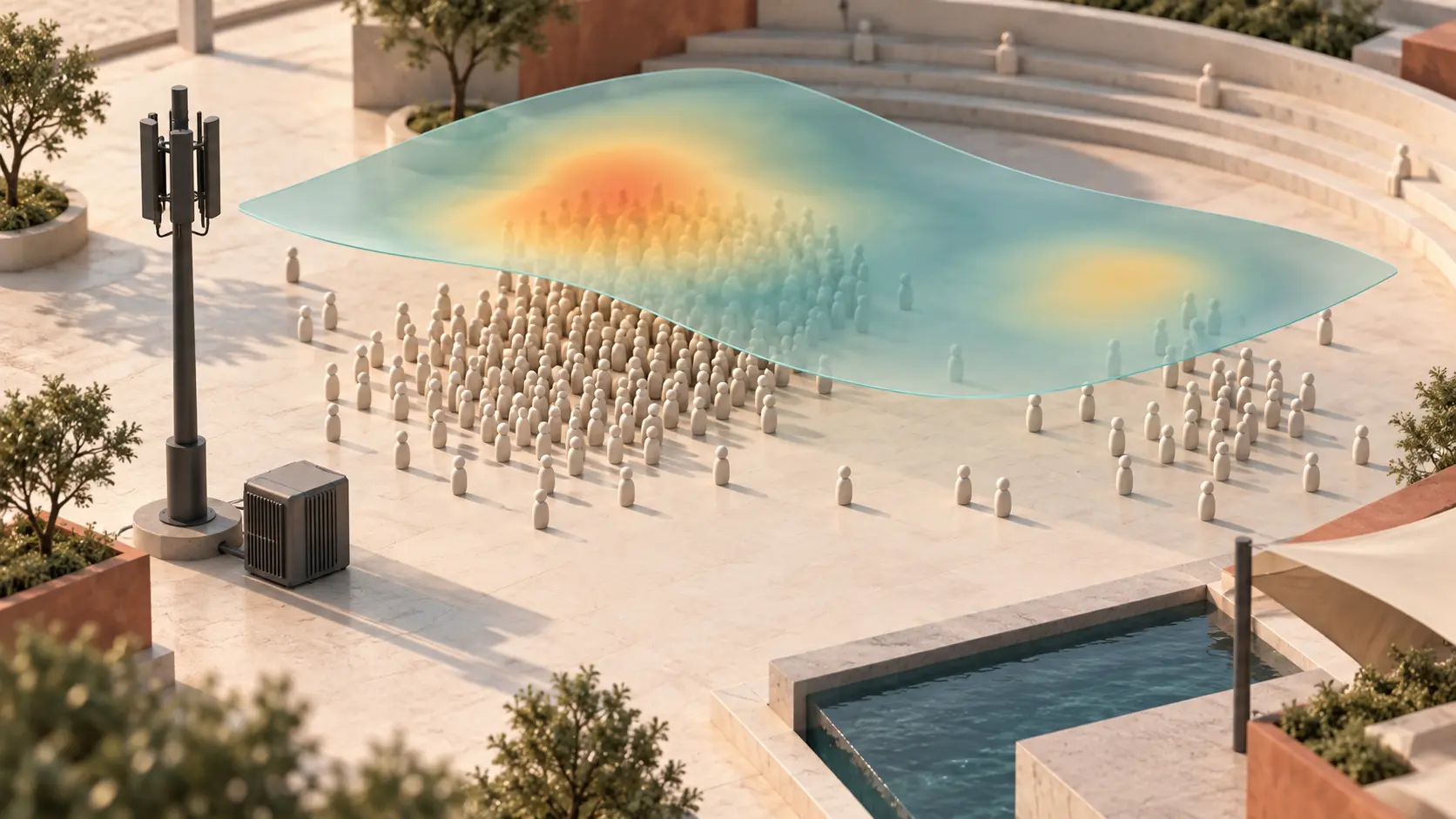
- Verizon and Samsung say a Dallas trial used a 5G base station, six localised smartphones and edge AI to display aggregate crowd density.
- The result points to a possible venue-information service, but the announcements disclose neither a paid deployment nor measured improvements in crowd management.
A venue operator may have plenty of mobile coverage and still struggle to see where people are bunching up. Verizon and Samsung are testing whether the same radio infrastructure can help answer that second question. In announcements on September 14, they described a Dallas experiment that converted changes in radio channels into a crowd-density heatmap. The prospective product is not another connection: it is information that someone running an event might act on.
The distinction matters for the economics. Carrying traffic gives a network one role; supplying a dependable input to staffing or queue decisions gives it another. The Dallas trial demonstrates a route from radio measurements to an aggregate display, according to the participants. It does not yet demonstrate a buying decision, a reliable operational intervention or an additional revenue stream.
What the Dallas trial actually used
Verizon's announcement describes a single 5G base station using 40MHz of CBRS spectrum and radio-channel variations from six localised Samsung Galaxy smartphones. Its Network in a Server, or NIS, edge platform used AI to derive heatmaps that could be shown on smartphones and a tablet. The six phones are part of the trial arrangement; they are not a disclosed count of spectators or a measure of the size of the crowd.
Samsung's account adds the deployment detail. A CBRS radio unit on a Verizon Cell-On-Wheels fed channel information into a platform combining commercial AI virtualised RAN, virtualised core and the integrated sensing and communication application. NIS analysed the information near the network edge to produce a near-real-time density map. The companies place the experiment at a major international soccer celebration in Dallas, without identifying the event or giving its exact trial date.
This is work on extending the functions of existing 5G infrastructure, with a research path towards 6G. It is not evidence that Verizon has launched a commercial 6G network. Nor should the Dallas result inherit specifications from the separate drone-and-vehicle demonstration described in Verizon's wider announcement. That experiment used a different arrangement in San Diego.
A heatmap is not an operating result
Samsung presents crowd information as potentially useful for locating resources, improving attendee services and recognising congestion. Those are proposed uses, not reported trial outcomes. Neither release supplies a benchmark for density-estimation accuracy, a false-alarm rate, a latency commitment, a crowd count or a measured reduction in queues. A display can be technically successful while remaining too uncertain, too slow or too awkwardly integrated to change a staffing decision.
The reuse claim also needs a narrow reading. Samsung says the trial builds on existing 5G connectivity without additional equipment. That does not establish zero incremental cost for a different venue, or remove the need to account for compute, software, radio placement and operation. The relevant comparison for a prospective customer is the total cost of useful information against the methods already available there—not the cost of a heatmap in isolation.
Both companies say the trial measured the number of people in an area without identifying individual users or objects, and that no identity information was obtained. That is an important stated boundary of this demonstration. It is not an independent privacy audit or a complete account of retention, access and governance in a future service.
The market signal is narrower than the 6G banner
Verizon announced nine additional members of its 6G Innovation Forum alongside the trials. A larger research group can broaden the technical effort; membership is not a venue customer's order. The releases name no price, paying customer, service-level agreement or revenue attached to the Dallas application.
For now, the useful market signal is that a mobile operator and its supplier have produced an additional output from a radio-and-edge-computing setup. Whether that output becomes a service depends on demonstrating that it changes a decision often enough, and credibly enough, for an operator of a venue to pay for it.
Member Briefing
Deeper Profile Context
Sign in with the right membership level to unlock the full briefing and source notes.
Only for Strategic Circle
Strategic Circle
Open to all readers. Unlock profile briefings after joining and signing in.
Join Strategic CircleOnly for Leadership Alliance
Leadership Alliance
For qualified IP-asset owners and management; sign in to unlock alliance briefings.
Join Leadership Alliance