
Summary
- What it says: Vapor IO built its edge-infrastructure thesis around a hard economic question: when does a customer earn enough from milliseconds to pay for data-centre capacity outside the cloud core?
- Main topic: Cloud service dependency; Local cloud substitution; Data centre investment; AI infrastructure economics
- Context: market / company research report / United States / North America
A Millisecond Has to Earn Its Rent
The most honest buyer of edge capacity is not a technologist admiring a map of low-latency nodes. It is a store operator watching a self-checkout lane, a city traffic room trying to detect a pedestrian conflict before an ambulance turns, or a manufacturer deciding whether a robotic cell can keep moving when a connection to a distant cloud region hesitates. In that room, the question is not whether the word edge sounds modern.
It is whether a few milliseconds of reaction time convert into something with a budget line: fewer shrink events, fewer safety incidents, less downtime, more ad impressions served before a user leaves, or a private wireless service that can be sold without building a bespoke server closet at every site.
That is the economic scene in which Vapor IO matters. Vapor IO is an Austin, Texas company selling distributed data-centre, interconnection, networking and edge-service infrastructure under the Kinetic Grid and Zero Gap AI labels. Its public message is near-premises rather than merely regional: put compute, storage, interconnection and private-network functions close enough to access networks and enterprise premises that the application behaves differently, while sparing the customer from owning on-site servers. The company's about page lists Cole Crawford as founder and chief executive and gives a Bridgepoint Parkway address in Austin. Its current product pages aim at clouds, content networks, cable operators, wireless providers, enterprises, private 5G suppliers and municipalities, not at hobby workloads.
The hard public number that anchors the company's scale ambition is the January 2020 Series C announcement: Vapor IO said it had brought aggregate Series C funding to $90 million, with Berkshire Partners and Crown Castle backing a plan to build the Kinetic Edge platform across 36 U.S. markets by the end of 2021. That figure is useful not because it proves the buildout succeeded exactly as described, but because it says what the company had to finance before customers could fully prove the market. Edge capacity is not software inventory. It requires a site, power, cooling, fiber, monitoring, physical security, permitting, integration and enough repeatable deployment process that the next city is not a one-off civil-engineering project.
The mechanism is therefore brutal and simple. Vapor IO can make an edge module cheaper to deploy than a conventional data centre and more useful than a server closet, but it cannot make fixed cost disappear. A module near a tower or fiber junction depreciates whether it is full or empty. Power, cooling, remote monitoring, field service, lease rights and network ports must be in place before a smart-city camera, a retail video model or a private 5G customer fills the rack. If a market has enough tenants, the same local footprint can sell colocation, interconnection, AI inference, private-network functions and resiliency.
If demand comes only as pilots, the unit cost of proximity rises quickly. Vapor IO's business is the attempt to make milliseconds shared, repeatable and billable.
That distinction separates this company from a generic edge-computing explainer. The core question is not whether low latency is technically desirable. The question is who pays for it when centralized cloud regions, regional data centres, content-delivery networks and ordinary broadband already satisfy most applications. Vapor IO's answer is that the profitable edge sits between the cloud core and the enterprise closet: close enough to change application performance, neutral enough for multiple service providers, and standardized enough that capital can be deployed before every tenant is known. That is a sophisticated wager.
It is also a utilization wager.
Identity, Services and the Public Operating Surface
Vapor IO's identity is unusually well supported for a private edge-infrastructure company because it leaves evidence across company pages, investor announcements, partner releases and internet-infrastructure records. The company describes the Kinetic Grid platform as an on-demand system of edge infrastructure that customers can consume as a service, bringing their own applications and servers while Vapor IO carries the capital risk, construction complexity and maintenance burden. Its edge-to-edge colocation page says Vapor IO builds and operates clusters of automated micro data centres adjacent to fiber intersections and last-mile networks in U.S. cities, connected by metro and national backbones. Its home page frames the product as a marketplace for clouds, CDNs, telcos, cable operators, private 5G providers, enterprises and municipalities.
The service mix is broader than colocation in the old sense. Vapor IO sells micro data-centre space, interconnection, national and metro connectivity, remote monitoring, private-backbone services, local breakout, cloud-adjacent application hosting, telco-cloud support, private wireless enablement and, more recently, AI-as-a-service through Zero Gap AI. The company's networking and interconnection page says the Kinetic Grid supports microsecond latencies, automated provisioning, telemetry access and predictable routes. The language is ambitious, but the economic claim underneath is concrete: if local application placement, private routing and nearby radio or wireline access eliminate enough delay or backhaul, customers may pay Vapor IO instead of overbuilding premises infrastructure.
Public network evidence adds a second layer, with an important caveat. PeeringDB lists Vapor IO as AS5670, a North America network service provider with the RADB as-set AS-VAPOR, two 100 Gbps DE-CIX exchange presences in Dallas and Chicago, and facilities in locations including Chicago, Dallas, Atlanta, Phoenix, Las Vegas, Pittsburgh, Los Angeles and Seattle. The PeeringDB organization page gives the Austin address and shows the record last updated in 2022. Those entries support the claim that Vapor IO has built an interconnection surface in recognized carrier hotels and data-centre facilities, not only a marketing site.
The caveat is that the public global-routing picture is less emphatic than the product language. bgp.he.net reports AS5670 as not visible in the global routing table since August 28, 2025, and RIPEstat's AS5670 page likewise indicates that the ASN was not seen originating address space at the observed time. That does not mean Vapor IO has no network: private backbones, customer networks, partner networks and exchange-facing infrastructure can exist without broad public origination from the company's ASN. It does mean that public BGP evidence should not be over-read as proof of a large active transit business. The safer conclusion is narrower: Vapor IO has documented interconnection locations and partner architecture, while traffic volume and live customer utilization remain private.
Market-count evidence also requires precision. In 2020, Vapor IO announced a 36-market plan with Cloudflare and its Series C raise. In 2022, the company said the Kinetic Grid was available in 32 U.S. markets, with live services in Las Vegas, Phoenix, Chicago, Atlanta, Dallas and Pittsburgh and additional markets becoming available. Current partner and product pages sometimes refer to 33, 36 or 36 key markets depending on the product context. Those numbers should be read as the commercial footprint and deployment plan of a modular platform, not as a public inventory of every installed cabinet, rack and filled tenant zone. For BTW's purposes, identity and product scope are high confidence; installed density is medium confidence.
What Vapor IO Sells Is an Option on Close-Enough Economics
Vapor IO's revenue logic starts with a buyer who wants on-premises performance but not on-premises responsibility. The company's homepage tells enterprises to trade on-prem for near-prem and advertises pay-as-you-go services for smart retail, smart factory, smart warehouse, private 5G and similar use cases. Its Zero Gap AI launch with Supermicro makes the same promise in AI language: deliver private 5G and GPU-based micro-clouds adjacent to storefronts, factory floors and city intersections without putting expensive servers on premises. That is a pricing clue even without a public rate card. The customer pays for avoided capital, avoided operations and useful proximity, not for raw compute alone.
This logic is economically appealing because enterprise edge demand is intermittent and uneven. A retailer may want local video inference in hundreds of stores but will not staff every location with data-centre engineers. A municipality may want pedestrian-safety analytics at intersections but does not want AI servers in every signal cabinet. A manufacturer may want private wireless plus low-latency inference on a production floor but cannot justify a bespoke micro data centre for a single line. Vapor IO's model bundles the local facility, managed infrastructure, connectivity and partner stack so the customer can buy a service.
In exchange, Vapor IO must aggregate many such customers across the same geography.
That aggregation is the hinge. A cloud region works because millions of unrelated workloads share a very large fixed-cost base. An enterprise server closet works because the buyer owns both the application and the reason for locality. The near-premises edge sits awkwardly between them. It needs enough standardization to resemble cloud economics, enough locality to beat a region, and enough multi-tenancy to keep the module full. Vapor IO's Kinetic Grid platform page is explicit that customers can scale as they grow and pay only for what they need. That is attractive to the buyer precisely because it moves construction and utilization risk to Vapor IO.
The first revenue stream is therefore recurring infrastructure rent: rack or sub-rack colocation, power, remote hands, cross-connects, private connectivity and managed edge operations. The second is platform revenue through software-defined interconnection, telemetry, service provisioning and customer portals. The third is partner-bundled services, where Vapor IO is the infrastructure layer inside a sale made by a systems integrator, managed-service provider, private-wireless vendor, AI vendor or last-mile network. The Monetize the AI Edge partner announcement described a reseller initiative for applications such as video security, public safety, traffic management, retail loss prevention, manufacturing and logistics, citing a Tolaga Research estimate that edge AI across Vapor IO's 36 markets could approach $180 billion by 2028. That market number is a vendor-framed addressable-market claim, not booked revenue, but it reveals the target: partner channels that can turn local AI services into repeatable demand.
The threshold for payment is stricter than the marketing category suggests. A customer will not rent Vapor IO capacity merely because the workload is modern. If a 50-millisecond CDN response, a normal cloud region or a regional colocation site is good enough, the cheaper and simpler option wins. Cloudflare's network page says its global network has 330-plus cities and reaches most internet users within 50 milliseconds. That is the competitive baseline for many web and security services. Vapor IO's stronger use cases are below, beside or outside that baseline: private wireless, local video inference, machine-control feedback, data-residency-sensitive operations, metropolitan resiliency, local breakout and applications where backhauling data to a distant region is too slow, too expensive or too exposed.
The company's economics therefore improve when latency is not an abstract quality measure but a monetizable feature. Retail shrink prevention, traffic safety, industrial uptime, mobile private-network coverage, event-venue experiences and public-safety analytics can all plausibly create value from local inference. A generic enterprise dashboard probably cannot. The difference between those two categories is the difference between a module with tenants and an expensive technology demonstration.
Pricing Without a Public Rate Card
Vapor IO does not publish a simple rate card, and that absence is itself informative. A commodity colocation company can publish cabinet, power and cross-connect prices because the buyer knows roughly what a rack in a regional facility is. Vapor IO is selling a bundle whose value changes with the buyer's topology. A rack near a tower, a private wireless network, a city intersection or a store cluster is worth little to a customer whose application tolerates regional delay. The same rack can be valuable to a customer whose operating model changes when video, radio and inference stay local.
The price is therefore closer to an avoided-cost and revenue-share negotiation than to a posted wholesale tariff.
The avoided costs are visible even when the contract prices are not. A customer building its own on-premises AI and private-network site would need servers, GPUs, storage, switches, racks, power protection, cooling, physical security, a maintenance contract, software integration, monitoring and staff or managed services. If that site is replicated across retail stores, factories, warehouses, campuses or municipal intersections, the cost multiplies in places that are rarely designed to host data-centre equipment.
Vapor IO's sales argument is that the customer can move the heavy equipment into a nearby professionally managed module, connect by private fiber or wireless access, and pay as the use case grows. The buyer converts a site-by-site capital decision into an operating service; Vapor IO converts that relief into recurring infrastructure revenue.
The revenue side has at least four layers. The first is physical capacity: tenant zones, rack space, power draw and remote operations. The second is connectivity: private links, local breakout, exchange access, backbone transport and cloud or core interconnection. The third is platform control: telemetry, provisioning, workload placement, service assurance and the management portal. The fourth is solution packaging through partners, where an enterprise may buy "pedestrian safety," "retail loss prevention" or "private 5G plus local AI" while Vapor IO is paid as the infrastructure substrate.
The fourth layer is strategically important because many customers do not want to buy edge infrastructure directly. They want an outcome from a familiar provider, integrator or network operator.
That structure creates operating leverage only after the site fills. A first tenant in a module may justify installation, but it rarely makes the local site efficient by itself. A second tenant can share power infrastructure, monitoring, security, network ports and field-service visits. A third tenant improves the case again, especially if traffic stays local and interconnection products become relevant. This is the same multi-tenant economics that made core carrier hotels powerful, but the denominator is smaller and more local. In a core interconnection facility, one building can serve a metropolitan or regional market.
In Vapor IO's thesis, several small sites may be needed across the metro to place compute near the relevant access networks. That improves latency and resiliency, while multiplying the number of local fixed-cost pools that must be fed.
The pricing challenge is also shaped by who captures the value of the saved millisecond. In retail loss prevention, the store operator captures reduced shrink. In city safety, the municipality captures avoided incidents and better traffic flow, while the technology provider may capture a managed-service fee. In private 5G, the enterprise captures operational reliability, the radio vendor captures equipment or software revenue, and the network operator may capture connectivity spend. Vapor IO sits beneath all of them.
The company must price high enough to earn a return on real assets, but low enough that the application owner, the channel partner and the network provider still see margin. Too high, and the buyer returns to cloud regions, regional colocation or on-premises boxes. Too low, and Vapor IO finances the edge for everyone else.
This is why channel design is not a side issue. The company's partner program and AI-service announcements are attempts to bundle demand before it reaches the rack. A value-added reseller can combine cameras, software, model management, private connectivity and Vapor IO capacity into one monthly service. A cable or wireless operator can sell local enterprise services using its customer base and access network while Vapor IO supplies neutral local infrastructure. A city or factory customer can buy a managed outcome rather than integrate every component. If those channels work, Vapor IO's capacity becomes part of a repeatable product.
If they do not, every deployment remains consultative, slow and utilization-poor.
The most valuable public proof would be a renewal curve, not another market map. A customer who keeps a workload local after the trial period is implicitly saying the latency, data-handling, reliability or avoided-capex value exceeds the monthly price. A partner who expands from one city to three is saying the model repeats. A market that adds a second and third tenant is saying the fixed module can move toward mature occupancy. None of those figures is public. The correct research stance is therefore to credit the logic, credit the partner evidence, and discount any addressable-market claim until it is connected to recurring usage.
The Real Estate Beneath the Radio Network
The word edge often hides the most important asset: a place to put the box. Vapor IO's original thesis was not simply that compute should be smaller. It was that the right small data centre belongs at the junction of tower real estate, metro fiber, wireless aggregation, local access networks and major interconnection points. The company's Crown Castle partner page says Crown Castle provides the fiber backbone supporting the Kinetic Grid, including backhaul to internet exchange points. The 2018 Series C announcement hosted by Berkshire Partners said Vapor IO's partner-driven edge colocation business would continue to leverage Crown Castle assets, including tower real estate and metro fiber.
That relationship matters because tower-edge infrastructure is a real-estate and rights-of-way problem before it is an AI problem. A micro data centre near a cell site or access aggregation point needs a pad, utility service, fiber entry, security, cooling, maintenance access and a commercial arrangement with whoever controls the ground or rooftop. The economic value of the site is not only its latitude and longitude; it is the pre-existing bundle of communications rights, utility relationships, fiber routes and customer adjacency. Crown Castle historically brought scale to that side of the equation. Its investor materials repeatedly described a footprint of roughly 40,000 towers and about 90,000 route miles of fiber across major U.S. markets, including in its first-quarter 2026 results.
The supplier map changed in 2026. Crown Castle closed the sale of its Fiber Solutions business to Zayo and its Small Cells business to an EQT-backed entity on May 1, 2026. Zayo's own announcement says the acquired fiber business contributed to a North American network spanning 224,000 route miles after closing. For Vapor IO, this does not erase the tower-edge logic, but it changes the counterparties and possibly the bargaining context. A company built around neutral-host edge locations must keep fiber owners, tower owners, small-cell owners, cloud providers and enterprise buyers aligned. When those owners split apart, coordination becomes more valuable and potentially more costly.
Vapor IO also leans on Zayo directly for long-haul connectivity. Its Zayo partner page says the Kinetic Grid incorporates Zayo fiber across markets, and the 2021 Kinetic Grid launch described Zayo dark fiber as the basis for cross-market private backbones. That gives Vapor IO a way to present local edge sites as part of a national fabric rather than isolated metal boxes. The same structure creates dependency: if local access, metro fiber, tower rights or long-haul economics move against the company, Vapor IO cannot simply substitute a software vendor and keep the same cost base.
This is why tower companies, CDNs, hyperscalers, cable companies and data-centre operators are both partners and competitors. A tower owner can rent ground or shelter space to a company like Vapor IO, but it can also decide that compute is an internal growth opportunity. A fiber owner can power the backbone, but it can also sell directly to the enterprise or cloud. A cable company can help deliver last-mile reach, as in Comcast's pilot, but it owns the customer relationship. Vapor IO's neutral-host claim is valuable only if enough of those parties prefer a shared middle layer to owning the entire stack themselves.
Modular Capex and the Utilization Trap
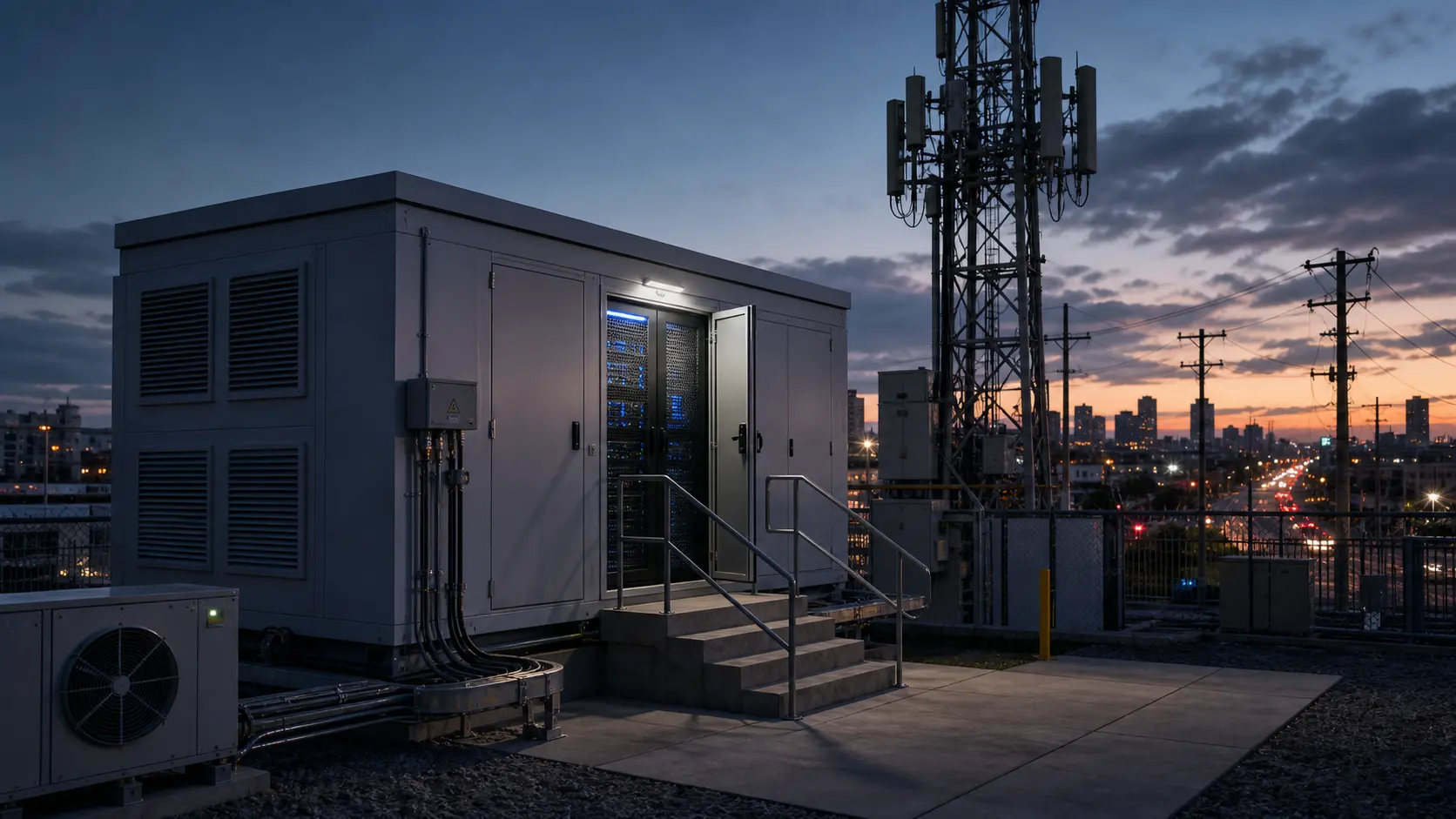
Vapor IO's strongest engineering answer to edge economics is modularity. The company's data sheets describe the VEM-20 as a high-density outdoor pedestal with two physically and logically isolated 10 kW racks, designed for edge applications and 5G O-RAN support. The same page describes the VEM-150 as a 150 kW class module, later superseded for new deployments by the VEM-180, a two-story stacked system capable of housing 180 kW of IT equipment with multiple tenant zones. The company's modular data-centres page says the target latency between adjacent facilities in a market is less than 1 millisecond, with tighter targets around radio heads and adjacent facilities in 5G settings.
Those specifications matter economically because they reveal the type of fixed asset Vapor IO is trying to standardize. A 10 kW rack pair can fit near telecom infrastructure and serve a narrow set of tenants; a 150 kW or 180 kW module can support a more conventional multi-tenant edge site. Both are far smaller than a hyperscale campus, but neither is financially trivial. Each needs an engineered enclosure, electrical service, cooling, backup power design, security, fiber, testing, shipping, crane or forklift handling, commissioning and remote monitoring. The 36-market expansion blog described factory-built Vapor Edge Modules arriving on a prepared slab with power and fiber conduits and noted that some sites require only a 10-by-20-foot footprint. That is a strong deployment story. It is not a free deployment story.
Modularity lowers construction variance. A customer or partner can certify once, then deploy similar equipment in multiple cities. Vapor IO can buy, test and operate standardized modules instead of designing a custom facility for every market. Remote operation and telemetry can reduce field labor. A smaller footprint can access locations that a normal data centre cannot. All of that improves the capital cycle.
But modularity does not solve demand timing. It may even expose the timing problem more clearly. If a full-size data centre waits years to fill, the owner at least has a large regional market, many enterprise use cases and a familiar leasing model. A near-premises module has a smaller addressable radius and a narrower buyer thesis. It is valuable because it is close; closeness also limits the pool of workloads for which that specific location is uniquely necessary. If the first tenant leaves or a pilot fails to become production demand, the remaining customers must absorb more of the fixed local cost.
Vapor IO's shift toward AI and private 5G is partly a response to this utilization problem. AI inference can consume high-value compute locally; private 5G can bind radios, local breakout and compute into one customer outcome; video and sensor analytics can turn cameras and devices into ongoing load. The Supermicro announcement gives examples such as automated checkout, pedestrian safety and factory IoT. Those examples are not incidental. They are high-utilization stories designed to justify a local facility as shared productive infrastructure rather than a dormant insurance policy.
The cost base also includes power-market exposure. Even small modules need reliable electricity, backup systems and utility coordination. The United States data-centre market is already constrained by power availability: CBRE's H2 2025 North America data-centre report says planned projects have been delayed by permitting, zoning and power-procurement hurdles, and the IEA's Energy and AI analysis projects global data-centre electricity use roughly doubling by 2030. Vapor IO's modules are smaller than AI campuses, but distributed power interconnections can still become a gating item. The edge does not escape the grid; it asks the grid for many smaller promises in many more places.
Partners as Demand Engines, Not Proof of Demand
Vapor IO's public record is rich in partner announcements, and that is both a strength and a warning. In 2020, the company announced that Cloudflare would deploy services on the Kinetic Edge platform across 36 U.S. cities, with Workers and security/performance services positioned close to users and devices. In 2019 and 2020, Vapor IO and Digital Realty presented a core-to-edge architecture, and Vapor IO's current Digital Realty partner page describes interoperation between Digital Realty campuses and Vapor locations for dynamic workloads. In 2023, Comcast and Vapor IO announced a pilot in Chicago and Atlanta to let third-party edge service providers host data and applications in local Comcast markets.
The AI and private-network partner list became more important after 2023. Vapor IO announced VAST Data collaboration for enterprise AI data architecture, NVIDIA AI Aerial in Las Vegas with Supermicro and the City of Las Vegas, and a Veea partnership in 2025 for turnkey AI-as-a-service and AIoT solutions. It had earlier partnered with AlefEdge to support edge services over LTE, CBRS, Wi-Fi and 5G private networks, as described in the 2020 private-wireless announcement.
These announcements validate Vapor IO's market map. The company is not guessing that applications may need proximity; it is working with cloud, CDN, cable, storage, server, wireless, city and AI partners that each have a reason to pull compute toward the access edge. The Las Vegas example is especially concrete because it ties local compute, private 5G and AI inference to public-safety and city-service use cases. The Comcast pilot is strategically important because last-mile networks control the path to many end users. Digital Realty matters because edge services still need regional and core interconnection.
VAST, Supermicro and NVIDIA matter because inference workloads can fill power-dense racks in a way that ordinary web applications may not.
But partner announcements are not the same thing as utilization. They can be technical integrations, pilots, market-development efforts, channel programs or proof points rather than durable rent streams. Industry coverage has repeatedly noted this distinction. Data Center Dynamics reported in 2022 that the Kinetic Grid was available in 32 markets but that some additional sites could be ordered and installed when customer demand required them. That is a rational capital-light posture, but it also says the public footprint should be read as service availability, not automatically as filled edge real estate.
The same caution applies to market chatter around edge AI. Channel coverage, including CRN's report on Vapor IO's partner program, framed the company as becoming more channel-centric. Public job, profile and social traces suggest a specialized infrastructure company rather than a hyperscale headcount machine. None of that proves weakness; private infrastructure companies often operate with lean teams and heavy partner leverage. It does mean the best public signal to watch is not the number of announced relationships. It is the conversion of those relationships into named production deployments, repeat customers and visible market-by-market capacity.
Demand Is Local, but Buying Power Is Concentrated
The awkward fact for Vapor IO is that the workloads that most need local infrastructure are often controlled by buyers with centralized procurement. A retailer may have thousands of stores, but the infrastructure decision may sit with a national technology team that already has preferred cloud, network and security vendors. A manufacturer may need local control on a production floor, but its purchasing process may run through a corporate engineering standard. A city may have urgent local safety use cases, but public procurement, privacy review and budget cycles can move slowly. Vapor IO's product is local; many budgets are not.
That mismatch helps explain why Vapor IO keeps returning to partners. A city innovation office may not buy directly from a small edge-infrastructure company at scale, but it may work through a public-safety technology provider, a systems integrator or a telecom partner. A retailer may not want a direct colocation contract for every metro, but it may buy a managed loss-prevention service that happens to run on Vapor IO capacity. A manufacturer may care about uptime, quality control and wireless reliability, not about the identity of the micro data-centre operator.
Vapor IO's strongest market path is to be invisible enough to fit inside another party's solution and visible enough to capture infrastructure margin.
There is also a timing mismatch. Enterprises do not adopt low-latency services everywhere at once. The first site is often a flagship factory, a downtown safety corridor, a stadium district, a distribution centre or a cluster of high-shrink stores. That first site may generate learning but limited volume. The economics improve only when the buyer expands across similar sites. Vapor IO's standardized module design and market-by-market platform are built for that second stage, but the second stage depends on application proof, not infrastructure availability alone.
Many edge vendors in the last decade discovered that "available in many markets" is not the same as "needed in many markets this quarter."
Customer dependency therefore cuts two ways. A large cloud, CDN, cable company, city, retailer or private-network provider can fill capacity quickly if it standardizes on Vapor IO. The same customer can create concentration risk if it delays expansion or moves the use case onto its own platform. Vapor IO's neutral-host posture is designed to reduce reliance on one buyer, but the early edge market tends to produce anchor tenants rather than hundreds of small independent customers. The economics of the first few sites may depend heavily on one or two programs that are not disclosed.
The best demand signal in the public record is the clustering of use cases around video, AI inference and private 5G. Those workloads have three properties Vapor IO needs. They create high local data volume, which makes backhaul expensive or slow. They can produce immediate operational value, which gives the customer a reason to pay. They benefit from shared infrastructure because not every store, intersection or plant wants to own data-centre-grade equipment. That is why the Las Vegas, Supermicro, NVIDIA, VAST and Veea materials matter more than older generic edge claims. They point toward workloads dense enough to fill hardware.
The weak demand signal is the relative scarcity of named production customers with published expansion metrics. Vapor IO's public record shows partnerships and pilots, but fewer durable customer case studies with numbers attached: sites in service, recurring revenue, latency achieved, downtime reduced, incidents avoided, shrink lowered or radios supported. That absence is not unusual for private infrastructure companies serving sensitive enterprise and municipal environments. It still limits confidence. An economics assessment cannot treat an integration announcement as equal to a paid multi-year deployment.
In practice, the market may develop city by city, not nationally. Las Vegas can be a strong market if smart-city, convention, hospitality, public-safety and private-network use cases overlap. Chicago or Atlanta can work if Comcast, Digital Realty, Cloudflare and enterprise demand converge. Dallas can work if regional data-centre, fiber and private-network demand meet. A 36-market footprint is valuable only if several of those local markets become dense enough to pay for themselves. The edge is national in sales decks but local on the income statement.
Hyperscaler Gravity and the Narrow Space for Neutral Edge
Vapor IO's biggest competitor is not a single edge start-up. It is gravity: the habit of developers, procurement teams and enterprise architects to put work where the clouds, CDNs and data platforms already are. Amazon, Microsoft and Google can amortize infrastructure across enormous customer bases, offer integrated identity and billing, and push new services through existing accounts. Amazon's 2025 annual report told shareholders that expected 2026 capital spending would be approximately $200 billion, much of it tied to AWS and already supported by customer commitments. Microsoft's 2025 annual report likewise says the company will continue capital expenditures to support cloud growth and AI infrastructure. Vapor IO cannot outspend that.
Nor can it out-CDN the largest content and security networks. Cloudflare says its global platform spans hundreds of cities and processes services close to users by design. Akamai, Fastly, AWS CloudFront, Google and carrier caches already solve large portions of the web-latency problem. For many applications, that is enough. A company like Vapor IO needs a sharper wedge: use cases where a CDN point of presence is too general, a hyperscale region is too far, a customer closet is too expensive, and a telco-owned service is too closed. That wedge exists, but it is narrower than the phrase edge computing once implied.
Tower companies and data-centre operators also compress the space. Crown Castle, American Tower, SBA Communications, Digital Realty, Equinix, DataBank, CoreSite and regional fiber owners all hold pieces of the geography, interconnection or customer relationship. Some may prefer Vapor IO as a partner; others may sell equivalent services themselves. Digital Realty's partnership illustrates one cooperative version: core-to-edge interoperation rather than direct substitution.
Crown Castle's evolution illustrates the opposite risk: asset owners may change strategy, sell segments or decide that their most attractive returns sit in towers and fiber rather than small compute facilities.
The competitive defense for Vapor IO is neutrality plus integration. A carrier-neutral, cloud-neutral, private-network-ready edge site can host multiple service providers in one place, reducing the need for every participant to build its own local cabinet. A cable operator can use it without ceding the whole service to a public cloud. A cloud provider can use it without negotiating every tower pad. A city can buy a bundled smart-infrastructure service without choosing a single carrier as the de facto owner of civic data flows.
This is the same logic that made carrier-neutral data centres valuable in the internet core, translated down to the metro edge. The question is whether demand at that layer is deep enough.
Regulation, Operating Risk and the Facts That Would Change the Judgment
Vapor IO faces three operating risks that are easy to underestimate. The first is local permission. Small modules need site access, utility interconnection, noise tolerance, security, backup-power arrangements and sometimes municipal comfort with equipment near public infrastructure. The second is service accountability. When an application is close enough to be useful for safety, retail operations or factory control, outages become operational events rather than ordinary IT inconvenience. The third is procurement complexity.
The buyer may need a service provider, a radio partner, an AI vendor, a data platform, a network owner and Vapor IO to align around one commercial outcome.
Regulation is not the dominant threat, but it is present. Private wireless can involve CBRS or licensed-spectrum partners. Municipal AI and public-safety use cases raise privacy, data-retention and algorithmic-governance questions. Data-centre power demand is becoming politically visible, even if Vapor IO's modules are small compared with hyperscale campuses. Edge sites can also create cybersecurity and physical-security obligations because the infrastructure is distributed and often remote.
Vapor IO's product design emphasizes lights-out operation and telemetry; the harder question is whether customers and regulators accept shared local infrastructure for sensitive workloads.
The current judgment is therefore measured. Vapor IO is a credible, technically sophisticated company attacking a real economic problem: how to create shared infrastructure for workloads that need to be closer than the cloud core but cannot justify bespoke premises builds. Its public evidence shows serious investors, meaningful partners, recognizable interconnection locations, modular product design and a clear pivot toward AI and private 5G use cases that can actually fill edge capacity. Its weakest public evidence is not identity or vision; it is utilization.
The company does not publish revenue, module occupancy, power under contract, live market-by-market capacity, customer concentration, churn or gross margin.
Several facts would materially improve the assessment. Named production deployments across multiple markets, with committed recurring revenue rather than pilots, would show that partners are converting into rent. Published capacity utilization by market, even in bands, would let analysts distinguish available footprint from occupied infrastructure. Evidence of repeat purchases from cities, retailers, manufacturers, cable operators or private-network providers would show that applications can monetize proximity after the first demonstration.
New PeeringDB updates, active public routing where relevant, additional exchange ports, or clearer Zayo/Crown/EQT commercial arrangements would strengthen the network record. Conversely, a long period of press releases without live customer disclosure, shrinking market counts, stale facility records or a retreat from modular infrastructure into consulting would weaken the case.
For now, Vapor IO should be read as an infrastructure option on a specific future: one in which AI inference, private 5G, city systems, retail analytics and industrial automation need local compute often enough to support shared edge facilities. If that future arrives unevenly, the winners will be the companies that control real estate, power, fiber and customer channels while keeping utilization high. Vapor IO has assembled many of those ingredients. The remaining question is whether enough buyers can turn milliseconds into money.