
Summary
- UNICABLE's own publications establish an operating footprint in Chía, Cajicá, Zipaquirá, Tabio and Cota, a mixed FTTH-and-cable access system, current plans up to 900 Mbps and local customer-service offices; they do not disclose fibre kilometres, plant ownership, upstream handoff sites, busy-hour headroom or backup-power duration.
- Public route observations on 17 July 2026 showed AS271952 originating two IPv4 /24s, but the sampled paths to 190.109.49.0/24 ended through Lumen's AS3549 while those to 209.61.57.0/24 ended through UFINET's AS52468, so two visible upstreams do not establish that either block can fail over to the other carrier.
- The decisive resilience surface remains local: a household receiving internet and television through one drop can lose both before global routing diversity matters, and recovery then depends on powered access equipment, safe pole or duct access, the right spare, an available field crew and clear authority across UNICABLE and its carriers.
When one aerial drop takes two services
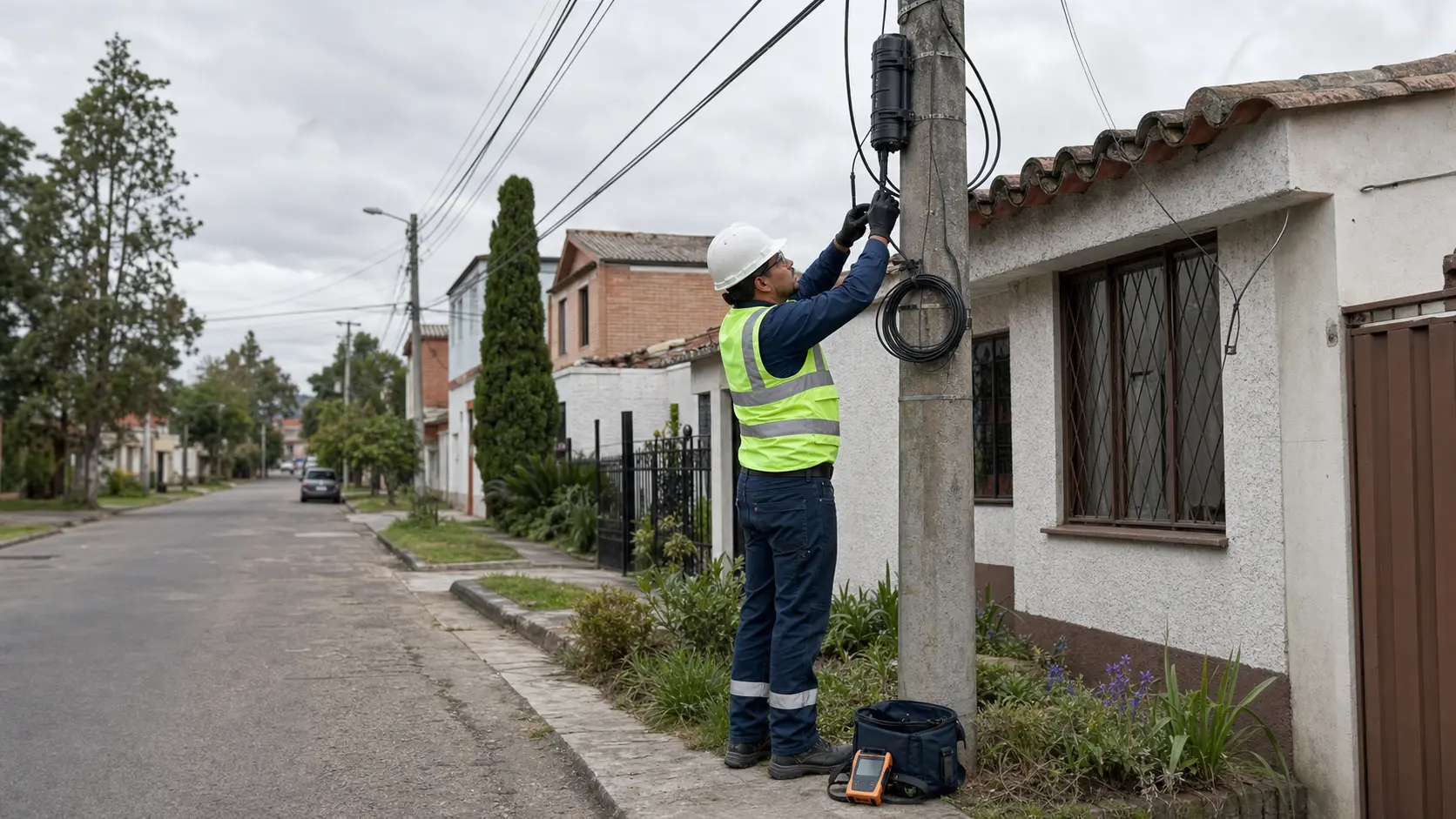
A Chía household can buy two apparently separate products and still receive them through one physical path. Internet packets and television channels may be separated in the billing system, displayed as different lights on a home terminal and supported by different teams, yet the final span from a pole or façade to the premises can be common. If a vehicle pulls an aerial drop, a branch rubs through it, a connector admits water or a neighbourhood distribution point loses power, both products can disappear together. Two upstream names on a routing page do not repair that span.
That opening is a failure exercise, not a report of a documented UNICABLE incident. No public notice reviewed for this article establishes that a particular Chía home lost internet and television in this way. The scenario follows from the service combination that UNICABLE actually sells. Its current public site presents internet, television and combined plans, while the operator's published fixed-services customer contract treats fixed internet and television as selectable services under one agreement. A bundle can simplify the customer relationship without creating two access routes.
The first restoration question is therefore where the light or radio-frequency signal stops. If only one customer is affected, the likely fault domain includes the indoor lead, power adapter, router, optical terminal, coax device or drop. If several homes on one street fail, attention moves toward a splitter, tap, splice, feeder or local active unit. If a municipality-wide group fails while nearby towns remain online, aggregation, transport or a local power domain becomes more plausible. If both public address blocks disappear from many external observation points, the route edge becomes relevant.
These are diagnostic possibilities, not conclusions about a specific event.
UNICABLE's own installation and use guidance makes the customer edge unusually visible. It says a technician determines the best cable route for a safe installation, delivers the Wi-Fi network and password, and expects someone to be present for the visit. It also warns that walls, floors, distance, interference, device load and customer changes can degrade the experience. Those are ordinary cautions, but they show why a complaint described as “slow internet” can originate on either side of the operator's demarcation. Wi-Fi congestion is not backhaul congestion; a dark optical terminal is not a BGP failure; a broken service drop is not cured by a second transit company.
The economic significance is larger than the cable itself. A small regional operator earns its reputation at the point where a remote alarm becomes a visit, a visit becomes an accurate diagnosis and a diagnosis becomes a durable repair. A national carrier can offer another route beyond the handoff, but it cannot climb a Chía pole on UNICABLE's behalf unless the operating agreement says it can. A customer may see one brand and one invoice while the restoration chain crosses the customer, local access operator, pole or duct custodian, electricity distributor and wholesale carriers.
This is why the last mile is not merely the last item on a network drawing. It is the first place a subscriber experiences failure and often the layer with the least automatic protection. Core routing can reconverge in seconds; an optical distribution cable does not grow a second strand around a damaged pole. A customer device can reboot in minutes; a field crew may need a safe work window, traffic management, access permission, a matching enclosure and a clean splice. The relevant measure is not only how many routes exist in normal operation, but how much service remains usable while the first route—or the first local branch—is unavailable.
Five towns make a service footprint, not a route map
UNICABLE publicly names five municipalities in the Sabana Centro area: Chía, Cajicá, Zipaquirá, Tabio and Cota. Its coverage page says its solutions are offered in all five and describes a map of the network plant between them. Its contact page lists a customer-service address and telephone number in each municipality. Together, those publications establish more than a vague regional ambition. They show a current commercial presence distributed around a cluster of towns north and northwest of Bogotá.
They do not establish continuous street-level coverage. An office can sell service, collect payments or receive complaints without housing an optical line terminal, core router, splice depot or generator. A municipality can contain served and unserved neighbourhoods. A line on a promotional image can indicate reach without disclosing whether the underlying segment is owned, leased, aerial, buried, lit, reserved or shared. The coverage page's embedded 2025 route image was not retrievable when checked on 17 July 2026, so even its visual precision could not be assessed.
The page text supports a five-town footprint; it cannot safely be converted into an exact fibre trace.
The shape of the geography makes that distinction important. Cota lies southwest of Chía, Tabio to the west, Cajicá to the north and Zipaquirá farther north. A network serving all five could be built as a ring, a chain, branches from one hub, several leased islands or a mixture of local plant and carrier handoffs. Each arrangement has different failure behaviour. A ring can still be cut twice at one road project. A branch can strand a whole town downstream of one splice. Two carrier circuits can enter the same building through the same duct. Separate town offices can all depend on one aggregation room.
Colombia's communications regulator offers useful context but not a substitute for operator drawings. The CRC's national intermunicipal fibre map compiles provider reports and public information, labels itself a beta resource and warns that its information is orientative and continually validated. It can show that transport infrastructure exists among municipalities; it does not identify which strand serves a UNICABLE customer or where the first common point lies. A national or municipal line must not be traced onto UNICABLE simply because the places overlap.
A defensible map would use several levels of precision. At the highest level, the five municipality names are confirmed commercial locations. At the next, the published office addresses are confirmed customer-facing points, not declared technical sites. At the network level, AS271952 is a confirmed logical origin and two external autonomous systems are observed next to it. At the physical level, no public evidence identifies UNICABLE's feeder alignment, distribution branches, pole attachments, ducts, handholes, splice closures, upstream entrances, aggregation buildings or protected crossings.
That leaves a practical mapping task for any serious buyer or local authority. The operator need not publish sensitive coordinates. It could disclose route diversity in bands: whether two upstream circuits remain separate through the first material convergence point; whether each town has one or more feeder approaches; whether active sites share a power circuit; whether an alternate path has enough capacity for all customers or only essential traffic; and which towns can remain isolated but online if the central hub fails. Such statements would turn “five offices” into an operating picture without exposing security-sensitive detail.
Until then, reach and resilience must remain separate. UNICABLE has evidence of service in five towns. It does not have public evidence of five independent repair systems, five independent transport exits or a ring that survives a single local cut. The visible footprint is commercially meaningful and physically unresolved at the same time.
One local company sits inside a longer operating chain
The legal operator is UNICABLE H.D. SAS, a Colombian simplified joint-stock company. A commercial presentation of Registro Único Empresarial y Social information identifies NIT 901183331, an active registration in Chía and economic activities covering television programming and transmission, wireless telecommunications and other telecommunications (RUES-derived company record). A separate commercial-company record dates incorporation to 24 May 2018 and places a reported registered address in Tabio. The difference between Chía and Tabio is not necessarily a contradiction: a company can update its domicile, maintain several operating locations or appear under different reporting dates. It is a reason to date each statement rather than merge the records into one timeless address.
An official Bogotá Chamber of Commerce registration bulletin records a 2023 shareholder-meeting act appointing a legal representative. The public excerpt confirms corporate activity; it does not disclose the current shareholder structure, ultimate owner or the operational powers of every individual involved. The company's own about page describes a mission centred on television and internet service and a vision of national telecom leadership, but it does not name a parent company or explain ownership.
Those facts set the entity boundary. UNICABLE is the retail company that presents the plans, offices, contract and support channels. UFINET and Lumen appear in public route observations as external networks. They should not be described as shareholders, parents or subsidiaries merely because customer routes pass through them. A carrier relationship is an operating dependency, not a corporate ownership claim.
The regional internet registry creates a second, technical boundary. LACNIC's AS271952 record assigns the autonomous-system number to the UNICABLE organisation handle, records registration on 6 August 2021 and links administrative, technical and abuse responsibility to the same contact handle. That makes UNICABLE accountable for a public routing identity. It does not show who owns the routers, which building contains them, whether management is performed by staff or a contractor, or whether every retail connection uses that AS.
These boundaries matter during an outage. The retail company can receive the complaint and owes the customer a response under the service agreement. The access-plant owner controls the splice, drop or cabinet if that plant is not fully owned by UNICABLE. A building or pole owner may control access. An electricity company controls grid restoration. A wholesale carrier controls its circuit and the route beyond a demarcation. If a carrier supplies address space or originates a route on UNICABLE's behalf, the technical boundary may differ again.
Good service depends on contracts aligning these responsibilities before failure. The customer should not be required to identify the responsible carrier. UNICABLE needs authority to test the premises, isolate the access segment, open a carrier ticket and dispatch or escalate field work. The carriers need a clearly defined handoff and an incident contact. The field team needs safe access and compatible spares. The public record does not reveal those arrangements, so it would be wrong to claim that UNICABLE controls the whole route—or that it controls none of it.
The durable conclusion is narrower and more useful. The legal and retail identity is well supported. The company has operated under that name since at least 2018, maintains service points across five municipalities and holds an AS number. Its ownership structure, plant-ownership split, wholesale contract terms and facility boundary remain private. Infrastructure analysis must therefore follow the responsibility chain without inventing a corporate group around it.
Fibre at the front door coexists with cable
UNICABLE's access network is not accurately described by a single word. Its equipment page publishes specifications for both a Huawei GPON optical terminal and a C-Data Ethernet-over-coax device. Its internet-quality publication explicitly labels the access technologies as “fibra óptica y cable.” These materials support a hybrid operating surface: fibre-to-the-home service is present, and cable-based access equipment remains part of the published technical estate.
The Huawei EG8247H sheet describes a GPON optical network terminal with four Gigabit Ethernet ports, two telephone ports, CATV output, Wi-Fi and USB. It supports dual-stack IPv4 and IPv6, receives optical downstream at 1490 nm, transmits upstream at 1310 nm and consumes up to 18 watts. This is a customer-edge device capable of combining broadband, voice and television functions. The publication shows a supported device type; it does not reveal how many units are installed, which towns use them or whether every 900 Mbps customer receives this exact terminal.
The C-Data CD5204LW sheet describes a different path. It carries Ethernet over existing coax alongside CATV, advertises a 600 Mbps physical-layer rate and up to 320 Mbps at the media-access layer, provides four 100 Mbps Ethernet ports and Wi-Fi, and consumes less than five watts from a 12-volt adapter. Those figures are device ceilings under the manufacturer's conditions, not customer speeds and not evidence of aggregate network capacity. The presence of the sheet nevertheless matters: it is consistent with an operator maintaining cable television plant while adding data over coax in at least some part of its service history or inventory.
UNICABLE's internet quality report supplies stronger operational evidence because it presents quarterly measurements under the company's name. The latest included table, for the first quarter of 2026, reports both HFC and FTTH samples. The FTTH rows cover symmetric offered rates from 200 Mbps to 900 Mbps, while an HFC row remains in the table. Earlier quarters show changing plan sets and both technologies. This supports current measured FTTH operation and continued reporting of cable access; it still does not disclose the number of live subscribers on either medium.
The distinction changes failure behaviour. Passive optical distribution uses feeder and distribution fibre, splitters and powered equipment at the customer and optical line terminal. Coax-based service adds taps, amplifiers or Ethernet-over-coax masters depending on the design, along with different signal and power constraints. A GPON branch and a coax segment may share a pole route, headend, building, power source or backhaul even if their final media differ. Conversely, they may serve different neighbourhoods with different local risks.
It also changes what “upgrade” means. A retail move from cable to fibre can improve the customer link while leaving the same upstream handoff, aggregation room, electricity circuit and field crew. Replacing a 100 Mbps home port removes one bottleneck but does not create a second feeder. Installing a GPON terminal that supports IPv6 does not mean the customer receives routed IPv6. Advertising a 900 Mbps plan establishes a service proposition, not the number of simultaneous customers the backhaul can sustain at that rate.
For due diligence, the important quantities are therefore not only homes passed by fibre. They include active lines by access technology and town, optical split ratios, OLT ports installed and lit, coax nodes still in use, the proportion of customers behind each aggregation point, spare terminals and optics, and the amount of traffic each feeder can carry after a failure. None of those values is public. The publications prove a mixed access system and meaningful retail speed; they leave its topology and failure-state capacity open.
Nine hundred megabits is an offer, not a resilience measure
UNICABLE's current Chía price menu is unusually concrete. The filtered Chía plan page lists residential internet offers from 200 Mbps through 900 Mbps for the selected socioeconomic band, with prices that rise by tier. Similar menus can be queried for the other offices. That is good evidence of what the company is prepared to sell at qualifying addresses on the date checked. It is not a count of customers, a guarantee that every address qualifies or a statement of dedicated bandwidth.
The quality publication adds tested performance. In the first quarter of 2026 table, the 900 Mbps FTTH row reports measured values around the offered symmetric rate, and the report gives 1,357 FTTH samples. The same page reports 1,261 HFC samples. These are explicitly samples, not active subscriptions. A monitoring test can be repeated many times on one connection, and the publication does not provide a denominator of customers or premises. Converting 1,357 samples into 1,357 fibre households would be false.
There are at least five different capacity layers behind one 900 Mbps label. Design capacity is what the technology and equipment can support under specified conditions. Installed capacity is what ports, optics, splitters, coax nodes, switches and carrier circuits physically exist. Lit or activated capacity is the subset configured and powered. Sold capacity is the aggregate of customer plans, shaped by take-up and contention. Usable capacity is what customers can actually draw at the same time in normal conditions—and, more importantly for resilience, what remains after a feeder, carrier, router or power source fails.
The public figures reach only part of that ladder. The plan page supports an offered rate. The quarterly table supports a set of operator-reported test results and access technologies. The quality landing page provides the publication series (UNICABLE quality indicators). The 2025 customer-attention report lists “no disponibilidad del servicio” among the recurring complaint categories for the published months, but it supplies no incident count, duration or affected-user total from which availability could be calculated. It shows that loss of service belongs in the support workload; it does not establish a poor or good outage rate.
The service form and the operator's regulatory publication page also distinguish service quality from simple speed. The contract identifies high latency, congestion or failures in the internet channel, backbone and access networks among factors under company control, while Wi-Fi conditions, user applications and congestion in international networks can lie outside that immediate control. That distinction is useful, although a customer still needs the retail operator to diagnose which category applies.
What is missing is commercially decisive. There is no public upstream port rate, committed information rate, burst allowance, busy-hour utilization, oversubscription range, OLT headroom, protected capacity or traffic level. There is no degraded-state figure saying how much of the five-town load can be carried when one upstream or one aggregation link is unavailable. There is no disclosed reserve of optical terminals, power supplies, transceivers, splitters, coax devices or cable.
A 900 Mbps speed test can therefore be genuine while the network remains vulnerable. A lightly loaded connection at midday says little about a carrier failure at the evening peak. A second upstream can improve reach while lacking enough spare capacity to absorb the first. A fast optical access line can terminate at a congested handoff. The correct resilience question is not “Can one subscriber reach 900 Mbps?” It is “What service remains for all affected subscribers when the first critical component is removed?”
The two IPv4 blocks do not show the same failover
AS271952 is currently visible, and several independent observations agree on its small public routing footprint. RIPEstat's AS overview reported the UNICABLE holder and an announced state on 17 July 2026. Its routing-status response counted two IPv4 prefixes, 512 addresses, no AS271952-originated IPv6 prefix and two observed neighbours. The announced-prefix response named 190.109.49.0/24 and 209.61.57.0/24.
The two blocks have different registry histories. LACNIC's 190.109.49.0/24 record identifies UNICABLE as registrant of a reallocated range and dates that record to August 2021. ARIN's record covering 209.61.57.0/24 places the block inside a larger Cogent direct allocation. That does not make the route illegitimate: route authorization, address assignment and parent allocation are different layers. It does mean the second /24 should not be casually described as company-owned space without a more specific assignment record.
The neighbour view supplies the two names. RIPEstat's AS-neighbour response observed AS3549 and AS52468 immediately to the left of UNICABLE in collected paths. Hurricane Electric's AS271952 page and the CIDR Report likewise showed two adjacent upstreams: Level 3 Parent, now presented commercially as Lumen, and UFINET Panama.
The more revealing fact appears when the prefixes are examined separately. In the RIPE RIS looking-glass response for 190.109.49.0/24, every sampled path retrieved for this review ended 3549 271952. In the corresponding response for 209.61.57.0/24, every sampled path ended 52468 271952. These are current collector observations, not configuration files. They show one public block visible through Lumen in the sample and the other through UFINET, rather than both blocks concurrently visible through both carriers.
That arrangement can still be intentional and useful. Different prefixes can carry different customer pools, services or traffic policies. Splitting announcements can distribute normal-state inbound traffic. If UNICABLE has conditional advertisements prepared, a block might move to the other carrier after a failure even though that backup is invisible while the primary path is healthy. Private interconnections or a route server might also escape the sampled view. The observations cannot prove the absence of a dormant failover.
They also cannot prove it exists. To call the AS dual-homed in a resilience sense, one would want evidence that each material customer pool remains reachable after either carrier session is removed, that outbound policy moves traffic as intended, that the alternate port has enough headroom, and that route filters and origin authorizations permit the change. Two provider names at AS level are not the same as two active paths for each prefix. Normal-state address-space partitioning may leave each block dependent on one visible carrier.
This is the article's most specific routing finding. UNICABLE does have two observed upstream relationships. Yet the public paths on the review date divide by prefix. If the Lumen path fails and 190.109.49.0/24 is not announced through UFINET, users behind that block can lose inbound reach even while 209.61.57.0/24 remains visible. The inverse applies to a UFINET failure. Whether customers are renumbered, translated, shifted or reannounced is not public. The word “redundant” should wait for a controlled failure result.
IPv6 exposes a different operating boundary
The IPv6 evidence complicates the picture in a useful way. LACNIC's 2803:5790::/32 record assigns the large IPv6 block to UNICABLE and dates registration to 29 August 2023. An IPv6 /32 provides an enormous logical address hierarchy for customer and infrastructure networks. That abundance is a property of IPv6 allocation practice, not proof of customer scale, traffic or installed capacity.
On 17 July 2026, RIPEstat's prefix overview reported the block as announced with AS3549 as origin. Its routing-status response for the /32 showed first visibility with origin AS3549 on 16 October 2025 and full visibility among the response's IPv6 peers on the review date. At the same time, the AS271952 status counted no IPv6 prefix originated by UNICABLE's own AS.
Both statements can be true. UNICABLE holds the allocation, while Lumen's AS originates it publicly. This may reflect a managed routing service, a provider arrangement or another delegated operating choice. The public records do not disclose the contract. What they do show is that “UNICABLE has IPv6 space” and “AS271952 originates IPv6” are not interchangeable statements.
The customer consequence is also unresolved. The Huawei terminal sheet says the published GPON device supports dual-stack IPv4 and IPv6 and DS-Lite. That proves device capability. A globally announced /32 proves public route presence. Neither proves that residential customers receive IPv6 prefixes, that all five municipalities are enabled, that customer firewalls are configured correctly or that traffic survives loss of AS3549. End-user measurements or an operator statement would be needed.
This boundary matters for resilience because IPv6 and IPv4 can fail differently. A household with working IPv4 and broken IPv6 may experience slow or selective application failure rather than a total outage. A dual-stack application may fall back, masking the defect. If the IPv6 /32 is originated only by AS3549, a Lumen routing interruption could affect IPv6 even while the UFINET-carried IPv4 /24 remains visible. Conversely, a customer without activated IPv6 would not benefit from the routed allocation at all.
It also illustrates the difference between held, announced and usable resources. The /32 is held by UNICABLE. It is announced by another AS. It may be available to some customers, all customers or none; public routing cannot tell. The GPON terminal can support it. That capability may be enabled, disabled or used only in part of the network. There is no public utilization figure, customer-prefix policy, failover origin or route-security publication for the operating arrangement.
A strong operator disclosure would therefore separate the layers: percentage of active fixed lines with native IPv6, municipalities enabled, normal origin, backup origin, failover test date and whether customer prefixes remain stable during a carrier change. None requires publication of sensitive addresses. Until those facts exist, the IPv6 allocation is a meaningful sign of technical development and a clear example of external dependence—not a measure of dual-stack resilience.
Two carriers can still converge before the customer
Logical route diversity begins at routers; physical diversity begins in the ground, on poles and at building entrances. The two can align, but one does not prove the other. UFINET's Colombia page confirms a carrier operation with Colombian offices and services including internet, capacity, dark fibre and FTTH. The CRC's wholesale-carrier availability dataset includes UFINET reporting wholesale service in Chía, with a March 2026 entry showing 100 per cent monthly availability. This supports local wholesale presence. It does not identify UNICABLE as the customer, locate a handoff or show the path between them.
Lumen's global network map presents a large fibre network but includes an unusually helpful warning: routes are representative and general, exact locations can change, owned, leased and indefeasible-right-of-use segments are not distinguished, and in-region carriers may provide service in some markets. That warning should govern how the map is used here. A Lumen route observed in BGP cannot be projected onto a particular Chía road or assumed to remain physically separate from UFINET.
Several convergence patterns remain possible. Both circuits could leave UNICABLE's router on different ports but enter the same patch panel. They could use separate fibres in one cable, separate cables on one pole line, or different pole lines that meet at one bridge. One carrier could lease a local tail from the other. Both could depend on the same electricity room, street cabinet or building entrance. They could be entirely separate until Bogotá and still share UNICABLE's access feeder. Public AS paths reveal none of these.
There is also a capacity version of convergence. Two physically separate circuits are operationally weak if the alternate is too small to carry the failed circuit's load. A second route used for one /24 may not accept the other /24, may lack an approved filter, or may be intentionally reserved. The route observations show which neighbour was visible immediately before each prefix; they do not show interface rates, committed bandwidth, utilization, packet loss, traffic-engineering communities or the time needed to shift.
The local access layer can erase upstream diversity altogether. If five municipalities feed one aggregation site, a site power failure can remove both carrier sessions. If internet and television use one headend, a common cooling or power incident can affect both. If a feeder cut isolates a town from the aggregation site, global routes remain healthy while customers are dark. If one field team covers several simultaneous faults, restoration time becomes a scarce form of capacity.
The right test is physical and staged. Remove one carrier session and confirm reachability of both IPv4 blocks and any active IPv6 service. Measure customer throughput, not merely route presence. Then test the second carrier. Test loss of the aggregation link and loss of site power. Confirm that alarms reach staff, that the generator or batteries carry the real load, and that traffic returns without unsafe manual intervention. Finally, compare the route documentation with a non-sensitive outside-plant map through the first common point.
Absent those tests, the balanced assessment is neither “single-homed” nor “fully redundant.” UNICABLE has two visible IPv4 neighbours, two prefixes that presently divide between them, and an IPv6 block originated by one. UFINET has reported wholesale availability in Chía; Lumen has broad regional reach. Physical entrances, local tails, convergence points and failure-state headroom remain unverified.
Recovery begins with power, premises equipment and a crew
Every access technology in UNICABLE's publications needs electricity somewhere. The Huawei optical terminal accepts household AC through a low-voltage adapter and can draw up to 18 watts. The Ethernet-over-coax unit uses a 12-volt supply and draws less than five watts. A customer can therefore lose service during a premises power failure even when the outside network is healthy. A small uninterruptible supply may keep the terminal and router alive, but no public customer document promises a runtime or says television equipment shares that protection.
Outside the home, passive fibre splitters need no power, but optical line terminals, switches, routers, monitoring units and any active coax equipment do. Backup capacity depends on battery age, load, temperature, generator starting, fuel, maintenance and the duration of the grid interruption. The public materials identify no UNICABLE technical site, battery bank, generator, redundant feed or test interval. It would be irresponsible to infer continuous backup from the mere presence of a town office.
Chía's municipal government identifies Enel Colombia among the utilities to contact for electricity faults and emergencies (Chía public-services contact notice). That establishes the local grid-service context, not the circuit serving any UNICABLE equipment. A network site may use the same distribution area as customers, a different transformer, a landlord feed or additional generation. The evidence needed is site-specific in aggregate terms: number of critical sites, normal load, battery autonomy band, generator coverage and last full-load test.
Field labour then determines how quickly a physical fault is turned into restored service. The five published offices create plausible staging points, but office opening hours do not equal technical dispatch coverage. The site does not publish a 24-hour network-monitoring schedule, number of crews, skills by town, contractor arrangement, stocked cable length, spare optical terminals, replacement power units or target time to repair. It also does not state who is authorized to work on carrier tails or utility structures.
A simple cut illustrates the chain. Monitoring detects loss on an access branch. Support confirms that several customers are affected and rules out a premises issue. A dispatcher identifies the likely span and checks whether the pole or roadside location is safe. A crew travels with the correct fibre, closure and optical equipment—or with coax parts if the segment is cable. If a carrier tail is involved, UNICABLE opens an external case and preserves evidence at the handoff. After the splice, the crew measures optical levels, confirms television and internet service, checks both address families and closes the customer loop.
Each step can fail without any shortage of nominal bandwidth. The wrong spare adds a journey. A locked site delays entry. A damaged utility pole requires coordination before telecom work. A battery alarm without a tested escalation path becomes an outage. An upstream can restore its circuit while a local router remains unpowered. A customer can regain internet but not television if only one service is verified. Recovery quality is the ability to manage the whole sequence, not just the speed of the fastest link.
Local support labour is therefore an infrastructure asset. It has coverage, concurrency and reserve like a network circuit. One crew can address one complex repair at a time; several weather or construction incidents can exhaust that reserve. Skilled staff also carry local knowledge that maps may omit: which enclosure serves a street, which route is accessible, which landlord answers and which spare fits an older cable segment. That knowledge should be documented and shared enough to survive staff absence.
The public evidence supports a real support surface: offices, phone numbers, customer reports and installation guidance. It does not support a claim about round-the-clock restoration, spare depth or power autonomy. Those are the most valuable facts UNICABLE could add because they connect its two visible upstreams to the moment a Chía household actually comes back online.
The users at risk are measurable only in ranges
No authoritative public source found for this article gives UNICABLE's active subscriber count. Two internet-measurement estimates illustrate why a precise number should not be reverse-engineered. Cloudflare Radar's AS271952 overview displayed an estimated population of about 8,200 users, while APNIC Labs' Colombia network-population table dated 29 June 2026 estimated 6,704 users for the AS from 3,444 samples. The values are measurements of internet use associated with an AS, not bills, households or premises.
Several factors separate an AS-user estimate from a customer total. A household can contain several people. Carrier-grade address sharing can place many users behind fewer public addresses. A business connection can serve staff and visitors. Some UNICABLE customers may use provider-originated space outside AS271952, especially given the separately originated IPv6 allocation. Conversely, an observed address can represent infrastructure rather than a retail line. The two estimates are best treated as evidence of a non-trivial live user population and of measurement uncertainty.
The affected group also changes by fault domain. A cut customer drop may affect one household and both bundled services. A damaged distribution branch may affect a street or development. An optical line terminal or coax headend fault can affect a larger cluster. A feeder or aggregation failure may isolate a town. Loss of one IPv4 announcement can affect customers assigned behind that block while the other block remains visible. Loss of the Lumen-originated IPv6 route can selectively affect dual-stack service. A central power failure can cross all of those boundaries.
Within each group, impact is not uniform. A household may lose entertainment, work, study, communications and security monitoring. A shop may lose card authorization, ordering or cloud applications. A remote worker may have mobile backup while another customer does not. A school, clinic or public office would have higher continuity needs, but no public evidence reviewed here identifies any such institution as a UNICABLE customer. They are examples of dependency, not claims about the customer list.
The customer-attention reports add one careful signal. “No availability of service” appears among the most frequent complaint categories in the published 2025 pages, alongside billing issues. The document does not provide counts or market-normalized rates, so it cannot support a conclusion that outages are common. It does show that total service loss reaches the support operation and that restoration communication is part of the customer experience.
For a regional provider, that communication has economic value. Customers often tolerate a physical fault better than uncertainty about whether it has been detected, who owns it and when the next update will arrive. Accurate incident boundaries reduce duplicate visits and call load. Clear separation of premises, access and carrier faults sends the right spare and the right team. Publishing a restoration objective and performance band can create accountability without revealing sensitive network details.
The defensible scale statement is therefore bounded. AS measurements suggest several thousand users, but the methods disagree and do not equal subscribers. The operator sells across five municipalities, but it does not publish addresses passed or active lines by town. Any claim about market share, average revenue, customer density or users affected by a specific failure would require company or regulator data. What can be said is that even a modest regional AS represents enough households and economic activity for repair capacity and route policy to matter.
The evidence that would change the resilience verdict
UNICABLE's public evidence is stronger than a bare marketing site. It establishes a legal company, staffed local offices, a five-town service claim, mixed FTTH and cable technologies, current 900 Mbps offers, quarterly performance samples, two IPv4 prefixes, two visible IPv4 neighbours and an allocated IPv6 block. It also reveals meaningful limits. The current route view partitions the two /24s by upstream, the IPv6 block is originated by Lumen rather than AS271952, and no public document connects those logical paths to separate local corridors or tested degraded capacity.
Route-origin security is one area where the evidence is positive. RIPEstat's validation response for 190.109.49.0/24 returned a valid status for origin AS271952. Its response for 209.61.57.0/24 also returned valid. Valid origin authorization reduces one class of routing error. It does not create an alternate carrier, protect a fibre, add port capacity or guarantee that a backup announcement is accepted.
The fastest way to improve the verdict would be a dated, non-sensitive resilience statement covering five items. First, identify whether both IPv4 prefixes can be advertised through both carriers and whether the IPv6 /32 has an alternate origin arrangement. Second, state the normal and degraded committed capacity of each handoff as a range. Third, confirm whether the local tails and building entrances remain physically separate to the first material convergence point. Fourth, publish the month and result of the last carrier-removal and site-power tests.
Fifth, give target and achieved restoration bands for access cuts, powered-site faults and carrier incidents.
The access layer needs an equally disciplined disclosure. Useful values include active lines and premises passed by town and technology; installed and active OLT ports; typical optical split range; remaining HFC or Ethernet-over-coax lines; number of aggregation sites; share of customers behind protected aggregation; critical-site backup runtime bands; and field-crew coverage. These can be aggregated. No responsible disclosure requires exact customer addresses, fibre coordinates, router passwords or spare-store locations.
Customers and business buyers can ask simpler versions. Is the second service physically separate or just sold by another brand? Does a 900 Mbps plan remain available at a stated minimum during a carrier failure? Which equipment must the customer power? Is television on the same drop? What hours cover emergency dispatch? How often will the operator update an open area incident? Can a business buy a diverse entrance, and will the contract name the point beyond which paths are separate?
Future route checks should be dated because BGP can change at any moment. The present evidence does not justify a permanent claim that 190.109.49.0/24 always uses Lumen or 209.61.57.0/24 always uses UFINET. It justifies a precise statement about the 17 July 2026 observations. A later review should repeat the AS, prefix, neighbour, looking-glass and IPv6-origin checks, then compare them with the operator's explanation rather than treating one monitor as a physical map.
The final assessment is medium strength for identity, current service, access technologies and logical routing, and weak for physical route diversity, failure-state capacity and restoration reserve. UNICABLE may have well-engineered protection that is not public. It may also depend on common local infrastructure that two upstream names cannot protect. The evidence does not settle that question.
What it does settle is where to look. The customer proposition is not only 900 Mbps at the optical terminal. It is the continued usability of internet and television when a carrier, feeder, power source or service drop is removed. In Chía and the surrounding towns, that promise ends not at a global route collector but at a physical repair point—and at the people, spares and authority required to reach it.