
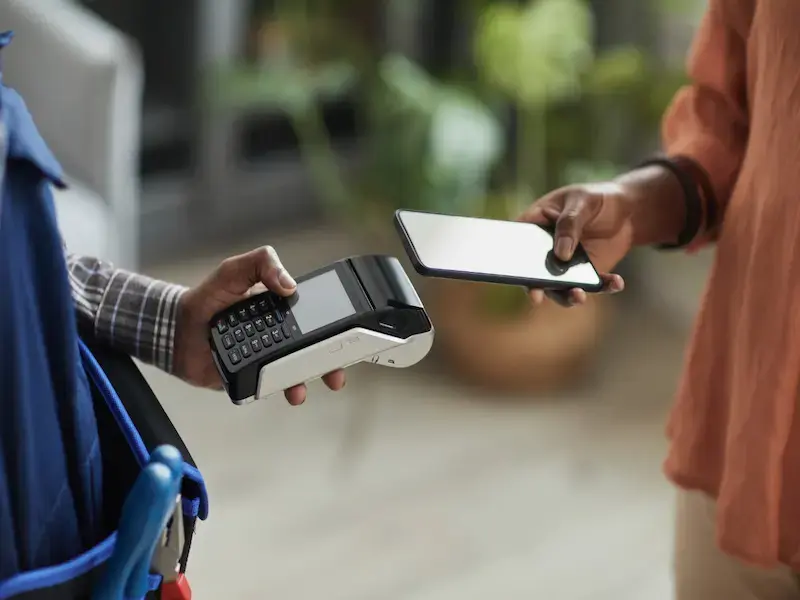
- NFC is a short-range wireless technology that enables communication between devices when they are brought close together.
- NFC is used in various applications, including mobile payments, access control, and data sharing between devices.
- NFC technology incorporates security measures such as encryption and tokenisation to ensure safe transactions and data exchange.
Near field communication is transforming the way we interact with technology by enabling seamless communication between devices over short distances. From contactless payments to smart tags, NFC has opened up a range of possibilities that enhance convenience and efficiency in our daily lives.
As more devices become NFC-enabled, understanding how this technology works and its various applications becomes essential. This blog will delve into the fundamentals of NFC technology, explore its applications, discuss its security features, and consider future developments in this rapidly evolving field.
Definition of NFC
NFC, or near field communication, is a set of communication protocols that allow two electronic devices, typically mobile devices like smartphones or tablets, to establish communication with each other just by being in proximity—usually within a few centimeters. This technology operates on the principle of inductive coupling, where an NFC reader generates a magnetic field that induces a current in an NFC-enabled device.
Also read: Key aspects of data mining technology
Also read: The benefits of AI technology
Working mode of NFC
NFC works through a process called “field coupling”. When two NFC devices come into close range, they communicate using electromagnetic fields. The initiating device (the one that reads) creates a radio frequency signal, which the receiving device (the one that responds) detects and uses to transmit data back. This interaction can be initiated in several modes.
Card emulation mode: In this mode, a phone acts like a contactless card. It’s used for mobile payments and transit passes.
Reader/writer mode: Here, an NFC-enabled device can read data from NFC tags, such as those found in posters or stickers.
Peer-to-peer mode: This allows two NFC-enabled devices to exchange information, such as sending files or contact details.
Applications of NFC
One of the most popular applications of NFC technology is in mobile payments. Services such as Apple Pay, Google Pay, and Samsung Pay allow users to make purchases by simply tapping their phones on compatible point-of-sale terminals. This eliminates the need for physical cash or cards, making the transaction process faster and more efficient.
Access control
NFC is also widely used in access control systems. Many modern office buildings and secure facilities utilise NFC-enabled key cards or smartphones for entry. Users can unlock doors and gain access by simply tapping their device against an NFC reader, enhancing security while improving convenience.
Another application of NFC is in data sharing. For instance, users can quickly share photos, videos, or documents by bringing two NFC-enabled smartphones close together. This feature simplifies the process of transferring files without needing a complex setup or internet connection.
Security features of NFC
While NFC facilitates convenient interactions, security is a critical concern. NFC technology incorporates several measures to protect user data.
Encryption: Data exchanged between devices can be encrypted, making it difficult for unauthorised parties to intercept and understand the information.
Tokenisation: In mobile payment scenarios, actual credit card numbers are not transmitted. Instead, a unique token is generated for each transaction, adding an additional layer of security.
Biometric authentication: Many NFC-enabled devices require biometric authentication—such as fingerprints or facial recognition—before a transaction can take place, further safeguarding sensitive information.
The future of NFC technology
As technology evolves, NFC is likely to expand its applications beyond current uses. We may see greater integration with the internet of things, allowing NFC to facilitate interactions between a broader range of devices. Advancements in security protocols could enhance consumer trust in mobile payments and other NFC applications.
Moreover, with the rise of smart cities, NFC could play a vital role in creating intelligent infrastructure that enables seamless interactions between citizens and urban services, such as public transport and smart parking.