
Summary
- What it says: Ultra Link Networks and the economy of being believed at Pakistan's edge
- Main topic: Network-resource evidence
- Context: market / company research report / Pakistan
The judgement is trust first, network scale second
Ultra Link Networks is best understood as a local proof-of-service business, not as a scaled backbone carrier. Its value comes from whether households, shops and small offices in Pakistan's edge markets can see that the link works, that a person answers the phone, that a technician can be sent, that a package can be changed without bureaucracy, and that the upstream route stays alive when national or city-level connectivity becomes uncertain. That makes the company economically interesting, but it also limits the valuation. Ultra Link does not yet deserve a premium infrastructure multiple on the public evidence.
It deserves a retention-and-repair multiple: useful where installed customers believe it, fragile where those customers see outages, silence, routing ambiguity or faster competitors.
That is a specific judgement. The public evidence shows a real operating company with a Pakistan Telecommunication Authority data CVAS internet licence, a public website, named offices in Rahim Yar Khan and Gujranwala, package pages, support numbers, an APNIC-registered autonomous system, two APNIC-registered IPv4 /24s, a PeeringDB record, and third-party routing visibility for Ultra Link address space. It also shows a business that has not made its own routing independence visible in the global table.
AS152678 is registered to ULTRA LINK (PRIVATE) LIMITED, but RIPEstat, Hurricane Electric and IPinfo did not show it originating routes in the checked July 2026 view. The two visible Ultra Link IPv4 /24s, 119.160.214.0/24 and 119.160.215.0/24, were visible through AS137047, Telecommunication and Technology Masters (Pvt.) Limited, whose upstreams include Pakistan Telecommunication Company Limited and Transworld Associates.
For a large carrier, that would be an obvious weakness. For a small local internet provider, it is a more nuanced signal. Many local ISPs buy transit, wholesale bandwidth, managed route support, upstream engineering or partial infrastructure from bigger operators. The question is not whether Ultra Link owns every layer. The question is whether it can convert that dependency into reliable service that customers trust. In Pakistan's smaller broadband markets, customers often do not buy a theoretical network.
They buy from the person who can keep the line working after office hours, who can explain the payment, and who can fix the drop before a school deadline, shop terminal, WhatsApp call or evening stream fails again.
The economic call is therefore conditional. Ultra Link has credible local value if it can use licensing, address resources, support presence and existing access relationships to retain subscribers in Rahim Yar Khan and Gujranwala. It does not yet show enough public evidence to be treated as a resilient independent platform. The decisive facts are simple: PTA compliance in the operating city, a clean route story, visible upstream redundancy, a stable support surface, and evidence that competitors cannot easily win on reliability.
Until those facts improve, Ultra Link is a local trust asset with upside from operational repair, not a scale compounder.
The company identity is modest but real
Ultra Link's identity is not hard to establish. The PTA's April 2025 CVAS licensee list records Ultra Link (Pvt.) Limited with licence DIR (L)/CVAS-997/PTA/2018, granted on 12 December 2018 and expiring on 11 December 2033. The same record lists Punjab jurisdiction, Data CVAS, internet services, a commencement certificate issued on 2 July 2021, Mr. Najam Zia as CEO, an address at Muhallah Fareedi, Airport Road, Rahim Yar Khan, and telephone numbers that match the public website's Rahim Yar Khan contact surface. That is the legal and regulatory anchor.
The public website gives the commercial identity. Ultra Link says it has points of presence in Rahim Yar Khan and Gujranwala, presents itself as a provider of fast, reliable and affordable internet, and gives separate contact numbers for the two cities: 03007820394 for Rahim Yar Khan and 03216474192 for Gujranwala. The same website lists a Rahim Yar Khan office at Street Faridi, Islam Nagar, Airport Road and a Gujranwala office near R.B Public School, Baghban Pura, Jinnah Road.
The English on the site is rough, but the content matters more than polish: it shows a local retail provider trying to be reachable through phone, WhatsApp, package pages, a panel login and physical offices.
The APNIC evidence broadens that identity from a local dealer into a network operator. APNIC RDAP records AS152678 as ULP-AS-AP, registered on 4 April 2024, country Pakistan, with the description ULTRA LINK (PRIVATE) LIMITED. The registrant record gives the same Gujranwala and Rahim Yar Khan address pattern and a public phone number. PeeringDB records the same ASN under "Ultra Link Networks," gives the alias "ULTRALINK PVT LTD.," lists the long name as ULTRA LINK (PRIVATE) LIMITED, points to http://www.ultralinknetworks.com, records two IPv4 prefixes and no IPv6 prefixes, and shows no public exchange or facility entries. That is not a large interconnection footprint, but it is a real network identity.
The practical identity is therefore three-layered. There is a PTA-licensed internet provider in Punjab. There is a public local broadband brand serving Rahim Yar Khan and Gujranwala. There is an APNIC and PeeringDB network identity, though current route visibility is not cleanly centered on Ultra Link's own ASN. Those layers are enough to treat Ultra Link as a real regional ISP. They are not enough to infer national scale, audited subscriber numbers, broad enterprise reach or robust independence.
That distinction matters because small Pakistani ISPs are easy to misread. A sparse website does not mean no business; many local operators live through WhatsApp, phone calls, local offices and building-level referrals. A registered ASN does not mean independent routing; it can be a preparation step, a future plan, a partial migration or a dormant identity. A licence does not mean high service quality; it means the operator has regulatory permission and obligations. Ultra Link's public identity is real, but its economic quality has to be tested against service evidence.
The product is proof of working access
Ultra Link sells fixed broadband as an everyday utility, not as a complex enterprise service. The Rahim Yar Khan package page lists speed tiers from 3 Mbps to 30 Mbps, all with unlimited data and "Happy Hours" from midnight to 1 pm. The Gujranwala page lists 4 Mbps, 8 Mbps, 10 Mbps, 15 Mbps, 20 Mbps and 25 Mbps tiers, each with unlimited data and extra speed during a 1 am to 4 pm window. The pages do not show monthly prices in the checked public text, but the structure says a great deal about the business.
First, the offer is mass-market and price-sensitive. Speeds of 3 Mbps to 30 Mbps are not the language of premium urban fiber. They are the language of households and small offices that want a workable connection at a monthly price they can justify. Unlimited data matters because customers do not want to count usage when the connection is used by a family, a small shop, a student, a remote worker or a gaming household. The time-of-day speed promotion is also revealing. It lets the provider advertise extra value when traffic is less expensive or less congested, while protecting the evening peak that drives upstream cost and customer complaints.
Second, the service proposition depends on local trust. Ultra Link's website does not ask the customer to compare global transit maps, internet exchange memberships or data-center locations. It asks the customer to call or WhatsApp a number. The panel login suggests a billing or account-management surface. The office addresses suggest a customer can visit or at least identify where the provider is based. In edge markets, that kind of proximity can be more valuable than a glossy brand.
A subscriber may tolerate modest advertised speed if the provider fixes a cable cut, extends a wire into the lane, replaces a router, and answers when national operators feel remote.
Third, the package ladder tells us the economic unit is probably retention. The most expensive part of a local broadband customer is often the initial connection and the recurring work required to keep it live: drop cable, router or ONU, splicing, field visit, local permissions, payment collection, support and upstream capacity. Once connected, the monthly subscription becomes valuable only if churn remains low and repair cost stays controlled. A 3 Mbps or 8 Mbps household cannot absorb unlimited technician visits.
A small ISP therefore has to sell enough service quality to prevent churn without spending so much on support that the customer becomes uneconomic.
The public pages do not prove subscriber count. They do not prove revenue. They do not prove service uptime. But they do show the shape of the product: local fixed broadband with unlimited data, off-peak speed inducements, phone-led sales and small-city support. That product can be durable if the provider has dense local pockets. It can also collapse quickly if customers discover that a competitor gives more stable evening performance.
Hidden prices still speak
Ultra Link's public package pages do not display tariffs in the captured text. That absence is not a small detail. Pricing opacity can be harmless in markets where packages are negotiated over WhatsApp and adjusted by neighborhood, installation condition, promotional period or router requirement. It can also indicate a less mature retail discipline. A customer who must call to learn the monthly fee may accept that because local broadband is relationship-driven. An analyst should still treat it as a risk because transparent pricing is one way to discipline customer acquisition and reduce dispute cost.
The economic logic is visible even without published rupee amounts. Ultra Link's speeds are relatively low compared with the claims of some Pakistani urban fiber providers and with SB Link Network's public LinkedIn claim of speeds up to 200 Mbps across southern Punjab. That does not mean Ultra Link is failing. It means Ultra Link is likely positioned toward affordability, local availability and practical support rather than premium speed.
In a city like Rahim Yar Khan, a household may choose the provider that can install in its lane and keep WhatsApp, YouTube, school portals and mobile backups running, not the provider with the highest headline plan somewhere else in town.
The risk is that low-speed packages create limited pricing power. If Ultra Link's revenue per subscriber is modest, the company has little room for high upstream utilization, repeated field visits, imported equipment replacement, power backup, network monitoring, customer-care staffing and regulatory compliance. The lower the monthly bill, the more the business depends on density. A technician who can fix five nearby homes in one trip is economic. A long trip to fix one low-paying subscriber is not. A local office that collects payments and handles support can build trust. The same office becomes a cost burden if customer density is thin.
The off-peak speed promise points to capacity management. Happy-hour or extra-speed windows can be a rational way to use idle capacity, but they also remind us that the evening peak is the core cost problem. The provider needs enough transit, aggregation capacity and access-node headroom to prevent the customer from feeling cheated at the moment they most want the service. If Ultra Link can manage peak utilization below regulatory concern while keeping packages affordable, the model can work. If it cannot, price-sensitive customers will still leave because reliability, not theoretical unlimited data, is what they experience.
This is where local-network trust becomes an economic asset. A customer may forgive a lower speed tier if the provider is honest about what it can deliver. A customer is less likely to forgive persistent congestion, unexplained outages or support silence. Ultra Link's value therefore depends less on whether it can advertise a bigger number and more on whether it can make the subscribed number feel dependable enough for daily life.
Routing evidence makes dependency visible
The routing file is the most important constraint on the valuation. Ultra Link has its own APNIC ASN, AS152678, registered in 2024. PeeringDB lists Ultra Link Networks with two IPv4 prefixes, open peering policy, no contract requirement, no location requirement and no disclosed traffic level. That looks like the beginning of an operator-controlled public routing identity. But the current global routing view is weaker. RIPEstat's AS overview for AS152678 on 3 July 2026 showed the holder as ULP-AS-AP - ULTRA LINK (PRIVATE) LIMITED and announced: false. RIPEstat's announced-prefixes call returned no visible prefixes. Hurricane Electric showed zero originated and announced prefixes, zero observed BGP peers and zero originated IPv4 addresses. IPinfo likewise showed no prefixes, peers, upstreams or downstreams for AS152678.
That does not mean Ultra Link has no customers online. The two APNIC-registered Ultra Link IPv4 blocks, 119.160.214.0/24 and 119.160.215.0/24, are active in public routing through AS137047, Telecommunication and Technology Masters (Pvt.) Limited. RIPEstat prefix-overview for both /24s showed them announced by AS137047. BGP.tools and Hurricane Electric list those two Ultra Link prefixes under AS137047. APNIC whois shows route objects for both /24s with multiple possible origins: AS137047, AS152678, AS17557 and AS38193.
The currently visible origin is AS137047, whose public upstreams include Pakistan Telecommunication Company Limited and Transworld Associates.
The commercial reading is straightforward. Ultra Link appears to own or control registered address resources and a registered ASN, but its live public route position currently depends on another Pakistani operator's ASN rather than its own. That may be deliberate managed routing. It may be a transition. It may be a practical arrangement that gives Ultra Link service continuity without maintaining a full independent BGP presence. The article should not turn that into a scandal. It should turn it into a valuation discount.
Customers rarely care which ASN originates their home connection. They care whether the route is stable, whether local and international destinations work, whether latency is tolerable, and whether the provider can explain a fault. But upstream dependency becomes visible when things go wrong. If the announcing network has congestion, a policy change, a financial dispute, a filtering issue, an outage or a peering problem, Ultra Link's customer promise is exposed. If Ultra Link lacks visible multihoming on its own ASN, it has less public evidence of independent resilience.
The absence of public PeeringDB exchange or facility entries reinforces the same point. Ultra Link is not advertising a broad interconnection estate. It is a local retail provider whose upstream and route arrangements are probably the hidden heart of service quality. For investors, creditors, suppliers or acquirers, the right question is not "Does Ultra Link have an ASN?" It is "Can Ultra Link keep routes, transit, support and access nodes working if its current upstream arrangement is stressed?"
Costs are local, upstream and regulatory at the same time
Ultra Link's cost base is likely simple in categories and unforgiving in execution. It has to buy or lease upstream bandwidth. It has to maintain access plant in Rahim Yar Khan and Gujranwala. It has to provide routers, cable, splicing, switches, wireless links or fiber electronics depending on each local pocket. It has to pay field staff, billing staff and support staff. It has to keep office and phone channels active. It has to comply with PTA licensing, quality measurement, customer-contract and security obligations.
It has to do all of this while selling low-to-mid speed household packages in markets where customers are price-sensitive.
Bandwidth is the first pressure. PTA's fixed broadband survey methodology treats peak utilization above 80 percent as a problem because congested links degrade user experience. A small provider that sells unlimited data must therefore manage contention carefully. Too much upstream capacity makes the package uneconomic. Too little capacity turns evening usage into complaints. Ultra Link's happy-hour and extra-speed windows show that capacity timing matters. They are a retail feature, but they are also a capacity-management instrument.
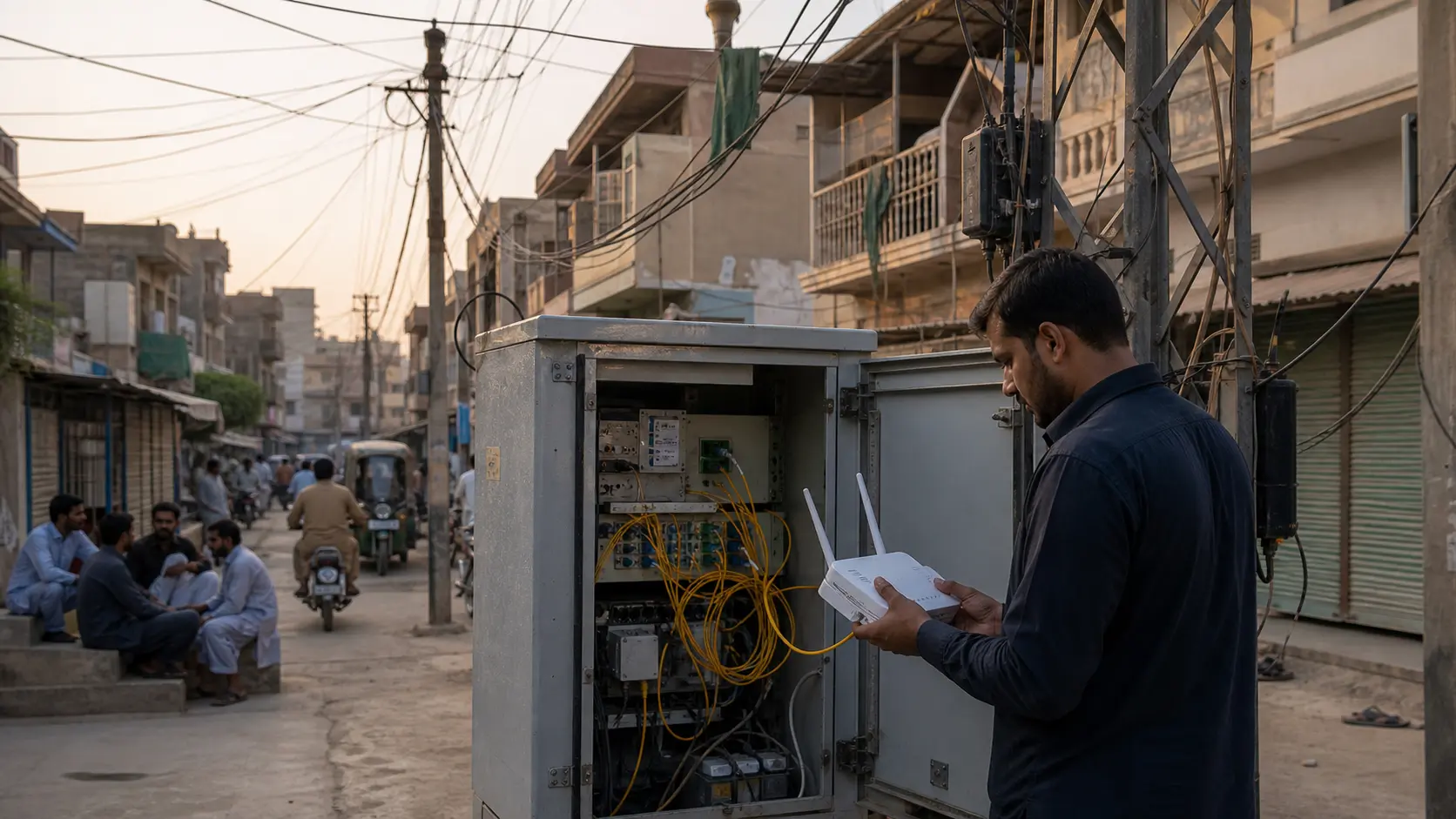
Field support is the second pressure. Local broadband survives on technicians. A working local ISP knows which poles, rooftops, cabinets, lanes, landlords and customer routers create trouble. That knowledge is valuable but labor-intensive. When a customer loses service, the repair is physical: a cable, splitter, connector, wireless alignment, router, switch port, power issue or local cut. The customer may not distinguish between Ultra Link's own access problem, an upstream issue and a national internet disturbance. The provider takes the blame because it sold the monthly link.
Regulation is the third pressure. PTA's CVAS internet license template requires operators to maintain service, meet quality standards, provide information to the regulator, support inspections, protect customer information, retain certain data, comply with national security directions, and follow rules on service discontinuation. Even if some details vary by final licence and amendment, the direction is clear: the small ISP is not operating in an informal vacuum. It is inside a regulated system where service quality, data handling, lawful directions and record-keeping can become real costs.
Equipment and power are the fourth pressure. Pakistan's fixed broadband growth has increased the importance of fiber, routers, access electronics and backup power. The 2025-26 Pakistan Economic Survey says Pakistan had 4.29 million fixed broadband connections by March 2026 and about 228,940 kilometers of fiber optic cable deployed nationwide by mid-2025. That creates a larger supplier ecosystem, but it also raises customer expectations. A local ISP that wants to stay relevant must keep pace with fiberization, imported equipment costs, exchange-rate pressure, power reliability and the skill needed to maintain modern access nodes.
These costs do not destroy the model. They define the model. Ultra Link can be profitable if it has dense pockets, disciplined package design, low churn, reliable upstream relationships and efficient local support. It becomes fragile if it has to spend heavily to repair a weak access layer while losing customers to faster rivals.
PTA quality evidence is the trust test
The strongest public warning is the PTA fixed broadband QoS survey for the second quarter of 2025. In the operator-wise table, Ultra Link in Rahim Yar Khan scored 3 out of 6, or 50 percent compliance. The city-wise table showed "RYK Ultra Link" not compliant for core-node availability, not compliant for access-node availability, compliant for local latency at 14 ms, compliant for international terrestrial latency at 42 ms, not compliant for bandwidth utilization at 91.18 percent, and compliant for jitter at 4 ms.
The report also listed Ultra Link (Rahim Yar Khan) among operators failing core-node and access-node availability thresholds.
That is exactly the kind of evidence that matters for the assigned economic lens. Ultra Link's sales pitch is not only "we exist"; it is "get connected and stay connected." The PTA data says the Rahim Yar Khan operation failed the specific availability and utilization tests that customers feel most directly. Latency and jitter were acceptable in that survey, which is a useful positive. The problem was not every technical parameter. The problem was availability and congestion. Those are the two metrics that convert a low-price local connection from a bargain into a source of distrust.
The same PTA survey also creates a competitive comparison. S.B Link in Rahim Yar Khan scored 6 out of 6, or 100 percent compliance, in the same Q2 2025 operator-wise table. That does not prove SB Link is always better, and it does not prove Ultra Link lost customers. It does show that a local customer had at least one same-city regulatory benchmark that could be used against Ultra Link's trust position. In a market where customers buy from whoever keeps the link working, a 50 percent compliance result is not just a technical note. It is a commercial problem.
There is a later ambiguity. The PTA's fourth-quarter 2025 report includes a row for "Karachi Ultra Link (Pvt.) Limited" with compliant metrics: 100 percent core and access availability, 1 ms local latency, 15.75 ms international terrestrial latency, 80 percent bandwidth utilization, zero jitter, and compliant throughput. That row may refer to the same legal company or to a same-name operation in a different city context. The public website and licence evidence tied to this article still point most clearly to Rahim Yar Khan and Gujranwala. For that reason, the later Karachi row should not erase the Rahim Yar Khan warning.
It should be treated as a fact that would improve the judgement only if Ultra Link can show the same compliance in its visible local footprint.
The conclusion is balanced. Ultra Link is not technically hopeless. The bad Q2 2025 RYK metrics are repairable: add capacity, fix access-node availability, improve power backup, monitor peak load, and improve fault response. But until that repair is visible in the operating city, local trust remains the central discount.
Customers are sticky only while the link feels dependable
Ultra Link's customer base is not publicly disclosed, so the article should not invent a subscriber number. The better way to think about customer dependency is by use case. In Rahim Yar Khan and Gujranwala, fixed broadband supports homes, students, small retailers, clinics, offices, freelancers, gaming households, video calls, payments and entertainment. A small internet provider becomes part of daily routine. When it works, the provider is barely noticed. When it fails, everyone knows.
The company's support model is therefore part of the product. The website puts phone and WhatsApp numbers in front of the package pages. The presence of a panel login suggests account or payment handling. The physical office addresses help convert a web page into a local promise. For a household that cannot get a fast installation from a national provider or does not want to navigate a remote call center, local support can be decisive. It is the advantage of proximity.
But proximity cuts both ways. A small provider cannot hide behind national brand abstraction. If the line is down, the customer may know the office, the technician or the reseller. If the evening speed collapses, the complaint spreads through neighborhood groups and shop conversations. If a rival has better uptime, the rival's field team can convert frustration into churn. The same local knowledge that helps Ultra Link sell can help customers compare it against nearby alternatives.
The unofficial market signals are mixed and should be used carefully. Ultra Link's Facebook page search result shows 682 likes and classifies it as an internet company. Its Instagram profile says "Best internet services provider in Rahim yar khan & Gujranwala" but shows a very small follower count in the indexed page. Yandex and other local-directory style pages list Ultra Link Network in Rahim Yar Khan or Gujranwala. Rentech's scraped Punjab ISP list shows many providers in the province and lists "ULTRA LINK NETWORK" in Gujranwala with a very small review base. None of these are audited measures of quality.
Together they show a local web footprint that exists but is thin.
That thin public footprint is not fatal. Many local ISPs have thin public footprints because their real acquisition channel is neighborhood referral. But it does raise the burden on service proof. If Ultra Link is not winning with a large national brand, it must win with reliability, responsiveness and perceived fairness. The more modest the public brand, the more important the lived customer experience becomes.
The business value is therefore in active, reachable customers, not in abstract coverage claims. A connected household that pays every month, rarely calls support and recommends the provider is valuable. A connected household that calls repeatedly, suffers congestion and considers SB Link, PTCL, Nayatel, StormFiber, Transworld, CyberNet, mobile broadband or another local provider is a shrinking asset. Customer stickiness is real only while switching feels more painful than staying.
Competition punishes doubt
Ultra Link competes in two kinds of markets at once. Rahim Yar Khan is an edge market where local operators and mobile broadband matter. Gujranwala is a larger Punjab market where national and city-focused fiber brands are more visible. In both places, the customer compares three things: price, working speed and support. Brand matters, but it matters less than proof.
In Rahim Yar Khan, the Q2 2025 PTA survey is an uncomfortable comparator because S.B Link scored 100 percent compliance while Ultra Link scored 50 percent. TestMy.net's city page for Rahim Yar Khan also lists Orbit Networks, S B Link, Cybernet and Brain Net among top ISP speed-test results, with city averages around 23.5 Mbps download, 10.8 Mbps upload and 121 ms latency in the checked public page. TestMy data is user-generated and should not be treated as a market-share table. It still matters as a signal that local users are comparing providers and that Ultra Link is not the only local option in the customer's mind.
In Gujranwala, competition is broader. Search-visible market signals include Nayatel availability in Gujranwala neighborhoods, StormFiber coverage in Gujranwala, Transworld home coverage references, PTCL's legacy and fiber presence, and multiple smaller local providers. Ultra Link's Gujranwala package ladder tops out at 25 Mbps in the captured page, with a confusing "Diamond" entry that labels 25 Mbps but lists "10Mbps Speed" inside the feature text. That kind of inconsistency may not matter if local sales staff explain packages by phone, but it does matter when competitors market cleaner fiber plans.
The competitive threat is not only faster speed. It is lower perceived risk. A household may tolerate 8 Mbps if it is stable and cheap. It will move if the connection fails during the evening, if support is slow, or if a rival can install quickly. A small shop may stay with a familiar local provider if payment devices, cameras and phones work. It will reconsider if outages affect transactions. A student may stay if uploads and classes work. A gamer or streamer will leave faster if latency and buffering become chronic.
That means Ultra Link's best competitive answer is not necessarily a headline 100 Mbps plan. It is a service promise the company can actually keep: clear packages, clean support, better availability, less congestion, transparent payment, and upstream resilience. The provider that wins in these markets is the one that reduces customer anxiety. Ultra Link can do that, but the public evidence says it still has to prove it.
Regulation, geopolitics and operations are inseparable
Pakistan's fixed broadband market is expanding, but the expansion raises the bar for small providers. The Pakistan Economic Survey 2025-26 says telecom subscriptions reached 207.22 million by March 2026, including 160.9 million broadband users and over 4.29 million fixed broadband connections. It also says broadband penetration reached 64.2 percent and that fixed broadband surveys under the 2022 regulations covered 65 cities and 122 operators, leading to corrective actions and enforcement where required. The national direction is clear: broadband is no longer a luxury edge product.
It is a regulated infrastructure service tied to economic inclusion, education, work and state policy.
The Universal Service Fund's Rahim Yar Khan lot shows why edge markets matter. USF said the lot aimed to provide broadband internet services to 741 unserved mauzas in the district, with 173 also requiring voice telephony, under a contract with PMCL Jazz signed in 2019. Ultra Link is not the named USF contractor in that record. The point is contextual: Rahim Yar Khan is not just another urban market. It sits inside a wider policy effort to extend connectivity beyond dense metropolitan cores. Local providers can benefit from that demand, but they also compete with subsidized or larger networks that reach previously underserved populations.
Operational risk also has a geopolitical layer. Pakistan's international connectivity depends on submarine cable systems and terrestrial routes; the Economic Survey describes six submarine cable systems and one terrestrial cable system with installed capacity of 17.7 Tbps. For a small ISP, international reach is mediated through upstreams. If upstream capacity, filtering, cable faults, foreign exchange, equipment procurement or regulatory orders affect the larger network environment, Ultra Link has limited ability to control the outcome alone. Customers still experience the problem through the provider that bills them.
The PTA CVAS licence template also shows that small ISPs are part of national security and data governance. It includes obligations around cooperation with the regulator, inspection, quality monitoring, records, customer information, discontinuation notice, local traffic handling and compliance with lawful directions. The article does not need to dramatize these obligations. It only needs to recognize that a local ISP is a regulated operating company. Compliance, data handling and network security are costs that sit beside bandwidth and field repair.
This creates the strategic dilemma. Ultra Link's local advantage is flexibility and proximity. The regulatory and upstream environment rewards discipline, documentation and redundancy. A provider that stays informal for too long may remain locally familiar but operationally brittle. A provider that professionalizes too aggressively may raise costs faster than customers will pay. The economic sweet spot is controlled informality: local support and flexible selling, backed by enough monitoring, upstream diversity and compliance discipline to pass public tests.
What would change the judgement
The judgement would improve if Ultra Link published transparent package prices, showed sustained PTA compliance in Rahim Yar Khan and Gujranwala, brought AS152678 into visible production with stable originated routes, disclosed or demonstrated redundant upstream paths, fixed package-page inconsistencies, and showed customer-support responsiveness through public service notices or measurable uptime claims. It would also improve if APNIC, RIPEstat, PeeringDB and third-party route views converged around a cleaner network identity and if the visible Ultra Link /24s were not solely dependent on AS137047 in the public view.
The judgement would weaken if Ultra Link remained absent from global routing under its own ASN, if its Ultra Link address space disappeared or became unstable, if the next local PTA survey repeated the Rahim Yar Khan availability and utilization failures, if competitors continued to show stronger local compliance, if package pages stayed stale, or if customer-facing channels became unreachable. A small ISP can survive modest public polish. It cannot survive the customer perception that nobody is accountable when the connection fails.
The most important unknowns are subscriber count, churn, monthly revenue, actual tariffs, installation fees, debt, staff size, network topology, access technology mix, uptime history, upstream contracts, power backup, and whether Gujranwala is a dense profitable pocket or a thin branch. Public evidence does not answer those questions. It does answer enough to frame the business: Ultra Link is a real local ISP with licence and resource evidence, but its economic value rests on proving reliability in specific streets and towns.
The final assessment is therefore neither bullish nor dismissive. Ultra Link has a credible local operating base and the kind of support-led product that can matter in Pakistan's edge broadband markets. Its weakness is that the public network and QoS evidence do not yet match a resilient independent-infrastructure story. If management fixes availability, reduces peak utilization, clarifies prices and makes routing resilience visible, the company can be a durable local cash-flow provider. If it does not, customers will not wait for a theory. They will buy from whoever keeps the link working.
Evidence register
https://www.ultralinknetworks.com/supports Ultra Link's public brand, contact emails and phone numbers, stated points of presence in Rahim Yar Khan and Gujranwala, customer-centric claims, office addresses and panel-login surface.https://ultralinknetworks.com/Ryk.htmlsupports the Rahim Yar Khan package ladder, including 3 Mbps to 30 Mbps tiers, unlimited data, happy-hour wording, contact number 03007820394, and the Rahim Yar Khan office address and opening hours.https://www.ultralinknetworks.com/Gujranwalpkg.htmlsupports the Gujranwala package ladder, including 4 Mbps to 25 Mbps tiers, unlimited data, extra-speed windows, contact number 03216474192, and the Gujranwala branch office address.https://www.pta.gov.pk/assets/media/2025-04-23-List-of-CVAS-Licensees-in-Pakistan-21-04-2025.pdfsupports Ultra Link (Pvt.) Limited's PTA CVAS internet licence, licence number DIR (L)/CVAS-997/PTA/2018, grant and expiry dates, Punjab jurisdiction, commencement certificate date, CEO name, Rahim Yar Khan address and contact numbers.https://www.pta.gov.pk/assets/media/2025-07-24-Fixed-Broadband-Quality-of-Service-QoS-Surveys---Quarter-02-2025.pdfsupports the Q2 2025 Rahim Yar Khan QoS finding: Ultra Link scored 3 out of 6, failed core and access availability, failed bandwidth utilization at 91.18 percent, and passed local latency, international latency and jitter in the displayed table.https://www.pta.gov.pk/assets/media/2026-01-15-Final-BB-QoS-Survey-Report-4th-Quarter-2025.pdfsupports the later PTA row for "Karachi Ultra Link (Pvt.) Limited" with compliant metrics, treated in the article as a same-name or broader-company ambiguity rather than proof that the Rahim Yar Khan issue was repaired.https://rdap.apnic.net/autnum/152678supports APNIC registration of AS152678, ULP-AS-AP, country Pakistan, description ULTRA LINK (PRIVATE) LIMITED, registration on 4 April 2024, last-changed date, registrant details and abuse-contact remarks.https://rdap.apnic.net/ip/119.160.214.1andhttps://rdap.apnic.net/ip/119.160.215.1support APNIC registration of the two Ultra Link IPv4 /24 resources, including ULP-PK netname, ULTRA LINK (PRIVATE) LIMITED description, address details and abuse/contact information.https://wq.apnic.net/apnic-bin/whois.pl?searchtext=119.160.214.0%2F24andhttps://wq.apnic.net/apnic-bin/whois.pl?searchtext=119.160.215.0%2F24support route-object details for the Ultra Link /24s, including route objects for AS137047, AS152678, AS17557 and AS38193.https://www.peeringdb.com/net/38257andhttps://www.peeringdb.com/api/net?asn=152678support the PeeringDB record for Ultra Link Networks, including ASN 152678, alias ULTRALINK PVT LTD., long name ULTRA LINK (PRIVATE) LIMITED, website, two IPv4 prefixes, no IPv6 prefixes, open policy and no public exchange/facility entries.https://stat.ripe.net/data/as-overview/data.json?resource=AS152678,https://stat.ripe.net/data/announced-prefixes/data.json?resource=AS152678andhttps://stat.ripe.net/data/asn-neighbours/data.json?resource=AS152678support the July 2026 finding that AS152678 was registered to Ultra Link but not visibly announced in RIPEstat's global routing view.https://bgp.tools/as/152678,https://bgp.he.net/AS152678andhttps://ipinfo.io/AS152678support the same current-route caution: the public pages showed AS152678 with zero or no visible originated prefixes, peers, upstreams or pingable IPs in the checked view.https://stat.ripe.net/data/prefix-overview/data.json?resource=119.160.214.0/24,https://stat.ripe.net/data/prefix-overview/data.json?resource=119.160.215.0/24,https://bgp.tools/as/137047,https://bgp.he.net/AS137047andhttps://ipinfo.io/AS137047support the currently visible origin of Ultra Link's two /24s through AS137047 and the upstream context involving Pakistan Telecommunication Company Limited and Transworld Associates.https://www.finance.gov.pk/survey/chapter_26/15_Information_Technology.pdfsupports the broader Pakistan market context: 207.22 million telecom subscriptions by March 2026, 160.9 million broadband users, over 4.29 million fixed broadband connections, 2.7 million FTTH subscribers, 228,940 kilometers of fiber by mid-2025, and fixed broadband QoS surveys covering 65 cities and 122 operators.https://www.usf.org.pk/programs/projects/rahim-yar-khan-lotsupports the edge-market context for Rahim Yar Khan, including USF's goal to extend broadband service to 741 unserved mauzas and the 2019 PMCL Jazz contract for the lot.https://www.pta.gov.pk/assets/media/consultation_paper_on_data_CVAS_License_Template_for_provision_of_Internet_Services_20240308.pdfsupports the regulatory discussion around Data CVAS internet licensing, operational continuity, QoS monitoring, information provision, national security obligations, customer information, and tariff freedom subject to PTA intervention.https://testmy.net/city/rahim_yar_khan_pbsupports unofficial local-market comparison signals, including Rahim Yar Khan speed-test averages and visible competing provider names such as Orbit Networks, S B Link, Cybernet and Brain Net.https://pk.linkedin.com/company/sblinknetworkpksupports SB Link Network's public positioning as a Rahim Yar Khan-based competitor, its claimed southern Punjab service, speeds up to 200 Mbps, 24/7 support, and billing/recovery hiring signal.https://rentechdigital.com/smartscraper/business-report-details/pakistan/list-of-internet-service-providers-in-punjab,https://www.facebook.com/p/ULTRA-LINK-Private-Limited-100063761602124/,https://www.instagram.com/ultralinknetwork/andhttps://yandex.com/maps/org/city_cable_office/47178755120/support only weak public-footprint and local-directory signals; they are not used as audited evidence of customer count or service quality.