
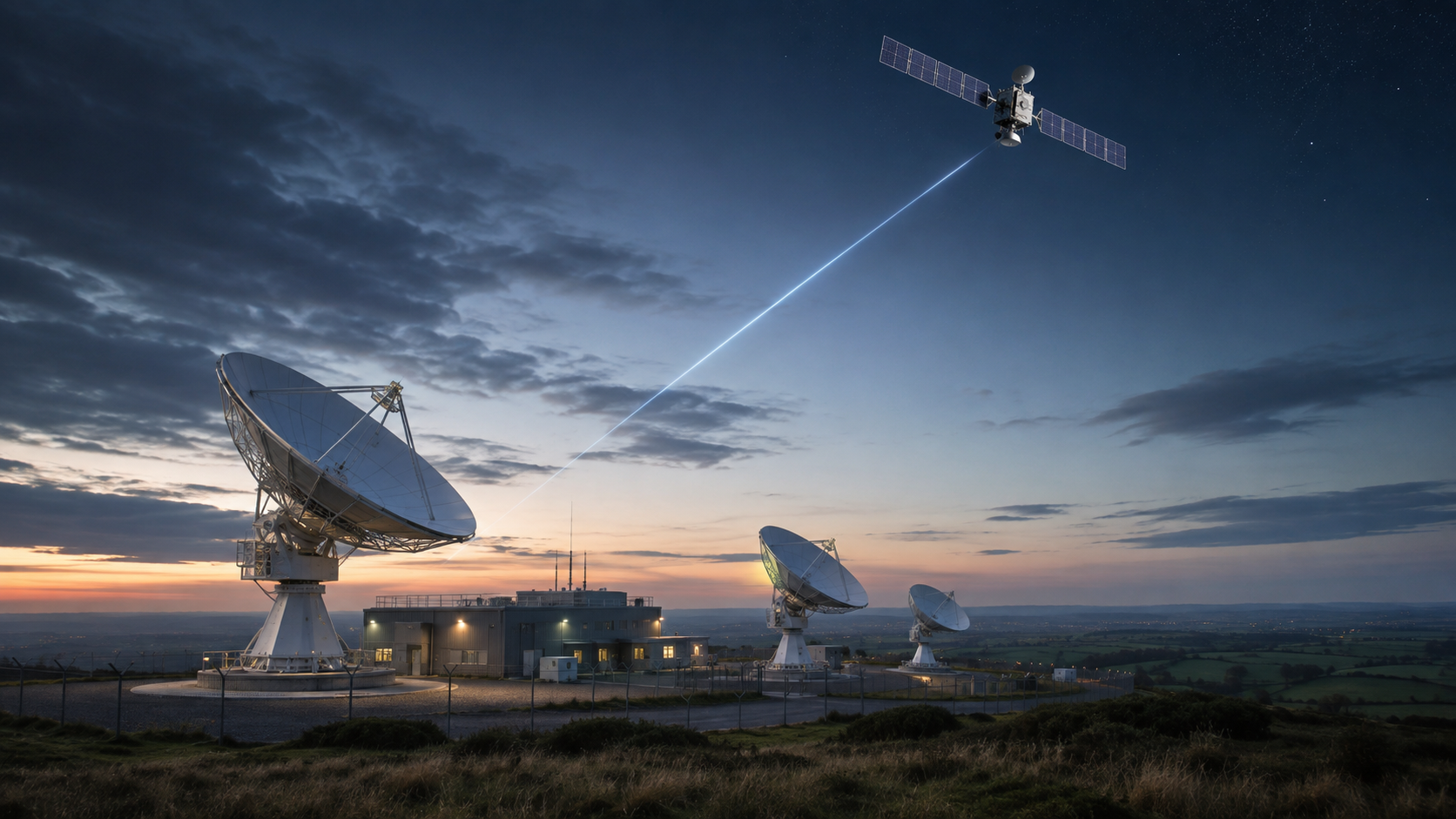
- Exobotics' STARS receives £2.1m, the largest award, while Archangel Lightworks gets £1.845m for a laser link targeting more than 100Gbps
- Other awards cover portable ground stations, software-defined onboard processing, rail broadband, user terminals and 5G and 6G integration
The fact
The UK Space Agency is providing £13 million for 16 satellite communications projects through the European Space Agency's Advanced Research in Telecommunications Systems programme. The awards cover optical communications, onboard processing, ground infrastructure, network software, user terminals, and applications linking satellite systems with terrestrial services.
The largest award is £2.1 million for Exobotics' STARS project, developed with Archangel Lightworks and the University of Nottingham to demonstrate optical communications for a planned satellite data-relay network. Archangel Lightworks will receive £1.845 million for Project Optimus, a laser communications system targeting data rates above 100Gbps. Orbital Astronautics will receive £1.71 million for a portable multi-band ground station, while Airbus Defence, and Space UK gets £1.5 million to expand its software-defined Hyperion processor.
Smaller awards include £428,000 for CGI's SODOR trial on ScotRail's West Highland Line and £429,000 for Lacuna Space to develop satellite-connected user terminals.
The assessment
The UK is not funding one new satellite network. It is funding separate pieces that would have to work together in a live service: optical links, onboard processors, ground stations, user terminals and connections into terrestrial networks.
Those projects will mature in different ways. STARS and Optimus have to prove their optical links; Orbital Astronautics has to put its portable ground station into the field; CGI has to test satellite connectivity on a working rail route. The 5G and 6G projects still have to show that satellite systems can be integrated with terrestrial networks. None of this amounts to new operational satellite capacity yet.
For BTW readers, the useful distinction is between a successful demonstration and equipment that somebody chooses to deploy. An operator integration, equipment order or deployment contract would matter more than another technical trial, because that is the point at which one of these funded technologies starts becoming part of a working communications network.
What to watch
Watch for STARS and Optimus to complete optical-link demonstrations, Orbital Astronautics to field its portable ground station and CGI to report results from the SODOR rail trial. For the 5G and 6G projects, named operator partners or live network tests would show progress beyond development. A commercial order or deployment contract would mark the strongest step beyond the funded development stage.
Member Briefing
Deeper Profile Context
Sign in with the right membership level to unlock the full briefing and source notes.
Only for Strategic Circle
Strategic Circle
Open to all readers. Unlock profile briefings after joining and signing in.
Join Strategic CircleOnly for Leadership Alliance
Leadership Alliance
For qualified IP-asset owners and management; sign in to unlock alliance briefings.
Join Leadership Alliance