
Summary
- UbuntuNet is a Malawi-registered, member-governed not-for-profit serving national research and education networks in Eastern and Southern Africa; its records use both “association” and “Trust”.
- It assembled regional capacity through carrier contracts, points of presence, member routes and AfricaConnect programmes, including 10 Gbps core links and larger national connections.
- The portfolio now extends beyond transport to identity, cloud and storage, open science, cybersecurity and NREN development, with services at different levels of maturity.
- Pooling demand and expertise creates value, but weak campus links, arrears, supplier power, conflict, grant cycles and incomplete reporting can prevent regional capacity reaching researchers.
Network 3 moved the core into a 10 Gbps operating class
The 2023 Annual Report describes major core links being upgraded from approximately 2.5 Gbps to 10 Gbps. The programme added PoPs in Gaborone and Johannesburg, introduced peering at NAPAfrica and increased the rates available to several NRENs. The same material described the redundant core as providing at least 20 Gbps of total capacity on relevant segments.
These numbers refer to different layers. A 10 Gbps core link is not the same as a 10 Gbps member access, a peering port, total aggregate capacity or traffic actually flowing. “20 Gbps core capacity” is most coherently understood as paired or redundant 10 Gbps design, not as one universal 20 Gbps service delivered to every country. The distinction prevents the largest number in the system from being converted into a misleading network-wide speed.
The upgrade changed operational possibilities. Member connections previously ranging from roughly 130 Mbps to 4 Gbps moved into a reported 500 Mbps to 8 Gbps range. More headroom supported cloud access, repositories, collaboration and larger scientific transfers. The gain remained conditional on national and campus infrastructure. A high-capacity core can be healthy while a university is constrained by a domestic circuit, firewall, wireless network or storage endpoint. Network 3 improved the regional layer and made the quality of the layers below it more important.
Lower unit prices were an infrastructure result, not a side effect
UbuntuNet reported unit-price reductions of 50% to 71.5% for NREN connectivity in 2023 compared with 2022, depending on the member and service. In a region where budgets can be fixed in local currency while international capacity is priced in dollars or euros, the cost per unit is as important as the headline rate.
Lower prices can allow an NREN to buy more capacity, connect additional institutions or maintain reserve for failure. They also express the Alliance’s member-governed mission: pooled procurement is intended to pass scale benefits to the community rather than maximise profit. A fall in connectivity revenue can therefore accompany a successful reduction in member cost.
Affordability cannot be separated from sustainability. Carrier invoices, staff, security work, colocation and renewal remain recurring obligations. If the service price is kept below cost by a temporary grant, the short-term benefit becomes a later funding gap. The strategic task is to distinguish genuine procurement savings from subsidy and to make the ongoing cost visible early enough for members to budget. The federation works when lower prices expand use while payments remain sufficient and timely enough to protect the shared layer.
BotsREN and ZIMREN show how regional upgrades reach national networks
BotsREN connected to the UbuntuNet backbone at 10 Gbps during the Network 3 phase and increased its regional access to 20 Gbps in January 2026. ZIMREN connected at 10 Gbps in June 2025. These are specific national access rates, not measurements of the whole backbone.
The milestones are meaningful because they show commissioned service rather than a planned map. A national NREN can use the connection to aggregate universities, exchange R&E traffic and reach shared services. The regional rate also gives the national operator a reason to improve domestic links and institutional onboarding.
The rate at the UbuntuNet handoff does not establish the experience at every Botswana or Zimbabwe campus. Domestic fibre, university equipment, endpoint tuning and local staffing remain decisive. Nor does one 20 Gbps member port prove that all members can receive the same service economically. The evidence should be read as uneven but real growth: some national networks have already moved beyond the first Network 3 access range, while the regional community still includes members with very different readiness and ability to pay.
The regional layer begins where national research networks reach their borders
A student or researcher rarely sees UbuntuNet Alliance named in the service they use. The first visible network is usually the campus or research-institution network. From there, traffic enters a national research and education network such as KENET, RENU, TENET, ZAMREN, TERNET or MoRENet. UbuntuNet becomes material at the next boundary, when a national network must exchange traffic with another country, reach an international scientific facility, connect to GÉANT or obtain a shared service that would be expensive to build separately in every member state.
That position explains why the Alliance can be important without looking like a retail provider. It does not normally sell household broadband, connect every university directly or control the local wireless network through which a researcher begins a session. It provides a regional route and service layer above nationally governed systems. Other regional networks, commercial carriers, cloud providers, internet exchanges and destination institutions then complete the path.
The user experiences one transfer, authentication or application session. Operational authority is divided. UbuntuNet can change its routing, upgrade a core link, monitor a regional service and coordinate an incident. It cannot repair a university power failure, correct an institution’s stale directory, compel a domestic carrier to restore fibre or guarantee that a destination cloud has enough capacity. The organisation’s central engineering challenge is therefore not to pretend that the chain has one owner. It is to make multiple independently controlled layers behave coherently enough that the research community can rely on the result.
Federation is the design, not a temporary substitute for central ownership
UbuntuNet Alliance is an alliance of national networks, not a holding company. Member NRENs retain their legal identity, staff, budgets, domestic routes, institutional customers, government relationships and pricing. The Alliance exists because those organisations choose to procure certain capacity together, exchange traffic through common locations, operate regional services and represent shared interests internationally.
This model is suited to a region where telecommunications markets, currencies, higher-education systems, regulation, language and institutional maturity vary sharply. A centrally owned academic network across all member countries would require political authority that UbuntuNet does not have and does not need. Federation allows national autonomy to coexist with regional scale. It also lets stronger NRENs contribute operational knowledge while emerging networks gain a community, an international route and services worth building toward.
Federation does not remove complexity; it places complexity at the interfaces. A slow transfer may involve a campus firewall, a domestic access circuit, a national router, an UbuntuNet PoP, a carrier segment, a global partner and the destination system. Each operator sees a different portion of the evidence. Reliable service therefore depends on handoff definitions, shared telemetry, escalation contacts, change procedures, contribution rules and practical exit options. UbuntuNet succeeds when independent organisations can collaborate without surrendering their legitimate local authority.
The legal record is operationally usable but not terminologically uniform
Current UbuntuNet material describes the entity as a Malawi-registered not-for-profit association of NRENs. The 2023 Annual Report and historical transition documents also describe a registered non-profit Trust governed through members and Trustees. The current statutory deed was not retrieved for the research pack, so the difference should not be silently resolved by choosing one label and discarding the other.
The practical governance is clearer. UbuntuNet has members rather than ordinary equity shareholders. Its documented structure consists of an Assembly of Members, a Board of Trustees and a Secretariat led by the chief executive. The organisation can employ staff, receive grants, enter carrier and supplier contracts, hold or lease assets and operate services. There is no evidence of distributable ownership or a conventional corporate valuation.
The distinction matters because language shapes assumptions about control. Calling UbuntuNet a private telecommunications company would imply investor ownership and a commercial return model. Calling it only a voluntary community would understate its contractual, operational and fiduciary responsibilities. The most defensible description is a Malawi-registered not-for-profit membership organisation of NRENs, while noting that its first-party records use both association and Trust terminology. That phrasing preserves what is known and does not manufacture legal precision that the public record does not provide.
The founding problem was the economics and direction of connectivity
Universities in Eastern and Southern Africa had internet access before UbuntuNet Alliance existed. The missing element was a durable regional mechanism for aggregating academic demand, exchanging research traffic and connecting to global R&E partners under conditions designed for education and science. Individual institutions bought commercial international capacity in relatively small quantities, often at high unit cost. National demand was fragmented, cross-border terrestrial routes were incomplete and traffic between African institutions could travel through Europe.
A normal commercial connection provided useful public-internet access, but it did not automatically produce direct routes to neighbouring research networks, predictable high-capacity paths for data-intensive science, federated identity, shared security practice or collective bargaining power. Smaller university systems negotiated from a weak position, and emerging NRENs had difficulty demonstrating value before they possessed enough members or capacity.
The Alliance changed the unit of demand. Campuses aggregated through national networks; national networks aggregated through a regional organisation. That larger community could plan common PoPs, sign longer capacity agreements, establish operational teams and negotiate with global partners. UbuntuNet did not eliminate the commercial market. It entered that market as a coordinated buyer and specialised operator with a public-interest mission.
Its founding question was therefore as institutional as it was technical: how could separately governed universities and national networks create enough scale to obtain a regional service none could sustain alone?
Five NREN initiatives created the first coalition
UbuntuNet Alliance was conceived in the latter half of 2005 by NREN initiatives in Kenya, Malawi, Mozambique, Rwanda and South Africa. The founding institutional base is associated with KENET, MAREN, MoRENet, RwEdNet and TENET, or the forms those organisations used at the time. They did not enter the project with identical resources or maturity.
TENET and KENET brought substantial operating experience and established university relationships. MAREN gave the emerging organisation an anchor in the country that would later host its Secretariat. MoRENet represented a government-supported national model. RwEdNet embodied both the promise and the fragility of a developing NREN; its later collapse and rebuilding would demonstrate that a regional backbone cannot compensate indefinitely for weak national institutions.
That mixture was useful. A coalition made only of mature networks might have become a narrow interconnection club, efficient for existing members but less committed to creating new national capability. A coalition made only of emerging initiatives might have lacked traffic, technical experience and credibility with carriers or funders. The five-network origin brought both conditions together. UbuntuNet could pursue production connectivity while helping national organisations build the governance, engineering and financial capacity required to use and pay for it.
Francis Tusubira helped turn a network proposal into an institution
Francis “Tusu” Tusubira is closely associated with UbuntuNet’s founding era and the wider movement to establish African NRENs. The task was not limited to choosing routes or equipment. Universities, ministries, regulators, carriers, donors and engineers had to be persuaded that a regional research network should be a lasting institution rather than a short development project.
Institution-building required a legal vehicle, member rules, accounts, contracting capacity, an annual community forum and a shared explanation of why an NREN was not simply a discounted ISP. It also required trust between countries whose public sectors, procurement rules and telecommunications markets differed. Tusubira’s contribution is best understood in that coalition-building context. He did not own the regional network or act alone; founding NRENs, boards, technical communities and international partners all shaped the result.
The durable output was an organisation able to receive programme funds, negotiate long-term capacity and represent a regional community. That institutional capability later made the AfricaConnect phases possible. A carrier can sell bandwidth to a buyer that already exists. UbuntuNet’s founders first had to create the buyer, establish who it represented and demonstrate that its members would maintain a regional service over many years.
Amsterdam provided an early legal vehicle; Malawi became the regional home
Registration documents were submitted to the Amsterdam Chamber of Commerce in 2006. For an organisation still assembling members and international relationships, a Netherlands vehicle offered a workable legal and administrative framework familiar to European R&E partners. It could support contracts and project relationships before the Alliance had completed a durable institutional base inside its operating region.
As the organisation matured, a legal home in Europe became less aligned with a membership body serving Eastern and Southern Africa. A new constitution was adopted in Malawi in 2012, registration followed during 2013 and historical records describe the transfer of assets and liabilities to the Malawi structure. The Secretariat is now based in Lilongwe. The move brought formal governance closer to the members and reinforced the idea that UbuntuNet was an African institution working with international partners rather than a European project office serving Africa.
The transition did not remove every ambiguity. Association and Trust language both remain in official material, and the precise legal history should not be compressed into one founding date. The defensible chronology is staged: a regional coalition emerged in 2005; registration work was undertaken in the Netherlands in 2006; a Malawi constitutional and legal transition occurred in 2012–2013; and the organisation continued operating through a member-and-Trustee governance model. That layered account is more accurate than a single ceremonial birthday.
Early GÉANT transit proved utility before a full regional backbone existed
Historical Alliance material says one of UbuntuNet’s earliest tangible services was R&E transit toward GÉANT, implemented around January 2008. The service allowed participating networks to exchange research traffic with European and global peers before the later AfricaConnect production backbone had been fully commissioned.
That first international relationship did not solve regional route localisation. A route toward Europe could improve access to European research resources while leaving African-to-African traffic dependent on distant paths. It nevertheless gave the Alliance practical experience with production routing, international support, address policy and service coordination. It also gave prospective members a visible reason to invest in national NREN capability: there was a specialised global research environment to connect to.
The GÉANT relationship supplied more than packets. European R&E organisations brought procurement expertise, project administration, trust-and-identity experience and access to long-term EU funding. That support was productive and material, but it also created a durable dependency on programme cycles and external expertise. UbuntuNet’s history is therefore neither a story of outside construction nor one of isolated self-sufficiency. It is a regional institution using international partnerships to build greater local operational choice.
Long-term carrier contracts turned pooled demand into infrastructure
UbuntuNet did not build one continuous, wholly owned fibre network. It assembled a service from leased capacity, carrier routes, PoPs, internet exchanges, member infrastructure and international interconnections. That capital-light structure allowed a relatively small organisation to operate regionally without financing a continent-scale civil-engineering programme.
The 2013 agreement in which DANTE and UbuntuNet awarded WIOCC a 15-year connectivity contract was a central step. A further 15-year SEACOM contract announced in 2016 covered Kampala–Dar es Salaam and Dar es Salaam–Amsterdam. Long terms could lower unit cost, make route planning more predictable and provide an upgrade path that annual retail circuits could not. They also established carrier relationships broad enough to support an RREN rather than one campus.
The contracts transferred neither physical ownership nor complete operational control. The suppliers still controlled fibre systems, repairs, landing environments and parts of the path. UbuntuNet remained exposed to carrier performance, foreign-currency costs, regulation and shared infrastructure that might not be visible on a logical diagram. Long commitments also had to be funded from shorter and sometimes uncertain payment cycles among member NRENs. The same instrument that created stability therefore created a financial obligation the Alliance had to carry through currency movements, delayed contributions and changing demand.
The 2014 commissioning changed the Alliance from promise to production operator
In July 2014, UbuntuNet Alliance and DANTE announced the commissioning of new 622 Mbps regional high-speed links. The number is modest by current standards, but the event marked the conversion of feasibility studies, institutional advocacy and procurement into a network carrying real traffic.
Production changes responsibility. Once traffic flows, an organisation must monitor equipment, maintain configurations, respond to carrier incidents, communicate planned work and support member engineers. An outage is no longer a delay in a project plan; it affects researchers and institutions. The 2014 milestone therefore mattered less as a speed record than as the point at which the federation acquired operational consequences.
The historical rate should be judged against the market in which it was delivered. Many institutions and national networks had been buying limited international capacity at high cost. A shared 622 Mbps environment could materially improve research connectivity and provide a base for later expansion. It also exposed the next limits: one commissioned route did not guarantee diverse paths, national reach or healthy campus networks. Each improvement made the remaining bottlenecks more visible.
AfricaConnect2 widened the programme and strengthened eastern resilience
AfricaConnect2, launched in the mid-2010s as a €26.6 million multi-region programme, brought UbuntuNet, WACREN, ASREN and GÉANT into a wider African implementation framework. The budget belonged to the programme, not to UbuntuNet alone. It funded capacity, institutional development and shared work across several regional and national organisations.
For UbuntuNet, the phase extended the first production network and addressed route and resilience gaps. The SEACOM agreement added an important eastern path through Kampala and Dar es Salaam toward Amsterdam. Additional national connections and training broadened the community that could use the network. The programme also reinforced a procurement model in which GÉANT and regional bodies combined technical requirements and donor rules with commercial carrier contracts.
Resilience cannot be inferred from the number of supplier names. Two logical paths may share a landing station, terrestrial corridor, power domain or upstream provider. Actual resilience depends on physical diversity, spare capacity, tested failover, route policy and a support process capable of finding the responsible operator. AfricaConnect2 improved the options available to the Alliance, while the operational quality of those options still had to be demonstrated in production.
AfricaConnect3 made the service portfolio as important as the backbone
AfricaConnect3 began in 2019 and ran through April 2025. It supported higher-capacity network infrastructure, new member connections, identity work, cloud services, open science, cybersecurity and training. That breadth reflected a change in the definition of research infrastructure. Moving packets was necessary, but it did not complete the workflow through which a researcher authenticates, finds a funding opportunity, accesses a journal, deposits data or uses compute.
The phase produced UbuntuNet Network 3, expanded member access and supported new PoPs. It also helped establish or extend services such as eduID.africa, Utafiti Africa, AfricArXiv hosting and the UbuntuNet Open Science Cloud. Capacity-building activities addressed engineering, cybersecurity and institutional management. The network was becoming a platform for common services rather than a single transport product.
Every additional service created a new responsibility surface. Identity systems depend on home institutions and federation policy. Repositories need curation and preservation. Clouds require hardware, software, security, backup and recurring finance. Training must become retained capability rather than an event count. AfricaConnect3 increased the value of membership, but it also made sustainability more complex: the Alliance had to decide which programme outputs would become ordinary regional services and who would pay to operate them after the grant period.
AfricaConnect4 brings a new investment window and a sustainability deadline
AfricaConnect4 began implementation in 2026 with an additional €40 million of EU Global Gateway support for Sub-Saharan African R&E infrastructure. The figure is programme-wide and involves more than one regional organisation. It is not a €40 million award that UbuntuNet can book as unrestricted revenue.
The fourth phase places greater emphasis on the national and campus layers that often prevent regional capacity from reaching users. It also includes work around climate data, sensors, EUMETCast, cybersecurity, federated compute or GPU resources, service development and NREN sustainability. This is an important correction to a purely backbone-centred model: a 10 or 20 Gbps regional port creates little value if an institution has weak local fibre, unreliable power or no team able to operate the service.
The four-year programme also creates a deadline. New circuits, repositories, cloud sites, identity services and training programmes can become essential before their long-term operator and budget are settled. AfricaConnect4 will be most consequential if it converts project assets into services that members can fund, govern and leave if necessary. A pilot that cannot survive the end of its grant is useful evidence, but not yet durable regional infrastructure.
AS36944 defines UbuntuNet’s public routing boundary
UbuntuNet Alliance appears in public interdomain routing as AS36944. The autonomous-system identity allows the organisation to originate its own prefixes, exchange routes with peers and upstreams and carry member or partner reachability according to policy. It is the clearest public technical boundary at which UbuntuNet acts as a routing operator rather than only a coordinating association.
PeeringDB and BGP observation services show different numbers because they measure different things. PeeringDB may include self-declared traffic ranges, announced customer routes and exchange information. A route collector may show only prefixes directly originated by AS36944 and the relationships visible from its vantage points. Neither source provides a complete picture of private circuits, member handoffs, utilisation, packet loss or contractual capacity.
Current observations indicate valid RPKI state for the directly observed UbuntuNet originations. That is useful evidence that the relevant route-origin authorisations permit AS36944 to announce those prefixes. It is not a complete routing-security verdict. RPKI does not validate the entire AS path, prevent every route leak, secure BGP sessions or guarantee member policy. UbuntuNet’s routing posture still depends on filtering, monitoring, peer behaviour, incident response and the practices of national networks.
PoPs and peering create options, but a map is not an asset register
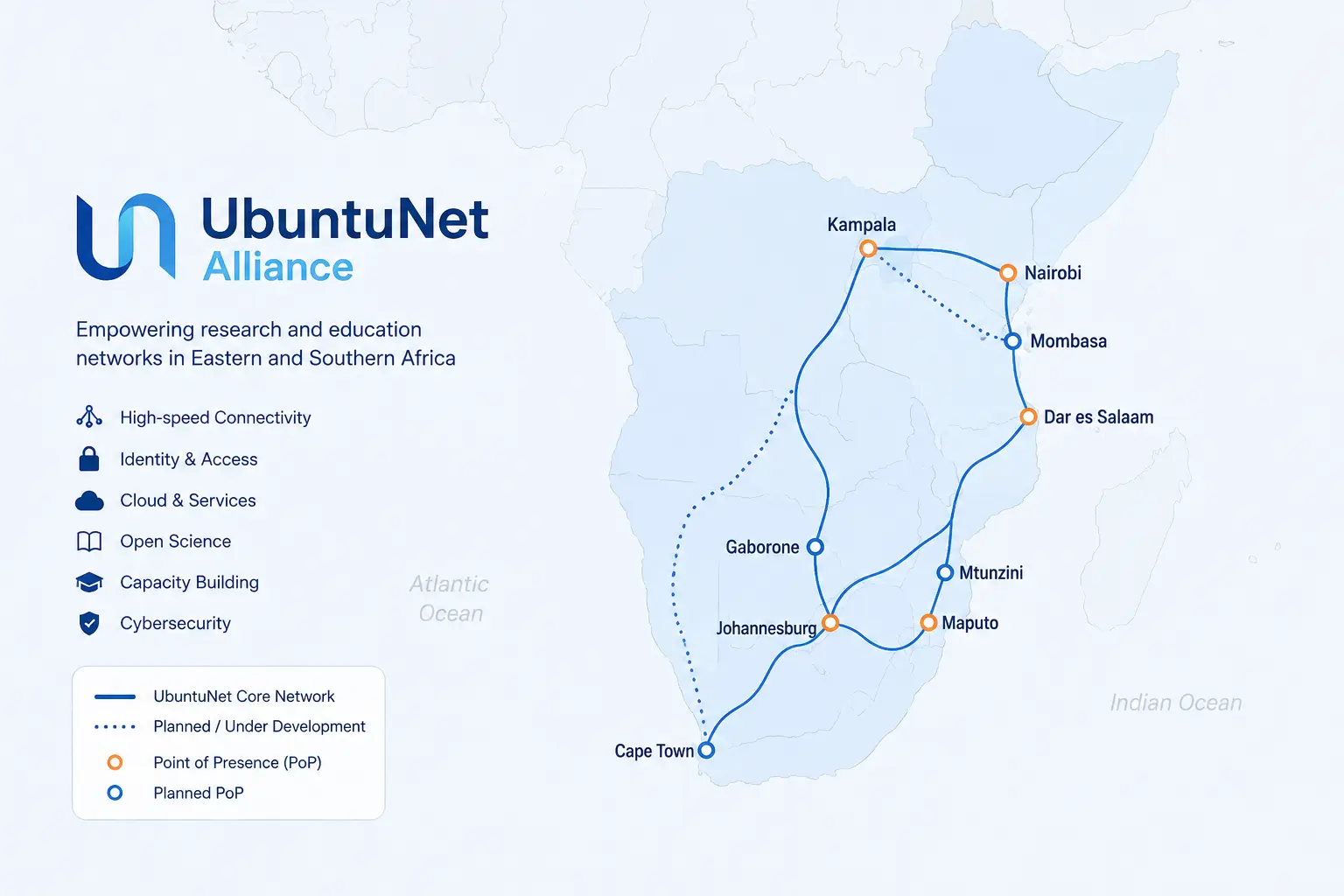
The 2023 report identifies core or important locations including Cape Town, Mtunzini, Maputo, Dar es Salaam, Nairobi, Amsterdam, Gaborone and Johannesburg. It also referred to Djibouti and Mombasa as planned or developing. Older network pages include London and a broader historical set of PoPs.
Different lists can reflect changes in carrier contracts, decommissioned sites, access handoffs, service presence or the distinction between a core router and a location at which capacity is available. A dot on a map does not prove that UbuntuNet owns the building, fibre or all equipment at the site. The network is assembled through commercial and partner infrastructure, so a current route-level asset and capacity register would be needed to make stronger ownership claims.
Peering at NAPAfrica in Johannesburg is operationally important because it can keep some traffic closer to regional content, clouds and networks and reduce avoidable transit. The result depends on which routes are exchanged and which peers are present. Exchange membership does not guarantee optimal routing for every destination. It does, however, widen the set of choices available to the Alliance and strengthens the connection between the specialised R&E environment and major southern African interconnection infrastructure.
The Lagos–Cape Town route made pan-African federation more concrete
The 2025–2026 Lagos–Cape Town development connected WACREN’s West African environment toward the South African exchange and NREN ecosystem, including ZAOXI, SANReN and TENET, and onward to UbuntuNet Alliance. The route created a direct operating relationship between African regional research networks whose inter-regional traffic had often depended on European paths.
The partners described it as the first effective direct interconnection among African regional R&E networks on African soil. The claim should remain attributed and narrowly scoped. It does not mean that Africa had no direct commercial, private or national links before the project. Its significance lies in the RREN governance and service relationship: regional research networks could exchange traffic through African infrastructure without Europe being the necessary middle point.
No single organisation owns the complete path. WACREN, UbuntuNet, SANReN, TENET, GÉANT, Sparkle and other carrier or facility partners control different segments. The route therefore advances a federated continental fabric rather than creating one centrally managed pan-African backbone. Its lasting value will depend on capacity, route diversity, use, restoration and the ability of the partners to maintain the relationship after the programme that helped assemble it.
Membership counts reveal different categories rather than one stable total
UbuntuNet’s public sources do not present one timeless membership number. The 2023 Annual Report recorded 15 active members and said the network served more than 3.5 million users at over 1,000 institutions in 13 member countries. A March 2026 internal-audit request listed NRENs from 18 countries. The current homepage displayed 16 member profiles. Lesotho was publicly welcomed in November 2025.
The differences may reflect legal membership, active membership, connected status, observer participation and the timing of website maintenance. A national network can be a member before it is fully connected; a connected NREN may serve only part of its country’s higher-education system; and conflict can constrain operations without removing legal membership. The correct editorial practice is to date and define every count rather than selecting the largest as the current truth.
The figures still demonstrate substantial reach. UbuntuNet has grown from five founding initiatives into a regional community spanning a large and diverse geography. That growth increases bargaining power and legitimacy, but it also increases coordination cost. New members may require training, identity onboarding, domestic network development and different payment arrangements. Membership is therefore both an indicator of institutional scale and a reminder that the federation’s operating conditions are not uniform.
Campus infrastructure is the decisive test of regional investment
A regional backbone can deliver 10 or 20 Gbps to a national handoff while a university remains limited by a 1 Gbps access link, an overloaded firewall, weak Wi-Fi, unreliable power or slow storage. The bottleneck can sit below the layer UbuntuNet operates, leaving expensive regional capacity underused.
This is not an argument against the backbone. It is a reason to measure the entire path and to invest at multiple layers. National NRENs need domestic fibre and capable operations. Universities need switching, wireless, security, identity and endpoints configured for long-distance high-throughput transfers. Research projects may need dedicated data-transfer nodes, parallel protocols and storage systems that can sustain the network rate.
AfricaConnect4’s stronger national and campus component reflects this lesson. Earlier phases showed that regional capacity does not automatically become research impact. A useful performance framework should track institutions actually connected behind each NREN, end-to-end loss and latency, utilisation, restoration time and application outcomes. The best regional network is not the one with the most impressive core number; it is the one whose members can turn that capacity into reliable work at the campus and research-project level.
Lilongwe governance and Kampala operations divide institutional and technical work
The Secretariat is headquartered at Golden Peacock House in Lilongwe, Malawi. Organisational and recruitment material associates the Network Operations Centre with Kampala, Uganda. The distribution is plausible for a regional body: contracts, finance, membership and strategy need not be located in the same place as continuous monitoring and technical escalation.
The Secretariat manages programme relationships, governance, budgeting and service development. The NOC monitors links and devices, responds to alarms, coordinates carriers and works with national engineers. A regional NOC can see patterns that one member cannot, particularly when an incident crosses several networks. It can also provide operational support to NRENs that cannot staff a 24-hour function independently.
Geographic separation is not itself resilience. Authority, access rights, documentation, backup communications and on-call coverage must be clear. The NOC may diagnose a domestic fault without permission to change a member router. The Secretariat may hold a supplier contract without direct control over the repair team. The operating model succeeds when each party knows who can act, what evidence must be shared and how a problem moves from observation to restoration.
Shared operations should strengthen national capability rather than replace it
Emerging NRENs often lack enough staff to monitor every link, maintain identity services, manage security incidents and negotiate with several carriers. UbuntuNet can lower this fixed cost by sharing tools, expertise, first-line diagnosis and escalation procedures.
The national network must still retain ownership of its customers, policies, equipment and domestic contracts. A regional team can identify loss, a failed BGP session or an unreachable service, but it cannot assume permanent authority over the member’s environment. If every operational skill remains centralised, a small NREN may become dependent on a regional organisation whose own workforce is limited. If the Alliance provides no shared support, the same NREN may never reach a sustainable operating level.
The most useful model is staged capability. Shared operations keep the service usable while local engineers gain access, documentation, training and experience. Responsibility then moves toward the national team as it becomes ready. This is why technical and institutional capacity building belongs inside the infrastructure story. A network is not durable merely because hardware is installed; it is durable when enough people understand how to operate, finance and recover it.
Federated identity is a second network built from institutional trust
UbuntuNet’s identity portfolio includes eduroam support, eduID.africa, eduGAIN onboarding and selected managed identity functions. These systems do not carry research data in the same way as the backbone, but they determine whether a user can reach a service without creating another account or sharing an institutional password.
The model is federated. A home institution authenticates its user and maintains the account. A national federation or roaming operator coordinates trust. UbuntuNet and partner RRENs provide regional proxies, metadata exchange, technical support and a route into global systems. The destination decides which attributes are sufficient for access. The architecture avoids one regional database containing every student’s password.
Trust remains only as strong as the participants. A stale account, weak authentication method, compromised identity provider or incorrect attribute can propagate through a technically correct federation. The regional layer therefore needs assurance practices, certificate management, incident contacts and clear metadata governance. Identity federation is not a convenience separate from networking. It is another distributed infrastructure whose failure can make an otherwise reachable research service unusable.
Eduroam turns campus identity into a mobility service
Eduroam allows a student or researcher to use home credentials at another participating institution. The visible action is a Wi-Fi login. Behind it, an authentication request may cross institutional, national, regional and global RADIUS infrastructure before returning to the visited campus.
UbuntuNet operates or supports federation-level RADIUS components for several countries and a regional proxy between national roaming operators and the global service. It can train teams and help an emerging NREN establish a national eduroam environment. The Alliance does not control every access point, realm, certificate or home account.
The distinction matters during failure. A traveller may be unable to connect because the home institution’s certificate expired, the account is stale, the visited campus configured wireless security incorrectly or a national proxy is unavailable. The user sees “eduroam is down,” while responsibility can sit at several layers. Successful roaming therefore measures the quality of the federation, not simply the existence of a regional server.
EduID.africa and eduGAIN provide a path into wider trust systems
EduID.africa is operated with WACREN and ASREN as a catch-all federation and a template for NRENs that are still developing national identity systems. It gives institutions a practical route into federated services when a mature national federation does not yet exist. EduGAIN then links national federations internationally through shared metadata and policy.
A catch-all service lowers the entry barrier but should not necessarily become the permanent home of every identity relationship. National federations can align support, assurance, language and policy with their institutions. The regional service is most useful when it accelerates that development and provides continuity while national capability grows.
The three-RREN collaboration also requires its own governance. Metadata changes, security incidents, certificate rollover and assurance differences must be coordinated across organisational boundaries. The architecture is technically distributed and institutionally negotiated. It extends access precisely because no one organisation stores or controls every identity.
Research4Life translates federation into practical access to knowledge
A Research4Life pilot launched in 2025 allowed institutions in Kenya, Malawi, Uganda and Zambia to use home credentials for remote access to scholarly resources rather than relying on shared passwords or campus IP addresses. A later follow-up reported 66 onboarded institutions in 15 countries. The count is a dated programme result, not evidence that every member institution has identical access.
The use case shows why identity belongs in an infrastructure profile. A network can deliver packets to a publisher, but the researcher still cannot use the material if authorisation is tied to one building or an insecure shared secret. Federated single sign-on links connectivity, institutional identity and content entitlement into one workflow.
The model improves accountability and can make remote research easier. It also depends on accurate institutional attributes, valid subscriptions, secure identity providers and support from the content platform. UbuntuNet influences the trust layer and onboarding process; it does not control every publisher’s licence or every university account. The benefit is real because the responsibility boundary is explicit rather than because the federation removes every dependency.
Cloud services combine regional infrastructure with commercial procurement
UbuntuNet’s cloud strategy has two distinct branches. One consists of infrastructure operated or hosted within the regional community: the UbuntuNet Open Science Cloud, file-transfer services, Drive, hosting, collaboration platforms and experimental compute. The other is a procurement and support route into commercial services, most visibly the Redington and AWS agreement announced in July 2024.
The distinction should remain explicit. A regional cloud can keep selected data, expertise and control closer to member institutions. A hyperscaler offers product breadth, geographic scale and managed services that a small RREN cannot reproduce. UbuntuNet can aggregate demand, simplify procurement and offer a trusted channel, but it does not own AWS infrastructure or determine the hyperscaler’s availability, pricing or roadmap.
The Alliance’s own cloud plans also require qualification. The 2023 report recorded a completed installation in Lusaka and equipment delivered for Kigali in early 2024, but the public record does not provide a current combined capacity, utilisation figure, tenant count or common SLA. “Installed” is not the same as a mature multi-region production cloud. Identity, orchestration, backup, security, application support and recurring funding determine whether hardware becomes a reliable service. Both cloud branches improve member choice only when data portability, jurisdiction, support responsibilities and exit costs are understood.
Research support services address ordinary friction as well as large science
Utafiti Africa is a free portal that aggregates research-funding opportunities and training. It reported more than 1,100 active users in 2024. The service does not award grants or guarantee that users receive funding. Its infrastructure role is narrower and useful: it lowers the information cost of discovering opportunities across institutions and countries.
The service catalogue also includes file transfer, collaboration, hosting and tools such as Drive, Meet or Learn. These offerings respond to practical problems faced by researchers and administrators. A temporary large-file transfer can be more reliable than email or consumer storage. A shared collaboration platform can reduce duplicate procurement among small NRENs. The maturity, operator and service level of each item nevertheless differ, and older service pages include developing or historically planned capabilities.
These tools should not be confused with a complete data-intensive-science environment. Moving a file of up to one terabyte through a convenient interface is different from sustaining flows from a telescope, sequencer or climate archive. The latter requires tuned endpoints, storage, parallel transfer, monitoring and often dedicated paths. UbuntuNet’s wider portfolio is strongest when each service has a clearly bounded use case rather than when every collaboration need is presented as evidence of a single mature cloud platform.
Open science became a second infrastructure layer
Connectivity can move a paper or dataset, but it does not make the object discoverable, citable, preserved or reusable. Many institutions still lack stable repositories, metadata practice, persistent identifiers and staff able to maintain publishing systems. UbuntuNet expanded into open science because those functions depend on the same foundations as the network: hosting, storage, identity, certificates, backup, monitoring and durable organisations.
UbuntuNet and Access 2 Perspectives began hosting AfricArXiv infrastructure in late 2023 using DSpace. AfricArXiv remains community led; the Alliance should not be described as its sole owner. UbuntuNet was also selected as the Southern Node of the Africa Open Science Platform. These roles connect a regional network operator to librarians, repositories, researchers and policy communities rather than only to routers and carriers.
The responsibility is long-term. A repository must maintain software, records, metadata, rights, security and preservation. Users need a way to export content if a partnership changes. The network can provide reachability and hosting, but curators and institutions govern what is deposited and how it is described. Open science therefore extends UbuntuNet’s mission while imposing a slower lifecycle than ordinary connectivity. A circuit can be replaced; a neglected scholarly record may be permanently damaged.
Repository stewardship and persistent identifiers require institutional labour
The Research Repository Stewardship Programme trains librarians, data stewards and repository operators. Its first Portuguese-language workshop was held in Mozambique in July 2026, showing that localisation is part of the infrastructure rather than a communications detail. A DSpace installation alone does not create a sustainable repository.
Institutions need deposit policy, metadata standards, rights processes, user support, backups, upgrades, preservation and a recurring budget. Shared or multi-tenant platforms can reduce duplication, but they also create a common failure domain. Programmes supported through the Network Adoption Fund are intended to help NRENs become capable service providers rather than leave each university to maintain an isolated server.
Persistent-identifier work adds another layer. DataCite services, DOI practice, ORCID integration and the 2026 DOCiD partnership with TCC Africa aim to make researchers, institutions, publications and datasets easier to connect. An identifier cannot repair poor metadata or guarantee preservation. The strongest role for UbuntuNet is to coordinate procurement, technical integration and regional practice while keeping global governance and local stewardship visible. These programmes are infrastructure development, not proof that every member already has a mature repository or identifier workflow.
Cybersecurity capacity is distributed across people and institutions
UbuntuNet’s security work includes regional bootcamps, in-country workshops, identity and systems training and participation in wider R&E security communities. The evidence does not establish one regional security operations centre that monitors every member. The model is closer to distributed capability: strengthen national and institutional teams, improve contacts and create common practice for escalation and response.
That approach fits the federation. Security laws, data, authority and incident procedures remain national or institutional. A regional organisation can share indicators, tools and knowledge, but it cannot automatically remediate a compromised campus device or override a domestic incident process. Common services also create their own risks. Identity proxies, repositories and shared cloud platforms need access control, logging, patching and recovery plans.
Capacity building includes finance and procurement because operational failure can begin outside engineering. The Alliance’s 2026 finance-officers programme brought participants from 15 countries. Staff must be able to budget carrier contracts, handle foreign currency, comply with grants, collect member contributions and maintain procurement controls. A router whose support contract cannot be renewed is not resilient infrastructure. Technical and administrative capability are therefore parts of the same operating system.
Governance and leadership show continuity alongside public information gaps
UbuntuNet’s documented structure places the Assembly of Members above the Board of Trustees and the Secretariat. The Assembly supplies legitimacy through the NRENs. The Board provides oversight and strategy. The Secretariat, led by the CEO, executes programmes, manages contracts and operates services. This is member governance rather than shareholder control.
Professor Madara Ogot was appointed CEO for four years effective 1 February 2022 and current 2026 material continued to identify him as CEO. A separate public reappointment notice was not found, so the current title is supported while the precise renewed term remains unresolved. Professor Hellicy Ng’ambi became the fourth Chairperson effective 1 January 2024. Miriam Chahuruva and Sabelo Dlamini were elected Trustees on 29 May 2026 for three-year terms.
The public sources do not provide one fully reconciled current Board roster after the latest election or identify every outgoing Trustee. The gap is not evidence of misconduct, but it limits external accountability. Dated lists, terms and committee responsibilities would make governance easier for members and funders to audit. The same caution applies to workforce figures: a current exact headcount was not published and should not be inferred from social platforms.
The 2023 accounts show a large mission with little financial cushion
UbuntuNet reported 2023 income of US$2,404,779 and expenditure of US$2,393,911, leaving a surplus of US$10,868. Connectivity services contributed US$1,902,318, or 79.1% of income. Network operating costs were US$928,032. The surplus was about 0.45% of income, a thin margin for an organisation carrying cross-border obligations.
The figures do not prove insolvency or failure. A not-for-profit procurement organisation can reduce its own revenue by passing savings to members. The report said connectivity income fell partly because Network 3 procurement savings were reflected in lower unit prices. That outcome advances the mission. It also leaves less room for an unexpected carrier invoice, exchange-rate movement or late payment.
Member arrears were the clearest warning. The CEO said delayed NREN operating-and-maintenance contributions severely affected the Alliance’s ability to meet obligations. Carrier and colocation invoices have fixed dates, while member payments can depend on public budgets and local currencies. A financial delay can therefore become a network incident without any fibre being cut. No later complete audited annual report was located, so current cash, assets, liabilities and reserves must not be estimated from programme announcements.
Donors, carriers, currency and conflict remain inside the operating model
UbuntuNet’s autonomy is real but conditional. AfricaConnect supplied the capital and coordination behind major network generations. Commercial carriers provide much of the physical underlay. Cloud suppliers control their platforms. Long-term contracts are commonly denominated in euros or dollars while members may collect revenue in local currency. Conflict or political instability can disrupt a national NREN even when the regional core remains healthy.
The history of RwEdNet is direct evidence of institutional fragility. The Rwandan NREN collapsed as an operating organisation in 2018 and was rebuilt by 2024. A regional route did not prevent the failure, and the later recovery required national institutional work. Membership from conflict-affected countries also cannot be treated as proof of uninterrupted campus service.
These dependencies do not make the Alliance irrelevant. They define the work it must do: diversify suppliers where practical, maintain reserves, improve national capacity, document responsibilities and avoid presenting regional sovereignty as isolation. UbuntuNet can increase control over procurement, routing, identity and service design while remaining connected to global partners and markets. The test is whether the federation creates choices and expertise rather than replacing one dependency with another opaque one.
Public evidence is strongest for programmes and weaker for current operations
UbuntuNet publishes a substantial record of programme milestones, governance decisions, member connections, training and service launches. That record is sufficient to reconstruct the organisation’s development and to identify many current responsibilities. It is much less complete when the question shifts from what was launched to how the system is performing at this moment. No public source in the research pack provides a current route-by-route asset register, multi-year availability history, complete traffic series, utilisation by link, incident database, full workforce count or audited post-2023 financial statements.
Different public datasets also measure different layers. PeeringDB’s self-reported 5–10 Gbps traffic category is not the same as UbuntuNet’s aggregate 20 Gbps core framing or a member’s 10 or 20 Gbps access circuit. bgp.tools shows directly originated prefixes and observed relationships, while the Alliance’s service reach includes routes learned from members and private connections that public collectors may not see. A point of presence can represent a router, a carrier handoff, a peering port or a broader metro service environment. None of those records alone proves end-to-end capacity or resilience.
This reporting gap should shape both journalism and management. It would be wrong to treat the absence of a public incident log as evidence that the network has never failed. It would be equally wrong to assume that every gap conceals poor performance. The defensible position is narrower: UbuntuNet’s public record is strong enough to establish the federation, major contracts, link upgrades and service portfolio, but not strong enough to calculate an independent current SLA or complete dependency map.
Better publication of service availability, restoration, utilisation, member contribution and service-adoption metrics would help members, funders and researchers judge whether programme outputs have become durable operations.
Regional autonomy is created through options, not by eliminating external dependence
UbuntuNet is often discussed in the language of African digital sovereignty. The most useful version of that idea is practical rather than absolute. The Alliance can increase regional control by aggregating procurement, keeping more research traffic on African paths, developing local engineering teams, operating shared identity and repository services and giving NRENs a collective voice with carriers, clouds and funders. It cannot make the region independent of global standards, commercial cables, equipment supply chains, hyperscale platforms or international research partners.
The relationship with WACREN, ASREN, SANReN, TENET and GÉANT illustrates the point. A pan-African R&E fabric is emerging through interconnection among separately governed regional and national systems. No single participant owns the whole path. The Lagos–Cape Town development improves the ability to exchange African research traffic without a European detour, while still depending on carriers, exchange infrastructure and coordinated routing policy. That is a gain in choice and locality, not the creation of a sealed continental network.
The same logic applies to cloud and open science. A Redington/AWS framework can improve contracting and support while increasing exposure to one hyperscaler. A regional repository can keep research outputs more visible and locally governed while depending on open-source software, persistent-identifier systems and recurring technical labour. Long-term capacity contracts can lower unit prices while binding the Alliance to supplier performance and foreign-currency obligations. Each measure strengthens autonomy in one dimension and creates or retains dependencies in another.
The strategic test is therefore whether members have credible alternatives and the competence to use them. Can a NREN change a transit supplier without losing its regional relationships? Can an institution export repository data, move a workload or retain its identity federation if a commercial agreement changes? Can the Alliance compare route performance and negotiate from evidence rather than from one provider’s claims? Autonomy grows when the answer becomes yes. It weakens when a programme replaces many fragmented dependencies with one central dependency that members cannot inspect or leave.
UbuntuNet matters because it turns separate networks into a usable research environment
UbuntuNet Alliance’s central achievement is institutional as much as technical. It allows independently governed national networks to pool demand, share operations, connect internationally and build services that would otherwise be duplicated or absent. The backbone, identity, repositories, cloud access and training are different products, but they address the same structural problem: the region gains more capability when national systems cooperate without being absorbed.
The organisation remains incomplete. Capacity is modest beside the ambitions of climate modelling, astronomy, AI and other data-intensive science. The public record is stronger on programme milestones than on current utilisation, availability and service adoption. Member finances vary. Carrier and donor dependence remain substantial. Some services are mature, others developing, and the current governance record is not perfectly synchronised.
Those limits make the profile more useful, not less. UbuntuNet is not a finished continental platform or a separate African internet. It is the shared regional layer that makes a larger system possible. Its long-term success should be judged by whether members can rely on the services, understand the costs, retain local authority, move data and identities safely, change suppliers when necessary and sustain the common layer after the programme that financed its construction has ended.