Summary
- Twilio's United States SMS page states that text messages are charged per segment and prints $0.0083 for long codes, toll-free numbers and short codes, before carrier fees.
- The same page glosses that rate as applying to a 160-character segment. The documentation page it directs readers to prints four sizes for the same unit: 160 and 153 characters under GSM-7, 70 and 67 under UCS-2.
- The six-byte concatenation header named in one guide pays for both subtractions exactly: seven GSM-7 characters at seven bits each, three UCS-2 characters at sixteen bits each.
- The 1,600 and 700 character maxima are the same 1,400 bytes printed in two widths, and a maximum-length message bills as eleven segments, not the ten its single-message arithmetic suggests.
- One character outside the GSM-7 set converts the entire message, so the same 140 visible characters cost one segment, two, or three depending on which printed limit you read.
The page that names the unit does not size it
The sentence sits in the small print of the United States pricing table: "Text messages are charged per segment." Then a pointer — "Learn more about character limits and message segments" — sends the reader somewhere else for the only number that decides what a segment is worth.
Read alone, the pricing page is coherent. Its own frequently-asked questions gloss the base rate as $0.0083 per 160-character segment across long codes, toll-free numbers and short codes, and the table lists outbound and inbound messages at the same figure. Carrier fees sit in a separate population further down, depending on destination and mobile network operator.
Nothing about that gloss is false. For the simplest case — a plain Latin-alphabet message under the limit, carried on a United States number — a segment is 160 characters and the arithmetic closes. The trouble is that the price page presents the simplest case as though it were the unit, and the unit has three other sizes.
Four numbers, one word
The character-limit glossary page opens with the cleanest possible demonstration:
"SMS transmits a 161-character, GSM-7 encoded message as two segments: one with 153 characters and a second with eight characters."
One character past the threshold, a second segment, and a second charge. The table beneath it then prints four sizes for the one billed word: 160 GSM-7 characters in a single segment, 153 per segment once a GSM-7 message is concatenated, 70 UCS-2 characters in a single segment, and 67 per segment once a UCS-2 message is concatenated. The same page gives the two maxima — 1,600 characters for a concatenated GSM-7 message and 700 for a concatenated UCS-2 one — and states that Twilio bills SMS per message segment sent.
So the unit that the price page sizes at 160 has a second size of 153 inside the same encoding, and two sizes in a different encoding entirely. Four numbers, each printed, each attached to the same noun. A reader who has been told to think in 160-character buckets has been told about a quarter of the bucket.
A header that reconciles the arithmetic
The international sending guide supplies the missing term. It explains that concatenation headers consume six bytes per message, which is why per-segment capacity falls from 160 to 153 under GSM-7 and from 70 to 67 under UCS-2.
That single sentence makes the whole table auditable, and nobody at Twilio appears to have done the division on the page. Six bytes is forty-eight bits. Divided by the seven bits a GSM-7 character occupies, that is 6.86 — which is the seven characters the table removes. Divided by the sixteen bits a UCS-2 character occupies, it is exactly three — which is what that column removes. The two subtractions that looked like arbitrary housekeeping turn out to be one header counted at each encoding's own character width.
The same guide prints the classification rule that decides which column applies, and it is worth stating plainly because it is the hinge of the whole bill: when the platform meets a character outside the GSM-7 set, it converts the encoding of the entire message to UCS-2. The GSM-7 glossary page adds the wrinkle inside the cheaper encoding — some characters, the page's examples are a brace and a bracket, need an escape character, and those escapes count as two characters in a GSM-7 message. The visible length of what you typed and the counted length of what you sent are two different quantities, and only one of them is on your screen.
One ceiling, two widths, eleven bills
The two maxima look like a contradiction. They are not, and this is the one place where the documents are more consistent than they at first appear.
A GSM-7 character is seven bits and a UCS-2 character is sixteen. Multiply the printed ceilings by their own widths: 1,600 × 7 = 11,200 bits, and 700 × 16 = 11,200 bits. Both are 1,400 bytes. The ratio between the two maxima, 1,600 ÷ 700 = 2.29, is the ratio of the two character widths, 16 ÷ 7 = 2.29, exactly. Twilio has printed one payload ceiling twice, once in each unit it bills in.
That arithmetic is mine, not Twilio's; no reviewed page prints the 1,400 bytes. But it explains a coincidence the documents leave sitting there. It also exposes what the maxima do to a bill. Each ceiling is exactly ten times its own single-segment limit — 1,600 = 10 × 160 and 700 = 10 × 70 — which is the arithmetic of somebody thinking in messages. The billing arithmetic is different. Ten concatenated GSM-7 segments hold 1,530 characters, short of 1,600; ten UCS-2 segments hold 670, short of 700. A maximum-length message therefore bills as eleven segments in either encoding.
Ten messages in the reader's head, eleven charges on the account.
The same 140 characters, one bill or three
Take a body of 140 characters, which is the sort of thing a marketing template lands on by accident. Under GSM-7 it is one segment and one charge of $0.0083. Put a single Chinese character or an emoji in it and the whole message converts, and 140 characters at 67 per concatenated segment divides to 2.09 — three segments, $0.0249, for a body the sender sees as roughly the same length.
There is a genuine conflict in the corpus at exactly this point, and I am recording it rather than smoothing it. The same character-limit page is reported as giving a 140-character message containing one non-GSM character as split into two segments. Two segments at 67 characters hold 134, which is less than the body. Two segments only work if the limit applied is the 70-character single-message limit, and that limit cannot hold a concatenated body. The retained copy is a model's reading of the page rather than the page's raw markup, so I cannot tell from here whether the example counts characters, bytes or something else. What I can say is that the document prints a 67-character concatenated limit and an example that does not follow from it, and that the difference between the two readings is one whole segment on the bill.
The count you get afterwards
The Messages resource documentation states the billing direction — "Your account is charged for each segment sent or received" — and exposes a field called NumSegments, which reports how many segments the platform used on an outbound message. The count exists. It is printed back to you, per message, after the fact.
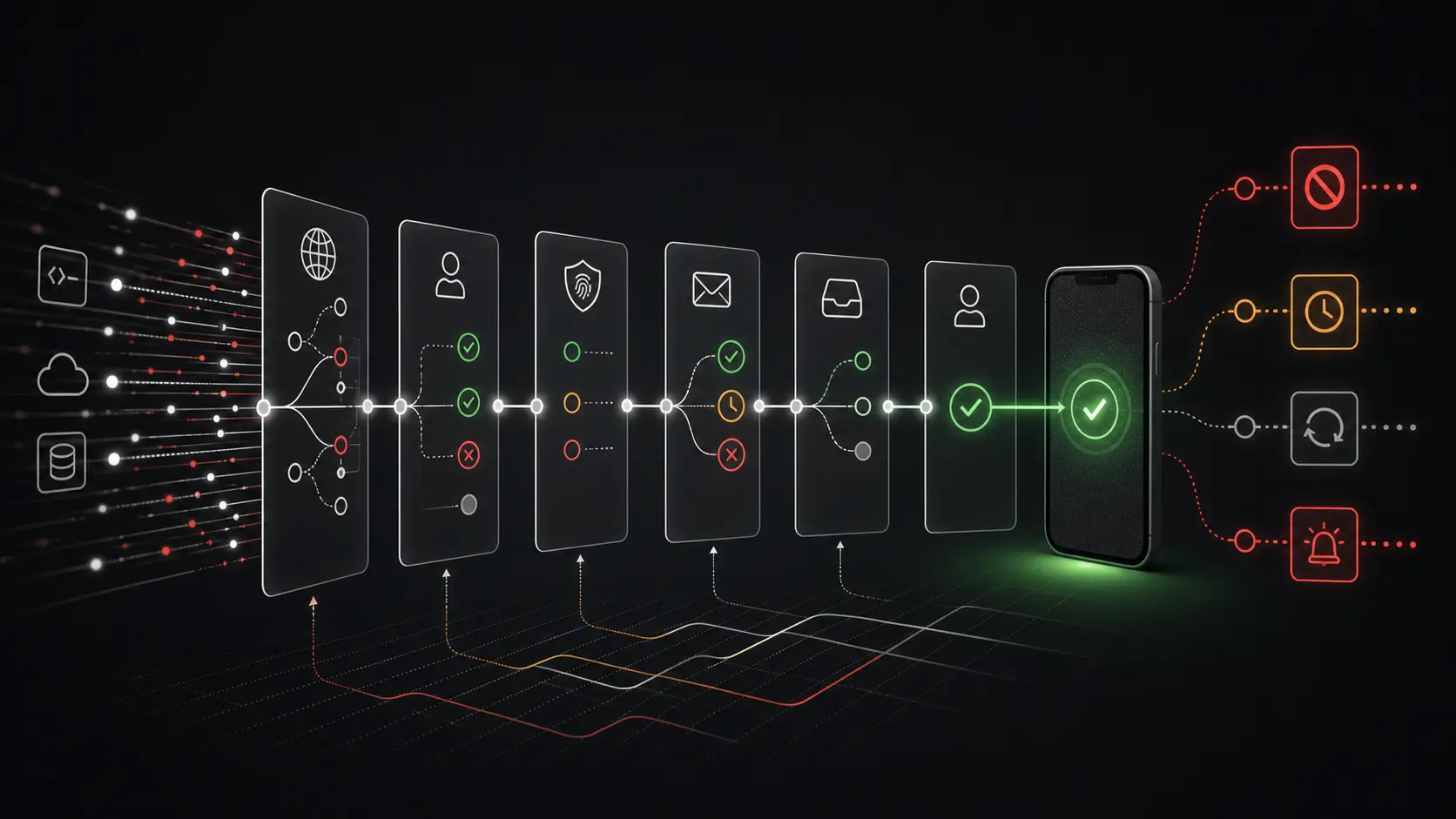
What none of the six reviewed documents does is tell the sender which encoding will be applied before the message goes out. The rule is published, and the rule is mechanical: scan for characters outside the set, and if one exists, convert everything. But no reviewed page prints a pre-send segment count, a dry-run field, or a lookup that turns a draft into a number. The customer supplies the characters; the platform supplies the classification, the segmentation and the count; and the reconciliation arrives as a field in an API response.
That is the shape of the thing. Twilio publishes the rate, the limits, the header cost, the extension-character rule and the segment count. Every term is printed. What is not printed on one page is the whole of it, and the page that carries the money is the page that says least about the unit. A messaging budget built on the 160-character gloss is not wrong for the case the gloss describes. It is simply unpriced for the case where someone on the team pastes in a curly apostrophe, a brace, or a line of Japanese.
One reading limit belongs beside these numbers. My evidence is the retained review copies of six Twilio addresses, retrieved on 21 November 2026, not the pages' raw markup, and two further addresses I asked for returned nothing usable: a documentation page on message segments answered with a 404 and a help-centre article returned no readable text. Neither is cited, and neither is evidence that anything is missing from the published corpus. The rate is the United States view; no other destination's price was read.
Sources: United States SMS pricing · How long can a message be? · What is GSM-7 character encoding? · Messages resource · Sending international SMS · SMS over 160 characters · Twilio Inc. in the BTW directory
Member Briefing
Read the full trend briefing
Members read the full briefing with the source notes behind every finding.
Strategic Circle
A daily briefing in your language, built from changes we have verified.
Join for USD 20/monthCancel anytime.
Members also get the full research library, a daily briefing on the networks they follow and the private forum.