
Summary
- What it says: TVIFIBER is not only a northern Mississippi fibre build. It is a test of whether an electric cooperative can convert the monthly trust of a utility bill, the memory of line crews after storms, and a known rural service territory into broadband take rate, lower churn, and a more d
- Main topic: Regional ISP economics; Data centre power and permitting
- Context: market / company research report / North America
The bill on the kitchen table and the line truck on the road
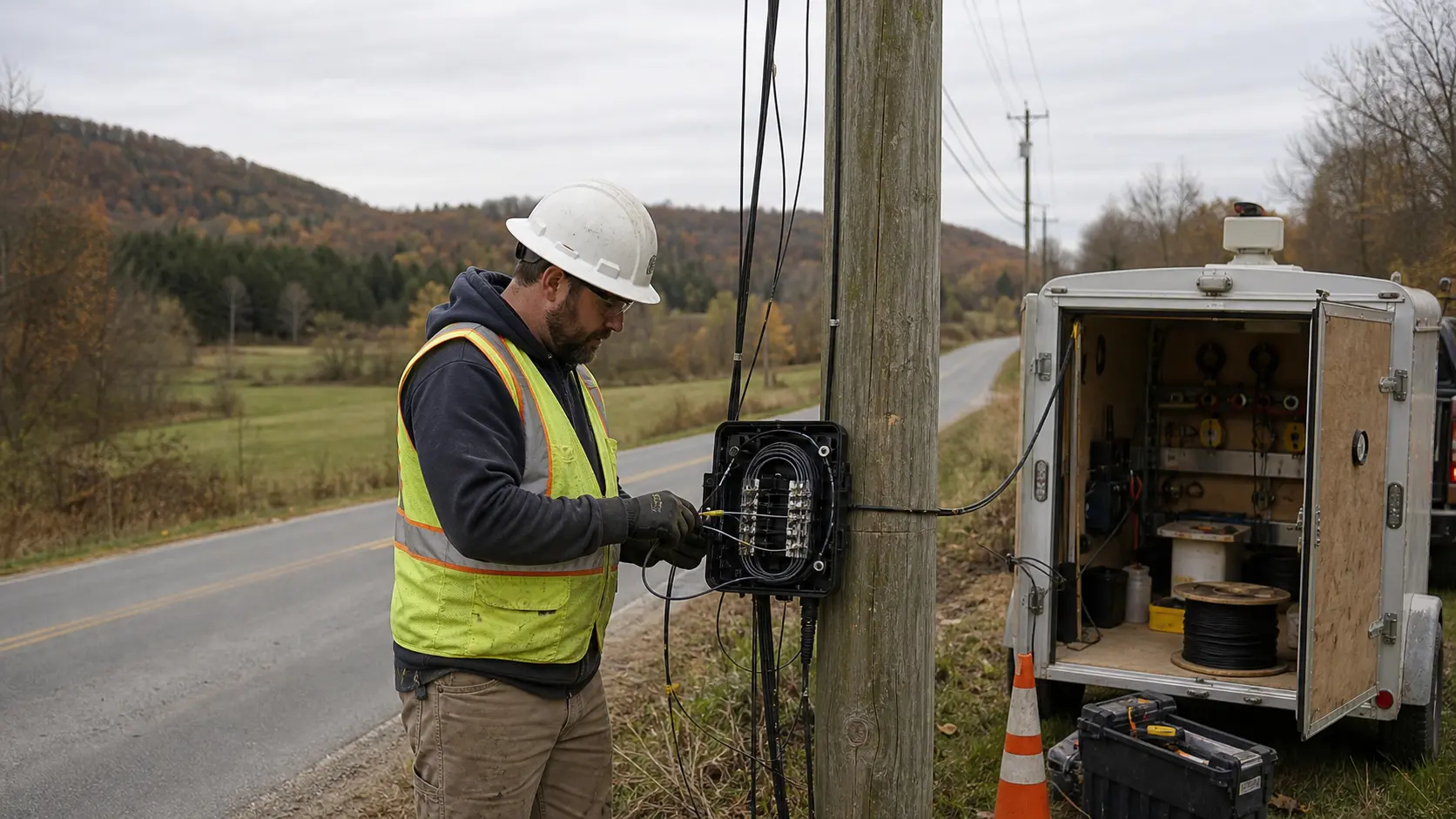
The economic story of TVIFIBER begins with a rural electric bill and a line crew, not with a speed-test graphic. A Tallahatchie Valley Electric Power Association member in Panola, Tate, Yalobusha or Grenada County already has a monthly relationship with the cooperative. The household knows where the office is in Batesville. It knows that a storm can send a red utility truck down a road where no national cable brand has a local crew waiting.
It knows that power restoration is a physical act: poles, spans, drops, transformers, rights of way, dispatch, overtime, and a crew that can find the address without asking a call center to spell the county. TVIFIBER is a broadband business built on that memory.
The load-bearing public anchor is straightforward. TVIFIBER's current product page lists a residential 300 Mbps symmetrical plan at $59.95 per month and a residential 1 Gbps symmetrical plan at $79.95 per month, with residential telephone available as a $24.95 add-on (https://tvifiber.com/products-and-pricing/). Its FAQ says all internet packages are unlimited, that the initial ONT and router equipment required for service are not separately charged, that all Tallahatchie Valley Electric Power Association members have access, and that TVIFIBER bills are separate from electric service (https://tvifiber.com/frequently-asked-questions/). The same operating surface gives the customer a concrete choice: keep paying for a legacy cable, DSL, satellite or wireless substitute, or buy a cooperative-linked fibre service whose price is close enough to the household's existing utility rhythm to feel like infrastructure rather than a luxury.
The cooperative footprint gives the price meaning. Zyxel's customer story says Tallahatchie Valley Electric Power Association is headquartered in Batesville, has more than 28,000 meters and more than 22,000 members, and operates over 5,000 miles of electric lines across very rural service areas reaching toward the Mississippi Delta (https://www.zyxel.com/service-provider/na/en/customer-stories/tvepa). TVIFIBER's own network disclosure says broadband service is delivered over the parent cooperative's fibre optic system, with cable brought past each home and business and a fibre drop built from the street to a subscribing premise where access is granted (https://tvifiber.com/net-neutrality-disclosure/). That is the operating fact behind the customer proposition. The company is not only buying wholesale access and reselling a plan. It is using an electric-utility route system to put communications plant along roads where the marginal economics of a standalone cable upgrade or private overbuild often looked weak.
Public subsidy lowered the initial capital burden but did not remove the need for retail discipline. TVIFIBER's April 2021 release says Tallahatchie Valley participated in the FCC's Rural Digital Opportunity Fund Phase I auction and was awarded $20,170,000 to make high-speed internet access and telephone service available to almost 8,700 homes and businesses in Panola, Tate, Yalobusha, Tallahatchie, Quitman, Grenada and Lafayette counties; it also says the Mississippi Public Service Commission approval made Tallahatchie Valley Internet Services an Eligible Telecommunications Carrier for the funds (https://tvifiber.com/news/april5/). The FCC's Auction 904 page says the nationwide Phase I auction allocated about $9.2 billion over ten years to more than 5.2 million unserved homes and businesses (https://auctiondata.fcc.gov/public/projects/auction904). Subsidy explains why a rural project can start. It does not prove that the project can keep customers once every household has a new option.
That distinction is the company thesis. TVIFIBER has to convert the cooperative's trusted physical presence into broadband retention. A $59.95 plan is only a contribution margin if the household stays, pays, calls the right number during an outage, and does not churn to a promotion from a cable, mobile, satellite or fibre rival. A rural fibre drop is only a long-lived asset if enough customers on the road subscribe and keep subscribing.
A field crew is only an advantage if dispatch discipline sends the right worker to the right problem: electric fault, fibre mainline cut, damaged service drop, ONT power issue, router problem or customer premise wiring. The cooperative model can reduce acquisition cost and strengthen trust, but it also makes broadband failure more personal. If the internet fails after the customer believed the utility promise, the disappointment lands on the same local institution that collects the power bill.
Identity, footprint and the cooperative conversion
TVIFIBER is the trade-facing broadband brand for Tallahatchie Valley Internet Services, LLC, a wholly owned broadband subsidiary associated with Tallahatchie Valley Electric Power Association. The company's Lifeline compliance summary identifies TVIS as a Mississippi limited liability company at 250 Power Drive in Batesville, doing business as TVIFIBER, beginning broadband and VoIP operations in 2019, and being authorized as an Eligible Telecommunications Carrier in Mississippi in 2021 (https://tvifiber.com/wp-content/uploads/2022/06/TVIS-Summary-Lifeline-Compliance-Plan.pdf). The same filing says TVIS is wholly owned by the rural electric cooperative, which received its certificate of incorporation in 1937 and began providing electricity two years later. That history matters because the broadband brand is selling continuity with rural electrification rather than novelty.
The public service area is broader than one town but still local enough for route economics to dominate. TVIFIBER says it owns and maintains fibre infrastructure connecting homes and businesses in and around Batesville, Sardis, Grenada, Senatobia, Water Valley and Holly Springs, with a service area spanning the Tallahatchie Valley region and communities in Panola, Tate, Marshall, Grenada and Yalobusha Counties (https://tvifiber.com/about-tvifiber/). Its communities page lists service or target communities across Panola, Tate, Yalobusha, Grenada, Quitman, Tallahatchie, Calhoun, Lafayette and Tunica Counties (https://tvifiber.com/communities-we-serve/). The footprint is not a dense metropolitan grid. It is a rural and small-town service map where the cost of passing a premise is shaped by road miles, pole condition, easements, tree exposure, truck time and the density of subscribing households.
The origin story shows why the electric cooperative moved into broadband. The Sun-Sentinel reported in August 2019 that Tallahatchie Valley Internet Services, using the TVI-Fiber trade name, had been formed after Mississippi changed the law to allow electric power associations to provide broadband; the report said TVEPA expected a 48-month buildout, ordered more than 380 miles of fibre optic cable for phase one, would own and maintain the infrastructure as part of smart-grid capability, and would not assess members a fee to fund broadband deployment or require them to subscribe (https://www.tallahatchienews.ms/news-front-page-slideshow/tvepa-creates-new-broadband-company-offer-high-speed-internet). Community Networks reported the same development as part of a Mississippi shift that allowed co-ops to address broadband gaps after earlier legal constraints (https://communitynetworks.org/content/tallahatchie-valley-electric-power-will-connect-rural-northern-mississippi).
The policy opening is important, but the business model is not guaranteed by statute. Electric cooperatives have a natural starting advantage because they already hold rights, billing identities, outage workflows and local legitimacy. They also face a hard accounting problem. Rural fibre has high upfront cost, and every mile of plant must be justified by a mix of utility modernization, grant support, broadband revenue and expected retention. In an urban build, a provider may pass dozens of dwellings on a short route.
In Tallahatchie Valley territory, a mile may pass a few farms, churches, houses, crossroads businesses, or seasonal connections. The cooperative can make a better social case than an investor-owned entrant, but it still needs enough take rate to carry electronics, backhaul, customer support, pole work, splicing, drops, CPE replacement and storm restoration.
TVIFIBER's product design reflects that tension. Residential plans are simple: 300 Mbps and 1 Gbps symmetrical fibre, unlimited data, no residential contract language in public pages, no separate initial ONT/router charge, and phone as an add-on. Business plans move the price ladder sharply upward: Business Lite at 200 Mbps for $99.95, Business Pro at 500 Mbps for $199.95, and Business Enterprise at 1 Gbps for $399.95, with business voice at $29.95 (https://tvifiber.com/products-and-pricing/). That spread is economically rational. Residential customers bring volume and community legitimacy. Small businesses, clinics, stores, farms, municipal offices and professional services bring willingness to pay for reliability, support, static addressing or voice continuity, even when the public page does not expose every enterprise term.
The route economics: poles, drops, take rate and repair cost
The central cost advantage is that TVIFIBER's parent already understands the pole route. A rural electric cooperative has asset maps, crew familiarity, vegetation exposure, right-of-way routines, storm experience and a reason to visit the same roads even if a broadband customer has not called. That does not make fibre cheap. It changes the cost stack.
The cooperative can combine some design knowledge and field logistics with a broadband build, but it still has to attach strand, place fibre, handle make-ready work, splice, test light levels, install ONTs, provision routers, support Wi-Fi, manage voice, and restore service after wind, ice, vehicle damage or trees interrupt the network.
TVIFIBER's Water Valley expansion page makes the construction sequence unusually visible. It describes engineering surveys, infrastructure review and make-ready work to prepare existing poles, fibre deployment, splicing, light-level testing, and then customer installation scheduling (https://tvifiber.com/tvifiber-hosts-community-forum-in-water-valley-shares-updates-on-broadband-expansion/). That sequence is not marketing ornament. It is the unit-economics stack. Every route segment has a design cost before revenue, a physical attachment or underground cost before activation, and a customer-drop cost that only pays back if the service remains active long enough. A cooperative can know which roads are worth building earlier, but it cannot avoid the time value of money on plant that may wait months or years for enough subscribers.
The public records also show how grant and route decisions interact. BEAM's 2025 annual report says Mississippi's Capital Projects Fund program made more than $154 million in preliminary and final determinations, with infrastructure funds to be spent by December 31, 2026. In the project tables, Tallahatchie Valley Internet Services appears with a Yalobusha County project of 811 locations and $3,804,700 marked more than 50 percent complete, and with Panola County and Tate County projects listed in planning and design with 735 locations for $3,190,383 and 1,073 locations for $4,937,172, respectively (https://www.beam.ms.gov/sites/beam/files/BEAM%20Annual%20Report%202025.pdf). Those figures are useful because they are small enough to show the real rural arithmetic. A few million dollars can move a county project, but it does not create infinite margin. The operator still needs recurring revenue, low churn and disciplined maintenance.
The approximate subsidy-per-location figures are revealing even without treating them as full project cost. The Yalobusha award shown in the BEAM report is about $4,691 per listed location. The Panola project figure is about $4,341 per listed location. The Tate project figure is about $4,601 per listed location. At $59.95 per month, a residential 300 Mbps customer pays $719.40 per year before tax and add-ons; at $79.95, the 1 Gbps customer pays $959.40 per year. That is gross retail revenue, not contribution margin.
Backhaul, support labour, CPE, billing, pole maintenance, make-ready, repair, bad debt, customer care, power, electronics depreciation and overhead all come out before payback. The simple arithmetic shows why take rate and retention matter more than any one launch headline.
The customer-drop decision is equally important. TVIFIBER's network disclosure says TVEPA builds a fibre drop from the street to any home or business that purchases service where access is granted, while noting that not all apartment and multi-tenant buildings allow access (https://tvifiber.com/net-neutrality-disclosure/). A drop is a capital action tied to a specific customer. If the customer leaves after a promotion, moves, fails to pay, or becomes unhappy with support, the project has stranded part of its customer-specific investment. This is where the electric cooperative's existing relationship can improve the economics. A household that trusts the cooperative may have lower acquisition cost and lower churn than a household acquired by a national online promotion. But trust must be maintained through installation, billing and repair.
The household choice: price, trust, dispatch and overbuild risk
By the middle of the analysis, the question should feel like a kitchen-table decision. A rural household sees TVIFIBER's $59.95 300 Mbps plan and $79.95 gigabit plan. It may also see satellite, mobile fixed wireless, legacy DSL, cable in town, C Spire fibre in some Mississippi areas, MaxxSouth in Water Valley, or AT&T-branded options depending on the address. C Spire's public home-services page has advertised a 1 Gbps fibre offer at $65 per month in select areas, with a wireless bundle discount and price-lock language (https://www.cspire.com/home-services/). T-Mobile's 5G Home Internet page shows home-internet plan pricing starting at $50 per month with AutoPay, or lower with a voice-line bundle, subject to availability and network conditions (https://www.t-mobile.com/home-internet/plans). Viasat has promoted satellite plans beginning at $39.99 for an introductory period and higher thereafter (https://www.viasat.com/satellite-internet/plans/). AT&T Internet Air is marketed as a fixed-wireless home internet option with a simple monthly price where available (https://about.att.com/pages/internet-air). None of those substitutes is identical to a local symmetrical fibre drop, but each can affect the customer's willingness to wait, pay or switch.
Overbuild risk is not only a competitor trenching next to TVIFIBER's fibre. It is any credible substitute that weakens the cooperative's take rate below the level needed to amortize the route. A fixed-wireless promotion can pull light-use households that mostly stream and browse. Satellite can serve remote premises before a fibre phase reaches them. A cable incumbent can lower introductory pricing when the cooperative build gets serious. A national mobile bundle can make the broadband line feel like part of a bigger discount. A second fibre provider in a small town can turn a once-protected route into a price fight. The Sun-Sentinel's 2019 report already noted TVEPA leadership saying competitors were lowering introductory pricing and trying to lock customers into longer contracts as the cooperative moved toward launch (https://www.tallahatchienews.ms/news-front-page-slideshow/tvepa-creates-new-broadband-company-offer-high-speed-internet).
TVIFIBER's counter is not only speed. It is the combination of fibre pricing, pole-route familiarity, power-utility trust, and local repair accountability. A small business in Water Valley does not evaluate broadband solely by peak download speed. It asks whether card terminals, cloud software, security cameras, VoIP, payroll, reservations, online ordering and remote backups will work on the day after an ice storm. A household with remote work asks whether upload speed and latency will hold during school, video calls and evening streaming.
A farm or home business asks whether the provider can find the road and whether customer support understands the difference between a customer router reboot and a broken drop. In those use cases, a $10 monthly price difference can matter less than the expected cost of downtime.
This is where repair dispatch becomes strategy. TVIFIBER warns customers not to report internet outages through the TVEPA electric outage system because doing so can cause unnecessary electric-truck rolls and delay internet and telephone restoration (https://tvifiber.com/). Its outage page says TVIFIBER does not use an online portal or map for outage reporting; subscribers must call tech support, receive guided troubleshooting, and get a ticket number. During storm restoration, the page tells customers to call if they see physical damage to their specific line, but if no visible damage exists, the issue is likely a mainline repair already in progress (https://tvifiber.com/reporting-outages/). That public instruction is an unusually direct window into operating economics. The cooperative has a powerful field organization, but broadband and electric dispatch cannot be allowed to blur.
The risk is obvious. If a broadband outage is reported as an electric outage, an electric crew may roll unnecessarily. If a mainline fibre break causes many internet outages, hundreds of individual calls can overload support and create duplicated truck work. If a customer's ONT is unpowered because the house lost electricity, a network technician cannot restore service until power is available. If a service drop is physically damaged, a mainline splice will not fix the individual premise. The cooperative advantage is that TVEPA and TVIFIBER can coordinate field reality.
The cost risk is that each misrouted call consumes labour, delays restoration and erodes trust.
Network evidence and upstream dependency
TVIFIBER has public network evidence consistent with an operating broadband provider rather than a thin brand. BGP.Tools lists Tallahatchie Valley Internet Services, LLC as AS55120, with the TVIFIBER AS name, registered in January 2020, active under ARIN, with originated IPv4 prefixes and observed upstreams including MS Fiber and Hurricane Electric in the current view (https://bgp.tools/as/55120). Hurricane Electric's BGP Toolkit lists AS55120 as Tallahatchie Valley Internet Services, LLC, with country of origin United States, two IPv4 originated prefixes in its view, and observed IPv4 peers including Hurricane Electric and Cogent (https://bgp.he.net/AS55120). These views are dynamic observations, not contracts. They still show that TVIFIBER has routing presence and public internet-number resources to manage.
The upstream dependency is material. A rural fibre operator can own the last-mile route and still depend on upstream capacity, internet exchange or transit terms, regional middle-mile partners, router capacity, DNS and security operations. If the last-mile plant is strong but backhaul is expensive or underprovisioned, the customer sees congestion or outage. If a rural network depends heavily on one regional route during a storm, a separate fibre cut can matter as much as the local drop. If public peering or transit changes, the end user will not know why a video call stutters.
The brand promise remains local, but the service is a chain of local plant, electronics, transport, routing, traffic management and support.
The supplier record also extends to customer-premises equipment. Zyxel's public case study says TVEPA selected Zyxel Wi-Fi gateways and remote-management features, including TR-069/TR-181 capabilities, as part of the TVI Fiber rollout; it explicitly ties remote management to reducing truck rolls and improving customer satisfaction (https://www.zyxel.com/service-provider/na/en/customer-stories/tvepa). That is not a minor procurement detail. In a rural service territory, every avoidable truck roll matters. If customer support can diagnose Wi-Fi, router, ONT or device problems remotely, the operator protects margin and restores service faster. If poor Wi-Fi inside the home is misread as a fibre problem, the operator may roll a technician to solve what a remote management tool could have identified.
The network-management disclosure says TVIFIBER does not currently employ a formal congestion management practice beyond network monitoring, given current bandwidth capacity, but reserves the right to do so in the future and says it designs and manages the network for high-quality service (https://tvifiber.com/net-neutrality-disclosure/). That phrasing is common in broadband disclosures, but it gives analysts the right watchpoint: as take rate rises and 1 Gbps usage grows, the pressure moves from passing homes to managing busy-hour throughput, backhaul, PON split ratios, core routing and support expectations. The early success of a fibre build can create the next cost wave.
Revenue, support labour and the economics of local service
The revenue model is cleaner than the cost model. TVIFIBER sells residential fibre, residential telephone, business fibre, business voice and app-based home network management. The Google Play listing for TVIFIBER My Net describes parental controls, device priority, guest networks and network usage visibility, with app support tied to TVIFIBER contact information and Tallahatchie Valley Electric Power Association developer identity (https://play.google.com/store/apps/details?id=com.tvifiber.smarthome&hl=en_US). These features help the company compete against national broadband bundles that market home Wi-Fi, security and device management. They also shift some support burden into software, if customers adopt the tools.
The business plan tier is where the economics may improve most. A $399.95 per month 1 Gbps Business Enterprise plan produces nearly five times the revenue of the $79.95 residential gigabit plan (https://tvifiber.com/products-and-pricing/). That difference can pay for more attentive support, service customization and higher expected traffic or voice needs. But it also raises expectations. A small office paying $199.95 or $399.95 expects something more durable than best-effort residential service. The public Water Valley page says business services are customized and have guaranteed support when needed (https://tvifiber.com/tvifiber-hosts-community-forum-in-water-valley-shares-updates-on-broadband-expansion/). The operational test is whether the company can make those assurances concrete in response times, escalation, credits and communication during outages.
Support labour is both a differentiator and a cost center. TVIFIBER's about page says the local team offers service packages, equipment, installation and 24/7 support (https://tvifiber.com/about-tvifiber/). The outage page tells subscribers to call tech support rather than use a portal. The FAQ requires a valid email address to schedule installation and describes online registration, product selection, available install dates and verification (https://tvifiber.com/frequently-asked-questions/). This model works when the support organization stays ahead of call volume. It becomes expensive when installation questions, billing confusion, storm restoration calls, router troubleshooting and commercial escalations all converge on the same small local team.
The cooperative can reduce some support cost by starting with known members. Address qualification is easier when the electric service territory is known, and brand trust can shorten the sales cycle. But the separation of electric and broadband billing matters. The FAQ says the fibre bill is separate from electricity. TVEPA's own payment pages show the electric side's existing customer-service routines: online payments, phone payments through PAL, drafts, mail, main-office payments, a drop box and Pay-Go options at participating stores (https://tvepa.com/billing-payments/ways-to-pay/). A broadband customer may expect the same frictionless local payment culture, even if TVIFIBER uses a separate broadband account platform. Any mismatch between the electric-bill habit and the fibre-bill process becomes a churn risk.
The residential electric rate schedule also gives the household context. TVEPA lists a billed residential customer charge of $29.60 per month after a hydro allocation credit, plus an energy charge of 8.026 cents per kWh and a Tennessee Valley Adjustment of 2.573 cents per kWh (https://tvepa.com/billing-payments/residential-rate-schedule/). The broadband bill is therefore not an abstract telecom line. It sits next to a real utility budget in a region where monthly cost discipline matters. A $59.95 internet line can be viewed as essential infrastructure, but only if reliability and support justify the recurring expense.
Regulation, subsidy obligations and public accountability
TVIFIBER's regulatory profile is a core part of its economics. ETC designation allows participation in federal support programs and imposes obligations around voice, Lifeline, service quality and customer responsibilities. The Lifeline compliance summary says TVIS would provide supported services using its own facilities or a combination of its own facilities and resale of another carrier's services, and would provide access to emergency services via E-911 (https://tvifiber.com/wp-content/uploads/2022/06/TVIS-Summary-Lifeline-Compliance-Plan.pdf). For a rural broadband provider, the voice and public-safety layer is not a decorative legacy add-on. It is part of the universal-service compact that helped finance the build.
RDOF also creates deployment milestones and reputational obligations. Winning support for almost 8,700 locations is a commitment to reach places that were previously unserved or underserved, not only to win easy customers near town centers. The FCC's RDOF program uses long-form review, letters of credit, deployment milestones and support disbursement over time. The more rural the route, the more the subsidy is tested against make-ready cost, labour availability, equipment timing, permitting, weather and actual demand.
If the company meets milestones and earns durable take rate, the public support looks like a productive infrastructure intervention. If take rate is weak, overbuild challenges intensify, or support costs run hot, subsidy may have solved construction but not long-run economics.
The state grant layer adds similar pressure. BEAM's 2025 annual report says Mississippi had all remaining unserved locations funded and slated to be built out, and it describes BEAD, Capital Projects Fund and Broadband Infrastructure Program activity (https://www.beam.ms.gov/sites/beam/files/BEAM%20Annual%20Report%202025.pdf). TVIFIBER's Water Valley post says the company remained committed to expansion despite uncertainty in grant funding and had begun serving first residents in Water Valley outside the traditional TVEPA footprint (https://tvifiber.com/tvifiber-hosts-community-forum-in-water-valley-shares-updates-on-broadband-expansion/). That phrase, "outside the traditional footprint," is economically loaded. It means the cooperative may be moving from pure member conversion toward adjacent-community expansion, where trust is still local but less automatic.
Regulation also shapes competitive boundaries. Mississippi's legal change made electric-cooperative broadband possible, but it did not shield TVIFIBER from national carrier bundles, cable response pricing or mobile fixed-wireless substitution. Grant maps and public funding can also attract challenges from incumbents who claim an area is already served. The Water Valley local press and TVIFIBER's own post indicate that grant uncertainty and community involvement have been part of the expansion environment.
The cooperative advantage may therefore depend not just on construction skill, but on regulatory evidence, address data, local advocacy and the ability to prove that a route remains underserved despite claims from existing providers.
Unofficial signals: customer satisfaction, outages and complaint risk
Unofficial market signals should not be treated as audited operating data, but they are useful where the business thesis depends on trust. ISP Reports shows only three TVI Fiber reviews in its TVI Fiber page, with an overall fibre rating of 4.67 out of 5 and individual comments split between praise for fast rural restoration and concern about outages, billing notices and small credits (https://ispreports.org/internet-service-providers/tvi-fiber-reviews/). InMyArea's TVI Fiber page says the provider offers fibre internet to an estimated 17,796 homes, no installation fee, and the same $59.95 and $79.95 residential plan prices, while carrying the site's usual caveats about availability and changing terms (https://www.inmyarea.com/provider/tvi-fiber). These third-party pages are imperfect, commercial comparison surfaces. They still show the themes a rural household weighs: price, installation, outage handling and whether the provider feels reachable.
Social and outage posts add a more concrete operating signal. TVIFIBER's own public site warns that reporting internet outages through the electric system creates unnecessary electric crew work and delays internet restoration. The outage guide explains when customers should call and when mainline restoration is likely underway. A 2022 Facebook-indexed outage item says storms damaged parts of both TVEPA and TVIFIBER infrastructure and that TVIFIBER continued repairs, with customers asked to call if service had not been restored (https://www.facebook.com/tvifiber/posts/the-storms-that-crossed-over-the-state-yesterday-41322-damaged-portions-of-the-i/822283529174828/). A 2026 North Mississippi Herald story on Winter Storm Fern says the storm crippled the regional power grid and that full power restoration closed one of the cooperative's major outage events (https://www.yalnews.com/2026/02/19/county-power-fully-restored-after-fern/). These signals do not prove broadband quality. They show why the field-service model is central.
The customer-retention value of the cooperative footprint depends on what happens in those stressful moments. A rural subscriber may forgive an outage caused by ice, trees or a regional transport cut if the cooperative communicates clearly and restores service quickly. The same subscriber may churn if support credits feel insulting, if bills arrive without warning, if no one can explain whether the problem is electric power, a fibre drop, a router or a mainline splice, or if a competitor promises a lower price with a gift card. In rural broadband, churn is often emotional before it becomes financial.
The customer remembers the provider that answered after the storm.
Competitors and substitutes: what can change the household decision
TVIFIBER's competitive set differs by address. In Batesville or Water Valley, a household may see AT&T, EarthLink, MaxxSouth, T-Mobile Home Internet, Verizon fixed wireless, satellite providers, or smaller local options on comparison pages. Water Valley's provider comparison pages list AT&T, Starlink, Viasat, T-Mobile, MaxxSouth, TVI Fiber and others as possible providers depending on location (https://www.inmyarea.com/internet/mississippi/water-valley). MaxxSouth markets Water Valley service directly (https://www.maxxsouth.com/watervalley). C Spire is a major Mississippi fibre competitor in selected markets, even if not every Tallahatchie Valley address sees it. Satellite and fixed wireless matter most where fibre has not reached the premise or where a household values immediate self-installation over symmetrical performance.
The competition is not purely about nominal speed. TVIFIBER's 300 Mbps symmetrical plan can beat many wireless and satellite substitutes on upload and latency even if a competitor advertises a lower entry price. A cable provider may match or exceed download speed, but upstream performance, data terms, promotional expiration and support reputation can change the decision. A mobile fixed-wireless product can be cheaper and easy to install, but tower congestion and in-home signal variability can make it less reliable for business or remote work.
Satellite can reach remote premises, but latency, weather, equipment cost and service-plan changes remain considerations. A second fibre provider may be the most serious threat because it can attack TVIFIBER's core performance claim while using national promotion tactics.
The cooperative response should be segmentation, not one generic promise. For remote households, the pitch is essential infrastructure: fibre where other providers did not build. For small businesses, the pitch is accountable uptime, upload capacity, voice and local escalation. For existing TVEPA members, the pitch is trust and physical route knowledge. For adjacent communities such as Water Valley, the pitch is proof that the cooperative can extend beyond its original footprint without losing service discipline.
For price-sensitive households, the pitch must be transparent monthly cost, no data cap, no initial equipment fee and no contract surprise. Each customer group has a different churn trigger.
Overbuild can also be beneficial if it forces quality. If TVIFIBER faces a cable or fibre rival in town, it must keep support tight and pricing credible. If no rival exists in the deepest rural areas, the company still has to avoid behaving like a monopoly because the cooperative's legitimacy is part of its asset base. Local broadband resentment can damage the parent utility's reputation. The best cooperative broadband businesses understand that customer goodwill is not a slogan; it is a balance-sheet asset that reduces acquisition cost, bad debt, complaints and churn.
The payback question: how a cooperative broadband build becomes durable
A rural fibre project pays back through a series of small successes rather than one large event. First, the provider must pass enough locations at a survivable capital cost. Second, it must convert enough households and businesses quickly after the route goes live. Third, it must keep truck rolls, support calls and CPE failures within the expected range. Fourth, it must buy or build enough backhaul and routing capacity for peak-hour use without overpaying for idle capacity. Fifth, it must keep churn low when competitors discount. Sixth, it must protect the cooperative's public trust during storms, billing problems and expansion disputes.
TVIFIBER has evidence on several of those fronts. The cooperative parent brings field knowledge and a trusted member relationship. The product page shows simple residential and business pricing. The network disclosure indicates owned parent-cooperative fibre routes past homes and businesses. RDOF and BEAM records show public support for high-cost areas. BGP records show a real routed network presence. The Zyxel case study shows attention to managed customer equipment and truck-roll reduction. The outage pages show that management understands the risk of misdirected dispatch.
Water Valley expansion shows willingness to grow beyond the original service area despite grant uncertainty.
The weaknesses are mostly about missing public data. TVIFIBER does not publish active subscriber count, take rate by route, churn by cohort, gross margin by residential and business product, support-ticket volume, mean time to repair, outage credits, backhaul cost, pole attachment cost, make-ready backlog, drop cost or customer-acquisition cost. Without those numbers, an external analyst cannot know whether the $59.95 and $79.95 plans are producing attractive contribution margin or simply filling publicly supported plant. The same uncertainty applies to business service.
The $399.95 enterprise plan looks attractive, but the number of business subscribers and service obligations are not public.
The key diligence file would be a route-level cohort table. It would show each fibre phase, number of passings, grants assigned, capital spent, make-ready cost, drops installed, active subscribers, plan mix, business accounts, average revenue per user, churn, outages, truck rolls, support contacts and gross margin. That file would answer whether the cooperative bill and line crew are translating into economics, not only good will. It would also show where overbuild risk is highest: roads with low take rate, towns with cable alternatives, business districts with multiple providers, and adjacent communities where TVEPA trust is less inherited.
Evidence register
The strongest identity evidence is TVIFIBER's FAQ, about page and Lifeline compliance summary. Together they identify TVIFIBER as the broadband service of Tallahatchie Valley Internet Services, tied to Tallahatchie Valley Electric Power Association, operating from Batesville, offering broadband and VoIP, and serving cooperative members and surrounding communities (https://tvifiber.com/frequently-asked-questions/, https://tvifiber.com/about-tvifiber/, https://tvifiber.com/wp-content/uploads/2022/06/TVIS-Summary-Lifeline-Compliance-Plan.pdf).
The strongest price and customer-offer evidence is TVIFIBER's products and pricing page, residential gigabit disclosure, FAQ and outage instructions. These support the $59.95 300 Mbps plan, $79.95 1 Gbps plan, business plan ladder, unlimited-data language, no initial equipment charge, separate electric and fibre bills, call-based outage reporting and storm-restoration guidance (https://tvifiber.com/products-and-pricing/, https://tvifiber.com/products-and-pricing/residential-1-gig/, https://tvifiber.com/frequently-asked-questions/, https://tvifiber.com/reporting-outages/).
The strongest route and construction evidence is TVIFIBER's network disclosure, communities page, Water Valley expansion page, The Sun-Sentinel's 2019 formation report and Zyxel's case study. These support the parent-cooperative fibre system, service counties, construction sequence, early phase-one fibre order, expected buildout period, smart-grid relationship, CPE strategy and truck-roll-reduction rationale (https://tvifiber.com/net-neutrality-disclosure/, https://tvifiber.com/communities-we-serve/, https://tvifiber.com/tvifiber-hosts-community-forum-in-water-valley-shares-updates-on-broadband-expansion/, https://www.tallahatchienews.ms/news-front-page-slideshow/tvepa-creates-new-broadband-company-offer-high-speed-internet, https://www.zyxel.com/service-provider/na/en/customer-stories/tvepa).
The strongest public-funding evidence is TVIFIBER's RDOF release, the FCC Auction 904 page, the Mississippi Public Service Commission note on TVIS's ETC filing, and BEAM's 2025 annual report. These support the $20.17 million RDOF award, the nearly 8,700 homes and businesses cited by TVIFIBER, the legal ETC pathway, and later state project figures in Yalobusha, Panola and Tate Counties (https://tvifiber.com/news/april5/, https://auctiondata.fcc.gov/public/projects/auction904, https://www.psc.ms.gov/sites/default/files/2021-01/FromtheDeskOfBB_MississippiLegislatureConvenes.pdf, https://www.beam.ms.gov/sites/beam/files/BEAM%20Annual%20Report%202025.pdf).
The strongest network evidence is BGP.Tools and Hurricane Electric for AS55120. These sources support the public routing identity, observed prefixes, upstream observations and ARIN-derived organization information, while requiring caution because BGP observations change (https://bgp.tools/as/55120, https://bgp.he.net/AS55120).
The weakest but still useful signals are customer-review and comparison pages, including ISP Reports and InMyArea, plus public social/outage traces. They indicate satisfaction themes, outage frustrations, provider alternatives and estimated availability, but they are not audited measurements and should be treated only as market signals (https://ispreports.org/internet-service-providers/tvi-fiber-reviews/, https://www.inmyarea.com/provider/tvi-fiber, https://www.inmyarea.com/internet/mississippi/water-valley, https://www.facebook.com/tvifiber/posts/the-storms-that-crossed-over-the-state-yesterday-41322-damaged-portions-of-the-i/822283529174828/).
What would change the judgement
The current judgement is constructive but conditional. TVIFIBER has the right ingredients for a durable rural broadband business: electric-cooperative trust, a real service territory, public funding, simple residential pricing, a higher-yield business tier, owned parent-cooperative fibre routes, visible network resources, local support language, and practical outage instructions. The company is economically interesting because it tries to turn the utility relationship into broadband retention. That is a stronger thesis than a generic rural ISP launch.
The judgement would improve materially if TVIFIBER published or provided credible evidence of high take rate by route, low churn after the first year, stable support response times, low repeat truck rolls, business-account growth, backhaul redundancy, and improving outage performance after major storms. It would also improve if the Water Valley expansion showed that cooperative trust can be exported beyond the original TVEPA footprint without relying only on grant support.
The judgement would weaken if route-level take rate stayed low after construction, if competitors forced heavy discounting in the more attractive towns, if support calls overwhelmed the local team, if storm repairs repeatedly blurred electric and fibre dispatch, if business customers could not get differentiated support, or if subsidy compliance absorbed management attention without producing self-sustaining recurring revenue. A rural fibre build can look heroic and still become financially thin if customer density, churn and repair labour do not cooperate.
For now, TVIFIBER is best understood as an electric-cooperative broadband retention story. The company sells internet, but the asset it is monetizing is the old rural utility relationship: the bill on the kitchen table, the known office in Batesville, the line crew after a storm, and the belief that a local cooperative will still answer when a national substitute is cheaper for the first year. If that belief keeps households and small businesses on the network through price promotions, weather events and overbuild, the fibre plant can earn its keep.
If it does not, the same utility footprint that made the launch credible will make any service failure visible.