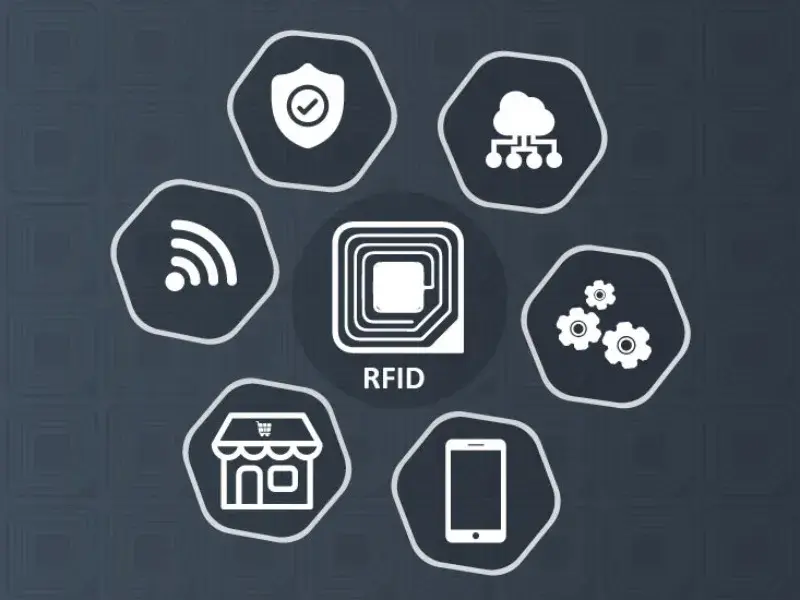
- RFID technology uses electromagnetic fields to identify and track tags attached to entities.
- The tracking capabilities of RFID chips depend on the type of tag and the system’s design. Here’s a breakdown of what each type can and cannot do.
As Radio Frequency Identification (RFID) technology becomes increasingly integrated into our daily lives, questions about its capabilities and privacy implications are more relevant than ever. One common query is whether RFID chips can be tracked. To answer this, we need to explore how RFID technology works, its intended applications, and the potential for tracking.
How RFID technology works
RFID technology uses electromagnetic fields to identify and track tags attached to entities. An RFID system typically consists of three components: a tag (or chip), a reader, and an antenna. The RFID tag contains a microchip that stores data and an antenna to transmit this data to an RFID reader. When the tag comes within range of the reader, it emits a signal with its stored information, which the reader captures and processes.
RFID tags can be either passive, active, or battery-assisted passive (BAP). Passive RFID tags do not have their own power source and rely on the reader’s electromagnetic field to power the chip and send a response. Active RFID tags have an internal power source, usually a battery, which allows them to transmit signals over greater distances. BAP tags use a small battery to help power the chip but still rely on the reader’s signal to communicate.
Also read: Amazon unveils new AI model for ‘Just Walk Out’ stores
Also read: Common protocols used by IoT devices
Tracking capabilities of RFID chips
The tracking capabilities of RFID chips depend on the type of tag and the system’s design.
Passive RFID tags: These tags have a limited range, typically from a few centimeters to a few meters. They are commonly used for access control, inventory management, and contactless payments. Due to their limited range and reliance on the reader’s power, passive RFID tags are not suitable for long-distance tracking. They can only be read when they come within the vicinity of an RFID reader.
Active RFID tags: These tags have their own power source and can transmit signals over much greater distances, sometimes up to hundreds of meters. Active RFID tags are used for applications requiring real-time tracking, such as in logistics, asset management, and large-scale inventory control. While they offer greater tracking capabilities than passive tags, their range is still finite and depends on the power of the tag’s battery and the sensitivity of the reader.
Battery-assisted passive (BAP) RFID tags: These tags bridge the gap between passive and active tags. They have a small battery to power the chip, providing a slightly extended range compared to passive tags but not as far as active tags. BAP tags are often used in environments where longer read ranges are beneficial but full active tag functionality is not required.
Limitations and privacy concerns
While RFID technology can provide tracking capabilities, there are significant limitations and privacy considerations.
Range limitation: The effectiveness of RFID tracking is limited by the range of the tags. Passive tags require proximity to an RFID reader to be scanned, making long-distance tracking impractical. Active tags have a longer range but are still confined by the strength of their battery and the reach of the reader.
Reader infrastructure: Effective tracking with RFID requires a network of RFID readers placed strategically to capture the tags’ signals. Without a comprehensive infrastructure of readers, tracking RFID tags over large areas or through complex environments becomes challenging.
Data security: Unauthorised scanning and skimming of RFID tags are valid concerns. While RFID protection measures, such as shielding and encryption, can mitigate these risks, they also highlight the need for robust security protocols to prevent unauthorised tracking and data breaches.
Privacy implications: The potential for RFID tracking raises significant privacy issues. If not properly regulated, RFID technology could be used to monitor individuals without their consent, leading to a loss of privacy and potential misuse of personal data. Ensuring transparent policies and stringent regulations is crucial to balance the benefits of RFID technology with privacy protection.
Practical applications and ethical considerations
RFID tracking is highly valuable in specific contexts. In supply chain management, RFID tags track goods through the entire logistics process, improving inventory accuracy and reducing losses. In healthcare, RFID tags monitor medical equipment and patient movements, enhancing efficiency and patient care.
However, the ethical considerations of RFID tracking cannot be ignored. Companies and institutions must use RFID technology responsibly, ensuring that its application does not infringe on individual privacy rights. Implementing clear usage policies, obtaining consent, and using the technology transparently are essential steps in maintaining public trust.
While RFID chips have tracking capabilities, they are limited by range, infrastructure, and ethical considerations. Understanding these factors helps balance the technology’s benefits with the need for privacy and security. As RFID technology evolves, it is crucial to navigate its applications thoughtfully to harness its potential responsibly.