Summary
- The DULT accessory-protocol draft would associate a verifiable owner identity with a tracker and make a limited, masked phone or email clue available through an identifier lookup. A person investigating unwanted tracking may recognize who owns the device without receiving a full contact record.
- The same draft warns that a stable device identifier plus even partial owner information can identify an accessory. Lookup is confined to an associated device in separated mode; a Bluetooth request needs user action, while close NFC proximity may count as intent.
A clue is useful because it narrows the room
An alert that says a tracker is nearby is an alarm, not an explanation. If a person finds the device, a fragment of an owner's phone number or email may tell them whether it belongs to a friend, a family member or someone they cannot place. The draft's owner-registry section requires verifiable identity information at association and says the identifier-retrieval response must include at least one masked clue: the last four digits of a phone number or a partly obscured email address. It does not promise both. The clue is deliberately incomplete, yet it is meant to be recognizable.
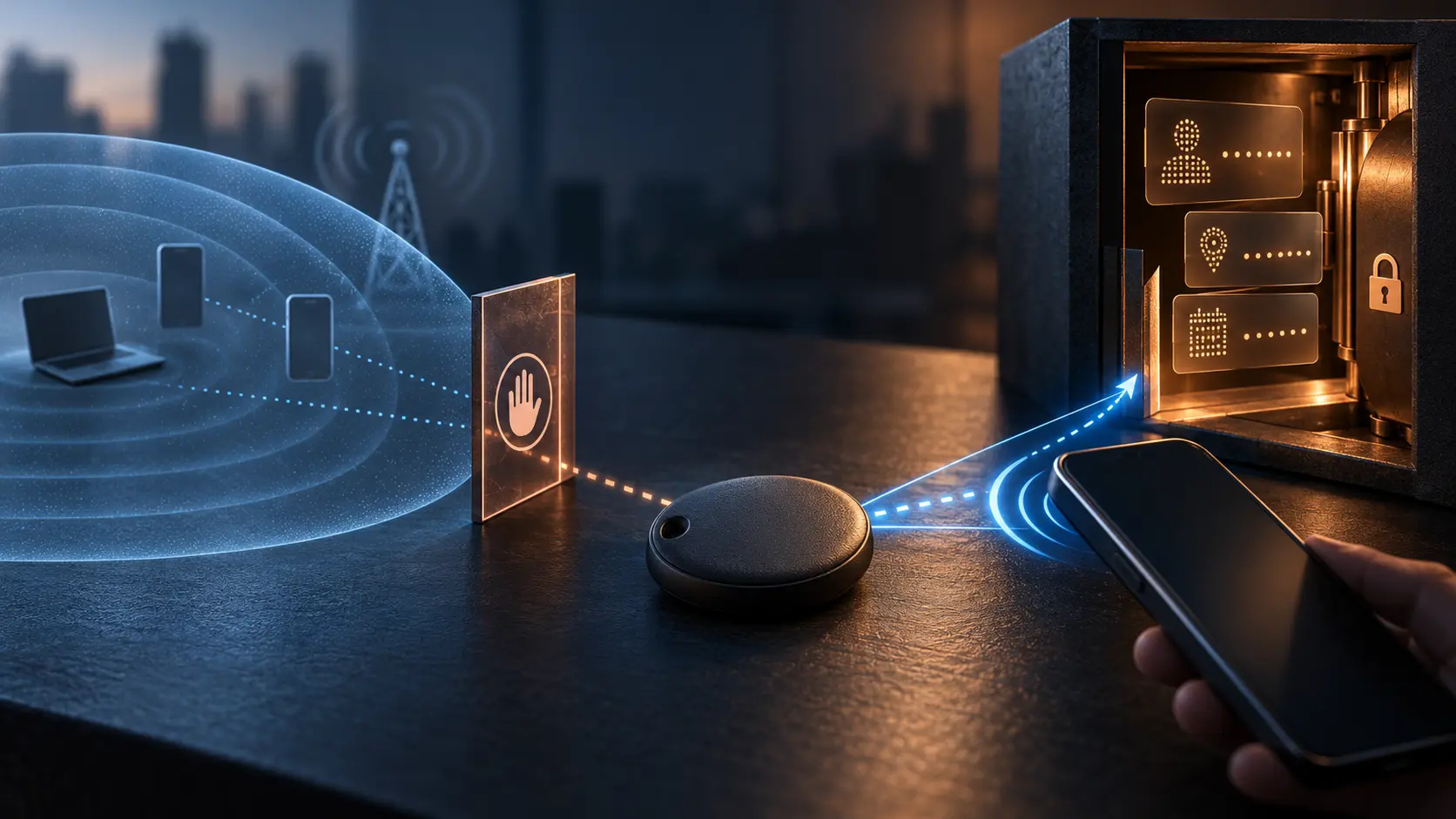
That usefulness creates the conflict. A stable identifier is a handle. Add a repeatable fragment of someone's contact information and the handle starts to point at a person. The draft explicitly warns against making the identifier and masked owner information directly available to any requesting device. An accessory intended to help locate lost property could become an oracle for identifying its owner whenever a passer-by can interrogate it. The protocol's answer is to make disclosure a controlled lookup, rather than a permanent label shouted into the air.
The current Datatracker record lists revision 01 as an active working-group Internet-Draft. These are proposed protocol requirements, not a report that a particular product behaves this way. In the text, lookup is allowed only while the accessory is associated and in separated mode. A request over a long-range wireless interface such as Bluetooth requires a user action. NFC may use the act of coming very close as the sign of intent. That distinction is more demanding than a screen that treats every radio hit as a person holding the device.
The draft also keeps the tracker from handing out identifying material directly to non-owner devices. It requires non-identifiable data at that interface and describes an encrypted, unlinkable payload that a network service can decrypt. Server-side rate limits and anti-fraud measures can then make repeated lookups harder. Authentication and replay protection address a narrower trick: someone who captures a payload once should not be able to reuse it to watch changes in the partial owner information. The draft sketches that design; it does not supply evidence that every network service has implemented it.
The tap, the scan and the request are different events
The privacy section states the physical fact that a Bluetooth dashboard can gloss over. NFC retrieval implies possession of the accessory; Bluetooth's range does not. The person receiving an unwanted-tracking alert, the person who finds the device, a phone within radio range and a remote service querying the owner registry are different actors. One tap may connect two of them. A silent scan cannot simply collapse them into one.
Another boundary is time. The draft says an owner registry should remain for at least 25 days after disassociation and then should be deleted. It separately says available information should be produced for a valid law-enforcement request under defined procedures. Neither rule turns a passer-by's lookup into a full identity request. They define different purposes, recipients and clocks around the same owner record. A provider that puts all of them behind one vague “safety” label is asking readers to trust a word where the draft specifies a sequence of gates.
The public record here has no implementation trace showing how a named tracker network handles an alert, physical action, server lookup, repeat request and registry deletion. Such a trace would decide whether the proposed separation survives contact with an actual product.
Sources
Member Briefing
Deeper Profile Context
Sign in with the right membership level to unlock the full briefing and source notes.
Only for Strategic Circle
Strategic Circle
Open to all readers. Unlock profile briefings after joining and signing in.
Join Strategic CircleOnly for Leadership Alliance
Leadership Alliance
For qualified IP-asset owners and management; sign in to unlock alliance briefings.
Join Leadership Alliance