
Summary
- Thales Nederland B.V. holds radar and naval system design authority within a company 99% controlled by Thales S.A.; the Dutch state's ownership of a 1% ordinary share improves access and trust but does not confer operational control.
- Its responsibility is divided by system boundary: Hengelo may supply radar hardware, fire control, TACTICOS software and integration, but a Dutch frigate may use a public combat management layer and a shipyard may remain the overall ship integrator.
- Public program totals rarely reveal the subsidiary's price. Sustainable profitability lies in non-recurring engineering, integration, controlled intellectual property, configuration knowledge, upgrades, obsolescence management and support over a ship's lifetime.
- Consequently, a sovereign buyer must purchase evidence and exit options as deliberately as detection performance: interface rights, acceptance records, security obligations, export authorisations, support data, failure allocation and a funded path through obsolescence.
Two Days in Hengelo
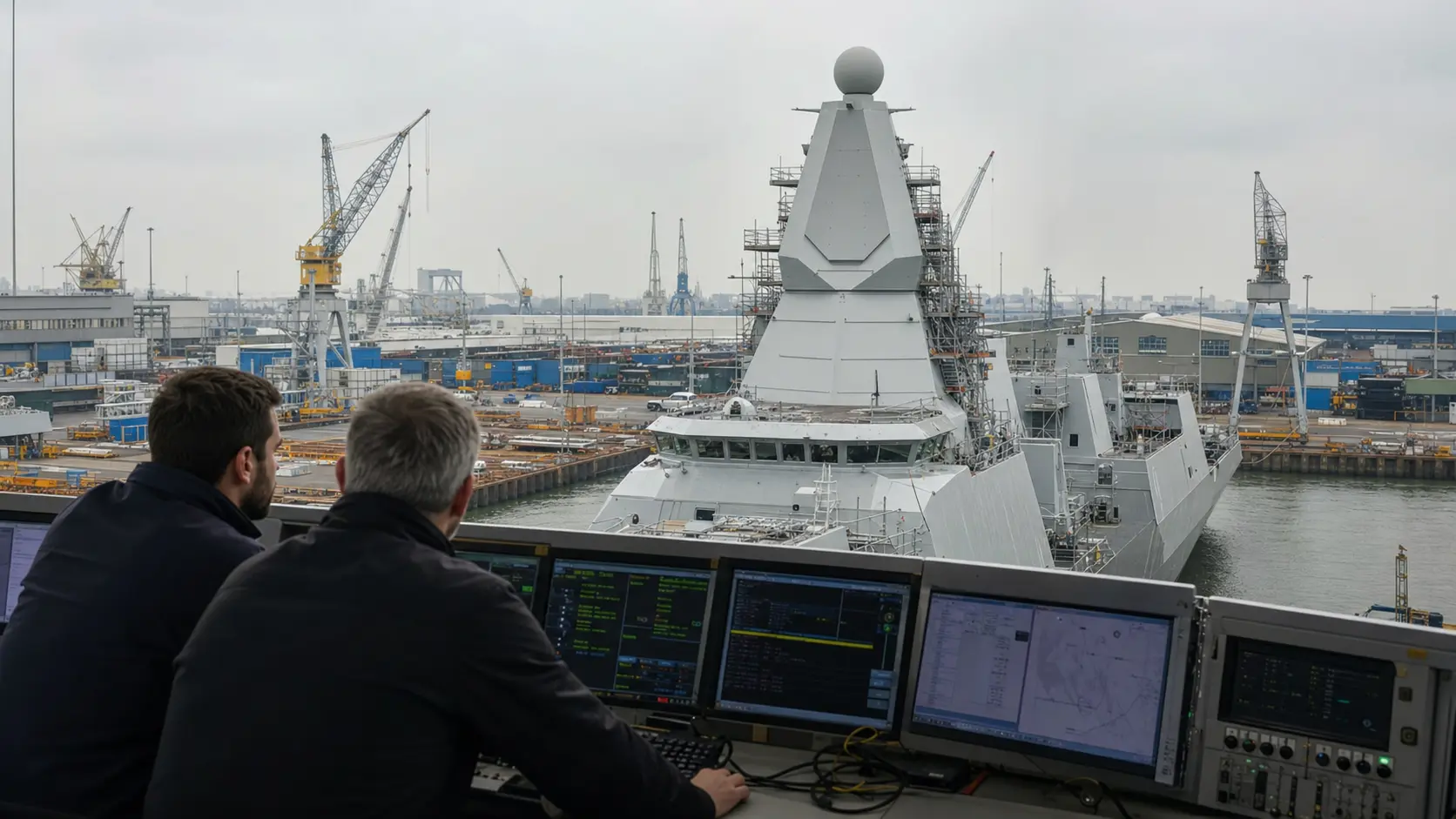
On 22 June 2026, the Dutch Ministry of Defence announced a strategic partnership with Thales Nederland to expand radar system development, production and testing in Hengelo. The ministry described additional facilities and capabilities, a more secure supply chain and a path by which allies could join Dutch contracts. It was an unusually explicit statement that radar capability was not merely something the Netherlands intended to buy. It was an industrial capacity the state intended to keep available on Dutch soil. The ministry and the company presented the arrangement at the place where metal, electronics, software, skilled labour and government demand meet:the Hengelo site itself.
Two days later, Germany terminated the F126 frigate program. Damen Naval was the prime contractor. Thales had been selected in 2020 to supply and integrate the mission system, including radars, sensors, command-and-control software and fire control. A test centre in Hengelo had been expanded specifically to prototype, validate and integrate that combat system before equipment went to German yards. Germany's cancellation did not make the radar partnership moot; it showed why the division of responsibilities matters. In its 3 July statement, Thales said it expected an exceptional charge of approximately €450 million, mostly non-cash, and attributed the deterioration to Damen's program execution and financial situation. That isThales's own account of its exposure and rights, not an independent judgment of fault. The German defence ministry confirmed the termination, whileindependent reporting described years of delay and a controversial replacement path. None of the public evidence reviewed for this article establishes that the Hengelo mission system caused the program collapse.
The sequence is more revealing than a conventional company profile. On Monday, a government treated a Dutch radar maker as sovereign infrastructure. On Wednesday, another government demonstrated that a warship program can fail even around a technically advanced subsystem, leaving clients, prime contractors and subcontractors to unravel completed work, stranded assets, intellectual property, claims and future fleet plans. In both cases, the company concerned isThales Nederland B.V., not an undifferentiated global Thales, nor Damen. The Dutch company bears particular design, production, integration and support obligations. Its French parent provides financial control, a global portfolio and other national operations, but the group's scale does not answer the question of which legal person promised which deliverable or who controls the technical records needed to sustain it.
The Company the State Does Not Control
The exact legal boundary begins with an apparent contradiction. Thales Nederland B.V. is a Dutch private company with its registered office in Hengelo, but it is not a state enterprise and it is not controlled by the Netherlands. A 2025 assessment by the Ministry of Finance states that Thales S.A. holds 99% and the Dutch state 1%. The state holds ordinary shareholder rights. It has no special veto over appointments or strategy, and the assessment states that its influence through company law powers is limited. The shareholding is therefore not a switch the government can flip when a program is late or a foreign export becomes controversial.
The samestate assessmentnevertheless concludes that the shareholding serves a public interest. The Netherlands considers national knowledge and capability for advanced radar design and production as strategically important. The shareholding helps the state maintain an information position and acts as a signal of trust when sensitive information is exchanged with foreign governments. The report also warns that loss of the development capability could compromise the ability to maintain systems already in service in the Netherlands. These are stronger claims than job creation or local content. They place continuity of military capability at the heart of the rationale for owning a fraction of the supplier.
The figures also show why identity and date matter. The assessment reports 2,278 full-time equivalents in 2023, turnover of €598 million, net profit of €49.8 million and exports at 84% of sales. A state shareholding survey reports 2,424 FTEs and €763 million turnover for 2024. Thecompany's current Netherlands pageadvertises around 3,100 skilled professionals and about €700 million annual turnover. These numbers should not be merged into a synthetic growth series: they have different report dates and may use different organisational scopes. What can be said with certainty is that the exact Dutch operating company is a large, export-focused defence supplier whose current public footprint extends beyond a single production hall in Hengelo.
Hengelo is the headquarters and the centre most closely associated with radars, naval mission systems and system integration. The state assessment mentions additional offices in Huizen, Delft and Eindhoven. The company describesDelft as a research extension of its naval organisation, opened to connect with the university and technology ecosystem. Huizen has a different industrial history and today houses activities including secure communications and cyber operations; that does not make every Huizen service part of the naval radar business. A Dutch accreditation entry provides a solid legal anchor: it names Thales Nederland B.V., chamber of commerce number 06061578, and an accredited environmental competence laboratory at Zuidelijke Havenweg 40 in Hengelo. The associatedISO/IEC 17025scope covers specified electromagnetic compatibility tests. That is proof of a particular laboratory competence, not a certification that every radar, source code or deployed combat system is secure or fit for every naval mission.
The company boundary matters every time a source says simply "Thales". Group marketing may describe global turnover, global cyber resources or products developed in multiple countries. These facts do not automatically become capabilities or obligations of Thales Nederland B.V. Conversely, a group press release can still be probative when it names a Hengelo program, a Dutch product or a contract. The disciplined test is whether the evidence links the claim to that legal entity, its facilities, engineers, intellectual property, deliverables or through-life obligations. Without that link, the group's scale is background, not assurance.
The state's 1% shareholding thus creates a relationship without solving the underlying control problem. Thales S.A. retains economic control; Dutch ministries retain procurement, security and export powers; the navy carries operational risk; and Thales Nederland holds the technical knowledge the government says it cannot easily afford to lose. Accountability arises from the overlap of these instruments, not from the share certificate alone.
Where Design Authority Actually Sits
"Radar company" is too narrow a description, while "combat system company" is too broad unless every layer is named. Thales Nederland's naval work covers at least four separable activities: radar and electro-optical hardware; combat management software; sensor and effector integration into a mission system; and post-delivery support, modification and obsolescence management. A customer may buy several layers together, a single layer, or split them across state and industry teams. The resulting authority map changes by ship class.
The anti-submarine warfare frigate program for the Netherlands and Belgium is the clearest example. TheDutch ministry selected Damen and Thales Nederland as principal industrial contractorsin 2023. Damen is responsible for the ships. Thales supplies what the ministry calls the surface combat suite: integrated radar equipment and fire control. TheThales contract announcement itselfidentifies the APAR Block 2 X-band, the SM400 Block 2 S-band, a Mirador Mk2 electro-optical fire control system, a Gatekeeper Mk2 surveillance system and the Scout Mk3. It also promises extended logistics support. Both radar systems are presented as a dynamically reconfigurable combination rather than isolated boxes.
But the ship's combat management responsibility is not exhausted by that list. ADutch program accountstates that the Joint Information Provision Command and RH Marine are responsible for integrated mission management, and that the naval combat management system is developed within the Dutch defence organisation. This means it would be wrong to write that TACTICOS is the combat management system of the Dutch-Belgian ASW frigates simply because TACTICOS is Thales Nederland's well-known CMS. On this program, Thales's sensor and fire control suite must connect to a state-centric mission management architecture. The interface between them is part of the accountability system.
The F126 used a different split. In 2020, Thales won a contract announced at €1.5 billion to supply the German frigates' mission and combat system, including TACTICOS, AWWS, APAR Block 2, communications and integration of government-furnished equipment. A2024 company statement on the expansion of the Hengelo test centresaid it would carry out mission system integration and validation with the German navy, the federal procurement authority and Damen. Here, the Dutch supplier's responsibility extended higher up the decision chain than on the Dutch ASW frigate. Yet Damen remained the shipbuilding prime, and German authorities retained acceptance. The 2026 termination is a reminder that a broad integration responsibility within a subsystem does not equate to prime responsibility for the ship or program funding.
SMART-L provides a third model. TheDutch Ministry of Defence states that the long-range radar was developed by Thales Nederlandand is installed on the four De Zeven Provinciën-class frigates. A land derivative also supports air and missile surveillance. Thales reports test achievements such as a SMART-L Multi Mission radar tracking a ballistic target over long range, but these performance claims are the supplier's description of particular tests and configurations. They should not be translated into a general guarantee of detection range against any target, environment or rule set. Design authority means owning the design base and being able to explain configuration-specific performance; it does not make marketing maxima universal.
Even a relatively bounded weapon project splits roles again. In the Dutch very short-range air defence system program, parliament was told that Thales Nederland would supply the Pharos radar, modify the radar and fire control systems and integrate components into a functional whole. Other manufacturers would supply different elements under eight subcontracts. The2024 procurement letterexplicitly recorded development and integration risks, including Pharos maturity and the possibility that the combined protection level might disappoint. It also separated legal bases: Thales elements were to be contracted under the national security exception of Article 346 of the Treaty on the Functioning of the European Union, while other military off-the-shelf elements followed a different single-source path. One operational capability, multiple design authorities, multiple contractual justifications.
The practical lesson is that product ownership must be proven at the configuration level. "Thales radar" is not enough. A procurement file needs the model, block, software base, antenna and processing configuration, third-party dependencies, interface owner, security and safety authority, test evidence, modification rights and designated support entity. Only then can a navy know whether a defect belongs to signal processing, track correlation, a data link, the CMS, a weapon interface, the ship network, platform power and cooling, or the operational requirement itself.
From Impulse to Decision
A naval customer does not experience this technology as a catalogue. It experiences a chain from an uncertain physical signal to a decision with legal and operational consequences. The radar emits or receives energy, forms beams, suppresses interference, detects returns and creates measurements. Processing transforms measurements into tracks. Identification and data links add context. A combat management layer presents a tactical picture, supports threat assessment and assigns sensors or effectors. Fire control refines the geometry needed to engage. Operators remain responsible for action under doctrine and rules of engagement.
Every transition can lose information, add latency or create false confidence that the entire picture comes from a single machine.
Thales Nederland's commercial strength is that it can occupy several adjacent steps. TACTICOS is its established combat management software family. Acompany brochure describes a modular, open architecturecapable of hosting third-party applications and connecting sensors, weapons and communications. A current job posting in Hengelo describes teams maintaining the Java-based TACTICOS software that collects sensor data, builds the operator tactical picture and controls effectors. The company's marketing claims installation on over 200 ships. This installed base number is not independently verified in public documents and may count variants, upgrades and ships in many countries; it is best treated as a company assertion rather than proven market share.
The architecture always has important closed centres. "Open" can mean published interfaces, standards-based messages, modular deployment or the ability to integrate approved third-party code. It does not necessarily give the customer source code, build environment, design rationale, cryptographic material or unlimited right to modify the kernel. Thales Nederland'sDecember 2024 general terms and conditions of sale, publicly posted, make this distinction visible. As a default commercial framework, they retain intellectual property in products, software, designs, interfaces, reports and developments for Thales or its suppliers. The customer receives limited rights for receipt, inspection, approval and operation, and is restricted from modification, derivative work, sub-licensing, reverse engineering or decompilation. Third-party open source and commercial software remain subject to their own terms.
These conditions may be overridden by a negotiated government contract, a program-specific data rights schedule or a security agreement. They do not prove that the Dutch navy, Germany or any export customer accepted the default. They reveal the negotiation starting point. A navy that needs sovereign modification rights, source code escrow, interface control documents, a reproducible build, third-party maintenance rights or access after insolvency cannot assume those rights arrive with the equipment. It must obtain them expressly, fund them and keep the deliverables current.
The hardware also has similar hidden dependencies. An active electronically scanned array contains a large number of modules and relies on specialised semiconductors, power supplies, cooling, timing and processing. A mission system may contain commercial servers, network switches and operating systems whose support cycles are much shorter than the ship's. Thales markets its unified ship networks as commercial off-the-shelf, IP-based and fault-tolerant, with multi-level security and obsolescence management. These are design propositions.
The accountability question is which exact components went into a customer base, which vulnerability and end-of-life notices apply, and who is contractually obligated to qualify replacements without breaking timing, electromagnetic compatibility or security assumptions.
Data sovereignty is equally concrete. Radar measurements, electronic support data, tactical tracks, mission plans, system logs, threat libraries and maintenance records do not all have the same classification or owner. Some may never leave the ship. Some may be shared with allies via tactical data links. Some diagnostic data may be accessible to a support portal or supplier team. The public record does not disclose data flows from current Dutch naval configurations, nor should it.
Procurement must still document where each data class is processed, who can retrieve it, what leaves the sovereign environment, what foreign nationality personnel can access engineering systems and what happens when remote support is unavailable. "Hosted in the Netherlands" would be an incomplete answer if design tools, update signing, parent company support or third-party dependencies remain elsewhere.
A Workflow Built Around Acceptance
The customer workflow begins years before a radar is switched on at sea. Defence planners define missions and threats; naval architects allocate weight, power, cooling and mast volume; procurement authorities choose competition or a sovereign exception; the supplier transforms requirements into a design base; and integration teams prove that sensors, networks, software and weapons exchange the right data with the right timing. Factory testing can validate equipment and simulated interfaces. A shore integration site can run representative hardware and code.
Harbour and sea acceptance trials add the real ship, electromagnetic environment, crew and motion. Operational testing adds doctrine and realistic scenarios. Each step should close a different risk class.
The Hengelo test centre for F126 exemplified the "test before ship" approach. Thales stated that the site would prototype and validate the integrated mission system with the customer, shipbuilder and procurement authority before shipment to Germany. That can find interface faults earlier and protect valuable yard time. It can also create a dangerous illusion if the shore configuration drifts from the ship or the simulated third-party equipment behaves more cleanly than the real article.
Accountability requires a controlled digital and physical baseline: the test centre rack, the ship installation, the software version, the interface simulator and the acceptance script must all be traceable to each other.
The ASW frigate program makes the handover sequence unusually visible. Damen builds and tests the platform; the Defence Materiel Support Command helps install the first systems and is supposed to assume increasing responsibility; final commissioning happens in Den Helder after platform trials. More than forty contractors are involved. The project manager's public description is important because it refuses the fiction of a single turnkey delivery. The government must accumulate enough knowledge during first-of-class design and integration to sustain follow-on ships.
This knowledge transfer is itself a deliverable, even when it has no antenna or serial number.
The schedule shift tests the same workflow. The2026 defence projects overviewmoves the planned delivery of the first ASW frigate from 2030 to 2033. It attributes the change to technical complexity and an unstable original ship design that required a redesign, including more margin for future systems. The report does not attribute the delay to Thales Nederland. It also does not make the supplier moot: a redesigned ship changes physical and logical interfaces, while a later delivery extends the period during which the electronics and software chosen early in the program can age before operational service. Configuration management must absorb both effects.
Acceptance is not just a pass/fail ceremony. It should produce evidence on detection and tracking in specified conditions, false alarms, latency, availability, cyber hardening, failover, electromagnetic compatibility, graceful degradation, maintainability, crew workload and recovery. Classified results will not be public, but their contractual existence matters. A state cannot hold a design authority accountable using only a brochure metric or a demonstration staged by that authority.
It needs government witness testing, independently controlled stimuli, calibrated equipment, preserved logs, fault classification and a clear process for concessions. The accredited EMC lab in Hengelo can contribute to a subset of this evidence; its narrow accreditation should not be inflated into end-to-end system assurance.
Training and support complete the workflow. Early operators need tactical and technical instruction. Maintainers need diagnostic tools, spares, technical publications and authority to perform particular repairs. Software teams need a release and vulnerability process. When ships deploy, support must work across time zones and classification boundaries. A repair that depends on moving a module or log across a border may also depend on an export licence.
Supplier accountability is therefore not finished at delivery, while navy accountability cannot be outsourced: it must retain the competence to recognise a wrong response, reproduce a defect and decide whether an operational workaround is safe.
The Integration Boundary Is the Product
Integration is often described as a service added to hardware. In complex naval procurement, it is closer to the product itself. A radar may satisfy its laboratory specification and fail to contribute to the combat mission if its tracks arrive late, identifiers are inconsistent, coordinate frames drift, time synchronisation is wrong or the CMS cannot command the required mode. Conversely, a combat management display may look coherent while hiding poor sensor provenance or stale data. The integrator decides how these conflicts are resolved and what evidence remains available to operators and investigators.
Thales Nederland can sell this integration capability because Hengelo combines radar engineering with mission system expertise and TACTICOS. The F126 contract made this combination explicit: Thales was to integrate its own equipment and government-furnished systems. A 2022 Janes report estimated the Thales contract at €1.5 billion and stated that more than €600 million was for subcontractors, including German partners for tactical data links and information processing elements. The figures describe historical award, not money finally earned after termination.
They show that "the Thales system" depended on a network of other companies and that the Dutch integrator's economic role included orchestrating external work.
The ASW frigate shows a sovereign alternative. The Netherlands retains a government-centric combat management layer and tasks Thales with the surface sensor and fire control suite. This partitioning can reduce dependence on a supplier CMS at the fleet level, but it creates a demanding interface between two design authorities. The government must own or control the integration contract, reference data, test environment and change process strongly enough that neither side can explain a defect solely as the other side's problem.
The boundary's value is not that it eliminates lock-in; it may shift lock-in to the interface laboratory and the small group of people who understand both sides.
The Dutch Multi-Mission Radar project offers another form of commonality. The 2026 project overview states that Thales Nederland had delivered first systems and that further systems were to be contracted in 2026. It describes common antenna and software technology with naval systems and a maintenance program that enables further development. Commonality can spread qualification costs, spares and engineering knowledge across land and maritime applications. It can also create correlated dependency: one defect, component shortage or delayed software baseline can affect multiple programs at once.
A buyer must therefore distinguish beneficial reuse from a single institutional point of failure.
Integration authority also determines the quality of an incident investigation. If an interception fails, investigators need timestamped logs from sensors, networks, CMS, fire control and the weapon; configuration records; operator actions; environmental data; and requirements showing the chain was tested. Contractual access to each box is not enough if clocks are not synchronised or suppliers can withhold analysis tools. The system integrator should be able to reconstruct the chain, but the customer needs sufficient independent access to contest that reconstruction.
Otherwise, the party potentially responsible for a defect also controls the evidence used to assign accountability.
That is why interface control documents, reference implementations and test harnesses have sovereign value. They enable a navy to add a new sensor, weapon or data link without reopening every design decision. They also provide an exit path if a supplier becomes unavailable. The public record does not show what rights the Netherlands or export customers hold for current Thales Nederland systems. The company's default intellectual property terms make the question material, while the ASW split proves that the Dutch state is capable of drawing system boundaries differently when it chooses.
The Price Is Hidden in the Program
No public price can explain this business. Every naval system is configured around a ship, a threat set, a national security policy, installed equipment and a support model. The contract may bundle development, recurring hardware, integration, test facilities, documentation, training, spares, software releases and decades of options. Some work is fixed-price; some risk is carried by milestones or change orders; some support is ordered later. The visible cost of one antenna therefore tells little about the economic commitment.
Dutch public documents use broad program ranges and protect commercially sensitive splits. The 2026 project overview puts the ASW frigate program above €2.5 billion. That is a binational ship program, not a Thales Nederland contract value. The very short-range air defence system sits in a range of €250 million to €1 billion, but that covers a multi-supplier capability and its implementation. The Multi-Mission Radar project moved from a €100-250 million range to a €250 million - €1 billion range as scope and quantities grew. Again, the range is not the supplier's revenue.
Treating any of these totals as Thales sales would be a serious category error.
F126 provides a rare and more specific figure: the announced €1.5 billion contract for the Thales mission system. Even there, the planned subcontracting was over €600 million, work was spread over years, and the program ended before delivery of six operational ships. Thales's estimated €450 million charge is an accounting estimate after termination, not a transparent calculation of cash loss, achieved performance, settlement or damages. Hensoldt separately disclosed a contract worth over €200 million on the program and said it was coordinating next steps with Thales Netherlands. The figures reveal a layered supply chain, not a single margin.
The revenue model can nevertheless be inferred from the work, provided the inference is labelled. First comes non-recurring engineering: adapting radar modes, software and interfaces; building test benches; and qualifying the system. Then comes recurring production of antenna arrays, cabinets, processors and ship sets. Integration and acceptance create program labour and milestone revenue. Training, spares and initial support follow. Later, the installed base creates demand for repairs, vulnerability patches, component substitutions, new weapons, new data links, threat library changes and major life extensions.
The state assessment's warning that loss of Dutch design capability could compromise through-life support strongly supports the existence of this lifecycle dependency, but public accounts do not disclose product-level margins.
The default terms of sale illustrate how costs can continue after acceptance. Thales Nederland's public terms provide a default warranty of twelve months from delivery for design, materials and workmanship, with repair, replacement or re-performance at Thales's option. Third-party products follow third-party terms; unauthorised modifications may void coverage; and travel, access and transport costs may be the customer's responsibility. Negotiated defence contracts may be far more demanding. The point is that a thirty-year support obligation is not created by a one-year default warranty.
It must be specified and priced through separate availability, support, spares, obsolescence and upgrade arrangements.
A 2025 UK procurement makes the economics of lock-in unusually legible without proving anything about Thales Nederland's own revenue. The UK proposed a £139.2 million eight-year support arrangement with two option years for proprietary TACTICOS systems on five Type 31 frigates and one shore installation. The contracting supplier isThales UK, not Thales Nederland. The notice justifies support from the system designer for defect correction, software updates, future integration, hardware modifications, maintenance and obsolescence. It is therefore evidence on the downstream economics of the TACTICOS product family and the value of design authority, not evidence that the Dutch entity booked that contract.
The true price for the customer is consequently the discounted cost of staying operational, modifiable and assured, not the acquisition invoice. A low initial bid with inaccessible interfaces, short warranties, proprietary diagnostics and separately priced upgrades can be more expensive than a transparent one. A high price may still be unjustified if it buys supplier effort without durable customer rights. Procurement must compare rights, evidence and future choices alongside equipment quantities.
Thirty Years of Software
A frigate may serve for thirty years while a server, operating system or programming framework may be commercially current for a fraction of that period. Software makes the gap manageable because behaviour can be changed without replacing an antenna; it also makes dependency continuous because every change must preserve real-time performance, safety assumptions, cyber controls and interfaces with systems that may not change together. A naval CMS is not a web application with a subscription that can tolerate unplanned feature regression. Its version history is part of the ship's certified configuration.
Thales Nederland's lifecycle responsibility can take several forms. It can fix its own defects, integrate a new navy sensor or weapon, replace obsolete computing hardware, adapt a tactical data link or qualify a new release against an old ship. It can also depend on parent company and external supplier components. The company's public material on S1850M radar support describes a service desk, on-site support, annual obsolescence scans, health checks, monitoring and configuration management for the French, Italian and British navies. Thisthree-year agreement with a two-year optionis a company account and discloses neither price nor all contracting entities. It shows that configuration knowledge and early obsolescence warning are sold as organised services, not ad hoc repairs.
The Netherlands is also trying to keep more of the maintenance chain. In 2024, the Defence Materiel Support Commandsigned long-term cooperation declarations with maritime companies including Thales Nederland. The ministry said industry would execute work while naval staff contributed fleet knowledge and that the arrangement was to support ships worldwide. That is not a transfer of all design authority to government. It is a recognition that availability depends on a shared knowledge base and that the uniformed maintainer and the original designer see different parts of a defect.
Changing supplier becomes hardest where history matters. A replacement company can read an interface specification; it may not know why a tolerance was chosen, what field defects produced a workaround, how a threat mode was validated or what undocumented dependencies remain in the build. Training, simulators, test scripts, spares, cable routes and operator doctrine all accumulate around the incumbent. The installed base can therefore be contestable in theory but economically captive in practice.
"Open architecture" reduces this risk only when the customer owns current specifications, usable rights, test assets and qualified people—and can demonstrate that a third party can indeed make a change.
An exit plan should be exercised before it is needed. That means periodically rebuilding the software from escrowed material; proving that government or an authorised third party can read logs and configuration data; validating a replacement component; maintaining interface simulators outside the supplier's exclusive control; and rehearsing ongoing support if a foreign parent reorients its investments. It also means identifying which export licences, security clearances and supplier consents would be needed for an alternative maintainer.
An escrow that contains obsolete source code without toolchains, dependencies, signing keys, documentation and test evidence is ceremonial rather than operational.
The Dutch state assessment effectively recognises this switching cost structure. Its concern is not simply that closing Hengelo would reduce market competition. It is that loss of radar development knowledge could compromise maintenance of existing systems. This creates reciprocal accountability. The state has reasons to sustain industrial capacity, but Thales Nederland should not benefit from unexamined incumbency simply because the exit cost is high. Every upgrade is an opportunity to measure whether sovereign knowledge and options are growing or shrinking.
Export Authorisation Is Part of Delivery
With 84% of 2023 sales reported as exports, export control is not a compliance service on the periphery of Thales Nederland's model. It is part of contract execution. The Dutch government requires licences for military goods and relevant dual-use items. The Central Import and Export Office handles applications, while the Ministry of Foreign Affairs assesses military exports against the eight criteria of the EU Common Position. These criteria include human rights, internal conditions, regional stability, allied security, risk of diversion and the recipient's technical and economic capacity. The government states that security interests outweigh economic interests in itsexport policy for strategic goods.
For a radar or combat system, controlled delivery can extend beyond hardware. Software, technical data, test tools, integration assistance, spares and subsequent upgrades may require authorisation. A program may therefore acquire a second lifecycle schedule: the engineering version may be ready while a licence is pending, or a political reassessment may affect support years after acquisition. A customer must know whether critical functions depend on recurring Dutch permission and whether components or code from other jurisdictions introduce additional controls.
The public debate around Egyptian naval exports demonstrates both scrutiny and an evidence limit. A2020 parliamentary letterdisclosed a licence of €114,038,400 for radar and command, control and communications goods, including software, test equipment and related services, destined for the Egyptian navy. It did not name the Dutch exporter. Civil society organisations and media associated the transaction with Thales Nederland, but that inference is not equivalent to official confirmation of the contracting entity. An earlier official report similarly described a €34.05 million licence for radar and C3 goods routed through France for Egyptian corvettes without naming the company. These records are relevant to the market in which Thales Nederland operates; they do not form a solid basis to assert as a verified fact that this exact entity booked every sale.
Litigation also shows what licence accountability can and cannot do. Dutch courts rejected an attempt to stop relevant exports after examining the government's assessment. A2022 parliamentary responsenoted allegations involving Egyptian naval conduct but stated that the court had not found a sufficiently clear link between the reported violations and the frigates' radar systems. A licence decision is therefore a government judgement against prescribed criteria, not proof that a recipient's broader conduct is benign. A valid licence also does not transfer full responsibility for end-use control from supplier to customer. Government, exporter and customer each hold different information and powers.
Procurement accountability must connect these regimes. The contract should say who bears the risk of delay or termination if a licence is refused, conditioned or withdrawn; who is responsible for accurate end-user information; how re-export and remote access are controlled; and whether long-term patches and spares are covered. The engineering configuration delivered to an ally may also differ from the Dutch baseline because classified modes, cryptography or third-country components cannot be transferred. These differences require their own test and support records. "Same radar family" does not mean identical sovereign capability.
Security Without Public Visibility
The most important security evidence for a naval mission system is unlikely to be public. Detailed network schematics, vulnerabilities, threat libraries, cryptographic controls and penetration test results must remain protected. Secrecy, however, can hide weak accountability as easily as it protects sound engineering. A buyer still needs to know which authority sets the security baseline, which party monitors vulnerabilities, how fast a critical patch can be qualified, what remote paths exist and who can declare a degraded configuration operationally acceptable.
The Netherlands has strengthened the contractual framework around sensitive suppliers. The general security requirements for government contracts, known as ABRO, apply to new central government contracts involving national security interests and replace the old defence-specific regime over time. Thegovernment descriptioncovers organisational, personnel, physical and cyber measures, including cloud services; a supplier can be excluded or a contract suspended if it cannot achieve the required level. This framework is relevant to Thales Nederland's Dutch work, but it does not reveal the classification, findings or mitigations of a particular naval contract.
The public EMC accreditation in Hengelo is also limited. It indicates that the named laboratory activities are assessed against ISO/IEC 17025. It does not attest to secure coding, vulnerability management, cryptographic design or the resilience of a deployed combat system. Certifications must be read by scope, site, version and expiry date. Group-level references or a parent company's security operations centre cannot be silently inherited by every Dutch product.
A disclosed cyber episode helps define the supply chain threat without proving a Dutch naval compromise. In November 2022, Thales Group stated that the LockBit extortion group had published company data. Thales said it had found no intrusion into its own IT systems and believed some information may have come from a partner account on a collaboration portal; it reported no operational impact at the time. Thegroup statementdid not identify a breach of Thales Nederland, TACTICOS or a naval platform. Its relevance is narrower and yet important: programs distribute sensitive artefacts through partner environments, and identity, access and data minimisation at collaboration boundaries matter even if the core engineering network is secure.
No credible public source reviewed for this article documented an operational cyber compromise specific to a Thales Nederland naval radar or TACTICOS installation. That absence should not be presented as a clean incident history. Classified operators may not disclose events; product names may be omitted; and vulnerabilities may reside in commercial components rather than the branded system. A serious procurement review would look for classified incident reports, software bills of materials, patch latency metrics, supplier access logs, secure development evidence, independent testing and contractual notification obligations.
It would also test degraded operation: what the ship can still detect and decide if external support, a network segment or a non-critical application is unavailable.
Security accountability follows the integration boundary. Thales may secure a radar processor while the navy secures the platform network and another company supplies a data link gateway. Yet an attacker targets the path, not the organisation chart. The system security authority needs the power to enforce cross-cutting fixes and access evidence from every supplier. When Thales Nederland acts as mission system integrator, this coordination duty should be explicit. When the Dutch government retains its own CMS, it must be able to run it.
What Can Be Attributed to a Failure—and What Cannot
F126 is the hardest current accountability test because the commercial consequences are large and the technical facts behind the termination are not public. Thales's 2026 statement says that Damen's execution and financial situation deteriorated and that Thales will enforce its contractual rights. Independent reporting describes a German decision driven by years of delay, cost escalation and lost confidence in the shipbuilding path. Hensoldt states that settlement terms remain unknown and that it is coordinating with Thales Netherlands.
These accounts support three facts: the program was terminated; Thales had a substantial mission system and integration subcontract; and claims and material losses remain to be resolved. They do not establish a final attribution of legal fault.
This distinction matters because a combat system can be technically on track while the platform around it fails, or can contribute to platform disruption through late data, changing loads or unresolved interfaces. A shore test centre can complete a milestone while ship integration remains impossible. Conversely, a ship design change can force rework of a valid subsystem. The final settlement may apportion contractual liability without publicly explaining technical causality.
Anyone assessing Thales Nederland should resist both convenient stories: that the Dutch supplier was at fault because it was the combat system integrator, or that it has no responsibility because Damen was the prime.
The ASW frigate delay deserves the same discipline. The 2026 official report points to program complexity and an unstable ship design. It does not blame Thales. The surface combat suite is nevertheless a large and technically ambitious part of the ship, and the redesign will need to preserve radar location, electromagnetic fields, cooling, weight, power, software interfaces and future growth. The correct surveillance point is whether these interfaces and the revised schedule are controlled—not an unsupported allegation about which supplier caused the shift to 2033.
Smaller public examples show how acceptance can reveal environmental issues. On the SMART-L land site in Wier, government testing found interference with household appliances, prompting an investigation with the manufacturer. That is not evidence of a naval combat failure and should not be presented as such. It is evidence that a system can satisfy design assumptions and yet interact unexpectedly with the field environment, and that the manufacturer and government must maintain a path from citizen report to reproducible test and fix.
The very short-range air defence program is a forward test rather than an incident. Parliament was told that Pharos was still in development, with completion estimated around 2031, and that component delay, capability and combined performance disappointment were contractual risks. Publishing these risks before completion is good for accountability. The next step is to maintain traceability between the predicted risk, mitigation, acceptance outcome and any subsequent change in cost or schedule. A risk register that disappears when a program becomes politically uncomfortable provides no institutional learning.
Failure accountability should therefore be designed before failure. Contracts need a system responsibility matrix, objective interface tests, shared log access, time synchronisation, defect categories, root-cause governance, warranties aligned with operational milestones and rules for latent defects. They must address consequential costs without creating incentives to hide early warnings. For multinational programs, they also need a forum that can decide between governments, prime contractor, subsystem integrator and national security rules.
F126 demonstrates how expensive ambiguity becomes when the program ends; the Dutch ASW program still has time to make the chain explicit.
Competition at the Architecture Boundary
Thales Nederland does not compete in a single market. A navy can compare radar families, compare combat management systems, appoint a separate integrator, preserve a national CMS or buy a tightly integrated combat system from a single prime. The relevant substitute depends on where the customer draws the boundary. A feature comparison that treats all these choices as equivalent will miss the real procurement decision.
For combat management,Saab markets 9LVaround modularity, third-party integration and avoidance of proprietary ties.Leonardo presents ATHENAas an open-architecture CMS integrating sensors, weapons and tactical data links.Lockheed Martin's Aegisoffers a more encompassing detect-to-engage system with a large allied base. Each description comes from the vendor and needs program-specific validation. Their strategic positions nevertheless differ: a customer may value a broad alliance ecosystem, a lighter modular CMS, national source access or compatibility with an existing weapon and radar fleet more than any isolated software function.
Radar competition is also constrained by ship design and national policy. Saab, Hensoldt, Leonardo and others may offer surveillance or fire control products, but replacing APAR or SMART-L is not a matter of mounting a different panel. Mast geometry, electromagnetic interaction, power, cooling, processing, weapons, combat system messages and acceptance evidence all change with it. A government can still create competition at upgrade boundaries, especially if it owns interfaces and test assets. Without those assets, the cost and risk of requalification protect the incumbent.
The Dutch ASW architecture is itself a competitive choice. By keeping integrated mission management and the naval CMS within a Defence/JIVC-centric arrangement while buying the Thales surface suite, the state avoids giving a single supplier every decision layer. It preserves a government role between the sensor and the mission command. The cost is that government must be a smart integrator, fund the interface and accept responsibility when failure lies between organisations. Sovereignty is work, not merely a contractual reservation.
Thales Nederland's best defence is therefore not an assertion that no substitute exists. It is accumulated evidence: radar intellectual property in Hengelo, test infrastructure, engineers who understand sensor-to-effector timing, a fleet of configurations and long customer relationships. Its vulnerability is the same concentration. Customers will ask whether proprietary rights, parental control, export dependencies and program shocks make this expertise a bottleneck. The June 2026 Dutch investment answers the capacity question with more Hengelo; it does not alone answer the contestability question.
Nine Tests for a Sovereign Buyer
A procurement authority evaluating Thales Nederland should start with legal identity. The tender, licence, security clearance, IP schedule, warranty and support agreement should name the entity doing the actual work. Parent company guarantees should be explicit rather than inferred from the Thales brand. Subcontractors and cross-border design authorities should be mapped to the functions and data they control.
Second, it should demand an authority matrix. For every radar mode, processing function, tactical picture, interface, fire control path and network service, the program should identify the design owner, integration owner, security authority, acceptance authority and in-service maintainer. The ASW split between the Thales surface suite and the government-centric mission layer makes this test indispensable.
Third, it should buy reproducible evidence. Performance requirements need operational conditions, not just maxima. Factory, shore, harbour, sea and operational tests should preserve configurations, stimuli, logs, anomalies and concessions. Government teams need tools to replay critical chains independently, especially when the supplier under test is also the system integrator.
Fourth, the buyer should assess data and exit rights. Required deliverables may include interface control documents, source or escrow packages, build environments, diagnostic formats, configuration databases, safety and security evidence, training materials, test harnesses and rights for an authorised third party. The buyer should periodically demonstrate that these assets work. Thales Nederland's public default terms make clear that broad modification rights cannot be assumed.
Fifth, security should be tested across the mission chain. ABRO compliance is a starting condition, not an operational outcome. The program should examine software composition, vulnerability intake, signing and deployment, privileged support, collaboration portals, segmentation, recovery and reporting. Duties must survive a prime contract dispute or parent company service interruption.
Sixth, export control dependencies should be modelled for the entire lifetime. The customer needs a schedule of controlled hardware, software, data and support; licence responsibility; end-use and re-export conditions; and contingencies if political decisions interrupt supply. Multinational crews, foreign yards and remote engineers can all change the analysis.
Seventh, lifecycle commitments should be measured rather than described. Useful metrics include repair turnaround, spares availability, software support periods, time to assess critical vulnerabilities, obsolescence notice, qualification time for substitutes and the proportion of defects the navy can diagnose without supplier access. Options should cover the real ship life, while competition or benchmarking should remain possible at planned refresh points.
Eighth, contracts should allow failure attribution. Shared clocks and logs, cross-supplier investigation rights, independent experts, escalation rules and preserved test artefacts are as important as liability caps. A program should know in advance how it will distinguish platform, radar, network, CMS, data link, weapon and operator causes. The F126 consequences are the warning: commercial claims become harder to assess when the public cannot see the engineering chain.
Ninth, the state should test continuity under stress. What happens if Hengelo loses a critical supplier, a parent changes strategy, a licence is suspended, a key team retires, a program is cancelled or the company cannot support a deployed ship? The answer may rightly include investment in Thales Nederland, as the Dutch government has chosen. It should also include government expertise, alternative capability, current technical data, strategic spares and exercised recovery plans. Supporting a national champion and contesting its dependency are not contradictory policies.
Evidence Gaps and Surveillance Points
The public record is rich enough to establish the accountability structure but not to audit its classified operation. No current complete naval contract reviewed here discloses detailed milestone prices, liability allocation, source code provisions, cyber baseline, service levels or government data rights for Thales Nederland. The posted general terms of sale are only a default framework. Product brochures establish vendor positions, not independently verified operational performance. Installed base claims are not reconciled ship by ship. Public incident data are too thin to infer a failure rate.
The most immediate surveillance point is F126. The size and timing of Thales's final settlement, treatment of completed work in Hengelo, ownership of program-specific designs and reallocation of people and test assets will reveal what value survives cancellation. Any judgment on fault should wait for evidence beyond unilateral company statements and high-level government explanations.
The ASW frigate is the second. The shift to first delivery in 2033 makes requirements stability, obsolescence planning and the boundary between the Thales suite, JIVC mission management, RH Marine and Damen more important. Future public reports should say whether the redesign restored weight, power and schedule margins and whether first-of-class knowledge is being transferred to the government support organisation.
The June 2026 strategic partnership is the third. The announced expansion of radar production and testing meets a need for industrial capacity, but the public notice does not disclose investment shares, guaranteed volumes, access rights for allies or how capacity is prioritised in a crisis. These details will determine whether the arrangement diversifies supply or deepens dependence on a single site.
Other program markers are concrete. Follow-on orders for Multi-Mission Radar were expected in 2026 after the project moved into a higher budget tranche. Pharos development and very short-range air defence integration extend to around 2031. SMART-L land sites provide ongoing evidence on environmental acceptance and support. Export reports may show destination, value and licence reasoning, though confidentiality may continue to prevent exact matching to the company. The next government review of its 1% shareholding should test whether the information and trust benefits identified in 2025 are measurable, not merely customary.
Finally, headcount and turnover claims need consistent scope. The gap between recent government figures and the company's current "3,100 professionals" description may reflect hiring, organisational change or different definitions. It must not be converted into a growth statement without comparable accounts. Reports on the exact entity are especially important after the 2023 divestment of transport activities, which left the company squarely defence-focused.
The Dutch Accountability Market
The Hengelo announcement and the F126 cancellation are not opposing verdicts on Thales Nederland. Together, they define the state's problem. The Netherlands needs a design authority close enough to protect radar knowledge, support deployed fleets and exchange sensitive information with trusted partners. Yet the most ambitious naval systems are multinational assemblies in which no single company controls all dependencies and every entity can point to an interface when cost or schedule collapses.
Thales Nederland's value lies in more than radar range. It combines hardware design, tactical software, integration laboratories and long-term configuration knowledge within a single Dutch legal entity. That concentration enables building and sustaining difficult systems. It also gives the supplier negotiating leverage after a navy has trained crews, installed equipment and accumulated classified configurations. The 99% French parent ownership adds scale but does not magically shift accountability upward. The Dutch state's 1% shareholding adds trust and information but does not constitute control.
The sustainable market must therefore be both contractual and institutional. Government needs engineers who can challenge design authority; tests whose evidence it controls; security and export processes that cross the supply chain; support arrangements aligned with ship life; and exit assets that work outside a binder. Suppliers deserve stable requirements, timely decisions and fair allocation of risks they cannot control. Primes and subsystem integrators need interfaces that make causal accountability visible. Allied customers need to know which sovereign permissions and which Dutch facilities their capability will continue to depend on.
If the new Hengelo capacity produces only more equipment, the Netherlands will have strengthened production without completing accountability. If it also produces maintained design records, government-witnessed evidence, competent public counterparts, usable interface rights and an honest trail from field failure to fix, it will strengthen sovereignty. That is the standard by which the partnership should be judged over the next three decades.
The celebrated moment of a radar is the distant track appearing on a screen. The harder achievement is everything after: preserving that track's meaning through software, organisations, boundaries and time, and ensuring that someone with both authority and evidence still answers when it is wrong. For Thales Nederland B.V., that—not the global Thales story—is the Dutch defence system's accountability test.