
Summary
- The exact legal identity is well supported. Brazil’s national internet registry assigns AS262775 and the domains
techs.com.brandtechs.net.brto TECHS TECNOLOGIA EM HARDWARE E SOFTWARE under CNPJ 00.981.458/0001-79; municipal and federal records repeat the same identifier. - Public records show more than a conventional IT reseller. They connect TECHS to registered IPv4 and IPv6 space, internet access authority, hosting and managed-service claims, municipal data transport, monitoring, security controls, and field-maintained video systems.
- The evidence does not reveal the municipal topology, last-mile ownership, route diversity, service levels, subcontractors, operations staffing, incident record, recovery performance or data-centre footprint. AS ownership proves an administrative and routing surface, not end-to-end control.
- A public buyer should procure a measurable operating system: circuit and asset inventories, physical-path diversity, routing-security evidence, named escalation roles, recovery exercises, export rights and a tested transition plan. Brand familiarity and a long relationship are not substitutes for those controls.
At 8:03, the map turns red
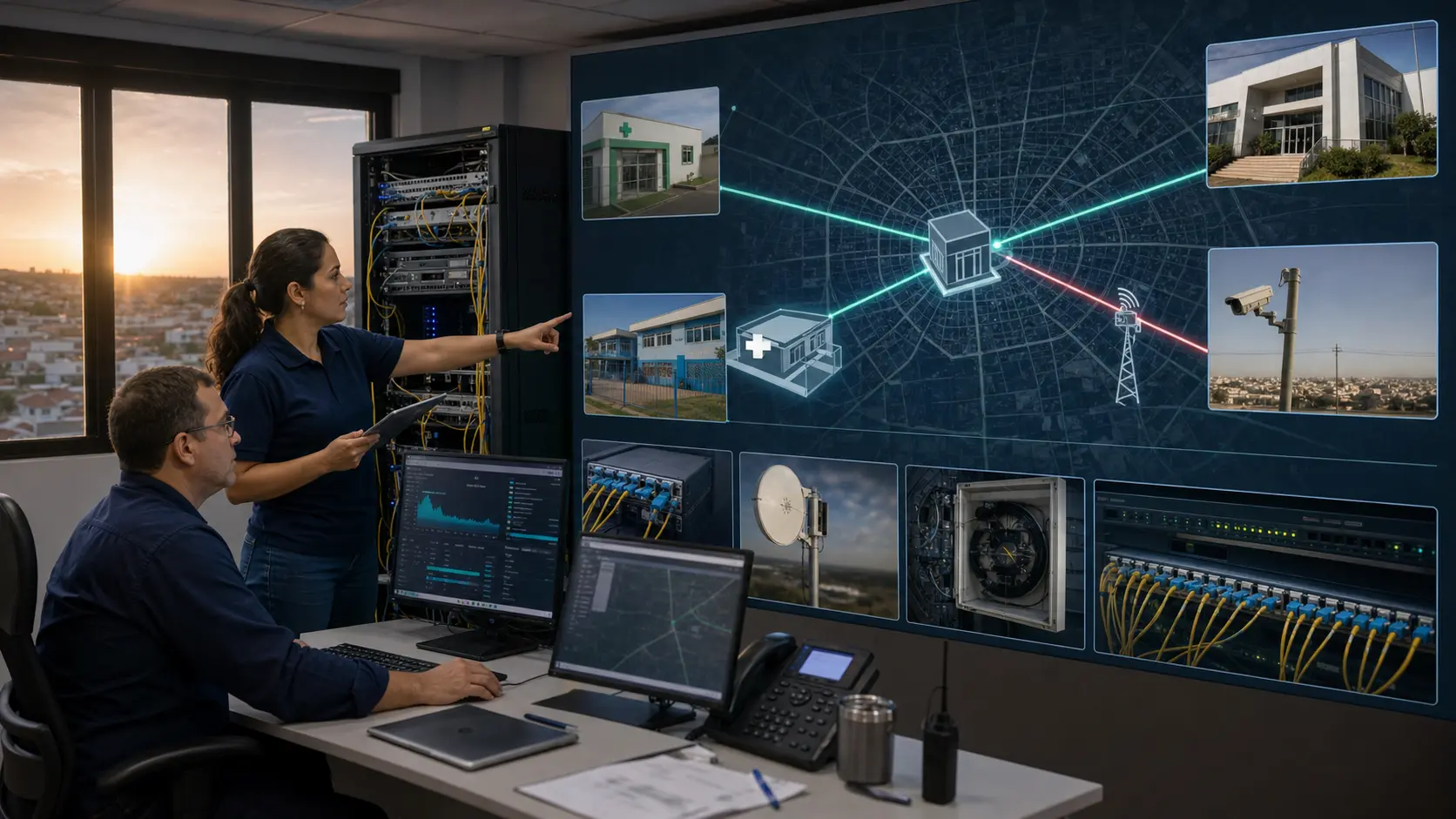
Imagine the first three minutes of a municipal network failure. At 8:00 on a weekday, staff begin authenticating at schools, clinics and administrative offices. At 8:03, several sites disappear from the monitoring map. A health unit can still power its local equipment but cannot reach a central application. A public counter can see the login screen but cannot complete a transaction. Cameras continue to produce images at the edge, yet the control room no longer receives them.
Someone must decide whether the common cause is a damaged fibre, failed radio, access switch, power supply, firewall policy, upstream route, name-resolution service, server platform or monitoring blind spot.
That moment is a better way to understand TECHS TECNOLOGIA EM HARDWARE E SOFTWARE than a catalogue of technology labels. The decisive product is not “internet,” “cloud,” “security” or “support” in isolation. It is the ability to preserve and restore a chain of municipal work across all of them. A public buyer is paying for a control boundary: who sees the alarm, who owns the route, who can enter the site, who has configuration authority, who calls a carrier, who informs the municipality, and who can prove that recovery is complete rather than merely plausible.
TECHS is an interesting test because the company leaves several strong public traces. The Registro.br record for AS262775 ties an autonomous system directly to the same Brazilian taxpayer identifier that appears in Araraquara’s contracts. The municipality’s 2022 award record describes interconnection and the transmission and reception of data, voice and images between municipal bodies, with security, control, management and monitoring. The company’s current managed-services page says it manages servers, networks and workstations proactively. Each item matters. None, alone, tells the contract manager what happened at 8:03.
The thesis, then, is deliberately narrow: for a local infrastructure supplier, the municipal network itself is the product. Registered resources can show that the supplier has an independent routing identity. Contract records can show that a government trusted it with a broad operational remit. Service pages can show the functions it wants to sell. But continuity depends on the joins between those surfaces, and those joins are precisely where the public record becomes thin.
First prove which TECHS is under examination
“Techs” is too generic a word to support serious attribution. Search results can mix brands, similarly named providers, historical legal forms and unrelated companies. The bridge must begin with the durable Brazilian identifier rather than a logo or a trading name.
The strongest bridge is the national internet registry. The AS262775 RDAP response names the registrant as TECHS TECNOLOGIA EM HARDWARE E SOFTWARE and gives its handle as 00981458000179, the digits of CNPJ 00.981.458/0001-79. It records the autonomous system as registered on September 2, 2010, and links it to the IPv4 allocation 186.232.248.0/22 and the IPv6 allocation 2804:df0::/32. A separate entity response repeats the same organisation name and identifier. This is direct registry evidence, not an association inferred from a similar brand.
The domain bridge is equally direct. The registry’s record for techs.com.br and its record for techs.net.br both identify the same CNPJ and exact organisation as registrant. That matters because the public website has used both domains: www.techs.com.br points visitors toward the latter, while the current service catalogue is presented at techs.net.br. The registry evidence therefore joins the legal entity, the autonomous system and the public web presence without relying on an unverified social account or a search-engine guess.
Current corporate data provides another check. A Casa dos Dados record, which says its underlying information was last consulted from federal tax records on June 13, 2026, lists TECHS TECNOLOGIA EM HARDWARE E SOFTWARE LTDA as active, opened on December 20, 1995, and based at Rua Primo Torquato 210 in Araraquara. It describes technical support as the principal activity and lists, among secondary activities, network-access provision, Serviço de Comunicação Multimídia, hosting and application services, construction of telecommunications networks, IT consulting and electronic-security monitoring. This is a registry mirror rather than the primary tax authority, so it should be treated as corroboration. Its value is that the CNPJ, address and range of declared activities agree with independent public records.
Municipal documents close the identity loop. Araraquara’s December 2021 contract extract identifies the contractor as TECHS TECNOLOGIA EM HARDWARE E SOFTWARE EIRELI and prints CNPJ 00.981.458/0001-79. The June 2024 extension does the same. The older “EIRELI” suffix and current “LTDA” suffix should not be treated as two suppliers: the invariant CNPJ is the stronger identity key. The records support continuity of the taxpayer even as the legal styling changed.
Federal regulatory material supplies the final bridge required for this examination. An Anatel act published in the federal official journal identifies TECHS TECNOLOGIA EM HARDWARE E SOFTWARE LTDA–EPP, CNPJ 00.981.458/0001-79, and grants radiofrequency-use authorisation associated with an authorisation to provide Serviço de Comunicação Multimídia. The act is dated 2018; it is evidence of that regulatory action, not a substitute for obtaining a current authorisation certificate during a 2026 procurement.
The identity conclusion is unusually firm. The directory entry, the taxpayer, AS262775, the two Techs domains and the municipal contractor can be analysed as the same enterprise. What remains uncertain is not who TECHS is. It is how much of each delivered service TECHS performs with its own people, facilities, links and systems.
Four operating surfaces, four different levels of proof
The public record supports four operating surfaces: software and managed IT, access and routing, hosting and security, and municipal data transport. The mistake would be to treat all four as equally proven.
Software is the least product-like of the four. The company name includes hardware and software, its declared principal activity is technical support, and the current managed-services description says TECHS manages servers, networks and workstations for organisations without a structured technology department or with overloaded staff. The service navigation also offers software-update management, access-policy configuration, hardware and software optimisation, asset inventory and remote helpdesk. That supports a managed IT operation. It does not identify a proprietary software platform, a development methodology, a product release cycle or a municipal application owned by TECHS. A buyer should therefore distinguish “software under management” from “software developed and controlled by the supplier.”
Access has harder evidence. The 2018 regulatory act, the registered autonomous system, the allocated address space and the corporate activity codes all support an access-provider role. The company’s own continuity account says it evolved from an internet provider into a managed-service, cybersecurity, cloud and hosting supplier over almost three decades. That is a company-authored claim, but it fits the independent registration history: the domain techs.com.br dates to 1996, AS262775 dates to 2010, and municipal data contracts appear across multiple later years.
Hosting sits between claim and observable capability. TECHS markets dedicated servers and virtual private servers with administrative access, Linux or Windows options, configuration and maintenance support, dedicated resources and what it calls redundant infrastructure for high availability. It separately markets corporate website hosting with scalable resources and daily backups. The CNPJ record includes hosting and application-service activities, while AS262775 supplies a plausible address surface. Yet the public pages do not disclose whether the servers are in a TECHS-owned room, a colocated rack, a partner cloud, multiple facilities or a mixture. They do not publish data-centre locations, power design, hardware generations, capacity, certifications or recovery-point performance. The evidence proves an offer, not its physical architecture.
Municipal transport has the clearest customer-side evidence. The 2017 Araraquara contract history describes corporate traffic among municipal bodies and secretariats with security, control, management and monitoring. The 2022 award expands the wording to data, voice and images and names TECHS as winner at R$2.4 million for 12 months. A 2023 extension and 2024 extension continued that contract, the latter through June 8, 2025. These records prove a sustained responsibility for a municipal interconnection service.
They do not prove the topology. None of those public extracts says how many sites were connected, which sites were critical, what bandwidth each received, whether access was fibre or radio, whether a private routed network or internet overlay was used, where egress occurred, how paths were diversified, or which devices belonged to the municipality. The extracts refer readers to tender specifications and annexes, but the summaries available in this evidence set cannot answer those questions. A contract title is therefore strong evidence of scope and weak evidence of implementation.
The four surfaces overlap operationally. A managed firewall may terminate a municipal circuit. A hosted system may use addresses originated by AS262775. A monitoring platform may watch both local servers and access links. A field technician may service a camera and the network carrying its images. But overlap is not ownership. Each join needs its own proof: asset title, configuration authority, support responsibility, data location, subcontractor disclosure and recovery obligation.
AS262775 proves a routing surface, not a municipal map
An autonomous system number is a meaningful control asset. It lets a network originate prefixes under a distinct routing identity and express policy to other networks. For a buyer, that is more informative than a provider that merely resells connectivity behind another company’s address space. TECHS can be tied directly to AS262775 and to its allocated IPv4 and IPv6 resources.
At the July 18, 2026 evidence freeze, the RIPEstat announced-prefixes response observed four advertisements: the IPv4 allocation 186.232.248.0/22, two more-specific routes, 186.232.250.0/24 and 186.232.251.0/24, and the IPv6 allocation 2804:df0::/32. The two /24 routes sit inside the /22; they should not be added to the allocation as though they were separate address holdings. More-specific announcements can be used for traffic engineering or resilience, but the public route list does not reveal TECHS’s intent.
The routing view is visibly narrow. The RIPEstat neighbour response observed only AS268976 adjacent to AS262775 in its collector data. Hurricane Electric’s BGP view also showed one observed IPv4 and IPv6 neighbour, AS268976, while the CIDR Report view placed the same ASN on the upstream side of the path it observed. Those sources are useful signals, but they are not contracts and not complete maps. Collector visibility can miss private interconnections, backup transit that is not currently carrying advertisements, internal rings and layer-two wholesale arrangements.
The right conclusion is bounded. Public BGP observation supports a live, independently numbered routing surface and shows one visible external adjacency. It does not prove that TECHS has only one commercial transit provider. It does not prove that a backup path is physically diverse. It does not show where interconnection occurs. And it does not establish that municipal traffic is originated by AS262775 at all. A private city network could travel over circuits that never appear in the global routing table.
Routing security adds another procurement question. Separate RIPEstat origin-validation queries for the 186.232.248.0/22 route, 186.232.250.0/24, 186.232.251.0/24 and 2804:df0::/32 returned unknown with no validating route-origin authorisations at the freeze time. That is a point-in-time technical result, not an accusation of a route leak or hijack, and it can change quickly.
The significance is explained by NIC.br’s RPKI guidance: resource certification establishes responsibility for address space, while origin validation checks whether an autonomous system is authorised to announce a prefix. For a public buyer, an unknown state should trigger a request for the operator’s RPKI plan and route-filtering controls. It should not be converted into a claim that the service is insecure. RPKI validates route origin, not path quality, facility resilience, customer isolation or incident response.
A competent tender would ask TECHS for a routing evidence pack rather than a screenshot. It would include current Registro.br allocation records; every originated prefix; route-origin authorisations and maximum-length choices; internet routing registry entries; intended upstreams and exchange connections; BGP communities; filtering policy; change-control records; and alerts for unexpected origin, visibility loss or path change. The municipality would validate the pack from independent collectors at award and periodically during service.
Even that pack would leave the physical network unanswered. Logical diversity can collapse onto one duct, pole line, building entrance, power feed or wholesale fibre. Two carriers can lease the same cable. A radio backup can share the primary site’s mast and electricity. Two border sessions can terminate on one router. The procurement test is therefore not “How many providers?” but “Which failure domains remain common?”
For each critical municipal location, TECHS should be able to produce a route-and-asset sheet showing the service demarcation, access medium, owner of each segment, carrier or subcontractor, building entrance, active equipment, power source, addressing, routing mode, monitoring source and restoration owner. Sensitive details need not be published, but they must be available to authorised municipal staff and auditors. Without that sheet, AS262775 is evidence of corporate capability, not evidence of citywide control.
Araraquara bought an operating chain
The language of Araraquara’s contracts is more revealing than a generic “internet service” description. The 2022 award combines interconnection, transmission and reception of data, voice and images, corporate traffic among municipal bodies, security, control, management and monitoring. Those nouns describe an operating chain, not a commodity link.
Interconnection means the sites must participate in a coherent design. Transmission and reception mean capacity must work in both directions, including applications with different latency and loss sensitivities. Voice and images add real-time traffic. Security implies policy enforcement and evidence. Control and management imply configuration authority, inventory and change discipline. Monitoring implies telemetry, alarm ownership and escalation. If the supplier performs all of those functions, then the product is the maintained municipal network.
The contract history suggests continuity. Araraquara’s 2021 extract refers to an initial contract signed in June 2017 and a fifth extension that ran from December 2021 to June 2022. The new June 2022 award was followed by a June 2023 extension and a June 2024 extension. The available record therefore connects TECHS to the city’s data-transport function over several procurement cycles. It does not establish a current contract after June 8, 2025.
That distinction matters. Long tenure can indicate accumulated local knowledge, stable operations and satisfactory renewal decisions. It can also increase switching cost because one supplier learns the undocumented exceptions, site access procedures, legacy addresses, radio alignments, device passwords, cable routes and application dependencies. Public extracts do not tell which interpretation dominates. A buyer should not use renewal itself as a performance metric.
The video contracts show why local operations deserve separate attention. An Araraquara camera-contract extension covered leased video-surveillance cameras, electronic-security systems, maintenance and support through September 2022. In nearby Américo Brasiliense, a contract addendum identifies the same CNPJ and a service involving 15 leased cameras, security systems, maintenance and support. A later municipal journal extract records another extension of that camera arrangement in 2023.
Those camera records should not be mistaken for proof that the same physical network carried Araraquara’s corporate data. They do demonstrate a related operating pattern: leased equipment, municipal sites, electronic systems, maintenance and support. That pattern needs local labour, spares, access coordination and restoration work. It makes TECHS more than a distant bandwidth broker, while leaving unanswered whether technicians were employees, contractors or vendor partners.
For the municipality, the customer workflow should start before an alarm. Every site needs an agreed criticality tier, business owner, technical owner and service window. Every circuit needs a unique identifier tied to a physical demarcation and monitored interface. Every alert needs a clock: detection, acknowledgement, diagnosis, dispatch, workaround, restoration and root-cause report. Every workaround needs an expiration date. Otherwise the supplier can report that a link is “up” while the municipal service remains unusable.
The chain also needs a single incident commander. If connectivity, firewall, hosting and end-user support are sold as an integrated managed service, the municipality should not have to arbitrate among the same supplier’s internal teams. TECHS should own triage across its scope and document every handoff beyond it. If a wholesale carrier or software vendor is responsible, TECHS should still provide the ticket linkage, escalation status and evidence used to exclude its own layers.
Service restoration must be measured at the application boundary. A recovered BGP session does not prove that a clinic can retrieve a record. A ping does not prove that a voice service has acceptable jitter. A camera responding on the network does not prove that its stream reaches the control room or is retained. The acceptance test should replay the municipal transaction that failed, with the business owner confirming recovery.
Local hands are part of the architecture
Local support labour is often described as a commercial benefit. In municipal infrastructure it is a technical dependency. Someone must have permission to enter a school after hours, know which rack belongs to which service, carry the correct optical module, recognise a failed power supply, test a radio path, protect evidence after a security incident and coordinate safely around public buildings.
TECHS’s public offer supports a remote operations layer. Its 24/7 monitoring page says it monitors server and workstation health, memory, disk space and temperature, generates anomaly alerts and provides periodic reports. Its helpdesk page lists telephone, email, chat and portal channels, secure remote access with user permission, and a ticket system with history. These are company claims, not independently measured service levels, but they describe a plausible detection and remote-resolution workflow.
They do not describe the field workflow. The pages do not publish the number of technicians, employment arrangement, shift roster, dispatch radius, security vetting, certifications, spare-parts stock or average arrival time. They do not say whether a 24/7 monitoring alarm can trigger a 24/7 physical dispatch. They do not identify who covers simultaneous incidents or how the company handles a regional storm that affects several sites.
A buyer should procure local labour as named capacity. The bid should include roles rather than biographies: network operations lead, field lead, security lead, service manager and authorised substitutes. It should state normal and emergency coverage, maximum dispatch times by site tier, minimum concurrent crews, vehicle and test-equipment requirements, spare holdings, and procedures for escorted access. Monthly reports should separate remote fixes, field visits, carrier escalations and repeat faults.
Knowledge continuity is just as important as headcount. Municipal networks accumulate tacit knowledge in technicians’ notebooks and memory. The contract should require site diagrams, labelled photographs, patching records, device inventories, configuration backups and restoration instructions to be updated after every change. The municipality should be able to replace one technician—or the entire supplier—without rediscovering the network under pressure.
This is where a local supplier can have a real advantage over a national carrier: proximity can shorten diagnosis and dispatch, and a stable team can understand the city’s peculiarities. But locality is a hypothesis until it is measured. The relevant evidence is response by incident class, first-time fix rate, repeat visit rate, ageing tickets, after-hours performance and the proportion of work handed to third parties.
The hosting and security promise must be unbundled
TECHS’s current website presents a broad managed-service stack. Its VPS and dedicated-server page offers administrative control, operating-system choice, scaling and configuration support. Its DDoS page claims automatic detection and mitigation, traffic filtering, real-time monitoring and security reports. Its managed-firewall page claims configuration, continuous monitoring, threat reporting and support. These offers can complement a municipal access network, but each introduces a separate control boundary.
“DDoS protection,” for example, could mean a feature in a hosting platform, an appliance at the edge, upstream scrubbing, remote-triggered blackholing or a partner service. Those designs have different capacity limits and failure modes. The public page does not identify scrubbing locations, committed mitigation capacity, attack types covered, diversion method, clean-traffic return path, detection threshold or time to mitigation. A buyer cannot infer those details from the label.
The same problem applies to managed firewalls. The public page does not identify the hardware or software family, ownership structure, high-availability design, policy-review process, privileged-access controls, log destination, retention or emergency change procedure. If the firewall sits between municipal sites and applications, these details determine whether TECHS can restore service, whether the municipality can audit changes, and whether another provider can assume control.
The company’s backup and disaster-recovery page is more specific about the intended process: scheduled automated backups, encrypted cloud storage, periodic recovery tests and support for servers, desktops and cloud environments. Those are sensible features. The page does not publish recovery-point or recovery-time commitments, immutability, separation of credentials, geographic location, retention schedules, test results or the share of customers whose recovery tests succeed.
Its SOC page says a 24/7 team analyses logs and network traffic, detects intrusions and anomalies, responds to incidents and issues reports. Again, the claim describes a function, not its assurance. The public record does not identify the monitoring platform, telemetry coverage, analyst staffing, data residency, detection catalogue, escalation thresholds, evidence-preservation procedure or independent certification.
A municipal buyer should therefore build a responsibility matrix for every layer. For physical access: who owns the cable and repairs it? For routing: who originates the prefix and controls the border policy? For firewalling: who approves and implements rules? For monitoring: which telemetry proves availability? For hosting: who owns the hardware, facility contract and hypervisor access? For backup: who can delete copies and who tests restoration? For incident response: who decides containment, who preserves logs and who communicates with authorities?
The matrix should mark four distinct states: operated directly by TECHS; operated by a disclosed subcontractor under TECHS’s service responsibility; operated by the municipality; or outside the contracted scope. Ambiguous shared responsibility is where outages lengthen and security evidence disappears. The supplier should not be penalised for using capable partners, but the buyer must know where those partners sit and retain contractual rights over their performance.
The price shows a bundle, not its unit economics
Public prices reveal the scale of the municipal commitment but not what each component costs. Araraquara’s 2022 homologation records R$2.4 million for 12 months—R$200,000 per month by simple division. The 2023 extension records a 3.6973 per cent adjustment and estimated expenditure of R$2,488,735.88, or about R$207,394.66 per month. The 2024 extension says values were maintained for another year.
Those numbers cannot be converted into a price per site or megabit from the public extracts. The number of endpoints, capacities, equipment, licences, staff, field visits, security functions and taxes are not stated there. Comparing the total with a consumer broadband tariff would be meaningless; a municipal managed network may bundle private transport, equipment, monitoring, security, repair and service management.
The correct commercial test is decomposition without destroying accountability. Bidders should price access circuits by tier, managed equipment by type, security services by protected unit, hosting by resource and support by service band. Shared operations and transition work should be explicit. The municipality can then compare market rates, identify cross-subsidy and calculate the effect of adding or removing sites.
At the same time, the city needs one end-to-end service measure. A fully itemised contract can encourage each component owner to meet a narrow target while the public service fails. The pricing schedule should therefore coexist with outcome credits for site and application availability, incident response and recovery. Component transparency and single-point accountability are complements, not alternatives.
The contract should also distinguish recurring value from embedded switching cost. Installation, civil work, configuration discovery and documentation are one-time activities. Circuits, monitoring and support recur. Supplier-owned edge devices, undocumented configurations and non-exportable logs may look inexpensive during service but become expensive at exit. A credible price includes the cost of leaving.
Compliance is a chain of current evidence
The legal and regulatory record requires careful chronology. In a 2011 TRF3 appellate decision, the court accepted a federal indictment concerning alleged unauthorised radio internet activity in Nova Europa between 2003 and 2007. The quoted accusation tied TECHS and CNPJ 00.981.458/0001-79 to equipment and a municipal service. The decision was procedural—it ordered the case to continue—and did not itself decide guilt.
Later docket publications complete more of the picture. A 2016 TRF3 journal entry in the same proceeding refers to execution of sentence and communication of a conviction. A January 2017 TRF3 entry records that punishability had been extinguished and orders the case archived. These public entries do not provide, in one concise record, a defendant-by-defendant account of the sentence, performance of obligations or technical remediation. They should neither be erased from diligence nor stretched into a claim of present non-compliance.
The later regulatory record moves in the other direction. The 2018 federal publication grants the exact CNPJ radiofrequency-use authorisation associated with an SCM authorisation. The current corporate record lists SCM and network-access activities. Together, they show a subsequent formal regulatory surface. They do not prove the status of every station, frequency or authorisation in 2026.
That is why a buyer should request current primary evidence: the service authorisation, station and radiofrequency records relevant to the proposed design, equipment certification where required, compliance contacts, and any pending enforcement that could affect delivery. The exercise should be repeated at renewal. A historical authorisation document should not be treated as perpetual, and a historical case should not be treated as a current condition.
The wider regulatory framework also matters. Anatel’s current General Regulation of Telecommunications Services characterises SCM as a collective-interest service provided under the private regime that can provide fixed transmission capacity and internet connection. The same regulation explains that private-regime services are not backed by a Union guarantee of universalisation or continuity. Municipal continuity must therefore be created by architecture, contract and operations; it cannot be assumed from the service category.
Data protection adds another join. Brazil’s LGPD governs the treatment of personal data, while the ANPD incident guidance says qualifying incidents must be communicated to the authority and affected people within three business days, subject to applicable rules; the authority’s regulation announcement says incident records involving personal data must be retained for at least five years. A supplier monitoring municipal networks may process logs, identifiers, camera data or authentication evidence, depending on scope. The contract must identify controller and processor roles, permitted data, locations, retention, access, subcontractors and the notification clock.
Marketing claims of firewalling, SOC monitoring or encrypted backup do not demonstrate compliance with the law. Compliance depends on the actual data flow and on timely joint action. The municipality needs to know when TECHS becomes aware of an incident, what facts it can supply, who decides whether risk is relevant, and how evidence reaches the municipal data-protection officer. A contractual notice to the city must be faster than the city’s external deadline.
Security assurance should include negative evidence as well as policy documents. The supplier should show recent restoration exercises, privileged-access reviews, vulnerability remediation, failed-login monitoring, configuration backup tests, route alerts and incident simulations. Where results reveal a gap, the buyer should require a dated improvement plan. The purpose is not to demand perfection; it is to prevent a broad service label from concealing an untested dependency.
Competition begins by separating control from convenience
TECHS’s long Araraquara history creates a real procurement dilemma. A local supplier with registered network resources and years of city work may understand sites and failure patterns better than a new entrant. Replacing it merely to create the appearance of competition could increase risk. Renewing without portable documentation could deepen dependence. The answer is not to prefer incumbency or novelty in the abstract. It is to make control portable.
The first competition test is resource control. A bidder should disclose whether customer addresses are provider-dependent, whether the municipality can use its own addresses, who controls domain and certificate accounts, and how routes change at transition. TECHS’s ownership of AS262775 is a positive capability signal, but municipal portability depends on the addresses and policies actually assigned to the city, not on the supplier’s corporate resources.
The second test is physical control. Bidders should map owned fibre, leased fibre, radio, third-party access, building entrances and restoration responsibilities. A low bid assembled from one wholesale provider may be less diverse than it appears. Conversely, a local operator using wholesale capacity can still deliver a resilient service if paths, contracts, spares and escalation are designed properly.
The third test is operational control. Monitoring data, ticket history, device configurations, diagrams and performance baselines must be exportable in usable formats. The municipality should have read access during service and full delivery at exit. Passwords and privileged accounts should be held in a controlled municipal escrow or transferred through a tested procedure. No critical service should depend on a former technician remembering how it worked.
The fourth test is substitution. The city should be able to replace hosting without replacing every access circuit, replace a circuit without losing monitoring, or add a second transit path without surrendering service management. Modular substitution creates competitive pressure. End-to-end accountability prevents the modules from becoming an excuse for failure. The contract needs both.
Federal public-sector guidance offers a useful benchmark even where a municipality applies its own rules. The Brazilian government’s ICT contracting instruction calls for a precise solution description across the life cycle, publication of planning and contract material, security and privacy requirements, and transition activities including final documentation, knowledge transfer, access revocation and continuity resources. Those are not administrative decorations. They are the mechanism by which a buyer converts a supplier relationship into an auditable service.
Switching cost should be measured annually. The service manager should maintain a register of dependencies that would delay exit: provider-owned addresses, proprietary monitoring formats, leased devices, undocumented local cabling, certificates, licences, cloud accounts, encryption keys, vendor-only support contracts and personal knowledge. Each dependency should have an owner, export method, test and removal date. If it cannot be removed, its cost should be visible in the next competition.
The evidence packet a municipal buyer should demand
TECHS can already provide the first page of a credible packet: CNPJ identity, AS registration, address allocations, domain registrations and contract history. The next procurement should require the rest in a form that can be tested.
Identity and authority. The supplier should provide current corporate registration, Anatel service authority, relevant station and frequency records, insurance, tax standing, and a list of legal names used in earlier contracts. Every document should resolve to CNPJ 00.981.458/0001-79. Any affiliate or partner must be named with its own identifier and exact responsibility. A similar brand is not enough.
Network resources. The packet should list all autonomous systems, prefixes, route-origin authorisations, internet routing registry entries, domains, certificate accounts and address assignments used for the service. It should state which belong to TECHS, the municipality or a third party. Independent route collectors should be used to verify announcements, but collector data should not be treated as a complete commercial topology.
Physical and logical topology. The supplier should deliver current diagrams at citywide and site level. They should show critical sites, paths, media, providers, demarcations, edge devices, security zones, routing, internet egress, management networks and monitoring sources. A separate diversity schedule should identify shared ducts, poles, entrances, power, hardware and upstreams. The buyer should conduct sample field inspections.
Service levels that follow public work. Availability should be defined at the site and application boundary, with agreed maintenance exclusions and a transparent calculation. Voice should have latency, jitter and loss targets. Video should have stream and retention tests. Security alarms should have triage and containment clocks. Field support should have dispatch and restoration targets by site tier. Repeated failures should trigger problem management, not an endless series of closed tickets.
Operations and labour. TECHS should name accountable roles, coverage windows, escalation routes and minimum concurrent capacity. The city should see staff turnover in critical roles, unresolved skill gaps, subcontractor use and after-hours coverage. Monthly evidence should include alarm-to-acknowledgement time, remote versus field resolution, carrier handoffs, repeat incidents, backlog age and root-cause completion.
Security and privacy. The packet should define privileged access, multifactor authentication, logging, vulnerability management, segmentation, configuration control, endpoint protection where in scope, backup immutability, recovery tests and incident notification. It should identify every data location and subprocessor. The city should retain audit access and receive evidence quickly enough to meet legal obligations.
Continuity and recovery. Every critical service needs recovery-point and recovery-time objectives, dependencies, alternate communications and manual workarounds. Tests should include loss of primary access, border equipment, power, a hosting node, credentials and a key technician. A tabletop discussion is useful but insufficient; selected recoveries should restore real services from documented backups.
Commercial decomposition. Prices should separate circuits, equipment, licences, hosting, security, monitoring, field support, projects and transition. The city should see wholesale pass-throughs and indexation. Service credits should attach to outcomes, while unit prices allow benchmarking and controlled changes. Renewal should be based on measured need, performance and exit readiness.
Transition. The supplier should maintain a living exit plan from the first month. It should cover configuration and data export, address changes, circuit migration, account transfer, certificate rotation, log retention, asset return, knowledge transfer, parallel running and revocation of old access. At least once a year, the municipality should test a sample export and recovery using staff who do not rely on the supplier’s private knowledge.
This packet is deliberately more demanding than a brochure, but it is not hostile to a local supplier. On the contrary, it gives TECHS a way to turn genuine operating knowledge into verifiable value. It also prevents the buyer from asking the company to guarantee dependencies it does not control. Clear boundaries protect both sides.
What the public record still cannot answer
The public evidence supports a robust core conclusion. TECHS is the long-lived Araraquara company behind CNPJ 00.981.458/0001-79, AS262775 and the Techs domains. It has held registered IPv4 and IPv6 resources, received a radiofrequency-use action associated with SCM authority, marketed access-adjacent hosting and managed services, and supplied municipal data transport and maintained electronic systems.
The record stops well before a topology. It does not show how many municipal sites were connected, what media or capacities they used, which paths were physically diverse, whether global routes carried municipal traffic, where network egress occurred or whether the visible AS adjacency represented the full transit design. It does not identify wholesale carriers or subcontractors.
It stops before a service-level history. Contract extensions demonstrate continued contracting decisions, not uptime, latency, incident response or user satisfaction. No reviewed public source supplies a complete outage log, root-cause archive, service-credit history or restoration distribution. The absence of those materials from this evidence set is not evidence that incidents did or did not occur.
It stops before a staffing structure. The company describes monitoring, remote support and 24/7 security functions, and public contracts involve maintenance. The reviewed sources do not disclose staffing levels, qualifications, employment arrangements, on-call depth or field-arrival performance. A buyer cannot infer 24/7 dispatch from 24/7 monitoring.
It stops before a hosting architecture. The public offer includes VPS, dedicated servers, website hosting, backups, DDoS mitigation, firewalls and a SOC. It does not publish facility ownership, location, power design, hardware estate, hypervisor controls, mitigation capacity, backup geography, customer isolation or independent assurance. Those are diligence questions, not established facts.
It stops before current regulatory completeness. The records show historical proceedings and a later authorisation action, but they do not replace a current regulator check for every service, station and frequency proposed in a new contract. Nor do they provide a comprehensive security-incident or enforcement history.
The watchpoints are therefore concrete. Monitor changes to the CNPJ and legal name; AS262775 contacts and allocations; announced prefixes and visible neighbours; route-origin validation; current authorisations; contract awards and extensions; disclosed partners; recovery-test results; recurring site failures; staffing coverage; and transition readiness. A change in any one item may be harmless. An unexplained cluster is a reason to investigate.
TECHS’s strongest public asset is not a claim of scale. It is the unusual ability to connect the company’s legal identity, internet resources and municipal work with primary records. That gives a buyer a solid starting point. The procurement task is to continue the chain down to cables, configurations, people, clocks and recovery evidence.
At 8:03, nobody benefits from an argument about whether the failure belongs to “network,” “cloud” or “support.” The public service either works or it does not. The supplier that sells the municipal network must be able to see the whole operating chain, act across its own boundary, escalate beyond it and prove recovery. That—not an ASN by itself, not a broad catalogue, and not an incumbent relationship—is the product.