
Summary
- Enegren Technology is best understood as a locally staffed managed-service provider, not as a general cloud operator. Its public offer combines managed IT, cybersecurity, backup, Microsoft 365 work, VoIP, websites, connectivity and managed AI workspaces around a flat-rate, local-support proposition.
- That consolidation can reduce coordination costs for a small business, but it also concentrates five kinds of control: identity administration, privileged support access, recovery infrastructure, communications, and AI-connected business data.
- Enegren publishes useful descriptions of its service scope and implementation thinking, yet the public evidence does not establish the exact contracting entity, standard service levels, current product vendors, backup recovery objectives, security assurance reports, AI subprocessors, workspace isolation design or exit mechanics.
- The most important procurement test is therefore not whether Enegren has a long service list. It is whether a buyer can convert each marketing promise into an owned account, a responsibility matrix, measurable evidence, an escalation path and a rehearsed exit.
Five keys, one local number
Consider a hypothetical 45-person Wichita business on a Monday morning. Its staff sign in through Microsoft 365. A managed endpoint tool watches their laptops. A firewall links the office to the internet. A cloud copy protects the accounting files. Desk phones and mobile applications carry customer calls. The company website and domain receive sales enquiries. An AI workspace can search internal policies, inspect spreadsheets and help staff work through email. When something fails, one local number is supposed to start the response.
That arrangement is attractive because small companies rarely have enough specialists to cover identity, networking, endpoint security, backup, telephony, web operations and AI governance in-house. A local managed-service provider can pool labour across customers, maintain tools that would be uneconomic for one small employer, and give management a single place to assign responsibility. Enegren Technology builds its public proposition around exactly that idea. It advertises flat-rate managed IT, round-the-clock network monitoring and a Wichita-based team, while its service catalogue extends into cybersecurity, backup, communications, websites and managed AI workspaces.
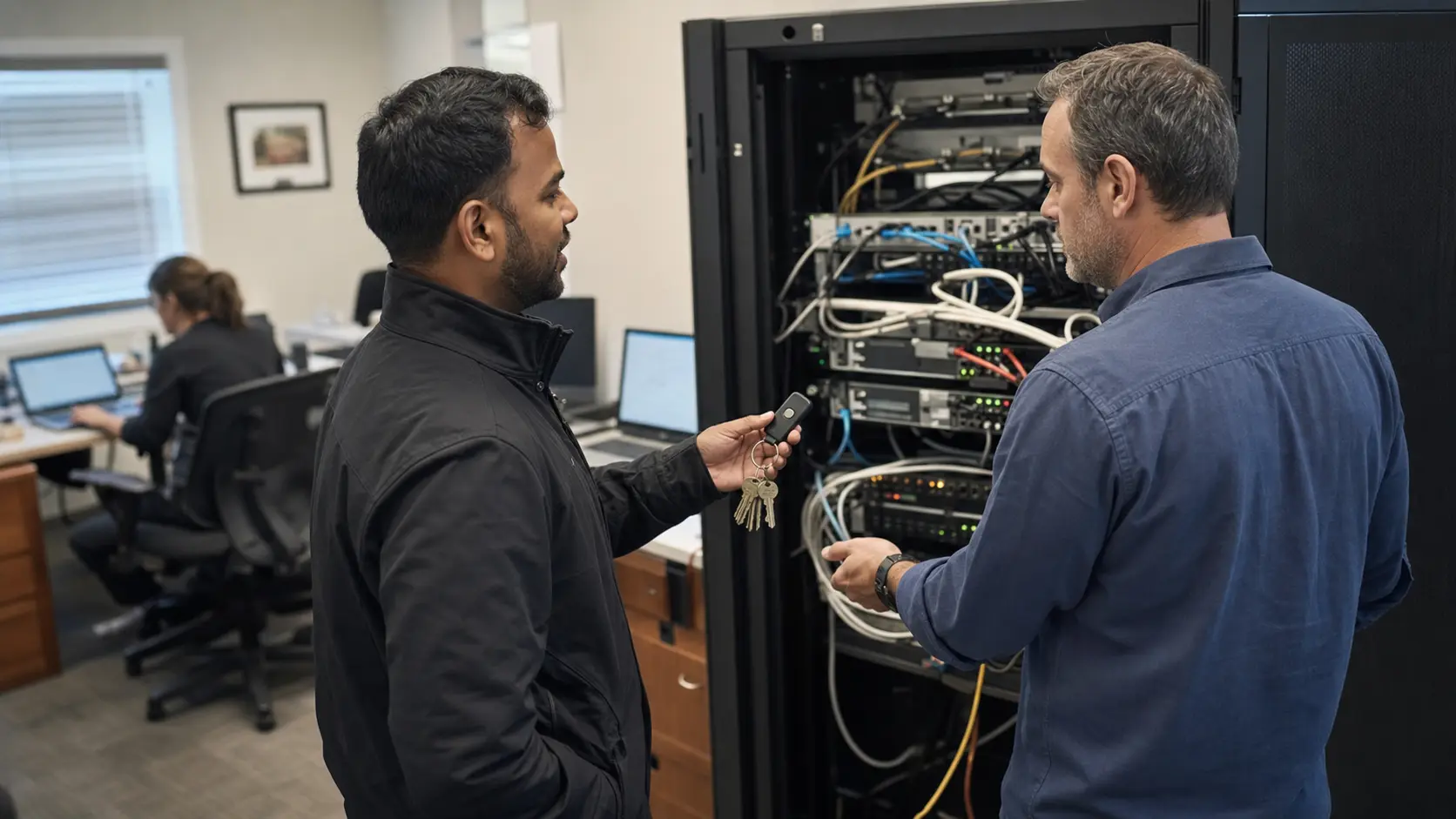
But the customer is not merely buying labour. It is handing over keys.
The first key opens the identity system: administrator roles, password resets, licence assignments and access policies. The second opens the support console: remote-control software, endpoint management, ticket history and network devices. The third opens continuity systems: backups, recovery credentials, retention policies and failover equipment. The fourth opens communications: telephone numbers, call routing, domains, DNS records and website administration. The fifth, newly important, opens business context to AI: email, documents, manuals, spreadsheets and the permissions that connect them.
The same concentration that makes the service convenient also enlarges the consequences of poor documentation, weak privilege controls, an unresolved incident or a difficult separation. This is not a criticism unique to Enegren. The US Cybersecurity and Infrastructure Security Agency has warned that managed providers are attractive targets because compromising one provider can create access to multiple customer networks, and it advises customers and providers to make security responsibilities explicit in contracts. The UK National Cyber Security Centre similarly tells buyers to examine privileged access, backups, incident notification, subcontractors, service levels and exit terms when choosing an MSP.
Enegren’s investment case therefore turns on a paradox: the buyer gains one accountable local relationship only if it resists treating that relationship as a substitute for verifiable controls. “One number to call” has operational value. It is not, by itself, an architecture, a service level or an exit plan.
A clear brand, a less clear contracting perimeter
The current public identity is straightforward at brand level. Enegren Technology presents itself as a family-owned Wichita company with more than 30 years of history. A June 2026 company announcement published by the Wichita Regional Chamber of Commerce identifies Martin Enegren as founder and chief executive, Danny Enegren as president, and says the business moved to its first owned headquarters at 3815 South Midco Street. The announcement says Enegren employs 27 people in Wichita, does not outsource support, and operates alongside sister businesses Enegren Security and Enegren Electric. These are company-supplied claims carried on a chamber site, not an independent audit, but they establish how management currently describes the group.
A July 2026 report by the Wichita Business Journal independently describes Martin Enegren as the founder and says the company works with about 400 businesses locally and nationally. The accessible preview does not disclose the customer mix, contract size, retention rate or which services those businesses buy. That figure is therefore useful evidence of reported reach, not proof that 400 organisations receive the same managed stack or service level.
The older record is more complicated. A Better Business Bureau profile associates the same website and phone number with “Enegren Computer Services, Inc.” and lists Martin Enegren as owner. It also reports a 1993 incorporation date and a 1996 business start, while current company material says the enterprise began in 1989. BBB explicitly cautions that it does not verify all information supplied by third parties. Its entry supports identity lineage, but it should not be used as a substitute for a current state registration, certificate of good standing or signed ownership disclosure.
The distinction matters because Enegren now markets several service families that can carry different legal and regulatory obligations. A buyer may encounter the technology company, an alarm and physical-security sister company, an electrical business, a software vendor, a cloud provider, a telecommunications carrier or another subcontractor in one project. The public site does not provide a standard agreement showing which entity contracts for each component, which one carries professional and cyber liability, or whether the customer has separate contracts when work crosses those boundaries.
The sensible procurement position is narrow and factual: the Enegren Technology brand is current and locally established; the precise contracting perimeter remains a document-level question. Before relying on a proposal, a customer should ask for the exact legal name, state registration, insurance certificates, tax form, service address, ownership of each service obligation and a list of subcontractors that can access customer systems. None of those requests is unusual for an MSP.
They are the minimum needed to know which counterparty is accountable if a recovery fails, a phone number cannot be released, or an AI-connected data store is mishandled.
What Enegren is — and is not
Enegren should be evaluated as a managed operator of a customer’s technology environment. Its managed IT page lists endpoint detection and response, spam filtering, security policy work, patching, remote connectivity, asset management, network monitoring, cloud backup, Microsoft 365 backup, firewall maintenance, licence management, assessments, training and a dedicated technical adviser. The company also offers a co-managed support model for organisations that retain internal IT staff. This is a broad operational role: the provider can observe, configure and support many of the systems through which a customer does business.
It would be a category error, however, to describe Enegren as a general cloud operator merely because it resells, configures or manages cloud-dependent services. The public pages do not identify Enegren-owned data centres, a proprietary infrastructure cloud, a carrier network or a foundation AI model. Its own language describes managed environments, cloud backups, Microsoft services, internet calling and cellular failover. Those offerings necessarily depend on upstream software, connectivity, hosting and communications providers, even when Enegren is the customer-facing operator.
Historical telecommunications records reinforce the need for care. A National Emergency Number Association Company Identifier record names “Enegren Computer Service Inc” as a VoIP reseller, but the record is prominently marked cancelled. Federal Communications Commission public notices show a 2011 action associated with call sign WQOL617 and the 3650–3700 MHz band, while a 2021 renewal action for the same call sign is marked dismissed. These records establish lineage only. They do not demonstrate current spectrum authority, current carrier status or a present ability to originate emergency calls independently of an upstream provider.
This operating distinction has practical consequences. If Enegren manages a cloud backup, the customer needs to know whose storage account and software perform the backup. If Enegren supplies VoIP, the customer needs to know the underlying carrier, account ownership and porting process. If Enegren supplies an AI workspace, the customer needs to know the model host, storage locations and connected applications. The MSP can still be accountable for design, support and escalation. It cannot make the upstream dependencies disappear.
Key one: identity and onboarding
An MSP relationship becomes consequential during onboarding, before the first ordinary support ticket. That is when the provider discovers the network, creates administrative roles, installs management software, changes security policies, connects backup systems, gathers vendor accounts and decides how much control remains with the customer.
Enegren’s public Microsoft 365 migration guidance offers a useful picture of how it thinks about this work. Its December 2025 article describes discovery, identity design, multifactor authentication, pilot users, DNS changes, cutover, post-migration support, documentation and a test restore. It also gives illustrative project ranges: $3,000–$5,000 for ten users, $10,000–$15,000 for 35 users and $20,000–$30,000 for 75 users, excluding licences and subject to scope. These are company-published examples, not binding prices, but they show that significant onboarding and migration work may be priced as a project rather than absorbed into a monthly fee.
The sequence is credible because identity is the root of the rest of the stack. If the customer’s Microsoft tenant is created under an account the customer cannot independently access, later control of email, files, security settings and AI connectors can become contingent on the provider. If domain registration and DNS are held in a technician’s account, a commercial dispute can become an availability incident. If the only emergency administrator is protected by a phone owned by the MSP, the customer has no true break-glass route.
Good onboarding therefore requires more than a list of installed tools. It should produce a signed control register:
| Control | Customer should retain | Enegren may operate | Evidence to collect |
|---|---|---|---|
| Microsoft 365 tenant | Legal ownership, billing visibility, at least two emergency administrators | Delegated administration and day-to-day policy work | Tenant identifiers, role export, emergency-access test |
| Domains and DNS | Registrant ownership, renewal rights, recovery contacts | Record changes and monitoring | Registrar export, transfer code procedure, DNS inventory |
| Endpoint management | Right to approve installation and revoke access | Monitoring, patching, remote support | Device inventory, role list, removal procedure |
| Firewall and network | Configuration copy and replacement rights | Maintenance, alerting and approved changes | Current configuration, diagram, change history |
| Software licences | Visibility into terms, quantities and renewal dates | Procurement and administration | Licence register, renewal calendar, assignment export |
Enegren says its managed service is customisable and includes asset and licence management. That makes a control register compatible with, rather than hostile to, its service model. The unresolved question is whether this level of documentation is standard, an optional project deliverable or something a customer must negotiate.
There is also a choice between fully managed and co-managed service. A small organisation with no internal technical staff may prefer Enegren to hold most operational roles. A larger buyer may keep identity architecture, security policy and vendor ownership internally while using Enegren for the help desk, field work and monitoring. Neither design is automatically superior. The important point is that “fully managed” should describe the division of labour, not the surrender of legal ownership or emergency control.
The onboarding acceptance test should be simple enough for a non-specialist executive to witness. The customer signs in with its own emergency account, verifies that it can see licences and administrators, retrieves a network diagram, confirms domain ownership, and watches Enegren revoke a temporary role. If those actions cannot be completed before go-live, the relationship has begun with dependency but without governable control.
Key two: the support console
The second key is privileged support access. Enegren’s current Quick Support page directs customers to a portal hosted at enegren.halopsa.com, an email address, a telephone number and a remote-connect service on an rmmservice.com domain. This is useful operational evidence: the support process is not just a local technician answering a phone. It includes externally hosted ticketing and remote-management surfaces that can mediate access to customer machines.
That is normal for an MSP, but it changes the threat model. A remote-management system can deploy software, execute commands, change settings and reach many endpoints quickly. A ticket system can contain names, device details, incident descriptions and screenshots. The provider’s administrators may hold delegated rights across multiple customer tenants. These capabilities make fast support possible; they also make identity security, logging and role separation at the provider materially relevant to the customer.
CISA’s joint advisory on protecting MSPs and their customers recommends multifactor authentication for privileged access, monitoring and logging, segregation of internal networks, least privilege, secure remote access, incident-response plans and contractual clarity. A buyer should turn those general principles into questions specific to Enegren:
- Is every technician’s access individually attributable, or are shared accounts used?
- Is phishing-resistant multifactor authentication required for remote administration?
- Can a technician connect without active customer approval, and if so, under what logged conditions?
- How quickly are departed employees removed from customer systems?
- Are customer environments separated within the support and management tools?
- Can the customer receive administrator, remote-session and configuration-change logs?
- What is the containment plan if the remote-management platform or ticketing service is compromised?
Enegren’s site uses several phrases that sound similar but should not be treated as interchangeable. It advertises 24/7 network monitoring. Its June 2026 company announcement refers to managed detection and response with a 24/7 security operations centre. Its IT support page lists normal office hours of Monday to Friday, 8 a.m. to 5 p.m. Monitoring can mean automated alert collection. A security operations centre can mean analysts triage security detections. Neither necessarily means that a general help-desk engineer will answer every after-hours operational call or begin remediation within a guaranteed period.
The company’s own 2025 pricing article says advanced managed packages may include 24/7 security operations and that buyers should expect published service levels. It also says Enegren offers service levels and round-the-clock options. Yet the public site does not show response targets, priority definitions, escalation tiers, maintenance windows or service credits. The gap is not proof that those terms do not exist. It means they must be obtained in the proposal and contract.
A usable service-level schedule should distinguish at least four clocks: acknowledgement, human triage, work start and restoration or workaround. It should state whether the clock runs outside office hours, which events are automatically opened as tickets, who can declare a severity-one incident, and when management is notified. The distinction matters at 2 a.m. when an alert says a server is unreachable. “The system was monitored” and “a qualified person acted” are different outcomes.
Local labour remains a genuine differentiator if it is real at the point of escalation. The chamber announcement says all 27 staff are Wichita-based and support is not outsourced. A buyer should test that claim operationally by asking who handles first-line tickets, security alerts, field dispatch, overnight calls and vendor escalation. If an upstream security operations centre, telecommunications carrier or cloud vendor supplies part of the response, that does not invalidate the local model. It should simply be disclosed so that “local accountability” describes the customer-facing chain accurately.
Key three: backup is a restoration service
Backup marketing often begins with copies and ends before recovery. Enegren’s backup page says it follows the 3-2-1 pattern, keeps an off-site copy, monitors backups around the clock and helps customers determine what to protect and how often. Its services overview adds encrypted cloud and on-site backups and says recovery procedures are tested regularly. A January 2026 readiness guide recommends off-site immutable backups and a restore test.
These are sensible design principles, but they remain company claims at a high level. The public pages do not name the backup software or storage provider, define the recovery point objective, define the recovery time objective, specify retention periods, identify the storage region, describe encryption-key custody, state whether the off-site copy is administratively isolated, or publish restore-test results. They also do not show whether “immutable” is a default technical setting, an available option or general advice in the company’s January 2026 readiness guide.
CISA’s StopRansomware Guide recommends offline or otherwise protected backups, encryption, regular testing of availability and integrity, and recovery planning. The reason is straightforward: a green backup dashboard does not prove that a business application can be restored into a clean environment after identity systems, production servers and administrator accounts have all been compromised.
For an Enegren customer, the recovery design should answer six concrete questions.
First, what is the unit of recovery? Restoring a file, a mailbox, a virtual machine and an entire business service are different tasks. The managed IT page specifically mentions Microsoft 365 backup, which is important because retaining cloud data is not the same as having an independent recovery copy.
Second, who controls the backup account? If the subscription, repository and administrator credentials all sit inside Enegren’s service environment, a customer may struggle to recover during a provider-side outage or commercial separation. Customer visibility, an emergency access method and export rights reduce that concentration.
Third, what can an attacker delete? Immutability should be demonstrated through retention locks, separate administrative roles or another enforceable control, not accepted as an adjective. The customer should know whether a compromised tenant administrator, an Enegren administrator or an upstream vendor can shorten retention or remove copies.
Fourth, how much loss is tolerated? A nightly copy may satisfy one workload and fail another. The contract should name recovery point and recovery time targets by system, together with exclusions such as large data transfers, replacement hardware or damaged third-party applications.
Fifth, how often is restoration witnessed? Enegren says recovery procedures are tested. A customer should receive dated evidence showing what was restored, how long it took, what failed and what changed afterward. At least one exercise should start from a scenario in which normal administrator credentials are unavailable.
Sixth, how does the customer leave? A practical exit provides a final verified copy, documented retention, deletion confirmation, configuration exports and enough time for a replacement provider to validate recovery. A backup that cannot be transferred may preserve data while still creating commercial lock-in.
Enegren’s local presence can improve recovery if technicians know the customer’s physical environment and can replace equipment quickly. It can also create geographic and organisational concentration if the same local team, office or communications path is affected by a regional event. A resilient design combines local field capability with independently reachable cloud copies, documented alternative contacts and customer-held emergency credentials.
Key four: security claims need a responsibility map
Enegren’s cybersecurity offer spans endpoint detection and response, firewall maintenance, email protection, vulnerability work, awareness training, policy assistance and managed detection and response. Its cybersecurity page promises continuous monitoring and proactive response planning. The June 2026 announcement adds a 24/7 security operations centre to the description. These statements indicate a broader service than traditional antivirus and break-fix support.
What they do not reveal is equally important. The public pages do not name the endpoint or managed-detection vendors, state which security operations centre receives alerts, publish analyst response targets, identify independent assurance reports, or list company-wide security certifications. A buyer cannot infer those facts from the breadth of the catalogue.
One external partner record provides a narrower, verifiable signal. PreVeil’s Midwest partner directory lists Enegren Technology in Kansas as an MSP and identifies Daniel Enegren as a Registered Practitioner in the Cybersecurity Maturity Model Certification ecosystem. That supports a relationship with PreVeil and the stated practitioner status. It does not mean Enegren itself is CMMC certified or authorised to conduct assessments. The Cyber AB describes Registered Practitioners and provider organisations as non-assessment consultants that help organisations prepare and implement controls; assessment roles are separate.
That distinction illustrates a broader rule for compliance purchasing. A provider can help configure technology, gather evidence and improve controls without itself conferring compliance. In healthcare, for example, the US Department of Health and Human Services says a covered organisation must have a written business-associate agreement before a service provider creates, receives, maintains or transmits protected health information on its behalf, and the obligations extend to relevant subcontractors. In payment security, the PCI Security Standards Council says outsourcing payment processing does not remove the merchant’s responsibility to verify provider compliance, maintain written agreements, understand shared responsibilities and monitor the relationship.
An Enegren proposal should therefore map each required control to four columns: customer responsibility, Enegren responsibility, upstream-provider responsibility and evidence. Consider multifactor authentication. Enegren may recommend and configure it; the customer may approve user exceptions; Microsoft or another platform may enforce it; the evidence may be a policy export and sign-in report. For endpoint response, Enegren may deploy the tool, an upstream operations centre may triage alerts, and the customer may authorise device isolation.
For backups, one party configures copies, another stores them, and the customer decides the acceptable recovery objective.
This map prevents two common failures. The first is assumed coverage: management believes a control is included because it appeared in a sales conversation, while the service schedule excludes it. The second is divided accountability: Enegren, the software vendor and the customer each believe another party owns the action. NIST’s guidance on cybersecurity supply-chain risk tells organisations to define and communicate supplier requirements rather than relying on unspoken expectations.
Security procurement should also separate internal control evidence from customer-service evidence. Enegren may operate customer firewalls well while still needing to demonstrate how it protects its own administrator identities, employee devices, remote tools and support data. Useful evidence could include a current independent assessment, cyber-insurance requirements, staff screening policy, security training completion, privileged-access design, vulnerability-management summary and incident-notification procedure. The absence of those items from a marketing site is not unusual.
The decision should turn on whether they are available under appropriate confidentiality when requested.
Finally, customers should ask for incident history in a form that is both candid and bounded: material service interruptions, security events affecting customer data, notification timelines and corrective actions over a defined period. No public status history or incident archive is evident on Enegren’s site. That does not establish an incident-free record. It leaves reliability and response performance to private diligence.
Key five: the AI workspace enlarges the trust boundary
Enegren’s managed AI workspace is the most strategically interesting part of its offer because it changes the relationship from maintaining systems to mediating business knowledge. The company says it creates private, dedicated, fully managed AI environments, keeps customer data under customer control, does not use that data to train public models or share it outside the workspace, and manages setup, optimisation, monitoring and support. It gives examples such as checking availability in Outlook, reviewing spreadsheet performance, and answering questions from an employee handbook or internal documents.
Those examples are operationally useful because they reveal where the risk enters. An assistant that checks Outlook needs an identity and permission scope. A tool that reviews a spreadsheet needs access to a file location and may retain derived data. A system that answers from an HR manual needs a document ingestion process, an index, a model and a way to decide which employee may retrieve which passage. “Private” and “managed” do not, on their own, specify any of those boundaries.
The first unresolved question is the model and hosting chain. The public page does not identify the model provider, hosting platform, inference location, or whether “dedicated” means a logically separated tenant, dedicated application resources, dedicated storage or dedicated compute. It also does not identify subprocessors. Enegren may have a well-designed answer in customer documentation; the website does not provide it.
The second question is data use. “Not used to train public models” is valuable but narrower than a full data-handling commitment. A buyer still needs to know whether inputs and outputs are logged, how long logs persist, whether data is used for service improvement, whether abuse monitoring involves human review, where indexes and backups are stored, and how deletion propagates. The distinction is especially important for personnel, legal, health, financial and customer records.
The third question is connector authority. If an AI workspace can read Outlook, internal files and business systems, the effective security boundary is not just the workspace. It includes every connected service and the identity through which access occurs. A broad application permission can expose more information than an individual user could see. A compromised user session can turn a helpful search feature into a discovery tool. The buyer should require least-privilege scopes, separate service identities, administrator approval, periodic access review and an immediate connector-revocation procedure.
The fourth question is retrieval accuracy and authorisation. A system may return an outdated HR policy, blend two versions of a document or expose a restricted passage to the wrong employee. The customer should know how source dates, access controls and versioning are preserved; whether answers display the underlying document; and which decisions require human confirmation. NIST’s Generative AI Profile highlights risks created by third-party models, datasets and libraries, as well as privacy leakage, weak provenance and over-reliance on plausible output. Managed operation can reduce those risks only if the controls are observable.
The fifth question is accountability when the answer is wrong. A managed service might keep the system available without guaranteeing the correctness of a generated answer. The contract should distinguish uptime, retrieval quality, model behaviour and customer decision-making. High-impact uses — employment decisions, security actions, financial approvals, legal interpretations or clinical matters — need explicit restrictions and review. “Compliant by design,” the phrase on Enegren’s page, is a company claim.
Compliance depends on the customer’s sector, data, use case, configuration, contracts and conduct; it cannot be inferred from the workspace label.
Healthcare illustrates the point. If the workspace receives electronic protected health information, the parties must determine whether Enegren and any upstream service are business associates, execute the required agreements, restrict permitted use and disclosure, and ensure relevant subcontractors accept equivalent obligations. HHS explains that even a cloud provider holding only encrypted protected health information can still be a business associate. A similar shared-responsibility problem arises for payment data, export-controlled information, legal privilege and regulated personnel records.
A serious AI workspace proposal should include a boundary document with at least the following evidence:
| Question | Minimum answer | Stronger proof |
|---|---|---|
| Which model and hosting services are used? | Named providers and service regions | Contractual service list and current architecture diagram |
| What customer data is stored? | Inputs, outputs, indexes, logs and backups identified | Data-flow map with retention and deletion periods |
| Is customer data used for training or improvement? | Contractual prohibition or precise permitted use | Upstream terms incorporated into the agreement |
| Who can access the environment? | Customer roles, Enegren roles and upstream roles | Access export, review cadence and administrative logs |
| What can connected applications expose? | Exact permissions for each connection | Least-privilege review and revocation demonstration |
| How is content separated among users? | Document and user authorisation design | Test showing restricted content remains inaccessible |
| How can the customer leave? | Export formats, deletion process and timetable | Demonstrated export plus deletion attestation |
| How are failures handled? | Incident and incorrect-output escalation routes | Exercise using a realistic data-exposure scenario |
The commercial opportunity for Enegren is substantial. Many small businesses want AI assistance but lack the staff to evaluate identity permissions, data retention and model terms. A local provider that already manages Microsoft 365, endpoints and security is well placed to integrate the service. The commercial danger is also substantial: the provider may become the interpreter of opaque upstream systems while holding unusually broad access to customer knowledge.
The difference between those outcomes is not the adjective “private.” It is whether the customer can see the boundary, test the permissions, audit the important actions and recover its data in a usable form.
Voice, connectivity and websites add hidden keys
The key ring extends beyond conventional IT. Enegren’s VoIP page describes internet-based calling, remote use, mobile routing during an internet failure and easy scaling. These are familiar benefits, but a business telephone service depends on broadband, power, network configuration, an upstream voice provider and accurate emergency-location information. The FCC’s current fixed-voice definitions note that interconnected VoIP uses broadband and registered location information.
Before moving telephone service, a buyer should identify the underlying carrier, the legal owner of the numbers, account and porting credentials, emergency-calling configuration for every site, power protection, call-record retention, fraud controls, and the behaviour when the main internet connection fails. It should perform a supervised emergency-location test through an approved non-emergency procedure and a real failover call test. A statement that calls can route to mobile phones is useful; evidence that the routing works under loss of power, internet or firewall service is better.
Enegren’s May 2026 article on backup internet describes a concrete implementation sequence: site assessment, cellular equipment, automatic failover, traffic priorities, a live failover test, documentation and monitoring. This is one of the company’s clearer operational descriptions. It still leaves the carrier, hardware, bandwidth, data allowance, external antenna, outage target and emergency-support terms to the proposal. A buyer should also test whether voice, payment, remote access and cloud applications receive the right priority when the backup link has less capacity.
Website service transfers a different set of controls: domain registration, DNS, content-management accounts, source files, analytics, forms, certificates and hosting. There is at least one independently named project. The Health & Wellness Coalition of Wichita’s 2025 annual report says its new website, funded by the Sunflower Foundation, was built by Enegren Technology. That corroborates website delivery for a local organisation. It does not establish the performance of Enegren’s managed IT, security, backup or AI services.
For a website project, the customer should remain registrant of the domain, have its own administrator account, receive a list of extensions and licences, know where form submissions go, and obtain an export or repository copy. For a site integrated with broader managed service, the contract should make clear whether security updates, backups, accessibility checks, content changes and incident response are recurring obligations or separately billed work.
The same principle applies across voice, connectivity and web: convenience becomes lock-in when the service’s transferable assets are not identified before deployment.
Flat rate does not mean one economic boundary
Enegren promotes predictable flat-rate managed IT and the absence of surprise bills. For a small business, that can be preferable to break-fix support because the provider has an incentive to reduce recurring faults rather than bill for each repair. The customer gains a known operating expense and access to a broader team. The MSP gains recurring revenue, standardised tools and the ability to spread specialist labour across many accounts.
Yet “flat rate” is a pricing logic, not a complete price. Enegren does not publish a standard fee schedule. Its October 2025 comparison article gives market benchmarks rather than Enegren quotations: roughly $125–$200 an hour for break-fix work, $100–$150 per user per month for standard managed service, and $125–$200 per user per month for packages with more advanced security, compliance and recovery capabilities. It also says projects can be billed separately. Those ranges are company-authored guidance and may not reflect a current proposal, a particular customer’s risk or the cost of third-party licences.
The Microsoft 365 migration examples reinforce the likely boundary between recurring operations and transformation projects. A customer could pay a monthly fee for ongoing support while separately funding migration, network replacement, cabling, a new phone deployment, website work, incident recovery or AI setup. That division is commercially reasonable if it is visible.
A comparable quote should therefore break the total into at least five layers:
- The managed labour fee and its unit, such as user, device, site or a fixed organisation fee.
- Third-party software and cloud licences, including renewal and price-change treatment.
- Communications and connectivity charges.
- One-time assessment, migration, installation and remediation work.
- Optional or usage-sensitive services, especially AI, storage, recovery and after-hours response.
The buyer should also ask what happens when the environment changes. Does adding a shared kiosk count as a user or device? Are seasonal employees billed monthly? Is onboarding a newly acquired site included? Does a security incident fall within the recurring fee or trigger emergency rates? Is replacement hardware marked up? Are AI costs fixed, metered by usage or bundled within a capacity limit? The public material does not answer those questions.
Flat-rate pricing can align incentives, but it can also encourage standardisation around the provider’s preferred toolset. Standardisation is not inherently negative; it often improves support and security. It becomes problematic if the customer cannot see the licence terms, export its configurations or substitute a component without replacing the entire relationship. A strong proposal explains both the economic benefit of the standard stack and the cost of deviating from it.
The correct comparison is total operational cost, not the monthly headline. Internal staff time, downtime, after-hours coverage, security tooling, backup tests, vendor management and transition risk all belong in the calculation. Enegren’s local model may be economically compelling for a Wichita employer that values on-site response and a known team. A remote national provider may offer greater scale or deeper specialisation. An internal hire may provide stronger business context but narrower coverage. The result depends on workload and risk, not on one universal per-user number.
Switching costs begin on the first day
An MSP’s most powerful switching cost is rarely a contractual termination fee. It is accumulated operational knowledge: undocumented settings, tool-specific policies, administrator roles, support history and the tacit understanding of how the customer actually works. Every month can make the provider more useful and the exit more difficult at the same time.
The NCSC’s MSP guidance advises customers to agree exit provisions, data return and secure deletion before the relationship begins. For Enegren’s broad service set, the exit plan must cover more than files. It should identify who owns and can transfer:
| Area | Transferable assets | Exit test |
|---|---|---|
| Identity | Tenant ownership, administrator roles, authentication policies, application permissions | Customer independently administers the tenant |
| Endpoints | Inventory, security policies, encryption keys where applicable, management removal | Replacement provider enrols a test device without conflict |
| Network | Diagrams, firewall and switch configurations, licences, credentials | Configuration restored to replacement equipment |
| Backup | Latest verified copy, retention history, recovery documentation | Independent restore after Enegren access is removed |
| Voice | Number ownership, carrier account, routing, recordings and emergency-location records | Number-port package accepted by a successor |
| Web | Domain, DNS, hosting, certificates, source files, content and analytics | Site runs under customer-controlled accounts |
| AI workspace | Documents, indexes or equivalent export, usage records, connection list, retention and deletion evidence | Customer revokes all access and receives usable data |
| Support | Asset history, open issues, warranties, vendor contacts and change records | Successor can triage a known issue from the handover |
The most revealing exercise is an offboarding rehearsal while the relationship is healthy. The customer does not need to terminate service. It can ask Enegren to produce the handover package, disable a temporary administrator, export an inventory, restore data to an independent location and explain how remote software would be removed. This tests documentation without the pressure of a dispute or outage.
Contract language should set a transition period, reasonable assistance rates, data formats, deletion timing, licence-transfer rules and continued security obligations. It should also prevent a service dispute from blocking access to customer-owned credentials or data. If a third-party licence cannot transfer, the customer should know whether it must buy a new licence, migrate data or rebuild configuration.
AI raises a newer form of switching cost. The valuable asset may not be the model itself but the accumulated document preparation, connection rules, access mappings, evaluation examples and staff habits around the workspace. If those cannot be exported, a customer can retrieve its original documents yet still lose the work required to make them useful. Enegren’s public AI page does not state export formats or deletion procedures, making them important pre-contract questions.
The objective is not to make switching frictionless; complex technology always carries transition cost. It is to ensure the cost comes from real migration work rather than withheld access, undocumented ownership or an architecture the customer was never allowed to see.
The competitive set is wider than other Wichita MSPs
Enegren competes first with other local managed providers that can offer on-site support, security, backup and cloud administration. It also competes with regional or national MSPs, specialist security providers, direct cloud consultancies and telecommunications vendors. But the most important substitutes are organisational designs rather than named rivals.
A business can employ an internal generalist and buy specialist support only when needed. It can keep architecture and security governance in-house while using Enegren in a co-managed role. It can retain break-fix support and accept more variability. It can buy Microsoft, security, backup, voice and AI services directly and coordinate them itself. Or it can consolidate almost everything under Enegren.
Each option optimises a different constraint. Full outsourcing reduces coordination overhead but increases provider concentration. Co-management preserves internal control but requires a capable employee to own it. Direct purchasing gives the customer clearer vendor relationships but creates more interfaces and renewal work. Break-fix may appear cheap when systems are stable but provides weak incentives for prevention and little guaranteed continuity.
This means a fair competitive test should use the same operating scenario, not an inventory of product names. Give each bidder a failed identity provider, a ransomware alert, a deleted mailbox, a broadband outage, a disputed phone-number transfer and an AI connection with excessive permissions. Ask who responds, which tools they use, what evidence the customer receives, what is excluded from the monthly price and how the customer exits. The quality of those answers will reveal more than the number of services on a website.
Enegren’s strongest potential advantage is not that it uniquely sells these technologies. It is the combination of a longstanding local relationship, field capability and a broad enough scope to coordinate them. Its corresponding weakness is that the public evidence does not yet let a buyer compare service levels, architecture and assurance with the same ease that it can compare the breadth of the catalogue.
A procurement trial built around failure
The best way to buy a concentrated managed service is to test it under controlled failure before depending on it under real failure. A 30-to-90-day acceptance programme can turn Enegren’s broad promises into observable performance.
Before signing, the buyer should complete an identity and contract gate. It obtains the exact contracting entity, insurance, service schedule, upstream provider list, data-processing terms, support hours, severity definitions, recovery objectives and exit terms. It creates the responsibility map for identity, endpoint security, network, backup, voice, web and AI. It asks for two or three customer references with similar size, sector and service scope; a website project reference is not enough to validate managed security or recovery.
During implementation, the buyer should require a baseline package: asset inventory, network diagram, administrator-role export, licence register, backup policy, data-flow map for the AI workspace, telephone-number inventory, domain ownership evidence and an escalation tree. Any unknown item should have an owner and completion date. This is where local knowledge is converted into durable documentation.
In the first month, the customer should run ordinary service tests. Submit a low-priority ticket by portal, email and phone, then compare acknowledgement and resolution. Request an authorised remote session and inspect the consent and logging process. Add and remove a user. Replace a device. Escalate a licensing question. Verify that reports match the asset inventory. These tasks expose friction before an emergency.
In the second month, it should test continuity. Delete a file and a mailbox, then restore them. Recover a representative server or application into an isolated environment. Disconnect the primary internet service and confirm that priority traffic moves to the backup link. Verify that voice routing and emergency-location records remain correct. Measure actual recovery against the proposed objectives and record the result.
In the third month, it should test security and AI boundaries. Simulate a suspicious administrator sign-in through a tabletop exercise. Confirm who receives the alert, who can isolate a device and when executives are notified. Ask Enegren to revoke an administrator and show the resulting logs. For the AI workspace, connect a limited document set, prove that an unauthorised user cannot retrieve a restricted document, revoke the connection, and confirm what data remains. Test a clearly erroneous answer and observe how users are directed to verify it.
The customer should then conduct a mini-exit. It requests current configurations, inventories and exports; creates an independent emergency administrator; removes a temporary management tool from one device; and asks for the number-port and domain-transfer package. Enegren remains the provider, but both parties learn whether the exit obligations are practical.
The acceptance scorecard should reward evidence, not presentation:
- Percentage of assets with a named owner and current record.
- Percentage of privileged access tied to an individual identity and strong authentication.
- Actual ticket response by severity and time of day.
- Successful restores by workload, with measured recovery point and recovery time.
- Time to detect, escalate and contain the security exercise.
- Successful internet and voice failover.
- AI connection scopes, access-control test results and deletion evidence.
- Completeness and usability of the handover package.
This approach is fair to Enegren because it tests the operational value the company says it provides. It is fair to the customer because it does not demand that trust substitute for evidence.
Evidence gaps that matter
Enegren’s public footprint provides enough information to understand the service proposition, but several decision-grade facts remain unresolved.
The current legal entity and exact ownership chain need documentary confirmation. Current company material, an older BBB record and historical telecommunications records use related but not identical names and dates. The historical NENA identifier is cancelled, and the later FCC renewal action is dismissed, so neither should be cited as current authority.
The standard implementation stack is undisclosed. The website does not name the endpoint, managed-detection, backup, firewall, voice, connectivity or AI providers. Customers need not demand one immutable vendor list on a public page, but they should receive the current list for their own service and notice of material changes.
Service levels are described rather than published. Twenty-four-hour monitoring, a 24/7 security operations function, local support and ordinary office hours can coexist, but their boundaries must be explicit. Public material does not provide response targets, restoration commitments, service credits or after-hours definitions.
Backup claims lack workload-specific recovery objectives, retention, storage, key custody, isolation and test evidence. Security claims lack named assurance reports and company-wide certification evidence. The PreVeil listing verifies a limited partner and practitioner signal, not broad certification.
The AI workspace has the largest information gap. The public page does not identify model hosts, data locations, subprocessors, retention, administrator access, connection permissions, separation controls, export formats or deletion evidence. These are central product facts, not technical trivia.
Customer evidence is thin relative to reported scale. The Wichita Business Journal reports about 400 businesses, while the strongest independently attributable public example found here is a website project for the Health & Wellness Coalition. Confidentiality may explain why managed-service references are not public. Procurement should still obtain relevant private references.
Finally, the company’s 2026 headquarters move appears to have left some public pages in transition. The homepage and newer service pages show the South Midco address, while an older contact page has displayed the former West Kellogg location; current and older pages have also pointed to different customer-portal domains. That may be ordinary website maintenance during a move or platform change. It is nonetheless a small, observable test of documentation control for a provider whose product includes maintaining customer systems and websites.
What to watch next
The first watchpoint is whether Enegren turns the managed AI workspace into a documented service rather than a compelling set of use cases. Named hosting dependencies, contractual data-use limits, connection controls, deletion terms and customer-visible logs would materially strengthen the offer.
The second is whether the company publishes or routinely supplies a clearer service boundary: support hours, after-hours response, security-operations coverage, recovery targets and the difference between recurring service and project work. Its own pricing guidance tells buyers to value clear service levels; demonstrating them would close the loop.
The third is how the group integrates technology, physical security and electrical work after moving the sister companies under one roof. Coordinated delivery could be valuable for facilities with networks, access control, cameras, alarms and backup connectivity. Buyers will still need to know which entity, technician, insurance policy and data practice applies to each component.
The fourth is evidence of repeatable outcomes. Relevant managed-service references, anonymised recovery results, incident-response exercises, customer-retention context or independent assurance would allow prospective customers to evaluate performance rather than infer it from longevity and catalogue breadth.
The fifth is exit maturity. As Enegren controls more of a customer’s identity, continuity, communications and AI-enabled knowledge access, portable documentation and rehearsed handover become a product feature in their own right.
Accountability must be engineered
Enegren Technology’s proposition is strongest when viewed from the customer’s desk rather than from a technology taxonomy. A Wichita business does not want seven vendors arguing over a broken workflow. It wants email, devices, files, phones, websites and new AI tools to work, and it wants a known person to take responsibility when they do not. Enegren’s local team, long operating history and broad service range are designed to meet that need.
The bargain becomes durable only when local accountability is supported by technical and contractual independence. The customer must still own its identity, know the upstream providers, see privileged access, witness recovery, define after-hours action, understand AI data boundaries and hold an executable exit package. Those controls do not weaken the relationship. They make it possible to depend on one provider without becoming unable to operate without it.
For a small business, outsourcing is not the removal of responsibility. It is the redesign of responsibility. Enegren can carry a large share of the work, but the customer should keep a map of every key on the ring — and prove that it can still open the door.