
Summary
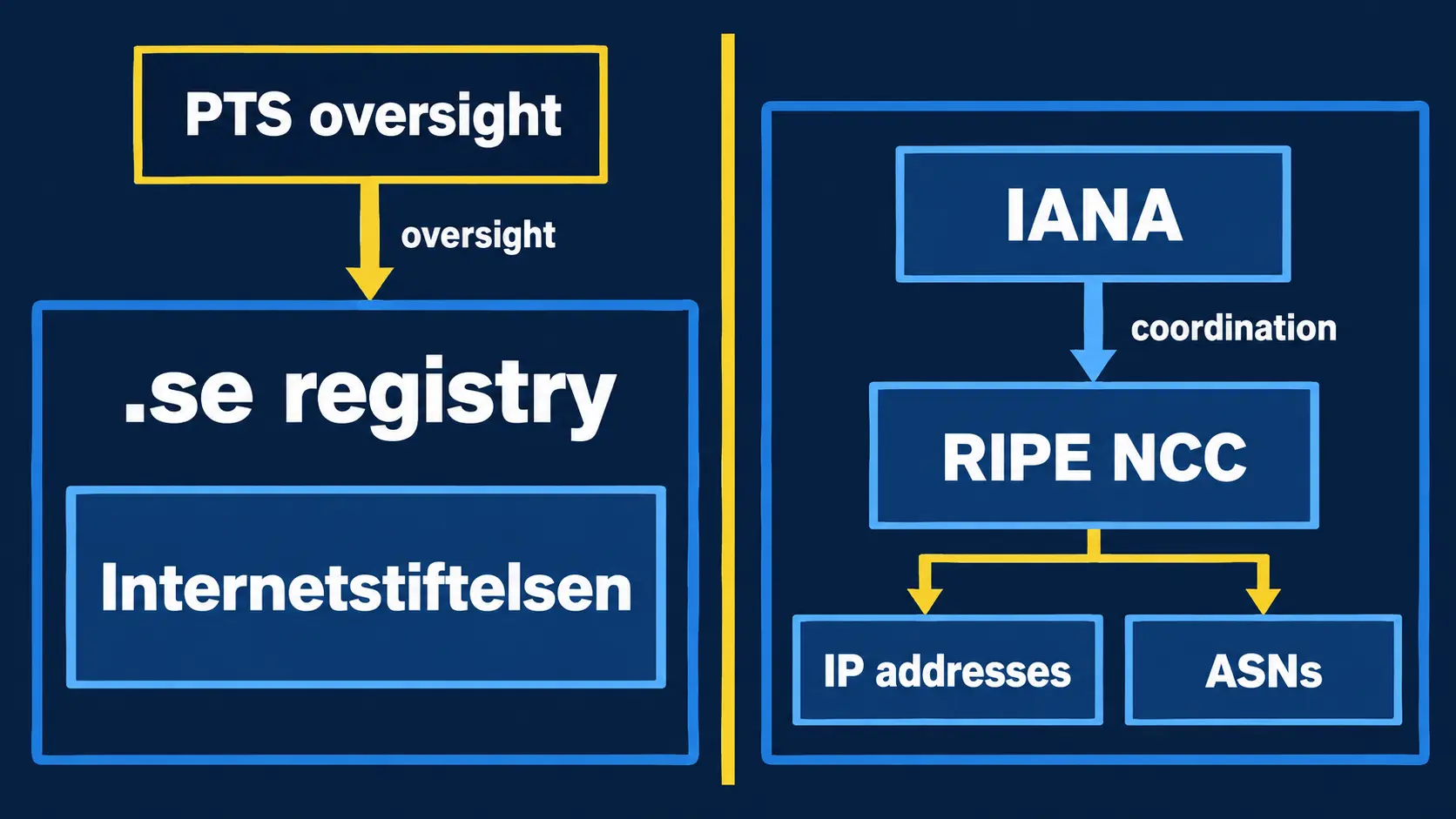
- Public records identify The Internet Infrastructure Foundation as the sponsoring organization for Sweden’s .se country-code top-level domain, while Internetstiftelsen describes responsibility for administering and technically operating the .se registry and operating or administering .nu.
- That evidence does not establish authority over IP addresses, IPv6 space, Autonomous System Numbers or RIPE NCC. Those functions belong to a separate regional Internet number-resource system coordinated globally through IANA and the Regional Internet Registries.
A directory label can make two very different kinds of Internet infrastructure appear to be one institution. In this case, the label “The Internet Infrastructure Foundation” points toward a Swedish organization associated with the .se domain, but the public record does not show that the organization is a Regional Internet Registry, allocates IP addresses or ASNs, or controls RIPE NCC’s number-resource functions.
That distinction is operational, not merely semantic. A domain registry maintains a namespace: records that connect names such as example.se to delegated operators and the technical systems that make those delegations resolvable. The Internet number-resource system manages different objects: IPv4 and IPv6 address space and Autonomous System Numbers used by networks to identify themselves and exchange routes. A registry role in one system is not evidence of authority in the other.
The available record supports a narrower and more useful conclusion. Internetstiftelsen’s documented control surface is the Swedish domain-registry layer, subject to a Swedish legal and supervisory framework. IANA’s .se delegation record identifies The Internet Infrastructure Foundation as the sponsoring organization for the country-code top-level domain. Internetstiftelsen’s own public materials describe administration and technical operation of .se, as well as operation or administration of .nu. Swedish statutory and regulatory materials describe the framework for administration, technical operation and supervision of national top-level domains, including .se. (Internetstiftelsen describes its role; its domain materials describe .se and .nu; IANA’s .se delegation record; Swedish regulatory material; the national top-level-domain statute)
The separate number-resource layer is documented by RIPE NCC, IANA and the Number Resource Organization. RIPE NCC describes itself as the Regional Internet Registry for Europe, the Middle East and parts of Central Asia, with a role involving IPv4, IPv6 and Autonomous System Number resources. IANA describes global coordination of Internet number-resource pools through the Regional Internet Registries, while the NRO identifies RIPE NCC as one of the five RIRs. (RIPE NCC’s description of its role; IANA’s number-resource explanation; the NRO’s RIR overview)
The result is a boundary around what can responsibly be claimed. The evidence supports a domain-registry role and a continuity question. It does not support a claim that the target allocates address space, assigns ASNs, operates the RIR system or possesses a verified network footprint. The supplied Directory projection is sparse: it labels the target a regulator and links it to .se delegation evidence, but contains no verified ASN, prefix, network relationship, service, people or control records.
The first control surface is the namespace
A country-code top-level domain is a shared naming layer. Its continuity depends on more than a visible website. Registry records must persist; the authoritative technical operation must continue; delegation and transfer processes must be governed; and there must be an accountable operator within the applicable legal framework.
IANA’s delegation record is important because it connects the .se top-level domain to a named sponsoring organization. But a delegation record is not a complete description of every internal responsibility. It does not, by itself, establish who approves every registration, who operates each technical component, how a suspension or transfer is reviewed, or which recovery arrangements would apply after a serious incident. Those are separate questions about control, service delivery, accountability and continuity.
Internetstiftelsen’s public materials provide the institution’s own description of its role. They describe responsibility for the administration and technical operation of the .se domain registry and identify related responsibility for .nu. That self-description is relevant evidence of how the organization presents its mandate, but it should not be expanded into claims the material does not make. In particular, it does not establish control over Internet number resources.
The Swedish framework adds another layer. Statutory and regulatory materials describe administration, technical operation and supervision of national top-level domains. This matters because legitimacy is distributed across the operator, the technical registry and the public framework around the namespace. A registry can be operationally central without being equivalent to a ministry, a court or an RIR. The practical question is therefore not simply “who owns .se?” It is “which actor can change which registry state, under what rules, with what checks and with what remedy if continuity fails?”
The current public record does not answer all of those questions. It establishes the operator relationship and the existence of a regulatory framework, but not a full control map for creation, modification, validation, publication, suspension, transfer and restoration of every .se record. That gap should remain visible rather than being filled with assumptions.
The second control surface is number resources
IP addresses and ASNs are not domain names. They are part of the Internet’s routing and addressing infrastructure. RIPE NCC describes its regional role across Europe, the Middle East and parts of Central Asia, including IPv4, IPv6 and ASN resources. IANA describes the global coordination system through which number-resource pools are coordinated with the Regional Internet Registries. The NRO identifies the five-RIR structure and includes RIPE NCC among them.
This division has a direct operational consequence. A Swedish organization can be central to .se name resolution without being the institution that allocates an operator’s IP address space or ASN. A company might use a .se domain, hold resources through a RIPE NCC relationship and announce routes through one or more networks. Those facts can coexist, but they do not collapse into one registry authority.
The supplied evidence does not show that Internetstiftelsen holds Internet number resources in its own right, nor does it show a RIPE NCC relationship for the target. It also does not establish an ASN, address prefix, network relationship or service dependency associated with the Directory object. The responsible conclusion is therefore negative but bounded: the record does not demonstrate RIR authority. It does not prove that no relationship exists anywhere; it shows that the available public evidence does not establish one.
That distinction is especially important when an English institutional label sounds broader than the organization’s documented role. “Internet infrastructure” can refer to naming, addressing, routing, connectivity, hosting, physical facilities or governance. The label alone cannot decide which meaning applies. The sources have to do that work.
Identity is part of the infrastructure question
The target’s identity remains partly unresolved. The Directory projection uses the English label “The Internet Infrastructure Foundation.” The supplied public records point toward Internetstiftelsen and its documented .se role, but they do not fully establish whether the English label is a historical rendering, a translation, an alias, a former name or another naming relationship. The available privacy-policy and institutional materials support the association but do not provide a complete provenance record for the Directory label. (Internetstiftelsen’s public website materials)
That uncertainty matters because names transfer legitimacy. If a Directory entry is read as a legal identity, a reader may attribute the organization’s documented .se responsibilities to a similarly named but different body. If it is read as a broad infrastructure mandate, readers may infer authority over addresses, routing or RIR functions that the evidence does not support. A clean article must therefore distinguish four things: the directory label, the organization named in public institutional records, the documented mandate and the unresolved historical relationship between the names.
The issue is not cosmetic. Legal identity determines who can be held accountable, which records are authoritative and where a continuity failure would be addressed. An alias can help a reader find the right institution; it cannot substitute for evidence of incorporation, succession, mandate or delegation. The current record supports an association with Internetstiftelsen, not a final legal-identity determination.
Continuity has several meanings
“Continuity” is often used as if it described one condition. For a national domain, it describes several.
Record continuity means that registrations, delegations, contacts and related data remain available, coherent and recoverable. A failure here can make names disappear from the effective namespace even if the underlying businesses and networks continue operating.
Service continuity means that the registry and authoritative DNS functions continue responding and processing legitimate changes. A registry can preserve a database while losing the ability to serve updates, process transfers or respond to incidents.
Legal-authority continuity means that the operator’s mandate remains recognized and that disputes, supervisory actions and exceptional interventions have a defined path. A technical copy of a database cannot by itself recreate authority to administer a country-code domain.
Operator continuity means that the incumbent institution remains able to perform the role. A domain can survive a change of operator, but the transition itself can create risk if records, credentials, contracts, technical dependencies or accountability arrangements do not transfer cleanly.
The evidence in hand establishes that .se has a named sponsoring organization and that Internetstiftelsen publicly describes administration and technical operation. It does not disclose a complete recovery architecture for each continuity dimension. Nor does it establish whether the same arrangements would apply to a change in operator, a legal dispute, a prolonged technical outage or a compromise of registry credentials.
This is where the separation from number resources helps rather than complicates the analysis. IP and ASN continuity follows a different institutional path. IANA and the RIR system coordinate number-resource pools; RIPE NCC serves the relevant regional role. A .se registry incident would not automatically be an RIPE NCC incident, and a routing-resource dispute would not automatically transfer to the .se operator. Organizations may depend on both layers, but the control and recovery mechanisms are distinct.
What the Directory record can—and cannot—tell readers
The Directory record is useful as a lead. It identifies a target, labels it a regulator and connects it to .se delegation evidence. It is not, by itself, proof of the target’s mandate. The source package contains no verified ASN, prefix, network relationship, service, people or control records for the target. That absence should constrain the article rather than be hidden behind a broad institutional label.
For operators and investors, the practical implication is to map dependencies by object. A registrar, DNS operator, domain holder, network operator and RIR account may sit in one organizational ecosystem, but they should be tested separately. Questions include:
- Which entity is named in the relevant delegation or registry record?
- Which entity performs the technical operation?
- Which entity has authority to approve or reverse a registry change?
- Which entity holds or administers IP and ASN resources?
- Which legal or supervisory framework applies to each action?
- What evidence exists for restoration after a technical or institutional failure?
For public-interest readers, the accountability question is equally concrete. A namespace can be critical without its operator being a state agency. Public oversight can coexist with independent operation. But the boundaries must be legible: who is responsible for service, who can intervene, and what remedy exists when the registry’s state is disputed?
The unanswered questions are narrower now
The research does not resolve the target’s identity or produce a complete continuity plan. It does narrow the investigation.
First, the exact legal identity and historical naming provenance of the Directory label require dated institutional or legal records. The current evidence supports an association with Internetstiftelsen but not a definitive account of how the English label arose.
Second, the control map for .se remains incomplete. Public records identify the sponsoring organization and describe administration and technical operation, but further evidence is needed on who can create, modify, validate, publish, suspend, transfer or restore registry records, and how those powers are reviewed.
Third, no supplied evidence demonstrates that the target holds Internet number resources in its own right or has a RIPE NCC relationship. That question would require a direct resource or membership record, not an inference from the words “Internet infrastructure.”
Fourth, institutional self-descriptions need independent corroboration where claims about accountability, remedies and continuity become material. A regulator’s framework, a delegation record and an operator’s own description answer different parts of the question.
The evidence therefore supports a controlled thesis: Internetstiftelsen’s documented role is in the Swedish domain-registry layer; RIPE NCC and IANA describe a separate number-resource system; and the Directory label should not be allowed to merge those authorities. The central risk is not that readers lack a grand theory of Internet governance. It is that a broad name can cause them to assign the wrong control surface to the wrong institution.
For now, the strongest operational conclusion is bounded. The .se namespace has a documented institutional sponsor and an operator that publicly describes responsibility for its administration and technical operation. The available record does not establish that the same institution controls IP addresses, IPv6 space, ASNs or RIPE NCC. Continuity analysis should follow the object being protected—domain records, DNS service, legal authority or number resources—and identify the accountable actor for each.
Member Briefing
Deeper Profile Context
Sign in with the right membership level to unlock the full briefing and source notes.
Only for Strategic Circle
Strategic Circle
Open to all readers. Unlock profile briefings after joining and signing in.
Join Strategic CircleOnly for Leadership Alliance
Leadership Alliance
For qualified IP-asset owners and management; sign in to unlock alliance briefings.
Join Leadership Alliance