
- One of the earliest examples of an electronic game is Nim, a mathematical strategy game created in 1940 by mathematician and engineer Arthur Samuel.
- Over the years, the industry has experienced significant growth and evolution, marked by the introduction of home gaming consoles, personal computers, handheld devices, and mobile platforms.
- As of early 2022, several key trends were shaping the video game industry.
OUR TAKE
While the origins of electronic games can be traced back several decades, the modern video game industry, characterised by commercial success, widespread adoption, and technological innovation, emerged in the early 1970s and has since grown into a multi-billion-dollar global industry.
–Miurio Huang, BTW reporter
The video game industry has been developed that spans several decades. The modern video game industry can be traced back to the early 1970s when arcade games such as Pong and Space Invaders gained widespread popularity. However, the concept of electronic games predates this period.
Origin
One of the earliest examples of an electronic game is The Nim Number Game (Nim), a mathematical strategy game created in 1940 by mathematician and engineer Arthur Samuel. This game was based on the ancient mathematical game of Nim and was implemented using electromechanical switches.
The term video game became more commonly associated with interactive electronic games following the development of the first commercially successful video game, Pong, in 1972 by Atari, Inc. This marked the beginning of the video game industry as we recognise it today.
Also read: Short videos have revolutionised the e-commerce industry, but is quality giving way to profit?
Also read: Amazon is trying to eat everything, even your sports games
Evolution
Over the years, the industry has experienced significant growth and evolution, marked by the introduction of home gaming consoles, personal computers, handheld devices, and mobile platforms. The industry has also seen the emergence of influential companies such as Nintendo, Sega, Sony, Microsoft, and a multitude of independent game developers and publishers.
The industry’s expansion into online gaming, e-sports, virtual reality, and augmented reality has further diversified the gaming landscape, attracting a wide and dedicated global audience.
Current popular trends
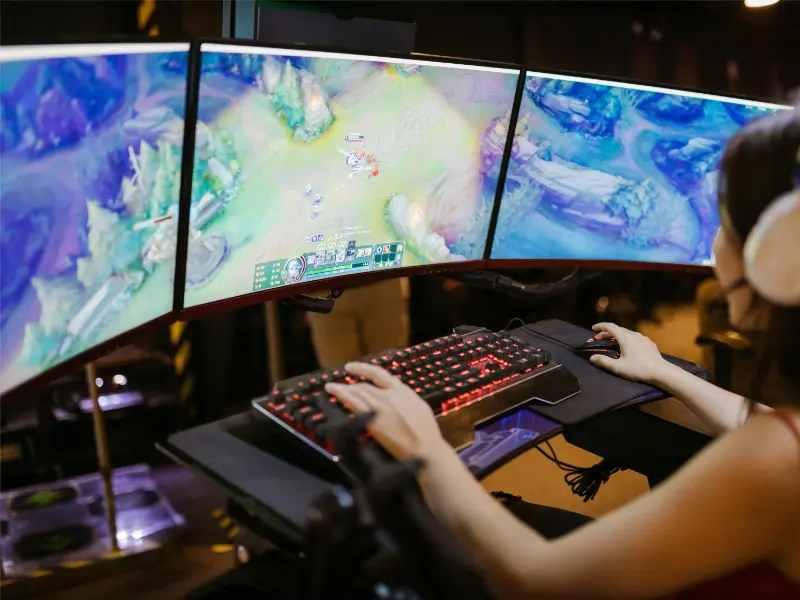
As of early 2022, several key trends were shaping the video game industry. Mobile gaming continued to dominate, with titles like Genshin Impact and Fortnite attracting millions of players on smartphones and tablets. Live service games like Fortnite and Apex Legends kept players engaged with regular updates and events. Cross-platform play became more common, allowing players to connect across different platforms in games like Rocket League and Minecraft. Free-to-play and freemium models thrived, driving revenue through microtransactions in games such as Pokémon GO and Clash Royale. Indie games experienced a renaissance with titles like Hades and Celeste showcasing creativity and innovation. Virtual reality and augmented reality gaming evolved slowly, while e-sports and competitive gaming continued to grow with popular titles like League of Legends and Valorant. These trends reflected the industry’s dynamic nature and the diverse experiences offered to gamers worldwide.
Meanwhile, AI has significantly contributed to the rebuilding of the video game industry by revolutionising various aspects of game development and gameplay. AI algorithms analyse player behavior to offer personalised experiences, while procedural content generation tools create vast and dynamic game worlds efficiently. Advanced AI-powered gameplay mechanics enhance realism and adaptability, and AI-driven narrative generation systems create branching storylines based on player choices.
Additionally, AI streamlines development processes through automation, optimises game design based on player data analysis, and enhances player interactions through virtual assistants and NPCs. AI technologies have transformed the industry by delivering more immersive, personalised, and engaging gaming experiences.