
Summary
- The article anchors Sure in the Falklands' new GBP 50 broadband floor, the compensation cap and the population denominator.
- It explains exclusivity as a financing model before Starlink turned performance and price into a political argument.
- The judgement depends on independent performance probes, Starlink adoption, universal-service cost transparency and future backhaul choices.
The GBP 50 package is the new island price signal
The Falkland Islands' telecom market can be reduced, for a moment, to one price and one population. The price is GBP 50 a month, before a GBP 12 fixed-line charge for most residential customers. The population is 3,662 usual residents in the 2021 census, with 2,964 in Stanley and 354 in Camp according to the Falkland Islands Government census report at https://www.falklands.gov.fk/policy/downloads?catid=13&id=219%3Afalkland-islands-2021-census-report&task=download.send and the census landing page at https://www.falklands.gov.fk/policy/2021-census/census. That is the commercial problem Sure South Atlantic faces: sell modern connectivity in a market smaller than a mainland suburb, spread service obligations across settlements separated by weather, road distance and sea, and buy international capacity from suppliers whose costs do not shrink just because the customer base is tiny.
The GBP 50 figure became public because Sure's old broadband ladder was broken open by satellite competition. From 1 December 2025, Sure told customers it would offer two new unlimited residential packages and discontinue the smallest legacy plans after 31 January 2026, with fixed-line rental changes set out on its own page at https://www.sure.co.fk/broadband/new-broadband-packages/. The Falkland Islands Government then announced a Broadband Support Package: eligible households could receive the lower unlimited package for GBP 20 a month, while Sure would still charge line rental separately, as described at https://www.gov.fk/press/falkland-islands-government-press-statement/. The support mechanism matters because it turns telecom pricing into a welfare question. A connection that is cheap by South Atlantic infrastructure standards can still be expensive for a low-income household.
The same settlement placed an upper bound on the public cost of changing the market. In the 30 October 2025 statement at https://www.gov.fk/commercialservices/wp-content/uploads/sites/18/2026/02/FIG_Sure_VSAT_Licensing_Agreement_Statement.pdf, the government said Sure could claim up to GBP 6.167 million over the remainder of its exclusive licence period for demonstrable broadband revenue losses caused by widespread Starlink use. Penguin News reported the same figure and the GBP 50 and GBP 115 unlimited package prices at https://penguin-news.com/headlines/2025/falkland-islands-government-to-compensate-sure-for-revenue-losses/. A tiny market had produced a seven-figure transition bill because the incumbent had not merely sold retail internet. It had carried the island's universal service bargain.
Exclusivity was the financing model before it became the argument
Sure South Atlantic is not just a shopfront with broadband plans. Sure's Falklands site says it provides fixed-line, mobile data, broadband, data centre and enterprise services to consumer and corporate customers, and states that Sure is part of Beyon with group headquarters in Guernsey: https://www.sure.co.fk/. A separate Sure Saint Helena page traces the South Atlantic business back through Cable & Wireless South Atlantic, the 2013 acquisition by Batelco, and the 2013 name change to Sure South Atlantic Limited: https://www.sure.co.sh/about-us/company-information/. The same operating family serves islands that are too remote, too small and too politically specific for an ordinary mainland telecom model.
That history explains why the Falklands accepted exclusivity. A government procurement notice for the 2G Mobile Network Expansion Contract says Sure South Atlantic Limited was awarded a new 10-year exclusive telecoms licence in 2017 after negotiation with the Falkland Islands Government, and that a key element was investment in a new 2G/4G mobile telephone network; the same notice put the estimated contract value at GBP 550,000 and the contract period from 31 December 2021 to 1 January 2028: https://procontract.due-north.com/ContractsRegister/ViewContractDetails?contractId=98221d66-f758-ec11-810e-005056b64545&p=fde78309-f11a-ec11-810e-005056b64545. In a large country, exclusive telecom rights read as market protection. In the Falklands, they also functioned as a financing device: one operator would carry fixed, mobile and universal-service obligations in exchange for a protected revenue base.
The Communications Regulator's 2025 annual report makes clear how hard that arrangement became to manage once a viable outside broadband alternative arrived. The report says 2025 required balancing Sure's exclusive rights against public expectations for improved services, and identifies the Starlink licence as the first introduction of regulated competition in the Falkland Islands telecommunications sector: https://regulatorfi.org.fk/publications/annual-reports/276-annual-report-of-the-communications-regulator-2025-pdf. That sentence is the pivot. Competition did not begin because a second cable operator dug streets in Stanley. It began because residents could put a satellite terminal on a roof and buy a different kind of capacity, if the law let them.
The old bargain therefore had two separate claims embedded in it. Sure could say it needed protection because a national telecom network for 3,662 people cannot be financed like a city ISP. Consumers could say protection had become a tax on performance because low-earth-orbit satellite service changed what was technically available. Both claims can be true. The economics are not a morality play; they are a small-market contract being repriced after the technology frontier moved.
Sparse demand makes every fixed cost visible
The Falklands do not give a telecom operator the luxury of statistical blur. Every additional obligation is visible because the denominator is so small. The regulator's annual report counted 8,322 commercial telephone numbers in use in 2025, of which 5,963 were mobile and 2,359 fixed line, representing 16.6 per cent of all available numbers in the +500 country code: https://regulatorfi.org.fk/publications/annual-reports/276-annual-report-of-the-communications-regulator-2025-pdf. That is not a mass market. It is a national utility with a few thousand billable units, many of them connected to the same households, businesses, government offices and service workers.
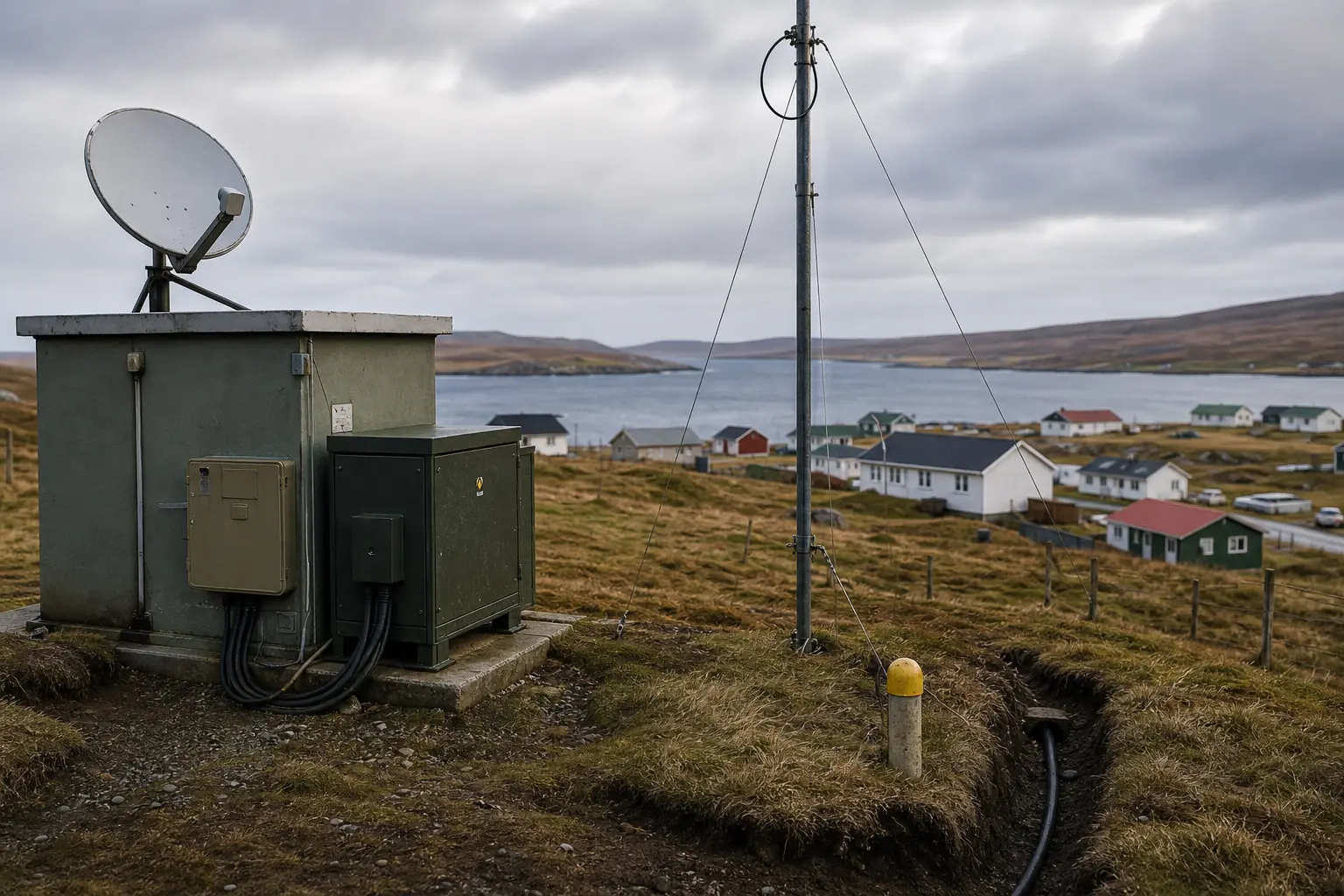
The geography compounds the arithmetic. Stanley contains most residents, but Camp remains part of the obligation. The regulator's later probe plan shows the service technologies that have to coexist across the islands: ADSL in Stanley and Fox Bay, LTE in Stanley, March Ridge and Goose Green, Fixed Wireless Access in Mount Kent and Fox Bay, and Telrad in Stanley and Mount Kent. Those locations and technologies are listed in the regulator's probe announcement at https://regulatorfi.org.fk/?catid=13&id=128%3Ainstallation-of-measurement-probes-on-sures-network&view=article. The list is a cost map. A dense mainland operator can depreciate fibre, towers and support systems over hundreds of thousands of subscriptions. Sure has to maintain a hybrid network where some areas justify fixed access, others require wireless access, and the same support organisation must handle both.
Retail prices therefore carry more than access speed. They carry imported spares, engineer travel, island stockholding, spectrum administration, customer support and a political expectation that basic communications remain available even where a narrow commercial case would be weak. Sure's business page advertises data hosting, teleconferencing, wind turbine services and satellite phone products to Falkland Islands businesses at https://www.sure.co.fk/business/. The point is not that each line is large. The point is that a national operator in a remote jurisdiction must be a generalist. It sells broadband to homes, connectivity to shops, communications to public bodies, and specialist services to sectors such as energy, aviation, maritime, government and defence-adjacent activity.
That generalist model explains why a small price change can become political. When Sure withdrew the XSML and SML broadband packages and replaced the lowest new broadband offer with GBP 50, the regulator described the policy problem as protecting low-income households from losing affordable access while keeping a coherent approach to a rapidly changing market. By the end of 2025, around 30 applications for Broadband Support Packages had been submitted, with eligible households paying GBP 20 for the GBP 50 package while government covered GBP 30: https://regulatorfi.org.fk/publications/annual-reports/276-annual-report-of-the-communications-regulator-2025-pdf. In an ordinary retail market, a withdrawn tariff is a product decision. In the Falklands, it becomes a public-access decision.
Satellite backhaul is the imported input behind the local bill
The deepest cost in this market is not the modem in a customer's house. It is the route off the islands. Sure's public network records show the Falklands internet system remains tied to satellite-scale upstream economics. BGP.tools lists AS204649, Sure South Atlantic Limited, as registered to the Falklands network, originating three IPv4 prefixes and no IPv6, with Intelsat Global Service Corporation as upstream: https://bgp.tools/as/204649. Hurricane Electric's BGP view similarly shows AS204649 originating three IPv4 prefixes, no IPv6 prefixes, 3,584 IPv4 addresses and one observed IPv4 peer, Intelsat: https://bgp.he.net/AS204649. IPinfo classifies the same ASN as a consumer ISP in the Falkland Islands, shows the same three Falklands IPv4 ranges, and reports Intelsat as the upstream and peer: https://ipinfo.io/AS204649.
Those routing records are dry, but they tell the economic story more directly than advertising copy. A network whose visible upstream is Intelsat is a network where international capacity is procured as a specialist managed service rather than casually bought across many fibre routes. Intelsat announced in 2023 that it had expanded an agreement with Sure South Atlantic to improve communications for the Falkland Islands, Saint Helena and Ascension Island, with an Intelsat-managed multi-orbit service for the Falklands and the ability to combine geostationary capacity with OneWeb low-earth-orbit capacity: https://via.tt.se/pressmeddelande/3341431/sure-south-atlantic-picks-intelsat-to-connect-three-british-island-territories?publisherId=259167. A Space Watch Africa republication described the same arrangement as supporting 4G, enterprise broadband, public Wi-Fi, streaming video, military connectivity and government operations across the three territories: https://spacewatchafrica.com/sure-south-atlantic-picks-intelsat-to-connect-three-british-island-territories/.
The operating implication is simple. Sure's margin is exposed to upstream capacity, performance guarantees, satellite technology choices and supplier concentration. If capacity is scarce, old metered plans and data boosters make sense. If capacity becomes more abundant through multi-orbit procurement, unlimited packages become feasible. If consumers can buy Starlink directly, the old model of rationing retail data becomes harder to defend. The public tariff therefore reflects not only local willingness to pay but the upstream market's transition from geostationary scarcity to multi-orbit competition.
The Falklands are not Saint Helena, and comparisons should be disciplined. Saint Helena is connected to the Equiano submarine cable, and Sure's Saint Helena page says Sure connected the on-island telecommunications network to that cable in 2023: https://www.sure.co.sh/about-us/company-information/. The Falklands do not have that same fibre landing. That difference matters because a cable changes the marginal cost of bandwidth, latency and upgrade planning. In the Falklands, the backhaul decision remains a satellite procurement decision with resilience and politics built in.
The network record shows a small national operator, not a cloud business
Sure's membership and numbering traces point to a national communications provider rather than a speculative internet shell. The LACNIC public member list includes "FK Sure South Atlantic Ltd (Adherent)" at https://milacnic.lacnic.net/lacnic/asociados/publico?locale=EN, while the routing records for AS204649 sit in the RIPE system and identify the Falklands network as Sure South Atlantic. This combination should not be overread as a headquarters claim. It is more useful as proof that Sure appears in public internet-number governance records while operating in a territory whose commercial and political geography does not fit neatly into the usual regional categories.
The visible address stock is modest. BGP.he lists 3,584 IPv4 addresses originated by AS204649 and no IPv6: https://bgp.he.net/AS204649. IPinfo lists 80.73.208.0/21, 185.244.12.0/22 and 80.73.216.0/23 as the main ranges and says 100 per cent of the Falklands ASN's geolocated IPv4 footprint sits in the Falkland Islands: https://ipinfo.io/AS204649. BGP.tools says the prefixes have valid RPKI status: https://bgp.tools/as/204649. For a national operator, 3,584 IPv4 addresses is a small pool. For a country of 3,662 residents plus businesses, public bodies, temporary workers and visitors, it is enough to show that Sure is running a real access network but not enough to suggest vast excess.
The latency measurements are consistent with the remote-island model. IPinfo's trace and ping samples for AS204649 show hundreds of milliseconds from European and North American probes to Falklands IPs, with routes through Intelsat and Falklands endpoints: https://ipinfo.io/AS204649. A reader should not treat one measurement service as a service-level audit. It does, however, align with the basic physics of satellite paths and the lived complaints that made low-latency alternatives politically explosive. The commercial pressure from Starlink was not just price. It was latency, data allowance and the feeling that the global internet was finally reachable without rationing.
The absence of visible IPv6 in the Falklands ASN is another small but telling constraint. It does not mean customers cannot use modern services, and it does not prove neglect. It does mean the public routing footprint still looks conservative: three IPv4 prefixes, no IPv6 origination, one observed upstream in the common public views. If Sure wants to position itself after 2027 as the resilient national platform rather than the legacy monopoly, visible modernization of the routing footprint would help.
The market will judge not only whether a package is unlimited, but whether the network starts to look less like a carefully stretched island system and more like a contemporary access provider.
Mobile coverage turns distance into capital spending
Broadband receives the most political attention, but mobile coverage is where geography becomes capital spending. The 2G Mobile Network Expansion Contract notice says the 2017 exclusive licence included a commitment to invest in a new 2G/4G mobile telephone network, and the public contract notice identifies telecommunications and related equipment as the category: https://procontract.due-north.com/ContractsRegister/ViewContractDetails?contractId=98221d66-f758-ec11-810e-005056b64545&p=fde78309-f11a-ec11-810e-005056b64545. Star Solutions, a Canadian mobile infrastructure supplier, said in 2019 that Sure South Atlantic, then described as a Batelco Group member, had upgraded the Falklands from a previously deployed GSM network to GSM and 4G LTE infrastructure, with the upgraded services fully operational the previous August: https://www.starsolutions.com/press-releases/sure-south-atlantic-in-partnership-with-star-solutions-delivers-lte-to-the-falkland-islands/.
That supplier record matters because it identifies imported equipment and integration as part of the cost base. A mainland mobile operator can choose between several vendors, local contractors and nearby spares depots. A Falklands operator imports equipment, carries repair risk and has to serve a mix of Stanley, Camp, roads, businesses, public services and transient users. The network's value is not measured only by average revenue per mobile subscriber. It is measured by whether a farm, a road crew, an emergency service, a tourist operator or a government team has coverage when it needs it.
The regulator's 2025 annual report shows why mobile and spectrum policy remain strategically sensitive. It notes that the Ministry of Defence is one of the most significant spectrum users in the Falkland Islands and that work on a suitable framework for military spectrum use was ongoing with decisions expected during 2026: https://regulatorfi.org.fk/publications/annual-reports/276-annual-report-of-the-communications-regulator-2025-pdf. It also states that telecommunications and broadcasting providers, including Sure and BFBS, held accurate and up-to-date radiocommunications licences, while broader private and public sector spectrum records still needed improvement. In this setting, the telecom operator is not just selling consumer data. It operates inside a national spectrum environment shaped by defence, broadcasting, maritime, aviation and remote civil administration.
This is why the "why not just let Starlink replace Sure?" argument is too simple. Starlink can discipline broadband pricing and performance. It does not automatically replace national numbering, fixed voice, mobile coverage, local business circuits, emergency communications expectations, radio licensing coordination or on-island customer support. The pressure from Starlink is real. The incumbent's remaining relevance depends on the services that still require local infrastructure and accountable operations.
Government demand anchors revenue and raises the political temperature
Government is both customer and referee. The Falkland Islands Government's legal services page says the Communications Regulator oversees the relationship between government, acting for the community, and Sure, and is responsible for licensing and regulating telecommunications and broadcasting under the Communications Ordinance 2017 and Sure's licence: https://www.falklands.gov.fk/legalservices/. That role is difficult because government also depends on the networks it regulates. It needs resilient connectivity for public administration, health, education, emergency services, airports, ports, defence interfaces and remote settlements.
The 2025 VSAT settlement exposed this dual role. The government statement said the settlement allowed Sure to continue discharging universal service obligations under its exclusive licence while a more permissive VSAT scheme moved ahead. It also said the compensation basis was that the previous regime created limited threat to Sure's broadband business, while the new regime fundamentally changed that position: https://www.gov.fk/commercialservices/wp-content/uploads/sites/18/2026/02/FIG_Sure_VSAT_Licensing_Agreement_Statement.pdf. In plainer economic terms, government had changed the risk allocation. Consumers could buy satellite broadband outside Sure, but Sure still had obligations under the old bargain. The compensation scheme was the bridge.
The Public Accounts Committee review sharpened the issue. The PAC published the Sure report on its reports page at https://pac.org.fk/published/, and OpenFalklands summarized it as covering more than GBP 8 million paid or to be paid by government to Sure between 2018/19 and 2026/27 for broadband improvements and Camp mobile network work: https://openfalklands.com/falklands-telecomms-8-million-broadband-spend-sure-sa-and-fig-under-scrutiny/. OpenFalklands is an advocacy and commentary site, so its interpretation should be separated from the primary documents. But the public-policy question it highlights is unavoidable: when public money is used to buy improvements from a protected operator, voters will ask whether subsidy, regulation or competition produced the improvement.
That question became more pointed after Starlink. The same OpenFalklands summary says the PAC concerns included transparency, access to contracts and performance monitoring, while the regulator's annual report says new probes funded by Sure were installed across multiple technologies and locations to improve independent performance measurement: https://regulatorfi.org.fk/?catid=13&id=128%3Ainstallation-of-measurement-probes-on-sures-network&view=article. Read together, those records show a political market learning to demand measurable value. Sure's future licence position will be stronger if government and residents can see performance, costs and obligations clearly enough to argue about facts rather than suspicions.
Starlink changed the bargaining table without taking every seat
The decisive change in 2025 was legal, not orbital. Starlink service could be seen in the sky before it could be comfortably fitted into the Falklands licensing structure. The Communications Regulator announced that a VSAT Broadband Connectivity Licence had been granted to Starlink Internet Services Limited and that Starlink could provide broadband to customers who held a VSAT licence issued by the regulator: https://regulatorfi.org.fk/?catid=13&id=121%3Astarlink-licenced&view=article. It also said residents and businesses with a VSAT licence could use Starlink legally from 3 November, while unlicensed use remained illegal.
The guidance notes explain the narrowness of that opening. A VSAT licence authorises personal use only; a household cannot use it to provide Wi-Fi to another household, and a business such as a hotel or restaurant cannot use it to provide internet access to customers. The fee is GBP 180 per year, every live VSAT requires a licence, and applicants who want to offer customer or guest Wi-Fi are told to approach Sure South Atlantic: https://regulatorfi.org.fk/spectrum/vsat-1/261-vsat-guidance-notes-pdf. The licence terms add that use may not be assigned or shared with third parties unless authorised: https://regulatorfi.org.fk/spectrum/vsat-1/258-vsat-licence-terms-and-conditions-pdf.
This creates a two-track market. For households and small businesses buying connectivity for themselves, Starlink is a substitute for Sure broadband. For hospitality, public Wi-Fi, resale, integrated business service, fixed voice and national mobile, Sure remains central. ISPReview reported that legal Falklands Starlink sign-up was live and put the Standard residential package at 75 Falkland pounds per month, while noting the local licensing requirements: https://www.ispreview.co.uk/index.php/2025/11/starlink-satellite-broadband-now-live-on-the-falkland-islands.html. Starlink's own service-plan page shows the broader UK-facing menu of residential and roaming options, although not the full Falklands regulatory context: https://www.starlink.com/gb/service-plans. The consumer comparison is therefore not just monthly price. A Sure Unlimited50 customer has a lower package price and local line tie-ins; a Starlink customer pays the equipment and service economics plus the annual VSAT licence but buys different latency and throughput characteristics.
The scale of demand was immediate. The regulator's 2025 annual report says 1,008 VSAT licences were successfully issued during November and December alone, showing sustained demand for high-performance broadband: https://regulatorfi.org.fk/publications/annual-reports/276-annual-report-of-the-communications-regulator-2025-pdf. In a population of 3,662, that is a striking number. It does not mean one-third of residents abandoned Sure; licences can map to households, businesses, second homes or other use cases. But it does mean the public had been waiting for a legal channel. Sure did not lose the national network. It lost the ability to define broadband expectations alone.
The compensation cap puts a price on protected revenue
The GBP 6.167 million compensation cap is the cleanest financial signal in the public record. It does not reveal Sure's broadband revenue, margins or customer count. It does reveal the government's maximum willingness to pay to avoid a prolonged legal fight while allowing VSAT reform to proceed. The government statement says actual claims depend on Sure evidencing losses against a pre-Starlink baseline, and that the more people retain or take up Sure broadband packages, the less will be claimed: https://www.gov.fk/commercialservices/wp-content/uploads/sites/18/2026/02/FIG_Sure_VSAT_Licensing_Agreement_Statement.pdf. That makes the compensation mechanism a variable bridge, not a blank cheque.
For analysis, divide the cap by the market scale. Spread GBP 6.167 million over 3,662 residents and it is roughly GBP 1,684 per resident before any adjustment for actual claims, households, businesses or timing. Spread it over two years and the public exposure looks like the price of buying time: time for the legal risk to settle, time for Sure to move to unlimited packages, time for the regulator to introduce Starlink licensing, and time for the government to plan the post-2027 market. The exact denominator is debatable; the existence of the cap is not.
A remote monopoly creates value for the operator precisely because it protects revenue, and changing that protection has a cost.
The consumer side has its own arithmetic. Sure's new entry package at GBP 50 plus a GBP 12 residential line rental is GBP 62 monthly for a standard household not receiving the support package. The subsidised household pays GBP 20 for the package plus the line rental unless a senior rate applies, as the government support statement explains at https://www.gov.fk/press/falkland-islands-government-press-statement/. A Starlink household faces a different bundle: service plan, terminal costs, power, installation, and GBP 180 per year for the VSAT licence under the regulator's guidance at https://regulatorfi.org.fk/spectrum/vsat-1/261-vsat-guidance-notes-pdf. The cheaper option depends on household circumstances, equipment cost, tolerance for line rental, need for fixed voice, and the value placed on speed and latency.
Sure's strategic problem is that the old scarcity premium has become contestable. If it can keep customers on GBP 50 and GBP 115 unlimited packages while improving performance, compensation claims fall and the company preserves an access base. If a large share of households move to Starlink and keep Sure only for phone or residual services, the incumbent becomes more dependent on government, enterprise, mobile and obligations. The compensation cap therefore prices not only lost revenue but the risk that Sure's product mix changes permanently.
The old metered ladder explains why unlimited felt like a rupture
The move to unlimited service should not be treated as a routine product refresh. It changed the organising principle of Falklands broadband. Before the Starlink settlement, the public discussion around Sure was built around small packages, data allowances and the need to manage consumption. The regulator's annual report records that the XSML and SML packages being withdrawn in 2025 had cost GBP 16 and GBP 39 a month respectively, and that the new lowest-price broadband package was GBP 50: https://regulatorfi.org.fk/publications/annual-reports/276-annual-report-of-the-communications-regulator-2025-pdf. Those old packages were cheaper because they were not the same product. They represented a rationed model in which affordability and scarcity were bundled together.
The high end of the old tariff ladder shows the other side of that bargain. Advanced Television, writing when Starlink approval was moving into view, described the Falklands as a market where a 10 Mb/s ProXL package capped at 365 GB cost GBP 467 per month: https://www.advanced-television.com/2025/11/04/falkland-islands-to-get-starlink-coverage/. That is secondary reporting and should not be used as a standalone tariff sheet. But it matches the broader policy record: the Falklands had been living with a price structure in which high monthly payments still did not necessarily buy the kind of unrestricted, low-latency broadband consumers had come to expect elsewhere. The new GBP 115 unlimited package is expensive in many countries, but in the Falklands it also signalled the collapse of the old metered ceiling.
This matters for Sure because metered tariffs can hide capacity constraints in consumer behaviour. If customers know a streaming session consumes scarce allowance, many will ration themselves. If the package is unlimited, the network has to absorb actual demand. That changes the operator's operational problem from selling scarce gigabytes to engineering for busy-hour performance. It also changes how customers complain. Under a capped model, a customer may blame the allowance. Under an unlimited model, a customer blames speed, latency, congestion or reliability. The regulator's decision to deploy probes and consider a future speed-based performance measure for 2027 fits that transition: https://regulatorfi.org.fk/?catid=13&id=128%3Ainstallation-of-measurement-probes-on-sures-network&view=article.
The package names carry a subtle risk. "Unlimited50" sounds like abundance, but the support statement says the lower package offers speeds of up to 5 Mb/s, not 50 Mb/s, and Sure's own hotspot FAQ says Unlimited50 users receive 5 GB of monthly hotspot use while Unlimited115 users receive 10 GB: https://www.gov.fk/press/falkland-islands-government-press-statement/ and https://www.sure.co.fk/broadband/new-broadband-packages/. If customers read "50" as price and "unlimited" as data, the product is coherent. If they compare it to mainland packages where "50" often means 50 Mb/s, the risk of disappointment rises. Sure's communication challenge is therefore unusually precise: sell a product that is cheaper and less rationed than the old Falklands model without inviting comparison to urban fibre markets it cannot yet resemble.
The economics point is that unlimited data does not erase scarcity. It relocates scarcity from the bill to the network. Sure can no longer rely on the customer's fear of overage to flatten demand. It has to buy or manage enough capacity, shape traffic fairly, maintain local access networks and explain the performance envelope. That is a harder retail bargain but a healthier public one, because the true constraint becomes visible.
Resilience is now something households buy for themselves
For years, resilience in the Falklands was a national procurement issue. The government negotiated with Sure, Sure negotiated with satellite and equipment suppliers, and consumers received the resulting package. Starlink changed the unit of resilience. A household or business can now buy a terminal, obtain a VSAT licence and create a second path to the internet outside Sure's access network, so long as use remains within the personal-use rules. The regulator's guidance is explicit that residents and visitors must license live VSAT terminals, that every live terminal needs its own licence, and that non-personal sharing is not permitted: https://regulatorfi.org.fk/spectrum/vsat-1/261-vsat-guidance-notes-pdf.
This is not full liberalisation. A hotel cannot simply buy one Starlink terminal and offer guest Wi-Fi under a personal VSAT licence. A tour operator cannot turn a terminal into customer connectivity. A household cannot become a neighbourhood reseller. The terms and conditions reinforce that the licensee may not share usage with another household, another business or other third parties without authorisation: https://regulatorfi.org.fk/spectrum/vsat-1/258-vsat-licence-terms-and-conditions-pdf. The result is a market that permits self-provision but not a parallel retail telecom sector. That distinction protects part of Sure's commercial role even while exposing its household broadband revenue.
The 1,008 licences issued in November and December 2025 show that many customers valued resilience enough to navigate the new system: https://regulatorfi.org.fk/publications/annual-reports/276-annual-report-of-the-communications-regulator-2025-pdf. In a small community, that level of uptake also changes social expectations. If a farm, office or neighbour has a visibly better connection through a licensed VSAT, the benchmark moves even for people who remain on Sure. The availability of a second path becomes part of normal consumer knowledge. Sure's customer support staff, engineers and executives then have to answer a different question: not "why is remote-island broadband limited?" but "why should I keep paying you when I can see an alternative working?"
Still, resilience bought household by household has limits. It can fragment support, complicate emergency planning, consume household power and equipment budgets, and leave non-personal use cases unresolved. It may improve a family's video calls while doing little for national mobile coverage, fixed voice reliability, public Wi-Fi rules or business connectivity that must be offered to guests and customers. The Falklands therefore needs both layers: a national operator with enforceable obligations and a legal self-provision route that reduces the incumbent's ability to ration the market.
This dual model creates a better bargaining position for government if used carefully. Instead of paying indefinitely for capacity improvements whose performance is hard to see, government can compare Sure's measured service against the lived reality of licensed VSAT users. Instead of forcing every household into Starlink, it can target support to those for whom the GBP 50 package is still too expensive. Instead of treating Sure as either untouchable or obsolete, it can decide which services are genuinely universal and which should be open to competition.
Resilience, in other words, has moved from a single protected contract to a portfolio of choices.
Quality reporting shifts the debate from anecdotes to repair times
Performance is where the politics becomes operational. The regulator's Q3 2025 quality-of-service release said faults decreased across all services compared with earlier in the year, reliability improved, and complaints remained low, with three received and all resolved within seven working days. The same release also said Stanley fault levels caused by Sure's equipment or network remained above target, and fault repair times fell short of targets for both residential and business customers: https://regulatorfi.org.fk/?catid=13&id=130%3Aqos-report-q3-2025&view=article. That mixed verdict is useful. It avoids the two lazy extremes: that Sure is simply failing, or that public criticism is only impatience.
The reporting framework itself is important. In a 2020 direction, the regulator required Sure to measure and report every three months on quality-of-service parameters, citing objectives such as facilitating communication between the Falkland Islands and the rest of the world, providing affordable access to high-quality networks so far as practicable, and strengthening the regulatory environment: https://regulatorfi.org.fk/publications/directions/174-direction-to-sure-qos-performance-reporting. The direction shows that performance monitoring was not invented after Starlink. What changed is the political force behind it. Once consumers have a credible alternative, repair times and fault rates are not merely regulatory indicators. They become churn indicators.
The new probes should make the next phase more disciplined. The regulator said probes installed in October 2025 would begin forming part of published quality reports from January 2026, measuring availability, ping, download speed and HTTP performance across Sure and external networks. The same notice said Sure's only current key performance indicator for availability was 95 per cent, with data gathered during 2026 to inform a possible future speed-based measure for 2027: https://regulatorfi.org.fk/?catid=13&id=128%3Ainstallation-of-measurement-probes-on-sures-network&view=article. For a broadband market that has moved from rationed data to unlimited plans, a speed measure is not a technical nicety. It is how customers will know whether "unlimited" means abundant usable service or merely the absence of a data cap.
Sure can benefit from this if it performs. A measured network that shows stable availability, better repair times and acceptable speeds across technologies can defend a local-service premium against a satellite-only alternative. A measured network that misses targets will lose the protection of ambiguity. In a small market, reputational evidence travels quickly; formal performance evidence travels further.
Saint Helena shows why the missing cable matters
Sure's South Atlantic footprint offers a useful comparison because the same corporate family operates under different physical constraints. Saint Helena's service changed after submarine cable connection. Sure's Saint Helena company page says it connected the on-island telecommunications network to the Equiano subsea cable in 2023, calling it a significant development for digital transformation: https://www.sure.co.sh/about-us/company-information/. Kentik's analysis of Saint Helena's internet transition described the island's earlier reliance on satellite and the importance of the Equiano connection to latency and capacity expectations: https://www.kentik.com/blog/ending-saint-helenas-exile-from-the-internet/. The details of Saint Helena's licence dispute are not the Falklands' facts, but the infrastructure lesson is direct.
A cable does not automatically produce cheap retail broadband. It still needs landing arrangements, local backhaul, on-island distribution, commercial terms and regulation. But it changes the frontier. It reduces the need to ration international capacity and changes the latency conversation from physics to network engineering. The Falklands, by contrast, are still priced by satellite dependency and political geography. Running a route through or near Argentina carries strategic sensitivities, while long submarine routes to safer landing points would require large capital for a tiny market.
That is why multi-orbit satellite procurement became the pragmatic middle ground and why Starlink could arrive as a disruptive but incomplete substitute.
This missing-cable reality also explains why Sure's incumbent role is still valuable. A local operator that understands Falklands sites, weather, customer locations, government requirements, spectrum conditions and support expectations can integrate satellite capacity into a national service better than a remote retail satellite provider can. But the same reality limits Sure's pricing power. If a customer can buy a direct low-earth-orbit connection, the incumbent must prove that its local integration, support, fixed voice, mobile network and government-grade resilience are worth staying for.
The comparison therefore cuts both ways. Saint Helena suggests what a structural bandwidth shock can do to an island market. The Falklands' Starlink opening is a different kind of shock: not a national cable landing, but a household-level bypass. The first centralises capacity; the second fragments it. Sure's future depends on whether it can turn fragmentation into an integrated offer rather than merely defending what used to be exclusive.
The post-2027 decision is about obligations as much as rivalry
The next serious judgement point is the market model after the exclusive period. The regulator's annual report says Starlink licensing in 2025 was the first regulated competition in the Falklands telecom sector and that the legal framework must continue to evolve to accommodate competition, provide clarity for new entrants and minimise disputes with incumbent operators: https://regulatorfi.org.fk/publications/annual-reports/276-annual-report-of-the-communications-regulator-2025-pdf. That is the right framing. The issue is not whether competition is emotionally satisfying. The issue is which obligations remain, who pays for them, and which parts of the telecom stack can support more than one provider.
Three separations would make the future clearer. First, broadband access should be separated from universal communications obligations. Starlink has shown that household broadband can be contested, but that does not settle fixed voice, business circuits, public-service resilience, mobile coverage or emergency expectations. Second, retail price should be separated from public subsidy. If government wants universal affordability, targeted support such as the GBP 20 Broadband Support Package is cleaner than hiding support inside protected tariffs. Third, performance obligations should be separated from technology choice.
A resident cares less whether a bit arrived by ADSL, LTE, fixed wireless, Telrad, OneWeb or geostationary satellite than whether the service works, at a known speed, within a repair standard.
The facts that would change the judgement are concrete. If Sure publishes or regulators confirm sustained speed and latency improvements on the new unlimited packages, the case for a strong local incumbent improves. If independent probes show persistent repair misses or poor speeds outside Stanley, the case for stronger competition and tighter obligations grows. If Starlink usage remains high after the first excitement and after full licence enforcement, Sure's broadband revenue base is structurally smaller.
If customers keep Sure broadband in significant numbers because the GBP 50 and GBP 115 plans perform well, the compensation exposure should fall. If government can publish clearer cost, contract and performance data for universal-service spending, suspicion around the incumbent model will ease. If a credible cable, wholesale backhaul or shared-infrastructure plan appears, every retail tariff should be repriced.
For now, Sure South Atlantic is best understood as a necessary incumbent under pressure. It operates the local communications fabric of a remote island economy, with satellite upstream exposure, imported equipment, government demand, defence-adjacent spectrum complexity and a customer base too small to absorb mistakes quietly. But it also benefited from a protected position that became hard to justify once households could see a faster satellite alternative. The GBP 50 package is therefore not just a new tariff.
It is the visible price of a changed bargain: lower retail friction for consumers, compensation risk for taxpayers, and a sharper test of whether Sure can remain the Falklands' communications operator by performance rather than exclusivity.