
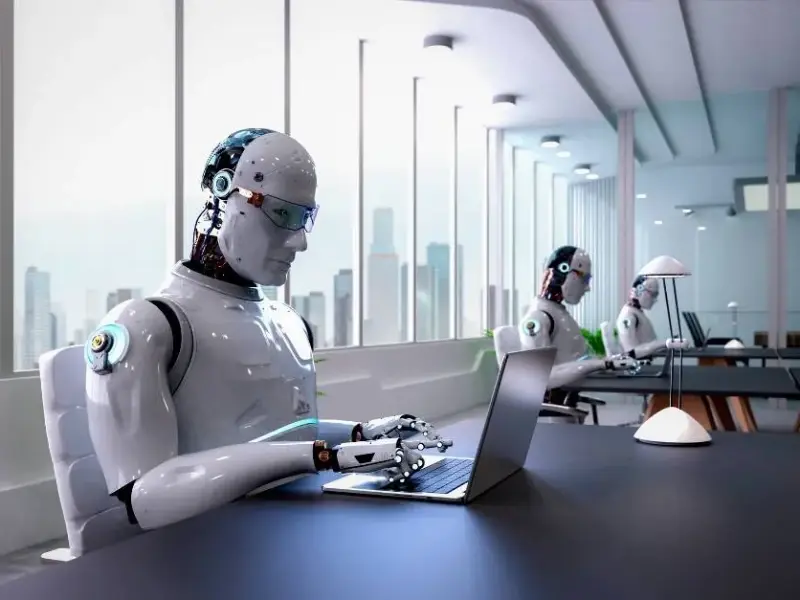
- AI is transforming the job market by automating routine tasks and enhancing human capabilities. While automation in industries like manufacturing reduces the need for human labor, AI augmentation in fields such as healthcare and finance improves decision-making and efficiency.
- The rise of AI is creating demand for new job roles, such as data scientists and machine learning engineers, and industries like autonomous vehicles are burgeoning. Lifelong learning and the development of both technical and soft skills are essential for workers to remain competitive and adaptable in an AI-driven world.
- The integration of AI into the workforce raises ethical concerns, including job displacement and bias in AI systems. Policymakers and businesses must collaborate to create policies and strategies that promote ethical AI use, support affected workers through retraining programs, and ensure inclusive growth.
As artificial intelligence (AI) continues to evolve, it is poised to revolutionise the job market in unprecedented ways. The integration of AI into various industries is reshaping traditional roles, creating new opportunities, and necessitating a shift in the skills workers need to thrive. The future of jobs in an AI-driven world presents both challenges and opportunities, and understanding these dynamics is crucial for workers, businesses, and policymakers alike.
The AI revolution: automation and augmentation
AI’s influence on the job market can be seen through two primary lenses: automation and augmentation. Automation involves AI taking over tasks that were previously performed by humans. This is most evident in industries such as manufacturing and logistics, where robots and automated systems are handling repetitive and routine tasks. For instance, in warehouses, AI-powered robots are used for sorting and packing goods, significantly reducing the need for human labor in these roles.
However, AI is not only about replacing human labor. Augmentation, where AI enhances human capabilities, is equally significant. In healthcare, for example, AI systems assist doctors by providing advanced diagnostic tools that can analyse medical images with high accuracy. This allows healthcare professionals to make more informed decisions and improves patient outcomes. Similarly, in finance, AI-driven analytics help professionals manage risks and identify investment opportunities by processing vast amounts of data quickly and accurately.
New job roles and emerging industries
While AI automates certain tasks, it also creates new job roles and industries. The demand for data scientists, AI specialists, and machine learning engineers has surged as companies seek to harness the power of AI. These professionals are responsible for developing, implementing, and maintaining AI systems, making their expertise highly valuable in the modern job market.
“Automation through AI has the potential to increase productivity dramatically, but it also poses significant challenges for workers whose tasks are susceptible to automation.”
Erik Brynjolfsson, professor of MIT
Emerging industries, such as autonomous vehicles, are also creating new job opportunities. The development and deployment of self-driving cars require not only software developers but also professionals in fields like infrastructure planning, vehicle maintenance, and regulatory compliance. Similarly, the growth of AI in healthcare is driving demand for roles such as bioinformaticians, who can interpret the complex data generated by AI systems.
Skills for the future: adaptation and lifelong learning
The rapid advancement of AI is reshaping the skills landscape. Technical skills such as programming, data analysis, and machine learning are in high demand. However, as AI takes over more routine tasks, the importance of soft skills is becoming increasingly apparent. Creativity, problem-solving, emotional intelligence, and the ability to adapt to new situations are critical for workers to remain relevant in an AI-driven world.
“Lifelong learning is no longer optional; it is essential.”
Sheryl Sandberg, COO of Facebook
The fast-paced nature of technological change means that skills can quickly become outdated. Continuous education and training are necessary for workers to keep up with advancements and maintain their employability. Many organisations are investing in upskilling and reskilling programs to help their employees adapt to new technologies. For example, companies like Amazon and IBM have launched extensive training initiatives to equip their workforce with the necessary skills to thrive in an AI-driven environment.
Also read: Tesla pledges $500M for charging network after layoffs
Ethical and social implications
The integration of AI into the workforce raises significant ethical and social challenges. One of the primary concerns is job displacement. Workers in roles that are highly susceptible to automation, such as manufacturing and administrative positions, face the risk of unemployment. Addressing this issue requires proactive measures such as retraining programs, social safety nets, and policies that promote job creation in emerging sectors.
AI also brings up issues related to privacy, bias, and accountability. AI systems are only as good as the data they are trained on, and biased data can lead to biased outcomes. This is particularly problematic in areas like hiring, where AI systems could inadvertently perpetuate existing inequalities. Ensuring that AI systems are transparent, fair, and accountable is crucial to preventing unintended harm and ensuring that AI benefits society as a whole.
“We need to ensure that the benefits of AI are distributed equitably and that those affected by automation are supported through this transition.”
Kai-Fu Lee, CEO of Sinovation Ventures
The role of policymakers and businesses
Policymakers and businesses play a crucial role in shaping the future of work in an AI-driven world. Governments need to create policies that foster innovation while protecting workers’ rights and promoting inclusive growth. This includes investing in education, supporting research and development, and creating a regulatory environment that encourages the ethical use of AI.
Businesses, on the other hand, must embrace AI strategically. Rather than viewing AI as merely a cost-cutting tool, companies should see it as a means to drive growth and innovation. This involves integrating AI into business processes, fostering a culture of continuous learning, and collaborating with stakeholders to address the broader implications of AI adoption. For instance, companies can work with educational institutions to ensure that curricula are aligned with industry needs and that students are equipped with the skills required in an AI-driven world.
Case studies: AI in action
Healthcare
In healthcare, AI is transforming the way diseases are diagnosed and treated. AI systems can analyse medical images and identify abnormalities with a level of accuracy that surpasses human capabilities. This technology is particularly useful in fields like radiology and oncology, where early detection of diseases can significantly improve patient outcomes. Additionally, AI-driven predictive analytics can help healthcare providers anticipate patient needs and allocate resources more effectively.

Autonomous vehicles
The development of autonomous vehicles is a prime example of how AI is creating new industries and job opportunities. Companies like Tesla, Waymo, and Uber are at the forefront of this technology, developing self-driving cars that promise to revolutionise transportation. The widespread adoption of autonomous vehicles could lead to job creation in areas such as vehicle maintenance, infrastructure development, and regulatory compliance. However, it also poses challenges for workers in traditional driving jobs, highlighting the need for effective transition strategies.
Finance
In the finance industry, AI is being used to enhance decision-making processes. AI-driven algorithms can analyse vast amounts of data to identify investment opportunities and manage risks more effectively. This allows financial professionals to make better-informed decisions and improves overall efficiency. However, it also requires workers in the finance industry to develop new skills, such as data analysis and AI system management, to remain competitive.
Also read: The future of AI and automation in the workforce
Pop Quiz
What skill set is increasingly important in an AI-driven world besides technical skills?
A. Financial management
B. Soft skills like creativity and emotional intelligence
C. Physical endurance
D. Manual dexterity
The correct answer is at the bottom of the article.
The future of jobs in an AI-driven world is complex and multifaceted. While AI has the potential to automate certain tasks, it also opens up new avenues for job creation and human enhancement. Success in this new era will depend on our ability to adapt, learn, and navigate the ethical and social challenges that AI presents. By embracing these changes and working collaboratively, we can harness the power of AI to create a more innovative, inclusive, and prosperous future for all.
The journey ahead requires a balanced approach, ensuring that technological advancements benefit society as a whole and provide opportunities for individuals to thrive. With proactive measures from policymakers, strategic adoption by businesses, and a commitment to lifelong learning from workers, the future of jobs in an AI-driven world can be bright and full of possibilities.
The correct answers is B.Soft skills like creativity and emotional intelligence mentioned in the article, feel free to hold your own opinion.