Summary
- Buchanan Automation's unusual value is not any single robot, valve or camera. It is the possibility of joining pneumatic, motion, vision, control, safety and support decisions under one engineering workflow.
- The public record supports a real operating company with a long history, two western US locations, manufacturer relationships, application engineering, prototyping, assembly and a documented proof-of-concept role. It does not, by itself, prove complete-cell accountability, response times or production outcomes.
- A buyer should make responsibility explicit. Buchanan's posted standard terms otherwise place suitability on the purchaser, pass through manufacturers' warranties and limit consequential-loss exposure—an awkward default for a system whose value rests on integrated performance.
- The decisive procurement test is a witnessed, part-specific acceptance programme tied to a signed responsibility matrix, safety file, source-code and configuration handover, remote-access controls, spares plan, recovery drills and post-start support.
A cell fails in the spaces between products
Imagine a machine-tending cell at 2:13 on a wet Tuesday morning. The CNC has finished cutting. Its status output says the cycle is complete. A robot controller is waiting for permission to approach. A pneumatic vice still holds pressure, but a sensor has not changed state. The camera sees a part, though coolant has reduced contrast. The safety controller believes the door is closed. The PLC believes it is open. An operator clears the fault, and the sequence starts again from a state its programmer did not expect.
No component has to be “broken” for this cell to lose the shift. The failure lives in the handshake: which state is authoritative, how long a signal may remain stale, what happens after a pressure dip, whether a retry is safe, and who owns the logic that joins the devices. This is why industrial automation is purchased as a control-and-support system rather than as a box of parts.
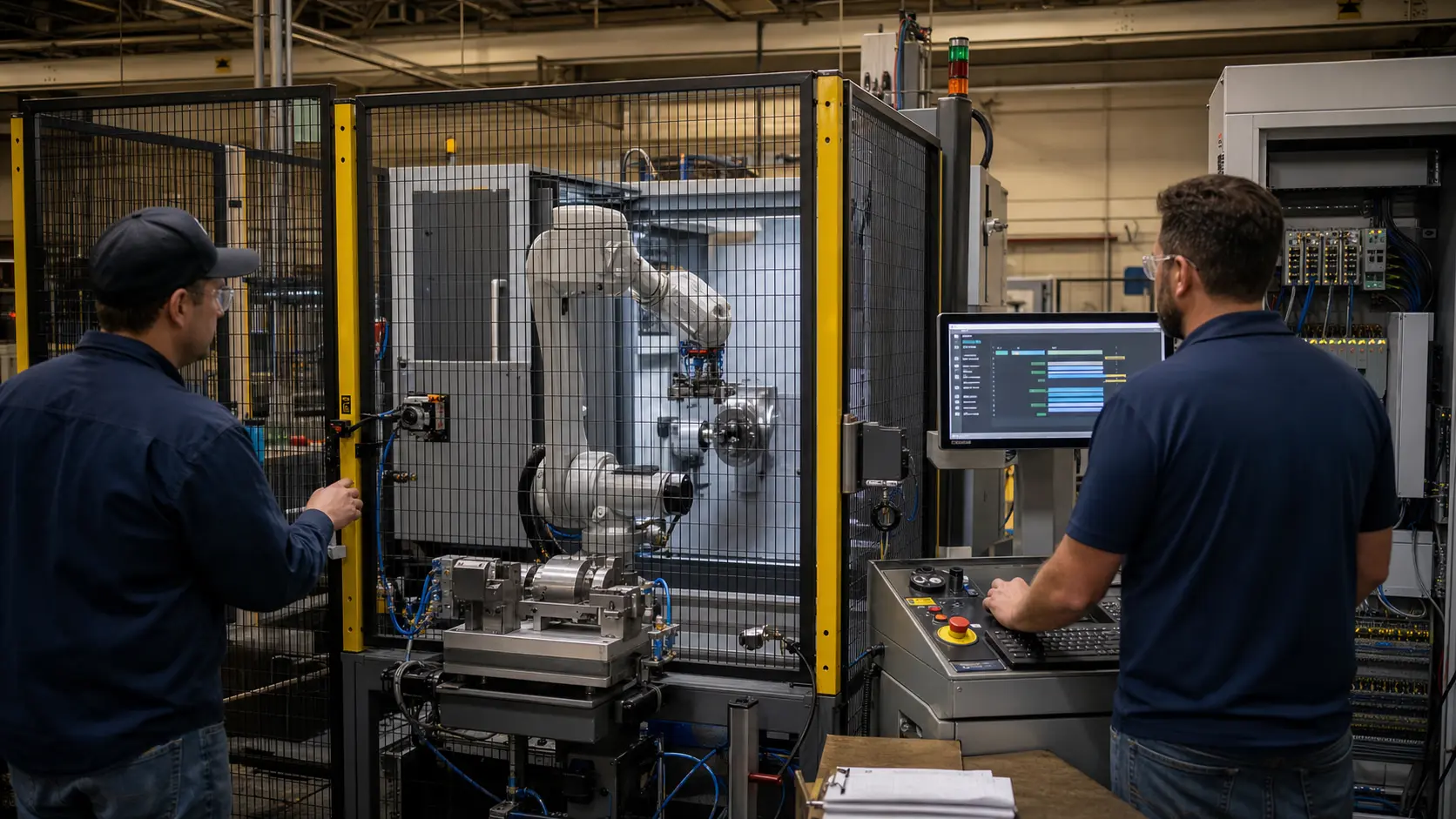
Robotiq's technical lesson on designing a CNC machine-tending cell states the problem plainly. The robot must receive and place parts, negotiate a machine door, exchange confirmed states with the machine, clear tooling, manage workholding and often deal with chips or coolant. The lesson's most useful idea is that making the arm move is not the hard part; making everything around it work correctly is. Its Machine Tending Playbook begins with the existing production baseline, the operator's real work and the physical workspace before it asks a buyer to calculate return.
That framing fits Buchanan Automation. The company is not a robot manufacturer. Its public proposition is breadth across interfaces. Buchanan's product map spans PLCs and HMIs, fieldbus I/O, sensors, machine vision, safety, industrial PCs, remote access, robots, end effectors, actuators, motors, conveyors, pneumatic controls and vacuum equipment. Its roster includes such different ecosystems as Schneider Electric controls, Balluff sensing, Universal Robots and Kawasaki robots, Robotiq tooling, Piab vacuum equipment and Secomea remote access. The point is not that this list is unique. It is that every item can become part of the same failure chain.
The investment case for Buchanan should therefore be judged at the boundaries. Can its engineers define the state model shared by the PLC and robot? Can they demonstrate that a dropped vacuum signal produces a safe, recoverable response rather than an unexplained stop? Can they separate ordinary production control from safety-related control? Can they document who is allowed into the cell remotely, what that person changed, and how a known-good version is restored? Can they supply the right spare valve quickly without allowing the installed bill of material to drift? Above all, will the contract make Buchanan answerable for the result?
That last question is more demanding than “Can Buchanan sell all these products?” The public evidence says that it can represent and combine a wide set of technologies. It does not say that every quotation makes it the prime integrator, that every design receives the same validation, or that every support request has a guaranteed response. A manufacturer should not fill those gaps with optimism. It should turn them into acceptance criteria.
The identity is clear; the accountability still has to be contracted
The company under review is BUCHANAN AUTOMATION INC, the Washington/California operator—not a similarly named software or Michigan automation business. The positive identity chain is unusually consistent. Buchanan's official history says Angus Buchanan founded the company in 1963 as a stocking distributor for fluid-power products and that it evolved into a multi-disciplinary automation provider. The page identifies a headquarters at 1920 Bickford Ave in Snohomish, Washington, and a second location at 940 Auburn Court in Fremont, California. Its contact page repeats those addresses and associates them with coverage across the Pacific Northwest, parts of the Mountain West, Northern California, Northern Nevada, Alaska and Hawaii.
The same bridge appears outside the company site. Buchanan's LinkedIn company page links back to buchanan-a.com, repeats the two addresses and the 1963 founding date, and describes the same mix of pneumatics, vacuum, motion, I/O, robotics, tooling, safety and vision. LinkedIn displayed a company-selected size band of 51–200 employees and 39 associated employee profiles when accessed. Neither figure is a payroll count: the band is self-reported, while associated profiles can be incomplete or stale. They are useful only as an instruction to ask for the named team allocated to the job, not as proof of available capacity.
A Better Business Bureau profile records the same Snohomish address, a June 1963 business start and a July 1971 incorporation. The BBB itself cautions that profile information may come from third parties and is not fully verified, so those dates are corroboration rather than a substitute for a corporate registry extract. More persuasive for the operating identity are current channel records: MAC Valves, Oriental Motor and Secomea all list Buchanan at one or both of the same locations with matching contact details.
This establishes continuity, place and field of operation. It does not establish the role Buchanan will play on a particular line. “Distributor,” “application engineer,” “solution provider,” “value-added assembler” and “system integrator” allocate very different risks. A distributor may correctly select and ship a component while the buyer remains responsible for the machine. An application engineer may size a valve without controlling the sequence. A panel builder may certify a panel without certifying the connected equipment.
A prime integrator may own the complete functional specification, safety strategy, commissioning and production acceptance.
Buchanan's own robotics intake form asks, among other things, who will be responsible for integration. That is an excellent question—and a warning not to assume the answer. The procurement file should name one accountable party for each interface and one party responsible for overall system performance. If Buchanan is intended to be that party, the statement of work must say so.
The reason is visible in Buchanan's posted standard terms. The document says third-party manufacturer warranties are passed through, describes repair or replacement as the exclusive remedy for defective third-party products, and places responsibility on the purchaser and user to determine suitability and fitness unless the arrangement is altered in a signed writing. It also disclaims consequential injuries or damages and claims for such items as labour, lost profit, repairs and transport associated with replacement.
Those may be negotiable boilerplate rather than the final agreement. They are nevertheless the opposite of an implied whole-cell performance warranty. If a valve works to specification, a camera works to specification and a robot works to specification, but the cell misses its cycle time because their logic does not cooperate, component warranties may answer nothing. The buyer needs a signed system-level promise: defined operating modes, throughput and quality thresholds, availability measurement, safe recovery behaviour, documentation, response times and a method for assigning root cause across suppliers.
Longevity matters in automation because lines outlive product cycles and staff tenures. A 1963 origin gives Buchanan a credible continuity story. It does not remove key-person risk, obsolescence risk or ambiguity in a modern software-heavy project. The practical identity check is therefore complete only when the historic company, the people named in the proposal, the manufacturing or assembly location, the software repositories and the on-call obligations all appear in the same contract.
Buchanan's real product is a regional control plane
Buchanan's public story begins with inventory but now reaches engineering. Its official history says the company started as a stocking fluid-power distributor, claims $2 million of inventory, describes rapid modelling and prototyping, and names AutoCAD, Autodesk Inventor and SolidWorks as engineering tools. Its homepage says it creates prepackaged pneumatic, vacuum and electronic solutions from design to delivery and integrates finished systems for both low- and high-volume applications.
The claim that deserves attention is not the dollar value of inventory, which is unaudited and can change. It is the operating model implied by inventory, local application engineers and assembly. Industrial downtime often turns on a mundane dependency: the precise valve coil, seal, gripper finger, sensor connector or I/O module that can restore service without redesign. A local stock-and-support model can shorten that path. It can also create silent dependence if the customer never receives an approved-equivalents list, drawings or configuration records.
Buchanan's Value Added Department describes assembling customer-approved bills of material into electrically and pneumatically tested kits, consolidating purchasing under one item or purchase order, supporting just-in-time delivery, and providing start-up and programming assistance. The same page offers component crossover and reverse-engineering help when a part is discontinued, hard to source, expensive, unreliable or slow to arrive. These are meaningful lifecycle capabilities because a production line rarely remains frozen at its factory-acceptance configuration.
But each capability contains a governance question. If Buchanan cross-references a valve, who checks flow, response time, environmental rating, diagnostic behaviour and safety consequences? If it reverse-engineers a bracket or manifold, who owns the drawing and validation record? If a kit arrives as one item, does the plant's maintenance system still receive every underlying manufacturer part number and revision? If just-in-time delivery reduces local stock, what buffer protects the plant from a regional disruption or supplier allocation?
The company also markets a process called Customer Profit Reinforcement. It says Buchanan compares current processes with proposed solutions, ranks opportunities by ease of implementation, examines component fit and process documentation, and produces before-and-after measures. The listed support includes pneumatic sizing, kitting, training and machine start-up. This is the right outline for an automation business case. It is not evidence that a specific saving will occur. The customer should own the raw baseline, the definitions and the measurement window.
The facilities matter because they form the physical support plane. Snohomish is described as headquarters and serves a broad northwestern territory; Fremont covers Northern California and Northern Nevada. The company lists applications across semiconductor, packaging, wood processing, food and beverage, logistics, medical, agriculture, solar and specialty machinery. Such variety may broaden component and application experience. It can also stretch specialists across different safety, cleanliness, validation and support regimes. A semiconductor handler, food washdown cell and sawmill motion system are not interchangeable references.
The most concrete public example of Buchanan doing more than shipping a box comes from Piab. In a case study involving DCL Logistics, Piab says DCL saw a Universal Robots arm with a Piab piCOBOT vacuum gripper at a Buchanan open house and then sent boxes to Buchanan for proof-of-concept testing. The case describes pre-installation simulation and gripper feedback for suction failures. That is useful evidence of a demonstration and test loop across robot and gripper.
It is not evidence that Buchanan delivered, warranted or supported DCL's entire production cell. The case publishes no safety file, final acceptance test, sustained uptime or project economics. Its value lies elsewhere: it shows the type of de-risking transaction a buyer should demand with its own parts before placing an order. Samples move through a representative setup, failure states are observed, and product fit is tested before production is exposed.
The operating thesis, then, is that Buchanan offers a regional control plane: local access to manufacturers, engineering interpretation, physical prototyping, inventory, assembly, commissioning help and lifecycle substitutions. That plane is valuable if it reduces the number of unsupported interfaces. It becomes a risk if it merely bundles interfaces while responsibility remains dispersed.
Start with the work, not the robot
A dependable automation project begins with an observed production system. The customer and integrator should watch complete shifts, not a clean demonstration cycle. They need the range of parts, process recipes, operators, raw-material variation, rework, cleaning, jams, changeovers, warm-up, maintenance and upstream starvation. They need to understand what an experienced operator notices before a sensor does.
The co-branded Buchanan edition of Robotiq's Machine Tending Playbook reinforces that sequence. It frames the job around establishing a production baseline, mapping the operator's work, fitting a robot into the existing setup and proving return with data. That is more useful than beginning with payload and reach because it exposes what must be automated outside the arm.
For a machine-tending project, the baseline should separate spindle cycle, operator attendance, door time, chuck or vice time, part exchange, gauging, cleaning, queueing, planned stops and unplanned stops. Average cycle time alone conceals tails. A cell that runs perfectly for 50 repetitions and then requires an expert recovery may appear productive in a demo while becoming a burden over a week. The baseline must therefore include distributions and fault categories, not just a mean.
The next step is a functional specification written in plant language. It should define every product family, orientation and permitted variation; environmental conditions; required rate and quality; modes such as production, setup, teaching, cleaning, maintenance and manual recovery; upstream and downstream signals; retained data; safety zones; and the person authorised to restart after each fault class. “Robot loads machine” is not a specification.
Only then should Buchanan select an architecture. Its broad line card can be helpful because an engineer can trade among pneumatic, electric and vacuum actuation; fixed or vision-guided presentation; distributed I/O or local panels; collaborative or guarded robots; and local or remote diagnostic access. The buyer should require a written rationale for each trade rather than accept a brand bundle.
Proof of concept follows. It must use production-representative parts, surfaces, tolerances, packaging, oils, dust, ambient light and damaged examples. Vision must be tested at the limits of contrast and pose. Vacuum gripping must be tested for porosity, leakage, contamination and pressure variation. Pneumatic moves must be tested at the lowest allowed supply pressure and worst credible payload. Robot reach must include dress packs, tooling, singularities and escape paths, not just nominal points.
The proof should deliberately fail. Disconnect a sensor. Delay a machine-ready signal. Present two parts. Remove one workpiece. Lower pressure. Obscure the camera. Open a guard at each sequence state. Restart a controller. Attempt to resume after an emergency stop. The purpose is not theatrical abuse. It is to discover whether the state machine has an unambiguous safe response and whether an ordinary technician can understand it.
After concept approval, the design review should produce a controlled bill of material, network diagram, I/O list, sequence description, cause-and-effect matrix, safety requirements specification, electrical and pneumatic drawings, risk assessment, software design, alarm philosophy, spares list and lifecycle assumptions. Each item needs an owner and revision. Buchanan's assembly and CAD claims make it plausible that it can contribute these artefacts; the contract must require them.
Factory acceptance should be a witnessed test against that package. The buyer should bring representative parts and operators. The test should include nominal production, changeover, all specified fault and recovery cases, safe stops, power loss, data retention, access-control checks and a sustained run long enough to reveal thermal, memory, leakage or queue effects. Open punch-list items should have severity, owner, due date and a rule governing shipment.
Site acceptance is not a replay in a new room. It tests the real utilities, guarding, network, upstream/downstream equipment, staffing and production mix. It should include restart after plant outages, restoration from backups, maintenance lockout, remote-support approval, spare replacement and a defined production run. Training must be role-specific: operators need recovery boundaries, maintenance needs energy isolation and diagnostics, controls engineers need code and change governance, and IT/security teams need ownership of accounts and logs.
Finally comes stabilisation. An integrator should not disappear at first production. The contract should define the early-life support window, daily issue review, defect classification, response and escalation, software-change discipline, performance report and exit criteria. A cell is accepted when the plant can operate and recover it safely at the contracted performance—not merely when it cycles in the presence of the people who wrote it.
This workflow turns Buchanan's breadth into a testable service. Without it, breadth is a catalogue. With it, breadth can reduce interface risk.
The architecture is a chain of promises
A modern automation cell can be read as a chain of promises from the physical process to the business outcome.
At the physical layer, fixtures, frames, conveyors, doors and tooling hold or move the work. Their stiffness, tolerance stack and wear determine whether a programmed path remains valid. The robot and motion axes provide reach, speed and force, but their nominal repeatability does not correct a fixture that moves or a part that arrives unpredictably. End-of-arm tooling converts motion into contact, suction or clamping. Pneumatic and vacuum circuits provide energy and state changes. Sensors and vision estimate what happened.
At the control layer, PLCs, robot programs, safety controllers, drives, HMIs and distributed I/O turn those observations into sequence. Buchanan's line card joins all of these categories. That makes the company well placed to see cross-layer interactions, but it also means the project can accumulate several engineering environments, firmware branches, licences and vendor-specific data models.
A simple sequence illustrates the issue:
- The machine declares its cycle complete.
- The controller verifies spindle stop, safe machine state and access permission.
- The door opens and proves open.
- Workholding releases and proves released.
- The robot enters only after the relevant safety and process conditions agree.
- The gripper confirms the finished part is held.
- The robot clears the envelope.
- The raw part is seated and its presence is verified.
- Workholding closes and proves clamped.
- The robot clears, the door closes, and the machine receives permission for the next cycle.
Every verb hides a policy. What qualifies as “proves”? Is a sensor edge enough, or must two conditions agree? How old may a networked signal be? What happens if a device reports contradictory states? Can a step be retried automatically? Does maintenance mode bypass an interlock? Which transitions are standard control and which are safety-related? How does the operator distinguish “waiting,” “blocked,” “faulted” and “unsafe”?
The architecture should make those policies explicit in a state model and cause-and-effect matrix. Tags should have defined owners. Alarms should identify a failed condition and recovery action, not merely a numeric device code. Timeouts should reflect physical behaviour rather than arbitrary programming defaults. After any controller restart, the cell should reconcile real state rather than assume it is at the beginning of a cycle.
Vision adds another promise: that an image represents the relevant physical truth. Buchanan lists machine-vision and identification products alongside sensors and robot guidance. A vision design must control illumination, lens, exposure, calibration, part presentation and rejection policy. Its confidence threshold is a production decision. False accepts can pass defects or cause collisions; false rejects can erase throughput. “AI vision” does not remove those trade-offs. It makes dataset scope, drift monitoring and fallback behaviour more important.
Pneumatics adds stored energy and timing. Valve response, tubing volume, pressure, flow, seal condition and load determine when an actuator actually reaches position. A PLC timer cannot prove motion. A sensor can. Yet the sensor itself can stick, move or fail. The cell needs plausible-state checks—such as rejecting simultaneous open and closed indications—and a defined response to lost pressure.
Remote access adds a second control plane. Buchanan's product map lists Secomea as a remote-access offering, and Secomea's partner directory lists Buchanan. The remote system can accelerate diagnosis by bringing an expert to a stopped cell without travel. It can also allow a person outside the plant to change the same logic that governs physical motion. That makes identity, approval, logging and rollback part of machine reliability.
The final promise is business performance. Throughput is not robot speed; it is accepted good units over a defined production period. Availability is not the absence of emergency stops; it is the ability to perform required work when scheduled, with exclusions agreed in advance. Quality is not a camera's pass rate; it is the process outcome measured against the customer's specification. Energy improvement is not a new valve's efficiency claim; it is metered plant consumption normalised for production.
An accountable integrator traces every business promise downward to an acceptance test and every component upward to a failure consequence. Buchanan's value will be highest when it owns that traceability rather than merely furnishing the parts.
Reliability lives in recovery, not the perfect cycle
Automation demonstrations usually show the happy path. Production economics are governed by the other paths.
Consider the difference between a stop and a trap. A stop is expected: the cell detects a condition, moves or remains in a known safe state, explains the cause, preserves relevant information and offers an authorised recovery. A trap leaves inconsistent device states, an obscure alarm or a sequence that only its original programmer can reset. Both reduce output, but only the second creates durable dependence.
Reliability design begins with failure-mode analysis across the interfaces Buchanan proposes to own. For each sensor, actuator, network link, controller and software service, the team should ask what failure looks like, whether it is detectable, what the safe state is, what production is lost, what diagnostic evidence remains and how service is restored. A failed-open pneumatic valve, a stale network bit and a corrupted vision recipe demand different responses.
The design should distinguish graceful degradation from unsafe improvisation. A plant may be able to run a cell in a slower guarded mode after losing non-safety vision guidance. It should not silently bypass a safety input or let an operator force an output without an approved procedure. Manual mode needs its own sequence and risk assessment; it is not production logic with protections removed.
Buchanan's value-added page says it electrically and pneumatically tests assemblies before delivery. That can remove wiring and leakage defects early. The buyer should ask for the actual test specification, results tied to serial numbers, calibrated equipment where relevant, and rules for retest after a substitution. “Tested” becomes valuable when the evidence travels with the assembly.
Inventory can reduce mean time to repair only if the correct spare can be identified and configured. The spares plan should separate consumables, strategic line-down items and long-lead assemblies. It should record shelf-life, storage requirements, firmware or parameter needs, and approved alternatives. For a configured drive, camera or controller, physical stock is not enough; the plant needs the correct version, licence, backup and restore procedure.
Software backup must be demonstrated, not promised. Before acceptance, a different qualified person should restore each controller, robot, HMI, vision system and remote-access gateway from the delivered package. The exercise should prove that source files are complete, versions are compatible, passwords and licences are governed, and the restored system matches the released baseline. If restoration requires Buchanan, that dependency should be priced and contracted consciously.
Change control is equally important. A five-minute online edit can alter cycle time, safety assumptions, alarm behaviour or data collection. Each change should have a request, risk assessment, reviewer, tested result, version, release note and rollback point. Emergency support changes need the same records after the line is stable. The plant should be able to answer who changed what, why and when.
Performance measurement should also resist convenient averages. Report good units, planned time, unplanned downtime by cause, mean time to acknowledge, mean time to restore, first-pass yield, operator interventions and energy per good unit. Separate integrator defects from upstream starvation, material problems and planned maintenance, but define those categories before the test. Otherwise every missed target becomes a debate over exclusions.
The public pages describe start-up support, programming assistance, training and machine optimisation. They do not publish a standard service-level agreement. That is not evidence Buchanan lacks one; it means the buyer must request it. A production-critical line needs named severity levels, acknowledgement and mobilisation targets, remote and on-site coverage, escalation, spare dispatch, temporary workaround rules and root-cause reporting.
The best reliability test is a recovery drill performed by the customer's team. Pull a fuse under an approved test plan. Replace a sensor. Restore a robot program. Revoke a remote user. Recover from a failed update. Restart after loss of pressure and power. If the plant can execute those tasks safely with the delivered documentation, the integrator has transferred capability rather than created a permanent rescue contract.
A collaborative robot does not make a collaborative application
Buchanan sells both collaborative and conventional robot families, along with safety components, sensing, framing and end-of-arm tooling. That breadth is necessary because the safety of a cell is not a property of the arm alone.
The International Organization for Standardization explains that ISO 10218-1:2025 addresses the industrial robot as partly completed machinery, while integration into a complete application is covered by ISO 10218-2. Additional hazards can come from the application itself. Universal Robots is even more direct in its risk-assessment instructions: the integrator is responsible for the application risk assessment, and that assessment must consider the tool, obstacles, other machines, teaching, troubleshooting, maintenance and normal operation.
This matters because a nominally collaborative arm can carry a sharp tool, trap a hand against a fixture, throw a poorly gripped part or enter a machine with stored pneumatic, electrical and mechanical energy. Speed and force limiting address only part of the hazard. A complete assessment considers reasonably foreseeable misuse and every task over the system's life.
US requirements add another layer. The Occupational Safety and Health Administration says machine guarding protects operators and nearby workers from hazards such as nip points, rotating parts and flying material. Its hazardous-energy standard governs servicing and maintenance and addresses situations in which guards are bypassed or a person enters a danger zone. A robot safety circuit does not replace an employer's energy-control programme.
The current US robotics benchmark has also moved. The Association for Advancing Automation says ANSI/A3 R15.06-2025 adopts ISO 10218 Parts 1 and 2 and updates functional-safety clarity, collaborative applications, end effectors, manual loading and unloading, testing and cybersecurity guidance. A project designed from old habits should be checked against the standards and local requirements in force for the installation.
The buyer should require a task-based risk assessment before detailed design is frozen, then update it as the cell changes. Each identified hazard should trace to inherently safe design, an engineering control, an administrative control or information for use, in that order of preference where applicable. Safety functions need required performance, architecture, validation method and proof-test assumptions. Residual risks need to appear in training and manuals.
Responsibility must be named. Buchanan's public A3 profile shows membership in motion, robotics and vision, but membership should not be mistaken for Certified Robot Integrator status. The frozen profile does not display such a badge. That bounded observation does not prove Buchanan lacks qualified safety staff or current credentials. It means procurement should request the names, training, certifications, standards versions and sample deliverables of the people who will perform and validate the work.
Electrical panels require the same precision. UL explains that its Industrial Control Panel Shop Program requires trained staff and a qualified technical representative at each participating manufacturing location. A buyer should verify the actual shop and listing if a UL-marked panel is required. It should also understand the boundary: UL states that certification of an enclosed control panel does not cover the connected loads or equipment. A labelled panel is not a certified robot cell.
Acceptance should include safety validation under realistic modes and faults, with calibrated measurements where the design depends on speed, stopping time, distance, force or pressure. The customer should receive the risk assessment, safety requirements, schematics, calculations, validation records, device certificates, password governance and change rules. Any modification after acceptance that affects a hazard must trigger review.
The principle is simple: the arm manufacturer certifies an arm within a defined scope; the integrator makes an application; the employer operates and maintains a workplace. A contract with Buchanan should connect those responsibilities without leaving a gap where everyone supplied a compliant component but no one accepted the safety of the whole.
Remote support turns the integrator into a security principal
Industrial support has a compelling remote use case. When a line stops, the engineer who understands its sequence may be hours away. A controlled remote session can shorten diagnosis, preserve production and avoid unnecessary travel. Buchanan's product page lists remote-access technology, and Secomea's partner directory identifies Buchanan as a regional channel partner. That makes security part of the integrator evaluation, not a separate IT purchase.
Operational technology differs from ordinary office IT because a cyber action can change a physical process. The National Institute of Standards and Technology's Guide to Operational Technology Security treats performance, reliability and safety as core constraints and covers devices such as PLCs that monitor or control the physical environment. A hurried patch, reboot or account lockout can have production and safety consequences even when it improves a conventional security metric.
The design should begin with ownership. The plant—not an individual salesperson, remote technician or machine builder—should own the policy that determines who may connect, to which assets, for what purpose and for how long. Every human needs an individual identity. Shared vendor accounts destroy attribution. Privileges should be limited to the required asset and protocol, granted for a bounded window and revoked when the work ends.
Secomea says its zero-trust remote-access platform can provide role-based permissions, MFA or SSO, approval-based and just-in-time access, file scanning, session monitoring, audit logs, recordings, encrypted tunnels and segmentation. Those are vendor claims about available features, not proof of the configuration Buchanan will quote. The buyer should require a feature-by-feature design, licence schedule and demonstration.
The network diagram should show every trust boundary and data flow: engineering workstation, robot controller, PLC, HMI, vision device, safety controller where networked, remote gateway, plant firewall, identity provider, log destination and any vendor-hosted service. It should state whether a connection is inbound or outbound, which ports and protocols are used, how certificates or keys are rotated, where logs are retained and what happens when the remote service is unavailable.
The Cybersecurity and Infrastructure Security Agency's internet-exposure guidance recommends changing defaults, maintaining patches, replacing unsupported systems, using monitored jump hosts, monitoring traffic, enabling MFA and reassessing exposed assets routinely. A Buchanan-supported cell should be checked against those basics before it reaches production. “Behind a firewall” is not a complete architecture.
Remote changes need a two-person operational process. The plant should open a ticket, approve the target and window, establish a known backup, monitor the session, test the result locally, close access and archive the change record. For high-consequence changes, a local authorised person should retain stop authority. Session recording can help investigation, but it does not replace source versioning or a precise diff.
File transfer deserves special attention. PLC, HMI, robot and vision projects are executable control logic. The support process should scan transferred files, verify source and integrity, test in an appropriate environment, control removable media and retain the released artefact. Firmware upgrades should include compatibility checks and a rollback plan. A vendor's “latest” version may not be the plant's validated version.
Logging also has to serve operations. Authentication, approval, connection, configuration change and file transfer events should reach a system the plant controls. Clocks must be synchronised so a remote session can be correlated with PLC alarms, safety events and quality deviations. Retention should match incident, contractual and regulatory needs. The customer should be able to export evidence if it changes integrator or remote-access platform.
Security is part of safety planning because loss of control integrity can alter physical behaviour. The 2025 robotics-standard update explicitly includes cybersecurity guidance in its safety context. The risk assessment should therefore cover remote misuse, credential compromise, stale accounts, unsupported firmware, malicious or mistaken logic changes and loss of the remote service. It should identify safe operating modes when connectivity is unavailable.
Finally, the support contract should state disclosure obligations. If Buchanan or a relevant supplier learns of a vulnerability affecting installed equipment, who notifies the plant, within what period, with what affected-version information and mitigation? Who tests and deploys the fix? Who pays when a component reaches end of support earlier than the expected machine life? The answers determine whether remote support reduces downtime or merely imports a new dependency.
Pneumatics makes energy, reliability and safety the same conversation
Buchanan's origins and current line card make pneumatics central to its proposition. Air moves cylinders, clamps parts, actuates doors, creates vacuum and drives tools. It is familiar, fast and robust—but it is not free, and its state is not always visible.
The US Department of Energy's compressed-air guidance recommends attention to leaks, inappropriate uses, pressure, storage, controls, air quality, preventive maintenance and end-use engineering. It says efficient equipment and good energy management can produce significant savings. That is a system claim, not a promise that replacing one valve will lower a plant's bill.
A Buchanan proposal should therefore begin with measured demand. Record pressure and flow at the machine under representative production, including transients. Identify the minimum pressure required for each function and the consequence of falling below it. Size tubing, valves and storage for actual timing rather than habit. Detect leakage and isolate unused branches. Consider electric actuation or local vacuum generation where the lifecycle case is stronger.
Energy and reliability often align. A leak wastes compressor energy and can slow an actuator until a timeout becomes intermittent. Excess pressure consumes energy and increases force, wear or impact. Undersized tubing can make a correctly selected valve appear unreliable. Poor air quality can shorten component life. The acceptance test should measure the complete circuit at its operating limits.
Safety must include stored pneumatic and vacuum energy. Lockout, bleed-down, gravity and retained loads need an engineered state and verified procedure. A closed solenoid is not necessarily isolation. A gripper can release a part when pressure or power is removed. The risk assessment should define what happens to each load on loss of utilities and what an employee must do before entering the hazard area.
Buchanan's application-engineering and sizing claims are relevant here. The buyer should ask for the calculations, assumptions and minimum utility specification, then meter the result. Energy performance should be expressed per good unit or representative cycle and normalised for production mix. Otherwise a slower line can appear “efficient” simply because it produces less.
Price the lifecycle, then repair the standard terms
There is no public Buchanan project price list in the reviewed material, which is normal for engineered automation. The commercial model is likely to combine third-party hardware, custom mechanical or pneumatic assemblies, engineering, programming, commissioning, training, travel and support. The absence of a list price makes quote structure more important.
The buyer should insist on a cost breakdown that separates reusable standard products, custom or non-returnable items, engineering by phase, software licences, recurring remote-access charges, factory and site testing, documentation, training, spares and post-start support. Milestones should correspond to evidence: approved design, completed build, passed factory acceptance, passed site acceptance and achieved production acceptance.
Buchanan's standard terms say prices may change, shipping dates rely on supplier information, special products generally cannot be cancelled or returned, and longer-lead items may require payment at order. Those clauses expose the customer to supply-chain and specification risk early. The design should therefore freeze custom purchases only after a documented review, and the agreement should define how substitutions, lead-time changes and price changes are approved.
Return on investment should be a range, not a sales number. The numerator includes more than the quoted cell: plant engineering, facilities, guarding, utilities, network work, validation, lost production during installation, training, maintenance, licences, spares and future changes. The benefit includes incremental good output, avoided overtime or hiring, improved quality, reduced ergonomic exposure, energy change and released capacity—but only where the plant can measure and actually capture it.
Labour savings deserve particular care. A robot may remove repetitive attendance while adding setup, material presentation, inspection, maintenance and recovery work. The business case should map hours by role and shift, not assume every automated minute becomes cash. If labour is redeployed, describe where. If throughput is constrained elsewhere, faster tending may create inventory rather than revenue.
Availability should be valued at the bottleneck. A cell serving a non-constrained process has a different economic consequence from one feeding the only critical machine. The contract can reflect that difference through stronger support, spare coverage, staged rollout or redundancy. It should not rely on consequential-damage recovery after an outage if the supplier's terms disclaim that exposure.
This is where the posted suitability clause becomes decisive. Buchanan's value proposition is integration, but its standard terms place fitness on the purchaser unless changed in writing. The customer should negotiate a signed statement of intended use and system performance. It should include:
- the approved parts, process envelope and utilities;
- rate, quality and availability definitions;
- operating and recovery modes;
- applicable standards and validation responsibility;
- deliverable documentation and source files;
- security architecture and access ownership;
- warranty start, defect correction and support response;
- responsibility for interface defects and supplier coordination;
- change control, obsolescence and spare support; and
- remedies for failure to pass acceptance.
The remedy does not have to be unlimited consequential liability to be meaningful. It can include correction at supplier cost, milestone holdback, extended support, replacement of non-performing elements, a defined rejection right, or termination for persistent acceptance failure. The essential point is that the economic risk should sit with the party best able to control it.
A small pilot can also price uncertainty better than contract language alone. Choose a representative but bounded application, capture baseline data, run the full design and acceptance process, and measure the first months of operation. The pilot should produce reusable standards—code structure, alarm philosophy, security pattern, safety documentation, spare strategy and training—before the plant scales.
Lock-in begins with undocumented convenience
Industrial lock-in is rarely one dramatic licence clause. It accumulates through ordinary choices: a custom gripper with no drawing, a PLC project saved in an old software version, a vision recipe known only to one engineer, an HMI password held by a vendor, a remote gateway tied to someone else's tenant, a safety calculation never delivered, or a replacement component whose mapping exists only in an email.
Buchanan's multi-vendor breadth can reduce single-manufacturer dependence, because it can cross-reference products and work across pneumatic, electrical and robotic layers. Its value-added page explicitly offers crossover and reverse-engineering work for discontinued or difficult parts. But multi-vendor integration can also increase toolchain dependence. Each controller, robot, camera, drive and gateway may bring a separate project format, firmware matrix, licence and training requirement.
The buyer should inventory lock-in before design approval. For every subsystem, record the manufacturer, model, lifecycle status, engineering software and version, licence owner, source format, export format, passwords or certificates, backup method, restore test, trained internal roles, approved alternatives and expected support horizon. Classify which elements can be replaced independently and which force revalidation of the whole cell.
Software ownership needs unambiguous language. The customer should receive editable source for custom PLC, HMI, robot, vision and integration logic; build or restore instructions; third-party libraries and licence terms; released binaries where relevant; comments and tag dictionaries; and a version history. If Buchanan retains reusable background intellectual property, the customer still needs a durable right to operate, maintain, modify and engage another qualified provider.
Data ownership matters too. Alarm history, production records, images used for troubleshooting, remote-session logs and configuration backups should have defined custodianship and export. If a cloud or vendor service is removed, the cell should fail into an agreed operating state and the plant should retain necessary records. The operational reality is cyber-physical: any cloud dependence must never be left implicit.
Hardware standardisation should be deliberate rather than automatic. Reusing a plant's established PLC, HMI, safety and network families can reduce training and spares, even if another component is cheaper. Conversely, forcing every application into an incumbent platform can exclude a better technical fit. The decision record should show lifecycle cost, competence, interoperability, availability and exit path.
Training is the most effective anti-lock-in deliverable. Operators should understand states and permitted recovery. Maintenance technicians should diagnose field devices, pneumatics and networks. Controls staff should navigate and version the software. IT and security staff should administer access and logs. The training should use the delivered machine and include hands-on fault recovery, not just slides.
An escrow arrangement may be appropriate where critical custom software or unique fabrication knowledge remains with a supplier, but ordinary handover is better. The goal is not to make Buchanan replaceable on day one. It is to make continued use of Buchanan a choice based on service quality rather than the only way to restart the line.
Obsolescence planning closes the loop. At acceptance, the supplier should identify known lifecycle risks, expected replacement paths and components whose substitution would require code, safety or validation changes. The support agreement should define notification when a part or software version approaches end of sale or support. A periodic lifecycle review can then turn emergency redesign into planned work.
Support is an engineered subsystem
When production is down, the support experience becomes part of the machine. The plant needs a clear path from alarm to triage, from triage to the right specialist, and from a temporary recovery to a verified correction.
Buchanan publishes customer-service contacts, describes application engineers and lists start-up and programming assistance. Its two-location footprint can be useful for western manufacturers. None of those public descriptions supplies a standard response time, support-hours commitment or escalation ladder. A buyer should obtain a project-specific support design just as it obtains an electrical design.
That design begins with severity. A safety-critical anomaly, complete line stop, degraded mode and ordinary question should have different acknowledgement and action targets. Coverage should state time zone, nights, weekends and holidays. Remote diagnosis and on-site mobilisation should be separate promises. If support depends on a component manufacturer, Buchanan should remain the coordinator rather than hand the customer a telephone number.
The escalation tree should name roles, not only individuals: service desk, controls engineer, robotics specialist, pneumatics specialist, safety authority, security contact, project manager and executive escalation. It should identify substitutes for each key person. The LinkedIn size signals make no statement about these disciplines; the proposal should name the people and their relevant competence.
Incident handling needs preservation before correction. Collect controller state, alarms, logs, recent changes, network events, images and operator observations. Synchronised time helps reconstruct the sequence. A technician should not erase evidence with a blind reset or unrecorded download. For recurring or high-impact failures, Buchanan should provide a root-cause analysis that distinguishes initiating fault, contributing conditions, detection failure and recovery failure.
Temporary workarounds require expiry. Bypassed diagnostics, forced I/O, widened vision thresholds or disabled remote controls can become permanent through inertia. Each workaround should have an owner, risk review, visible status, removal date and final corrective action. Safety functions should never be casually bypassed to recover output.
The service plan should include supplier vulnerability and quality notices. Buchanan's role across many brands can be advantageous if it consolidates relevant notices and assesses installed exposure. The asset register must be accurate enough to know which plants, firmware versions and serial numbers are affected. The customer should receive the notice and decision record even when no immediate action is taken.
Spares and remote access should be rehearsed together. A replacement device may need parameters, firmware, certificates and network settings before it becomes useful. The recovery drill should install a spare from shelf, restore its configuration, verify security and retest the relevant function. That exercise exposes documentation gaps while the line is not in crisis.
Service performance should be reviewed with data: acknowledgement time, diagnostic time, restore time, repeat incidents, overdue root-cause actions, first-time fix rate, spare fills, remote sessions and unauthorised configuration drift. These measures should improve the system, not merely grade the help desk. A pattern of sensor faults may indicate poor mounting; repeated operator errors may indicate a bad HMI or recovery design.
The incident question is not whether a public search reveals a Buchanan-specific event. Public silence would not prove safe operations, and a reported event would need context. The procurement question is whether Buchanan and the plant can detect, contain, explain and prevent recurrence of the incidents that will inevitably occur in a complex physical system.
Competition should sharpen the statement of work
Buchanan operates in a market where other regional providers also combine component distribution, engineering and integration. Their public pages are not a league table, but they reveal useful comparison axes.
Olympus Controls presents itself as an engineering-services company focused on motion control, machine vision and robotics, offering components, design/build, prototyping/manufacturing and training. Valin advertises robotics, vision, sensors, pneumatics, industrial networking, proofs of concept and custom automation subassemblies. Clayton Controls markets machine and motion control, robotics, vision, safety, pneumatics and vacuum, while publicly stating ISO 9001 registration and a UL 508A panel shop.
These are company claims and should be verified. Their relevance is that the buyer can ask every bidder the same questions:
- Are you supplying components, a subassembly, a machine or a complete integrated system?
- Which design, build, software, safety, installation and validation tasks are in your price?
- Where will panels and assemblies be built, and which current certifications apply there?
- Who owns the system risk assessment and who independently validates it?
- Which technologies are you authorised and trained to support?
- What representative projects can the proposed team show, with customer permission?
- What are the factory and site acceptance methods?
- What source, drawings, calculations, licences and training will the customer receive?
- What happens at 2:13 in the morning, and how quickly?
- How does the customer exit the relationship without losing the ability to run?
A3's system-integrator directory describes a broad integrator role that can include research, specification, design, build, installation, programming, training and maintenance, and it visibly marks some certified robot or vision integrators. That is a useful procurement taxonomy. The buyer should verify the exact status and scope of every bidder rather than awarding points for an association logo alone.
Buchanan may have an advantage where the problem crosses pneumatic and electrical boundaries and where local inventory, application engineering and physical prototyping matter. A pure controls house may be stronger in large software standardisation. A turnkey machine builder may assume more complete performance risk. A large national integrator may offer deeper 24-hour coverage. A specialised safety firm may provide more independent validation. The right comparison depends on what the customer wants one party to own.
Price comparisons must normalise scope. A lower bid that excludes guarding, machine interface, safety validation, production data, source handover or post-start support is not cheaper in the same sense. The commercial evaluation should map every bid to the same responsibility matrix and quantify exclusions.
References should be task-specific. A successful pneumatic manifold assembly does not prove robot-cell safety. A clean demo does not prove high-mix recovery. A logistics pick application does not prove semiconductor cleanroom practice. Ask to speak with the operations and maintenance people who inherited a comparable system, not only the manager who bought it. Questions should cover ramp time, unresolved faults, documentation quality, change support, spare availability and whether the promised team remained engaged.
The result of competition should be a better contract, not a collection of marketing adjectives. Even if Buchanan is the preferred technical partner, a rigorous comparison will expose which obligations need to be made explicit.
The verification test before Buchanan becomes the accountable integrator
A manufacturer can reasonably treat Buchanan as the accountable integrator only after the following evidence is complete and internally consistent.
1. A signed identity and responsibility package. The quotation, statement of work and insurance documents should name the exact contracting entity and locations involved. A RACI or equivalent matrix should allocate requirements, mechanical design, electrical design, pneumatic/vacuum design, software, networking, cybersecurity, machine interfaces, guarding, risk assessment, validation, installation, training, documentation, production acceptance and support. One party should own overall functional integration.
2. A named competent team. Buchanan should identify the project manager, lead controls engineer, robot engineer, mechanical/pneumatic engineer, safety assessor, commissioning lead and support escalation, along with relevant training and current credentials. The customer should verify substitutes and workload. A social-network company-size band is not capacity evidence.
3. A representative baseline and use specification. The parties should jointly record real production, part families, shifts, failure modes, process limits, quality rules, utilities, environment, cleaning, maintenance and human tasks. The intended use and foreseeable misuse should appear in the signed specification, closing the gap created by generic suitability terms.
4. A proof of concept with failure injection. Use the customer's difficult parts and realistic contamination, lighting, pressure and presentation. Test not just successful picks but leaks, missing parts, double parts, bad orientation, sensor disagreement, communication loss, power loss and restart. Record raw results and disposition every failure.
5. A controlled architecture package. Require drawings, bill of material, approved alternatives, network and data-flow diagrams, I/O list, state model, cause-and-effect matrix, alarm philosophy, software structure, safety requirements, calculations, lifecycle assumptions and spares. Freeze revisions before custom procurement.
6. A complete safety file. Confirm which standards and regulations apply, who performs the task-based risk assessment, who validates safety functions and how modifications are governed. Verify any claimed panel-shop, robot-integrator or product certifications against the actual entity, people, site and scope. Do not treat a collaborative arm or marked panel as proof of a safe cell.
7. A plant-owned security design. Individual identities, MFA, approval, least privilege, bounded access, segmentation, logging, session evidence, file controls, patching, vulnerability notification and account revocation should be demonstrated. The plant should own or control the tenant, logs and recovery path. Remote loss should not prevent safe local operation unless explicitly designed and accepted.
8. Witnessed FAT, SAT and production acceptance. Tests should trace to every requirement and include faults, recovery, restore, safe modes, utilities, changeover and sustained representative production. Define good units, rate, availability and exclusions in advance. Hold back a meaningful milestone until the cell proves performance at site.
9. Editable handover and a restore drill. Deliver all custom source, drawings, settings, licences, certificates, passwords through approved governance, backups, release notes and training. A person other than the original programmer should restore the system from the package and run the acceptance subset.
10. A lifecycle support agreement. Set response and mobilisation targets, coverage, escalation, spare obligations, root-cause reporting, change control, cybersecurity notification, obsolescence review and warranty coordination. Buchanan should remain the single coordinator for interface failures even when a component manufacturer is involved.
11. Commercial terms that match integration value. Replace any conflicting generic suitability, warranty and remedy language with a signed system-level acceptance and correction regime. Allocate supplier-delay and substitution risk. Identify recurring licences and future engineering rates. Make payment follow evidence.
12. A bounded first deployment. Where the relationship or application is new, begin with a cell whose technical and operational learning can be contained. Require the pilot to produce reusable plant standards before expansion. Scale only after measured stable operation and closure of recurring defects.
If Buchanan accepts this test and passes it, its breadth becomes an advantage. The company can coordinate components, application engineering, prototypes, assemblies, local stock and support across the exact interfaces where automation projects fail. If it will only sell the layers while leaving suitability and system performance with the customer, it should be procured as a capable distributor or specialist—not described as the accountable integrator.
What to watch after the purchase order
The first watchpoint is scope erosion. During design, a difficult machine interface may be reclassified as “by customer”; a safety device may be supplied but not validated; a vision recipe may be demonstrated on easy parts; a remote gateway may be installed without IT ownership. The responsibility matrix should be reviewed at every design gate and change.
The second is substitution. Buchanan's ability to cross over scarce or obsolete components can protect delivery, but every substitution must preserve function, diagnostics, environment, safety assumptions and lifecycle. The bill of material and drawings must remain current. A physically compatible part is not automatically a validated equivalent.
The third is software fragmentation. Watch the number of engineering tools, licence dependencies and unsupported versions. Require a released baseline and restore test before site acceptance, then audit drift after stabilisation. Do not allow emergency online edits to become the only true copy of the programme.
The fourth is remote-access creep. Temporary commissioning accounts and broad vendor access tend to survive if no one owns removal. Review identities, permissions, gateways, firmware, exposure and logs before production and periodically thereafter. Revoke the project team when its role changes.
The fifth is the gap between training and competence. Attendance sheets do not prove that a technician can isolate energy, replace a device, restore configuration and recover the sequence. Test those tasks. Refresh training after major changes and preserve a sandbox or safe practice method where practical.
The sixth is unsupported economics. Buchanan's profit-improvement method rightly emphasises before-and-after evidence. Keep measuring after the celebratory acceptance run. If output gains depend on extra tending labour, if scrap shifts downstream, if air use rises, or if recoveries consume expert time, the business case needs correction and the design may need work.
The seventh is concentration. A good integrator naturally becomes the first call. Preserve enough documentation, internal knowledge and supplier visibility that the relationship remains healthy. Review key-person dependence, critical spares and alternative support before a crisis.
The final watchpoint is accountability under pressure. When the line misses output, component suppliers may each show that their device is healthy. The integrator's job is to explain the behaviour of the whole. The purchase order should make that obligation unmistakable.
Buchanan Automation has a credible foundation for this role: a long operating history, two relevant regional facilities, a wide technology surface, manufacturer relationships, application engineering, prototyping, tested assembly claims and at least one public proof-of-concept example. Its public record also makes the central risk visible. Breadth does not automatically create responsibility, and standard component terms do not automatically create a performance contract.
The manufacturer should buy the five-second handoff. That means buying the state model, the safe failure, the recoverable restart, the documented change, the guarded remote session, the stocked spare and the person who answers when all the green lights are on but the line will not run. If Buchanan will contract and demonstrate those outcomes, it can be more valuable than the sum of its line card. If not, the customer is still the integrator—whether or not anyone says so.