
Summary
- Torc Robotics, Inc. is the precise operational subject: a legal entity based in Blacksburg in which Daimler Truck disclosed a 91.05% stake for 2025, not a shorthand for Daimler Truck, Freightliner, or an unrelated robotics company.
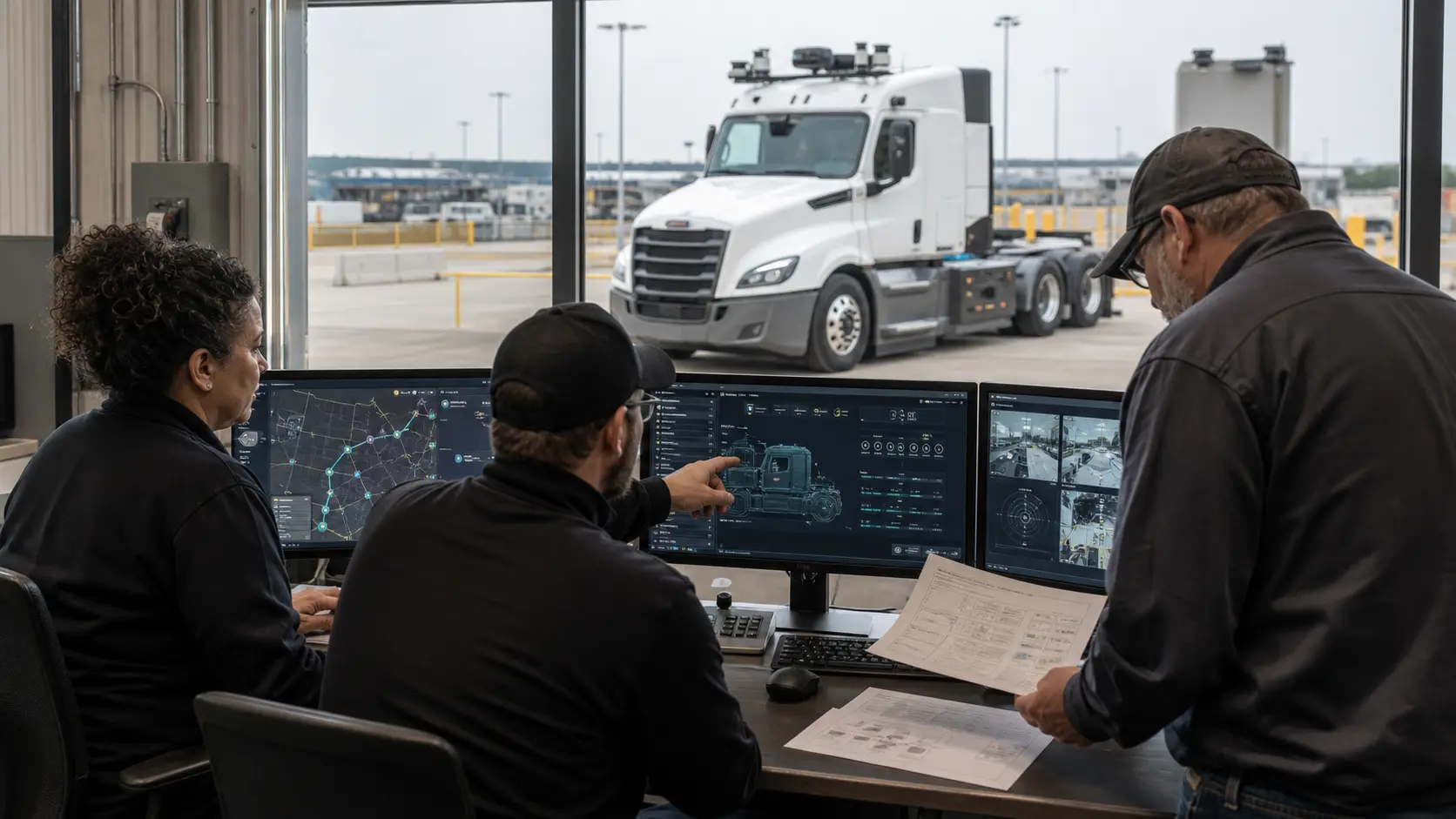
- Torc's product is best understood as a freight control plane. TorcDrive, Torc Deploy, Torc Dispatch and Torc Assist must coordinate with a redundant autonomous-ready Freightliner Cascadia, NVIDIA/Flex onboard computing, multiple lidar suppliers, cloud development systems and depot operations.
- The strongest disclosed validation evidence is significant but limited: a driver-out product acceptance test of over five hours on a closed multi-lane course at speeds up to 65 mph. This is not proof of regular driver-out public road service.
- The economic test is as demanding as the safety test. Daimler Truck's entity accounts report a net loss of EUR 365 million in 2025 at Torc, while public documents do not disclose production pricing, service level commitments, customer revenues, data portability terms, or a completed independent evaluation of final safety evidence.
- A buyer should procure a defined operational domain and a liability model—not a percentage of autonomy—and make public road permission, incident handling, maintenance, cybersecurity, fallback, evidence access and exit rights contractual acceptance criteria.
Five Hours and EUR 365 Million
Two numbers situate Torc's position more precisely than a catalogue of autonomous driving features. In October 2024, a production-intent truck operated without a driver forover five hours on a closed multi-lane course, reaching speeds up to 65 mph. Torc called the exercise a product acceptance test. In the 2025 separate accounts of its controlling shareholder, Torc Robotics, Inc. appears with anet loss of EUR 365 million for the year.
The units do not compare naturally. One measures a controlled run; the other is an accounting result, not a disclosed engineering budget or cash burn figure. Yet together they describe the industrial problem. An autonomous truck can look finished on a clean run while the organisation around it still pays to establish that the same behaviour can be repeated across multiple vehicles, routes, weather conditions, maintenance states, software versions and abnormal situations. The empty seat removes a versatile human from the cab. Everything the driver noticed, interpreted, improvised, reported or escalated must be allocated elsewhere.
That allocation is the real product. A vehicle must know when it is inside its operational design domain. A depot must know whether a sensor remains calibrated after an intervention. Dispatching must know whether a route is currently eligible. A remote assistance team must understand what it can advise without silently becoming the driver. A carrier must know who holds the motor carrier obligation, who reports an incident, who maintains the base vehicle, and who decides that a release is safe. The evidence supporting these decisions must survive a software update.
Torc increasingly reflects this wider problem in its public documents. Its current product language separates the autonomous driver from yard deployment, fleet command and human assistance. Daimler Truck designs a chassis with redundant systems rather than asking Torc to retrofit a conventional tractor indefinitely. The Fort Worth hub includes control rooms as well as truck bays. The safety case encompasses how the system is built and operated, not just whether its perception stack performs.
This is a stronger proposition than 'the truck drove itself'. It is also harder to prove. The relevant question is not whether Torc has demonstrated Level 4 behaviour in selected conditions. It has. The question is whether Torc has made that behaviour governable enough for a freight carrier to buy an operating system for a lane, understand its limits, survive a failure, and eventually leave it. Based on publicly available evidence as of July 2026, the architecture of that system is visible. The fence around its commercial and safety obligations is not.
The Company Behind the Generic Name
Legal identity matters because autonomous freight divides responsibility among a software developer, a vehicle manufacturer, a carrier, infrastructure operators and suppliers. A vague reference to 'Daimler's autonomous truck' can obscure which party develops and operates the virtual driver. A vague reference to 'Robotics, Inc.' could point almost anywhere.
Here, the bridge is direct. Torc's siteterms and conditionsstate that the agreement is between the site user andTorc Robotics, Inc.Its corporate history indicates that the business started in 2005 as Torc Technologies, a name derived from 'Tele-Operated Robotic Controls', and became Torc Robotics after Daimler's investment. Daimler Truck's 2025 entity accounts listTORC Robotics, Inc., Blacksburg, Virginia, with an equity share of 91.05%. Those documents also list Torc's Canadian subsidiary separately and a German Torc entity in liquidation, evidence that the parent does not treat 'Torc' as an indistinct product label.
The ownership boundary is equally clear. When the deal was announced in 2019, Daimler said it wouldacquire a majority stake while Torc remained a separate entity, retaining its name, team and facilities. Daimler provides the Freightliner vehicle platform, manufacturing system, dealer reach and capital. Torc provides the automated driving system and the operational layer around it. Daimler's disclosures are therefore relevant when they concern ownership, funding, vehicle integration, validation and commercialisation; they are not a reason to replace Torc with its shareholder as the subject.
This distinction also disciplines product claims. The redundant braking, steering and electrical systems belong to the autonomous-ready Freightliner platform. TorcDrive belongs to Torc. The combined service depends on both, but a buyer should not let the combined brand story blur contractual responsibility for a faulty chassis component, an autonomy release, a missed remote assistance response, or a poorly maintained sensor.
Torc's lineage is useful but is not evidence of the current product. The company traces its experience through the DARPA Urban Challenge, mining and defence applications. It acquired Montreal computer vision company Algolux in 2023. These facts explain accumulated engineering capability and the present Montreal presence; they do not validate a 2026 freight release. The identity is compelling precisely because it does not need to borrow validation from history: the current legal terms, shareholder accounts, vehicle disclosures and Torc's own operating sites all converge on the same company.
A Route Is the First Product
Torc does not propose that a tractor accepts any mission offered to it. Its first commercial form is a hub-to-hub service on selected long-haul motorways. The company'sfrequently asked questionsdescribe initial motorway and interstate routes of over 250 miles, while Daimler and Torc have centred recent work on the I-35 freight corridor in Texas between Laredo and the Dallas–Fort Worth area. Torc opened its first autonomous hub at AllianceTexas in May 2025; the facility includesdedicated fleet management and operations control rooms.
This geography reveals the workflow. A load must be matched to an eligible lane, a tractor and a departure window. A manned or conventional operation can bring the trailer to a transfer point. The autonomous tractor must be inspected, fuelled, prepped and paired with the correct trailer. Dispatching must confirm that road, weather, construction, mapping and vehicle health conditions are inside the approved envelope. The truck runs the middle mile. At the destination hub, another operation receives the trailer and performs local delivery.
Part of this sequence is reasonable inference from hub-to-hub freight rather than a published procedure from Torc. Public material does not disclose its full handover protocol, cut-off times, trailer compatibility matrix, or exception queue. These missing details matter because the economics of a long autonomous segment can be consumed by downtime, repositioning, or failed handovers at either end. A virtual driver does not eliminate yard work or local drayage. It changes where they happen.
Torc has named the layers intended to manage this change.Its solutions portfoliodescribes:
- TorcDrive, the Level 4 virtual driver responsible for the driving lifecycle;
- Torc Deploy, which coordinates yard and deployment activities;
- Torc Dispatch, a central command layer for fleet operations; and
- Torc Assist, which gives human staff a role in difficult or uncertain situations.
These are corporate descriptions, not independently measured product capabilities. They nonetheless show a healthy decomposition. The truck is not the only unit of operation. The route, the hub, the command centre, the assistance team and the maintenance state form a distributed service. A shipment succeeds only when the entire chain moves the load within the promised window and records why an exception occurred.
This also changes what 'availability' means. A functional vehicle can be commercially unavailable because the lane is outside its weather envelope, a support centre is understaffed, a sensor cleanliness check failed, a map or policy bundle is out of date, a regulator has restricted an authorisation, or the destination hub cannot receive it. Conversely, a stopped vehicle can behave correctly if the approved response is to reach a minimal risk condition. Fleet buyers need two metrics: the technical availability of each component and the system's completed-loads availability. Torc publishes neither.
Four Products, One Control Plane
Calling Torc's stack a control plane is an interpretation, not the company's formal category. It is useful because the four named products appear to distribute authority over a single journey.
TorcDrive decides and executes the vehicle trajectory within its operational design domain. Torc Deploy governs whether a physical truck is ready to enter that domain. Torc Dispatch governs fleet assignment and status. Torc Assist introduces a bounded human escalation path. None can be designed in isolation. If TorcDrive encounters a scene it cannot resolve, the assistance workflow must classify the request, establish communications, preserve a safe vehicle state, and log the advice. Dispatch must then determine whether the journey remains viable. Deploy may need to quarantine the vehicle on its return.
The distinction between assistance and teleoperation is particularly important. Torc says Torc Assist provides human supervision and support for complex or uncertain conditions. It does not publicly describe a general teleoperation service in which a person remotely drives the truck continuously.
A buyer should demand the exact authority model: whether the human provides context, selects from bounded manoeuvres, approves a proposed trajectory, modifies a route, or directly controls actuators; what happens when connectivity is lost; how many vehicles an operator can supervise; how identity and authorisation are enforced; and which decisions enter the safety log.
The four-layer structure also creates version coupling. A new perception or planning release can change the scenes that generate assistance requests. This changes the staffing demand and response time risk even if the remote assistance software itself is unchanged. A revised yard procedure may prevent a sensor defect that would otherwise surface on the road. A dispatching policy may keep a vehicle out of weather conditions that the driving stack technically handles but that have not yet been approved for commercial handling. The safety impact of a release cannot therefore be measured solely in the vehicle code.
Torc's current 'AV 3.0' language acknowledges this system problem. The company describes a data loop linking road experience, simulation and machine learning, running on production-intent hardware and supported by the operational services around it. Its strongest design claim is not that a neural network has solved trucking, but that learned components can sit inside a modular, inspectable structure.
That is the right claim to test. A governed system needs traceability from a hazardous scenario to a requirement, a test, a software release, a vehicle configuration and an operational restriction. It needs a release authority with the power to say no. It needs a way to roll back or restrict a release without corrupting fleet state. The public product pages do not disclose Torc's configuration management model, its release cadence, its rollback process, or its customer approval rights. The control plane is visible in sketch; its governance interfaces remain a purchase question.
The Chassis Is Part of the Software
A conventional autonomy retrofit starts with a vehicle whose steering, braking and electrical architecture assumed an attentive driver. Torc and Daimler instead treat the base vehicle as part of the Level 4 system. In April 2025, Daimler delivered the latest autonomous-ready Freightliner Cascadia to Torc after designing it againstover 1,500 requirements.
The disclosed design includes redundant braking and steering and a secondary power network. Torc's FAQ adds useful detail: multiple brake controllers with pneumatic backup, two steering servo motors, duplicated low-voltage power supply, and additional communications and cybersecurity requirements. Daimler says the production architecture is intended to receive Torc's computing and sensor kit during manufacturing.
This is more than integration convenience. Level 4 software cannot make a truck safe after a single steering or electrical failure unless the vehicle exposes an independent path to reach a minimal risk condition. Redundancy must also be diagnosable. Two actuators are not truly independent if they share a hidden power, communication, software or maintenance failure. The vehicle and the virtual driver therefore share a safety argument.
Factory integration could improve repeatability. Cable routing, mounting tolerances, cooling, electromagnetic compatibility, sensor position and end-of-line calibration may be better controlled in production than in ad hoc retrofits. It could also make fleet maintenance more familiar if Freightliner dealers receive the right tools and procedures. The Daimler dealer network is a potential operational advantage, but public disclosures do not establish which autonomy-specific repairs dealers will be certified to perform at launch, which require a Torc facility, or what spares and restoration commitments will apply.
Integration also creates a boundary problem. When a truck makes an unnecessary stop because a power diagnostic signals a fault, did the base vehicle fail, did Torc interpret the diagnostic too conservatively, or did a service procedure leave the configuration inconsistent? A buyer cannot resolve this dispute by reading the marketing architecture. The contract needs an incident commander, shared telemetry, evidence preservation rules, and a no-fault process to restore service before the vendors allocate liability.
The Freightliner focus restricts Torc's first addressable platform, but that is not necessarily a weakness. A bounded hardware configuration can reduce the number of combinations to validate. It becomes a commercial weakness if the buyer cannot obtain enough compatible tractors, if a component becomes unavailable, or if the economic life of the chassis and the support life of the autonomy kit diverge. These risks become clearer in the bill of materials for computing and sensor components.
The Data Centre in a Truck
In November 2025, Torc described the move to AV 3.0 on an embedded platform built with Flex and NVIDIA. Theproduction-intent designcombines Flex's Jupiter computing platform with NVIDIA DRIVE AGX hardware, Orin system-on-chips and DRIVE OS. Torc says the work aims to balance performance with cost, power consumption and reliability rather than reproducing a laboratory server rack in a cab.
The sensor chain is also distributed. Aeva was selected to supply long- and ultra-long-range frequency-modulated continuous-wave 4D lidar for series production, with the companies describing factory integration and a planned start in 2027. In December 2025, Daimler and Torcselected Innoviz for short-range lidar, complementing long-range lidar, radar and cameras. The exact production sensor layout, quantities and supplier allocation remain undisclosed.
These choices create at least four classes of dependency. NVIDIA provides the computing silicon and a safety-relevant operating environment. Flex provides the embedded computer and manufacturing capability. The lidar suppliers must industrialise optical hardware to automotive quality and volume. Daimler must incorporate the physical and electrical interfaces in the truck. Torc must make its models, middleware and diagnostics behave consistently in the resulting configuration.
Supplier announcements are intentions, not proof of production yield. Before a 2027 service can scale, components must survive vibration, thermal cycling, contamination, cleaning, power faults and replacement. Calibration must be repeatable after repair. Firmware and driver releases must remain compatible with the validated Torc release. A substitute component cannot simply be inserted because it has similar specifications; it may change perception behaviour and reopen part of the safety case.
Embedded constraints also discipline the machine learning strategy. A model that performs well on an unconstrained cloud cluster may miss latency, power or thermal limits on the truck. Torc's November account says it had run the stack on the embedded platform during the closed-course test, but it also says work remained on vehicle integration and safety case completion. That is a narrower claim than 'production-ready'.
For a buyer, the bill of materials should become a service document. It should identify approved component and firmware versions, expected replacement times, diagnostic coverage, calibration equipment, end-of-support dates and the consequences of a supplier change. Public sources reveal the big names but not that lifecycle contract. The hardware is tangible; the availability promise attached to it is not.
From Rules to a Glass Box
Torc's architectural story has changed. In a2021 AWS interview, co-founder Michael Fleming described machine learning as supporting perception rather than directly commanding the truck's behaviour. By May 2026, Torc presented AV 3.0 as a broader learned architecture and argued that its modular design made ita 'glass box' rather than an opaque black box.
There is no contradiction if the product has evolved. However, the change raises the level of proof. Rules can be fragile, but an engineer can often trace why a rule fired. Learned systems may generalise better from data but fail unexpectedly, and their behaviour changes with training data, model design and optimisation. Calling the stack modular and inspectable explains an assurance strategy; it does not demonstrate that every consequential behaviour is interpretable.
Torc says its approach uses learned components while preserving interfaces that can be tested and inspected. It also argues that generative techniques can create simulation scenarios, including rare conditions. These are corporate claims. Public sources do not disclose model sizes, training corpus composition, coverage by geography and weather, hallucination and uncertainty handling, runtime confidence thresholds, safety monitors, or the proportion of driving policy produced by learned versus deterministic components.
A particularly useful publication from Torc makes the process risk more concrete. Authors from Torc and TÜV Rheinland proposed aFailure Mode and Effects Analysis for machine learningcovering data collection, labelling, training, evaluation, deployment and monitoring. It identifies failures that conventional component analysis may miss: biased or unrepresentative data, label errors, model degradation and deployment mismatch. The paper says a proof of concept and further validation are still needed. This is evidence that Torc's engineers frame the right lifecycle problem, not evidence that the resulting production system has passed independent certification.
The practical test of 'glass box' is change control. Can Torc identify which safety claims a retrained model affects? Can it reproduce the training and evaluation set, test regressions against a frozen scenario library, explain a changed assistance request rate, and prove that the embedded binary is the evaluated binary? Can an independent reviewer examine enough evidence without receiving every trade secret? These questions turn interpretability from a visual metaphor into operational governance.
Torc's learned architecture may eventually reduce the burden of hand-written rules and better adapt to the long tail of motorway scenes. The unresolved problem is not whether machine learning belongs in the truck. It is whether the company can make continuous learning compatible with discrete releases that carriers, regulators and insurers can approve.
Why Road Miles Cannot Close the Case
The five-hour test is significant because it brought production-intent software and hardware together in a driver-out run at motorway speed. Its boundary matters more. The course was closed to ordinary traffic. Daimler's account of that milestone says Torc's public road development had used asafety driver and an operator, and identified driver-out public road operation as a later milestone.
No responsible developer can expect to meet every dangerous combination on the road. RAND quantified the problem in 2016: showing with conventional mileage statistics that an autonomous fleet fatality rate is 20% better than the human baseline could requirebillions of miles, depending on assumptions. Human crash data is also under-reported and the comparison rate changes. Road exposure remains essential, but mileage alone cannot establish safety before deployment.
Torc assembles several complements. Its voluntary safety self-assessment describes system safety, operational design domain, entity and event detection and response, fallback, validation and human-machine interaction. NHTSA includes Torc in itsVSSA disclosure index, while explicitly warning that inclusion is not a federal endorsement or approval. The distinction prevents a public disclosure from being mistaken for a regulator's certificate.
For scenario-based testing, Torc has worked with TNO on theStreetWise scenario database and residual risk methodsand with Foretellix onlarge-scale virtual testingusing ASAM OpenSCENARIO 2.0. Supplier and partner announcements describe methods and ambitions, not audited coverage results. They do not publish the number of distinct safety-relevant scenarios, pass thresholds, independence criteria, or remaining residual risk.
Torc's more recent safety case description is organised around three propositions: the system is safely built, safely operated, and can be trusted on the road. It includes maintenance, sensor calibration, training, human supervision, emergency response and governance. In 2025, Torc engaged Edge Case Research fora sequence of independent evaluationsof its framework and evidence. The announcement envisioned a later review of completed evidence; it did not say that a final safety case had already been approved.
This is the correct form of proof: hazard analysis and requirements; components and software testing; scenario coverage; simulation; track testing; supervised road data; operational controls; and independent challenge. What is publicly missing is the closure status. Torc does not publish the top-level safety claims, unresolved exceptions, quantified confidence per operational domain, independent findings, or release criteria for removing the safety driver. A carrier does not need all proprietary evidence to be public, but it should receive enough under controlled access to know what it is accepting.
Three Incidents Without a Denominator
The federal crash reporting register offers a narrow view of Torc's early public road operations. NHTSA's Standing General Order requires certain named operators and manufacturers to report certain crashes involving automated driving systems. The agency warns that the data havesignificant limitations: reports may be incomplete, criteria have changed, duplicate reports may be filed by different parties, and the dataset lacks exposure measures necessary to calculate rates.
A review by name and date ofNHTSA's archived ADS incident fileidentifies three distinct Torc episodes, represented by paired or updated reports from Torc and Daimler Truck North America.
Two occurred in New Mexico in July 2022. In each case, the truck encountered road debris. The safety driver disengaged the automated system before or around contact. One entity punctured a fuel tank, resulting in a leak, clean-up and towing. Another struck a transmission air tank component, releasing air and requiring a stop and repair. The third episode occurred in Texas in December 2023 on a wet road, when a deer contacted the tractor after the safety driver disengaged. The reports describe no injuries in these three episodes.
These records do not establish that TorcDrive caused the contacts, and the disengagement sequence makes simplistic attribution particularly unhelpful. Nor can they prove that the system is safe. Three events divided by an undisclosed and incomparable mileage denominator would produce a meaningless rate. NHTSA's current file, covering the most recent reporting period, does not provide a Torc-specific operational performance series.
The episodes are nevertheless instructive because they expose the operating system around autonomy. Road debris can damage fuel, air and power systems even when perception and planning behave as intended. An animal collision can occur after a human has taken control. The safety outcome depends on detection, disengagement, stopping location, spill response, roadside repair, towing, reporting and evidence preservation. Autonomy changes the control path; it does not abolish the physical hazards of the road.
A mature commercial disclosure would connect such events to corrective actions without revealing personally identifiable or proprietary information. Did an event change entity classification, route policy, vehicle shielding, inspection or response procedure? Was the same scenario added to simulation? Did the safety case already cover the failure? Torc does not publish this trace. It also does not maintain a public service status history or security incident log comparable to a cloud provider's status archive.
The right conclusion is bounded. The examined reports show earlier supervised testing encountering ordinary trucking hazards without reported injury in those episodes. They are not a statistically valid safety comparison and are not evidence of routine driver-out operation. Their greatest value is to show that incident recovery must be designed as carefully as driving.
Safety Moves into the Depot
Removing the driver transfers daily observation to other people and systems. A driver who notices a dirty lens, a damaged fairing, unusual brake response or a warning light is a low-latency sensor with wide context. In a driver-out operation, pre-trip inspection, self-diagnosis, depot staff and remote monitoring must close that loop.
Torc'scurrent safety case accountexplicitly includes maintenance, sensor calibration, training, first responder interaction, human supervision and independent validation. Its Fort Worth hub is therefore not merely real estate near I-35. It is where software state and physical condition meet: vehicles arrive, are inspected and prepped; operational staff monitor the fleet; exceptions become work orders; and trucks are either released or held.
The company also publishesfirst responder guidesfor its test vehicles, including identification and interaction information for Texas and Virginia. This is useful preparation, but a production fleet creates a larger coordination task. Emergency services need current vehicle configurations and a reliable contact path. Tow operators need procedures for a broken-down autonomous-ready tractor. A load owner must know who protects the cargo while the vehicle is in a minimal risk stop. A motor carrier needs reportable event criteria and an evidence preservation clock.
Calibration is a particularly consequential dependency. A replacement windscreen, sensor bracket or body panel can change geometry. A seemingly successful repair can leave a perception system systematically inaccurate. Procurement should specify who may perform autonomy-related work, what diagnostic and calibration tools are required, how the vehicle proves fitness afterwards, and whether a remote software check is sufficient. It should distinguish a conventional safe-to-drive state from an approved driver-out state.
Public documents do not disclose Torc's mean time to restore, reserve vehicle policy, depot staffing ratios, mobile recovery coverage, or dealer certification map. They also do not say whether a truck that loses autonomous eligibility can immediately return to revenue-generating service with a human driver. These are implementation and support questions, not footnotes. The commercial product exists only when the depot can turn safety constraints into predictable freight availability.
The Ghost Fleet in the Cloud
The truck runs locally, but much of its development and evidence life happens in the cloud. An AWS security case study says Torc has used AWS since 2021 acrosshundreds of accounts and multiple regionsfor coding, testing, verification, simulation, machine learning and data acquisition.
These are vendor case studies based on a customer deployment, not independent security audits. They nonetheless reveal a major dependency. Road data must flow from trucks to storage. Simulation and model development need compute. Engineers and subcontractors need controlled access. Logs from many cloud accounts must be correlated. A compromise of development credentials, build infrastructure, training data, or version artefacts could affect the integrity of a later vehicle release even if the operating truck is isolated from the internet.
Torc's VSSA describes a defence-in-depth cybersecurity approach and references NHTSA guidelines, ISO/SAE 21434 and ISO/IEC 27001:2013 controls. Referencing a standard is not the same as disclosing a current certification and its scope. The examined public material does not provide a software bill of materials, public product vulnerability response process, vulnerability advisory archive, penetration test summary, over-the-air update architecture, patch service level, or a certificate covering TorcDrive and its support operations.
Cloud resilience has a subtler safety boundary. A vehicle must remain safe when wide-area connectivity or a cloud service fails, but the freight service may stop accepting trips. Torc does not publish which functions are on board, at the edge, at the hub, or in the cloud; how long a truck can continue after losing contact; whether Dispatch or Assist is geographically redundant; or what recovery point and recovery time objectives apply. The AWS multi-region use does not answer these system-level questions.
A buyer's security review should therefore follow the release chain rather than stop at the vehicle firewall. It should cover data provenance, developer access, model and software signing, dependency updates, supplier firmware, remote assistance identity, logging, retention, incident notification and recovery exercises. It should also allocate ownership of freight and road data. The cloud is a ghost fleet: invisible from the motorway, but capable of grounding every truck if its integrity or availability cannot be trusted.
Daimler's Accounts Count the Wait
Torc does not publish independent revenue, pricing or cash flow. Daimler Truck's disclosures offer a partial view of the cost. Its 2025 entity accounts show a 91.05% equity stake in Torc Robotics, Inc., negative equity of EUR 175 million, and a net loss of EUR 365 million. Afirst-quarter 2026 interim reportsays Daimler Truck made an additional capital injection into Torc while minority shareholders did not participate.
These numbers require restraint. They are accounting results reported in Daimler Truck's entity disclosures, not a line-by-line expense statement from Torc. The net loss cannot be automatically equated to annual cash burn, and the public accounts do not attribute it among software development, testing, hardware, facilities, or other costs. Negative equity does not prove Torc is insolvent as long as a controlling shareholder continues to fund it. The numbers show that the pre-revenue or early-commercial burden of proof is sufficiently material to be visible in a global truck manufacturer's accounts.
The expected revenue logic is recurring. Aeva's 2024 announcement described Torc's virtual driver and mission control centre as asubscription service. Daimler's 2025 annual report frames autonomous trucking as a source of significant recurring revenue and targets a 15% to 20% improvement in customer total cost of ownership. These are corporate objectives, not achieved customer results.
A subscription could align payment with active trucks or miles and preserve an ongoing relationship for updates, support and fleet control. It also means that the productive capacity of the vehicle may depend on a licence and service whose terms outlive a normal software purchase. The public record does not say whether Torc will charge by truck, mile, load, corridor, uptime, or outcome; whether computing and sensors are included in the vehicle price; who pays for hub infrastructure and remote assistance; or how risk is shared when a truck is safe but unavailable.
The TCO claim cannot be evaluated without these terms. Savings could come from higher asset utilisation, reduced driver cost, or more predictable schedules. Costs may increase through specialised tractors, sensors, computing, cloud services, depots, local transfers, maintenance, insurance, remote operations and downtime outside the approved domain. Work is displaced and redistributed, not simply erased.
The best economic proof will not be a modelled percentage. It will be repeated, paid loads under driver-out public road conditions, with disclosed service availability and credible allocation of all support costs. Torc names fleet partners such as Schneider and C.R. England in pilot activity, but itspartnerships pagedoes not disclose production contracts, pricing, revenues, or conversion commitments. Until these appear, the balance sheet measures the wait more clearly than the market measures the product.
The Buyer Buys a Boundary
Level 4 is not a promise that a vehicle can drive everywhere. It means that the automated system performs the driving task within a defined operational design domain and can reach a minimal risk condition without waiting for a human fallback driver. The product a carrier buys is therefore a boundary: approved roads, speeds, weather conditions, construction conditions, vehicle configurations, trailer types, maintenance state and operational support.
The boundary is technical, commercial and legal. Texas now requires an authorisation for commercial operation of Level 4 or 5 vehicles without a human driver. As of 28 May 2026, applicants must make representations covering traffic code compliance, registration, federal compliance, minimal risk capability, registration and insurance, and provide plans for first responders. The Texas Department of Motor Vehicles mayrestrict, suspend or revoke an authorisationwhen the legal threshold of public safety is met.
Authorisation is not product certification. The application relies heavily on the operator's representations, while road and administrative enforcement continues. A Torc customer must know whether Torc, Daimler, the carrier, or a dedicated operating subsidiary will hold the authorisation and maintain the vehicle list. It also needs a change process: a new software release, sensor configuration, lane or corporate operator may alter the facts behind the authorisation.
Federal motor carrier obligations remain part of the picture. A draft from FMCSA updated in October 2025 says that integrating higher automation into a carrier's safety management system involvesdesign, operation, maintenance, inspection, and human operator training and location. It examines how a developer's safety case should feed into the carrier's operational safety plan, referencing functional safety, safety of the intended functionality and autonomous product standards. This is a research programme, not a final approval of Torc.
This is where liability can fall into gaps. Torc may control the autonomy software; Daimler may warrant the truck; a carrier may hold the operating authority; a hub contractor may inspect sensors; and a remote assistance worker may advise the vehicle. The law may assign ultimate duties to an operator even when the operator cannot inspect proprietary evidence or modify code.
A purchase contract should close this asymmetry. The party bearing regulatory and insurance exposure needs audit access, timely incident evidence, release notice, the right to suspend a configuration, and indemnification aligned with actual control. Torc, in turn, needs the carrier to respect maintenance, route and loading restrictions. The safety case must become a shared operating contract rather than a document that ends at the developer's boundary.
Lock-In Starts at the Factory
Torc's integration with a specially designed Freightliner offers a plausible path to reliability, but the same integration creates switching costs before the first subscription invoice.
The physical layer starts with a specific autonomous-ready Cascadia. Computing, power, steering, braking, communications and sensor mounts are designed together. The Aeva and Innoviz lidar, NVIDIA computing, Flex integration and Torc software become a validated configuration. Replacing the virtual driver with another supplier would not be equivalent to installing a fleet management application. The new system would need compatible interfaces, physical integration and a new safety case.
The operational layer deepens the commitment. Routes and hubs are prepared around Torc's domain. Staff learn Torc Deploy, Dispatch and Assist. Maintenance teams acquire procedures and calibration tools. Incident and regulatory processes depend on Torc's evidence. Historical road and fleet data accumulate in the development loop. If Mission Control is sold by subscription, continued operation may depend on the availability and commercial terms of that service.
Not every dependency is undesirable. Standardising on one production configuration can reduce uncertainty and allow the developer to improve a consistent fleet. Switching cost becomes a governance problem when the buyer cannot measure it or exercise an orderly exit.
The examined public material does not disclose data export formats, customer rights to raw and derived telemetry, software escrow, licence survivorship, post-termination operation, hardware reusability, minimum support life, rights to training models, migration assistance, or the ability to operate the tractor conventionally after autonomy service ends. It also does not say whether a vehicle licence can be transferred to a replacement chassis or whether a fleet can use independent dispatch and maintenance systems via stable interfaces.
These omissions do not prove unfavourable terms; they show that the public product is not yet commercially specified. A sophisticated buyer should demand three exit states. In the first, the Torc service is temporarily unavailable and the truck returns to service later safely. In the second, the autonomy kit is deactivated and the tractor remains usable with a human driver. In the third, the relationship ends and the carrier can export the records needed for compliance, insurance, maintenance and future procurement.
The most lasting bargaining power will come before the fleet is ordered. Once plants, depots, routes, training, safety plans and data flows are aligned with Torc, a nominally annual subscription can carry an industry-scale commitment.
The Timeline Has Competitors
Torc's commercial target of 2027 cannot be evaluated in isolation. The relevant competitors do not all sell the same boundary, but they show what different stages of autonomy look like in public evidence.
Aurora Innovation's 2025 annual report says it launched its commercial driver-out trucking subscription in Texas in April 2025 and had expanded its driver-out customer cohort by year-end. It reports relationships with PACCAR and Volvo rather than Daimler and Freightliner. The document describes a Driver-as-a-Service model and ongoing maintenance work with Ryder. Because it is an issuer filing, it provides operational and risk detail that private Torc does not, though its performance claims are still management's.
Kodiak offers another comparison. Its 2025 Form 10-K says it began paid driver-out operations with Atlas Energy Solutions in an industrial domain in December 2024 and exceeded 10,700 paid driver-out hours by end-2025. It describes aper-vehicle or per-mile licencefor customer-owned vehicles, while acknowledging that its ability to scale and commercialise remains largely unproven. The off-road or private-road industrial work is not equivalent to driver-out public long-haul motorways, but it tests maintenance, customer operation and recurring billing earlier.
Torc's differentiated bet is closer OEM integration: Freightliner designs the base platform, production suppliers are selected, and Torc develops the driver plus operational services. This may produce a more sustainable production vehicle than a flexible retrofit. It also ties Torc's timeline to automotive validation, supplier industrialisation and Daimler's production programme. Aurora's earlier public road launch raises the evidence bar; Kodiak's paid operating hours raise the business process bar.
The deepest substitutes are not other virtual drivers. A carrier can continue with human-driven Cascadias, use advanced driver assistance systems, redesign relay networks, subcontract the lane to another carrier, or shift suitable freight to rail and intermodal services. These options may have lower theoretical utilisation but clearer availability, liability, maintenance and exit costs. Torc must outperform the risk-adjusted workflow, not just a driver's wage in isolation.
Competition therefore tests the timeline in two directions. Going too slowly lets rivals accumulate driver-out miles, customer procedures and incident experience. Going too fast before the safety and support system is ready can turn a failure into regulatory restriction and trust loss. Torc's willingness to integrate deeply and close a wide safety case may be an advantage, but only if the 2027 milestone produces a service whose evidence can be examined by customers.
An Acceptance Test for the Operating System
The October 2024 product acceptance test answered one valuable engineering question: could a production-intent configuration execute a sustained, driver-out mission at motorway speed on a closed course? A fleet purchase needs a different acceptance test. It should demand the following evidence before scale-up, with thresholds tailored to the contracted lane rather than borrowed from an industry slogan.
Identity and authority.The contract should name Torc Robotics, Inc.; the Daimler or Freightliner entities responsible for the base vehicle; the motor carrier; the holder of each state authorisation; the remote assistance operator; and the parties responsible for maintenance and incident reporting. Brand names should not substitute for legal liability.
A machine-readable operational domain.The buyer should receive the approved routes, road classes, speeds, weather limits, construction handling, trailer and load constraints, vehicle and sensor configurations, mapping or infrastructure dependencies, and minimum connectivity. Dispatching should enforce this domain automatically. Material domain changes should require notice and, where risk increases, customer approval.
Safety case access and closure.Torc should map top-level claims to hazards, requirements, tests, scenario coverage, residual risks and operational controls. The buyer should see independent evaluation findings and unresolved conditions under appropriate confidentiality. A release should identify exactly which evidence applies to its software, model, hardware and vehicle configuration. 'VSSA published' and 'standards referenced' should not be treated as certification.
Vehicle and depot readiness.End-of-line and pre-trip checks should prove the health of redundant braking, steering, power, communications, computing and sensors. The contract should define calibration after repair, qualified technicians, parts availability, mobile recovery, towing, safe conventional operation, and the evidence needed to return a truck to driver-out service.
Driver-out public road performance.The buyer should distinguish supervised autonomous miles, closed-course driver-out miles, and commercial driver-out public road miles. It should receive metrics for completed loads, interventions, minimal risk stops, assistance requests and service unavailability with consistent definitions and exposure. Rare event statistics should be complemented by scenario and systems evidence, not presented with false precision.
Human operations.Torc Assist should have an explicit authority model, staffing plan, competency standard, workload limit, response objective and behaviour on loss of connectivity. Dispatch and depot staff should train on abnormal scenarios. Logs should retain what the system proposed, what the human advised, and what the vehicle did.
Release and rollback.Every change should have a safety impact assessment, regression results, deployment stages and a rollback plan. The buyer needs emergency suspension rights and a way to restrict a faulty release by vehicle or lane. Torc should disclose which supplier firmware and cloud dependencies are included in the approved baseline.
Security and resilience.The service should provide a software and firmware inventory, vulnerability notification terms, signing and key management controls, access review, supplier security obligations, penetration test evidence and recovery exercises. It should prove that loss of cloud or communications leads to a safe vehicle outcome and separately state how that affects trip availability.
Incident learning.The parties should agree on immediate notification, data preservation, regulator and insurer access, root cause analysis governance, corrective actions and scenario library updates. Reporting should distinguish ADS failure from road hazards, base vehicle defects, maintenance errors and human actions while still examining interactions between them.
Commercial truth.Pricing should expose cost per truck, mile, load or active hour; hardware and sensor replacement; support; hub and connectivity requirements; insurance; minimum commitments; credits for unavailable service; and paid versus pilot freight. The customer should model end-to-end lane cost, including drayage, downtime and exceptions, against a human-driven alternative.
Exit and continuity.The agreement should define data ownership and export, licence survivorship, support lifetime, spares, hardware disposal, conventional human-driven use, migration assistance and protections if Torc or a critical supplier ceases service. A long vehicle life should not depend on an undocumented software promise.
Passing this test would not prove universal safety or profitability. It would show that a particular carrier can operate a particular Torc configuration on a particular lane with understood risk. That is a more defensible commercial unit than an undifferentiated autonomy claim.
What to Watch Until 2027
Torc's public FAQ says commercial operations are targeted for 2027. The next disclosures should be judged as changes in evidence, not ceremonial milestones.
First, look for driver-out public road freight under a clearly stated operational domain. A count of loads, miles and operating hours should separate public roads from closed tracks and distinguish paid service from testing. Any safety observer or chase vehicle support should be described.
Second, identify the operator and authorisation structure in Texas. The state regime is already in force. An active authorisation, a vehicle register and a first responder plan would show legal readiness, but do not substitute for the safety case.
Third, look for closure of the independent review sequence. The announced Edge Case work should produce findings on the sufficiency of actual evidence, not just the form of Torc's framework. Torc should explain material conditions without pretending that inclusion in the disclosure index is approval.
Fourth, follow production evidence for the autonomous-ready Cascadia, the Flex/NVIDIA computing, the Aeva long-range lidar and the Innoviz short-range lidar. Supplier appointments should progress towards qualified configurations, service procedures and a support plan. A late component change can shift vehicle and safety schedules together.
Fifth, monitor commercial specificity: named production customers, paid loads, pricing units, availability metrics, maintenance liability and service credits. The 15%–20% TCO target should eventually be reconciled with actual hub, support and hardware costs.
Sixth, watch the funding burden. Daimler's 2026 capital injection shows ongoing commitment, while Torc's 2025 loss shows the scale of investment. Future accounts may reveal whether spending increases with industrialisation, decreases as development closes, or is joined by visible recurring revenue.
Finally, watch incident transparency. Driver-out operation will generate stops, disruptions and collisions even if the system improves overall safety. The credible operator will publish denominators, definitions and corrective learning rather than treating each event as evidence of failure or irrelevant noise.
The Empty Seat Must Remain Explainable
Torc's most consequential engineering decision may be to treat autonomy as more than the code that turns a wheel. The autonomous-ready Cascadia provides physical fallback. The embedded computing makes the learned stack deployable. TorcDrive handles movement; Deploy, Dispatch and Assist surround it with operational authority. Hubs, cloud systems, maintenance, first responders and safety governance carry functions that previously converged on a driver.
This breadth makes Torc a serious operational proposition. It also prevents an easy verdict. The closed-course run proves integration under controlled conditions, not commercial reliability. The VSSA proves disclosure, not federal approval. The supplier selections prove a planned production chain, not yield or support. The pilot partners prove access to freight workflows, not recurring revenue. A modular learned architecture offers a path to assurance, not assurance itself.
The EUR 365 million net loss in 2025 is also not a verdict. It is the available price signal of a period in which a private autonomy company asks its shareholder to fund evidence before customers can fund scale. Daimler's control and vehicle platform give Torc resources and an industrial path that many software developers lack. They also make the programme dependent on one truck architecture and one shareholder's willingness to continue counting the wait.
The decisive milestone will not be another video of an empty cab. It will be a load whose eligibility was correctly constrained, whose truck was correctly prepared, whose software and evidence matched, whose exceptions were handled without improvisation, whose customer could audit the result, and whose economics survived all the humans and infrastructure displaced from the cab.
At that point, the empty seat will be less interesting than the control plane around it. Until then, Torc has shown the design of a governable autonomous freight system and a credible path towards its industrialisation. The public record has not yet shown that the system can close its safety, service and commercial obligations simultaneously. That is the test 2027 must pass.