
Summary
- Pacer Software built a two-sided compatibility system, not just a desktop terminal window: pcLINK combined host software, terminal definitions, transport choices, file transfer, print services, virtual disks, configurable keys and scripts.
- The strongest surviving evidence supports a Macintosh-centred PacerTerm product line and a broader PacerLink/PacerShare/PacerPrint family. It does not establish that PacerTerm/Windows shipped, and it shows that HyperWindows belonged to a separate software lineage.
- Pacer’s value grew where host behaviour met local workflow. Mouse-driven keys, startup scripts, host-triggered commands and file semantics turned terminal access into a small automation platform whose real specification lived partly in configuration files and user habits.
- AGE Logic acquired Pacer in March 1995, and NetManage acquired AGE later that year. That compressed corporate transition illustrates a recurring lifecycle risk: ownership can change quickly while the operational dependencies embedded in an access layer remain.
- A modern migration should inventory sessions, scripts, keys, screen attributes, transport paths, file and print behaviour, identity controls and timing assumptions before choosing a replacement. Passing a login test is not the same as preserving the work.
One keystroke, two computers and a hidden contract
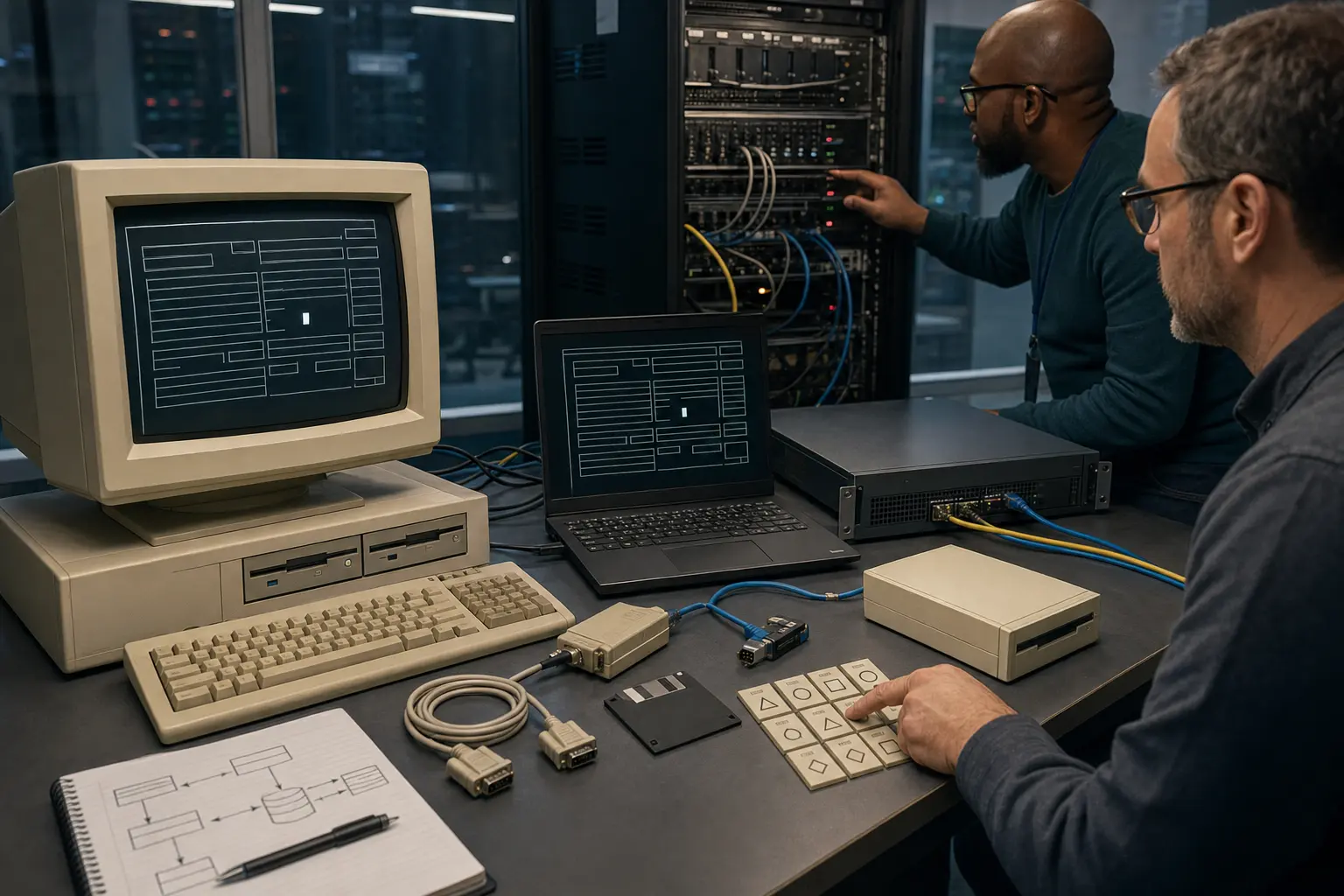
Imagine a Macintosh on a desk in 1986. The user is not composing a document or drawing a picture. A host application on a VAX, Prime, Stratus or another larger machine is waiting somewhere beyond a serial line or network. The Macintosh displays the host’s text, but the familiar desktop is already changing the relationship. The mouse can move the host cursor. A selectable button can stand in for a sequence of keys. Text can be copied to the Clipboard. A file can move between systems without the user manually reconciling their formats. The old computer has not disappeared; it has acquired a new control surface.
That control surface is the proper starting point for Pacer Software, Inc. The cover of the surviving October 1986 manual calls pcLINK “The Macintosh-Mainframe Solution”, and the contents make clear that this was more than advertising shorthand. The program dealt in terminal emulation, editing, file utilities, traffic logging, configuration, soft keys, modem handling, scripts and host-backed virtual disks. The same manual says a system administrator first had to install a host-resident component. In other words, the product straddled the desktop and the host. It translated not only characters but also expectations between two computing cultures. The manual is unusually rich primary evidence because it documents what a user and an administrator actually had to do.
The economic consequence followed from the architecture. A generic communications program could sell a dialler and a terminal window. Pacer could sell continuity: a Macintosh could replace a dedicated terminal while retaining the host application, then add file movement, printing, automation and a degree of graphical convenience. The host owner avoided an application rewrite. The user gained a friendlier workstation. Pacer sat in the narrow but valuable space between those savings.
It is tempting, from the distance of four decades, to call such software a bridge and leave the analysis there. A bridge sounds passive. pcLINK was active. It interpreted escape sequences, generated cursor movements, invoked host-side services and allowed the host to cause local actions. It stored the user’s chosen terminal, key definitions, connection parameters and startup routine. Each choice increased usefulness. Each also became part of the environment’s unwritten contract.
That is why the smallest unit of Pacer’s history is not a product box or an acquisition. It is the keystroke. A key left the Macintosh, crossed a transport, entered a host application and returned as a changed screen. If a replacement altered the key code, the cursor location, the timing, the attribute rendering or the script waiting for the response, the user did not experience a theoretically compatible system. The user experienced failure. Terminal emulation concentrated enterprise knowledge in behaviour so ordinary that organisations could stop seeing it.
First, separate Pacer from the names around it
Historical software research is vulnerable to name collision. Pacer is a common word; terminal products were renamed for partners; “Windows” appeared in both product names and legal disputes; later companies used similar brands. The correct entity here is the Pacer Software, Inc. named on the pcLINK manual and in federal filings, associated in the surviving record first with Framingham or Westborough, Massachusetts, and later with La Jolla, California. The product evidence and the legal evidence meet at that exact company.
Three boundaries matter.
First, PacerTerm is well supported. Pacer’s name appears throughout the product documentation; contemporary coverage identifies PacerTerm as a high-end Macintosh Communications Toolbox package; and a February 1995 MacUser item describes PacerTerm 3.0, priced at $249, with HyperTalk scripting, PC-ANSI and VT420 emulation, FTP, Telnet, PPP, SLIP, LAT, Xmodem and Zmodem support, plus PowerTalk and System 7.5 Drag Manager integration. That contemporary report is evidence of a shipping Macintosh product near the end of Pacer’s independent life.
Second, PacerTerm/Windows must be treated more carefully. The official Trademark Trial and Appeal Board record identifies Pacer Software, Inc. as the applicant for serial 74106001, the mark PACERTERM/WINDOWS. Microsoft opposed it. Pacer did not answer the proceeding; the Board sustained the opposition, and the application ended in September 1992 with the status “abandoned—after inter-partes decision”. The proceeding proves the application and its fate. It does not, by itself, prove that a Windows edition was completed, sold or deployed. The public record examined here does not supply a manual, review, customer account or release notice that closes that gap. PacerTerm/Windows therefore belongs in the corporate record as an attempted mark, not in the installed-base narrative as a verified product.
Third, HyperWindows is not a Pacer product on the evidence. The official proceeding for serial 73837848 identifies a different defendant, Ed Anson, and a separate cancellation action involving Microsoft. That record has no Pacer party. The registration describes HyperWindows as software that added windowing functions to other programs; the surviving trademark history shows a 1989 filing, a 1990 registration and later cancellation, with ownership ultimately associated with Microsoft. The goods description and chronology are distinct from Pacer’s host-access line. Similar placement in a list of Microsoft “Windows” disputes can make the names look related. The underlying records separate them.
This distinction is not clerical housekeeping. It changes the business story. If HyperWindows were incorrectly attached to Pacer, the company would look like a general-purpose interface-tools vendor. If an unverified Windows edition were treated as shipped, Pacer would look more cross-platform than the record supports. The safer reconstruction is more interesting: Pacer had deep Macintosh-to-host expertise, expanded its host and network services, explored adjacent naming and platform territory, and was acquired just as desktop networking, Internet protocols and graphical host access were converging.
pcLINK was a system, not a terminal picture
The architecture can be reconstructed from the 1986 manual and Apple’s 1990 multivendor networking guide. At the desktop sat the pcLINK application. Around it were configuration files, terminal definition files and soft-key files. On the host sat server software that handled requests. Between them could be a direct RS-232 connection, a modem path, Ethernet or LocalTalk bridged to Ethernet. Apple’s guide describes multiple simultaneous connections, potentially to different hosts, each in its own emulation window. It lists DEC VAX, Data General, Stratus, Prime and a range of Unix hosts among the supported systems.
The terminal layer was deliberately data-driven. pcLINK loaded a terminal definition corresponding to the host’s expected device. The manual shows files for VT100, PT200, ADDS 60 and Televideo 950, among others. That separation mattered. The connection was one concern; the terminal personality was another. A customer could retain a host application designed around a particular family of physical terminal while changing the desktop machine and, in some cases, the route between them.
The emulation window also translated the Macintosh interface into host actions. Clicking in the window caused pcLINK to generate enough cursor-key commands to move the host’s text cursor to the chosen position. Selecting text made Clipboard operations possible. A resizable graphical window surrounded an application that still thought in terminal rows, columns, control codes and device states. This was not full application modernisation, but it was a form of interaction modernisation: Pacer attached mouse, window and Clipboard affordances to software that had not been written for them.
File movement was another subsystem. pcLINK offered text, binary and MacBinary modes. Text transfers converted file format for the destination; binary moved bytes without conversion; MacBinary preserved the Macintosh data and resource forks by packaging them for storage on the host. A host program named pcSERVER participated in the transfer and could be started during link initialisation. That combination explains both the product’s usefulness and its installation burden. Reliable movement was not a property of the terminal screen. It depended on coordinated software and naming conventions at both ends.
Virtual disks pushed the integration further. A host file could appear to the Macintosh as a mounted disk. The client could mount a volume read-only or read-write, and the Finder represented it with a disk icon. The manual describes multiple mounted virtual disks, a MiniMac host utility and host-specific path examples for PRIMOS, VMS, VOS and Unix. This made host storage feel local, but the illusion depended on Pacer’s driver, host utility, configuration and state. A replacement emulator that faithfully drew VT100 text but omitted virtual disks would preserve appearance while removing part of the workflow.
Printing and graphics followed the same pattern. Apple’s guide lists PacerPrint for PostScript spooling and PacerGraph for VT240 or VT241 graphics, including ReGIS and Tektronix modes, with Macintosh operations to mark, print or copy a graphics region. The broader family included PacerShare for AppleShare-compatible file service, PacerPost for mail connectivity and PacerTOPS for participation in a distributed file-serving environment. The guide’s product-family description shows that Pacer was turning terminal access into desktop-to-enterprise interoperability.
The result was a layered system whose components could fail independently. The terminal might connect while file transfer failed because pcSERVER was unavailable. A session could display text while a character-set mismatch corrupted printed output. A mounted disk could depend on memory allocated in the Macintosh System Heap. A soft key could send the right visible text but the wrong leading or trailing terminal function. “It logs in” was never a complete acceptance test.
The control surface accumulated workflow knowledge
Pacer’s most consequential feature may have been the way it let organisations move knowledge out of manuals and into the access layer. Soft keys could be labelled and configured with text plus terminal functions. Configuration files chose an emulator, a soft-key set and a startup script. Scripts could record and replay actions, be checked for syntax and run at startup. Later PacerTerm used a language based on HyperTalk and could construct dialogs. These were developer tools hiding inside a communications product.
The 1986 manual also documents host-to-client escape sequences that went beyond ordinary screen control. A host application could tell the client to enter file transfer, start a spool operation, execute a pcLINK command file, write to the terminal status line or—in the PC version—run a DOS program. The manual’s example suggests placing a file-transfer action inside a VAX ALL-IN-1 menu so the user would not have to see the DCL command line. That is a concise description of a modernisation strategy still in use: leave the core application intact, then wrap its difficult edges with a controlled interaction.
Such wrapping changes where the application ends. Suppose an accounts clerk presses a button labelled “Month End”. The button emits a leading function, a command string and a return. A host menu responds. A script waits for a screen cue, sends a date, starts a transfer and stores the result under a local filename. The official host application may contain none of that orchestration. Yet the clerk’s job depends on the whole sequence. The real application is now the host plus the emulator configuration plus the script plus the file convention plus the clerk’s knowledge of what success looks like.
PacerTerm made this logic more approachable. A 1992 guide to online communications described the program as tightly integrated with Apple’s Communications Toolbox and highlighted its HyperTalk-based scripting and connectivity tools. The author’s recommendation was specifically aimed at users who needed Unix connectivity or who wanted to build advanced scripts in a familiar, English-like language. That positioning matters economically. Pacer was not only saving the cost of a host rewrite; it was lowering the skill threshold for incremental automation around the host.
The developer-tool economics were attractive but double-edged. A local expert could turn repetitive terminal work into a button or dialog without waiting for the host application vendor. The benefit arrived quickly and close to the user. Documentation, source control, testing and ownership were less certain. Each useful script created an asset. If the organisation did not inventory it, the asset became a hidden dependency.
Modern terminal products expose the same structural truth. OpenText’s current Reflection documentation says legacy macros can be run or migrated, but some objects, methods and properties are unsupported and may limit or break functionality. It even describes cases where a legacy session file lacks enough information to distinguish an IBM 3270 session from a 5250 session, forcing a manual conversion path. That is a contemporary reminder that a macro is inseparable from its session type and automation structure. The technology has changed; the migration problem Pacer helped create has not.
Who depended on it—and what “dependence” meant
Pacer’s surviving customer evidence is fragmentary, but it is sufficient to show several kinds of dependence.
The clearest commercial bridge is Data General. In January 1989, Data General agreed with Pacer to supply a version of PacerLink that made a Macintosh emulate a D461 Dasher terminal and access applications on the Eclipse MV family, including Comprehensive Electronic Office. The report says the companies were considering both asynchronous and local-network connections. It also records concurrent-session pricing from $2,000 for five sessions to $37,500 for 500. This was not a hobbyist use case. A computer manufacturer was using Pacer to make a new desktop acceptable to customers of its established minicomputers.
Medical information access provides a different view. A 1993 paper on Yale’s NetMenu described a common front end deployed across hospital and library settings. The authors chose commercial communications applications to launch online services and selected PacerTerm on the Macintosh because their chosen Macintosh alternative did not support direct network communications. The paper places PacerTerm inside a workflow that reached hospital information, laboratory, drug and bibliographic systems. Pacer was not the clinical system. It was the access component that let a common menu hand a Macintosh user into one of several institutional systems.
An Apple support case describes 23 Macintosh II computers using PacerLink to reach software on a DEC VMS host. Users experienced delayed screen echo over EtherTalk, while a Kinetics FastPath route behaved normally. Apple’s diagnosis focused on AppleTalk routing and a remote bridge, not on host load. The account is valuable because it shows how an apparently minor network path choice could change interactive usability for an entire group. Character-at-a-time interaction turns latency into interface behaviour. A technically live connection can still be operationally unacceptable.
Another Apple support record concerns a Macintosh Plus, PacerLink 5.3, a VAX and a FastPath connection onto a fibre-optic Ethernet backbone. The client sometimes froze and produced a fatal error. Apple’s diagnostic sequence moved the computer to another network connection, substituted another user’s software or disk and then worked outward through the environment. The case illustrates how the support boundary crossed client software, local hardware, network attachment and host connectivity.
Users on Prime systems expose the importance of terminal-specific behaviour. In a 1993 discussion, participants described PrimeLink as a renamed or derived PCLINK product, noting Pacer strings in binaries and a host directory still named for PCLINK. One user particularly valued Televideo 950 emulation because Prime applications at the site were configured around it. This is user testimony rather than a vendor contract, so the OEM lineage should be treated as reported experience, not a definitive legal chain. Its operational lesson is stronger: support for a less common terminal personality could be the deciding feature because the host applications had already encoded that choice.
Dependence, then, did not mean simply that a company had paid for Pacer. It meant that Data General applications expected a Dasher terminal; a hospital menu expected a launchable Macintosh communications tool; 23 desktops expected interactive echo over a particular route; Prime applications expected Televideo behaviour; and users expected their keys, files and printouts to work the same way tomorrow. Pacer’s installed value was distributed across all of those expectations.
From pcLINK to PacerTerm: modularity changed the product boundary
The early pcLINK architecture bundled a great deal: host-resident support, terminal emulation, transfers, printing and virtual disks. By the early 1990s, Apple’s Communications Toolbox offered a more modular architecture in which terminal, connection and file-transfer tools could be selected separately. PacerTerm sat within that architecture and added its own higher-level features.
TidBITS called PacerTerm a high-end, Communications Toolbox-compatible package when Pacer distributed an update in March 1992. The report’s reference to loyal customers receiving a two-disk update is modest but direct lifecycle evidence. The Toolbox architecture separated terminal, connection and file-transfer choices. The modularity expanded choice: a session could combine a terminal personality, a network or modem connection and a transfer protocol without requiring one monolithic stack.
PacerTerm 3.0, as reported in 1995, shows how far the boundary moved. Its list of connection and transfer tools spanned older local networking and Internet protocols. Its terminal choices reached PC-ANSI and VT420. PowerTalk and Drag Manager connected the session to newer desktop workflows. HyperTalk scripts could build a front end around host interaction. The emulator was becoming a framework for assembling access rather than a single path into one host.
Pacer also moved sideways into file, print, mail and collaboration services. A 1990 industry report described PacerShare storing Macintosh files on DEC Ultrix servers, PacerLink moving files and mail between Macintosh Ethernet users and Unix systems, and PacerPrint serving PostScript output. The report links these products to DEC, Data General and Sun environments. By 1994, a groupware FAQ carried a Pacer representative’s description of PacerForum, a bulletin-board-style collaboration product with multiple attachment types, and said Windows client and server components were being rolled out after more than two years of a Mac-only solution. That source is a preserved company statement, not an independent product test.
This expansion did not eliminate the original control-surface logic. It generalized it. Pacer was trying to make enterprise resources—host applications, files, printers, mail and discussions—appear in desktop-native forms. The common asset was not a single protocol. It was the company’s knowledge of how to mediate between desktop expectations and systems that were not designed around them.
The attempted PACERTERM/WINDOWS mark fits this transition as evidence of intent or positioning, but no more. It suggests that Pacer contemplated a name explicitly tied to Microsoft’s platform at a time when Windows was becoming a dominant desktop environment. The trademark proceeding says nothing about engineering completion. The later PacerForum statement does establish some Windows work in the collaboration line. Those are adjacent facts, not permission to infer a shipped Windows PacerTerm.
Pricing captured avoided disruption
Pacer’s pricing evidence reveals two different products and two different theories of value.
The 1986 Macintosh Buyer’s Guide described pcLINK as a Macintosh-to-VAX product with terminal emulation, file transfer and mouse-activated macros. It said only the VAX side was licensed and gave a range from $2,000 to $15,000, scaling from five personal computers to an unlimited number on one host. The catalogue description ties price to the host deployment rather than to a boxed client. The 1989 Data General report used a concurrent-session ladder reaching 500 sessions. Both structures attempted to charge in proportion to organisational reach.
PacerTerm 3.0, by contrast, was reported at $249. The difference is not merely inflation, discounting or product age. pcLINK with host services could be budgeted as infrastructure. PacerTerm could be bought as a desktop communications application assembled from modular tools. Pacer’s portfolio therefore spanned a host-side enterprise sale and a shrink-wrapped client sale.
The enterprise price made sense because the alternative was expensive. If a VAX or Data General application still performed a critical job, rewriting it for Macintosh was not one project. It required reproducing business rules, data access, security, output and operational knowledge. A compatibility layer deferred that undertaking. The vendor could price against a fraction of avoided disruption rather than against the number of lines in an emulator.
The same logic created lock-in. Host-based or concurrent licensing linked commercial terms to capacity planning. A customer deciding to migrate had to understand peak sessions, remote locations and service components. Scripts and soft keys reduced labour but raised the cost of changing the tool. File and print services expanded the purchase’s value while enlarging the replacement scope. Pacer could deepen its account by solving the next adjacent incompatibility.
This is developer tool economics in an enterprise setting. A tool becomes valuable when it lets a small amount of configuration or script preserve a much larger investment. The price reflects the system not rewritten and the work not interrupted. But the customer’s savings and the vendor’s defensibility arise from the same source: accumulated compatibility knowledge.
Implementation lived in the seams
The pcLINK manual reads less like the instructions for one application than a map of seams.
At installation, the administrator had to place software on the host. The Macintosh needed sufficient memory, the right cable or network path and a configuration selecting host type, operating system, emulator and soft-key file. File transfer invoked pcSERVER. TCP/IP over AppleTalk relied on a Kinetics FastPath and a client driver. Virtual-disk and TCP drivers consumed System Heap memory; the manual advised enlarging the heap when both were used. These details were rational for the period, but each created a deployment variable.
At runtime, the seams multiplied. A terminal session might use a direct line, a modem or a network. Transfer could be text, raw binary or MacBinary. Printing could originate from the host or desktop. A virtual disk could be read-only or read-write. A script could run at startup and optionally quit the client when finished. Traffic could be logged in either direction. Scrollback depended on available memory. Multiple host operating systems used different path syntax.
Support therefore required layered diagnosis. The Apple echo-delay case showed that a routing advertisement from a remote bridge could divert interactive packets through a slow path. The PacerLink fatal-error case began by swapping physical location and client software. A separate Apple note on Wyse 60 access said Pacer engineers suggested trying ADDS 60 emulation, while warning that it did not work in every instance. That limitation is exactly what “near compatibility” looks like in practice. A substitute terminal profile might satisfy ordinary screens and fail on a specific application function.
Timing was part of correctness too. Current Reflection automation guidance states that a terminal session is asynchronous with its display: after a macro sends input, it must wait for the host response, using events or wait methods rather than assuming immediate completion. The documentation treats this as foundational knowledge for terminal automation. Pacer’s recorded scripts and startup actions faced the same class of problem, even if the implementation vocabulary differed. A faster network or replacement client can expose a race just as readily as a slower one.
The implementation lesson is not that old systems were uniquely fragile. It is that compatibility products integrate at boundaries other products abstract away. The more successful the abstraction, the more likely the organisation is to forget the machinery underneath. A disk icon looks local. A soft key looks like a button. A terminal window looks like text. Each can conceal a distributed transaction.
Operational incidents were failures of meaning
There is no source-backed basis in the public record examined here for attributing a security breach or named vulnerability to Pacer Software. That absence is not proof that none occurred; the public archive is incomplete and predates modern disclosure practice. What the record does preserve are operational incidents, and they are revealing because they show how small deviations become business failures.
Delayed echo is one example. The bytes eventually arrived, but a typist could not work naturally. A freeze and fatal error is another: the connection stack crossed enough layers that the support process had to isolate location, client disk, software and network. The Wyse 60 case is a third: an alternative emulation could work for many screens and still fail where an application depended on a terminal-specific sequence.
Printing exposes a subtler risk. The core manual and Apple’s networking guide treat terminal display and print or spool services as separate behaviours. It follows that a migration must test print output independently: a correct screen does not prove a correct printed result.
Modern products continue to ship fixes in this territory. IBM’s Host On-Demand fix list, current in 2026, includes items involving cursor and keyboard behaviour, incomplete screen loading, printer-session reconnection, copy and paste, client certificates, FIPS/TLS combinations and connections to the default Telnet port. The list demonstrates that terminal access remains a living compatibility surface, not a solved parser. The importance of the list is not that IBM’s product is unusually defective. It is that every layer—display, transport, printer, security provider, runtime and host negotiation—can alter the user-visible result.
An incident in terminal access is often a failure of meaning rather than availability. A field attribute rendered incorrectly may let a user type into a protected area or prevent entry into a valid one. A cursor lands in the wrong column. A key produces an application command instead of a character. A session reconnects but receives a different logical unit. A transfer succeeds but converts line endings or resource forks incorrectly. A macro sees the expected word in the wrong screen and acts too early.
Availability monitoring will miss many of these cases. A TCP port can be open, TLS can negotiate and a login can succeed while the work is broken. Observability must therefore include behavioural probes: expected screen signatures, attribute maps, round-trip timing, key results, transfer hashes, print samples and script outcomes. Pacer’s history makes the need visible because its product joined so many behaviours in one apparent window.
Security: do not project modern promises backwards
Pacer’s surviving manual should be read in its technological context. It documents direct serial links, modems, AppleTalk, Ethernet and an early TCP/IP arrangement. It describes traffic logging and detailed session behaviour. It does not document the identity-aware access policy, transport encryption, certificate validation, device posture or central audit controls expected of a modern remote-access service. That observation is limited to the cited manual; it is not a claim that no Pacer deployment ever used compensating controls elsewhere.
Telnet itself illustrates the historical boundary. RFC 854 defines a bidirectional, byte-oriented facility carried in a TCP connection, with a Network Virtual Terminal and negotiated options. Its purpose is interoperability between terminal devices and terminal-oriented processes, not the security architecture later supplied by SSH or TLS. PacerTerm 3.0’s support for Telnet and FTP was useful because those protocols were widely available. A modern buyer cannot treat protocol reach as equivalent to secure reach.
SSH provides a contrasting architecture. RFC 4251 specifies transport with server authentication, confidentiality and integrity; user authentication; and multiplexed logical channels. It also warns about control characters, weak transport and host-key trust. The comparison is not a demand to replace every legacy terminal protocol with an SSH shell—host systems and terminal families differ. It is a demand to identify exactly where confidentiality, integrity, server identity and user authentication are enforced.
NIST’s zero-trust guidance sharpens the point. It says trust should not be granted solely because a user or device is on an internal network or owned by the enterprise; access decisions should focus on users, assets and resources. Authentication and authorisation occur before a session to a resource is established. NIST’s remote-access guidance adds that client devices and all remote-access components should be secured against the threats identified in an organisation’s risk assessment. It places remote access within access control, configuration, authentication, contingency and communications protection.
A modern legacy-access gateway must therefore separate four questions that pcLINK could largely leave to its surrounding environment. Who is the user? Is the client device acceptable? Which host resource and application may this session reach? How are the data and actions protected and recorded across every channel?
“Every channel” is crucial. IBM’s current Host On-Demand documentation says a secure emulator session does not automatically secure an integrated FTP session; FTP security must be configured independently. The same page explains server-certificate trust, client authentication and macro- or connection-based express logon. Pacer’s architecture already taught the structural lesson: terminal display, file transfer, printing and virtual disks are different data paths. A security review that tests only the terminal tunnel can leave the adjacent workflow exposed.
IBM’s product page shows what the category has become: browser-based access, TN3270E, TN5250 and VT emulation, SSH, TLS, FIPS-oriented connectivity, custom applications and real-time licence tracking. It is a current vendor claim and should be evaluated in procurement, not accepted as independent assurance. The continuity with Pacer is striking. Terminal types, custom front ends, central deployment and licence use remain selling points. The security and delivery expectations have risen around them.
Competition was a contest over the size of the compatibility promise
Pacer competed at several levels.
At the desktop application level, users could choose among Pacer and other communications packages. Apple’s support notes presented alternatives when a required terminal behaviour was unavailable. A generic tool could be sufficient when the requirement was a common VT session over a straightforward connection.
At the emulation level, breadth and fidelity differentiated products. The Prime users’ discussion valued PT and Televideo behaviour. Data General wanted D461 Dasher emulation. PacerGraph extended the family into DEC and Tektronix graphics. A long list of terminal names was commercially useful only if applications using their awkward corners behaved correctly.
At the integration level, Pacer’s host component, file conversion, virtual disks, print spooling and network services distinguished it from a window that merely sent characters. Apple’s multivendor guide described PacerLink as a server-assisted system able to copy files, access printers and perform host functions. Pacer could compete for a broader budget because it promised to make the Macintosh participate in the enterprise environment, not simply view it.
At the automation level, soft keys and HyperTalk scripts let customers adapt the product. This lowered the need for Pacer to anticipate every workflow, while making the platform more valuable to organisations willing to customise it. Competitors with strong scripting or macro systems attacked the same opportunity. The NetMenu paper’s platform split is instructive: its authors chose one family of communications tools on Windows and PacerTerm on Macintosh based partly on direct network support. Customers assembled a portfolio rather than necessarily standardising on one vendor.
At the distribution level, manufacturer relationships mattered. Data General’s arrangement converted Pacer’s compatibility work into a route to the minicomputer vendor’s customers. Reported PrimeLink reuse, if taken as user testimony rather than a verified contract, suggests the same OEM potential. A terminal vendor could make a niche emulation once; a systems vendor could distribute it to an installed base that considered the terminal personality part of the platform.
This explains why “best emulator” was not one question. Best for which host, application, transport, file path, scripting language, support arrangement and licence scale? Pacer’s competitive advantage was widest where the answer required several layers at once. Its vulnerability was the same: platform standards were becoming more modular, Internet protocols were broadening connectivity, and larger vendors could acquire specialised compatibility portfolios.
The company transition happened faster than the dependency transition
The corporate bridge is unusually clear.
NetManage’s later annual filing says that AGE Logic acquired all outstanding Pacer Software stock, options and warrants in March 1995. It valued the consideration at approximately $774,000, recorded Pacer’s results from the acquisition date and said those results were not material to the consolidated financial statements. The same filing describes AGE as a supplier of desktop-to-Unix X servers, file sharing and terminal emulation, and says NetManage acquired AGE in November 1995.
Apple’s Technical Information Library was updated in December 1995 to label AGE Logic as “formerly Pacer Software, Inc.” and described the operation as specialising in Macintosh-to-minicomputer data communications. That compact vendor record independently joins the names and the product field. Contemporary reporting adds that AGE bought Pacer earlier in 1995 and expected the Pacer technologies to enter NetManage’s broader communications portfolio after the share exchange. The report framed AGE’s own market as rapidly maturing.
The sequence matters: Pacer went from independence to AGE and then into NetManage within one calendar year. Yet a customer’s terminal definitions, scripts, host utilities and habits did not change ownership so cleanly. They remained on machines and in workflows. Support contacts, release plans and product priorities could change around them.
This is a standard lifecycle asymmetry. Corporate assets are transferable on a closing date. Operational meaning is not. An acquirer receives source code, trademarks, contracts and employees to the extent specified by a transaction. A customer retains local configuration, undocumented automations, exceptions and business deadlines. The acquirer may see a small product line; the customer may see the only reliable route into a critical host.
The transition also complicates product history. AGE continued to describe Pacer products after the acquisition, and NetManage then combined AGE’s X server and Pacer technologies with its own networking portfolio. That continuation does not mean every Pacer feature survived indefinitely, nor does acquisition prove direct lineage into any later host-access product with a similar function. The record supports ownership transition; feature-by-feature continuity would require release notes, source comparison or customer documentation not present here.
For procurement, the lesson is to buy an exit plan while the vendor relationship is healthy. Customers should retain configuration exports, script source, terminal definitions, key maps, licence metrics, installation media where lawful, version records, support cases and a tested route to an alternative. Those assets do not eliminate vendor dependence, but they convert an opaque control surface into an inspectable one.
Why replacement projects mistake the screen for the system
Terminal migration projects often begin with a screenshot and a host address. The team opens a replacement emulator, chooses VT220 or another plausible terminal type, connects and signs in. The first screen looks correct. The project declares early success.
Pacer’s product anatomy shows why that test is inadequate.
The old configuration may choose a terminal definition whose behaviour differs from the label selected in the new client. It may load a soft-key file with leading and trailing functions. A startup script may navigate menus before the user takes control. The host may emit vendor-specific escape sequences to invoke local actions. Text transfer may convert records while binary transfer does not. MacBinary may preserve structure that a simple FTP copy loses. Print output may depend on control sequences and character sets. A virtual disk may be part of the process even though it is invisible during login.
Network timing may affect recorded scripts. The licence server may allocate by concurrent host sessions rather than named users.
The undocumented layer is larger. Users learn to double-click a word, place the cursor with the mouse, paste a block in a particular order, wait for a status-line change, ignore one warning, reconnect after a specific host message or press a soft key whose label no longer explains its contents. Those habits are not irrational. They are local adaptations to stable behaviour. When software has been in place long enough, the users become part of its error-handling system.
A modern browser gateway can improve deployment, identity enforcement and patching. It can also remove local affordances, alter keyboard handling, constrain Clipboard operations, change font metrics, introduce browser shortcuts, time out background tabs or route file transfer through a separate service. None of those changes is automatically wrong. Each must be compared with the job.
The migration objective should therefore be stated in behavioural terms: preserve the approved business outcomes and controls while deliberately changing the access architecture. That wording allows a team to retire an unsafe transport or an unsupported client without promising pixel-for-pixel imitation. It also forces the team to identify which behaviour is essential, which is accidental and which should be prohibited.
A procurement test for a modern legacy-access gateway
Pacer’s history suggests a procurement method organised around evidence rather than feature checkboxes.
Start with an inventory of actual sessions. For each one, record the host, application, terminal type, terminal identification response, transport, port, network route, character set, screen dimensions, keyboard map, soft keys, scripts, file-transfer methods, printers, mounted storage, authentication path, authorisation group, peak concurrency, owner and business calendar. Export configurations where possible. Hash script and configuration files so later changes are visible.
Then build a behavioural corpus. Capture representative screens without sensitive production data: login, menus, data-entry panels, protected fields, reverse video, underline, colour, line drawing, 80- and 132-column modes, scrolling, error messages and disconnect states. Record the raw host stream in an authorised test environment if policy permits. Save expected cursor positions, field attributes and key results. Include obscure screens, because common screens exercise the smallest part of an emulator.
Test input, not just output. Verify every function key, keypad mode, modifier combination, Compose or control sequence, mouse-to-cursor action, paste mode and international character. Check what the host receives. A key labelled identically in two clients can emit different sequences. Test terminal identification and option negotiation because the host may alter its behaviour based on the device it believes is connected.
Treat automation as code. Locate recorded scripts, HyperTalk-style logic, VBA, external desktop macros, launchers and spreadsheets that drive sessions. Identify wait conditions and hard-coded coordinates. Run them against delayed, fast and unexpected host responses. Current Reflection guidance on asynchronous sessions is directly relevant: automation must wait for state, not sleep for a guessed interval. Assign owners, version scripts and log their privileged actions.
Test every adjacent data path separately. Perform text and binary transfers with known hashes and line endings. If legacy metadata matters, define how it will be represented. Validate uploads, downloads, failed transfers, restart behaviour and file permissions. Test print jobs containing attributes, special characters, wide lines and page boundaries. If the terminal channel uses TLS, confirm independently that FTP or another transfer channel is also secured; IBM’s current guidance explicitly warns that one does not imply the other.
Measure interaction under realistic topology. Reproduce branch latency, packet loss, proxy traversal, load balancers, idle timeouts and reconnects. The Apple PacerLink case involving a remote bridge proves that route selection can become user-interface performance. Measure echo time and screen completion, not merely throughput. Verify whether a reconnect preserves or changes host-side session identity and whether abandoned sessions consume licences.
Make security demonstrable. Require current cryptographic protocols, trusted server identity, user and device authentication appropriate to risk, least-privilege host routing, session timeout, administrative separation, audit export and revocation tests. Map each control to the terminal, file, print and management channels. A gateway should not obtain broad implicit trust merely because it sits inside the network. Test negative cases: an untrusted certificate, a disabled user, an unmanaged device, an unauthorised host, a stale session and a transfer using the wrong security setting.
Test operations and lifecycle. Patch a non-production gateway, roll back, rotate a certificate, restore configuration, exhaust the concurrent licence pool, fail over a node and recover a session. Review the vendor’s fix history for the exact terminal families and integrations in use. IBM’s current list shows why: cursor, screen, printer, certificate and runtime regressions can all matter. Ask how long old macro formats and session files will be supported, and obtain a machine-readable export where possible.
Finally, run parallel work. Choose users who perform the real job, including the people known for solving edge cases. Compare task completion, errors, timing and output—not preferences in the abstract. Preserve the old route during a defined rollback window, subject to risk controls. Remove it only after the new route has passed the business calendar that matters: month-end, annual filing, processing close, enrolment, claims run or another peak cycle.
This test is more demanding than a product demonstration. It is also cheaper than discovering after cutover that the terminal was carrying a file service, a print convention, a macro platform and twenty years of muscle memory.
The archive’s limits are part of the finding
Several questions remain open.
The surviving sources do not establish Pacer Software’s founding date, complete ownership before 1995, revenue, headcount or comprehensive customer list. Promotional claims and office listings exist, but they are not a substitute for audited operating data. The SEC filing says Pacer’s results were not material to NetManage’s restated statements and assigns a transaction value; it does not reveal a standalone income statement.
The record does not prove that PacerTerm/Windows shipped. The trademark application and opposition are real, but a product manual, release notice, independent review or customer deployment has not been identified in the public record examined here. The safest conclusion is that Pacer sought the mark and lost it.
HyperWindows is affirmatively separated from Pacer by the official parties and goods description. It should not be used to fill the Windows-product gap.
The PrimeLink discussion is valuable user evidence but not enough to reconstruct contractual ownership, source licensing or every version. The same caution applies to third-party recollections of OEM products. Binary strings and host-directory names support a technical relationship; a definitive commercial chain would require agreements or vendor records.
The acquisition evidence proves that AGE bought Pacer and NetManage bought AGE. It does not prove which engineers, customers, support obligations or product components moved, how long each Pacer release remained supported, or whether later NetManage functions descend directly from particular Pacer code. Those are plausible research questions, not settled facts.
No security incident can be responsibly attributed from this source set. The absence of a public record is especially weak evidence for software whose main life predates web disclosure norms and central vulnerability databases. A present-day operator should assess surviving installations directly rather than infer safety from archival silence.
These gaps do not weaken the core thesis. They refine it. Pacer’s importance is visible in the documented behaviour of its products, the workflows that used them and the speed of its ownership transition. The missing facts are a warning against turning a sparse archive into a heroic company narrative.
What survives from Pacer
Pacer Software’s machines, operating systems and corporate shell all changed. The problem it addressed survived.
Enterprises still run applications whose value lies in accumulated rules rather than modern presentation. Users still need a safe, manageable way into them. Vendors still package terminal personalities, secure transports, scripting, central configuration and concurrent licensing. Browser delivery and identity-aware policy have replaced floppy disks and serial cables at the edge, but the access layer remains a place where compatibility and control meet.
Pacer’s first lesson is that the emulator is an application platform when it can translate input, invoke local or host actions, move files and run scripts. Govern it accordingly. Its configurations and automations deserve owners, version history, testing and security review.
The second lesson is that fidelity is empirical. A standards label such as VT220 narrows the problem; it does not settle it. Applications depend on terminal identification, optional modes, escape-sequence corners, timing, character sets and key maps. Compatibility must be demonstrated against the actual host workflow.
The third is that convenience compounds. Every soft key, script and mounted disk saves effort. Together they increase exit cost. This is not an argument against customisation. It is an argument for documenting the value as it is created, so the organisation can later distinguish essential behaviour from accidental dependence.
The fourth is that security belongs around the whole workflow. Encrypting the screen path while leaving file transfer separate and weak is not enough. Neither is authenticating a user without restricting which host resource the session can reach. Modern gateways must make identity, device, resource, channel and audit controls explicit.
The fifth is that corporate transition and software transition run on different clocks. Pacer entered AGE and then NetManage in months. Customer behaviour could persist for years. An acquisition may preserve a product, combine it, reposition it or end it. Customers need their own continuity assets and tested alternatives.
The final lesson returns to the blinking cursor. A terminal emulator can outlive the desktop around it because it is not preserving a computer. It is preserving an agreement between a person and a remote process: what a key means, when a screen is ready, where a file goes and how success is recognised. Once that agreement becomes routine, it disappears from view.
Migration begins by making it visible again.