
Summary
- Credapp Software's main product is a perishable content operation as much as a design application: Brands.live continuously packages festivals, public holidays, professional categories, local languages and social formats into templates that can receive a client's brand details in a few clicks.
- The 5 million+ installs and roughly 75,000 reviews on Google Play establish substantial Android distribution, but they do not establish active businesses, paying subscribers or revenue. Third-party download and revenue estimates are directional and contradict each other.
- The subscription pays for future freshness, speed and repetition rather than exclusive ownership of designs. Exported images and videos are portable, so defensibility depends on calendar coverage, localisation, reliable delivery, support and workflow convenience—advantages that direct rivals and broad platforms can copy.
- Procurement should verify asset rights, language and political content controls, subscription restoration, social account permissions, data deletion, incident management, service continuity and a usable export path. Public privacy statements and store labels reveal significant data processing, but they are not a security assurance report.
Midnight Makes Inventory Obsolete
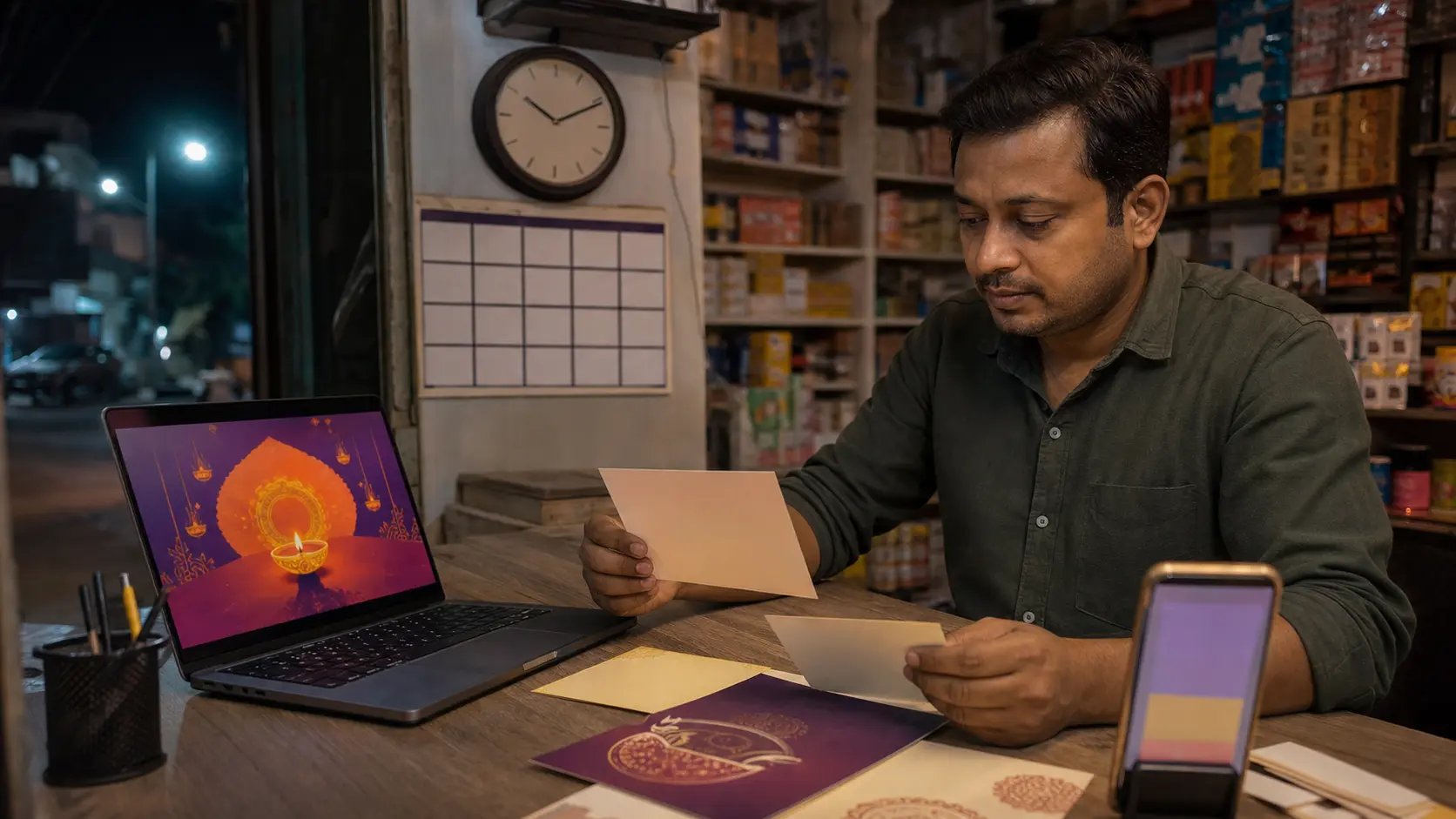
At 11:45 PM, a small retailer does not need a general theory of brand management. It needs a square image for WhatsApp and Instagram before customers wake up: the right holiday, the right script, a respectful message, a visible logo, a working phone number and maybe an offer. A local politician needs roughly the same assembly with a portrait and party colours. A real estate agent may need a different format for breakfast and a video for the evening. The economic value is concentrated in a short window. Yesterday's design for today's occasion rapidly approaches zero.
This decay explains Brands.live better than the usual 'poster maker' description. The currentGoogle Play listingfeatures a library of more than 100,000 ready-made templates, automatic application of the company's name, logo and contact details, several Indian languages, daily additions, image and video tools, a one-page website, a quote generator and seven-day social scheduling with recently announced artificial intelligence. These are company claims, not an independently counted catalogue or a verified feature test. They nonetheless expose the operational logic: prepare a large supply of dated and categorised assets, reduce customisation to a few fields, and make distribution easier than calling a designer.
The template is the inventory unit. It has a production cost—calendar research, ordering or generating illustrations, correct composition, rights clearance, size rendering, testing editable fields and publishing variants—but near-zero cost for the next download. A single Diwali frame can be sold many times; a wrong date, clumsy translation or unlicensed photograph can also be repeated at the same scale. Unlike physical inventory, excess designs do not need a warehouse. Like fresh food, however, much of their value disappears after a date.
Credapp must continuously replenish the catalogue so that a subscription is more useful than a folder of last year's exports.
That is why the calendar is the factory. The app interface is a distribution line between Credapp's content operation and the client's social channels. The client provides a small brand dossier; Credapp provides time-sensitive creative stock; the phone combines them; WhatsApp, Instagram, Facebook or another channel receives the result. The business opportunity lies in serving companies too small to maintain a creative team but active enough to fear silence on an important day. Its constraint is that the finished JPEG or video has little technical lock-in. Once delivered, the asset can travel without Brands.live.
The rest of the business must be judged against this perishable inventory thesis. A large number of installs only matters if users return for the next occasion. Localisation only matters if it is accurate and discoverable when needed. Artificial intelligence only matters if it shortens the path to an acceptable post without introducing factual, cultural or rights errors. A subscription only matters if next month's offering is worth more than the client's saved files, a competitor's free tier or a local designer's WhatsApp number.
The Exact Company Behind the App
The entity here isCREDAPP SOFTWARE PRIVATE LIMITED, with reported company identification numberU72900GJ2018PTC105439. AZauba record derived from the registerindicates it was incorporated on 4 December 2018, registered with the Registrar of Companies in Ahmedabad, and active in the July 2024 snapshot of that register. It gives a registered address at Units 420–423, Solaris Business Hub, near Bhuyangdev Char Rasta, Ahmedabad, and reports an authorised capital of 1.2 million rupees and paid-up capital of 160,790 rupees. As this is a commercial reproduction of corporate data rather than a fresh certificate from the Ministry of Corporate Affairs, the status and capital figures should be verified directly before contracting.
Current operational evidence tightens the match. Google Play names CREDAPP SOFTWARE PRIVATE LIMITED as the developer of Brands.live and displays the same Solaris Business Hub address. Apple's Indian store names the same legal entity as theprovider of Brands.live. Apple'sdeveloper portfoliolists Brands.live, Pixify and CredApp Customer under this seller identity. These independent platform records link the assigned company to the software more convincingly than a name on an undated promotional page.
Intellectual property evidence provides another bridge. Athird-party reproduction of Indian trademark file 5427790identifies CREDAPP SOFTWARE PRIVATE LIMITED as the owner of the Brands.live device mark in class 9, records a filing date of 28 April 2022 and reports registration until 28 April 2032. The public search of the Indian register is interactive, so a buyer should retrieve the official certificate and current status rather than relying solely on the reproduction. Nevertheless, the filing links the mark, a software class and the exact company; it does not establish ownership of every image, font, song, portrait or generated element offered through the service.
There is an essential exclusion. This company is not the well-known Indian financial services company commonly referred to as CRED. The latter'sprivacy pagecarries a 2020–26 copyright notice for Dreamplug Technologies Private Limited and describes payment and financial products. Similar spelling is not business continuity. Nothing in the app store, corporate or trademark evidence examined here supports importing Dreamplug's founders, funding, clients, licences, metrics or products into Credapp Software's file.
The current portfolio also requires careful phrasing. Brands.live is clearly active: Google Play shows an update from 19 June 2026, and Apple records ongoing iOS versions. Apple'sPixify listinglinks the video template app and its in-app purchases to the same seller, but its last visible version dates from April 2024.CredApp Customer, an offline register in Gujarati, Hindi and English for personal or store credit, remains listed under the seller but has no recent visible version history or current Apple privacy details. These are verified listings, not evidence of equal current investment. The defensible description is an active Brands.live centre, a listed but apparently less recently updated Pixify adjacency, and a seemingly legacy CredApp Customer product whose current support level is unresolved.
Five Clicks from Identity to Distribution
Brands.live's client workflow begins by transforming a business into a reusable set of fields. The store descriptions tell the user to sign up with a mobile number, add a company name, logo, phone number, address and website, choose a business category, select a frame or video, customise text or colour, and save or share. The sequence matters because it removes a repeated design task. A pharmacy, salon or training centre should not have to retype its identity for every public holiday or seasonal offer. Once the brand dossier is stored, each new template becomes a merge operation.
In its narrowest form, the service is mail merge for images. A background and an occasion arrive from Credapp. The client's logo and contact details occupy reserved positions. A mobile editor allows limited changes, and the result is exported to the device gallery. This simplicity is a feature for a time-pressed owner who does not want layers, grids or typographic controls. It is also the economic limit of the product. The more control Brands.live adds, the more it competes with full design suites; the less it adds, the easier it is for another holiday poster library to replace it.
The latest listing extends beyond this narrow workflow. Credapp advertises text-to-image creation, product presentations, image-to-video, background removal, collages, digital cards, web pages, calculators, quote tools, post boosting and a week of automatically scheduled posts. Apple's iOS release notes also mention scheduling for Facebook, Instagram and LinkedIn. These statements show the desired expansion from 'download an asset' to 'run a small marketing routine'.
The public documents do not demonstrate which network interfaces are active in each platform version, which functions require a paid tier, whether scheduled posts survive an expired subscription, or how a failed publication is reported. A procurement test must distinguish the functional vocabulary of a listing from an end-to-end result.
The company has also built a more assisted offering around the former name Brandspot365 embedded in the Android package identifiercom.brandspot365. TheBrandspot365 sitecarries a CREDAPP SOFTWARE PRIVATE LIMITED copyright notice and markets a content repository, version control, collaboration, custom templates, professional design, video production, social publishing, analytics and campaign services. Its onboarding language shifts from the app store's self-service to consulting, custom strategy, implementation and ongoing optimisation. This is a different delivery mode even if it reuses content and infrastructure.
This gives Credapp a plausible monetisation ladder. A freelancer can download free content or buy a low-cost mobile subscription. A growing business might want custom frames or help. A larger SME can purchase a managed package with human production and social account management. Climbing the ladder increases revenue per client and reduces direct comparison with a cheap poster app, but it also increases work, permissions and service obligations.
Twelve promised posts and four videos require delivery, review and approval; three managed social profiles require credential governance; analytics and lead generation claims require measurement definitions.
Implementation is therefore bifurcated. The mobile user can be productive in minutes if sign-up, payment and asset downloads work. The managed client needs a brand brief, asset receipt, access roles, social connections, approval rules, a content calendar and escalation contacts. The public pages do not specify implementation timelines, supported file formats, revision limits, service hours or contractual response targets. 'Easy' is plausible for applying a logo to a standard frame. It is not evidence that a multi-user brand repository or managed campaign can be commissioned without operational work.
Support is visible but poorly specified. Google Play provides an email address and Indian phone numbers, while Brandspot365 advertises consultation and daily WhatsApp service. No surface publishes severity definitions, staffing hours, response times or uptime commitments. For a 199 rupee monthly user, informal support may be economically rational. For a business entrusting three social accounts at 10,000 rupees per month, the same ambiguity is a procurement problem.
A Content Operation Disguised as an App Icon
Credapp's most important production system may not be its mobile code. It may be the machinery that decides what the library should contain tomorrow. The company says it serves festivals including Holi, Eid, Onam, Pongal, Navratri, Diwali, Christmas and Easter, as well as national days, professional occasions, anniversaries and business promotions. Each item may require multiple scripts, region-appropriate images, multiple aspect ratios, still and animated versions, free and premium treatments, category-specific text and modifiable brand space.
This inventory has three clocks. The annual clock contains public holidays and anniversaries whose dates can be planned. The business clock contains offers, product categories and routine 'good morning' or motivational content. The news and political clock contains emerging events where speed is valuable but mistakes are more costly. A reusable production system can plan the first two; the third requires editorial judgement. A quickly generated image around a developing event can be technically polished yet false, incendiary, outdated or legally unusable.
Localisation is not simply translating a caption. A festival may have different names, observances and visual conventions across states. Text must display correctly in different scripts. A line that fits in English may overflow in Gujarati or Tamil. Numbers, honorifics, religious symbols and portraits carry context. Brands.live's iOS information field states that the interface language is English, while its Google Play description claims content in regional languages. These statements are compatible: an English navigation shell can distribute designs written in multiple languages.
They should not be reduced to a claim that the full product experience is localised.
The competitive bar rises. Adobe's September 2024announcementregarding Indian languages indicates that Adobe Express added Hindi, Tamil and Bengali interfaces and translation into eight Indian languages, along with image generation and editing functions. A targeted local app can still win on calendar depth and faster discovery, but 'supports local language content' is no longer a sufficient distinction over a global suite.
Volume creates its own quality problem. One hundred thousand assets, if the company's claim is accurate, cannot all receive the attention given to a custom campaign. The useful question is not whether the library contains errors—any large-scale catalogue will—but how they are detected, prioritised and corrected. Does Credapp maintain a source for official dates and observances? Can a language reviewer approve a revision? Can a rights complaint remove an asset across cached variants? Can a client report an offensive or inaccurate template before thousands of copies circulate?
Is there a record of what was available and downloaded when a dispute arises? The public pages do not answer these questions.
Artificial intelligence changes the throughput equation without eliminating the editorial cost. It can create visual variants, captions and weekly schedules faster. It can also produce mis-spelled text in images, implausible products, distorted symbols, invented claims or stylistically repetitive results. Credapp does not publicly identify the provider, model family, safety controls, data path for user inputs, review threshold or rights allocation for its announced AI features. Buyers should consider the functionality as uncharacterised until these details and sample failure rates are provided.
The sustainable asset of the service is thus not any particular poster. It is the combination of a living taxonomy of occasions, a brand field system, a content procurement process and on-demand distribution. This combination may be valuable. It is also operationally costly in ways that raw software margins can mask: every additional language, category, political use case and video format expands the review burden.
What the Public Architecture Proves
No public technical design describes Brands.live's hosting provider, database, tenant separation, content delivery network, rendering engine, social connectors or artificial intelligence providers. It would be speculation to name them. The observable workflow nonetheless supports a limited architectural inference.
An account service must recognise a mobile number and retain company details; a catalogue service must deliver changing templates; a rights layer must separate free and paid access; a rendering engine must combine selected content with client fields; and social scheduling, if operational as advertised, must store future actions and sufficient authorisation to publish them.
Some functions may occur on the phone. Selecting images from the gallery, positioning a logo, adding text and exporting a file are natural client-side tasks. Other functions inherently depend on a remote service: receiving daily assets, verifying a subscription, regenerating a planned week and coordinating a future post. The ongoing value of the app therefore combines on-device software with a cloud-fed content stream. A downloaded image may remain usable during an outage; tomorrow's templates, rights checks and scheduled actions may not.
TheAppBrain recordreports Android version 6.79, 33 requested permissions and 47 libraries as of its snapshot date of 1 July 2026. These counts are third-party static metadata. They prove neither excessive collection nor identify actual runtime access, and a library count is not a vulnerability count. They justify requesting the actual permission inventory, software component list, third-party SDK purposes and deletion history. A poster app that touches photos, identity, location, contacts, advertising identifiers and social publishing deserves a data flow diagram even if every permission has a legitimate use.
Official privacy documents confirm several of these data surfaces. Credapp's Brandspot365privacy policydescribes collection of name, email, phone number, one-time codes, device and log data, approximate location derived from IP, cookies, activity, commercial information, geolocation and gallery access. It states that third-party services may receive information, mentions marketing communications and business transfers, and says separately that users voluntarily permit contact list access to facilitate sharing. These are policy statements, not packet captures; they show intended or permitted processing, not the frequency of each operation.
Several dependencies are outside Credapp's direct control. Apple and Google govern listing, review, discovery, updates, billing and rule compliance. Mobile operating systems govern permissions and background execution. Social networks govern their interfaces, tokens, rate limits, content rules and account penalties. Telecom delivery affects mobile number verification. Payment systems affect activation and rights restoration. Font, stock media, music and generative providers affect what content may be legally distributed.
A failure in any layer can appear to a shop owner as 'Brands.live not working' even when Credapp's core service is available.
Brandspot365 adds a different architectural claim: a central content repository with version control, collaboration, analytics and campaign management. These features imply roles, histories, shared assets and more durable business records than a simple exported poster. The public site gives no technical assurance for access isolation, immutable version history, backup, recovery, regional hosting or audit export. The managed service must therefore be evaluated separately from the consumer app. A satisfactory mobile permission review does not answer the question of how a shared brand repository is administered.
The public boundary is clear enough to reject two extremes. Brands.live is not merely a static set of images; updates, accounts, rights and scheduling imply ongoing services. It is also not publicly demonstrated as a full marketing automation platform simply because the listing contains calculators, websites, boosting and AI scheduling. The evidence supports a cloud-powered mobile content and design service extending toward marketing workflow. The depth and reliability of that extension remain to be tested.
Millions of Installs, Active Businesses Unknown
Google Play currently shows the app in the 5 million+ install bracket, a rating around 4.2 and roughly 75,000 reviews. These are platform-displayed facts at the time of access. The bracket is cumulative and coarse. It may include updates, re-installs, personal greeting users, inactive devices and people who never completed sign-up. A review count is not a customer count, and the company expression 'trusted by lakhs of Indian businesses' is not accompanied by a verified definition of business, active period or paying status.
Third-party estimates add resolution and uncertainty. AppBrain estimates 9.9 million lifetime downloads, roughly 200,000 in the prior 30 days and a position in the top 100 Art & Design apps; it also showed an Indian free rank of 21 in its snapshot.Sensor Tower's public pageestimated roughly 300,000 downloads and less than $5,000 in Android revenue in its last month, with an Indian category rank in the high teens. These estimates differ, use proprietary methods and may change daily. Sensor Tower's revenue view may exclude advertising, web payments, iOS, managed services, taxes or other channels. No source should be converted into a precise figure for active users or company revenue.
Apple offers a second, smaller but useful view. The Indian store showed roughly 2,400 ratings, a 4.6 score and a Graphics & Design rank of 114 at access. The US store showed only nine ratings. Store differences are expected for an India-focused product. They demonstrate geographical concentration more than global penetration, and rank positions are momentary rather than sustainable market share.
The addressable need is credible even without a market size display. A 2025India SME Forum digital adoption report, based on 7,835 respondents and produced with a Meta-backed programme, found that 53.8% had integrated internet, digitalisation or e-commerce into their core operations. It also reported that more than half found it difficult to select appropriate digital tools and described social media as a cost-effective brand channel. The sample and sponsor context limits national generalisation, but the tension is relevant: many businesses are online while tool selection, skills and spending remain constrained.
Brands.live fills this gap by reducing the decision. It does not ask the owner to choose a design system; it asks which occasion and category apply today. This reduction may extend use well beyond trained marketers. It also means that installation scale may contain low-intensity behaviour: a user arrives for a festival, downloads a free card and shares. The metric that would validate the business is not the disclosed download count but cohorts—registered businesses, monthly creators, paid conversion, renewal, posts per active client, scheduled post success and support-adjusted retention.
No public audited revenue, subscriber count, client concentration, churn series or cost structure was identified for CREDAPP SOFTWARE PRIVATE LIMITED. Its reported small paid-up capital is a legal capital figure, not a valuation, cash, revenue or solvency figure. The company may operate profitably, raise funds privately or fund content from subscriptions and services; the public evidence examined does not resolve this. A serious commercial evaluation should request financial statements and channel-level unit economics rather than infer them from downloads.
Tomorrow's Post Is the Subscription
The app is free to install and sells access via in-app purchases. Apple's Indian description lists a quarterly plan at ₹499 and a monthly plan at ₹199, each with seven-day trial variants. The store's purchase list also displays quarterly, Silver and several annual products ranging from ₹1,799 to ₹4,499, as well as several promotional labels. These are live store observations, not a proprietary universal price list. Typographic inconsistencies and overlapping annual products make it particularly important to inspect the offering on the actual device before comparing prices or testing renewal.
The economic item sold is not the already exported poster. It is ongoing access to future assets, premium formats, download allocations, automation and convenience. This fits a subscription well: festivals and working days recur, social feeds demand repetition, and yesterday's content cannot fill tomorrow's slot. Apple'sreview guidelinesexplicitly recognise continuously updated media collections and software services as appropriate subscription uses while requiring ongoing value and clear disclosure of what the user receives.
The entry-level price competes with worker savings. At ₹199 per month, a shop owner only needs to value a few avoided design tasks for the subscription to seem cheap. But a low price does not reveal healthy economics. Credapp must fund app development, store commissions, support, content creation, translation, video bandwidth, payment failures, user acquisition and all the compute its generative features consume. Free users may impose much of this cost without paying. A large install base combined with low conversion may be an acquisition burden rather than a moat.
App stores participate directly in unit economics. Google's currentservice fee schedulestates 15% fees for auto-renewing subscriptions in markets still under the existing regime and a four-percentage-point reduction for eligible alternative billing in India. Apple'sSmall Business Programoffers a 15% commission to enrolled developers below its $1 million revenue thresholds. Public evidence does not show Credapp's enrolment, billing choice or effective rate on each platform. The correct conclusion is exposure to platform rules and fees, not a calculated net margin.
Brandspot365 moves the pricing boundary. Its publishedGold+ planis ₹10,000 per month for two users, a central repository, 12 brand-specific social posts, four short videos, management of three social profiles, WhatsApp service, festival creations, business stationery, an NFC card and an annual profile video. This is not simply a Brands.live premium entitlement. It bundles software, creative work, account management and physical or custom items. The gross margin and scalability will differ from the self-service app because each account consumes human production and coordination.
Pixify offers another comparison within the same seller portfolio. Its website advertisesplans at ₹99 monthly and ₹999 annuallyfor beat-synced video templates, while Apple lists monthly purchases at $0.99 or $1.99 and annual at $9.99 in the US. This suggests Credapp has experimented with product-specific content subscriptions at multiple price points. It does not prove cross-selling, shared accounts or shared infrastructure.
Pricing also reveals the commoditisation boundary. The client can compare a Brands.live quarterly plan with a direct rival, a global suite, a freelancer or a folder of reusable Canva templates. A unique design may justify custom fees; a near-identical holiday frame does not. Credapp must therefore sell time saved, local relevance and ongoing replenishment. If users perceive the output as interchangeable clip art, pricing pressure will be persistent.
The strongest commercial path may be segmentation rather than a universal tier. Free content builds distribution. Low-cost subscriptions monetise recurrence. Custom frames and Brandspot365 managed services monetise clients who care about consistency or lack staff. This ladder is plausible, but the public pages do not disclose how many clients move between tiers, whether managed work subsidises the app, or whether app store acquisition produces profitable renewals. These are the numbers on which the business economics rest.
Local Relevance Carries Editorial Responsibility
Credapp's specialisation creates value by putting context into the template before the client arrives. It also assumes a responsibility that a neutral blank canvas can avoid. A prebuilt Navratri, Eid, Ambedkar Jayanti or political leader template makes implicit choices about imagery, wording, dates and prominence. The app can transfer a logo automatically; it cannot transfer responsibility for whether the surrounding content is accurate, respectful and legally compliant.
The first control is provenance. Google's description calls templates 'royalty-free', but the public terms examined do not provide a detailed licence schedule for stock photos, fonts, music, portraits, symbols or generated material. Indian copyright law treats designs and photographs as artistic works; the India Code'sdefinitionsalso state that a licence is a legal allocation of rights, not a marketing adjective. A professional client should obtain the exact permitted uses: organic posts, paid ads, print, resale, modification, use after cancellation and use of music on different platforms. The Brands.live trademark registration does not answer any of these asset questions.
The second control is cultural and linguistic review. Brands.live markets several Indian languages and a catalogue of more than 100,000 templates, while its iOS listing identifies English as the interface language. These company and store disclosures establish breadth claims, not the accuracy or appropriateness of any single asset. Catalogue scale therefore cannot substitute for sample-based acceptance tests: a buyer should verify whether brand colours work with the template, whether text displays and wraps correctly in required scripts, and whether appropriate image and video formats are available under the purchased right.
The practical gap between volume and relevance remains an unanswered due diligence question; the public record establishes neither a measured defect rate nor systematically acceptable output.
The third control is political use. Google explicitly markets Brands.live to political leaders, and direct rivals advertise political posters. During India's 2026 regional elections, theElection Commission of Indiareiterated that political advertisements on the internet and social media require pre-certification by the appropriate Media Certification and Monitoring Committee and that campaign-related costs must be reported. Organic posts on personal accounts may be treated differently under the Commission's guidelines, so classification depends on use. A poster generator does not exempt a candidate, party or agency from these obligations.
This creates a clear product boundary. Brands.live can assemble artwork; it is not demonstrated as an election compliance system. A 'boost post' button or planned campaign can bring an asset closer to regulated advertising. Procurement by a political organisation should therefore require approval states, user attribution, preserved final files, expenditure records, access revocation and a mechanism to stop queued publication. Speed without proof can turn a convenience tool into a compliance problem.
The fourth control is brand abuse. Brandspot365'stermsstate that uploaded media must carry a clearly visible company logo and reserve the right to block users, including paying users, for hidden or transparent branding. This rule may deter unbranded redistribution or spam, but it grants broad enforcement discretion. The terms give little detail on warning, appeal, access to already created work or what happens to a planned campaign after blocking.
Refund language is also conditional. The publishedrefund policyallows a claim within seven days, states that a refund, credit or replacement may be considered if the issue is deemed genuine, and excludes a 'Privilege' subscription. It does not define the decision standard or reconcile each in-app purchase stream. Apple and Google separately administer subscription cancellation and some refunds. Buyers should record which contract and payment channel governs their plan instead of assuming the website policy overrides the store's.
Quality control is therefore not a cosmetic addition. It is the system that preserves the product's central promise: the right content at the right time. Credapp should be able to show source calendars, language reviewers, asset rights records, correction timelines, generative content labelling, political content procedures and complaint statistics. Without these controls, catalogue scale amplifies error as effectively as it amplifies convenience.
Privacy Labels Are Not Assurance
Brands.live asks for information that makes automation useful: a mobile number, company name, logo, address, website and possibly gallery images. The company-linked Brandspot365 policy expands this set to email, one-time codes, device data, IP address, approximate and device geolocation, activity, cookies and contact permission, though its scope is drafted around the former Brandspot365 name rather than a clearly versioned Brands.live mobile notice. Some of this is ordinary for account security, analytics, advertising, personalisation or sharing.
The combination nonetheless creates a significant record of a small business and the people who run it.
Google Play's current data safety panel states that the app may collect and share location, personal information and device or other identifiers; it also states that data is encrypted in transit and that deletion can be requested. Apple's label states that diagnostics may be used to track users across other companies' apps and sites, that name and phone number may be linked to identity, and that email and crash data may be collected without being linked. The labels do not perfectly mirror each other, which may reflect platform differences, feature differences or disclosure choices.
Neither label is an independent audit. Google's owndata safety guidestates that developers are responsible for complete and accurate disclosures, including the behaviour of third-party libraries, while Google reviews the submission as part of its policy process. Apple states on the Brands.live page that the developer's information has not been verified by Apple. These disclosures are useful starting points. They do not prove encryption at rest, secure key management, least-privilege access, deletion completion, incident detection or a tested recovery process.
The website policy presents material ambiguities that procurement should resolve. One passage describes personalised content and advertising based on collected information; another asserts a strict no-logging approach and minimal anonymous collection. One passage states that users can use the services without revealing personally identifiable information; the app store workflow starts with a mobile number sign-up and asks for company details. The policy mentions third-party services but does not provide a named sub-processor list.
It discusses retention in general terms but gives no schedule by data class, backup deletion timeline or social token retention rule.
Contacts deserve a specific test. The policy states that a user may permit contact list access to facilitate sharing and suggests that sharing will not work without it. Modern mobile systems can often share via a system sheet without transferring the entire address book to the app, though implementation choices vary. Credapp should demonstrate whether contacts stay on device, which fields are accessed, whether any are uploaded, how consent can be withdrawn and whether ordinary sharing remains possible after refusal. The public text does not resolve these questions.
India's data protection framework adds a temporal compliance horizon. TheDigital Personal Data Protection Act, 2023establishes notice, consent, data fiduciary obligations and individual rights, with commencement set by government notification. The finalDigital Personal Data Protection Rules, 2025use staggered dates: some provisions took effect on publication, Rule 4 follows after one year, and Rules 3, 5–16, 22 and 23 after eighteen months. As of July 2026, several detailed operational rules are therefore still on the published ramp rather than fully in force.
The upcoming requirements are nonetheless useful procurement benchmarks. Rule 6 describes encryption or comparable protection, access control, logging and monitoring, backups, contractual processor safeguards and organisational measures. Rule 7 specifies breach notifications to affected individuals and the Board, including a detailed update within 72 hours. Credapp's public documents do not establish readiness against these controls. This is an evidence gap, not a conclusion of breach or non-compliance.
No public ISO 27001 certificate, SOC report, penetration test summary, bug bounty programme, availability history, status page, recovery objective or named security contact was identified for Brands.live or Brandspot365. AppBrain's permission and library counts do not substitute for these artefacts. No credible public disclosure of a material Brands.live breach or prolonged service outage was found either. The absence of a public incident record cannot establish that none occurred; small consumer software companies often disclose less than regulated or enterprise vendors.
Rights continuity still merits direct testing becauseApple's Indian storeshows overlapping monthly, quarterly, Silver, annual and promotional purchase labels, while thepublished refund policydoes not match every in-app product nor override Apple and Google purchase flows. This documented ambiguity is evidence only of unclear public mapping, not of a client outcome. It makes the control path observable and testable: purchase, rights activation, restoration, cancellation, refund and escalation should be exercised on both Apple and Google accounts before a business depends on the service for a campaign. Payment continuity is part of product continuity when premium assets depend on rights verification.
Minimum evidence for a managed client should go further: a data map; named processors; hosting regions; access roles; encryption design; backup and restore testing; deletion verification; social token storage; staff departure; incident notification commitments; vulnerability reporting; and a contract that allocates data fiduciary and processor responsibilities. A privacy page written for a mobile download is too broad to carry a multi-user content repository and managed social service by itself.
Competition Is a Click Away
Brands.live occupies a busy category in which competitors describe almost the same five-step journey.AdBanaotells the client to install the app, upload a logo and brand details, select festival or event content and create branded posters, banners or videos.BrandFlexadvertises thousands of festival and political templates, daily updates, automatic custom details and a menu of professional, annual and service purchases.PosterBanaomarkets a ready festival frame, brand insertion and immediate sharing on WhatsApp or Instagram, with language support as a selling point. These are separate sellers; their descriptions demonstrate how reproducible the category proposition is.
AppBrain's alternative list adds several poster makers with Google Play install brackets of five or ten million and up. These figures are not comparable active-user metrics, but they show that Brands.live does not own 'easy poster' demand. Search visibility, ratings, update cadence and paid acquisition may shift users among similar icons. Credapp's own long app description includes competing terms such as PosterMyWall and AdBanao, evidence of an intensely contested discovery vocabulary even if it does not reveal the company's acquisition strategy.
Broad design suites attack from another direction. Canva'sIndian App Store pagelists 86 interface languages, roughly 638,000 ratings, templates, brand assets, collaborative editing, video, bulk creation and extensive artificial intelligence features. These platform figures are dynamic, but the product scale is clear. Canva is more complex than selecting a festival frame; it can also retain a team's editable designs and support work beyond social greetings.
Adobe Express combines broad tools with explicit Indian localisation. Its eight-language translation capability, multilingual interfaces and generative features weaken the assumption that a global platform cannot serve vernacular creation. Conversely, a large suite may still cause a shop owner to search among too many options. Brands.live can compete by making tomorrow's occasion the first screen and the client's category the filter.
Non-software substitutes are equally important. A local designer can understand a city, correct a spelling mistake via WhatsApp and produce distinctive work. An agency can plan a campaign rather than simply fill a feed. A franchise can distribute approved files from headquarters. A shop can reuse last year's artwork, post a product photo directly, use social networks' editing tools or stay silent. These alternatives put a ceiling on what standard templates can charge and a floor under the value of reliable human service.
Credapp's strongest differentiation is therefore operational density in an Indian calendar: many relevant occasions, quickly discoverable, already sized and ready to absorb a business identity. Its weakest position is any claim based solely on asset volume or generic AI. Competitors can order templates; global platforms can generate variants; users can export and leave. A defensible advantage would require evidence of superior retention, language accuracy, category depth, scheduled post reliability, support and a content cost per retained subscriber that rivals cannot match.
Brandspot365 is a strategic response to this weakness. Managed content, repositories and custom work create relationships that a free template cannot. They also move Credapp into competition with agencies and social management platforms, where clients expect approvals, reports, service levels and accountable humans. The company can only escape purely commodity pricing by accepting these heavier obligations.
Leaving with a JPEG
The switching cost begins with what the client can take away. A downloaded JPEG, PNG or video is highly portable. It can be stored in a gallery, sent to a colleague, re-uploaded and archived outside the service. The logo, phone number and address are facts the client already owns. For the simplest use of Brands.live, the output can be easier to leave than accounting, customer management or web hosting software.
But a flat export is not the same as an editable project. It may not preserve layers, font files, animation settings, variant history, captions, approval comments or a reusable template. Scheduled posts may remain in the seller's queue. A Brandspot365 repository may contain custom frames and campaign history. A social connection may retain authorisation until revoked. The public policies do not specify bulk export, machine-readable project format, schedule export, administrator transfer or recovery window after termination.
Rights may also constrain portability. A client may own the file while lacking clear authorisation for paid advertising, modification, printing, continued use after subscription or reuse of included music on another platform. This is why the exit test must include evidence of licence, not just a successful download. A usable export with uncertain rights is not a clean exit.
The continuity risk is unusual because it is time-sensitive but rarely existential. If a banking system fails, money may stop moving. If Brands.live fails on the morning of a festival, the shop can still trade; it loses a marketing moment that cannot be replayed the following week. For a single shop, the impact may be modest. For an agency, franchise or political team planning many accounts, an outage or rights failure can multiply missed posts and emergency work.
The service can reduce this risk by allowing early download, local storage, schedule visibility and alternative export routes. The buyer can reduce it by retaining original logos, fonts and brand guidelines outside the service; archiving final files; retaining direct ownership of social accounts; recording administrator access; and maintaining an alternative creation method. Dependency should be proportional to consequence. A convenience app does not need to be designed like a payment switch, but a business should not discover that its only credential, logo or campaign queue is inaccessible on the day that matters.
Lock-in is greatest where Credapp adds service. Custom templates encode work. Human account managers learn preferences. A repository accumulates assets. Social connections and reporting become routine. These advantages may justify staying; they also require contractual exit conditions. The relevant question is not whether switching is possible. It is how many editable assets, approvals, credentials and hours must be rebuilt when the client changes.
Procuring During a Festival Week
A feature demo will flatter this product. A realistic procurement test should span seven days containing at least one major festival, one ordinary business offer and one fast-moving event. It should use the buyer's real logo, colours, scripts, staff roles and social accounts in a controlled environment. The goal is to measure finished, publishable outputs—not the number of menu items.
Start with identity and contract. Obtain the current master data from the Ministry of Corporate Affairs for CIN U72900GJ2018PTC105439, the registered office, directors authorised to sign, tax details and the exact legal entity on the invoice. Match this entity to the Apple or Google seller and any Brandspot365 service contract. Confirm whether the app subscription, managed creative work and physical NFC items have different terms. Explicitly exclude Dreamplug from seller and payment records so that name confusion cannot contaminate due diligence.
Test the mobile journey next. Register a new Android account and a new iOS account. Decline contacts and location first; record what still works and why any blocked feature needs access. Add a deliberately long company name, a transparent logo, two phone numbers and a multi-line address. Create the same post in English and at least two relevant Indian languages. Check font rendering, truncation, contrast, logo free space, date, honorifics and export resolution on both a cheap phone and a recent device.
Exercise rights rather than relying on a price screen. Purchase the exact plan offered, record the renewal amount and trial end, restore it on another device, sign out and back in, cancel the renewal, request an eligible refund and verify continued access to paid exports. Ask what each annual, quarterly, monthly, Silver, Elite or promotional stock-keeping unit includes. The overlapping store labels make a written rights table necessary.
Test content freshness and correctness. Select ten planned occasions and trace the date source. Introduce a reported spelling or factual error via support and measure acknowledgment, correction, cache removal and client notification. Ask for a language reviewer's approval record on a sensitive template. For generated images, test text rendering, brand fidelity, prohibited content, factual claims and near-duplicate outputs. Demand a clear path to human review before a political or religious post is published.
Test scheduling as a stateful system. Connect temporary Facebook, Instagram and LinkedIn accounts with minimal privileges. Queue posts, revoke a token, change a password, let a subscription expire and disable a network. Determine whether Brands.live reports failure, retries safely, avoids duplicates and allows an administrator to stop the queue. Confirm where captions and credentials are stored and how they are deleted. A green 'scheduled' state is not proof of publication.
Test asset licensing. Take one static template, one video with music, one AI-generated visual and one political frame. Ask Credapp to provide the rights basis for each component and written authorisation for the buyer's intended organic, paid, print and post-subscription uses. Run reverse image checks on a sample. Confirm who handles a removal and whether a contested asset can be withdrawn from future schedules without erasing evidence of what the client used.
Test security and recovery. Ask for the permission map, component inventory, sub-processor list, hosting regions, encryption controls, access review, backup schedule, last restoration exercise, vulnerability process and incident history. Create and delete a test account; then ask what remains in backups, analytics and support systems. For Brandspot365, add two users with different roles, delete one, inspect version history and try to recover content after termination. Verify that social tokens die with the user or contract that created them.
Test support at value time. Open an ordinary ticket, a payment-rights ticket and an urgent content-error ticket outside Ahmedabad business hours. Record response, ownership and resolution. For the ₹10,000 managed plan, define in writing the revision numbers, approval timelines, missed-post remedies, account transfer and service availability. A daily WhatsApp relationship can be effective; it should nonetheless have an accountable escalation path.
Finally, perform an exit exercise. Download every final asset and any available source project; export schedules, captions, analytics and approval history; revoke social access; obtain deletion confirmation; and rebuild a week of posts in a competing tool. The cost and information loss observed in this exercise are the true switching cost. If the buyer cannot perform it before purchase, the contract should create the right to do so later.
The result of this week is not a beauty contest. It is a ratio: accepted, correctly localised, rights-verified posts delivered on time per rupee and per staff hour, with failures and revisions included. That metric captures the value Brands.live promises and the work its marketing language tends to hide.
The Evidence That Should Tip the Scales
Credapp Software has stronger public operational evidence than a mere app-store shell. The exact company is linked across corporate, trademark and marketplace records. Brands.live has a current publication cadence, material Android distribution, paid products, a recognisable India-specific workflow and an adjacent managed service offering. The company is substantial enough to warrant due diligence without borrowing the glory of the unrelated financial services firm.
The central thesis is also commercially coherent. Thousands of businesses face recurrent demand for culturally timely social content but cannot justify a designer for every occasion. By pre-producing the occasion, storing the client's brand fields and reducing creation to selection and export, Credapp turns repetition into a service. The perishable nature of inventory supports renewal: the client buys what will be relevant next, not just what exists now.
Yet the evidence stops at the questions that determine durability. Public downloads do not reveal active businesses or paid retention. Store prices do not reveal net revenue or content cost. A huge catalogue does not reveal rights coverage or error rates. Privacy statements do not reveal control effectiveness. Feature lists do not reveal scheduling success, recovery or support capability. No public financial statements, client cohort data, formal service levels, security assurance or detailed architecture were available in the examined record.
Five disclosures would materially strengthen the case. First, active and paying cohort data separated from cumulative installs. Second, a language and content quality report showing corrections, reviewers and rights provenance. Third, a current security and privacy assurance package aligned with India's staggered data rules. Fourth, measured scheduling, rights and uptime performance. Fifth, export, deletion and post-termination rights that make the managed service safe to adopt.
Surveillance points are also concrete: whether Android update cadence continues; whether Pixify becomes active again or remains a secondary experiment; whether Brands.live's AI scheduling produces reliable publication rather than feature inflation; whether the store price proliferation becomes clearer; whether political content gains approval controls; whether Brandspot365 gains recurring managed clients without overwhelming a small support organisation; and whether broad suites erase the local language and calendar advantage.
Brands.live sits on an intriguing frontier. It automates repetitive marketing assembly, but it does not automate judgement. It distributes creative assets at software scale, but the assets themselves are easy to copy and export. It can give a small business the appearance of constant activity, but it cannot guarantee that activity creates sales or trust. Credapp's durable product, if it can prove one, is the operational discipline behind the flow: knowing what tomorrow means for a particular business, publishing it correctly tonight, and starting again the next day after the downloaded poster has lost its value.