
Summary
- Telenet Digital’s public footprint joins named neighbourhood coverage, an autonomous system and its own IPv4 and IPv6 allocations, but it does not disclose the physical routes, access-node locations, power arrangements or wholesale links that determine whether a local cable break becomes a brief interruption or a long outage.
- The company advertises residential speeds of up to 500 Mbps and dedicated connectivity with a test-port ceiling of 10 Gbps, yet those figures do not establish installed, lit, sellable or spare capacity; current public routing observations show one immediate external network neighbour, while older commercial data presents a conflicting picture that cannot prove physical diversity.
- Its user manual is unusually useful because it separates faults inside the home, faults within Telenet Digital’s distribution and aggregation domain, and failures beyond the operator; that division makes field diagnosis, escalation discipline and honest recovery reporting more important to users than the headline speed alone.
The warning that matters more than the speed card
The most consequential sentence on Telenet Digital’s public website is not the promise of fibre, the “up to” figure beside a residential plan, or the availability percentage attached to a business service. It is the warning that a fixed connection can slow or disappear because of cut cable, poor distribution wiring, unauthorised manipulation, aggregation pressure or constraints in an international channel. Those causes sit at different distances from a customer’s router, require different people to investigate them and recover on different clocks. A household can experience all of them as the same spinning icon.
That is why the operator’s user manual is more informative than a conventional product page. It groups performance constraints into three broad domains: conditions attributable to the subscriber, conditions within the operator’s sphere, and external conditions involving the destination or wider connectivity. The language is uneven in age—it refers both to distribution cable and to cable-modem or splitter arrangements even though the current site emphasises fibre—but the causal map is valuable. It acknowledges that access quality is a chain rather than a single advertised number.
The commercial proposition remains clear. Telenet Digital’s home page presents residential internet and television, dedicated access for internet providers and small businesses, point-to-point connectivity, monitoring and maintenance. It also promotes a maximum of 10 Gbps per test port for dedicated services. The residential packages page places 100, 200, 300, 400 and 500 Mbps options in one ladder and describes them as speeds of up to the stated figure. Those are saleable labels. They are not measurements of the capacity that has been installed in each neighbourhood, activated at each access node, reserved for existing subscribers or held spare for growth and recovery.
Telenet Digital itself gives readers a reason to be cautious about treating every website statement as a durable engineering fact. Its site terms identify Telenet Digital S.A.S. as the owner of the site but say that online information can change and can contain inaccuracies. That qualification does not nullify the commercial claims. It defines their evidentiary weight. The pages establish what the company chooses to offer and how it explains service; they do not provide a dated network inventory, independently measured availability record or neighbourhood-by-neighbourhood capacity account.
The distinction matters because local fixed access is sold at the edge but produced across several layers. A subscriber pays one company, sees one Wi-Fi name and normally calls one support number. The service nevertheless depends on indoor power and wiring, an optical or other access segment, street distribution, an aggregation point, upstream connectivity, name resolution and the remote service being requested. If a branch scrapes an aerial cable or a third party opens a chamber, the 500 Mbps label has no restorative power.
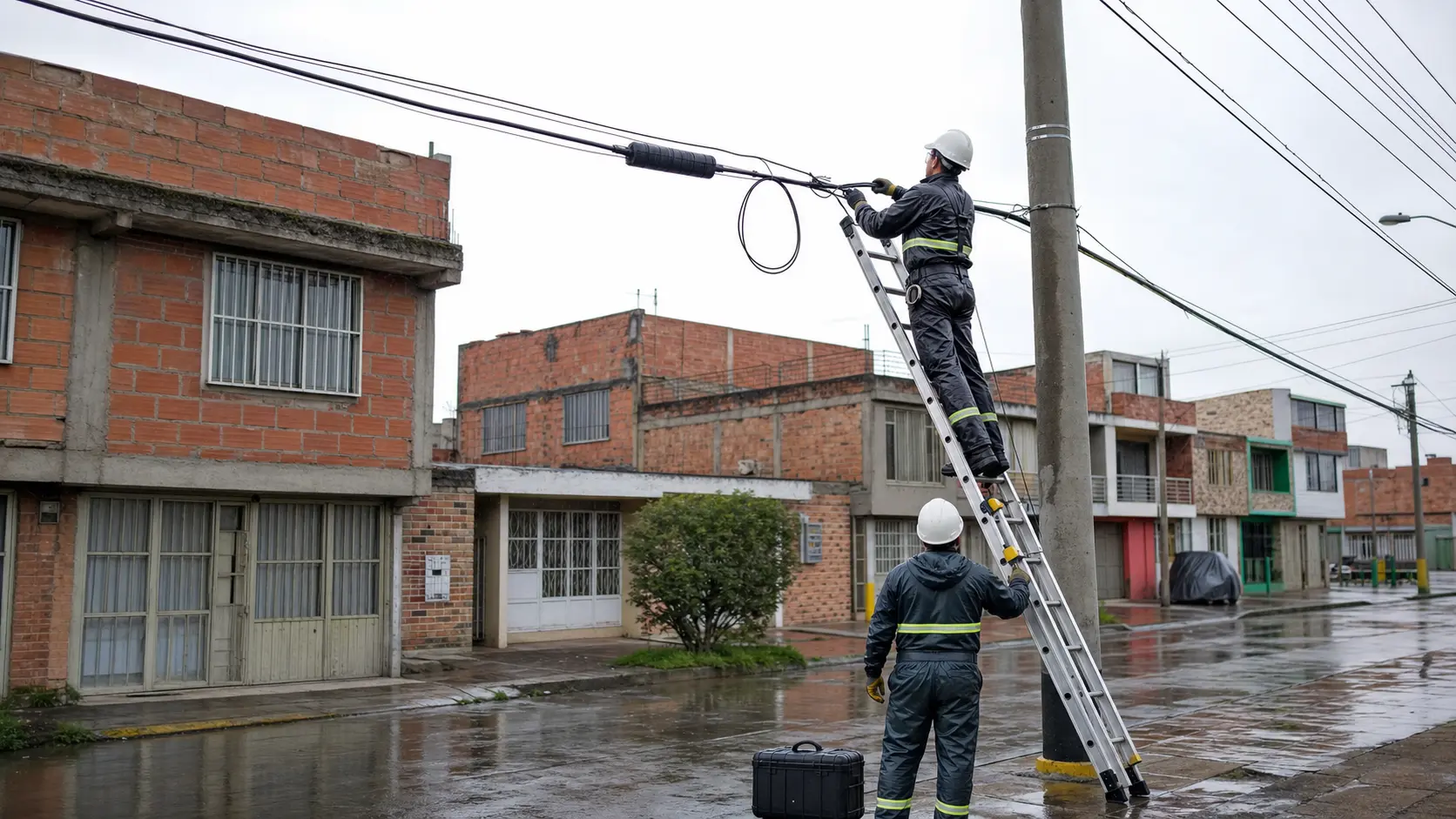
Repair depends on whether the operator can locate the break, reach it safely, splice or replace the damaged section, restore power where needed, verify optical levels and then distinguish any remaining upstream problem from the original local fault.
This is the central test for a regional provider. Large national brands can spread crews, spares and network operations across a broad base, although scale does not guarantee a good repair. A smaller provider can possess sharper local knowledge, shorter dispatch paths and stronger relationships with the people who maintain a particular street. It can also have fewer alternate routes, fewer spare interfaces and less room to absorb simultaneous incidents. Public evidence does not settle which side of that trade-off defines Telenet Digital.
It does show where the answer would have to come from: route disclosure at a useful but safe level, measured capacity, power and spares policy, fault statistics and recovery performance.
The company’s own manual therefore changes how its offer should be read. It turns speed from a standalone promise into the final output of a physical and organisational system. It invites harder questions than “How many megabits?” Who owns each repair boundary? What can be tested remotely? Which faults require a field visit? Is there another path when a distribution segment is cut? How long can access equipment remain powered? Does upstream dependence converge on one external network even if two commercial names appear in historical records?
Until those questions are answered, the most honest account of the offer is conditional: attractive headline rates, a real local operating presence, and a recovery capability whose depth remains largely unpublished.
A Bogotá company with a narrower public footprint
Telenet Digital describes itself as a Colombian provider operating since 2017. Its company page says it supplies fibre-backed internet, digital television and technical infrastructure for companies, small and medium-sized businesses and other internet providers. The same page names a deliberately compact retail geography. In Bosa, the list includes Bosa Jardín, San José, El Toche, Primavera, Villa Anny and San Diego. In Soacha, it names Ciudad Verde and the Magnolia, Pensamiento, Alely, Buganvilla, Camelia 1 and Camelia 2 residential complexes.
That list is useful because it replaces the vague phrase “Bogotá coverage” with a set of places where commercial reach is claimed. It is not a census of homes passed, homes connected or buildings ready for activation. It does not say whether every block inside a named neighbourhood can be served, whether entry agreements exist for every multi-dwelling building, or whether the access medium is identical across the footprint. The company’s contact page explicitly says coverage can change, describes standard distribution for end users and tells internet providers to ask about dedicated coverage. That makes availability an address-level question, not a conclusion that can be drawn from the neighbourhood name alone.
The legal and internet-routing boundary is clearer. The public LACNIC autonomous-system record identifies AS270031 with TELENET DIGITAL S.A.S., records a Bogotá address and shows an original registration date in June 2020. That registration is evidence that the company has its own autonomous-system identity. It does not reveal ownership of ducts, poles, fibre strands, buildings or power equipment, and it does not establish that every retail packet originates from every advertised neighbourhood under that number.
A Bogotá Chamber of Commerce bulletin records a 2020 corporate act affecting the company’s purpose, representation, powers and statutes. A separate Colombian public-sector market-study document includes Telenet Digital among providers consulted or identified, with contact details. These records help distinguish a legal operating company from a brand page. Neither demonstrates that the company won the procurement in question, owns a particular route or currently delivers service at every place mentioned in its marketing.
This boundary discipline is especially important for a small provider because names on a website can easily be mistaken for network ownership. Telenet Digital displays various industry and utility logos in its presentation material. A logo can indicate familiarity, a past project, a commercial relationship, a client, a supplier or simply an association the company wants visitors to notice.
Without a current contract, a route record or a statement from both parties, it cannot be converted into a claim that a named carrier supplies live transit, that a utility’s poles carry Telenet Digital fibre, or that a particular organisation provides route diversity.
The strongest public description is consequently modest but meaningful. Telenet Digital is a legally identifiable Colombian company with an autonomous system, address resources and a website that names retail coverage in Bosa and Ciudad Verde. It sells to households as well as organisations and other providers. That combination makes it more than a reseller page, yet still leaves open how much of the physical access estate it owns, leases, shares or operates under building-level arrangements.
The address shown in registration records should not be confused with an operational node. A corporate address can be an office, a correspondence point, a sales location or a technical site; public records do not make that distinction. Likewise, the Centro Comercial Prado Verde location on the contact page is evidence of a customer-facing presence and stated office hours, not proof of a core site, network operations room or spare-parts depot. A defensible physical account must resist turning every known location into infrastructure.
The public footprint is narrow enough that local operating detail could be unusually valuable. A national coverage map cannot tell a household which cabinet, pole line or building riser matters. A provider concentrated in a handful of neighbourhoods could explain, without exposing sensitive coordinates, whether a zone is served by aerial or underground distribution, whether a multi-dwelling complex has more than one building entry, and which hours have field coverage. Telenet Digital does not yet publish that layer. Its legal and logical identity is visible; its street-level dependency map is not.
What the coverage images show—and what they hide
The operator publishes two visual aids for its stated footprint. The Bosa coverage graphic places named areas and purple coverage shapes over satellite imagery. The Ciudad Verde graphic is presented as the corresponding view for the Soacha development. These images are better than a country-level splash map because they anchor the offer to recognisable local geography. They are still commercial coverage illustrations, not engineering route maps.
That difference is easy to miss. A shaded polygon can mean an area where sales are accepted, an area where distribution is already present, an area that can be extended after a survey, or a mixture of all three. It does not reveal the path of a feeder cable, the boundary between access nodes, the location of an optical line terminal, the number or position of splitters, the fibre count, the spare strands, the pole or duct owner, or the building entry point. Nor does it show whether two apparently separate streets converge on the same upstream segment.
The image format also cannot establish serviceability inside apartment complexes. Multi-dwelling buildings introduce additional boundaries: permission from an owner or administrator, the condition and capacity of internal conduits, riser access, distribution boxes, power for any active equipment and the distance from a building entry to the dwelling. A coverage shape around a complex can be accurate at the development level while an individual tower or apartment remains unavailable. That is why the contact page’s request to check availability remains important.
Colombia’s rules for infrastructure sharing explain the range of physical supports that can sit beneath an internet service. The communications regulator’s sharing-regime overview lists telecommunications poles, ducts, chambers and boxes, as well as eligible electrical infrastructure, roads, mass-transit systems and street furniture. The list is a statement of the regulated support environment, not evidence that Telenet Digital uses any particular pole, duct or chamber. It nevertheless illustrates why a coloured coverage area is not a map of operational control. The provider may depend on assets owned or administered by others even when it owns the active equipment and fibre.
A 2026 CRC study of local wholesale connectivity describes the wider move toward access to local fibre infrastructure and notes information gaps in the Colombian market. That context matters for a provider that advertises service to other internet providers. Wholesale access can broaden local competition and improve asset utilisation, but it creates several capacities that must be kept separate: premises passed by fibre, premises technically connectable, ports installed, ports activated, capacity available to third parties, and capacity actually contracted by them.
None of those measures can be read from the coverage images. Even “fibre present” is not a complete availability statement. A street may have cable but no spare strand, a splitter may be full, an optical budget may be exhausted, a building entry may be blocked, or the upstream aggregation segment may lack headroom. Conversely, an area outside a shaded shape may be serviceable after a short extension. A useful public map would combine a date, technology label and coverage status with clear definitions: passed, ready for installation, subject to survey or planned.
It could disclose route type and resilience class without publishing exact node coordinates.
The absence of such detail should not be filled by guesswork from the satellite base. Visible roads and roofs do not disclose where fibre runs. A line that looks like a likely corridor may be unusable, unavailable to the provider or physically unrelated to its service. Pins and place names show commercial orientation, not cable paths. The responsible conclusion is that Telenet Digital claims a local footprint in the named Bosa neighbourhoods and Ciudad Verde complexes, while the topology within and between those areas remains unresolved.
That unresolved topology determines the meaning of a cable-damage incident. If two areas share a single feeder, one break can affect both. If building entries use separate branches but converge at one powered access point, a power event can reproduce the same common failure. If an alternate route exists but switching requires manual intervention, resilience depends on crew availability as well as spare fibre.
The maps do not answer those questions, yet they help frame them: the relevant geography is compact, urban and specific enough that street-level dependencies—not national backbone abstractions—are likely to dominate many customer incidents.
The access chain from street fibre to a usable connection
Telenet Digital’s business-services page claims experience with fibre projects, structured cabling, Wi-Fi zones and television networks. It also describes a private data-processing facility, monitoring and preventive and corrective maintenance. These statements indicate the capabilities the company markets. The page does not provide a facility location, equipment inventory, power design, cooling arrangement, generator endurance, carrier list, maintenance staffing level or evidence that every retail service is anchored in the same facility.
The physical chain begins before a packet reaches that claimed facility. At a household, the service relies on the customer terminal and power, the cable or fibre between the terminal and the building or street handoff, and any passive connections along the way. In an apartment complex, it may traverse an internal riser and building distribution point. Outside, it may use aerial supports or underground chambers, feeder fibre and one or more passive splits before reaching active access equipment. From there, aggregation links carry traffic toward routing equipment, external connectivity and the requested destination.
Public internet observations illuminate only a few points in that chain. A live customer portal carries Telenet Digital branding and provides a customer sign-in surface. The operator also links to a dedicated speed-test host from its main site. Their existence supports the conclusion that customer and measurement services are operated under company domains. It does not show how many physical servers exist, where they are located, whether a content-delivery service is involved, or whether the speed-test path represents traffic to the wider internet.
Current public DNS observations add a narrow piece of information. A lookup for the main domain returned a website address inside the company’s registered IPv4 block. Separate lookups placed the seller host and speed-test host at other addresses inside that same block. DNS can change, and an address does not prove the location or ownership of the machine responding behind it. The observation is still consistent with Telenet Digital using its own address space for public-facing operational services.
The distinction between an endpoint and an access path is crucial. A speed-test server close to subscribers can measure the local access and aggregation segment while excluding international transit and much of the public internet. That is useful for isolating faults, but a high result to the local host does not guarantee equivalent performance to a cloud application abroad. Conversely, a poor result to a distant or overloaded test destination can understate local access capacity. A responsible diagnosis needs multiple tests and knowledge of where each measurement terminates.
Power is the least documented physical dependency. Passive fibre can carry light without field power, but customer terminals, access equipment, aggregation switches, routers, monitoring systems and the claimed private facility require electricity. The company does not publish whether access equipment is passive all the way to a central site, whether any street equipment is powered, how long batteries or generators can sustain service, or whether home service is expected to survive a local electricity interruption when the customer terminal has backup power.
Route ownership is similarly opaque. A provider can own fibre while leasing support infrastructure, lease fibre while operating electronics, buy a wholesale bitstream, or combine those arrangements by neighbourhood. Each creates a different repair path. Damage to owned cable may be within the operator’s direct field remit; damage to leased or shared assets may require notification, access authority and coordinated repair. A building riser may sit under an administrator’s control. The website’s general maintenance claim does not allocate those responsibilities.
The public evidence therefore supports a layered but incomplete operating picture: local access in named neighbourhoods, company-controlled internet identifiers, company-domain customer services, marketed engineering and maintenance capability, and external connectivity. It does not support a claim that Telenet Digital owns the entire end-to-end route or operates a fully redundant facility. The usable service emerges only when every layer is available. That is the physical reason a fault manual is more important than a decorative network map.
Capacity is a chain, not a 500 Mbps number
Capacity has at least four relevant states. Installed capacity is the equipment and medium physically present. Lit capacity is what has been activated and configured. Sellable capacity is what can be committed after engineering and commercial constraints. Usable capacity is what a subscriber can actually draw at a particular moment after sharing, protocol overhead, equipment limits, upstream congestion and destination conditions. Telenet Digital’s public figures touch the last category as an offer but do not quantify the first three.
The company controls a registered IPv4 allocation of 186.194.160.0/22, a range of 1,024 addresses, and a registered IPv6 allocation of 2803:85e0::/32. Current RIPE Stat prefix observations show both prefixes announced by AS270031 during the observation window. These records demonstrate address-resource control and public routing visibility. Address count is not transport throughput, access-port count, subscriber count or spare capacity.
The residential claim of up to 500 Mbps is also not a statement that 500 Mbps is reserved for each connected premise. The public pages do not state upload speeds, minimum speeds, contention ratios, busy-hour performance, access technology by address, optical split ratios, port utilisation or monthly traffic policy. “Up to” describes a ceiling under conditions the site does not fully specify. It may still be a useful and attainable product; the published evidence cannot show how often or where the ceiling is reached.
The dedicated-service claim needs its own boundary. A maximum of 10 Gbps per test port establishes the limit presented for a measurement interface or dedicated context. It does not say how many 10 Gbps ports are installed, which are lit, how much aggregate throughput feeds them, how much has been sold, or whether 10 Gbps can be delivered at every requested address. The enterprise page also advertises no oversubscription and symmetric service, but no dated service schedule, utilisation series or independent test is published. Retail and dedicated numbers should not be merged into one network-capacity total.
Availability percentages carry the same problem. The residential page presents a 99.9 per cent figure, while the dedicated material uses language beginning at 99.671 per cent. Without a measurement period, service boundary, exclusions, maintenance treatment, remedy or result history, those percentages are marketing parameters rather than observed reliability. A percentage can conceal very different customer experiences: many brief interruptions, one long incident, a neighbourhood-only failure or a wider event. The company does not publish the denominator or incident distribution needed to interpret them.
Colombian regulatory material helps define what a fuller account should contain. A CRC concept on fixed-internet speed information says contracts must identify download and upload speeds and that operators should explain factors affecting effective performance, including conditions within and beyond their control. CRC’s 2025 reporting resolution treats effective downstream and upstream capacity as involving the access segment and national and international channels, rather than a single isolated link. These are general obligations and definitions, not measurements of Telenet Digital.
For this company, a useful capacity account would begin with access nodes and their served zones. It would record installed and active ports, split ratios where passive optical access is used, connected premises, spare ports, feeder capacity and the number of premises sharing each aggregation segment. It would then add busy-hour throughput, headroom, national and international capacity, routing handoffs, protected links and planned upgrades. For business offers, it would separate committed information rates from port rates and explain any protection option.
Recovery capacity deserves equal status. A network can have ample traffic headroom and still be fragile if it lacks spare optics, cable, connectors, batteries or trained crews. Conversely, a constrained access segment may remain operational through incidents if routes and power are well protected. Telenet Digital publishes maintenance capability but not spare holdings, crew coverage or mean time to restore. Those are forms of capacity: the ability to absorb a hardware failure, reroute traffic or dispatch a repair before an outage becomes a day-long event.
Nothing in the public record justifies converting the company’s address allocations into customer numbers, its speed tiers into aggregate bandwidth or its local test facility into international capacity. The defensible conclusion is more limited. Telenet Digital has its own routed address resources and advertises products from 100 Mbps residential access to a 10 Gbps dedicated test ceiling. The installed, lit, committed, occupied and spare resources that make those products possible remain undisclosed.
One current BGP neighbour, two historical signals
Telenet Digital’s logical connection to the public internet is visible under AS270031. A current RIPE Stat overview identifies the network as announced. Its neighbour observation reported one unique immediate adjacent autonomous system, AS272156, in the latest data examined. A separate routing-status view showed one IPv4 and one IPv6 announcement, the registered address quantities and broad collector visibility.
The underlying BGP-state observation contained hundreds of routes collected from different vantage points, with sampled paths ending in AS272156 followed by AS270031. Hundreds of observed paths do not mean hundreds of upstream connections. They are many remote views of routes that can share the same final external adjacency. The observation is a logical control-plane view, not a count of cables, ports, trenches or commercial contracts.
Route authorisation is in place for the visible prefixes. RIPE Stat classified the exact IPv4 origin announcement and IPv6 origin announcement as valid against their route-origin authorisations at the time examined. That reduces one category of routing-origin ambiguity. It does not measure reachability, latency, packet loss, protection or the provider’s ability to survive an upstream or physical fault.
The routing-history observation places IPv4 visibility back in 2021 and shows IPv6 visibility emerging much later in the available series. Collector history is not a service-availability log. A missing or present observation can reflect routing policy and the set of peers seeing the route; it cannot be translated directly into a household outage. The series is best used to establish the broad chronology of public routing, not an uptime percentage.
AS272156 is identified in its own RIPE Stat overview as WEB MASTER COLOMBIA SAS and is itself announced. That is the external network currently visible next to Telenet Digital in the examined data. The evidence does not specify the commercial product between them, the handoff location, port capacity, physical carrier, fibre route or whether a backup link is kept out of the public routing view.
Other observers reinforce the narrow current picture while adding important caveats. CAIDA’s AS Rank record describes AS270031 with one provider relationship and a very small customer cone. CIDR Report’s AS270031 view also presents AS272156 as the adjacent upstream and the /22 as the IPv4 announcement. Both are derived observations. Their agreement with the current RIPE view improves confidence in the logical adjacency, but none of them observes the street-level route.
An older IPinfo AS270031 page presents a different and evidently stale picture: it lists AS262191 as well as AS272156 among upstreams, carries an early-2021 update date and does not recognise the currently visible IPv6 announcement. This is not a basis for claiming two present upstreams. It is evidence that another external-network association has appeared in commercial data or history. The difference could reflect a discontinued relationship, a secondary arrangement not currently visible, an old inference or data error. The company’s website also displays a Liberty logo, but that visual signal cannot resolve which explanation is correct.
This conflict illustrates why routing diversity must be dated. “Has two providers” is not a durable attribute unless both adjacencies are current, active in the relevant failure state and physically separated far enough to avoid a shared cut, power loss or building failure. One current public BGP neighbour can represent several physical circuits to the same network, while two autonomous-system neighbours can ride the same duct and fail together. Logical and physical diversity are related but not interchangeable.
The present evidence supports a concise statement: on 17 July 2026, current public observations examined for AS270031 converged on AS272156 as the sole immediate external autonomous-system neighbour, while one historical commercial page retained a second upstream signal. That makes external concentration a legitimate diligence question, not a proven single-cable vulnerability. Telenet Digital would need to disclose current handoffs, protection design and failure tests—or allow an independent party to verify them—to turn the question into a resilience finding.
The fault manual draws three responsibility zones
The operator’s manual divides service problems in a way that mirrors the lived experience of a support desk. The customer domain includes device limitations, software, internal wiring, the number of connected devices, Wi-Fi distance and physical obstacles. The operator domain includes maintenance, cable ruptures, damaged or manipulated distribution wiring and pressure at aggregation or international channels. The external domain includes overloaded or failed destination servers, web applications and conditions beyond the access provider.
That tripartite structure is useful because it prevents every low-speed report from being treated as the same incident. A phone in a distant room behind reinforced walls can have poor Wi-Fi while the fixed line is healthy. A damaged drop can affect one home. A feeder cut can affect a street or complex. An overloaded external service can fail for customers of many networks. Each case requires a different measurement point and a different owner.
The manual also creates an interpretive problem. References to cable modems, splitters and old device environments sit beside current fibre marketing. They may describe a legacy access segment, generic guidance retained across service generations, or documentation that has not been fully refreshed. The public material does not say which technologies serve which addresses. It would be unsafe to infer that every current connection uses coaxial cable, or that every named coverage area is fibre to the home, solely from those words.
Telenet Digital’s PQR page sets out channels for petitions, complaints, claims and appeals. It says internet complaints receive a unique filing number and describes a general response period of 15 business days, with the legal consequences of silence and a route for appeal. That is an administrative timetable. It is not a promise that a cut access cable will remain unrepaired for 15 days, nor a commitment that service will be restored within a shorter period.
The broader CRC user-protection compilation provides rights and compensation rules for service unavailability and preserves the user’s ability to submit a complaint. The manual refers to the earlier CRC Resolution 5111 of 2017, which forms part of the history of the user-protection regime. Readers should rely on the current compiled rules for present obligations rather than assume an old citation in the manual captures every later amendment.
Responsibility boundaries are not the same as blame. If a third party cuts a cable, the operator may not have caused the break, but it remains the customer’s service provider and normally controls diagnosis, communication and escalation to the asset owner or repair party. If the customer’s unpowered terminal is the immediate cause, the operator still benefits from explaining how to test it. If a destination server is overloaded, support should be able to distinguish that condition before sending a field crew.
The operator can make these zones actionable by defining test points. First, verify power and terminal status. Second, test the wired connection at the customer handoff, reducing Wi-Fi variables. Third, inspect optical or signal levels and alarms for the drop and distribution segment. Fourth, compare multiple customers or nodes to determine scope. Fifth, test local and external destinations separately. Sixth, inspect aggregation utilisation and upstream reachability. Each step narrows the possible failure domain and records evidence for the next owner.
The published manual gets much of the causal vocabulary right but stops before this operational detail. It does not state which remote signals support can see, how incidents are correlated, when a field visit is dispatched, who can authorise work on shared support infrastructure or how users receive restoration estimates. Those omissions do not show that the capabilities are absent. They show that customers cannot evaluate them from the public material.
Cable damage turns network design into labour economics
A cable break is a physical incident with an organisational cost curve. Detection may be automated if optical levels or interface states are monitored, but localisation can still require comparison across alarms, test equipment and field inspection. Access may require permission from a building administrator, utility, road authority or support-asset owner. A safe repair may need traffic control, a suitable ladder or lifting equipment, personal protective equipment, fibre preparation and splicing, replacement hardware, weather tolerance and a technician qualified for the environment.
The repair clock therefore begins before the splice and continues after it. A crew must be available, know the route, carry compatible material, reach the right point and distinguish the visible damage from any additional fault. After physical continuity returns, technicians must verify signal levels and service across affected branches. Support then needs to close or update linked complaints. If a temporary repair is used, a permanent work order remains even after customers are back online.
Local concentration can improve this sequence. Technicians who repeatedly work in Bosa or Ciudad Verde can learn building access rules, recurring pole-line hazards, administrator contacts and the practical route between likely fault points. Travel distances may be shorter than for a national dispatch centre. A local provider can also maintain direct communication with a small base. These are plausible advantages, not confirmed performance. Telenet Digital publishes no crew roster, depot location, call-out schedule or restoration statistics with which to test them.
The same concentration can amplify a common failure. A small number of technicians may be adequate for routine single-customer faults but insufficient after a storm, vehicle strike, vandalism event or multiple concurrent cuts. A compact network may have short routes yet limited alternate paths. Spare cable is useful only if the correct type, closures, connectors and optics are available. An access agreement is useful only if it works outside office hours. Resilience is partly fibre and power, partly contracts and labour.
CRC guidance on field visits gives a regulatory outer boundary. The regulator’s technical-visit explanation says an operator has up to 15 business days after a report to carry out a technical visit, subject to stated exceptions. That should not be read as a normal repair target. For a household whose work, education or security depends on connectivity, even one business day may be consequential. A competitive local provider should publish a much more informative operational objective, separated by fault class and measured against actual results.
Restoration time can be decomposed into intervals: report to detection, detection to scope, scope to dispatch, dispatch to access, access to physical repair, repair to validation, and validation to customer notice. Publishing the total alone can conceal where delay occurs. A provider with good remote monitoring but slow property access has a different problem from one that reaches the site quickly but lacks route records or spares. This decomposition also makes investment choices clearer.
Labour economics enter the price of redundancy. A second route reduces some incidents only if it is genuinely separated and can take traffic. Maintaining it costs capital, fees, testing time and operational attention. A larger spare stock ties up cash. Twenty-four-hour field coverage requires staffing or dependable contractors. The right level depends on customer mix: a household entertainment service, a home worker, a security system and an internet provider buying dedicated capacity impose different outage costs.
Telenet Digital sells across those categories but does not publish differentiated repair commitments. Its business claims suggest that preventive and corrective maintenance are part of the offer, while residential pages emphasise speed and uptime. A clearer account would specify which services include continuous monitoring, protected paths, priority dispatch, on-site targets or service credits. It would also distinguish the administrative PQR response from the technical recovery objective.
The manual’s inclusion of cable damage is thus a revealing act of realism. It acknowledges a failure that cannot be solved by changing a Wi-Fi password or rebooting a router. Once physical plant is damaged, the operator’s local human system becomes part of the network. The quality of route records, access relationships, training, spares and communication determines how quickly optical continuity becomes a working service again.
Recovery begins with diagnosis, then narrows to escalation
A credible recovery path starts with scope. One customer offline with neighbours healthy suggests a home, drop or building-branch fault. Several customers in one complex point toward shared distribution, building power or an access segment. Multiple named zones failing together suggest a common feeder, aggregation node, core service or upstream dependency. The provider does not publish an outage map, so customers cannot independently see whether their report is isolated or part of a wider incident.
The first support exchange should preserve evidence rather than repeat generic resets. Power and indicator states, the time of failure, a wired test where safe, the behaviour of several destinations and whether nearby customers are affected all narrow the search. Remote support can then compare terminal status, signal levels, interface alarms, authentication events, local server reachability and route state. A local test host is useful at this stage if its limitations are explained.
Escalation should follow the inferred boundary. An indoor wiring issue may require the customer or an authorised installer. A failed terminal requires replacement stock and provisioning. A distribution alarm may require a field crew. Damage on shared infrastructure may require the pole, duct or building owner. An aggregation-capacity event belongs with network operations. Loss of external routing requires engagement with the adjacent network. A remote application failure should be communicated as external while the operator verifies that other destinations remain healthy.
Telenet Digital’s public support surfaces provide entry points but not this full sequence. Its office, telephone, administrative email, complaint form, social channel and customer portal give users several ways to report a problem. The useful next step would be one incident identity shared across those channels. Without that, duplicate reports can fragment the evidence, and a customer may receive administrative acknowledgement without a technical status.
Communication during a cable incident should distinguish facts from estimates. “We see loss of signal affecting part of Ciudad Verde” is an observation. “A fibre break is suspected” is a diagnosis with uncertainty. “A crew has access and located damage” is a field milestone. “Restoration is expected in two hours” is an estimate that should name the assumptions, such as safe access and no second break. That vocabulary prevents an early guess from becoming a false promise.
The recovery path must also test what appears to be success. Restoring light does not ensure that every branch has acceptable levels. Bringing an interface up does not prove that routing, name resolution and customer authentication are working. A robust closeout samples affected users, checks local and external paths, confirms capacity and looks for intermittent degradation. For a major cut, the operator should retain a cause account and identify whether a permanent repair or protection change is still needed.
Power events require a parallel sequence. Determine whether the failure is confined to customer premises, a building, an access node, a central facility or an external handoff. Record when backup starts, its remaining endurance and whether fuel or battery replacement is required. If home terminals lack power while the network remains available, customers need an accurate explanation. If the provider’s equipment exhausts backup first, that is an infrastructure failure even when the public electricity event began outside the company.
The public pages do not disclose these procedures, so they cannot be credited as established performance. They are the minimum analytical path implied by the company’s own division of faults. That division is valuable because it can support honest escalation: each hypothesis is tested, each handoff has an owner, and customer communication evolves as evidence improves.
For Telenet Digital, the recovery question is especially connected to external concentration. If current public routing reflects the normal design, an incident at the AS272156 handoff could affect external reachability even while local access and the speed-test host remain available. Support must be able to recognise that pattern. If another standby or private path exists, the operator should test its activation and say what traffic it protects. A route that exists only on paper is not recovery capacity.
Who bears the outage when fixed access fails
The immediate users are households in the named Bosa and Ciudad Verde areas. Within one connection, impact varies. A student can lose a live class, a home worker can miss a meeting, a shop can lose payment or messaging access, and a family can lose television and internet together if both share the same local infrastructure. A person with mobile data may have a temporary alternative; another household may not. Headline customer counts are not published, so the scale of any shared incident cannot be estimated responsibly.
Telenet Digital also markets connectivity to small businesses, enterprises and other internet providers. For those users, the effect can multiply. A business connection may support voice, security cameras, point-of-sale systems, cloud access and remote administration. An internet provider buying dedicated capacity can pass the failure to its own customers. The website does not identify current wholesale customers or the capacity they buy, and their existence should not be inferred merely from the offer.
Television adds another dependency. The company’s television page describes analogue and digital terrestrial options and presents IPTV as becoming available in 2026, with other services framed as future developments. A future-facing statement is not proof that IPTV is currently installed or sold across the footprint. It does show that service convergence could increase the number of functions sharing access infrastructure. When several products travel over one local path, a single cut can create several apparent service failures.
Financial responsibility is governed partly by Colombian user protections. Automatic compensation can address qualifying unavailability, but a credit does not replace connectivity during the incident. The more important operational responsibility is to detect, communicate and restore. If a third party caused the damage, the provider can pursue the relevant contractual or legal remedy while still giving users one accountable service interface.
Information asymmetry shapes the burden. The operator can see alarms, customer clusters and routing state; an individual user sees only a failed application or router light. When status information is absent, users spend time repeating tests, filing reports and seeking neighbours’ accounts. An outage page with a timestamp, affected area, confirmed scope and next update can reduce that burden without disclosing sensitive infrastructure.
The effect of uncertainty is greatest for users deciding whether they need backup. A company can compare a published restoration history and resilience option against its own outage cost. A household can decide whether mobile failover is worthwhile. Without measured interruption frequency, duration and affected zones, each user must infer reliability from anecdote and marketing. That favours neither the provider nor the customer: good local performance remains invisible, while a bad incident can dominate perception.
The planned expansion of wholesale fibre reporting may improve this information environment. CRC’s 2026 local wholesale access resolution introduces detailed reporting concepts such as premises passed, premises connected by third parties, locality, network type, commercial terms and agreements, with implementation dates extending beyond the date of this article. It does not currently supply operator-specific answers for Telenet Digital. It does define distinctions that future public or regulatory evidence can test.
Affected users therefore sit across several layers: the paying subscriber, other people sharing the connection, organisations whose applications depend on it, and any downstream provider. The company’s compact local geography can make those impacts highly concentrated. A feeder serving one residential complex may not look significant in national statistics but can interrupt hundreds of daily routines at once. This is why service impact should be reported by premises and service type, not only by aggregate traffic.
The evidence Telenet Digital still needs to publish
Telenet Digital has disclosed enough to establish a real operating outline: a Colombian legal company, named local coverage, residential and dedicated offers, an autonomous system, IPv4 and IPv6 resources, public services within its address block, a current external routing adjacency and an unusually candid list of fault causes. The remaining gaps concern the engineering and labour that connect those facts.
First is a dated coverage account. For each named zone, the company could identify the access technology, whether coverage means passed or ready to connect, the role of building approval, and whether distribution is mainly aerial, underground or mixed. Exact cable coordinates are unnecessary. A resilience class and route-count description would be more useful than a decorative polygon.
Second is a capacity account that separates installed, active, occupied, reserved and spare resources. At minimum, users need the stated upload rate, a meaningful minimum or typical performance measure, busy-hour methodology and the boundary of the local test. Business buyers need port rate, committed rate, protection option and service objective. Wholesale buyers need clear premises, port and aggregation definitions. None of these should be replaced by address-space size.
Third is a power and facility account. The enterprise page’s private-facility claim should be supported by a high-level description of power feeds, battery or generator endurance, cooling, monitoring and maintenance without exposing security-sensitive details. Access-node power needs the same treatment. Customers should know which part of the service is expected to remain available during a local electricity failure and what backup remains their responsibility.
Fourth is current external-connectivity evidence. The present public view shows AS272156 as the one immediate neighbour; an old commercial page preserves another name. Telenet Digital can resolve the ambiguity with a dated statement of active upstreams, handoff separation, capacity and failover testing. It can report diversity without identifying exact routes. If the current design intentionally relies on one upstream, the company can explain its protection within that relationship and the recovery agreement.
Fifth is a repair account. Publish fault categories, monitoring coverage, escalation ownership, normal and priority dispatch objectives, access dependencies, spare strategy and measured restoration distributions. Separate the PQR legal-response clock from technical recovery. For major incidents, provide a short cause and corrective-action note after service stabilises.
Sixth is documentation currency. The useful causal structure in the manual should remain, but legacy cable-modem and splitter language should be mapped to the actual access technologies still in use. Future television offers should be clearly dated and separated from live products. Availability claims should define their period, exclusions and remedy. Every operational page should carry a visible review date.
These disclosures would not eliminate outages. They would let customers and wholesale buyers distinguish a provider with constrained but well-managed local infrastructure from one relying on attractive speed labels and opaque dependencies. They would also give Telenet Digital credit for capabilities it may already possess but does not currently prove in public.
The company’s fault manual provides the right starting insight: service quality is co-produced across the home, local plant, aggregation, external connectivity and destination. The evidence examined here supports confidence in Telenet Digital’s legal and logical presence, moderate confidence in its named commercial footprint, and only limited confidence about route diversity, installed capacity, power endurance and restoration performance. Those limits are not accusations. They are the boundary between what public records show and what only the operator can substantiate.
For a regional provider, that boundary is commercially important. A 500 Mbps offer can be matched by another speed card. A credible account of where the network runs, what remains spare, how it stays powered and how a damaged cable is repaired is harder to imitate. Telenet Digital’s own manual has already identified the decisive test. The next step is to publish the evidence that shows how the company passes it.