
Summary
- TELECOMNET currently advertises fibre and Wi-Fi 6 service in Piñas, Portovelo, Zaruma, Paccha, Marcabelí and Balsas, with six residential tiers from 350 to 800 Mbps and a stated 99% monthly availability level.
- AS272939 was actively announcing 512 IPv4 addresses and an IPv6 /32 in July 2026, but public route collectors saw only AS52468 immediately upstream; that is evidence of one visible BGP relationship, not proof of one physical circuit or of physical redundancy.
- The material resilience unknown is below the national backbone: TELECOMNET publishes no street-POP battery autonomy, generator reach, cabinet-temperature record, replacement cycle, powered upstream-handoff map, spare stock or town-by-town field-repair target.
At blue hour, the useful speed test is a battery test
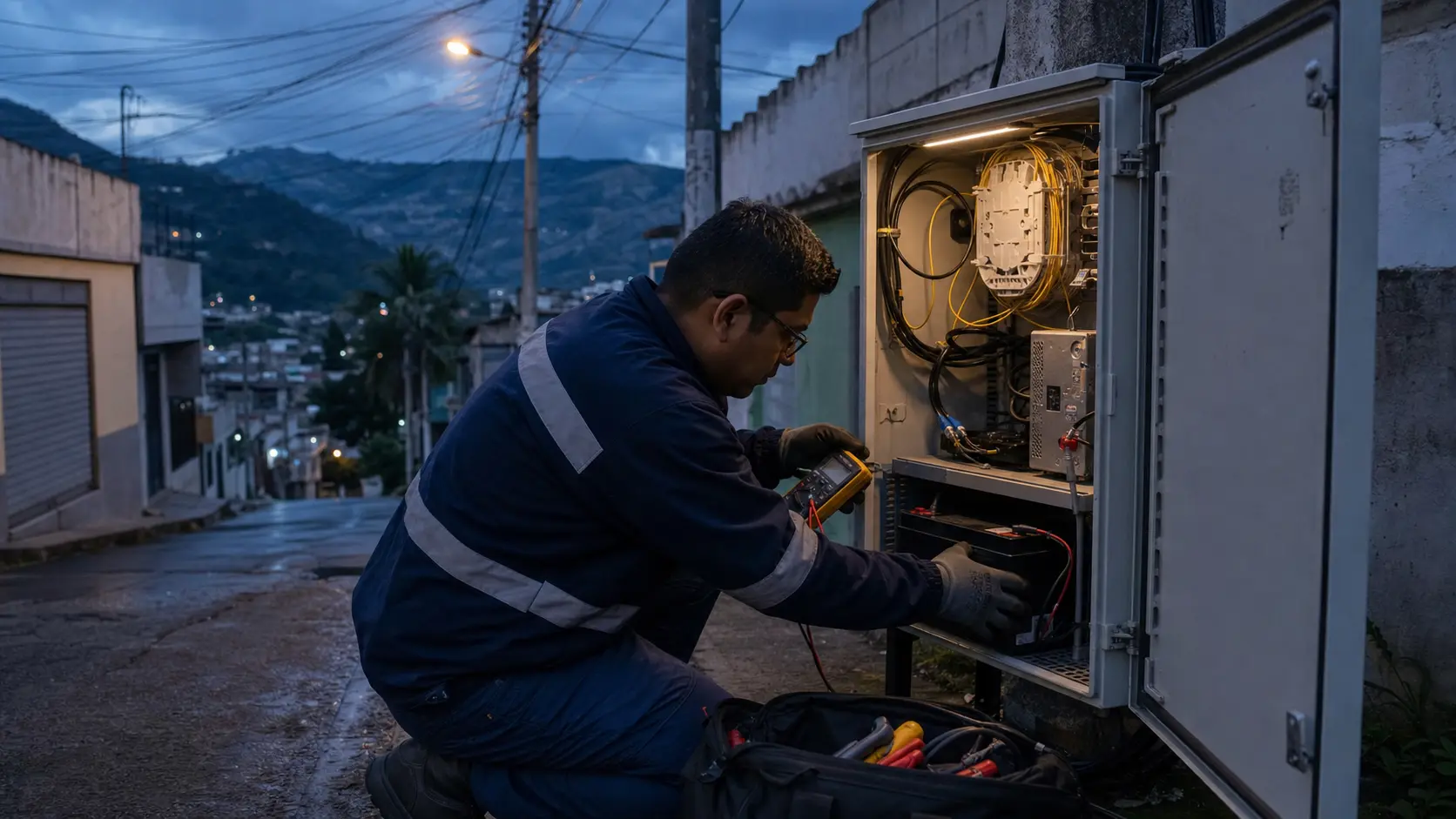
At blue hour, a technician is crouched beside an open weatherproof fibre cabinet while the surrounding block remains dark. A compact replacement battery sits on the pavement. A test meter is clipped across the terminals. Inside the cabinet, a rectifier, optical equipment and cooling vents turn a household promise measured in megabits per second into a more basic question measured in minutes: will the access node stay alive until the utility supply returns, or until a crew can install charged storage?
That is a reconstruction of the operational test TELECOMNET’s public material leaves unanswered, not a claim that this exact intervention occurred at a particular company site. It matters because fixed fibre is not electrically passive from end to end. A passive splitter may need no local power, but the optical line terminal, aggregation switch, wireless relay if one is used, upstream handoff and customer equipment all do. A customer can put an optical network terminal and Wi-Fi router on a small uninterruptible power supply and still lose service if a powered node farther upstream exhausts its reserve.
Conversely, a provider can keep its network live while the customer’s dark home has no way to energise the terminal.
El Oro has supplied recent reminders that these layers can be tested at the same time. In June 2026, Ecuador’s public transmission company reported maintenance at the Machala and La Avanzada substations and on the 230 kV Machala-La Avanzada line as part of work intended to reduce future failure risk (CELEC EP). That was planned maintenance, not a recurrence of the nationwide rationing crisis. Yet planned work and unplanned failure expose the same engineering boundary: every active telecom site must bridge the loss of mains power or disappear from the service path.
During Ecuador’s much longer 2024 cuts, an industry representative told El Universo that some telecom battery banks or generators could provide roughly three hours, while planned outages were expected to last eight hours, and that depleted reserves could need 24 to 48 hours to recharge fully (El Universo). Those figures described the sector broadly, not TELECOMNET. They therefore cannot be assigned to any cabinet in Piñas or Portovelo. They do show why “backup power” is an incomplete answer. Runtime under actual load, state of charge before the cut, temperature, battery age, repeated discharge, generator access and recharge time all determine whether the second outage is worse than the first.
A 2025 comparison of Portuguese mobile networks found that deeper battery reserves delayed service loss and that restoration followed grid re-energisation (GSMA). It is not evidence about TELECOMNET’s equipment, but it shows why resilience is established by the timed behaviour of powered dependencies, not by the fastest plan.
TELECOMNET’s case is therefore stronger and narrower than a claim that its network is fragile. Current evidence shows a live commercial offer and a live routed edge. No public evidence shows that a street POP failed, or that the company missed its availability objective. The defensible finding is that its public 99% statement cannot be independently connected to a disclosed power design. The missing bridge is the asset-level record: cabinet load, usable battery energy, tested autonomy, generator coverage, handoff power and the crew plan for the hour when blue light gives way to full darkness.
A current six-town offer, not merely an old company name
The operating-status question can be answered more firmly than the power question. TELECOMNET’s current home page markets fibre-optic internet with Wi-Fi 6, installation included and round-the-clock support. It names Piñas, Portovelo, Zaruma, Paccha, Marcabelí and Balsas as service locations and carries a 2026 copyright notice. Its plans page lists six residential products at 350, 500, 600, 700, 750 and 800 Mbps. Its contact page gives an office at Calle 9 de Octubre and García Moreno in Piñas and again describes technical support as available 24 hours a day, seven days a week. Its company page describes a fibre network serving homes and businesses. These are operator statements, but they are current operator statements with enough specificity to establish a live sales presence.
The network identity is also current. LACNIC’s autonomous-system registration assigns AS272939 to TELECOMNET S.A. and records its registration in January 2023. The associated organisation record names TELECOMNET S.A., places it on 9 de Octubre in Piñas and shows that the organisation entry was changed in September 2024. Route collectors were seeing the system in July 2026. A functioning site, a current commercial catalogue and current route propagation are independent signs of operation; together they are substantially better evidence than a dormant corporate listing.
The legal company predates the ASN. A 2015 incorporation instrument records the constitution of TELECOMNET S.A. in Piñas and includes telecommunications in its stated purpose. A 2016 company-information update gives RUC 0791779340001, company file 703178 and the same Piñas street intersection. Those documents establish legal continuity, not present ownership of particular network assets.
A commercial registry aggregator lists the company as active and reports open branches in Portovelo, Alamor, Marcabelí, Balsas and Zaruma, with a closed location in Celica (EcuadorNegocios). That is a useful secondary signal, especially where it overlaps the operator’s six-town list, but it remains secondary. A branch address can be a shop, billing point, warehouse or legal establishment. It must not be relabelled as a powered POP, tower, splice point or route node without asset evidence.
Those distinctions define the company correctly. TELECOMNET S.A. is the Ecuadorian legal person. The same name is attached to AS272939 and to the current retail offer. That supports describing it as the operator of the routed edge and seller of the service. It does not follow that the company owns every pole, duct, tower, fibre strand, upstream circuit, building or power system used to deliver the service. Some infrastructure may be owned, some leased, and some supplied by other regulated utilities or carriers. Public material does not divide those categories.
The result is a positive but bounded operating finding. TELECOMNET is not a ghost inferred from an old registration. It is selling service, answering from a current domain and originating routes. What remains thin is the engineering disclosure beneath that activity. The public can locate the company and choose a speed tier. It cannot yet trace the operating asset, identify the powered points in each town, determine who owns the supporting structure, or see how a failed component is isolated and restored.
Six advertised speeds disclose sold units, not aggregate headroom
TELECOMNET’s retail catalogue is unusually concrete about the unit a household buys. The six plans range from 350 Mbps at $17.39 per month plus VAT to 800 Mbps at $43.48, with intermediate 500, 600, 700 and 750 Mbps offers (TELECOMNET plans). The page says installation is free and a dual-band Wi-Fi 6 router is included. Those facts describe the commercial edge of the network on the date observed. They do not disclose the capacity of any shared optical segment, town aggregation link or international transit circuit.
The operator’s regulatory-information page adds three important qualifications. First, it says residential plans operate with a sharing ratio “up to 1:1.” Second, it states a minimum service availability of 99% and separately says channel availability is guaranteed at 99% monthly. Third, it says effective bandwidth is measured between the customer terminal and a server inside TELECOMNET’s network. The page also says a monthly comparison of effective capacity used against contracted international capacity is available on request by email rather than publishing the figures directly.
Each statement needs its own boundary. “Up to 1:1” is the operator’s wording; it is not enough to conclude that every subscriber has a physically dedicated 350-800 Mbps path through every shared layer. A speed measured to an internal server tests the access and part of the provider network, but not necessarily the congested path to a remote cloud, video platform or international destination. A monthly availability percentage does not reveal whether outages are evenly distributed, concentrated in one town, excluded as force majeure or measured at the customer terminal, the access node or a central platform.
The requested international-capacity ratio may be informative, but evidence that is available only on request is not a publicly inspectable time series.
As bare arithmetic, 99% over a 30-day month permits 7 hours and 12 minutes outside the available state. That is not an allegation that TELECOMNET uses the full allowance, and contractual exclusions could change the calculation. It shows why a percentage alone does not answer the power question. One seven-hour interruption could fit inside the arithmetic while being devastating to a shop, remote worker or school. Seven separate one-hour failures could produce a different operational burden even if the percentage were identical.
Availability also says nothing about degraded performance: a path can remain technically reachable while congestion, packet loss or an exhausted Wi-Fi environment makes it difficult to use.
Installed, lit, powered, operational and usable capacity are different states. A fibre strand can be installed but unlit. An optical port can be lit but dependent on a cabinet whose battery has failed. An aggregation link can be operational but oversubscribed at the busy hour. An upstream circuit can have ample contracted bandwidth while the local feeder is cut. A plan can be sold but not simultaneously deliverable to every subscriber at its headline rate. None of those possibilities should be presumed to apply to TELECOMNET; they are the categories needed to interpret what its price sheet does and does not prove.
The missing capacity disclosure is therefore not a single grand total. A useful account would identify, at a safe level of aggregation, the number of active access segments by town, the line rate and utilisation of their uplinks, the split policy, the aggregate handoff capacity, busy-hour utilisation, reserved headroom, packet loss and latency beyond the internal test server. It would distinguish design capacity from equipment installed, ports lit, capacity actually powered during an outage and bandwidth usable after a major route or power failure.
Until those numbers are public, the 350-800 Mbps range is best treated as evidence of what TELECOMNET sells. It is not evidence that 800 Mbps is continuously available to every address, that six towns share no bottleneck, or that enough spare capacity remains when one link fails. The operator’s own decision to make the international-capacity ratio available on request suggests that the measurement exists. Publishing a dated, town-level or network-wide series would let customers connect the commercial promise to the shared infrastructure that supports it.
Four routed prefixes end at one visible neighbouring network
The routed edge is the most measurable part of TELECOMNET’s infrastructure. LACNIC allocated the company an IPv6 block, 2803:b190::/32, in January 2023. The IPv4 side has a different ownership boundary: RIPE’s 171.22.166.0/23 record describes 512 addresses as ASSIGNED PA, identifies TELECOMNET as the organisation, and also shows a separate maintainer for the covering address space. In practical terms, the /23 is assigned for TELECOMNET’s use, but the public record does not support calling the parent block company-owned.
On 16 July 2026, RIPEstat’s AS overview reported AS272939 as announced. Its announced-prefix view showed four origin announcements: the IPv4 aggregate 171.22.166.0/23, its two component /24s, and 2803:b190::/32. The routing-status view counted 512 announced IPv4 addresses, one IPv6 /32 and one observed neighbouring autonomous system; it also showed broad visibility among the route collectors available at that time.
The separate neighbour view identified AS52468, Ufinet Latam, as that single observed neighbour. The BGP-state data placed AS52468 immediately before AS272939 in collected paths once repeated origin prepending is set aside. Route-origin authorisation was valid for both the IPv4 /23 and the IPv6 /32 in the checks used here. These are meaningful operational positives: the network is globally visible, its origin is stable enough to be widely collected, and the two principal aggregates have valid RPKI outcomes.
They still do not reveal throughput. Address count is not bandwidth. Route-collector visibility is not subscriber count. A valid route-origin authorisation reduces one class of routing error; it does not stop a fibre cut, cabinet blackout or congested uplink. Most importantly, one visible neighbouring AS is a logical observation, not a fibre diagram. TELECOMNET might buy two physically diverse circuits from Ufinet that present the same AS relationship. It might have a private or conditional backup not visible to the collectors queried. It might instead have one handoff and one route.
Public BGP data cannot choose among those physical possibilities.
Ufinet’s current PeeringDB record describes AS52468 as a regional network service provider with a self-reported traffic level of 5-10 Tbps, and lists exchange and facility presence across Latin America, including Ecuador. That scale belongs to Ufinet’s regional network, not to TELECOMNET’s purchased capacity. Ufinet’s published network map marks Ecuadorian locations including Machala, Santa Rosa, Balsas, Guayaquil and Quito. It does not plot a TELECOMNET circuit, an exact Piñas handoff or an independently routed second path.
The routing evidence supports a precise sentence: AS272939 was reaching the wider internet through one publicly observed neighbouring network in the July 2026 view. It does not support “TELECOMNET has only one cable,” “TELECOMNET has no redundancy,” or “TELECOMNET has 5-10 Tbps.” The test that would settle the issue is physical and contractual: the number of active handoffs, their committed and burst capacity, the facilities or towns in which they terminate, whether they traverse independent ducts or poles, whether separate power domains feed them, and what route becomes active when the preferred path is withdrawn.
A service-area list is not a fibre-route map
The six names on TELECOMNET’s site form a service-area claim, not a network drawing. Piñas, Portovelo, Zaruma, Paccha, Marcabelí and Balsas are real places in the upper and south-eastern part of El Oro, but a town label can mean many things: universal urban coverage, selected neighbourhoods, buildings passed, radio reach, an office that takes orders, or simply a market in which installation is offered after a feasibility check. The home page does not publish street polygons, premises passed, feeder routes, tower coordinates or a distinction between fibre-to-the-home and any fixed-wireless extensions.
The physical geography makes that omission consequential. El Oro’s provincial development plan identifies road circuits linking Machala, Santa Rosa, Piñas, Portovelo, Zaruma and Atahualpa, and another connecting Marcabelí, Balsas and Piñas. It also records substantial road exposure to mass movements in the mountainous part of the province, with particularly high-risk lengths in Zaruma and Piñas (Prefectura de El Oro PDOT). Roads do not prove fibre routes, but they define the corridors crews may need to use and the terrain in which poles, ducts or aerial spans may be repaired.
The national mapping authority’s El Oro thematic-map collection supplies a cartographic base at provincial scale. It can locate cantons and major terrain. It cannot identify TELECOMNET plant. Similarly, the secondary branch list and the operator’s Piñas contact location can anchor offices, but no office should be turned into a POP on a map without evidence of active network equipment there.
There are several plausible architectures. A core in Piñas could feed neighbouring towns in a chain. Multiple town POPs could connect in a ring. Balsas and Marcabelí could use a different approach from Portovelo and Zaruma. Some access could share poles with electricity distribution, while another segment uses buried ducts or a leased wholesale path. Paccha, the cantonal seat of Atahualpa, could be reached from Piñas, Portovelo, Zaruma or another direction. Every one of those sentences is a hypothesis, not a finding.
The difference matters during a cut. A ring can reroute traffic only if the two arcs are physically independent and the surviving nodes remain powered. Two fibres on the same pole line are vulnerable to the same falling tree, vehicle impact or landslide. Two upstream circuits entering the same cabinet through the same duct can fail together. A wireless backup can avoid a severed cable but still depend on the same grid supply, tower access road or aggregation site. “Redundant” is therefore not a count of links; it is a claim about separated failure domains.
A responsible public map need not reveal cabinet coordinates that would create a security risk. It could show town-level POPs, approximate inter-town corridors, route A and route B as separately surveyed paths, the ownership class of the supporting infrastructure, and the direction of upstream handoffs. It could mark whether a segment is aerial, buried, leased or radio-based, and whether each town can reach the upstream network after either adjacent inter-town link is removed. That level of disclosure would let a customer understand resilience without exposing a splice enclosure.
At present, the evidence establishes a six-town commercial footprint and a Piñas corporate base. It does not establish route length, homes passed, fibre ownership, ring closure, tower use, pole independence or the location of active facilities. Any map that draws exact TELECOMNET lines from the public town list would be illustration masquerading as evidence.
El Oro’s power record turns autonomy into a local specification
The power risk is not theoretical and it is not confined to the 2024 national emergency. The most recent public example is preventative: CELEC’s June 2026 work on the Machala-La Avanzada transmission system showed that the infrastructure feeding El Oro still requires planned intervention. Earlier, CNEL said it had installed voltage-regulation equipment in Piñas, Zaruma, Portovelo and Atahualpa to improve service quality in the province’s upper cantons (CNEL EP). Investment in the grid can reduce risk; it does not eliminate the need for telecom autonomy at the load.
The 2024 rationing period provides a harsher stress test. A CNEL schedule reported by El Universo covered all of Piñas and its parishes, the industrial and mining sector of Portovelo, and much of Zaruma during a September interruption (El Universo schedule). A later El Oro schedule reported by Machala Móvil placed Piñas, Marcabelí and Balsas in two four-hour windows and Atahualpa, Zaruma and parts of Portovelo in another pair of four-hour windows on the same day (Machala Móvil). The schedules are historical, and they do not prove a TELECOMNET outage. They show that a network spanning all six advertised towns could face long, geographically broad utility interruptions rather than an isolated transformer failure.
The national crisis ended as a rationing programme in December 2024. The government announced that normal residential service would resume after three months of daily cuts, some as long as 14 hours (Associated Press). It would be wrong to write as though those nationwide cuts are continuing in July 2026. It would be equally wrong to treat them as irrelevant. Battery age, generator procurement, operating procedures and customer expectations are all shaped by a recent event in which the duration of grid loss exceeded ordinary short-backup assumptions.
Weather creates a second path to the same failure. A March 2025 situation report on heavy rain in Piñas described road clearing and CNEL work to restore electricity (National Secretariat for Risk Management). A storm can remove power, damage an access route and increase telecom faults at once. The battery may provide the time needed for a crew to arrive, but a blocked road turns nominal autonomy into a logistics race. If several cabinets discharge together, the operator needs charged spares, safe transport, enough technicians and a priority order.
Ecuador’s National Assembly recorded that power cuts had caused mobile and internet failures affecting thousands of users, and heard evidence about data centres, transport networks and antennas as distinct service components (National Assembly). ARCOTEL’s contingency-plan rules require access providers and other telecom operators to submit annual plans intended to preserve service during disasters or internal disturbance, with training and exercises among the stated obligations. The existence of a regulatory duty does not reveal TELECOMNET’s confidential plan or prove that any particular autonomy target has been met.
This is why the local specification should be expressed as a matrix, not a slogan. For each town and site class: normal DC load; usable battery energy at end of life; tested runtime at local temperature; generator connection; generator or mobile-set travel time; fuel endurance; recharge time; remote alarms; and the time within which a technician can safely reach the site. The matrix should also identify the upstream handoff’s power reserve. A four-hour cabinet battery is of limited value if the aggregation node fails after 90 minutes; a central generator is of limited value if the street POP cannot be reached before its battery disconnects.
No such figures were found in TELECOMNET’s public pages. That absence is not proof of absence in the network. It is the reason the company’s 99% claim remains operationally opaque precisely where El Oro’s power history makes transparency most useful.
Heat, ageing and recharge can defeat a battery before its nameplate does
Battery autonomy is often presented as rated capacity divided by load. A field network is less forgiving. Capacity falls with age, discharge rate, temperature, low-voltage cut-off and imperfect charging. Fans, heaters or cooling systems add load. A cabinet exposed to sun can be hotter inside than the ambient air. A battery that delivered three hours when new may not do so after repeated deep discharges. A reserve that survives the first outage may begin the next one partly charged.
The latest ITU recommendation on telecom battery monitoring describes grid-connected site standby ranges from roughly ten minutes to 48 hours as a broad industry span and emphasises integrated monitoring and control (ITU-T L.1397). That span is not a recommended TELECOMNET value; it demonstrates how little the word “battery” says without a site class and test condition. The recommendation’s focus on state, alarms and control is directly relevant to a dispersed operator: a network operations centre needs to know which battery is discharging, how quickly voltage is falling and whether a replacement intervention is likely to arrive in time.
An ETSI report on energy use in telecom infrastructure describes valve-regulated lead-acid batteries in outdoor cabinets, thermal isolation intended to keep them near 25°C, temperature-corrected float charging and end-of-discharge disconnection (ETSI TR 102 530). It does not tell us that TELECOMNET uses lead-acid storage. Lithium systems, lead-acid systems and other technologies have different space, thermal, safety and lifecycle profiles. The relevant inference is technology-neutral: cabinet temperature and charging behaviour affect whether nameplate energy becomes usable runtime.
A GSMA case study describes how an operator used site DC consumption and grid-cut statistics to dimension backup time and battery count, and monitored battery status before deciding when to start generators (GSMA Turkcell power management). Again, that is not a TELECOMNET design. It illustrates the measurements required to make an autonomy claim auditable: site load, outage history, battery voltage, discharge status and generator response. The 2024 Ecuador reporting adds the operational consequence of repeated cuts: industry representatives warned that backup reserves could require a day or two to recharge completely.
TELECOMNET publishes none of the variables needed to estimate its street-POP runtime. There is no public battery chemistry, nominal amp-hour figure, DC load, end-of-life derating factor, test interval, replacement age, cabinet-temperature range, fan condition, low-voltage threshold or state-of-health alarm policy. There is also no public distinction between a central office, town POP, roadside cabinet, tower, repeater and customer-powered device. Those site types may have radically different reserves.
The company need not release security-sensitive details to improve confidence. It could publish distributions: the percentage of active access sites tested in the last quarter; median and minimum autonomy by site class; the share with remote state-of-health telemetry; maximum recorded cabinet temperature; the percentage of batteries beyond replacement policy; generator-connectable sites; and recovery from a defined four-hour and eight-hour outage. A dated statement that “all critical town POPs sustain X hours at end-of-life load” would be much stronger than an undated claim that backup exists.
Until that evidence appears, the correct status is unknown. It is not safe to infer zero autonomy from silence, and it is not safe to infer adequate autonomy from 24/7 support or 99% availability. The most revealing resilience event may not be the first utility interruption. It may be the second cut after a hot cabinet’s partially recharged, ageing battery has already surrendered a large portion of its usable energy.
A powered upstream network does not keep an unpowered neighbourhood online
TELECOMNET’s visible upstream, Ufinet, has substantial regional infrastructure. Its Guayaquil Digital City data-centre page describes multiple fibre entrances, modular UPS, generators, cooling redundancy and protected rack power. Ufinet’s map also shows a broad Ecuadorian footprint. Those facts help explain how a regional carrier can support many downstream networks. They do not identify TELECOMNET’s handoff facility, show that its traffic passes through Digital City, or transfer the data centre’s power resilience to every local access node in El Oro.
The service path should be read from the customer outward. First is the optical network terminal or other customer-premises equipment, usually powered by the customer. Next may be a passive splitter, then a fibre feeder to an optical line terminal or active Ethernet switch. The town POP aggregates traffic onto an inter-town link. One or more aggregation nodes lead to a carrier handoff, where TELECOMNET exchanges routes and traffic with the upstream. Beyond that point, Ufinet and other networks carry packets toward their destinations. A failure at any active stage can end the session even if every other stage remains healthy.
This produces four separate power questions. Can the customer energise the terminal? Can the street or town access equipment remain powered? Can TELECOMNET’s aggregation and edge router remain powered? Can the carrier handoff and upstream path remain powered? The answer can differ at every layer. A home generator does not rescue a dead OLT. A perfectly backed-up OLT does not rescue a dark upstream edge. A data centre with 2N systems does not rescue an unpowered roadside cabinet. End-to-end availability is constrained by the weakest powered dependency actually traversed.
The single visible AS52468 relationship sharpens the question but does not answer it. Ufinet could deliver two independent physical circuits into different TELECOMNET sites while appearing as one BGP neighbour. Alternatively, two nominal links could share the same La Avanzada-area transmission exposure, bridge, duct, pole corridor or powered aggregation room. True diversity requires separation in route, support structure, equipment, facility and power domain. The public Ufinet map is too coarse to test those conditions, and Ufinet’s interconnection inventory lists its own facilities rather than TELECOMNET’s circuit endpoints.
The capacity boundary is equally important. Ufinet’s regional traffic level is not TELECOMNET’s committed information rate. The number of TELECOMNET links, port sizes, contracted capacity and burst terms are undisclosed. A 10 Gbps physical port could carry a smaller commitment; a smaller port could be lightly used; two ports could be configured as active/standby rather than load-sharing. Without utilisation and contract data, the most that route evidence says is that AS52468 was the immediate publicly visible network toward the wider internet.
A good resilience disclosure would pair logical and physical information. It would say that AS272939 has, for example, two active upstream handoffs without revealing exact rack positions; identify whether they are in separate towns or facilities; state whether carrier and route diversity are independent; publish the power autonomy of the edge sites; and report the result of withdrawing each handoff under load. If both handoffs are from Ufinet, the company should explain which failure modes remain common. If another backup exists but is normally hidden from route collectors, a dated failover test could demonstrate it.
The current evidence permits neither reassurance nor condemnation. TELECOMNET’s routes were broadly visible in July 2026 and RPKI-valid, which is a real strength. The physical and powered implementation beneath those routes remains undisclosed, which is a real uncertainty. The network can only keep a dark neighbourhood online if the complete path from customer power to local access to upstream exchange survives at the same time.
Twenty-four-hour support is a contact promise, not a repair-time measurement
When a cabinet battery nears disconnect, resilience becomes a labour problem. Someone must recognise the alarm, decide whether the outage will outlast the remaining reserve, select the right battery or generator, load a vehicle, reach the site, obtain safe access, isolate the equipment and restore power without damaging optical service. If a storm has also cut a feeder, the crew may need fibre, closures, connectors, test gear and permission to work on a pole or roadside structure. A phone line answered at 02:00 is valuable, but it is not the same as a technician arriving before the reserve is exhausted.
TELECOMNET’s public contact material says support is available 24/7. It does not state acknowledgement time, dispatch time, arrival time, repair target, number of simultaneous crews or whether each advertised town holds spares. That omission is especially important in a six-town footprint. Piñas can be an efficient base for nearby work, but the provincial development plan’s road and landslide evidence shows why travel time cannot be assumed from straight-line distance. A single blocked corridor can affect both the cable and the crew sent to repair it.
The March 2025 Piñas rain report is a concrete example of compounded recovery conditions: public works teams cleared roads while the electricity distributor worked on service restoration. It says nothing about TELECOMNET’s performance. It demonstrates that local power, transport and communications can share the same weather event. A network plan that budgets only component repair time but not access delay is incomplete. So is a plan that holds all charged batteries or fibre closures in one depot exposed to the same road failure as the damaged site.
Local labour also determines how redundancy performs. A ring does not remove the need to repair its failed arc; it buys time before the network is exposed to a second fault. A generator does not remove the need for refuelling, oil checks and safe exhaust. Batteries do not remove the need for periodic load testing and replacement. A wireless backup does not remove the need for alignment, tower access and power at both ends. Spare parts count only when they are compatible, charged, inventoried and reachable.
There is evidence that TELECOMNET has supplied institutional links, though it is historical rather than current. The Balsas-Marcabelí-Piñas education district reported that four rural educational-institution links used 20 Mbps fibre service from TELECOMNET in 2021 (Ministry of Education district report). The record does not establish that those contracts continue in 2026, identify the schools or reveal the routes. It does show the kind of customer for whom a field-repair delay may interrupt administration and classroom access rather than only entertainment.
For a regional provider, a practical repair disclosure could be concise. Publish the staffed and on-call coverage model; median and 95th-percentile acknowledgement, dispatch and restoration times; town-level spare categories; the number of portable power units; the longest planned travel time under normal and disrupted roads; and the escalation rule for simultaneous failures. Report performance separately for access cuts, upstream loss, mains failure and customer-premises faults. Those categories require different people and equipment, and a single average masks the constraint.
A well-designed remote power system can reduce unnecessary dispatches. The GSMA power-management example shows the value of observing load and battery condition before starting a generator or sending staff. But remote alarms cannot replace people when energy is physically depleted. TELECOMNET’s resilience ultimately depends on whether its local labour system can convert telemetry into safe intervention faster than the weakest battery runs down.
Homes, shops and schools experience different versions of the same outage
The six-town footprint should not be mistaken for a subscriber count. TELECOMNET does not publish active-account totals by town, premises passed, business-versus-residential mix or the number of customers behind each access node. Route-collector address counts cannot fill that gap: 512 announced IPv4 addresses can support carrier-grade address sharing, infrastructure interfaces, public business assignments or other arrangements, while an IPv6 /32 is an allocation scale rather than a count of connected households.
Still, the affected groups can be described without inventing totals. Residential customers need the connection for messaging, education, entertainment and increasingly work. Small shops may depend on card authorisation, bank transfers, cloud point-of-sale systems, orders and security cameras. Professional offices may need government portals, tax systems and remote applications. Schools and public institutions may have modest headline bandwidth but high sensitivity to a full loss during operating hours.
The 2021 education record proves at least one historical institutional use case in the Balsas-Marcabelí-Piñas district; it does not justify claiming every school is a TELECOMNET customer.
The failure looks different at each premises. A household without backup power may report “internet down” even while TELECOMNET’s network is fully operational. A shop with a generator may keep its router alive and then discover that the neighbourhood access node has failed. A school may retain access but experience congestion as users shift traffic or as the provider reroutes onto a smaller backup. A business with a second mobile connection may still fail if the same utility interruption depletes nearby mobile-site batteries.
The National Assembly’s 2024 hearings underline that electricity loss affected multiple telecom components and thousands of users, not one uniform network layer.
Geography can also distribute pain unevenly. A network-wide 99% figure could coexist with materially lower availability in one town if stronger performance elsewhere lifts the average. A short interruption in Piñas and a long one in Paccha are not interchangeable to the people affected. The same is true of repair priority. Restoring the largest customer cluster first may minimise aggregate downtime, while restoring a school, health point or public-safety dependency first may minimise social harm. Public reporting should make the chosen method visible.
Customers also bear some resilience cost themselves. Keeping the optical terminal and router alive requires a battery or generator at the premises, and the required energy depends on device load and outage length. That customer-side responsibility should be stated clearly in service guidance. It should not be used to obscure provider-side failures. A diagnostic process ought to distinguish loss of premises power, Wi-Fi-only failure, optical signal loss, access-node outage, upstream withdrawal and congestion. Each diagnosis assigns a different remedy and a different owner.
The economic bargain behind a low monthly price is therefore broader than Mbps per dollar. It includes the probability and duration of loss, the cost of a customer UPS, the availability of human support, the chance that a field crew can reach the fault, and the consequence of being offline. A household may rationally accept occasional downtime for a lower bill. A clinic, school, mine office or payment-dependent shop may require a second connection and documented route independence. The correct choice depends on evidence about the failure path, not on the plan name.
TELECOMNET’s public offer gives customers enough information to compare speed and price. It does not yet let them compare outage exposure by town or choose a resilience tier. Publishing town-level availability, outage causes and restoration distributions would turn the 99% claim from a single headline into information that different customers can actually use.
The evidence needed to make 99% operationally credible
TELECOMNET has a stronger factual base than many small providers with little more than a social-media page. It has a current six-town website, a Piñas office, a legal history, a live autonomous system, current IPv4 and IPv6 announcements, valid route-origin outcomes and a clearly visible upstream relationship. It also states the measurement boundary for effective bandwidth and acknowledges that international capacity is a tracked quantity. Those are useful foundations.
The unresolved issue is not whether the company exists. It is whether the public commercial promise can be followed through the physical failure chain. The answer requires five compact disclosures.
First, an operating-footprint statement should distinguish towns marketed, neighbourhoods serviceable, premises passed, active access segments and the mix of owned and leased plant. It should identify fibre, fixed-wireless or other access by town without publishing sensitive exact coordinates.
Second, a route-and-facility statement should show approximate inter-town topology, whether a ring is closed, which paths share poles or ducts, how many upstream handoffs are active, and which route, facility and carrier failures are independent. One visible BGP neighbour can be fully compatible with physical diversity, but only a physical account can prove it.
Third, a capacity statement should separate plan speed from shared capacity. It should publish aggregate handoff commitments, busy-hour utilisation, access-uplink headroom, packet loss and latency to both an internal server and representative external destinations. The international-capacity ratio that TELECOMNET says is available on request would be more useful as a dated public series.
Fourth, a power statement should report site classes, tested end-of-life autonomy, generator reach, portable-unit deployment time, recharge assumptions, battery chemistry, replacement policy, cabinet-temperature monitoring and upstream-handoff power. The most important number is not the best site’s runtime. It is the minimum credible runtime among the active components needed to keep each town connected.
Fifth, a recovery statement should publish acknowledgement, dispatch and restoration distributions, simultaneous-incident capacity, town-level spare coverage and post-incident findings. ARCOTEL’s contingency framework already treats planning, training and exercises as part of continuity. A public summary of test outcomes could improve confidence without exposing the full regulatory plan.
Customers can ask for the same evidence now. A business buyer should request a route-diversity drawing, identify every shared power or structure risk, ask for recent failover-test results, obtain historical availability and packet-loss data, and require restoration targets by failure type. It should test its own premises backup separately. If a second provider is purchased, the buyer should verify that it does not ride the same pole line, upstream handoff or local power domain.
The current network evidence grade is medium. Current operation, service towns and logical routing are well supported. Physical plant, aggregate capacity, route independence, power autonomy and recovery performance are not publicly demonstrated. That is a statement about evidence, not a finding of deficient engineering.
The blue-hour battery swap is the right closing image because it compresses the whole service into one accountable moment. The 800 Mbps plan, the 99% promise, the valid route and the regional upstream all matter. But when the block is dark, the customer remains online only if the smallest powered site in the actual path has enough usable energy and if a local technician can reach it before that energy is gone. TELECOMNET can make its availability claim persuasive by publishing that clock.