
Summary
- What it says: In Comoros, TELCO S.A is not just selling data. The company now trading as Yas Comoros is trying to turn a thin island market, expensive backhaul, prepaid behaviour, tower maintenance and new fibre ambitions into a recurring national utility business.
- Main topic: Regional ISP economics; Peering and transit; Data centre power and permitting; Telecom spectrum and security
- Context: market / company research report / Comoros
The tariff starts at the shoreline
A 10 Mbps home-fibre plan in Comoros is not a simple consumer offer. Yas Comoros lists Dagonet Fibre at 19,000 KMF per month with 200 GB of volume, a post-fair-use speed of 2 Mbps and 30-day validity; the same public page lists a 25 Mbps plan at 29,500 KMF with 500 GB and a 40 Mbps plan at 75,000 KMF with 1 TB. It also says installation takes 7 to 15 days and home intervention takes one to two working days (https://www.yas.km/dagonet/). Those details are the best opening to TELCO S.A's economics because they put a price on a national problem: how do you sell broadband in a three-island country where every additional gigabyte begins as imported equipment, tower power, scarce field labour and wholesale capacity that has to land somewhere on a coast?
The same retail logic appears at the low end. Yas's consumer FAQ says Maxi Rahisi mixed voice, SMS and data bundles range from 250 FC to 15,000 FC, while Forfait Net is built for subscribers who want internet-only use, including routers and Wi-Fi boxes (https://www.yas.km/consumer-faqs/). A subscriber can live in the prepaid world of small daily bundles, graduate to router-based mobile broadband, or commit to a fixed-fibre monthly bill. That ladder is not just packaging. It is the operator's way of sorting a small population by willingness to pay, reliability needs, device ownership and address-level availability.
That is why TELCO S.A should be read less as a brand entry and more as an island-capacity business. The company has to monetise a national map that is small in population but expensive in topology. Grande Comore, Anjouan and Moheli are close enough to be one retail market, yet far enough apart to make every backbone decision consequential. If a cable route, microwave hop, power supply or support crew fails in the wrong place, the commercial effect is not local inconvenience; it is lost utility value for customers whose telecom choice may already be narrowed to two mobile operators and a handful of partial fixed substitutes.
The company behind the offer is findable. Its January 2025 service terms identify TELCO S.A, capitalised at 4,000,000,000 Comorian francs, registered at RCCM Moroni under KM-HAH-01-2015-B14-07025, and governing offers and services supplied to subscribers (https://www.yas.km/wp-content/uploads/2025/12/CGV-Internet-FTTx-TELCO-S.A.pdf). PeeringDB lists the network as TELCO S.A, also known as TELMA COMORES, with the long name TELECOM COMORES S.A and ASN 328061 (https://www.peeringdb.com/net/34740). The current public brand is Yas Comoros, after AXIAN Telecom unified its mobile brands in Madagascar, Comoros, Senegal, Togo and Tanzania under Yas in 2024 (https://www.axian-telecom.com/2024/11/26/axian-telecom-launches-unified-pan-african-brands-for-its-mobile-network-operators-and-fintech-operations/).
The awkward naming matters. "Telecom Comores S.A" can be mistaken at a glance for the state incumbent Comores Telecom, which now markets mobile services under Huri. The subject here is the private second operator historically known as Telma Comores and now branded Yas Comoros. That distinction is more than legal hygiene. In Comoros, the economic story since 2015 has been the effort to end a monopoly without pretending that a second operator can erase geography, cable dependence or state-owned infrastructure politics in one move.
The second licence was a price intervention
The strongest public history begins with the licence. The World Bank says Telma Comores, a subsidiary of Telecom Malagasy S.A., won the second Comoros telecom licence in October 2015 at a cost of USD 16 million, launched operations in 2016, and within a year had gained a quarter of the telecom market (https://www.worldbank.org/en/about/partners/brief/comoros-transforming-telecommunications-in-union-of-the-comoros). IFC later described Telco SA as the second mobile network operator in Comoros, providing nationwide wireless services over 2G, 3G and 4G under a global and unified licence (https://www.ifc.org/en/pressroom/2019/ifc-s-first-investment-in-comoros-helps-transform-telecom-sector).
The economic significance of that licence is not that it created another logo. It created a second retail price maker in a market where monopoly pricing had survived the arrival of submarine capacity. World Bank completion reporting for the regional communications project says wholesale prices fell from USD 5,500 per Mbit to USD 2,750 when Comores Cables was created, and from USD 2,500 to USD 18.7 the year Telco entered the Comoros market (https://documents1.worldbank.org/curated/en/099191503242311967/pdf/BOSIB096cafe3e0c0084f70822a76892f1a.pdf). The same report says the cost of a 2 GB mobile data package fell from 30.7 percent to 7.9 percent of GNI per capita between 2014 and 2021.
Those numbers explain why a small operator can matter even when it is not yet a broad fixed-line incumbent. A lower retail data price changes how households allocate cash. It lets a student use a mobile phone as the primary internet device, lets a shop use messaging and mobile payments, lets diaspora relatives top up a local number, and pushes the incumbent to respond with better networks. The World Bank says Telma's launch expanded services, brought high-quality 4G LTE mobile broadband at lower prices, and pushed Comores Telecom to launch a faster 4.5G network; by 2018, mobile broadband subscriptions had risen to 58 per 100 inhabitants (https://www.worldbank.org/en/about/partners/brief/comoros-transforming-telecommunications-in-union-of-the-comoros).
The result was still a mobile-first market. The World Bank completion report says CT and Telco reported 535,128 mobile internet subscribers in 2022, reflecting 2G, 3G and 4G subscriptions, and only 1,468 fixed broadband subscribers. That is the key substitution fact. In Comoros, the mass internet product is not a fibre line to every home. It is a SIM, a prepaid bundle, a router, a handset-financing offer, and only then, for a narrower base, home or business fibre. The Dagonet tariff is therefore not the core of the whole market. It is the high-commitment edge of a much larger mobile-data business.
Geography is the balance sheet
The Comoros telecom market is small enough that a single bad assumption about infrastructure sharing can move the whole sector. The country crossed a major connectivity threshold when the EASSy submarine cable landed in Grande Comore and became operational in 2011, according to the World Bank completion report. The project design then supported FLY-LION3, a link between Comoros, Mayotte and Madagascar, and the creation of Comores Cables as a special-purpose wholesale-capacity vehicle. A WIOCC project description says FLY-LION3 is a 400 km extension of the LION and LION2 cable systems and a junction to EASSy, connecting Mayotte and Grande Comore (https://www.wiocc.net/fly-lion-3).
Another cable, Avassa, gives the same story a redundancy lens. Huawei's release says Comoros Telecom and Mayotte-based STOI signed a contract for a 260 km cable system connecting two locations on Grande Comore to Anjouan and Mayotte, with the project intended to strengthen international gateway safety for Comoros and Mayotte (https://www.huawei.com/en/news/2016/11/avassa-submarine-cable-project). TeleGeography's cable map also identifies Avassa landing points in Chindini, Moroni, Mutsamudu and Mamoudzou (https://www.submarinecablemap.com/submarine-cable/avassa).
For TELCO S.A, those cable records define the cost floor. The company can sell small prepaid bundles and app-based recharges, but the invisible product is route diversity. A national operator in Comoros has to buy, cross-connect, backhaul and protect capacity through infrastructure whose ownership and operating history are politically sensitive. A cable landing station is not a neutral warehouse. It is a bargaining position, a regulatory file, a maintenance obligation and a source of wholesale leverage.
This is where the post-monopoly story becomes less clean. The World Bank completion report says open-access principles were not fully enforced, that Comores Cables charged high cross-connection and maintenance prices, blocked additional capacity sales to Telco for a period, and that a 2018 decree granted Comores Cables exclusivity for selling international bandwidth. The report says the exclusivity issue was later removed, and that by project closure both CT and Telco could access EASSy and FLY-LION3 capacity, but it also notes that high prices and interconnection issues remained under review (https://documents1.worldbank.org/curated/en/099191503242311967/pdf/BOSIB096cafe3e0c0084f70822a76892f1a.pdf).
That history is not an old footnote. It is the operating risk behind every "unlimited" plan and every 5G announcement. A mobile operator can add towers, radios and fibre access, but if international and inter-island capacity remains expensive, contested or operationally fragile, retail generosity has a ceiling. The company's strongest economics arise when it can blend its own radio and fixed access investments with stable wholesale capacity, and then sell enough prepaid data, fibre, business failover and financial-service usage to keep utilisation high.
Routing proof turns the brand into an operator
Public routing records support TELCO S.A's operating identity. PeeringDB lists AS328061 under TELCO S.A, with 25 IPv4 prefixes, no IPv6 prefixes shown on that page, traffic in the 1-5 Gbps band, mostly inbound traffic and global geographic scope (https://www.peeringdb.com/net/34740). BGP.tools identifies AS328061 as TELECOM COMORES S.A (TELCO S.A), country KM, with AFRINIC assignment details, an LIR organisation record, address in Moroni and multiple announced prefixes such as 102.223.120.0/22 and 164.160.136.0/22 carrying valid RPKI labels in its observed table (https://bgp.tools/as/328061).
Those records do not reveal retail revenue, uptime, customer count or tower condition. They do, however, prove that the company is not merely a storefront reselling someone else's connectivity under a brand. It has a public network identity, address resources, routing visibility and enough traffic to appear as an active national operator. For a buyer, lender or enterprise customer, that distinction matters. A company with its own ASN can still depend on upstreams and wholesale cables, but it has a control surface that can be tested: route origin, prefix hygiene, abuse contacts, path diversity, traffic growth and interconnection posture.
The traffic ratio is also telling. "Mostly inbound" is the normal signature of a consumer and small-business access network whose users request content from outside. Comoros does not host the world's content platforms at scale. Its operator economics are therefore asymmetric: customers pay locally in Comorian francs to consume content, software updates, video, messaging and cloud services sourced from elsewhere. The operator must buy or secure enough upstream capacity to satisfy that demand while pricing retail bundles low enough for an affordability-constrained market.
That asymmetry is why local caching, peering and any future internet exchange would matter. The World Bank completion report says there were plans to create an internet exchange point under the project, but it did not materialise because of insufficient operator commitment. For a small island country, a working exchange would not eliminate international dependence, but it could keep local traffic local, reduce latency between domestic networks, and make national services more resilient. The absence of that public exchange is a hidden tax on everyone, including TELCO S.A.
The retail stack is built for substitution
Yas Comoros' public offer set looks like a company trying to meet customers at several levels of cash and reliability. The homepage presents mobile internet "a partir de 250 FC", mixed bundles, roaming, device financing and MVola-linked bonus promotions (https://www.yas.km/). The device page lists smartphones and a 4G MiFi modem at 19,900 FC, with some phone financing framed at daily amounts such as 300 FC or 500 FC per day (https://www.yas.km/devices/). The fibre pages sell fixed home broadband. The enterprise page for Fiber Pro frames a symmetric 40 Mbps business connection with automatic 4G failover if fibre has an incident (https://www.yas.km/fiber-pro-boostez-lefficacite-de-votre-entreprise-avec-le-debit-symetrique/).
The product ladder is economically coherent. Small prepaid bundles catch low-cash users and keep SIMs active. Larger monthly mobile or router packages capture households that may not have fibre at the address or may not want installation cost. Device financing lowers the handset barrier and can pull usage forward. Home fibre creates higher monthly commitment in urban or commercially viable locations. Business fibre with 4G backup sells continuity rather than raw megabits. MVola and app surfaces increase transaction frequency and make the operator harder to replace if the customer uses one account for telecom, money movement and support.
The January 2025 TELCO terms show how some of the risk is pushed back to subscribers. They state that the contract becomes effective after activation confirmation and identifiers are made available; they reserve rights around credit limits, detailed bills, the operator's billing records as evidence, suspension or termination after false declaration or regulatory-authorisation withdrawal, and force majeure. They also say mobile numbers remain the property of TELCO and can be modified, and that roaming billing can vary by partner (https://www.yas.km/wp-content/uploads/2025/12/CGV-Internet-FTTx-TELCO-S.A.pdf). These clauses are ordinary in telecom contracts, but in a small island market they show the operator protecting itself against credit, identity, regulator and partner-network uncertainty.
The high-end fixed plans expose the margin problem. A 19,000 KMF 10 Mbps line sounds expensive when compared with mass-market mobile bundles, but it is not expensive if the operator has to install customer equipment, support a home visit within one to two working days, backhaul usage through constrained national infrastructure, and absorb power, truck-roll and imported-equipment costs. The 75,000 KMF 40 Mbps plan is the other end of the same curve: it prices households or small offices that are willing to pay for volume and consistency, not just occasional connectivity.
The enterprise offer with 4G backup is perhaps the clearest statement of value. If a business pays for fibre and the contract promises automatic fall-back to mobile broadband, TELCO is selling two access networks and the handoff between them. That is costly to deliver, but it is defensible. In a market where a bank branch, hotel, remittance counter, public office or health facility can lose revenue or public trust when connectivity fails, resilience is a service, not an add-on.
Capital followed the scarcity
IFC's role gives TELCO S.A an unusually visible financing trail for a private operator in a small market. In 2019, IFC announced a EUR 13 million loan to Telecom Comores S.A, known as Telco SA, describing it as IFC's first investment in Comoros and saying the money would support competition after the second licence (https://www.ifc.org/en/pressroom/2019/ifc-s-first-investment-in-comoros-helps-transform-telecom-sector). In 2025, AXIAN Telecom announced a new EUR 25 million IFC loan for Yas Comoros to accelerate infrastructure deployment, improve network quality, strengthen inter-island connectivity and invest in 5G, FTTH and FTTO, with the initial 2019 loan fully repaid in June 2025 (https://www.axian-telecom.com/2025/06/20/yas-comoros-part-of-axian-telecom-secures-e25-million-ifc-loan-to-drive-digital-transformation-in-comoros/).
That second loan is the most important recent commercial signal. It says the lender saw enough repayment and operating performance from the first phase to finance a larger build-out. It also shifts the question from "can a second operator enter?" to "can the second operator deepen fixed and mobile capacity without overbuilding a tiny market?" The answer depends on take-up, not press releases. A 5G site or fibre distribution area is an investment only if customers buy enough data, enterprises buy enough continuity, and the regulator keeps access terms credible.
AXIAN's financial statements add scale. In its Q1 2025 statement, AXIAN says the Telma Comoros acquisition added 0.3 million revenue-generating subscribers, 0.2 million active data users and 0.1 million active mobile financial service users to the group, and that the group added 150 owned towers from Telma Comoros. It also says Q1 2025 revenue growth included USD 8.5 million of inorganic revenue from Telma Comoros, and that adjusted EBITDA included USD 4.0 million from Telma Comoros (https://www.axian-telecom.com/ac-content/uploads/2025/06/AXIAN-Telecom-Q1-2025-Unaudited-Condensed-Consolidated-Financial-Statements.pdf).
Those are group disclosures rather than standalone audited accounts for TELCO S.A, so they should be used carefully. Still, they turn the company from a thin local listing into a measurable contributor to a pan-African operator. The tower number is particularly useful. A 150-tower footprint in Comoros is not a passive asset; it is the physical shape of coverage, power consumption, site rent, generator maintenance, radio refresh cycles and rural obligation. If those towers are mostly owned rather than leased, the company has more control and more capex burden at the same time.
AXIAN also reports that on 31 May 2024 it completed an additional 50 percent acquisition of Telecom Comores Holding, the parent company of its Comoros operations, and that the group thereafter controlled 93.28 percent of voting rights in Yas and MVola Comoros, consolidating those operations from that date (https://www.axian-telecom.com/ac-content/uploads/2025/11/AXIAN-Telecom-Q3-2025-Unaudited-Condensed-Consolidated-Financial-Statements.pdf). The practical implication is that TELCO S.A is now more tightly tied to AXIAN's capital allocation, brand discipline, procurement and reporting rhythm than it was as a smaller joint operation.
Regulation can create value or trap it
ANRTIC's current public site describes the regulator's role as regulation, observation and supervision of the ICT sector in the Union of the Comoros, and its May 2025 article says it assigned 5G frequencies to Yas Comoros, opening the way for ultra-fast services and next-generation network deployment (https://www.anrtic.km/actualites/articles/attribution-de-frequence-5g-a-l-operateur-yas-comores-par-l-anrtic). The same regulator also assigned 5G frequencies to Comores Telecom, meaning the next phase remains a two-operator contest rather than an uncontested concession.
For TELCO S.A, spectrum is both asset and obligation. It grants the right to deploy, but it also raises expectations. Once a company has 5G frequencies and IFC financing for 5G, FTTH and FTTO, customers and public institutions will expect better coverage, better speed and fewer excuses. The regulatory risk is not just sanction. It is the possibility that obligations, floor prices, interconnection charges or wholesale terms distort the investment case after money is spent.
The World Bank completion report gives several warnings. It says CT continued operating for a period without a licence despite legal obligations; that national interconnection between CT and Telco was not initially agreed after the second licence; that customers once faced the absurd outcome of needing two SIM cards or paying international tariffs for domestic calls; and that ANRTIC decisions on floor prices for SMS, voice and data required the entrant to increase prices, damaging consumer interests (https://documents1.worldbank.org/curated/en/099191503242311967/pdf/BOSIB096cafe3e0c0084f70822a76892f1a.pdf). This is not a standard mature-market regulatory environment. It is a market where the rules can be pro-competitive in law and uneven in practice.
That unevenness has direct commercial consequences. If TELCO pays too much for cross-connections, retail prices rise or margins shrink. If interconnection is delayed, users keep two SIMs and treat networks as incomplete substitutes. If the incumbent controls key fibre paths or if a wholesale entity prices access opaquely, a private operator's capex becomes partly hostage to someone else's public-infrastructure decisions. Conversely, if ANRTIC enforces open access, transparent prices and quality standards, TELCO's investment case improves and consumers get a real choice.
Competition is not only another operator
The obvious competitor is Comores Telecom, the state incumbent. But the practical competitive field is wider. A household can stay prepaid and avoid fibre installation. A small shop can run on a 4G router. A diaspora relative can buy remote top-ups through services such as Ding or Comores En Ligne, both of which present Telma/Yas as a rechargeable operator for Comoros numbers (https://www.ding.com/countries/africa/comoros/recharge-telma and https://comores-en-ligne.fr/en/telecom/yas-comores). A business can buy dual SIMs, split traffic by operator, or use a fixed line only where address-level availability is reliable.
DataReportal estimates that Comoros had 312,000 internet users at the start of 2025, with internet penetration at 35.7 percent, and that there were 760,000 cellular mobile connections active in late 2025, equivalent to 85.7 percent of population (https://datareportal.com/reports/digital-2025-comoros and https://datareportal.com/reports/digital-2026-comoros). Those figures capture the commercial tension. Mobile connections are already near the size of the whole population, but internet usage remains far from universal. The remaining market is not simply unserved; it includes people who may have coverage but lack money, devices, confidence, literacy, electricity, or a compelling reason to buy regular data.
TELCO's task is therefore not just to win share from Huri. It has to deepen usage among existing SIM holders, bring low-usage subscribers into higher-frequency data behaviour, make the app useful enough to matter, and convince some households and SMEs to move from occasional prepaid use to recurring fixed or router subscriptions. Each step has a different payback period. Selling a 250 FC bundle is immediate cash. Financing a handset is credit risk. Installing fibre is capex plus support. Upgrading a tower to 5G is a bet on future data demand.
The substitution risk also runs backward. If mobile broadband becomes good enough, some households may never take fibre. If fibre becomes reliable and affordable in dense areas, some higher-value users may reduce mobile data spend at home. If Comores Telecom improves 4.5G or 5G faster in a particular island or district, Yas may have to discount or over-invest locally. In a country of this size, micro-geography matters: one town's fibre availability, one tower's congestion, one support crew's performance can change perceived network quality.
What the soft signals say
Unofficial market signals should not be treated as hard operating proof, but they are useful because telecom service is experienced publicly. Google Play lists the Yas et Moi app under YAS Madagascar with 500,000-plus downloads, a 2.1-star rating and more than 5,000 reviews as of the page captured on 19 June 2026; the app description says users can access consumer information, send offers or credit, recharge accounts, request SOS credit, use call-back reminders and contact customer service (https://play.google.com/store/apps/details?id=mg.telma.telmaetmoi). Some recent reviews complain about crashes, data use, language and pricing, while the app's own listing shows it was recently rebuilt. That is a weak but relevant signal: the self-care app is now part of the product, and if it fails, the operator's low-cost service model fails with it.
Social-search results also show a noisy public comparison culture. Posts and videos compare Yas and Comores Telecom, discuss customer service numbers and test internet performance. Yas's own site lists customer assistance through 400, WhatsApp and email surfaces, while Comores En Ligne publishes external support contacts for online top-up users (https://www.yas.km/device-financing/ and https://comores-en-ligne.fr/en/telecom/yas-comores). These signals do not prove chronic weakness or superiority. They show that users are actively arbitraging between operators, channels and recharging intermediaries.
The most important soft signal is diaspora behaviour. Remote top-up products exist because Comorian connectivity is funded not only by local wages but by relatives abroad. A customer in France, the Gulf or elsewhere can pay to keep a Comoros number active. That creates a different affordability curve from a purely domestic market. It also creates service expectations: if the diaspora pays, the family expects the line to work; if the line fails, complaints travel across borders.
The unit economics of an archipelago operator
Assemble the economics and the company looks like this. Revenue comes from prepaid voice and data, higher-value data bundles, router use, fixed fibre, business connectivity, device sales and financing, roaming, interconnection, possible MVola ecosystem activity and public or enterprise accounts.
Costs come from radio access equipment, tower power, batteries, generators, site rental, imported handsets and routers, customer acquisition commissions, SIM distribution, app development, call-centre and shop labour, fibre installation, maintenance visits, wholesale submarine and backhaul capacity, regulatory fees, taxes, spectrum, marketing, debt service and group overhead.
The best customer is not necessarily the one with the biggest headline plan. It is the customer whose spend is recurring, whose service path is controllable, and whose support burden is predictable. A household on fibre in a dense Moroni neighbourhood may produce better long-term economics than a remote, low-usage prepaid subscriber, but only if installation cost, churn and power costs are controlled. A business on symmetric fibre with 4G backup may be more valuable than either, because continuity needs justify a premium and because the operator can bundle service-level expectations.
A diaspora-funded monthly top-up may be unusually sticky if it is tied to family communication and mobile money.
The worst line is one where TELCO pays for coverage, capacity and support but cannot grow usage. A tower serving low-income users who buy tiny bundles only during emergencies may be socially valuable and regulatorily necessary, but it may not cover its capital cost quickly. A fibre build to sparse addresses can trap capital if take-up is weak. A 5G rollout can become a prestige asset if customers lack 5G handsets or if affordable data plans cannot support high-volume usage.
This is why the 2025 IFC loan is both opportunity and test. EUR 25 million is material in a country where the first licence fee was USD 16 million and where the earlier EUR 13 million IFC loan had to prove itself. The money can improve network quality, inter-island connectivity and next-generation access. But it also raises the fixed-cost base. TELCO will need higher data usage, more enterprise contracts, better fixed take-up, stronger app retention and reliable wholesale access to make the next layer of infrastructure pay.
Power, devices and field labour are not background costs
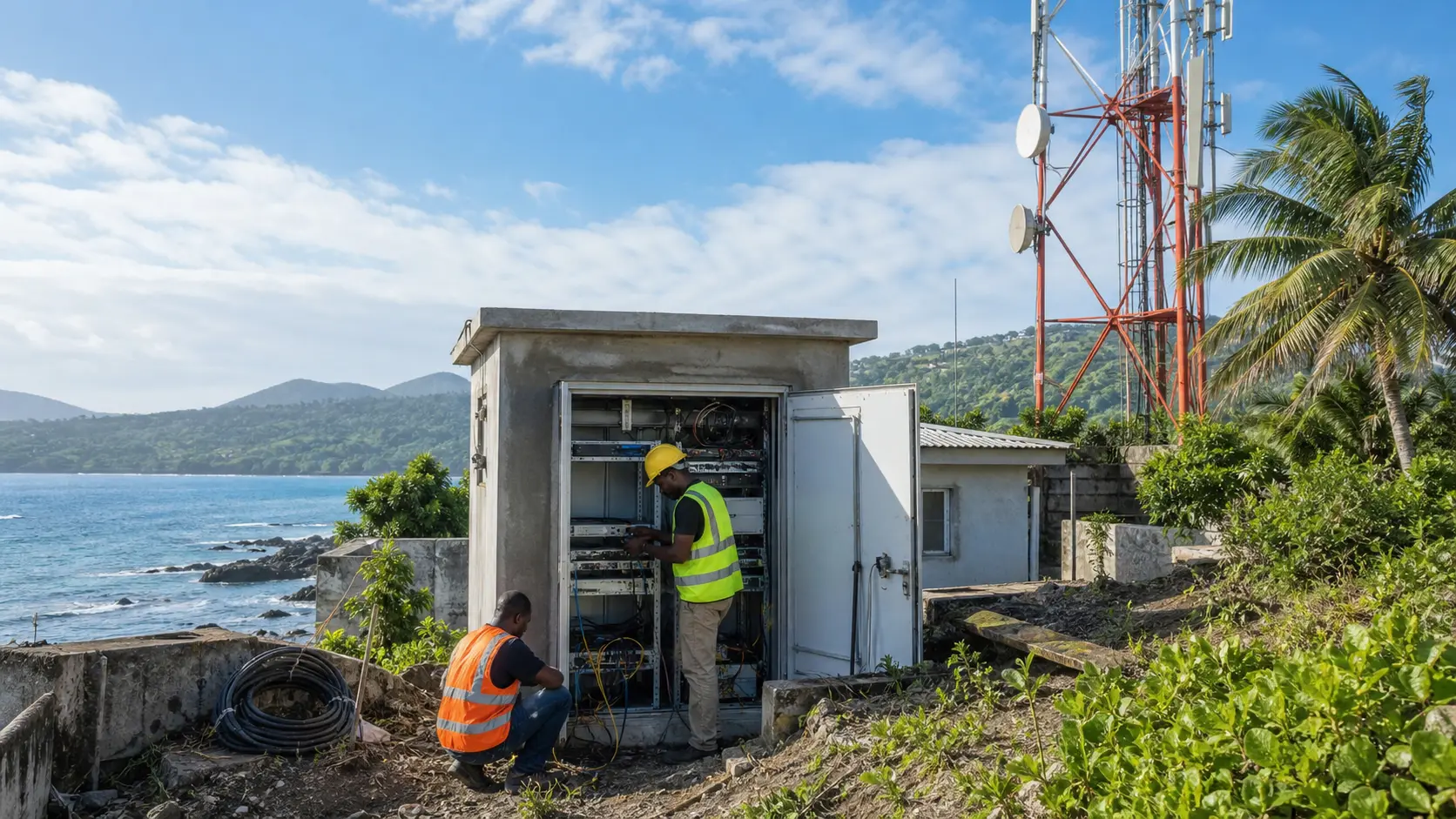
The public documents do not disclose TELCO's diesel bill, battery fleet, tower lease terms or imported equipment costs. But the operating model makes those costs central. A 150-tower addition in AXIAN's Q1 2025 disclosure is not just a coverage statistic. It implies civil works, radio equipment, shelters, batteries, power conditioning, backhaul, spares, tower climbs, site access, security and maintenance routines. In dense continental markets, many of those costs can be spread across millions of users. In Comoros, each site is carrying a smaller addressable population and a harder logistics environment.
Power is the simplest way to understand the pressure. A mobile site or fixed access node has to stay on when customers need voice, data, mobile money or business continuity. Grid reliability, storms, battery degradation, generator fuel and theft risk all become telecom costs. A plan priced at 250 FC may be commercially necessary for inclusion and customer acquisition, but it cannot pay for many truck rolls.
The operator therefore needs the whole ladder: tiny prepaid bundles for reach, larger bundles for margin, home fibre for higher monthly commitment, enterprise failover for premium reliability, and device financing or app usage to pull customers into more frequent spend.
The device page is economically revealing for the same reason. Yas lists a 4G MiFi modem at 19,900 FC and phones such as ZTE and Samsung models, including financing language for some low-end devices (https://www.yas.km/devices/). A MiFi is not just a gadget sale. It can turn a mobile network into a household broadband substitute. A financed phone is not just retail inventory. It is a bet that the user will buy enough data, voice, app services and perhaps mobile-money transactions to justify credit risk and distribution cost. The weaker the country's household purchasing power, the more device financing becomes part of network monetisation.
This is also why customer support is part of the economic product. Yas pages list help through 400, WhatsApp and email, and the Dagonet page lists a home-intervention target of one to two working days (https://www.yas.km/dagonet/). Each service promise creates labour cost. If a fibre line fails, a home router misbehaves, a SIM registration is wrong, an app update breaks, or a customer misunderstands fair-use speed, the operator pays through shops, calls, field visits or social support. A tiny bundle may produce almost no support allowance; a business continuity product can support more human intervention. The operator's pricing structure is therefore an allocation of labour, not only bandwidth.
The imported-equipment issue is harder to see but impossible to ignore. Radios, routers, fibre equipment, handsets, batteries, generators, antennas and testing gear are not manufactured at scale in Comoros. They arrive through foreign suppliers, foreign currency, shipping, customs and spare-parts planning. AXIAN's group scale should help procurement, because a pan-African buyer can negotiate more effectively than a standalone island operator. But group scale does not remove local logistics.
A replacement card, a fibre terminal or a battery that is late to Moroni is still late to the customer, and a customer does not care whether the delay came from a global supplier or a local warehouse.
Island obligation changes the value of coverage
National-telecom economics in Comoros are also political in the practical sense: coverage has public value even where the near-term margin is thin. IFC's 2025 announcement says the new loan is meant to improve inter-island connectivity and expand high-quality mobile and fixed broadband access across the islands, with particular public language around social inclusion (https://www.axian-telecom.com/2025/06/20/yas-comoros-part-of-axian-telecom-secures-e25-million-ifc-loan-to-drive-digital-transformation-in-comoros/). The regulator's 5G notice frames new spectrum as a national modernisation step, not just a private product launch (https://www.anrtic.km/actualites/articles/attribution-de-frequence-5g-a-l-operateur-yas-comores-par-l-anrtic).
That creates a different test from a city ISP. A city ISP can chase dense buildings and ignore uneconomic addresses. A national mobile operator in Comoros cannot behave that narrowly for long. Its licence, spectrum and political legitimacy depend on serving across islands and communities. Yet every non-dense coverage area carries the same economic question: how much revenue will flow through the site, and how many customers will buy enough data to justify power, backhaul and maintenance?
The island shape also changes how customers judge quality. A subscriber may not describe the issue as backhaul, spectrum, tower load or cable access. They will simply say the network is better in one district than another, or that one operator works on one island route while the other does not. That kind of informal reputation travels quickly in a small market. It affects dual-SIM behaviour, top-up choices, router purchases and whether a family abroad pays for a monthly plan or only sends emergency credit.
Enterprise customers are even less forgiving. A hotel, remittance counter, government office, clinic, logistics operator or bank branch may need both redundancy and a named support path. For them, the value of Yas's business fibre with 4G backup is not 40 Mbps in isolation. It is the promise that when a fibre incident occurs, the session falls back to the mobile network and the business keeps operating. That promise only works if both access paths have enough real capacity and if the support organisation can diagnose which layer failed.
There is a national-development angle, but it should not be sentimentalised. Better connectivity can support schools, clinics, entrepreneurs and public services. It can also force the operator to hold capacity and coverage in places where payback is slow. The commercial art is to make inclusion and utilisation reinforce each other: better coverage drives more usage; more usage funds more sites; more reliable sites persuade businesses and households to buy larger plans; larger plans create the cash to keep the network resilient. If that loop breaks, public ambition becomes private strain.
Financial services and diaspora money thicken the relationship
Telecom operators in small markets often make their best money when the SIM becomes a daily account rather than a periodic recharge. Yas's public surfaces point in that direction. The homepage promotes MVola-linked bonuses, the MVola page markets pocket financial management, and Google Play lists Yas et Moi functions that include recharging, sending offers or credit, SOS credit, customer service and daily-life information (https://www.yas.km/ and https://play.google.com/store/apps/details?id=mg.telma.telmaetmoi). TELCO S.A's direct legal role should not be conflated with every affiliated financial-service company, but the customer relationship clearly becomes richer when telecom and money functions sit near each other.
The diaspora-top-up market thickens it further. Ding and Comores En Ligne both make it possible to recharge Yas/Telma numbers from outside the country (https://www.ding.com/countries/africa/comoros/recharge-telma and https://comores-en-ligne.fr/en/telecom/yas-comores). That matters because Comoros has a large overseas community relative to its domestic market. A local subscriber's telecom spend may be partly funded by someone earning in France, Mayotte, the Gulf or elsewhere. The operator still collects in a local product market, but the customer's ability to pay may come from a foreign household budget.
That diaspora channel can stabilise revenue, but it can also raise expectations. A remote payer wants the family line to work. If data disappears quickly, if the app is hard to use, or if a bundle is misunderstood, the complaint can come through social channels, app reviews or the top-up intermediary rather than a local shop. This makes digital self-care more important. The app is not a side project; it is a low-cost substitute for shop labour, a sales channel for bundles, and a way to keep diaspora-funded spend recurring.
The risk is that the app and money surfaces create a second reliability burden. If the radio network works but the app crashes, the customer's commercial experience still fails. Google Play's low rating for the Yas et Moi app should be read cautiously because the app spans wider Yas/Telma usage, not just Comoros, and reviews are anecdotal. But the signal is relevant: when an operator asks customers to manage telecom life through a phone interface, software quality becomes part of network quality.
What an underwriter would demand
A lender, acquirer, large enterprise buyer or regulator should pay for the parts of TELCO S.A that are hardest to recreate: the national licence, spectrum, tower footprint, customer base, routing identity, brand distribution, AXIAN procurement support, IFC repayment record, mobile-money adjacency, and the right to sell both mobile and fixed broadband in a two-operator market.
The same counterparty should discount anything that depends on opaque wholesale capacity, weak interconnection enforcement, diesel and power exposure, undocumented churn, unsupported coverage claims, app instability, or 5G demand that has not yet translated into paid usage.
The proof package should be concrete. It should include audited local accounts, ARPU by prepaid and postpaid segment, active data-user trends, tower power costs, churn by island, fibre take-up by coverage area, enterprise-contract backlog, spectrum obligations, quality-of-service reporting, cable and cross-connection agreements, RPKI and route-security controls, customer-care response data, app crash and usage metrics, and a capex plan that separates replacement, coverage, 5G and fixed access. Without those documents, the visible evidence supports a real and strategically important operator, but not a full valuation.
What would change the judgement
The positive case is clear. TELCO S.A ended a monopoly, operates a visible network, sells a real mobile and fixed service set, participates in a much larger AXIAN group, has attracted and repaid IFC financing, has new IFC money for network expansion, and has regulator-cleared 5G frequencies. It also operates in a country where internet penetration is still low enough for meaningful growth if affordability and reliability improve.
The risk case is just as clear. Comoros is a small, low-income market with expensive geography. Mobile use is broad but not always high-value. Fixed broadband is still narrow by public evidence. Wholesale cable access and interconnection have a history of dispute. State-owned infrastructure and regulator enforcement remain decisive. A larger capex plan can improve the network but also raise the revenue hurdle. A rebrand can simplify marketing but cannot solve power, backhaul or affordability.
The fact that would most change the judgement is not a new slogan or a 5G launch photo. It is a public disclosure showing how many customers are moving up the ladder from low-value prepaid to sustained data, router, fibre, business and mobile-money usage, island by island, against the cost of towers, capacity and support. If that ladder is steepening, TELCO S.A is converting island scarcity into a durable utility franchise. If it is flat, the company is still carrying the expensive part of national connectivity without enough high-quality revenue to justify the next build.
Public evidence register
- https://www.yas.km/dagonet/ supports current Dagonet fixed-fibre pricing, fair-use volumes, post-FUP speeds, installation timing, support hours and home-intervention timing.
- https://www.yas.km/consumer-faqs/ supports the 250 FC to 15,000 FC Maxi Rahisi range and the positioning of Forfait Net for internet-only and router/Wi-Fi use.
- https://www.yas.km/wp-content/uploads/2025/12/CGV-Internet-FTTx-TELCO-S.A.pdf supports TELCO S.A's legal registration details, capital, service-contract terms, billing proof, suspension rights, mobile-number treatment and roaming-billing cautions.
- https://www.peeringdb.com/net/34740 supports the TELCO S.A / TELMA COMORES / TELECOM COMORES S.A identity, ASN 328061, prefix counts and public traffic band.
- https://bgp.tools/as/328061 supports AFRINIC/RIR-style routing details, AS328061 name, Moroni address context and visible IPv4 prefixes with RPKI status.
- https://www.ifc.org/en/pressroom/2019/ifc-s-first-investment-in-comoros-helps-transform-telecom-sector supports the 2019 EUR 13 million IFC loan, the second-operator role and nationwide 2G/3G/4G description.
- https://www.axian-telecom.com/2025/06/20/yas-comoros-part-of-axian-telecom-secures-e25-million-ifc-loan-to-drive-digital-transformation-in-comoros/ supports the 2025 EUR 25 million IFC loan, repayment of the first IFC loan, and planned 5G, FTTH and FTTO investment.
- https://www.axian-telecom.com/ac-content/uploads/2025/06/AXIAN-Telecom-Q1-2025-Unaudited-Condensed-Consolidated-Financial-Statements.pdf supports group-level Telma Comoros additions to subscribers, data users, mobile-financial users, towers, revenue and adjusted EBITDA.
- https://www.axian-telecom.com/ac-content/uploads/2025/11/AXIAN-Telecom-Q3-2025-Unaudited-Condensed-Consolidated-Financial-Statements.pdf supports AXIAN's May 2024 acquisition/control and consolidation disclosure for Yas and MVola Comoros.
- https://documents1.worldbank.org/curated/en/099191503242311967/pdf/BOSIB096cafe3e0c0084f70822a76892f1a.pdf supports the market-opening, wholesale-price, mobile-internet, fixed-broadband, cable-access and interconnection analysis.
- https://www.worldbank.org/en/about/partners/brief/comoros-transforming-telecommunications-in-union-of-the-comoros supports the second-licence history, USD 16 million licence fee, launch timing, early market share and 4G/mobile-broadband price effect.
- https://www.anrtic.km/actualites/articles/attribution-de-frequence-5g-a-l-operateur-yas-comores-par-l-anrtic supports the May 2025 5G frequency assignment to Yas Comoros and regulator framing.
- https://www.wiocc.net/fly-lion-3 and https://www.huawei.com/en/news/2016/11/avassa-submarine-cable-project support the submarine-cable dependency and redundancy context.
- https://datareportal.com/reports/digital-2025-comoros and https://datareportal.com/reports/digital-2026-comoros support internet-user and mobile-connection context.
- https://play.google.com/store/apps/details?id=mg.telma.telmaetmoi supports the Yas et Moi app function, download count, rating and app-review signal.
- https://comores-en-ligne.fr/en/telecom/yas-comores and https://www.ding.com/countries/africa/comoros/recharge-telma support diaspora/top-up and prepaid recharge distribution signals.