
Summary
- What it says: Techminds Networks is not interesting because it promises fast internet. Every ISP promises that.
- Main topic: Regional ISP economics; Peering and transit; Wholesale access economics; Cross-border connectivity
- Context: market / company research report / Nepal
The economics of broadband in Nepal begin with an awkward fact: geography does not appear on a tariff sheet, but it still sends the bill. A Kathmandu apartment customer may judge an ISP by evening speed, router reach, the ease of payment and how quickly a support call is answered. A district hospital, school or ward office judges by uptime and repair. A household in a smaller town judges by the difference between a national brand that advertises everywhere and a local crew that can actually reach the lane.
Behind those judgements sit costs that do not look like marketing: backhaul, poles, duct, splicing, batteries, field vehicles, call-centre staff, customer-premises equipment, route security, upstream transit, taxes, licence compliance and the working capital needed to keep vendors patient.
Techminds Networks sits in that difficult middle. It is too visible to be dismissed as a small local reseller, but not large enough to enjoy the same buffer as Nepal's biggest fixed-line operators. The company appears in the Nepal Telecommunications Authority's fixed broadband tables as a top-20 ISP. NTA's Baisakh 2083 MIS, published in spring 2026, showed Techminds Network Pvt. Ltd. with 116,808 fibre subscribers, 270 wireless subscribers, 117,078 total subscribers and a 3.36 percent share of fixed broadband subscriptions.
Earlier NTA tables and a 2025 credit-rating report show the company's count has moved around: above 80,000 in early 2025, around 110,000 active subscribers by mid-July 2025, more than 123,000 in Paush 2082, and then lower again in Baisakh 2083. That does not by itself prove commercial weakness. Subscriber counts can move because of reporting definitions, inactive-line cleanup, migrations, resellers, acquisitions, wireless shrinkage or genuine churn. But it does prove something important: Techminds is large enough for movements in its base to matter, and small enough that movements still change the story.
Its visible business is a mixture of ordinary consumer broadband and more complicated local infrastructure work. The public website sells residential internet plans, office internet, business packs and IPTV. Older company pages show annual residential offers around Rs 10,956 for 75 Mbps internet-only, Rs 12,642 for 100 Mbps and Rs 14,749 for 150 Mbps, with internet-plus-IPTV variants at higher prices and free installation stated on those packages.
The current site describes residential plans as unlimited and no-data-cap, while the Apple App Store page for the Techminds customer app says subscribers can view plan and service details, check subscription status, renew packages, see invoices, pay bills, monitor usage and raise support tickets. Khalti and Fonepay pages list Techminds as a bill-payment option. That matters because a broadband business is not only a cable and a router; it is a cash-collection system, a reminder system, a ticketing system and a way of shortening the distance between a complaint and a repair.
The stronger, less visible part of the company is its network and institutional work. APNIC records identify AS58504, TECHMINDS-NP, as Techminds Networks Pvt. Ltd. in Bharatpur, Nepal. BGP records show the company originating IPv4 and IPv6 space and using upstreams including WorldLink International Transit Services, Vianet and Dish Media Network. BGP.Tools classifies the network as an eyeball/home ISP and shows it as active, allocated under APNIC, with 16 IPv4 and 16 IPv6 originated prefixes, three upstream carriers and Nepal rankings around the top ten for estimated eyeballs, known peers and originated address space.
Hurricane Electric's BGP pages show npIX presence in Kathmandu and a set of observed peers and prefixes. NPIX itself welcomed Techminds Network Pvt. Ltd. to its switching fabric in 2012 as its 27th member, describing it then as a Narayangarh-based ISP serving several districts around the Narayani zone. That early local shape has since widened, but the original commercial problem remains recognizable: build enough local reach to be trusted, then buy or peer enough upstream capacity to keep the promise.
The company's public identity has some noise around dates and names, which is common in regional telecom records. LinkedIn describes Techminds Network Ltd as a telecommunications company headquartered in Lalitpur, founded in 2007, with 501-1,000 employees, a Narayanghat location and more than 60 districts of network reach. Job and directory pages preserve an older brand story in which Techminds began in 2002 as TechMinds Communication and later offered full internet service as TechMinds Network.
CARE Ratings Nepal gives the more formal corporate chronology: Techminds Network Limited was incorporated on June 2, 2011 as a private limited company and converted into a public limited company on July 10, 2024. It says the company has operated for around 15 years, is promoted by Kamal Raj Bastola, Chairman and CEO, and is among Nepal's top nine ISPs by retail subscriber base. The different dates should not be forced into one neat origin myth. The useful reading is that the operating brand claims a longer lineage than the current rated legal vehicle, while the credit record gives the cleaner corporate anchor.
The thesis of this article is therefore deliberately conditional. Techminds looks like a real, scaled, regionally rooted Nepali ISP with independent number resources, payment rails, national subscriber visibility and some government/corporate exposure. It also looks like a company trying to grow in one of the harder broadband markets in Asia. Its advantage is not technology in the abstract. Fibre, BGP, IPTV and customer apps are available to competitors too.
Its advantage, if it has one, is the ability to convert hard geography into local operational trust: a branch that picks up the phone, a field team that knows the pole route, an office that can persuade a municipality, a support workflow that reduces anger before a customer switches. Its risk is that the same geography makes every failure expensive.
Identity: a Chitwan-rooted ISP with a larger national posture
The public record places Techminds in several Nepali geographies at once. The older website and NPIX record point to Narayangarh and Bharatpur in Chitwan. APNIC's organisation record lists Sahid Marga, Bharatpur-3, and APNIC role records point to Bharatpur-3, Chitwan. Current and directory pages also point to Lalitpur/Nakhhu as a corporate office or headquarters. Social pages and local branch traces mention Dhading, Kapilvastu, Bhojpur, Surkhet and other service presences. This is not an identity problem so much as an operating clue.
A Nepali fixed-broadband provider that began in a regional city and later sought Kathmandu Valley and multi-district reach will naturally leave a trail of old and new addresses, branch names and support numbers.
The company calls itself dedicated to connectivity and presents itself as a leading Nepali internet provider. The homepage and about page describe a fibre-optic network spanning Nepal from mountain villages to hills and the Terai. Those are company claims, not independent proof of every route. Still, they align with third-party traces. LinkedIn claims more than 60 districts of network span and 100 Gbps of internet bandwidth. Jobejee says the company's fibre infrastructure connects government schools, health posts, rural municipalities, municipalities and wards across 26 districts.
Such job-board and social-profile statements should be weighted below regulator and routing records, but they help explain the company's market posture. Techminds is not presenting itself merely as a city broadband storefront. It is presenting itself as a Nepali coverage and service organisation.
That matters because Nepal's broadband demand is uneven. The Kathmandu Valley carries dense residential and business demand. The Terai gives providers larger settlements and cross-border economic activity. Hill and mountain areas add government facilities, schools, clinics, local businesses and households that may be underserved by national sales machines. A company that can bridge those demand pockets has a different economic profile from an operator that sells only in one dense urban neighbourhood.
It must hold more spare parts, manage longer repair loops and train more field staff, but it can also become the default local choice where switching options are thinner.
The legal development also matters. The 2025 CARE Ratings Nepal report says Techminds converted from private limited to public limited on July 10, 2024. In Nepal, such a conversion can be a preparation for larger financing, wider ownership, future capital-market options or institutional credibility. The same report assigns CARE-NP BB ratings to Rs 420 million of term loan facilities and Rs 3,000 million of proposed long-term bank facilities, for Rs 3,420 million total rated bank facilities. That is not a small working-capital line for a village network.
It is a growth and consolidation signal, and it makes debt service part of the operating story.
The people side points in the same direction. CARE identifies Kamal Raj Bastola as Chairman and CEO, with over two decades of managerial and technical experience in Nepal's internet service industry. LinkedIn shows recurring job posts for front-line support executives, retention executives, operation assistants, sales coordinators and vehicle-management roles in Kathmandu. Those job categories may sound routine, but they reveal the guts of a regional access provider. Front-line support and retention are the staff categories a company adds when customer churn, ticket volume and plan renewals become strategic.
Vehicle management is not a glamorous job signal; it is a geography signal. A broadband company with field movement across Nepal has to manage the cost, timing and reliability of getting people to faults.
What Techminds sells is reliability wrapped around access
The visible retail product is simple enough. Techminds sells residential internet, office internet, business packages and IPTV. Its older plan page shows 75 Mbps, 100 Mbps and 150 Mbps annual packages, with internet-only and internet-plus-IPTV variants. The current residential-plan page describes flexible no-data-cap home internet for streaming, work-from-home and gaming. The website and directory pages list support numbers and email addresses. Khalti's Techminds payment page tells customers to select the internet icon, choose Techminds, enter the customer ID, fetch details and pay. Fonepay lists TechMinds among supported ISP billers.
Google Play says the Android app was updated on June 10, 2026. Apple's App Store page lists features including subscription management, billing, usage graphs, router information, support tickets, notifications and payment methods including Khalti and eSewa where enabled.
That customer-app evidence is not a minor detail. A five-year-old Reddit thread about Techminds asked whether the ISP had a customer portal or app, with the original poster complaining that they had to call to check balance, expiry or upgrade details. A commenter suggested an old portal link and another said the only practical workaround was to try eSewa recharge to reveal package details. That was informal chatter, not a statistically valid survey. But it was a precise complaint about a process gap. By 2026, app-store records show the company has an official customer app for exactly those functions.
In a market where users often blame the ISP for every outage, speed drop or billing confusion, reducing friction around self-service is not cosmetic. It is churn control.
For households, the revenue logic is annual prepayment, renewal discipline and add-ons. The older prices imply that the advertised annual 75-150 Mbps internet-only packages translated into roughly Rs 913 to Rs 1,229 per month before considering installation, router economics, support, VAT treatment and discounts. The internet-plus-IPTV variants pushed that higher. A provider can like annual cash because it improves working capital and reduces monthly collection friction. Customers can like annual cash because discounts and installation offers are clear. But annual plans also create a support obligation.
Once customers have prepaid, their tolerance for downtime falls. A local ISP that collects upfront must be especially good at proving that prepaid trust was not misplaced.
For business customers, the product is less about headline speed and more about continuity. The company and job-market descriptions mention internet, intranet, IPTV, fibre-optic lease services, office internet and business packs. CARE's FY25 revenue mix is revealing. It says around 28 percent of revenue came from retail customers, around 7 percent from corporate clients, around 26 percent from equipment sales, and around 29 percent from monitoring and technical support. That mix is unusual if one imagines Techminds as only a household broadband biller.
Equipment sales and monitoring/technical support together formed more than half the reported FY25 revenue mix in the rating account. Government projects, corporate clients and support contracts may be essential to the margin structure.
This also explains why geography can be a cost and an asset at the same time. A national operator can advertise a cheaper plan and still struggle to create local institutional trust. A regional provider can win a school, ward office or health post if it can supply equipment, install the link, maintain the route, answer the call and invoice in a way local administrators understand. The same provider then has to carry inventory, train technicians and finance receivables. CARE's report says Techminds has obtained tenders for various government projects, has steady corporate clientele and an increasing retail subscriber base.
Tenders are attractive because they add volume and institutional credibility. They can also lengthen receivable cycles and require working capital before cash arrives.
Network evidence: real operating footprint, but not independence from the national hierarchy
The hard network evidence starts with AS58504. APNIC WHOIS identifies the autonomous system as TECHMINDS-NP, described as TECHMINDS NETWORKS PVT. LTD. in Bharatpur, Nepal. The APNIC organisation record names Techminds Network Pvt. Ltd., country Nepal, address at Sahid Marga and Bharatpur-3, and lists the official contact email. The internet resource record is not a marketing statement. It shows that Techminds has an independently visible routing identity.
BGP.Tools adds scale and context. Its AS58504 page lists the network as registered on December 22, 2011, active and allocated under APNIC, with a home-ISP tag, 16 IPv4 and 16 IPv6 originated prefixes, three upstreams and rankings around number nine for estimated eyeballs in Nepal and number seven for known peers in Nepal. The upstreams listed there are WorldLink International Transit Services, Vianet and Dish Media Network. Hurricane Electric's BGP page shows the same basic identity and records npIX presence in Kathmandu. PeeringDB lists TECHMINDS NETWORKS PVT. LTD.
as a Cable/DSL/ISP network with AS58504, website techminds.com.np, Asia-Pacific geographic scope and self-reported traffic level of 10-20 Gbps. LinkedIn's 100 Gbps claim may refer to capacity, commercial bandwidth or a broader internal definition; PeeringDB's figure is a self-reported interconnection profile; BGP observed routing is another measurement. The useful conclusion is not to reconcile every number. It is to see a real network with multiple public traces.
The prefix descriptions also reveal a regional and wholesale shape. Public BGP pages show ranges labelled for client distribution, infrastructure, Kathmandu distribution, EastLink, K.R.B Net, Nimble Network and other named Nepali networks. BGP.Tools lists downstreams including Prime Network, Barahi Internet Technologies, Max Net Solutions, Nimble Network, Global Trading and IT Solution, and Shangrila Informatics. That does not mean every downstream relationship is economically equal or current in every detail.
It does suggest Techminds functions not only as a retail access provider but also as part of Nepal's domestic hierarchy for smaller networks and regional traffic.
The NPIX history is commercially important. Joining the Internet Exchange Nepal switching fabric in 2012 made Techminds part of Nepal's local interconnection environment relatively early in its growth. Local exchange participation can lower latency and reduce unnecessary upstream transit for domestic traffic. It also signals that the operator has at least some technical discipline beyond pure resale. In a geography-cost lens, this matters: every megabit that can be exchanged locally is less dependent on foreign transit paths and cross-border economics. But local peering does not remove the hard dependency on upstream internet access.
Most global content, cloud services and international traffic still require upstream paths and international capacity. Nepal's repeated bandwidth payment disputes make that dependency painfully visible.
Route security looks reasonably mature on the public record. BGP.Tools marks many originated prefixes as having valid RPKI certification or trusted route information, and Hurricane Electric shows no RPKI-originated invalid routes for AS58504 at the time observed. For a consumer, this is invisible. For counterparties and infrastructure buyers, it matters. Route hygiene is one of the quiet signs that a provider is not merely selling access but maintaining a network that others can interconnect with. It does not prove service quality, but it reduces one class of avoidable operational risk.
Geography is the cost base
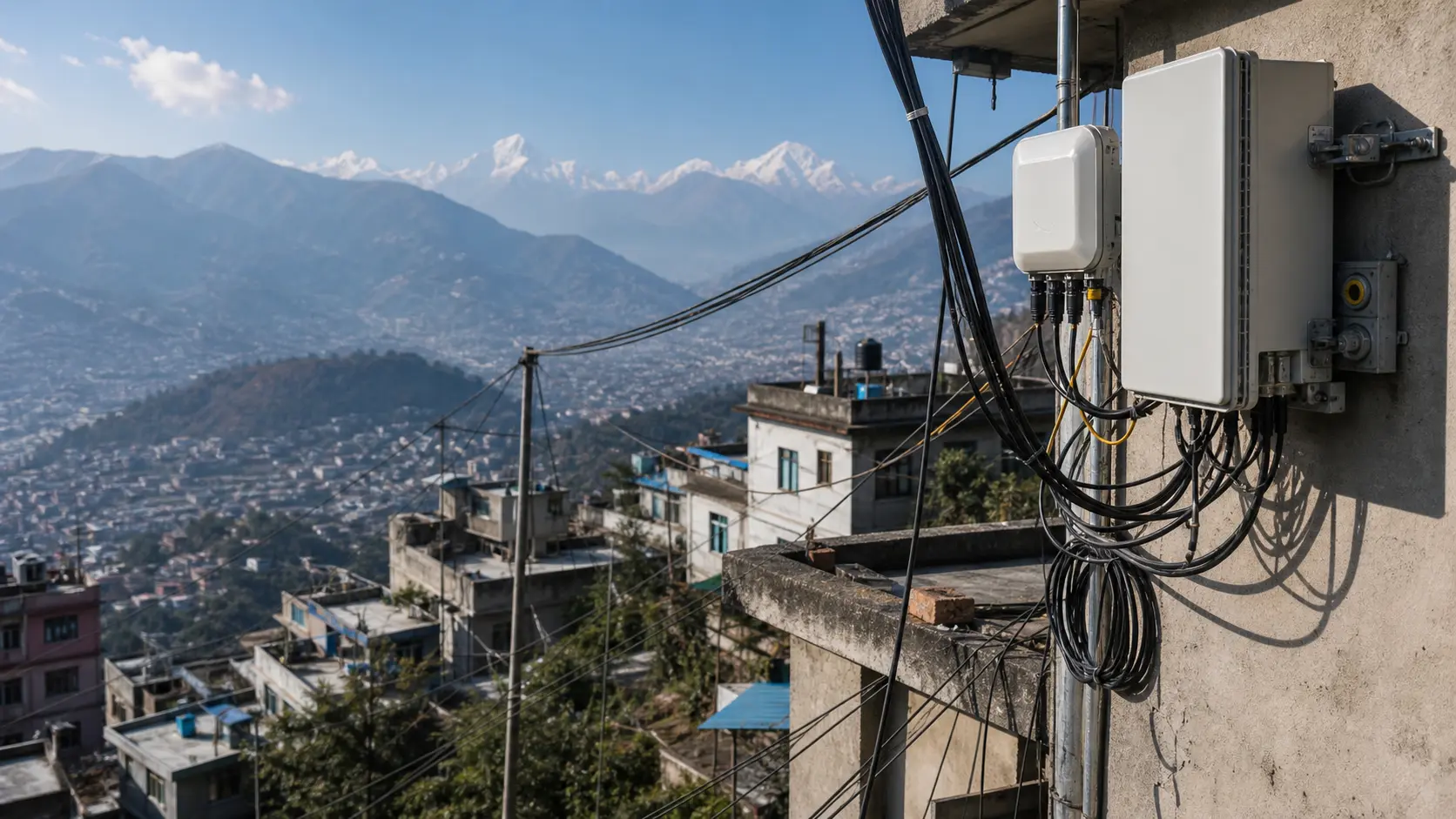
Nepal's terrain turns ordinary access economics into a problem of route density. The World Bank's Digital Nepal Acceleration project documents describe coverage gaps as typically linked to high deployment costs, especially in rural or mountainous areas, and note that the high cost of upstream international connectivity raises prices. That one sentence captures much of Techminds' commercial problem. The cost of reaching a customer is not only the optical cable. It is the road, pole, right-of-way, power backup, technician trip, spare router, fault isolation and time-to-repair.
A route that looks profitable in a dense neighbourhood can look fragile in a hill settlement. A government school or health post can justify extension in one district; a scattered residential base may not.
This is why local trust has value. In a dense city, customers can choose among several providers and switch when a promotion looks attractive. In a district or semi-urban pocket, the known local operator may have more staying power because customers know the branch, technicians and payment route. The Reddit user who said Techminds was the only ISP in their village was not proving monopoly power across Nepal. It was a small anecdote about local dependence. For a provider, that dependence can be valuable if service is acceptable. It can also create anger if customers feel trapped.
The cost of geography also appears in staffing. LinkedIn job posts for front-line support, retention, operation assistants, sales coordinators and vehicle-management roles are not just human-resources noise. They show the labour categories required to make a regional broadband promise credible. Broadband margins are often discussed as bandwidth minus subscriber revenue. That misses the support labour that stands between a speed problem and a lost renewal. A household may tolerate a national-brand outage as bad luck. It may take a local provider's missed visit personally.
A regional ISP therefore needs a service culture, not just a fibre map.
Power and physical resilience sit in the background. Public sources in this research set did not provide a Techminds-specific power-resilience inventory. That gap matters. Nepal's electricity reliability has improved significantly over the past decade, but access networks still need backup for nodes, data rooms and customer premises. Terrain and weather can turn a fibre cut into a long repair. The 2025 Kathmandu Post report about a nationwide disruption traced one February service interruption not to unpaid dues but to fibre cuts in Airtel's network in Birgunj and Bhairahawa, disrupting services for 47 minutes.
The lesson for Techminds is wider than one incident: in Nepal, a customer-facing ISP inherits route risks that sit well outside its own office.
The company tries to convert this cost base into a trust claim. Its old homepage says it is trusted by more than 120,000 subscribers across Nepal. CARE says around 110,000 active subscribers at mid-July 2025. NTA's spring 2026 table showed 117,078 total fixed broadband subscribers. These numbers are close enough to support the broad claim of six-figure customer scale, though not every source uses the same date or definition. Scale helps because support systems, equipment procurement and upstream buying all improve with volume.
But six-figure scale in Nepal is still far below WorldLink, Vianet, Nepal Telecom, DishHome, Subisu, Classic Tech or Websurfer in many tables. Techminds must be large enough to bargain and small enough to remain local. That is a narrow operating lane.
The revenue story is stronger than the headline subscriber story
CARE Ratings Nepal provides the clearest financial picture in the public set. It reported operating income of Rs 799 million in FY23, Rs 742 million in FY24 and Rs 719 million in FY25. The top line therefore declined from FY23 to FY25, even as the report described improving profitability and operational stabilization. PBILDT margin was 15.83 percent in FY23, 15.39 percent in FY24 and 16.73 percent in FY25. Profit after tax was modest, between Rs 10 million and Rs 43 million over FY20-FY25. The cost of sales declined from 87 percent of sales in FY22 to 57 percent in FY25.
That is a material improvement in cost structure, but it sits inside a competitive and capital-intensive ISP sector.
The revenue mix is the most important detail. Only about 28 percent of FY25 revenue came from retail customers, according to CARE. Corporate clients contributed about 7 percent. Equipment sales contributed about 26 percent, and monitoring and technical support contributed about 29 percent. This is a reminder that Techminds' economics may not be readable from subscriber count alone. A smaller number of institutional, equipment or support contracts can carry margin or cash timing differently from residential subscriptions. Government broadband projects can inflate revenue in one period and fall away in another.
Retail customers provide recurring revenue and brand visibility, but support and equipment work may be where the company tries to monetise its field capability.
The Build Broadband Network segment appears to have driven a large FY22 peak. CARE says total operating income rose from Rs 787 million in FY20 to a peak of Rs 2,301 million in FY22, driven by higher execution under that segment, before moderating to Rs 742 million in FY24 and Rs 719 million in FY25 as the company refocused on core ISP service income. This matters for valuation and judgement. A company that once had large project revenue can look like it is shrinking when project execution normalises. That may be healthy if recurring ISP income becomes more durable. It may be weak if project revenue was masking slow retail economics.
For Techminds, the public answer is not fully visible. The rating report leans toward operational stabilization; subscriber volatility still deserves attention.
Debt makes the story more serious. CARE listed overall gearing of 1.74 times in FY23, 1.51 times in FY24 and 1.50 times in FY25. Interest coverage fell from 4.60 times in FY24 to 3.35 times in FY25. Total debt to gross cash accruals increased from 2.81 times in FY23 to 5.36 times in FY25. The report also described exposure to volatile interest rates because borrowings are linked to Nepal's floating-rate bank regime. That is not fatal, but it makes growth more conditional. A regional ISP can live with debt if subscriber additions, support revenue and project cash flows arrive on time.
It can struggle if creditors stretch, interest rates move, acquisitions disappoint or customers churn after promotional periods.
Working capital is the red flag. CARE says Techminds had a negative operating cycle of 264 days in FY25 amid highly stretched creditors, with average creditor days increasing from 104 in FY20 to over 400 in recent years. It also says the average collection period lengthened from 27 days in FY20 to 114 days in FY25 and that current ratio stayed below 1.0 over FY20-FY25. In plain language, suppliers have been financing a lot of the business, while receivables have slowed. That can work for a while in an infrastructure business if vendors trust growth and customers eventually pay.
It can also become a constraint if suppliers tighten, banks become cautious, or government/project payments slow.
The proposed Rs 3,000 million loan facility is therefore a fork in the road. CARE says the company intends to invest in acquiring and merging local players, with project cost financed about 75 percent by debt and Rs 1,000 million by equity. The strategy makes sense in a geography-cost market: buying operational providers with existing customer bases may be cheaper than building every route from scratch. It can add scale, reduce competition in pockets and create backhaul efficiencies. But consolidation also imports other people's network quality, billing habits, staff culture, customer complaints and hidden liabilities.
In Nepal, an acquisition can buy access to trust, or it can buy a bundle of angry renewals.
Upstream dependency is Nepal's hidden tax on broadband promises
The most important dependency in Nepal's broadband market is not always the immediate upstream listed in a BGP table. It is the country's reliance on Indian upstream capacity, foreign-exchange permissions and government-regulator disputes over telecom dues. AP reported in May 2024 that broadband internet was disrupted in many parts of Nepal after Indian vendors stopped providing services because of payment defaults by Nepali private operators.
The report said private ISPs could not pay Indian vendors for months because the government had failed to provide foreign currency from banks, while the government was refusing until companies cleared taxes on certain services. WorldLink, Nepal's largest ISP, blamed the government in a notice, saying its upstream provider disconnected internal links citing non-payment and that ISPs could not remit payments without foreign-exchange permission.
The Kathmandu Post reported in May 2024 that ISPs warned of possible disruption because Indian upstream providers had again threatened to stop services. It said the NTA had asked the central bank not to provide foreign exchange and guarantees until ISPs cleared taxes. It also reported that Nepali ISPs had annual transactions around Rs 27 billion and paid more than Rs 9 billion in government revenue under various headings.
Kantipur's English translation reported that major providers including WorldLink, Subisu, Vianet and TechMinds were affected by the May 2024 disruption, and that ISPAN said about Rs 3 billion for bandwidth purchases over nine months remained unpaid. In April 2025, the Kathmandu Post reported that Nepali ISPs owed more than Rs 8 billion to Indian upstream providers, primarily Tata and Airtel, with only around Rs 1 billion paid over two years. It quoted Airtel at around 70 percent and Tata at around 20 percent of Nepal's overall internet bandwidth supply.
This is not a Techminds-only problem. That is precisely why it matters. A customer does not distinguish between a local ISP's fault and a national upstream/foreign-exchange crisis when video calls fail. A regional ISP inherits reputation damage from national infrastructure politics. It can diversify immediate upstreams through WorldLink, Vianet, Dish or other domestic paths; it can peer locally; it can cache some content; it can manage traffic. It cannot fully escape the country's dependence on upstream routes and the foreign-payment approval chain.
For Techminds, this means that trust must be built not only through local repair but through explaining, engineering around and financially surviving shocks beyond its direct control.
The BGP upstream list shows Techminds buying or reaching upstream through large Nepali networks, including WorldLink International Transit Services and Vianet. That is rational. It gives the company access to scaled domestic and international connectivity without owning every international path. It also places Techminds beneath the economics of larger national carriers. If those larger carriers face bandwidth-payment or foreign-exchange constraints, a mid-tier regional provider can be affected even if its own local field team is competent.
In the language of this article's lens, geography includes geopolitics and payments, not only mountains.
Techminds' network role as a possible upstream or transit path for smaller Nepali networks adds another dimension. Downstream relationships can create revenue and strengthen routing relevance. They also create responsibility. If a smaller ISP depends on Techminds for connectivity, then Techminds' upstream arrangements, route hygiene and support discipline affect more than its own residential customers. The company becomes part of Nepal's dependency chain. That is valuable if managed well. It is reputationally costly if not.
Competition is concentrated above and fragmented below
NTA's spring 2026 fixed-broadband table illustrates the competitive squeeze. WorldLink Communications had about 1.08 million total fixed broadband subscribers and roughly 30.93 percent market share in the Baisakh 2083 MIS snippet. Vianet had more than 363,000 and around 10.41 percent. Other large operators in recent NTA and media tables include Dish Media Network, Nepal Telecom, Subisu, Classic Tech, Websurfer, CG Communications and WiFi Nepal.
CARE's rating report said that as of mid-April 2025 the top 20 ISPs collectively held about 98 percent of the market, the top five held about 72 percent, the leading ISP alone held about 32 percent, and Techminds had around 3 percent. A market can have more than 60 licensed ISPs and still be concentrated where scale matters.
This creates two different competitive threats. Above Techminds are providers with better national brand recognition, bigger advertising budgets, more procurement leverage, more content arrangements and, in some cases, stronger balance sheets. If they decide to lower prices or offer favourable payment terms, CARE warns that Techminds could see margin pressure or customer erosion. Below Techminds are smaller local providers with branch intimacy, lower overhead and possibly looser service expectations. Techminds must defend against national scale and local familiarity at the same time.
The company appears to be responding by trying to be both scaled and local. Its app and payment rails mimic larger-operator convenience. Its branch and support posture preserve local presence. Its proposed acquisition plan aims to consolidate smaller operational providers. Its network record gives it enough routing visibility to serve smaller networks or regional customers. Its marketing claims national reach while preserving Narayangarh and Chitwan roots. The strategy is sensible, but it is hard to execute. A mid-tier ISP can lose the local touch before gaining the full cost advantage of a national platform.
Pricing is the battlefield where this tension shows. The old Techminds annual packages are not obviously ultra-cheap. They appear designed around a standard Nepali fibre value proposition: unlimited bandwidth, annual payment, router/install offer, optional IPTV. If WorldLink, Vianet, DishHome, CG Net, Classic Tech or WiFi Nepal undercut in a given neighbourhood, Techminds has to defend on installation speed, repair, payment convenience, local staff and trust. If it cuts price too far, its debt and support obligations become harder.
The price of distance is not only the fibre route; it is the inability to match every big-player discount without damaging the service promise that makes a regional provider worth choosing.
Customer dependency is also changing. Once an ISP app, payment wallet, router, IPTV box and support ticketing system become part of a household, switching is not frictionless. But in Nepal's fixed broadband market, switching is not prohibitively hard either. Customers can compare advertised speeds, ask neighbours, complain on Facebook groups and move when a competitor pulls fibre down the lane. The only durable defence is experienced reliability. For Techminds, that means its retention staff may be as important as its sales staff. The sale wins the first annual payment; retention proves that geography has been turned into trust.
Unofficial signals: trust is visible in complaints before it is visible in accounts
Unofficial signals around Techminds are thin but useful. Reddit and Facebook search results show a familiar ISP pattern: users ask about portals, router credentials, slow new connections, branch staff, 5G router promises, secondary routers and support delays. Some comments praise speed or say there is no speed complaint but service is delayed. Others complain about customer-service friction. A five-year-old Reddit thread said the lack of a working portal forced a customer to call for basic account information; another commenter said Techminds was the only ISP in their village.
Facebook group snippets show branch-specific irritation and technical questions. These signals are not facts about network-wide performance. They are smoke from the support surface.
The most important thing about these signals is their specificity. Generic "bad internet" complaints are everywhere in Nepal. The more useful signals are about process: no portal, slow new connection, router handoff, balance enquiry, support response, branch staff, expiry dates, and whether customer-payment systems reveal the right details. Those are exactly the points where a mid-sized regional ISP either builds trust or loses it. A speed test can be repaired by adding capacity. A pattern of confusing support, poor account visibility or missed promises corrodes renewal behaviour.
The app-store evidence suggests Techminds has tried to answer part of that gap. Apple's listing says the app offers account dashboard, subscription status, renewals, invoices, billing, usage graphs, router information, support tickets, notifications and payments. Google Play shows 5,000-plus downloads and a June 2026 update. The absolute download number is small relative to the subscriber base, but the existence and recent update matter. If adoption rises and the app actually works, Techminds can lower call-centre load and reduce customer anxiety around payment and expiry. If the app is unreliable, it becomes another complaint channel.
Local review aggregators add little hard evidence. NearIF search snippets show a low-looking rating headline for a TechMinds corporate office but the opened page itself displays no review data. GeoMyIP says online reputation signals are thin and cites only one Glassdoor signal. Such pages should not anchor any judgement. They do, however, confirm a broader point: Techminds' public reputation is not cleanly documented in a way an outside buyer or institutional customer could easily audit. The company would benefit from more transparent service metrics, support response data and clear outage communications.
Social marketing is lively but not decisive. Facebook and Instagram snippets show promotional language about reliability, 24/7 support, customer-centric service and branch contact numbers. That is normal ISP marketing. More meaningful are the job posts for retention and front-line support, the customer app, the payment integrations and the public regulatory/routing traces. Together they show a company that knows customer trust is operational, not merely rhetorical.
Regulation and operating risk are part of the product
The regulatory baseline is that Techminds operates in a licensed Nepali telecom environment. NTA MIS materials and older search results show TechMinds Network Pvt. Ltd. in subscriber tables for years, including Narayangarh/Chitwan listings. A Poush 2073 NTA MIS result records issuance of a Network Service Provider licence to Techminds Network Pvt. Ltd., Bharatpur-3, Chitwan. APNIC resource registration and NPIX membership add the internet-infrastructure layer. CARE's report adds the financial-institution layer. This is a real regulated operator, not a purely social-media broadband brand.
Regulation also creates cost. Nepali ISPs face licence obligations, taxes, Rural Telecommunication Development Fund issues, royalty disputes, foreign-exchange approval processes and regulator reporting. These are not back-office details; they affect uptime. The May 2024 disruption showed how a dispute over taxes and foreign-currency recommendations can become a customer outage. For a regional ISP, the problem is asymmetrical. Customers remember the service failure, not the legal logic. Larger operators may have more ability to negotiate, delay or absorb; smaller operators may be more exposed to sudden cash strain.
Techminds sits between those worlds.
Abuse handling and route reputation also matter. APNIC records list abuse contacts and validation dates for Techminds. Public blacklist and spam pages show activity statistics for AS58504, but such third-party reputation pages often mix residential dynamic IP behaviour, compromised customer devices and scanning noise. They should not be treated as direct evidence of company misconduct. Still, a home ISP with thousands of customers needs abuse workflows. If it supplies smaller networks, it also needs escalation paths. Poor abuse response can affect peering, email deliverability and institutional trust.
The conversion to public limited company and the CARE rating raise the governance bar. A company seeking large bank facilities and acquisitions cannot rely only on founder reputation. It will need better financial reporting, receivable control, creditor management, acquisition integration, support performance and customer data discipline. CARE's rating is not investment praise; it is a credit opinion that records strengths and weaknesses. The weaknesses are directly relevant to public trust: high working-capital intensity, stretched creditors, slower collections, competition and floating-rate exposure.
Those are the places where operational promise meets finance.
What would change the judgement
The bullish case would become stronger with evidence in five areas. First, NTA tables over the next several months should show stable or growing active subscribers after the spring 2026 decline from the Paush 2082 level. A drop from more than 123,000 to around 117,000 total fixed subscribers may be benign, but only if it stabilizes. Second, Techminds should demonstrate that the customer app is materially adopted and reduces call-centre friction, not merely exists in app stores.
Third, the company should show cleaner public service indicators: outage notices, support response ranges, installation timelines and area availability that customers can understand. Fourth, the acquisition plan should add subscribers without worsening working capital, creditor days or support complaints. Fifth, upstream diversification and local peering should continue to improve, making national payment shocks less destructive to end-user experience.
The bearish case would strengthen if subscriber decline continues, if proposed debt rises faster than cash generation, if creditor stretch remains the hidden funding source, or if customer chatter shifts from ordinary support irritation to chronic non-response. It would also strengthen if acquired local providers add low-quality networks that require expensive cleanup. A regional ISP can be undone by integration. Billing systems, router fleets, field maps, customer promises and staff habits are rarely identical across small providers. Buying a customer base is easier than absorbing its expectations.
The biggest fact that would change the valuation of Techminds is not a single speed claim. It is evidence of renewal behaviour. In annual-prepay broadband, trust is measured when customers renew after living with the service through outages, festival demand, monsoon faults, router problems and support tickets. A provider that can renew households and institutions across difficult geographies has a real moat. A provider that grows by promotion and loses customers at renewal is financing churn.
The second biggest fact is project cash quality. If government, school, health-post and equipment contracts generate durable support revenue with timely payment, Techminds' mixed revenue base is a strength. If they create receivable delays and creditor stretch, they are a liquidity risk. CARE's working-capital warning makes this distinction central.
The third is whether Techminds can keep a local service culture while scaling. The company has enough public evidence of network maturity to be taken seriously. The harder test is mundane: does the branch answer, does the app fetch the right bill, does the field team arrive, does the upstream survive, does the customer know what happened, and does the next renewal happen without a discount war?
Evidence register
Techminds official older homepage: https://techminds.com.np/ - supports company contact details, Narayanghat/Bharatpur identity, service categories, older public pricing for 75 Mbps, 100 Mbps and 150 Mbps annual plans, IPTV variants, support number, subscriber claim and public marketing language. It does not prove audited subscriber count or service quality.
Techminds current about page: https://www.techminds.com.np/about-us - supports the company's stated mission, fibre-optic network positioning, Nepal-wide aspiration and internal functions around technology, sales/marketing and operations. It is company-authored and should be weighed as positioning, not independent verification.
Techminds current residential plan page: https://www.techminds.com.np/services/residential-plan?slug=residential-plans - supports the current residential product framing around no-data-cap home internet, streaming, work-from-home, gaming, filters and plan-selection workflow.
CARE Ratings Nepal bank-facility rating for Techminds Network Limited: https://www.careratingsnepal.com/upload/CompanyFiles/PR/202511111107_Techminds_Network_Limited_-_Bank_Facility_Rating_Assigned.pdf - supports incorporation on June 2, 2011, conversion to public limited company on July 10, 2024, promoter identity, around 110,000 active subscribers at mid-July 2025, roughly 3 percent market share, top-nine ISP status, FY23-FY25 income and margin data, debt metrics, revenue mix, working-capital warnings, competition risks and proposed debt-funded acquisition strategy.
Nepal Telecommunications Authority MIS Baisakh 2083 PDF search result: https://nta.gov.np/uploads/contents/MIS_Baisakh_2083.pdf - supports the spring 2026 fixed broadband table entry showing Techminds Network Pvt. Ltd. with 116,808 fibre subscribers, 270 wireless subscribers, 117,078 total subscribers and 3.36 percent share, as well as WorldLink's 1,078,709 total and 30.93 percent share in the same table. The PDF is a regulator source; public search extraction supplied the relevant row.
Nepal Telecommunications Authority NTA_MIS Paush 2082 PDF search result: https://nta.gov.np/uploads/contents/NTA_MIS_%202082%20Paush.pdf - supports the earlier table entry showing Techminds Network Pvt. Ltd. with 123,036 fibre subscribers, 295 wireless subscribers, 123,331 total subscribers and 3.62 percent share. This helps compare subscriber movement before Baisakh 2083.
BGP.Tools AS58504: https://bgp.tools/as/58504 - supports AS58504 identity as TECHMINDS NETWORKS PVT. LTD., registration age, APNIC allocation, home-ISP tag, originated IPv4 and IPv6 prefix counts, upstreams including WorldLink International Transit Services, Vianet and Dish Media Network, rankings inside Nepal, route/prefix labels, downstreams and route-hygiene indicators.
Hurricane Electric BGP AS58504: https://bgp.he.net/AS58504 - supports country of origin Nepal, npIX exchange presence, observed peers, prefix counts, RPKI originated-valid indicators, APNIC WHOIS excerpt and visible route descriptions.
APNIC WHOIS query for AS58504: https://wq.apnic.net/apnic-bin/whois.pl?object_type=aut-num&searchtext=AS58504 - supports the aut-num record, as-name TECHMINDS-NP, description TECHMINDS NETWORKS PVT. LTD., Bharatpur, Nepal, internet-resource contacts, Sahid Marga/Bharatpur-3 address and 2026 validation of contact records.
PeeringDB AS58504: https://www.peeringdb.com/net/11790 - supports public interconnection profile: organisation TECHMINDS NETWORKS PVT. LTD., ASN 58504, website, network type Cable/DSL/ISP, Asia-Pacific geographic scope, traffic level 10-20 Gbps and mostly inbound traffic ratio. It is user-maintained/self-reported, so it is weaker than observed BGP for route counts.
Internet Exchange Nepal NPIX welcome post: https://www.npix.net.np/techminds - supports Techminds joining the NPIX switching fabric in 2012 as the 27th member and being described then as a Narayangarh-based ISP serving several districts around Narayani zone.
LinkedIn company page for Techminds Network Ltd: https://np.linkedin.com/company/techminds-network-ltd - supports public company profile claims around telecommunications industry, Lalitpur headquarters, 501-1,000 employees, 2007 founding claim, Narayanghat location, more than 60 districts of network reach, 100 Gbps bandwidth claim and recent hiring for support, retention, operations and sales roles. It is self-presented and should be used as market signal rather than audited proof.
Jobejee employer profile: https://jobejee.com/employer/Techminds-Network-Pvt-Ltd-/4248 - supports job-market descriptions of Techminds as an ISP, corporate-office signal, 501-1000 company-size range, service categories including internet, intranet, IPTV and fibre-optic lease services, and claims around connecting government schools, health posts, rural municipalities, municipalities and wards across 26 districts. It is a directory/job-site profile and weaker than regulator or credit evidence.
Google Play listing for Techminds: https://play.google.com/store/apps/details?hl=en_US&id=com.hashcnet.techminds - supports Android app existence, June 10, 2026 update, 5,000-plus downloads, productivity category and stated purpose around digital access for TechMinds customers.
Apple App Store listing for Techminds: https://apps.apple.com/us/app/techminds/id6766584056 - supports iOS customer app features including account dashboard, subscriptions, invoices, billing, usage graphs, router information, support tickets, notifications and payment methods, plus seller identity TECHMINDS NETWORK and version-history update in 2026.
Khalti Techminds bill-payment page: https://khalti.com/payments/techminds-internet-bill-payment/ - supports Techminds being available for online internet bill payment through Khalti, using customer ID lookup and bill-payment flow.
Fonepay internet bill-payment guide: https://fonepay.com/blogs/how-to-pay-internet-bill-online - supports Fonepay listing TechMinds among supported ISP billers in Nepal, alongside WorldLink, Vianet, Subisu, Classic Tech, Websurfer, CG Net and others.
Reddit thread on Techminds customer portal: https://www.reddit.com/r/Nepal/comments/ry1slz/doesnt_techminds_isp_have_customer_portal_or_app/ - supports an informal 2022-era customer signal that some users struggled with account/portal visibility and had to call or use wallet flows for balance and expiry information. It is anecdotal and old; the later app-store evidence suggests Techminds has since addressed part of this gap.
AP report on Nepal broadband disruption: https://apnews.com/article/nepal-internet-disruptions-india-1135220df29dbce698555df2e9cae793 - supports the national upstream-payment context: private Nepali ISPs saw service disruption in May 2024 after Indian vendors stopped services over payment defaults, with foreign-exchange approvals and tax disputes central to the disruption.
Kathmandu Post, May 1, 2024: https://kathmandupost.com/money/2024/05/01/isps-warn-of-possible-internet-disruption - supports the pre-disruption warning context, including upstream-provider threats, foreign-exchange recommendation issues, and industry-scale government revenue/payment stakes.
Kathmandu Post, April 27, 2025: https://kathmandupost.com/money/2025/04/27/isps-struggle-to-pay-dues-to-indian-providers - supports the later outstanding-dues context: more than Rs 8 billion owed to Indian upstream providers, only around Rs 1 billion paid over two years, Airtel and Tata together accounting for roughly 90 percent of Nepal's internet bandwidth, and ongoing foreign-exchange recommendation constraints.
Kantipur English translation, May 3, 2024: https://ekantipur.com/news/2024/05/03/en/tax-arrears-dispute-disrupts-internet-across-the-country-54-48.html - supports the local report that major providers including TechMinds were affected by the May 2024 disruption and that around Rs 3 billion of bandwidth purchases had been unpaid for nine months according to ISPAN.
World Bank Digital Nepal Acceleration project PDF: https://documents1.worldbank.org/curated/en/995101654266502751/pdf/Nepal-Digital-Nepal-Acceleration-DNA-Project.pdf - supports the broader Nepal geography-cost thesis: rural and mountainous deployment costs and high upstream international-connectivity costs contribute to coverage gaps and higher prices.