
Summary
- Tarana and Scot-Tel-Gould announced plans on 9 September for a four-carrier 6 GHz trial around Aberdeen under an experimental licence.
- Ofcom's technology-neutral sharing decision broadens the equipment choices available to operators. It does not guarantee a particular site's frequencies, power or retail performance.
A rule about how radios share airwaves can also shape which suppliers get to sell them. That is the market opening behind Tarana and Scot-Tel-Gould's planned Scottish trial, not simply the prospect of a larger speed-test number.
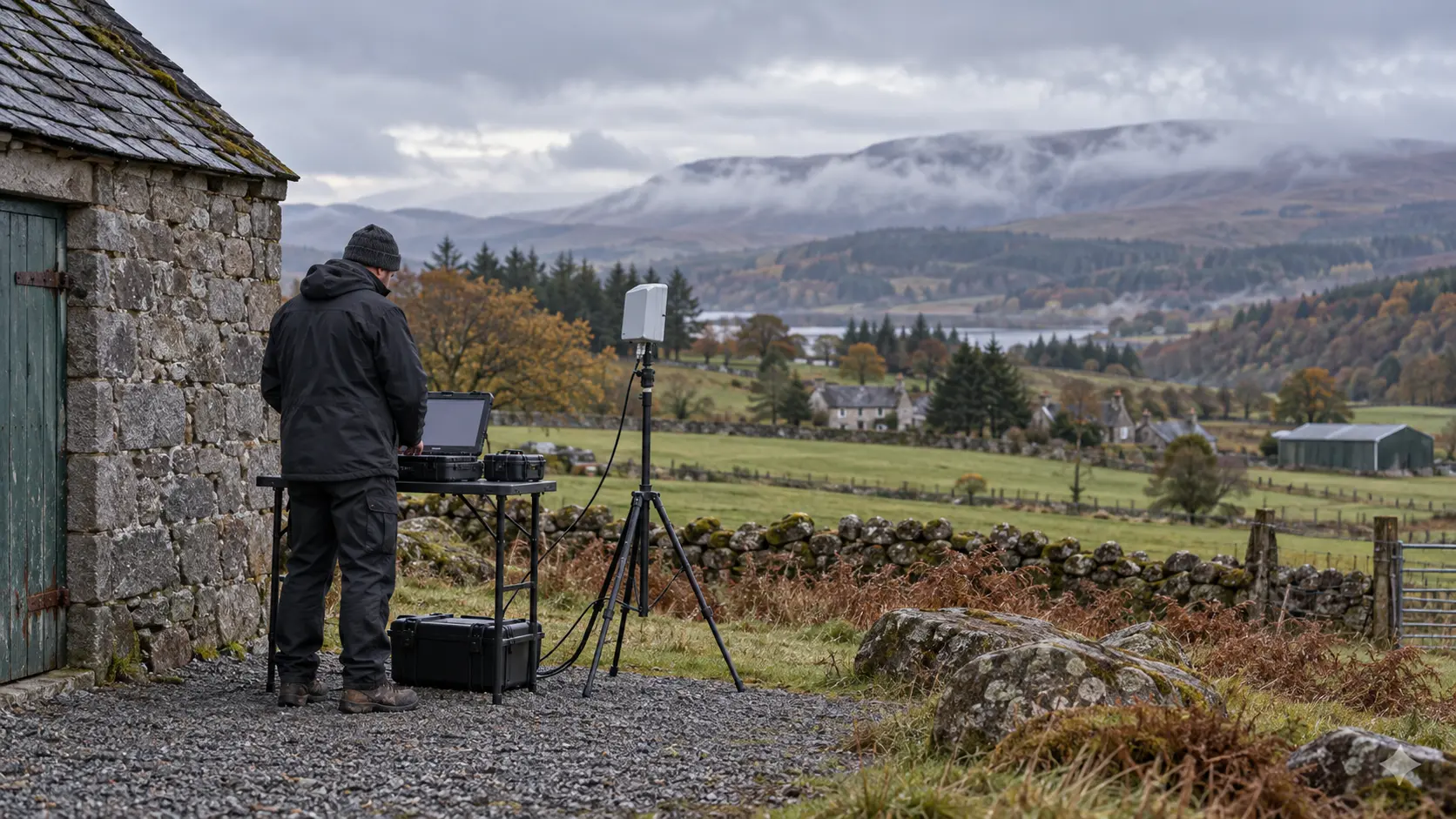
The companies' 9 September announcement proposes deploying Tarana G1 base nodes around Aberdeen and testing four-carrier operation under an Ofcom experimental licence. Tarana describes support for four independent 40 MHz carriers and up to 1.6 Gbps of aggregate capacity per link. These are platform capabilities, not published measurements from the planned trial or a guaranteed household download rate.
Scot-Tel-Gould already uses the vendor's equipment in the Huntly 5G Project, according to the announcement. That earlier deployment provides an operating relationship; it does not supply the missing results for this 6 GHz test.
A less prescriptive entrance test
The important backdrop is in Ofcom's July decision. Rather than requiring every relevant device to use a contention-based protocol, the regulator accepted techniques offering at least equivalent spectrum-sharing performance. Its discussion names several contributors, including Comsearch, Cambium and Tarana.
Tarana's own consultation response had sought that technological latitude. Its argument was that fixed directional systems should not be forced into the same access method as conventional Wi-Fi. This is a supplier advocating for its architecture, not independent evidence that its equipment is superior, and the final decision cannot be attributed to that supplier alone.
The commercial consequence is a broader field of eligible designs. Regional operators can consider different ways of supplying capacity without one protocol choice deciding entry in advance. Interference protection remains the performance obligation; technology neutrality is not an exemption from sharing responsibly.
The usable resource is local
An open equipment choice still has to meet a specific location. Ofcom's AFC guidance explains that automated frequency coordination uses device parameters, position and information about protected services to determine available frequencies and permitted power. AFC providers must register with the regulator before offering that service.
For a network planner, therefore, four supported carriers are not four assured carriers everywhere. The worthwhile result would connect the frequencies and power available at a site to repeatable service capacity under realistic demand. A peak link figure alone does not answer how much service can be sold reliably across a rural footprint.
No completed Aberdeen results, local frequency assignments, customer tariff or rollout timetable have been disclosed in this evidence package. The proposed experiment should be read as a way to produce those operating insights, not as proof that a general commercial 6 GHz service is already available. Opening the contest between radio designs is one step; demonstrating an offer a regional operator can sustain is the next.
Member Briefing
Deeper Profile Context
Sign in with the right membership level to unlock the full briefing and source notes.
Only for Strategic Circle
Strategic Circle
Open to all readers. Unlock profile briefings after joining and signing in.
Join Strategic CircleOnly for Leadership Alliance
Leadership Alliance
For qualified IP-asset owners and management; sign in to unlock alliance briefings.
Join Leadership Alliance