
Summary
- SunPower says it has broken ground on the first phase of a solar power system for a new AI data centre in Reno, with Cobalt Power Systems awarded the work.
- The company discloses no project capacity, contract value, customer, delivery schedule, margin or follow-on award. Its executive says the project is below 100MW-plus scale and describes installation as a learning opportunity.
- The award is evidence of a commercial reference point, not proof of a scaled pipeline or attractive project returns. The next test is whether execution produces disclosed capacity, collections, margins and repeat work.
The first phase has a smaller job than the headline
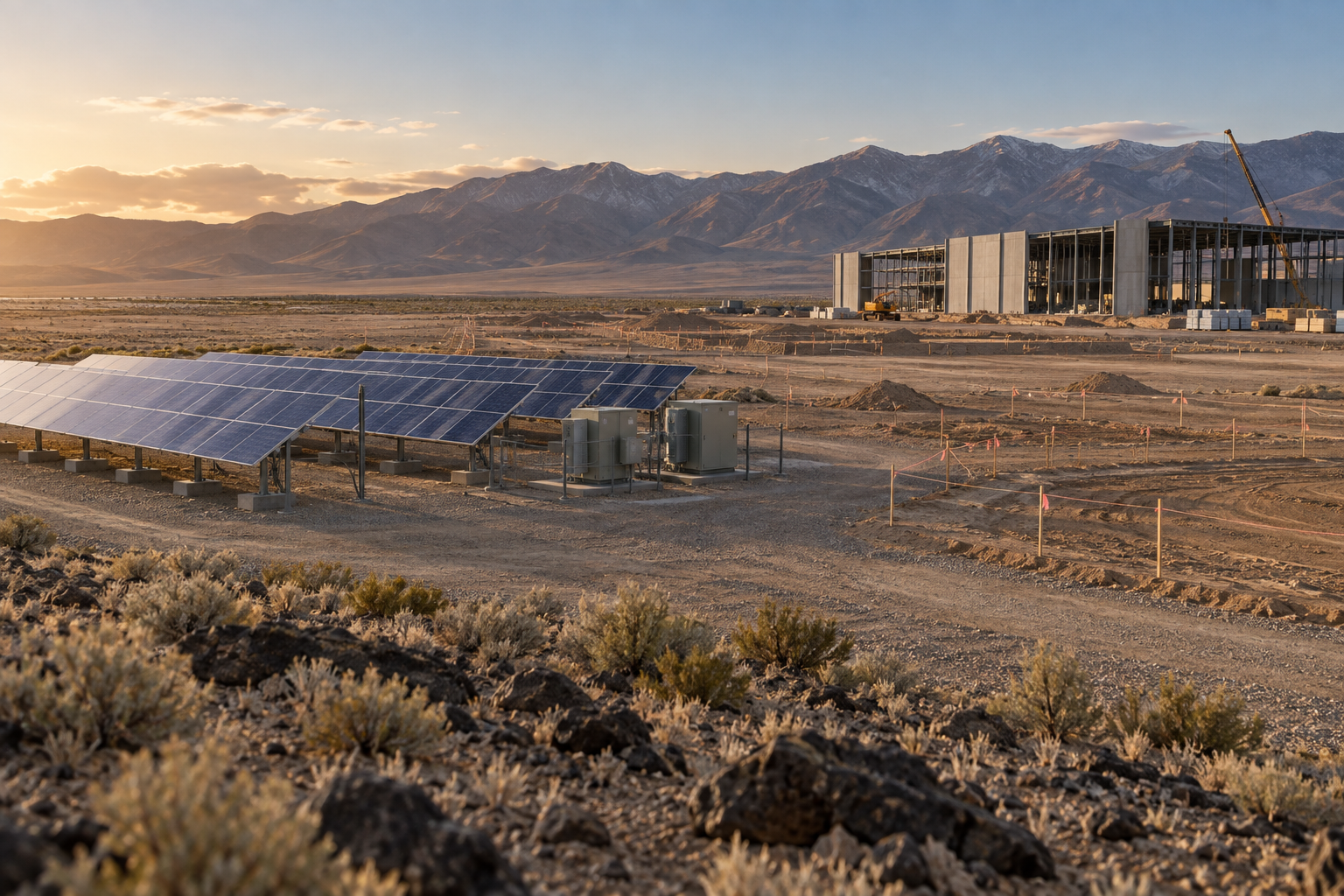
The AI data-centre label is large; the disclosed contract is not. SunPower’s 6 October announcement says it has broken ground on a solar power system for a new data centre “located in Reno, Nevada.” Its subsidiary Cobalt Power Systems won the first phase. That is the full public description of the work’s scope. The release gives no solar capacity, site address, end customer, project owner, contract price, financing, interconnection, commissioning date or expected output. (SunPower’s announcement)
The company itself supplies the most useful scale warning. Cobalt executive John Paul Bergh says the project is “not yet at the 100-megawatt-plus scale,” calls it complex and says installation will be a learning opportunity as SunPower expands its commercial-system capability. That language describes a milestone in capability-building, not a completed proof of large-project economics. “First phase” may imply later work, but the release does not promise or price any follow-on phase.
The distinction matters because AI infrastructure headlines often compress several economic layers into one image: a data-centre campus, its electricity demand, a solar installation, the grid connection and the contractor’s revenue. They are not the same asset or claim. SunPower’s award establishes a construction role in one solar phase. It does not establish that the solar system can power the full data centre, that the site has a particular load, or that the contractor will earn a durable share of the facility’s spending.
A bigger invoice is not a margin disclosure
CEO T.J. Rodgers says SunPower’s average residential solar job is about US$32,000, its high-tech Silicon Valley installations average US$44,000, and some commercial installations exceed US$1 million. He concludes that “bigger is better on the bottom line.” These are management’s comparisons, not project-level financials. The release does not say the Reno award exceeds US$1 million—or disclose what it is worth at all.
Average ticket size is a weak substitute for unit economics. A larger installation may carry more engineering, permitting, equipment, working-capital and commissioning obligations. It may also have better fixed-cost absorption. Without the contract value, project cost, payment milestones, change-order exposure, warranty allocation and final acceptance terms, neither effect can be measured. Gross margin cannot be inferred from a large invoice, and revenue cannot be treated as collected cash.
There is evidence that Cobalt has delivered commercial work before. In May, SunPower said Cobalt completed three solar photovoltaic systems at Santa Clara University, with 1.2MW of installed capacity. The company estimated annual generation above 2.1 million kilowatt-hours and US$8.8 million in energy savings over a 25-year warrantied life. Those numbers describe the university project and are company-reported; they are not specifications, savings or contract economics for Reno. The example supports a narrower conclusion: Cobalt has executed at least one multi-site commercial installation.
It does not establish that a different customer, site and scale will repeat the same result.
SunPower acquired Cobalt in an all-equity transaction valued at US$12 million in February. The strategic logic is understandable: an acquired engineering and installation unit can extend a residential-led platform into commercial projects. But acquisition consideration is not a return hurdle by itself. Investors still need to see post-acquisition bookings, completed work, collections and contribution after direct costs. One first-phase award is a starting observation, not evidence that the acquisition has paid for itself.
The balance sheet makes conversion—not aspiration—the test
At 28 June, SunPower reported US$4.024 million of cash in its quarterly filing. Its July Q2 release showed revenue of US$55.956 million, down from US$72.793 million in Q1, a 47% GAAP gross margin versus 62% in the prior quarter, and a GAAP operating loss of US$18.115 million. Those dated company disclosures frame why execution and collection matter, but they are not an October cash balance or proof that the Reno project changes the company’s financial trajectory. SunPower announced a separate US$26.2 million equity private placement in September, after the quarter-end snapshot.
Nor does the existence of cash pressure prove that the Reno project is a rescue, or that it will consume a particular amount of working capital. The release does not disclose either. The practical question is whether SunPower can turn a technically demanding contract into cash on schedule while preserving quality and service across its other businesses. A project that expands capability but ties up cash, produces rework or misses acceptance can be strategically useful and financially disappointing at the same time.
Reno is a location label, not a permitting conclusion
The City of Reno says it will not accept new conditional-use-permit applications for data centres within city limits through 31 August 2027, unless adequate regulations are adopted sooner. That policy is a relevant diligence trigger, not proof of a problem with this project. SunPower identifies only “Reno, Nevada,” without an address or jurisdiction. The site could have prior approvals, lie outside the city boundary, or be described using the broader metro area. No conclusion about permitting can be drawn from the two statements alone. (City of Reno development update)
The next disclosure that would change the investment reading is not another AI label. It is a small set of operating evidence: the project’s location and customer, installed megawatts, contract amount and payment schedule, the date of commissioning and acceptance, and whether SunPower reports positive contribution after direct costs. Follow-on phases would matter only when awarded, not when implied by the phrase “first phase.”
For now, the Reno award shows that Cobalt has entered a more demanding project environment and that SunPower wants to learn from it. It does not yet show the scale, economics or repeatability needed to value the company as a scaled commercial solar contractor. The capability test has begun; the scale proof has not.
Sources: SunPower’s Reno announcement, 6 October 2026; SunPower Q2’26 results, 28 July 2026; SunPower Form 10-Q, quarter ended 28 June 2026; Cobalt acquisition close, 3 February 2026; Cobalt’s Santa Clara University project, 26 May 2026; City of Reno development update; September equity placement filing.
Member Briefing
Deeper Profile Context
Sign in with the right membership level to unlock the full briefing and source notes.
Only for Strategic Circle
Strategic Circle
Open to all readers. Unlock profile briefings after joining and signing in.
Join Strategic CircleOnly for Leadership Alliance
Leadership Alliance
For qualified IP-asset owners and management; sign in to unlock alliance briefings.
Join Leadership Alliance