Summary
- STTGDC says operational capacity rose 25% from the end of 2025 to 780MW by June 2026. It separately reports a 50% rise in contracted capacity and a 30% rise in annualised EBITDA, without publishing the absolute contracted MW or EBITDA in the closing release.
- Nearly 2GW of powered land is secured for assets under construction and pipeline development. It is not another 2GW of operating capacity and should not be added to the 780MW base.
- KKR and Singtel were expected to own 75% and 25% after buying the remaining 82% for S$6.6bn. The S$13.8bn implied enterprise value includes leverage and capital expenditure for committed projects, making a headline value-per-live-MW ratio misleading.
The most useful sentence in STTGDC's closing announcement contains two capacities that never meet. One is 780MW of operational capacity. The other is close to 2GW of powered land for assets under construction and development. They belong to the same company, but not to the same stage of production.
That distinction becomes more important after a takeover. At signing, the KKR-led consortium and Singtel agreed to pay S$6.6 billion for the 82% of STT GDC they did not already own. KKR's transaction announcement put the implied enterprise value at S$13.8 billion and said KKR and Singtel would hold 75% and 25% after completion. The acquisition is now closed. The development risk is not.
The operating receipt is 780MW
The SGX-hosted closing release says operational capacity increased 25% from the end of 2025 to 780MW by June. “Operational” is the strongest capacity label in the update: it identifies infrastructure that has crossed more gates than land, design or construction.
Even this number should not be stretched. The release does not provide a site table, disclose how much is leased or billable, or say how much entered service at each location. Nor should a reader reverse the rounded 25% change to manufacture a precise December base. The defensible receipt is the reported direction, period and ending level.
Two other indicators point to commercial progress but are less complete. Contracted capacity grew 50%, and annualised EBITDA rose 30%, for the period from December 2025 through June 2026. The percentages have no published absolute starting or ending values in the release. They cannot be turned into contracted megawatts, dollars of EBITDA or a valuation multiple.
The difference between 50% contract growth and 30% annualised-earnings growth is not, by itself, evidence of deteriorating economics. Contracts may start at different times; capacity may still be under construction; revenue recognition may wait for readiness and acceptance; ramp costs may precede billing. Without the bases and definitions, the two percentages are indicators, not a margin bridge.
Powered land is an input, not an output
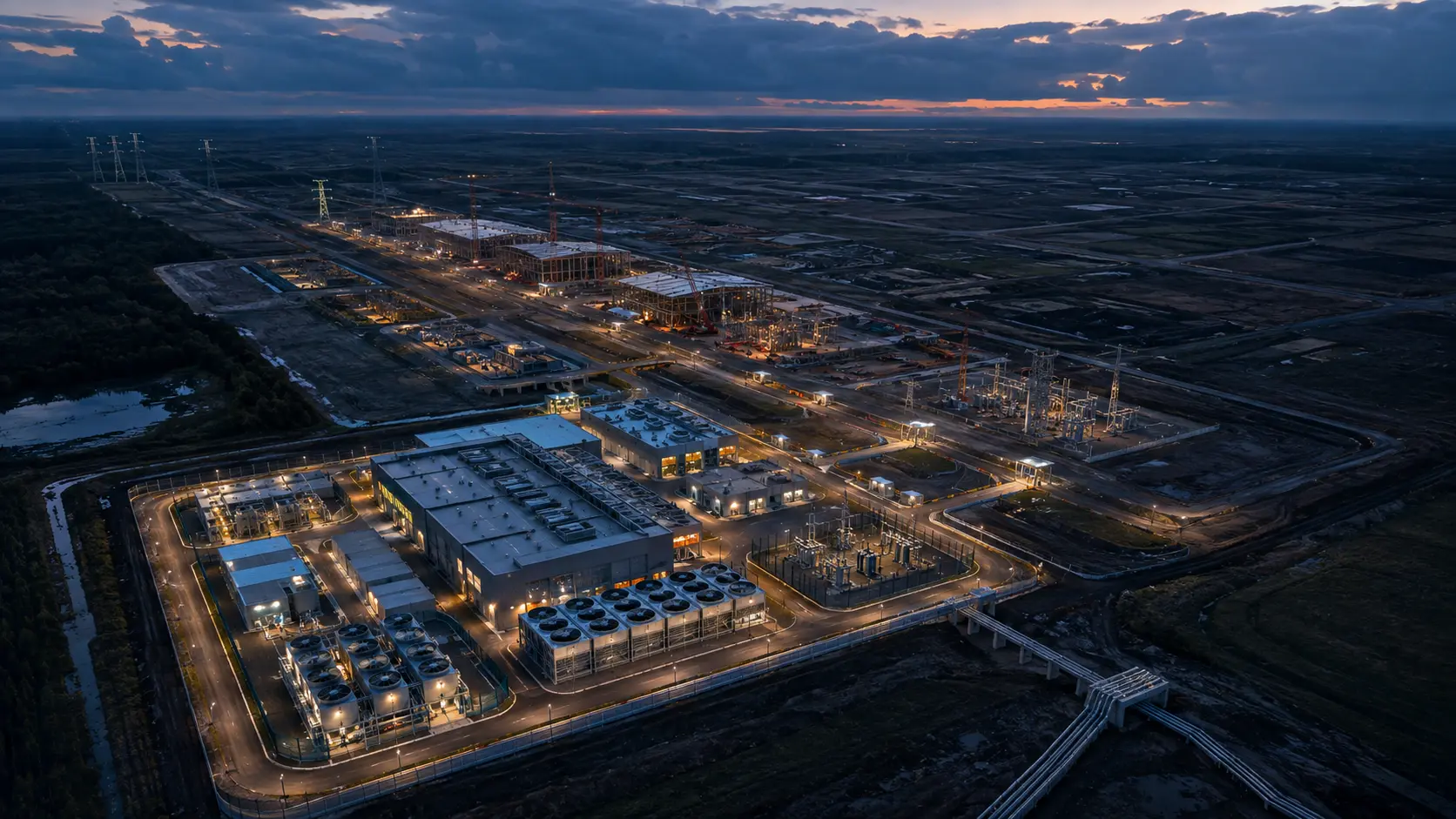
STTGDC says it has secured close to 2GW of powered land for assets under construction and pipeline development. “Powered land” can be highly valuable. Access to sites and electricity is often the scarce input in data-centre markets, and it can shorten the path to a credible customer offer.
It does not eliminate the path. A powered site may still need permits, utility milestones, financing, civil works, substations, backup systems, cooling, network routes, server halls, customer fit-out, testing and acceptance. The announcement does not publish those stages site by site. Nearly 2GW therefore belongs in a delivery queue, not in an operating-capacity total.
The February signing release used still another pair of measures: 2.3GW of design capacity and a pipeline that had grown from 1.4GW in 2024 to more than 1.7GW. September's “close to 2GW of powered land” is not labelled as an update to either series. A tempting claim that the pipeline grew by roughly 300MW would join unlike definitions. Design capacity, development pipeline and powered land can overlap, but the public record does not reconcile them.
Regional numbers have the same problem. The closing release cites 34 Indian data centres with more than 613MW of IT capacity, an Indonesian development pipeline above 360MW backed by secured power, and a 50MW Singapore selection. The nouns do the accounting: capacity, pipeline and selection are not interchangeable. Adding them would count geographies and project states without knowing their overlap.
The price has more than one perimeter
The consortium's S$6.6 billion consideration bought the remaining 82%. The S$13.8 billion figure is an implied enterprise value that the signing release says includes leverage and capital expenditure for committed projects. One number describes what changed hands; the other describes a broader financing and project perimeter.
Dividing S$13.8 billion by 780MW would look rigorous and mean little. Its numerator includes debt and committed-project capital, while its denominator is operating capacity only. Dividing by 2GW would be no better, because the denominator would then include projects that are not operating. Neither ratio measures a price paid for a homogeneous block of live capacity.
The transaction is better understood as a purchase of control over a conversion system. The buyers receive the operating platform, customer relationships, staff, development rights and a pipeline of potential future assets. Their return depends not only on demand but on the sequence in which capital becomes sites, sites become commissioned halls, halls become accepted capacity and accepted capacity becomes durable cash.
Continuity does not mean unchanged control
STTGDC says customers will continue to be served by the same leadership team and that the name will remain. Singtel had also said in its full-year update that STTGDC would operate independently from Nxera, Singtel's regional data-centre arm. Operational continuity can protect customer trust and keep local execution intact.
Capital allocation is nevertheless under new control. A 75% KKR interest and 25% Singtel interest give the consortium the economic incentive to accelerate valuable projects, but also to rank them. Locations with contracted demand, firmer power, clearer permits and financeable returns may move first. Sites with weaker receipts may wait even when they remain inside the headline pipeline.
That selection is not a flaw. It is how a large development portfolio avoids treating every megawatt as equally mature. The risk is that aggregate pipeline language hides the ranking, making investors and customers infer a delivery schedule that management has not published.
What the next receipts should show
The first useful disclosure would reconcile capacity by state: operating, commissioned but not billable, contracted under construction, powered-land pipeline and earlier-stage design. A common reporting date and site-level movements would reveal whether the 780MW base is growing through completed delivery rather than reclassification.
The second would give absolute contracted capacity and an occupancy or billing bridge. A percentage increase is helpful, but it cannot show whether customer commitments are keeping pace with construction, how concentrated they are, or when they begin producing revenue.
The third is capital. Because the enterprise-value figure includes capex for committed projects, future reporting should distinguish acquisition financing, existing leverage, project-level debt, equity contributions and customer-supported fit-out. Otherwise the same future megawatt can appear both in the valuation story and again in the expansion budget.
The acquisition has supplied a clean ownership receipt. STTGDC has supplied a meaningful operating receipt. The remaining question is whether the owners can produce a chain of delivery receipts long enough to turn close to 2GW of secured powered land into capacity that customers can use and pay for.
Member Briefing
Deeper Profile Context
Sign in with the right membership level to unlock the full briefing and source notes.
Only for Strategic Circle
Strategic Circle
Open to all readers. Unlock profile briefings after joining and signing in.
Join Strategic CircleOnly for Leadership Alliance
Leadership Alliance
For qualified IP-asset owners and management; sign in to unlock alliance briefings.
Join Leadership Alliance