Summary
- The Utility Regulator’s new annual threshold is £3.5 million in 2021/22 prices. Approved severe-weather recovery costs above it move to full consumer pass-through.
- The same licence changes create a route for later resilience allowances. The regulator’s 11kV tree-cutting example is estimated at £20 million, with about £1.50 added to the average household bill by 2031. The first project award still awaits its own published determination.
The storm left a bill-shaped hole
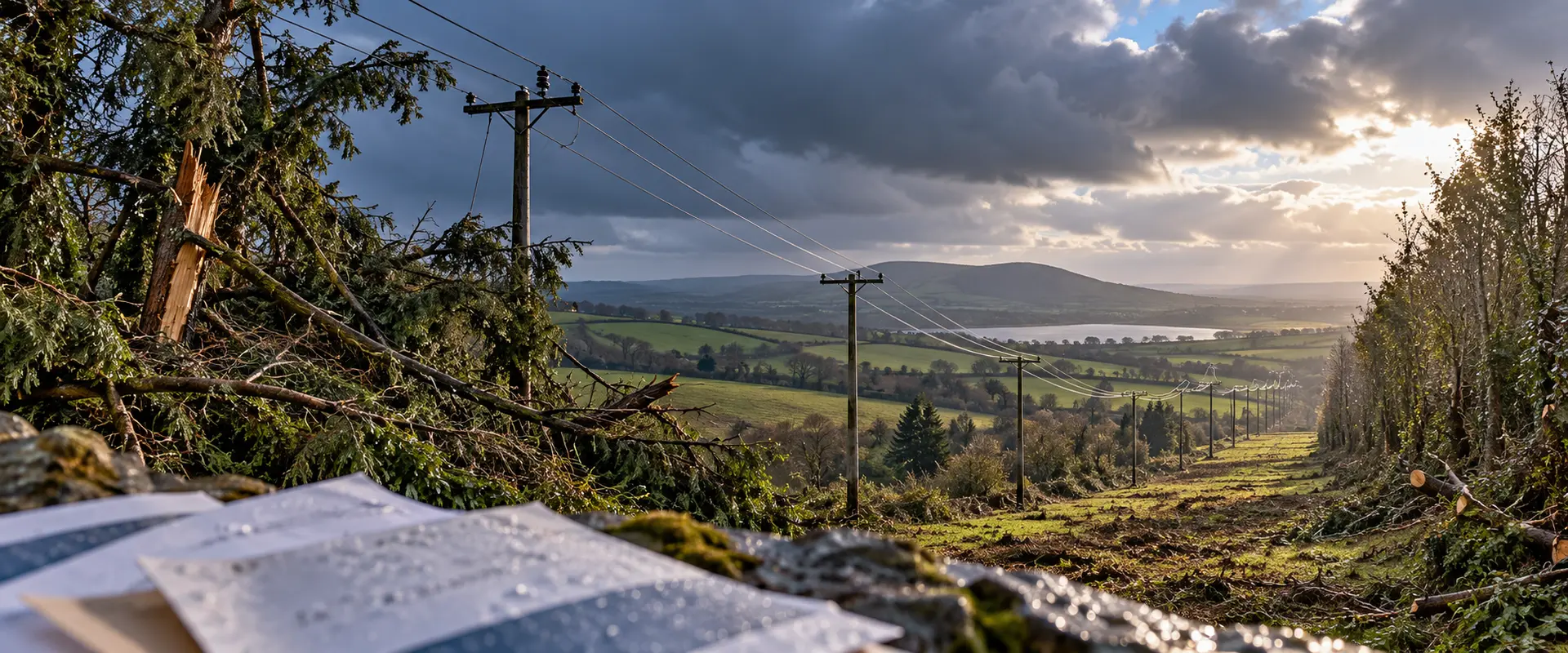
On 24 January 2025, Storm Éowyn dropped power to more than 320,000 homes and businesses across Northern Ireland. The Utility Regulator’s decision records more than 5,000 faults and gusts above 90 mph. Repairs and restoration cost £22 million. Under the price-control rules then in force, consumers and NIE Networks each carried half. The storm’s final power restorations ended on 3 February. (Utility Regulator decision paper, §§2.5–2.7)
The repair arithmetic now has a new hinge: £3.5 million in 2021/22 prices in any one year. The threshold is adjusted for inflation. Once approved severe-weather recovery costs cross it, costs above the line become pass-through expenditure recovered in full from consumers. Operating costs go through first, so the extra revenue can reach tariffs in the following October-to-September tariff year. A storm can therefore arrive in January and appear on a later bill with the administrative punctuality of a tax inspector. (Utility Regulator decision paper, §§3.19–3.23, 3.31–3.42)
The cap limits the network company’s exposure while keeping approval and audit control with the regulator. NIE Networks must submit the cost record; the regulator can investigate or audit it before approving an amount. The definition covers marginal costs caused by severe weather and excludes fixed overhead allocations. Consumers pay approved costs above the threshold in full; the existing 50/50 cost-sharing mechanism governs the amount below it.
The Regulator built the threshold from 12 years of reported severe-weather costs, excluding 2024/25. It judged £3.5 million, in the old price base, a reasonable 95th-percentile annual level—roughly a one-in-twenty-year event. Applied to Éowyn, the new design would have cut NIE Networks’ exposure after cost sharing from £9.8 million to £1.75 million. Across RP7, the regulator says the company’s maximum exposure would be £10.5 million. (Utility Regulator decision paper, §§3.27–3.30)
Trees, wires and a £1.50 household wager
Éowyn’s damage concentrated on lines with a large reach. The regulator’s table records 240,112 customer interruptions and 335 million customer-minutes lost on the 11kV overhead main line. That was 74% of interruptions and 65% of lost minutes in the event’s total. The main line feeds spur lines and lower-voltage customers, so one fault can darken a large branch of the network.
NIE Networks had completed resilience tree cutting on 11% of its 11kV main line before the storm. The company’s comparison estimated that a completed programme would have cut Éowyn’s total faults by 9%, customer interruptions by 35% and customer-minutes lost by 50%. It put the accelerated work at about £20 million and the average domestic bill impact at £1.50 by the end of 2031. These are counterfactual estimates for a proposed programme. Measured post-cut results will come from the circuits after the work is completed and their fault records accumulate. (Utility Regulator decision paper, §§2.11–2.17)
The August licence change gives the regulator authority to determine additional capital and operating allowances for material resilience projects that are likely to reduce severe-weather harm to consumers. It also gives more flexibility over when further IT allowances are set and adjusts rules on non-locational charges. The licence changes took effect on 19 October 2026. The decision describes the tree programme as an example and says future allowances require a published determination. The next hard evidence is therefore a funded project, its approved cost and the interruption measure it promises to improve. (Decision notice; licence decision notices and modified licences)
The operator gets a ceiling; customers get the weather
The design draws a clean line between a rare event and ordinary operating discipline. Below the annual threshold, NIE Networks shares costs with consumers. Above it, approved marginal costs pass through. The company’s exposure gets a ceiling; the bill does not. The regulator prefers an annual threshold over a single RP7-wide cap because a cumulative ceiling would send every later storm into consumer pass-through and weaken the company’s incentive to control repair costs.
There is a sharper bargain inside the tree-cutting estimate. Customers would pay about £1.50 per year by 2031 for work estimated to reduce interruptions by 35% in a repeat of Éowyn. The number is small enough to sound like loose change and large enough to require a decision about who gets cut first, which lines count, and how anyone will measure the promised improvement. The licence supplies the decision route; the first project paper must supply the operational case.
A sensible next filing should show its map, cost, risk ranking and expected interruption reduction before the regulator signs off. After completion, the network’s fault and restoration records can test the estimate. The work log can count trees cut; the service test is fewer interruptions and customer-minutes lost.
Sources
Member Briefing
Deeper Profile Context
Sign in with the right membership level to unlock the full briefing and source notes.
Only for Strategic Circle
Strategic Circle
Open to all readers. Unlock profile briefings after joining and signing in.
Join Strategic CircleOnly for Leadership Alliance
Leadership Alliance
For qualified IP-asset owners and management; sign in to unlock alliance briefings.
Join Leadership Alliance