
Summary
- What it says: Stadtwerke Lübeck is not just a local energy brand that added internet products to a website.
- Main topic: Regional ISP economics; Wholesale access economics; Data centre power and permitting; WHOIS/RDAP accountability
- Context: market / company research report / Europe / Germany
The expensive fact is the open street
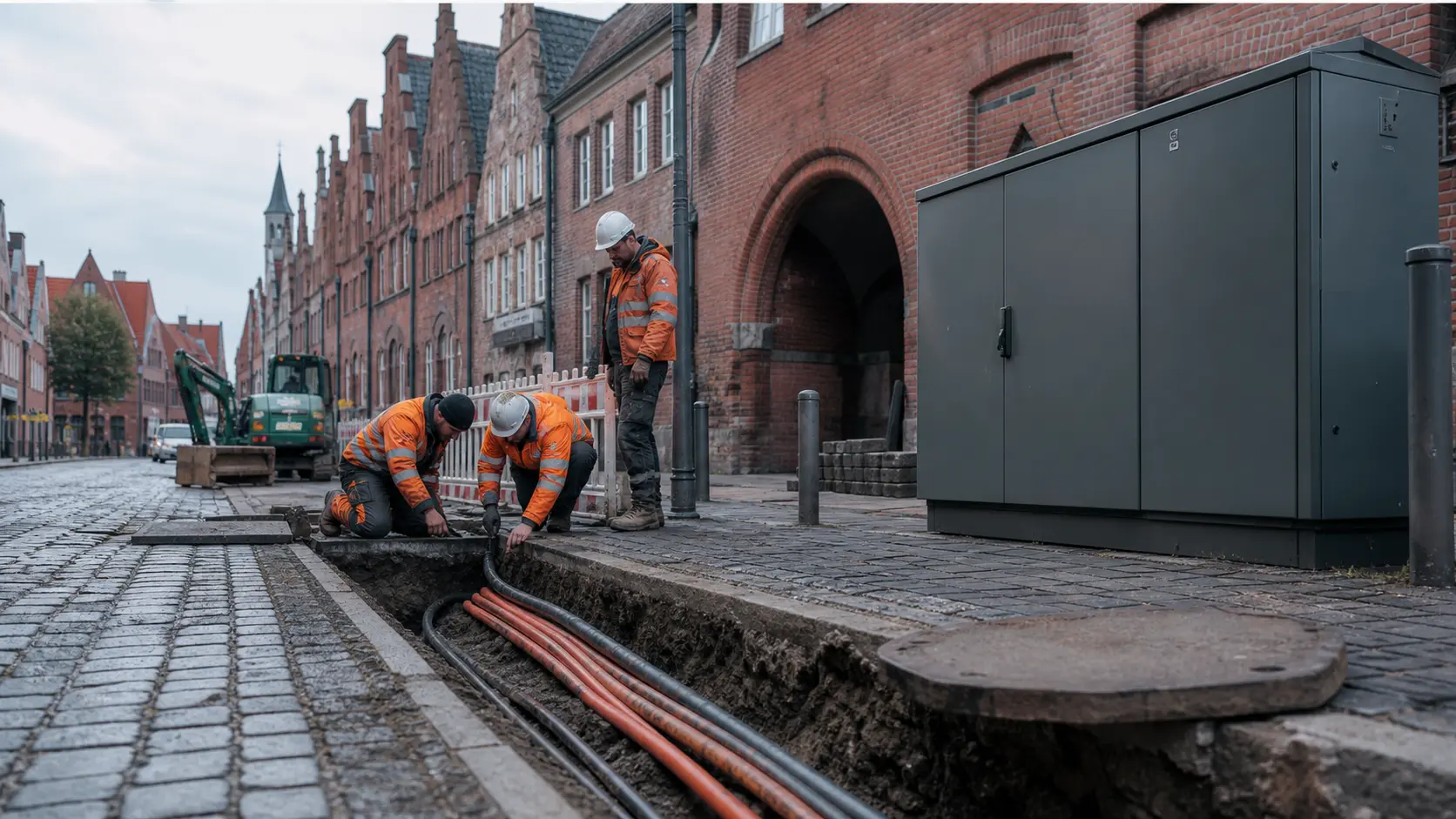
The first fact to hold in mind is not that Stadtwerke Lübeck sells gigabit internet. It is that somebody has to open a street, coordinate permissions, restore surfaces, get into a building, and then wait for enough residents or businesses to move from copper to fibre. A fibre strand is cheap compared with the trench around it. Stadtwerke Lübeck's own public help page explains why the rollout is "not as fast as we would like": the work has to meet many rules, collect permissions, deal with traffic orders, nature-protection issues such as tree roots, ordnance clearance, and in some districts coordinated construction with other network operators; it also says the utility renews walkway surfaces and street lighting for the city as part of fibre laying (https://www.swhl.de/hilfe/glasfaser/). That sentence is the economics of municipal broadband in miniature. A city utility can lower the cost of trust because it is already a civic operator, but it cannot make street work costless.
The second fact is the size of the asset now visible. On 10 June 2026, Stadtwerke Lübeck announced an open-access cooperation with 1&1 Versatel for business fibre in Lübeck, saying the agreement covers access to the municipal company's circa 240 kilometre fibre network in the Hanseatic city (https://www.swhl.de/news/2026/1-1-versatel-und-stadtwerke-luebeck-digital-schliessen-open-access-kooperation-glasfaser-fuer-unternehmen-in-luebeck/). The same announcement says 1&1 Versatel will connect the regional Stadtwerke network with its national fibre transport network so that companies in Lübeck can be supplied with high-performance internet and telecom services in the short term. That is a more important clue than an ordinary reseller badge. It says Stadtwerke Lübeck has enough physical network to be useful to a specialised national business carrier, and it says the municipal fibre asset is now being judged not only by direct retail sales but also by utilisation of existing infrastructure.
The retail price card shows the other side of the bargain. On the residential page, LueConnect surf is advertised at 49.95 euros per month for a maximum 1,000 Mbit/s download and 500 Mbit/s upload, with zero-euro FRITZ!Box, zero-euro provisioning, zero-euro house connection and a twelve-month contract term; the phone and multimedia bundles rise to 59.95 euros and 69.95 euros per month (https://www.swhl.de/internet/glasfaser/). On the business page, LueBusiness 500 is shown at 49.95 euros per month excluding VAT for 500/150 Mbit/s, LueBusiness 1000 at 69.95 euros for 1,000/250 Mbit/s, and LueBusiness 1000 Pro at 149.95 euros per month plus a 149.95 euro one-off charge, with optional symmetrical bandwidth and business features (https://www.swhl.de/gek/digital/glasfaser/). Those prices are not an audited revenue model. They are a signal of the recovery problem. A utility can spend millions building a network, but the household product is still anchored around monthly bills that look close to mass-market broadband, not a bespoke infrastructure rent.
This is why Stadtwerke Lübeck is economically interesting.
Its public evidence changes the buy-versus-build decision from "should a local utility become an ISP?" into "when should a utility keep building and selling itself, when should it lease capacity to specialist carriers, and when should it use its street-level civic position to reduce the customer-migration cost that private overbuilders struggle to overcome?" The 240 kilometre open-access figure, the tariff card, the AS29505 route record and the municipal financial reports all point to the same decision: the value is not only in owning fibre, but in filling it without letting civil works, low take-up, contractor delays and
support obligations consume the return.
A municipal digital company sits behind the retail brand
The public-facing name is Stadtwerke Lübeck, but the telecom operating evidence points specifically to Stadtwerke Lübeck Digital GmbH. The city's 2026 participation report describes Stadtwerke Lübeck Digital GmbH at Geniner Strasse 80, 23560 Lübeck, with a corporate purpose covering network build and operation in digitalisation and telecommunications as well as related products, services and data-based business models (https://www.luebeck.de/file/beteiligungsbericht_2026.pdf). The same report states that Stadtwerke Lübeck Gruppe GmbH owns 100 percent of the company. That matters because this is not a thin access brand using a local-sounding name. The fibre and digital business is embedded in a municipal corporate group that also sits beside energy, mobility, grid and civic-service functions.
The numbers show both strength and strain. In the city's 2026 participation report, SWL Digital's balance sheet total rises from about 25.8 million euros in 2023 to about 46.0 million euros in 2024, with planned 2025 assets of about 69.9 million euros; fixed assets rise from about 19.3 million euros in 2023 to about 41.7 million euros in 2024 and a planned 67.8 million euros in 2025 (https://www.luebeck.de/file/beteiligungsbericht_2026.pdf). Elsewhere in the same report, the city says SWL Digital's balance sheet total increased by 20.2 million euros compared with the prior year because of a fibre asset deal, with fixed assets rising by 22.3 million euros to 41.7 million euros and liabilities to affiliated companies increasing by 22.2 million euros to 28.4 million euros (https://www.luebeck.de/file/beteiligungsbericht_2026.pdf). That is the capital intensity of the story in official municipal language.
The income statement is less flattering but more useful. SWL Digital's revenues were about 14.4 million euros in 2023 and 14.5 million euros in 2024, with a plan of about 21.3 million euros for 2025, while ordinary operating results were negative 4.9 million euros in 2023 and negative 4.1 million euros in 2024 before loss absorption (https://www.luebeck.de/file/beteiligungsbericht_2026.pdf). A pure growth investor might read that as early-stage pain. A municipal lender should read it more carefully. Fibre ownership creates depreciation, interest, contractor and support costs before the customer base is mature. If take-up and wholesale utilisation rise, the asset base can become a durable city platform. If they lag, the same asset base becomes an expensive civic bet carried by the wider group.
The wider group is not fragile, but it is not a free capital machine. Stadtwerke Lübeck said in June 2026 that the group closed 2025 with a positive annual result of 5.7 million euros, revenue of 577 million euros, group equity of 208 million euros and a 7 million euro capital contribution from the city planned for 2026 to strengthen the group's financial basis (https://www.swhl.de/news/2026/stabile-basis-fuer-die-zukunft-stadtwerke-luebeck-gruppe-mit-positivem-ergebnis-2025/). The release frames energy transition, networks, heat and mobility as major investment tasks. Fibre is therefore competing for capital inside a municipal infrastructure portfolio. The political advantage is that digital infrastructure fits the city's long-term public-service agenda. The financial constraint is that buses, heat, electricity grids and water also need money.
This balance-sheet context is the first reason not to describe Stadtwerke Lübeck as just another regional ISP. The municipal group can carry projects through long payback periods, coordinate street access, bundle customer relationships and tolerate a lower early return than a venture-backed overbuilder. But it also has public accountability. A private ISP can exit a bad cluster. A Stadtwerke group has to explain delays, surface restoration, tariff changes and customer service in the same city where it also sells energy and runs other civic services.
That accountability is an asset when trust is high and a cost when build performance disappoints.
The product is migration, not only bandwidth
The tariff pages show bandwidth, but the real product is migration from an old relationship to a new one. Stadtwerke Lübeck's fibre page sells LueConnect at up to 1,000 Mbit/s down and 500 Mbit/s up, but the same product card also advertises a zero-euro house connection, zero-euro provisioning, a twelve-month term, a router, TV options and help with cancelling the old provider when the customer ports a number (https://www.swhl.de/internet/glasfaser/). The help page goes further: if customers port their existing phone numbers, Stadtwerke Lübeck says it will cancel the old connection and provide the new tariffs only at the porting date so customers do not pay twice; if there is no porting, the customer may need to coordinate the old contract separately (https://www.swhl.de/hilfe/glasfaser/). That is a sales function, but it is also a cost function. Every avoided migration failure protects take-up.
The same page says an already connected house may be activated in roughly four weeks after an order is received, while a house without fibre depends on the build status in the relevant area (https://www.swhl.de/hilfe/glasfaser/). That distinction matters more than the headline speed. A household deciding whether to switch from DSL does not buy a 30-year infrastructure model. It buys confidence that the order will not leave it paying two bills, waiting through a long build, or explaining to an old provider why a number was not ported. Stadtwerke Lübeck's municipal advantage is that many residents already know the name. Its burden is that a fibre delay can spill into the broader reputation of the utility brand.
The business product has a different migration problem. The LueBusiness page starts at the same 49.95 euro monthly level excluding VAT for a 500/150 Mbit/s business tariff and rises to 149.95 euros per month for the Pro product, with one fixed IP included in the lower tiers, up to eight fixed IPs available in the Pro tier, optional symmetrical bandwidth, optional router, and optional service-level arrangements (https://www.swhl.de/gek/digital/glasfaser/). The page also advertises an optional professional SLA with 24/7 reachability and express fault repair, usually within about eight hours (https://www.swhl.de/gek/digital/glasfaser/). For a business customer, that eight-hour repair claim is more economically meaningful than the difference between 500 and 1,000 Mbit/s. It is the difference between broadband as a utility bill and broadband as an operating dependency.
There is a clear segmentation logic. Households anchor take-up and political legitimacy. Small businesses and professional users raise average revenue and create demand for fixed IP, symmetrical bandwidth and repair assurances. Larger business customers, multi-site customers and companies outside the build area are invited into custom solutions, which can turn the same physical fibre into higher-margin work if the cost of connection is controlled (https://www.swhl.de/gek/digital/glasfaser/). The open-access agreement with 1&1 Versatel adds another layer: Stadtwerke Lübeck can monetise the municipal network without always owning the customer interface (https://www.1und1.net/unternehmen/presse/pressemitteilungen/1und1-versatel-und-stadtwerke-luebeck-digital-kooperation).
This is the second reason the company is more interesting than its tariff card. The product is not "gigabit for 49.95 euros." It is a conversion engine. A successful conversion engine persuades landlords, residents, tenants, businesses, old-provider customers and wholesale partners to move onto a newly built network quickly enough to support the street-work bill. A weak one leaves the city with technically modern fibre that is underused while customers keep paying for copper, cable or a larger carrier's service. The most valuable operating metric would therefore not be advertised speed.
It would be cluster-level take-up by build year, split between residential retail, business retail and wholesale lines.
The build method explains the cost curve
Stadtwerke Lübeck's own build information is unusually useful because it describes the physical sequence. The company says it works in clusters of about 2,000 residential units, opens streets one after another inside those clusters, uses modern microduct systems, and uses surface-friendly procedures that disturb pavements as little as possible (https://www.swhl.de/internet/glasfaser/hausanschluss-bauinfos/). It distinguishes network levels: NE1 and NE2 for regional and city networks, NE3 for fibre from the street to the building, and NE4 for in-building fibre to the apartment (https://www.swhl.de/internet/glasfaser/hausanschluss-bauinfos/). Those labels are technical, but the economic point is simple. Every step from backbone to apartment creates a different permission, labour and failure surface.
The FAQ adds the customer-side detail. Stadtwerke Lübeck says a house can often be connected without trenching across the garden: a small head hole is opened at the wall, the cable is pushed from the pavement toward the house using a pneumatic mole, and the wall penetration is sealed gas- and watertight (https://www.swhl.de/hilfe/glasfaser/). It also says the standard private-property trench is 60 cm deep and 30 cm wide, though actual scope depends on local conditions, and that the company restores the original condition after work (https://www.swhl.de/hilfe/glasfaser/). In multi-dwelling buildings of three or more units, Stadtwerke says it creates the in-building wiring and gives each unit its own fibre termination; in smaller homes, the customer is responsible for internal cabling, though Stadtwerke recommends professional installation (https://www.swhl.de/hilfe/glasfaser/).
That evidence makes the cost curve visible. A household tariff can be sold online, but the gross margin is created or destroyed by how many houses in a cluster can be connected while crews, permits, contractors and reinstatement work are already in motion. A missed owner appointment, a blocked duct, a disagreement over the building entry point, a heritage or tree-root constraint, a traffic order delay, or a coordination requirement with another network operator can add costs before a single monthly bill is paid. The street is also a public space. If surface restoration is poor, the complaint is not only a telecom complaint.
It is a municipal complaint.
The free-house-connection offer sharpens the bet. Stadtwerke Lübeck's fibre page tells customers to order quickly during the build phase because the utility will cover the cost of building the house connection in connection with a tariff booking and says customers can save up to 1,000 euros (https://www.swhl.de/internet/glasfaser/). This is a rational customer-acquisition tool: the connection is cheapest when crews are already there. But it also brings forward capital recovery risk. The company spends to connect premises now and recovers through monthly service, wholesale utilisation or later customer additions. If a cluster has strong conversion, the free connection is a smart accelerator. If a cluster has weak conversion, the same offer can turn into subsidised dormant infrastructure.
The city's wider civil-works logic supports the municipal case. The Bundesnetzagentur notes that companies from different sectors can cooperate in infrastructure buildout and that simultaneous laying of electricity lines and telecom infrastructure can raise synergies and accelerate broadband expansion (https://www.bundesnetzagentur.de/DE/Fachthemen/Telekommunikation/Breitband/Ausbau/ausbau-node.html). A Stadtwerke group with energy, grid and municipal relationships is well placed to exploit that coordination. But coordination is not automatic. It requires route planning, shared cost allocation, documentation, contractor discipline and clear responsibility for later faults. The hidden asset is not simply a trench. It is the institutional ability to make one trench do more than one job.
AS29505 gives the fibre business a network spine
The route record is the strongest evidence that Stadtwerke Lübeck is not only a municipal construction and billing operation. PeeringDB lists the network as Stadtwerke Lübeck Digital GmbH, also known as TRAVEKOM, TraveNetz and Stadtwerke Luebeck, with AS29505, IRR set AS-SWHL, looking glass at https://lg.travenetz.ip-works.de, network type Cable/DSL/ISP, 50 IPv4 prefixes, 10 IPv6 prefixes, and a public website at https://www.swhl.de (https://www.peeringdb.com/net/13213). PeeringDB also places the organisation at Geniner Strasse 80 in Lübeck (https://www.peeringdb.com/org/16768). This is not proof of retail service quality, but it is proof of a visible network identity.
BGP.tools describes AS29505 as a 22-year-old BGP network registered to Stadtwerke Luebeck Digital GmbH, with visible prefixes including 85.233.0.0/19, 85.233.31.0/24, 149.249.64.0/18 and 2a07:6c40::/29, valid RPKI marks on those listed prefixes, 285 peers and three upstream carriers in the observed view (https://bgp.tools/as/29505). Hurricane Electric's BGP Toolkit reports five internet exchanges, four originated prefixes, valid RPKI for all originated prefixes, 227 observed BGP peers and 24,576 originated IPv4 addresses (https://bgp.he.net/AS29505). IPinfo likewise identifies AS29505 as Stadtwerke Luebeck Digital GmbH in Germany and shows the swhl.de domain attached to the ASN (https://ipinfo.io/AS29505).
The interconnection list is useful because it shows regional and national reach. BGP.tools shows the network peering at DE-CIX Frankfurt at 100 Gbit/s, MegaIX Hamburg at 20 Gbit/s, MegaIX Frankfurt at 10 Gbit/s, AMS-IX at 10 Gbit/s and DE-CIX Hamburg at 10 Gbit/s (https://bgp.tools/as/29505). PeeringDB search output for the same network shows DE-CIX Hamburg, MegaIX Frankfurt and MegaIX Hamburg entries with route-server participation and BFD support, while Hurricane Electric lists upstreams and peers including Core-Backbone, Cogent and COLT among the visible peer set (https://bgp.he.net/AS29505). The exact traffic commercial terms are not public. The economic meaning is still clear: Stadtwerke Lübeck can speak BGP in its own name, run customer address space, participate in major internet exchange environments and choose among upstream paths.
That changes the investment reading. A municipal utility that merely resells another carrier's broadband has limited control over route quality, wholesale cost and business-customer credibility. A utility with AS29505, exchange presence and address resources has a stronger claim to being an operator. The claim is not unlimited. The network still depends on upstream carriers, exchange ports, optical transport, data-centre access and engineering staff. But it can offer a business customer or wholesale partner more than a local access tail. It can offer a route-aware local network.
The route data also sets a harder service test. Business customers who buy fixed IP, symmetrical options, multi-site service or a repair SLA will eventually care about the behaviour of the network under stress. How does AS29505 reroute around an upstream problem? How much capacity is actually available during peak traffic? Which links are diverse in practice rather than only in diagrams? How quickly can engineering identify whether a fault is in the street, the building, the customer router, the PON segment, the exchange port or the upstream? The public route record gives confidence that the company has an operational spine.
It does not prove the incident discipline that premium business tariffs require.
Open access is the discipline test
Open access is where Stadtwerke Lübeck's economics become less local and more financial. The company's FAQ says that, in most cases, only Stadtwerke Lübeck services can currently be obtained over Stadtwerke Lübeck Digital GmbH fibre connections, while the company is working to allow other service providers access through IP bitstream access if the necessary network interfaces and provider interest exist (https://www.swhl.de/hilfe/glasfaser/). That statement is important because it defines the starting position: a vertically integrated municipal retail network whose physical access was not yet broadly wholesaled.
The 1&1 Versatel agreement changes the direction. Both Stadtwerke Lübeck and 1&1 Versatel describe the June 2026 cooperation as an open-access arrangement for companies in Lübeck, with 1&1 Versatel connecting the regional municipal network to its national fibre transport network (https://www.swhl.de/news/2026/1-1-versatel-und-stadtwerke-luebeck-digital-schliessen-open-access-kooperation-glasfaser-fuer-unternehmen-in-luebeck/ and https://www.1und1.net/unternehmen/presse/pressemitteilungen/1und1-versatel-und-stadtwerke-luebeck-digital-kooperation). 1&1 Versatel says it cooperates with more than 400 regional telecom partners across Germany as both buyer of wholesale inputs and lessor of its own 68,500 kilometre fibre infrastructure (https://www.1und1.net/unternehmen/presse/pressemitteilungen/1und1-versatel-und-stadtwerke-luebeck-digital-kooperation). In other words, Stadtwerke Lübeck is now plugged into a national partner model built exactly for regional infrastructure monetisation.
The upside is simple: wholesale demand can improve utilisation of a network that would otherwise depend too heavily on Stadtwerke's own retail acquisition pace. A business customer that prefers 1&1 Versatel can still generate value for the municipal fibre owner if the access price is right. A national enterprise with sites in multiple German cities may buy from 1&1 Versatel rather than negotiate directly with each local Stadtwerke. Open access can therefore turn local civil works into a broader business-service input.
The risk is equally simple: wholesale access can reveal whether the cost base is competitive. A national carrier will not pay a sentimental price because the fibre is municipal. It will compare service availability, handoff terms, fault process, provisioning time, address coverage, service levels and price against alternative suppliers. If the wholesale terms are too high, the partner will use the network only where it has no better route. If the wholesale terms are too low, Stadtwerke Lübeck fills fibre without earning enough return on the trench. The open-access contract is therefore a discipline mechanism.
It forces the municipal network to be operationally legible to outside carriers.
It also changes the competitive story inside Lübeck. A closed municipal fibre network competes by trying to make households and businesses choose the Stadtwerke brand. An open-access network competes by making the physical fibre so useful that multiple service brands want to ride it. That is a different investment thesis. It is less dependent on a single retail marketing machine and more dependent on asset quality, service interfaces and wholesale governance. For a Stadtwerke group with civic obligations, that may be the more durable path.
It turns a street-level monopoly of effort into a shared platform, while preserving the municipal benefit of having the fibre in the ground.
The failure scenario is a migration shock inside a coordinated street job
The most credible failure scenario is not an abstract internet outage. It is a coordinated street job that becomes a customer-migration shock. Imagine a cluster in which the city wants pavement restoration, street-lighting work and fibre rollout to move together. Several network operators have to coordinate because not every operator can simply open its own trench. A housing owner signs during the build phase to secure the free house connection. The old DSL contract is still running. A contractor completes the wall entry but in-building work is delayed.
A traffic order expires, a route has to move around tree roots, or another network operator's schedule controls the pace. Months pass before service is ready. Then a tariff increase or changed commercial condition arrives before the customer is live.
This is not a hypothetical invented from nowhere. Stadtwerke Lübeck's own FAQ says the rollout is slowed by permits, traffic orders, nature-protection issues, ordnance clearance, surface renewal, street lighting work and coordinated construction in areas including Marli-Brandenbaum and Huxtertor-Muhlentor-Gartnergasse (https://www.swhl.de/hilfe/glasfaser/). A local Reddit thread from late 2025 alleged that a customer had signed more than three years earlier, expected buildout in 2023, received a basement penetration, then heard little before receiving a price-increase letter; this is a single public complaint and should be treated only as market chatter, not as proof of general performance (https://www.reddit.com/r/luebeck/comments/1pbo5o6/kostenerh%C3%B6hung_f%C3%BCr_glasfaser_noch_vor/). A paywalled local-news search result from LN-Online separately described a 10 euro fibre fee increase before completion and a customer feeling surprised, which is also a signal rather than a full evidentiary record (https://www.ln-online.de/lokales/luebeck/luebeck-stadtwerke-erhoehen-preise-fuer-glasfaser-internet-noch-waehrend-bauarbeiten-AXOOLSDNTFEAFLVJ2IHHWU5I54.html).
The economics of that failure are severe because they strike exactly where a municipal utility should be strongest: trust. A normal telecom overbuilder can be blamed as a stranger. A Stadtwerke is embedded in the city. If a customer waits through a street job, house entry and old-provider coordination only to face delay, unclear communication or price drift, the complaint is not just "the internet is late." It becomes "the local utility made a promise it could not schedule." That can slow demand in the next cluster, raise the cost of door-to-door sales, make landlords more cautious and increase support workload.
The operational failure can also produce churn before activation. A household may keep copper or cable because the old service works well enough. A small business may decide that a national carrier with an existing account manager is safer. A landlord may delay permission for in-building wiring. A resident may refuse a house appointment after hearing neighbours complain. Each individual decision is small. Across a cluster, it can lower the take-up that justifies the build.
The result is a negative loop: slower build and weaker communication reduce conversion, weak conversion worsens unit economics, and weak unit economics makes management more reluctant to subsidise generous customer terms.
This failure scenario is not a prediction that Stadtwerke Lübeck will fail. It is the correct stress test for the company. The public sources show a real network, a real municipal balance sheet, a real business tariff set and a real open-access partner. They also show a build environment where civil works, permissions, contractors, customer appointments and old-provider migration must all work together. A lender should care less about the maximum download speed and more about the rate at which addresses move from "passed" to "active and paying" without reputational damage.
German regulation rewards fibre, but it also protects customer choice
National policy pushes in Stadtwerke Lübeck's direction. The federal progress report on Germany's Gigabit Strategy says Germany remains committed to a nationwide, energy- and resource-efficient supply of fibre connections to the building by 2030, and reports that gigabit-capable fibre availability for households rose from 18.2 percent at the start of the strategy in summer 2022 to 32.1 percent by the end of 2023 (https://www.bmv.de/SharedDocs/DE/Anlage/Z/fortschrittsbericht-gigabitstrategie.pdf?__blob=publicationFile). The same report says 87 of 100 measures were fully implemented or in ongoing implementation, with 13 still in progress (https://www.bmv.de/SharedDocs/DE/Anlage/Z/fortschrittsbericht-gigabitstrategie.pdf?__blob=publicationFile). That policy environment helps a municipal fibre builder because it frames FTTH as national infrastructure, not a luxury product.
But policy support does not remove the adoption problem. The Bundesnetzagentur's public page on the transition from copper to fibre says consumers should retain provider choice, should receive address-specific information with sufficient lead time, and should have the opportunity to use an appropriate alternative before copper can be shut down in a given area (https://www.bundesnetzagentur.de/DE/Vportal/TK/InternetTelefon/GlasfaserStattKupfer/start.html). It also says there is no single fixed date for replacing copper nationwide; the transition is gradual. For Stadtwerke Lübeck, that means copper retirement may eventually help fibre take-up, but it cannot be assumed as an immediate demand accelerator. Customers still have time, and time is expensive when the fibre asset is already on the balance sheet.
The company's own policy posture appears aligned with this tension. A public statement filed under the German copper-to-fibre migration consultation says Stadtwerke Lübeck Digital builds and operates fibre networks and has entered into cooperation with Telekom Deutschland for fibre expansion, while observing that customers remain hesitant to migrate from copper to fibre (https://www.bundesnetzagentur.de/DE/Fachthemen/Telekommunikation/Kupfer-Glas/_Stellungnahmen2/StadtwerkeLuebeck.pdf?__blob=publicationFile&v=2). A similar statement to the federal digital ministry argues for investment-secure transformation of telecom infrastructure (https://bmds.bund.de/fileadmin/BMDS/Dokumente/Gesetzesvorhaben/Stellungnahmen_KGM/Stellungnahme_STW_L%C3%BCbeck.pdf). The important point is not the legal drafting. It is that the operator itself identifies customer hesitation as a real constraint.
Competition policy also matters. The federal report says a functioning competition environment is the most important driver for fast and nationwide fibre rollout and supports consumer access to higher quality and appropriate prices (https://www.bmv.de/SharedDocs/DE/Anlage/Z/fortschrittsbericht-gigabitstrategie.pdf?__blob=publicationFile). The 1&1 open-access deal fits that principle by adding product choice on an existing local network. Yet open access can also compress margins. A municipal owner must earn enough wholesale return to maintain the network, while retail competitors use the same fibre to challenge its own service brand. That is the paradox of a platform: the fibre gets more valuable as more providers use it, but the local retail monopoly becomes less valuable.
The geopolitical and energy-risk angle is modest but real. Germany's municipal utilities are investing simultaneously in energy transition, heat, mobility electrification and digital networks. Stadtwerke Lübeck's 2025 result release explicitly ties the group's future to energy, grids, heat and mobility investment alongside digital themes (https://www.swhl.de/news/2026/stabile-basis-fuer-die-zukunft-stadtwerke-luebeck-gruppe-mit-positivem-ergebnis-2025/). Inflation in civil works, contractor scarcity, interest rates, energy costs for active network equipment and cybersecurity obligations can all pressure the model. Fibre is efficient once built, but the path to a connected customer is labour-heavy. A municipal utility has resilience advantages, but it is not insulated from the cost of capital or the market price of construction.
What a buyer, lender or large customer would underwrite
A buyer or lender would pay for four things. First, it would pay for the 240 kilometre local fibre network if the route records, ducts, wayleaves, customer drops and maintenance records match the announcement (https://www.swhl.de/news/2026/1-1-versatel-und-stadtwerke-luebeck-digital-schliessen-open-access-kooperation-glasfaser-fuer-unternehmen-in-luebeck/). Second, it would pay for AS29505 and the operating team behind it, because the public routing record shows real peering, address resources and upstream diversity rather than a purely white-labelled broadband service (https://bgp.tools/as/29505 and https://bgp.he.net/AS29505). Third, it would pay for municipal trust and street access, because those are hard for a private overbuilder to reproduce. Fourth, it would pay for the wholesale optionality shown by the 1&1 Versatel cooperation.
The same buyer or lender would discount several things. It would discount the asset if cluster take-up is weak, if many premises are only passed rather than active, if free house connections are creating idle capital, if customer complaints show long delays, if contractor claims are rising, if wholesale revenue per line is too low, or if business SLA obligations are not backed by enough repair capacity. It would also discount the company if the 2024 and 2025 growth in fixed assets and debt-like obligations produces losses for longer than the group is politically willing to absorb (https://www.luebeck.de/file/beteiligungsbericht_2026.pdf).
The hard private-underwriting question is specific: show the cluster-by-cluster route contract and civil-works ledger that reconciles the 240 kilometre fibre network to homes passed, active retail lines, active wholesale lines, contractor change orders, reinstatement costs, customer activation dates, trouble tickets and churn by street section. Without that document, the public story is strong but incomplete. With it, a lender could tell whether Stadtwerke Lübeck's fibre business is a civic network becoming a cash-generating utility asset or a technically real network still waiting for enough customers to justify the street openings.
A large customer would ask a different version of the same question. It would want evidence that a business fibre service is not merely available but supportable: route diversity, static IP policy, repair windows, SLA credits, escalation contacts, maintenance notice periods, power and exchange dependencies, and clarity on whether the service is delivered by Stadtwerke directly or through a partner such as 1&1 Versatel. The business tariff page's optional 24/7 and roughly eight-hour express fault repair language is a useful promise (https://www.swhl.de/gek/digital/glasfaser/). A serious customer would want the contract terms and repair history behind it.
Public evidence register
Stadtwerke Lübeck's retail fibre and residential tariff evidence comes from the LueConnect fibre page, which supports the 49.95, 59.95 and 69.95 euro monthly household offers, the 1,000/500 Mbit/s headline speed and the zero-euro house-connection marketing claim (https://www.swhl.de/internet/glasfaser/).
The construction and migration evidence comes from the fibre help and build-information pages, which support the cluster build model, permissions and coordination constraints, FTTH/XGS-PON and point-to-point architecture, house-entry method, standard trench dimensions, in-building wiring responsibility, porting support and the note that Stadtwerke is working toward IP bitstream access for other providers (https://www.swhl.de/hilfe/glasfaser/ and https://www.swhl.de/internet/glasfaser/hausanschluss-bauinfos/).
The business-revenue evidence comes from the LueBusiness tariff page and the digital-solutions page, which support the 49.95, 69.95 and 149.95 euro business tiers, fixed IP, optional symmetrical bandwidth, optional SLA and broader digital-infrastructure positioning for companies, municipalities and energy-sector organisations (https://www.swhl.de/gek/digital/glasfaser/ and https://www.swhl.de/gek/digital/).
The wholesale evidence comes from the 10 June 2026 Stadtwerke Lübeck and 1&1 Versatel announcements, which support the circa 240 kilometre municipal fibre network figure, the business open-access cooperation, 1&1 Versatel's national transport connection, and the statement that the cooperation should increase infrastructure utilisation and provider variety (https://www.swhl.de/news/2026/1-1-versatel-und-stadtwerke-luebeck-digital-schliessen-open-access-kooperation-glasfaser-fuer-unternehmen-in-luebeck/ and https://www.1und1.net/unternehmen/presse/pressemitteilungen/1und1-versatel-und-stadtwerke-luebeck-digital-kooperation).
The ownership and financial evidence comes from the Hansestadt Lübeck 2026 participation report and the Stadtwerke Lübeck 2025 result release, which support SWL Digital's purpose, 100 percent group ownership, asset growth, fixed-asset growth, revenue, loss absorption, liabilities, the fibre asset deal, and the wider group's 2025 revenue, profit, equity and planned capital contribution (https://www.luebeck.de/file/beteiligungsbericht_2026.pdf and https://www.swhl.de/news/2026/stabile-basis-fuer-die-zukunft-stadtwerke-luebeck-gruppe-mit-positivem-ergebnis-2025/).
The routing evidence comes from PeeringDB, BGP.tools, Hurricane Electric and IPinfo, which support AS29505, Stadtwerke Lübeck Digital GmbH, aliases including TraveKom and TraveNetz, the looking glass, AS-SWHL, exchange presence, prefixes, RPKI-valid route entries, peer counts, upstreams and the 24,576 IPv4-address figure in the HE snapshot (https://www.peeringdb.com/net/13213, https://www.peeringdb.com/org/16768, https://bgp.tools/as/29505, https://bgp.he.net/AS29505 and https://ipinfo.io/AS29505).
The market and policy context comes from the German Gigabit Strategy progress report, Bundesnetzagentur broadband-build and copper-to-fibre pages, and Stadtwerke Lübeck's public consultation statements, which support the 2030 national fibre objective, the homes-passed adoption gap, infrastructure co-laying logic, consumer-choice protections and the operator's own observation that copper-to-fibre migration remains difficult (https://www.bmv.de/SharedDocs/DE/Anlage/Z/fortschrittsbericht-gigabitstrategie.pdf?__blob=publicationFile, https://www.bundesnetzagentur.de/DE/Fachthemen/Telekommunikation/Breitband/Ausbau/ausbau-node.html, https://www.bundesnetzagentur.de/DE/Vportal/TK/InternetTelefon/GlasfaserStattKupfer/start.html, https://www.bundesnetzagentur.de/DE/Fachthemen/Telekommunikation/Kupfer-Glas/_Stellungnahmen2/StadtwerkeLuebeck.pdf?__blob=publicationFile&v=2 and https://bmds.bund.de/fileadmin/BMDS/Dokumente/Gesetzesvorhaben/Stellungnahmen_KGM/Stellungnahme_STW_L%C3%BCbeck.pdf).
The customer-signal evidence is limited and should be treated cautiously. The Reddit thread and local-news search result support only the existence of public irritation around build delay and price-change perception, not a statistically reliable service-quality conclusion (https://www.reddit.com/r/luebeck/comments/1pbo5o6/kostenerh%C3%B6hung_f%C3%BCr_glasfaser_noch_vor/ and https://www.ln-online.de/lokales/luebeck/luebeck-stadtwerke-erhoehen-preise-fuer-glasfaser-internet-noch-waehrend-bauarbeiten-AXOOLSDNTFEAFLVJ2IHHWU5I54.html).
The one fact that would change the judgement
The single fact that would most change the judgement is cluster-level take-up after build completion, with a split between direct residential retail, direct business retail and wholesale access. If Stadtwerke Lübeck can show that finished clusters convert quickly, that wholesale partners add incremental utilisation without cannibalising too much high-margin retail, and that business repairs meet the advertised service levels, the company looks like a credible municipal fibre platform. In that case, the 240 kilometre network, AS29505, civic trust and open-access partner base would form a defensible local infrastructure position.
If the opposite is true, the conclusion changes quickly. A fibre network with low active penetration, high support load, slow customer migration, rising contractor costs and weak wholesale revenue is still valuable, but less than its construction cost implies. The municipal owner would then have to choose between more open access, sharper retail pricing, slower expansion, stronger copper-migration advocacy, or a deeper group subsidy. The street would still be open. The question would be whether enough customers had crossed it.