
Summary
- Sotcom is best read as a Ryazan continuity operator, not a scale broadband challenger. Its public offer combines local fixed telephony, fixed internet, television bundles, virtual PBX, data-centre, Wi-Fi-zone, VPN, industrial and bank-oriented services around an operator that says it has worked in the region since 1993.
- The core economic problem is line contribution. Residential broadband tariffs visible on the company site are low in absolute terms, while corporate telephone tariffs show that the old switched-service relationship can still generate monthly margin when a customer needs a stable number, multiple lines, a call-centre path, an office PBX or repair accountability.
- The public network evidence is real but concentrated. AS34467 is active and announces eight IPv4 prefixes in RIPEstat observations; several routing sources put the IPv4 footprint at about 9,728 addresses. RIPEstat neighbour data shows two observed adjacent ASNs, including RETN. That supports operating legitimacy, but it also makes upstream price, route quality and renewal terms economically important.
- The public record does not disclose subscriber count, churn, private contract revenue, access-line age, capex, debt, customer concentration by revenue, or the cost of keeping legacy telephony running. Those missing variables matter more than the presence of a long service list.
- The judgment is conditional. Sotcom can remain economically useful if it converts the local telephone relationship into priced business continuity: static addressing, support, virtual PBX, data transport, repair response and managed office connectivity. If the company is forced to compete mainly as a low-priced residential 100 Mbps provider against national bundles and mobile substitution, its legacy costs become a drag rather than a moat.
Start with one customer who still pays to remain reachable. The customer may be a small office near Esenina Street, a shop in a Ryazan retail centre, a public body with old printed telephone numbers, or a household that wants an internet connection, television channels and a local number to keep working without thinking about the network. On Sotcom's public pages, that relationship is presented as ordinary communications service: phone, internet, television, payment methods, repair bureau, support numbers and a personal account. Economically it is more interesting than that.
The customer is paying not just for traffic or minutes, but for continuity. Continuity means the number answers, the IP address remains usable, the Wi-Fi works, the cable repair is local, the bill can be paid through familiar channels, and a person or institution does not have to redesign its communications stack every time a national operator discounts a bundle.
That is the narrow business case available to a regional fixed operator in a market where broadband speed has become cheap and mobile substitution is normal. Sotcom's own public identity leans into age and locality. It says the company was formed in Ryazan in 1993, calls itself one of Russia's first alternative communications operators, and presents a broad Ryazan communications menu. The legal and registry evidence confirms a long-lived company with the same address pattern, INN 6231004437 and OGRN 1026201264429. The routing evidence confirms an active autonomous system, AS34467.
The regulatory evidence shows telecom licences attached to the legal entity. But none of those facts by itself answers the economic question. A licensed operator with an ASN, office, tariffs and a long history can still be under pressure if the monthly revenue per line does not cover switch support, field labour, cable plant, upstream internet, billing, compliance and the next cycle of equipment renewal.
The temptation is to describe Sotcom as a small regional ISP. That description is true but incomplete. The company's public pages put internet at the centre of the retail pitch, including Ethernet broadband, static IP address availability, internet and TV bundles, and speed language that reaches up to 10 Gbit/s in the general homepage proposition. Yet the name remains Telephone Company, the main registered activity in several public registries is telephone-service provision, and the business pages still advertise local telephone access, digital station numbers, PBX connections, call-centre organisation, virtual PBX and office telephony.
The economics therefore sit between two eras. One era is the old local access relationship, where a number, line and repair bureau created stickiness. The other is the current broadband market, where a household compares headline megabits, entertainment bundles and national mobile discounts.
The line contribution problem is plain in the tariff arithmetic. Sotcom's residential internet page lists 50 Mbps at 400 rubles per month, 70 Mbps at 500 rubles and 100 Mbps at 600 rubles, with a white IP address included and Ethernet marked as the technology for those headline speeds. The price per advertised megabit falls as the customer moves up the ladder: about 8 rubles per Mbps at 50 Mbps, about 7.14 rubles at 70 Mbps, and 6 rubles at 100 Mbps. That does not mean the cost per real delivered Mbps follows the same line. Peak contention, access equipment, uplink capacity, customer support and truck rolls decide the cost.
It does show a familiar retail broadband pattern: the higher-speed plan improves perceived value for the customer but can compress the operator's room to fund maintenance if the customer does not also buy higher-margin services.
The ADSL line on the same residential page is even more revealing. It is priced at 300 rubles per month and described with maximum possible speed rather than a fixed promise. Sotcom's technology page says ADSL uses existing telephone cables, but also states that compared with Ethernet its advantage essentially ends there, and that line condition may prevent the theoretical 24 Mbps maximum from being stable. That is an unusually candid public acknowledgement of the legacy trap. Copper reuse lowers incremental access cost and keeps old telephone relationships alive.
But copper also imports repair cost, variability, customer complaints and speed inferiority into a market where national operators and mobile carriers can advertise faster bundles. The copper customer may still be profitable if the line is already in place, the support burden is low and the customer values reachability. The same customer becomes uneconomic if the access plant requires repeated field work for a bill smaller than the cost of the visit.
The business telephony tariff table makes the economic hinge clearer. Sotcom lists three local telephone structures for legal entities and non-household use, without VAT: unlimited at 596 rubles per month; time-based at 228 rubles for the line plus 0.42 rubles per minute; and a combined tariff at 376 rubles including 350 minutes plus 0.37 rubles per minute above the included volume. Simple break-even arithmetic explains why this old product still matters. A time-based customer reaches the unlimited monthly price at roughly 876 local minutes. A combined customer reaches the unlimited price at roughly 945 minutes.
The combined plan beats pure time-based pricing only after roughly 370 minutes. In other words, the operator still has a way to segment customers by usage intensity, and the customer with a busy office line can produce recurring value that is not identical to residential internet traffic.
This is the part of Sotcom that should not be dismissed as nostalgia. A business that needs a fixed number, an office PBX path, call recording, a multi-channel number or a public switched telephone network connection is not simply buying a commodity broadband port. It is buying operational continuity.
Sotcom's corporate telephony page lists the ability to provide any number of telephone numbers from a digital station, radio-access-based modern connectivity, additional digital and IP PBX services, connection of institutional PBXs to the public telephone network, turnkey PBX supply and installation, call-centre organisation, virtual PBX, virtual office and call recording. Even if some of that language is older marketing copy, the product architecture is economically coherent. The operator uses the local telephone relationship as the trust anchor, then tries to attach managed services that are stickier than a cheap household data plan.
The question is whether enough customers still pay for that anchor. National data points suggest fixed telephone subscriptions keep declining while mobile broadband is widespread. International telecom data for Russia show far more mobile-broadband subscriptions than fixed telephone subscriptions. DataReportal counted cellular mobile connections in Russia at well above the population in early 2025, and ITU data show active mobile-broadband subscriptions per 100 people far above fixed-telephone subscriptions. This does not make fixed services irrelevant.
It does make plain that a local telephone company cannot rely on the social habit of keeping a fixed line. The line has to do a job that mobile service does not do as well: stable office identity, wired reliability, addressable IP service, PBX integration, alarm or security connectivity, local repair and accountable installation.
The public payment evidence also points to a legacy relationship rather than a pure app-era operator. Sotcom's payment page describes identification by account number of up to five digits, by six-digit telephone number installed by the company, or by a ten-digit contract code. It separates telephony and other communication services from internet and television in payment grouping. It lists physical cashier hours, a company terminal, Sberbank, local banking channels and card payment through the personal account. A five-digit account-number universe is not a subscriber count, and it would be wrong to treat it as one.
But it does suggest a billing system built around long relationships and multiple service contracts, not merely anonymous prepaid broadband. The economic value of that kind of system is retention; the cost is complexity, support and the need to keep old identifiers and service categories intelligible.
Sotcom's own infrastructure language describes a mixed access ladder. The residential internet page says the telecommunications network is built using protected underground communications and contrasts that with suspended cable networks in reliability terms. The technology page presents Ethernet, fibre, ADSL and WiMAX as access methods, describes fibre as a priority implemented over recent years, and describes WiMAX as useful where cable or telephone-line access is unavailable. The client page says the company used radio technologies early and connected enterprises and cottage settlements outside the city, naming places around Ryazan.
The industrial-services page includes high-speed internet with radio-channel reservation, VPN networks, data storage, rack rental in a data centre and hosting. This is the profile of a local access operator that has had to solve many small reachability problems rather than one national mass-market problem.
That access mix can be a strength if it is priced as a local engineering capability. A shop, factory, bank branch or public institution may not care whether the last-mile solution is fibre, copper or radio if the service works, the number remains reachable and a responsible technician can solve faults. The same mix can be a weakness if it creates too many bespoke configurations for too little monthly revenue. Every access technology adds training, inventory, troubleshooting and renewal problems. ADSL has copper quality issues. Radio backup can be valuable but depends on spectrum, equipment and weather-sensitive path planning.
Fibre improves capacity and reliability but requires civil works, building access and capital. Ethernet in apartment blocks can be efficient at density, but it invites direct tariff comparison with larger players. The company has to decide which parts of the old network earn their keep and which parts consume repair labour without defending revenue.
Public registry and finance sources make the scale constraint visible. RBC's company profile reports 2024 revenue of 71.349 million rubles, profit of 334,000 rubles, cost of sales of 40.948 million rubles, gross profit of 30.401 million rubles and average headcount of 65 employees. Audit-it and Checko-type profiles point to 2025 revenue around 75.5 million rubles. These figures should be treated as public-accounting indicators rather than a management account. They are still enough to frame the problem. A company around this revenue scale cannot solve every network-modernisation issue by spending like a national operator.
Even if gross profit is positive, reported net profit in the 2024 RBC data is thin. A small absolute change in repair cost, upstream terms, salary pressure, electricity, rent, tax, licence cost or bad debt can matter. The economic discipline has to come from choosing customers and services where support intensity is justified by recurring revenue.
That is why the customer list matters, even though it is not independently audited by the customer side. Sotcom's clients page says that expert estimates put around 40 percent of Ryazan legal entities using its services, and it lists public bodies, courts, tax and cadastral offices, retail complexes, business centres, industrial companies, banks, chain retailers and residential complexes. The specific names include local government and regional institutions, banks, shopping centres, industrial plants and housing developments.
This is not proof of current revenue share, nor proof that every named organisation remains a paying customer on meaningful terms. It is a signal about the kind of market position Sotcom has tried to defend: not a faceless mass of residential ports, but a dense local map of institutional communications points.
The risk in that map is concentration. If a few public bodies, banks, industrial sites or business centres account for a large share of revenue, contract loss can hurt quickly. If the customer base is broad but mostly low-priced residential lines, churn and support load can erode margin slowly. Public government-contract aggregators do not give one clean answer. RBC reports 205 contracts totalling 33.32 million rubles over time, with only 430,000 rubles for the last year in its visible profile. Saby shows tender participation and wins with Voentelecom named as a main customer, but its visible figures differ from RBC's.
Those are not contradictions that decide the case; they are warnings about relying on any single aggregator. The better conclusion is narrower: public procurement exists in the record, but it should not be assumed to be the main profit engine without primary contract detail.
The routing evidence is one of the stronger parts of the public record. RIPE RDAP identifies AS34467 as SOTCOM-AS, active, registered to JSC Telephone Company "Sotcom", with organisation ORG-JTC5-RIPE and an address at Esenina 47/24 in Ryazan. RIPEstat's AS overview reports the ASN announced as of the query date. RIPEstat's announced-prefixes endpoint shows eight IPv4 prefixes visible over the two-week observation window: 178.255.124.0/23, 176.227.184.0/21, 93.92.86.0/23, 178.255.120.0/22, 185.23.32.0/23, 93.92.84.0/23, 93.92.82.0/23 and 80.72.112.0/20.
IPinfo, IPIP, db-ip and IP2Location independently describe AS34467 as JSC Telephone Company Sotcom or equivalent, with several sources putting the IPv4 address count around 9,728. That gives Sotcom a real internet-routing footprint, not merely a reseller storefront.
But footprint is not the same as resilience. RIPEstat's neighbour data for AS34467 showed two adjacent ASNs in the observed period, AS9002 and AS57304, with AS9002 carrying far greater observed peer power. BGP.tools describes AS34467 as peering with two other networks and having one upstream carrier, and identifies RETN Limited in the upstream view. The exact commercial contracts cannot be inferred from BGP observation, and route collectors see the internet from particular vantage points. Still, the public signal is concentrated enough to matter.
A regional ISP with a small number of observed upstream paths has to manage route quality, outage exposure, price negotiation and geopolitical payment risk carefully. The customer's perception of Sotcom's reliability will include failures that originate outside Sotcom's local plant if upstream redundancy is thin or expensive.
IPv6 is another uncertainty with practical consequences. IPinfo and IPIP show no originated IPv6 prefixes for AS34467 in their visible summaries, while IP2Location's page displays a large IPv6 figure that conflicts with those routing-oriented summaries. RIPEstat's visible announced-prefixes result in this research window listed IPv4 prefixes only. The safest conclusion is not that Sotcom has no IPv6 capability anywhere, but that public route evidence does not show an IPv6-originating posture comparable to its IPv4 footprint.
For an operator selling continuity to business customers, that may not be an immediate revenue problem in Ryazan. Over time, however, it can become a modernisation signal. Customers may not ask for IPv6 by name, but cloud services, security tooling, hosting, address scarcity and enterprise procurement can make dual-stack maturity part of perceived competence.
Security and abuse signals are mixed but not alarming in the public footprint. Scamalytics describes traffic from JSC Telephone Company "Sotcom" as low fraud risk in its own visibility and assigns a 0/100 risk score, while noting the limitations of what it sees. That is useful reputational evidence, but not a security audit. RIPE RDAP lists a Sotcom abuse contact role. RPKI validation for one major prefix, 80.72.112.0/20, came back as unknown in the RIPEstat check used here because no validating ROAs were returned for that prefix.
One prefix result should not be inflated into a full routing-security assessment, but it does point to a professionalisation area. A local operator that wants to sell business continuity should treat routing hygiene, abuse responsiveness and security evidence as part of the product, not only as back-office compliance.
Regulation is a cost surface, not just a permission surface. Roskomnadzor's public licence registry shows Sotcom in communications-licence records, including intra-zone telephone service and telematic services in visible search results. Sotcom's own legal-basis page lists the federal laws and regulations it considers relevant, including communications, personal data, information protection, commercial secrecy and technical regulation. The payment page refers to government rules for local, intra-zone, long-distance and international telephone service, telematic services and data transmission when discussing refunds.
The licences and rules matter because they attach process cost to revenue. A customer may see only a 600-ruble internet bill or a 596-ruble business telephone plan; the operator has to fund lawful billing, records, complaint processes, personal-data handling, support, and whatever technical obligations come with operating in the Russian communications regime.
Recent Russian regulatory behaviour also makes licence dormancy less comfortable for operators generally. Industry reporting in late 2025 described Roskomnadzor terminating hundreds of communications licences for non-provision of services, following earlier clean-up actions. Sotcom is not presented there as the subject of that action; the relevance is broader. A local operator cannot treat a licence portfolio as decorative. It needs to keep services real, documented and renewed. For Sotcom, that reinforces the same economic point: breadth is useful only when the services have active customers and defend contribution.
A long list of legacy capabilities can become a compliance and maintenance burden if the revenue behind it thins out.
The supplier boundary is visible in fragments. Sotcom's public pages mention equipment from leading global manufacturers but do not identify the vendors. The corporate telephone page points to MTT tariffs for long-distance and international services. A public MTS offer document describes Sotcom as a local telephony operator and sales intermediary for MTS for long-distance and international telephone services for certain users. Routing sources identify RETN as an observed upstream relationship.
The company page says Sotcom worked with the SKT-project group, described there as a subsidiary since 2000, on design and construction of communications facilities. These fragments indicate a business that is not vertically self-contained. It depends on upstream carriers, interoperator arrangements, billing and switching platforms, equipment suppliers, contractors and possibly affiliated engineering capacity. That is normal for a regional operator; the economic question is whether dependency costs are passed through in prices or quietly absorbed in margin.
Competition is harsher on the residential side than on the managed-continuity side. Ryazan residents can compare Sotcom with national or larger brands including Rostelecom, Dom.ru, MTS and other listed providers. Public aggregator pages show gigabit and high-speed offers in the city, while official Dom.ru, Rostelecom and MTS pages advertise Ryazan home internet, bundles, television, mobile integration, address checking and equipment options. MTS's fixed offer emphasises up to 1 Gbit/s and bundles mobile service, television and digital content. Rostelecom and Dom.ru also sell larger service ecosystems.
Sotcom's retail tariff at 600 rubles for 100 Mbps can be competitive for a certain customer, especially with an included static IP address, but it is not a dominant weapon against a national bundle if the household wants mobile, streaming, smart-home equipment and a promotional discount in one bill.
This is why mobile substitution matters even when fixed broadband traffic is growing. Mobile service is not a perfect substitute for a stable wired office or a household that streams heavily, but it is a substitute for voice and for many light-data uses. If a household keeps only one recurring communications relationship, a mobile-led bundle can displace fixed voice entirely and threaten standalone fixed broadband at the margin. If a small business already relies on mobile numbers, messaging apps and cloud PBX tools, a local fixed line has to justify itself.
The justification is not romance about landlines; it is accountability, fixed addressing, stable installation, local support, and integration with payment terminals, alarms, reception desks, call queues or industrial workflows.
Sotcom's public data-centre language is therefore strategically important, but it needs scale discipline. The homepage says its data centre has guaranteed power, internet access up to 10 Gbit/s, video-surveillance and fire-extinguishing systems, and can connect to any communications operator. The industrial page advertises storage placement, telecom rack rental and hosting. Those services can increase ARPU and improve retention among business customers. They can also consume capex, electricity, cooling, maintenance and security cost.
A small operator should not chase the economics of a hyperscale or even a large regional data-centre platform unless it has density. The stronger version is local continuity: a rack, backup, routing, support and voice/data integration for Ryazan customers who value proximity and accountability more than national cloud scale.
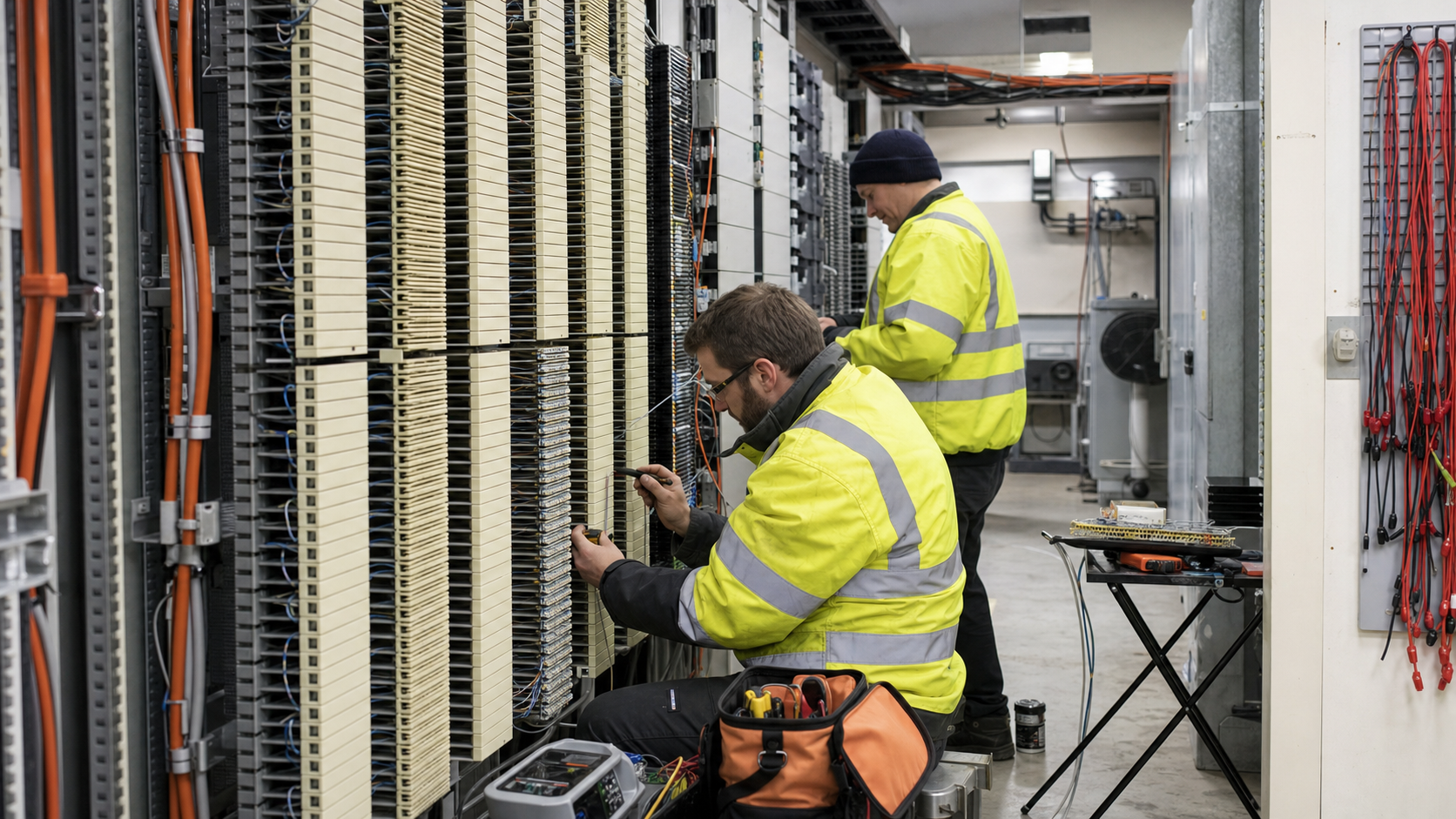
The labour signal is also important. The official vacancy page says Sotcom, described as a large, stable, dynamically developing company with a broad range of telecom services, was seeking staff due to expansion and listed an electromechanic role involving site surveys, cable-route installation, equipment installation, fibre splicing, reflectogram work, fault-section identification and repair, computer competence and preferably a personal car. Even if vacancy status changes, the role description is a compact description of the cost structure. A regional ISP is partly a field-labour business.
The attractive monthly tariff is possible only if installation and repair labour are used efficiently. When a fault requires a technician, a vehicle, test equipment and time, the monthly margin of a low-price customer can disappear quickly.
This is where renewal capital becomes the real strategic constraint. A national operator can spread platform refresh, routing engineering, customer applications, television rights and procurement overhead across a very large base. Sotcom cannot assume that luxury. A local operator at the public revenue scale visible in registry profiles must make each renewal decision answer a specific question: which paying relationship becomes safer, stickier or more profitable after this spend?
Replacing fragile copper with fibre makes sense when it protects a business centre, a dense residential building, a bank branch or an industrial site with multiple services attached. It is less obvious when the replacement merely keeps a single low-priced access customer who can churn to a mobile or national-bundle offer at the next promotion. The old telephone relationship supplies knowledge of streets, buildings, account histories and fault patterns. That knowledge has value only if it guides selective modernisation.
The same discipline applies to the data-centre and hosting story. Sotcom's public language around guaranteed power, fire protection, video surveillance, high-capacity internet and operator-neutral connection sounds like a sensible extension of local trust. A Ryazan enterprise that already buys phone numbers, data links and repair accountability may prefer a local rack, backup or hosted service if the alternative is a remote provider with no local field team. But the economics are unforgiving. Power, cooling, fire systems, physical access control, batteries, monitoring and specialist support are fixed-cost commitments.
They should be justified by business customers who buy continuity bundles, not by a desire to make the company catalogue look modern. A small data-centre service is attractive when it deepens existing relationships; it is dangerous when it becomes a capital project chasing scale the local market may not supply.
Television bundles require the same caution. The public internet-plus-TV plans add more than 150 channels and move the monthly bill into the 750 to 930 ruble range, depending on speed. That can help household retention because a customer who receives broadband and television on one local bill may be less likely to churn on price alone. Yet television is rarely free economics for an operator. Content carriage, set-top support, customer education and equipment issues can turn an apparent ARPU increase into a thinner contribution than the headline suggests.
Sotcom's own page notes equipment considerations and the possibility that older televisions may need a compatible receiver. For a local operator, TV is most useful when it reduces churn and supports a broader household bundle; it is less useful if it forces expensive support for customers who still choose primarily on the cheapest monthly internet price.
The most promising professional scenario is therefore not rapid reinvention. It is a measured migration from old reachability into modern managed service. In that scenario, the company keeps the trusted phone and account relationship, moves high-value users to more reliable access, attaches static addressing and managed Wi-Fi, sells virtual PBX or call routing to offices, and uses local field labour for customers who pay for responsiveness.
The public facts fit that possibility: the company has official voice tariffs, business PBX language, data transport and VPN claims, local payment and support channels, a visible routing footprint and named institutional categories. The weak scenario is different. Sotcom continues to advertise broad service capability but lacks the margin to renew access plant, cannot prove upstream resilience, carries old support obligations, and competes for households mainly through low absolute tariff levels. In that case, history becomes a cost base.
The middle scenario may be the most realistic. Sotcom may have enough loyal business and residential customers to remain relevant, but not enough surplus to modernise everything at once. That creates a triage problem. Management would need to know which buildings generate repeatable contribution, which radio-served customers are profitable after maintenance, which ADSL lines should be retired, which voice customers can be moved to SIP without losing trust, which support issues are really customer-premises equipment problems, and which public or institutional accounts are defensible at renewal. None of that appears in public disclosures.
The absence does not imply failure. It means the outside analyst should not confuse service breadth with economic freedom.
There is a second labour problem in support promises. Sotcom's public pages advertise 24/7/365 technical support for internet and industrial services. Customers like that promise. It creates fixed cost and managerial complexity. If the support team handles mostly straightforward access issues and preserves high-value business customers, it is a moat. If it is pulled into repeated low-revenue home Wi-Fi, old copper and customer-equipment problems, it becomes a margin leak. The operator has to decide what it actually supports inside the price and what it charges separately.
The residential page lists Wi-Fi router connection and setup at 500 rubles and a safe internet service at 40 rubles per month, which is the right instinct: turn support actions and add-ons into priced products where possible. But the scale of those add-ons has to be meaningful.
The public unofficial signals should be read cautiously. 2IP identifies Sotcom as an internet provider with ASN 34467 and a rating visible on its page, but such ratings and old reviews are not a scientific satisfaction measure. TestMy.net hosts speed-test statistics for the ASN, but speed-test samples are self-selected and can overrepresent users who choose to test. Scamalytics' low-fraud assessment is useful but limited to that company's observed traffic and methodology. JustConnect lists Sotcom's services and tariff context, but aggregator listings can lag official terms.
These signals are still worth including because they show that Sotcom is visible to consumers and internet-observation services as a real provider. They should not replace primary service, routing, registry and financial evidence.
What would make the case stronger? First, a current subscriber count split by residential internet, business internet, telephone lines, PBX seats, TV bundles and data-centre customers. Second, churn by service and by access technology. Third, gross margin by product, including support and field-labour allocation. Fourth, the percentage of revenue from the top 10 customers and from public-sector contracts. Fifth, upstream capacity, redundancy and actual cost per Mbps. Sixth, the age of access equipment, copper plant and switching systems.
Seventh, capex required to retire uneconomic legacy plant and move valuable customers to fibre, Ethernet or managed IP telephony. Without those numbers, the public judgment must remain probabilistic.
Some facts would change the view materially. If Sotcom's residential base is small but the business-customer base is sticky, high-ARPU and buying managed continuity, then the company is healthier than a simple ISP tariff comparison suggests. If most revenue comes from low-priced residential internet and declining voice with high support intensity, then the legacy telephone identity is a cost burden. If the company has strong private fibre access to dense office buildings, banks, public institutions and industrial sites, its local economics are defensible.
If its network depends on a small number of upstream routes without affordable redundancy, service quality and negotiating power are fragile. If the reported thin profit in public data reflects conservative accounting while cash flow is healthy, investment capacity may be better than it looks. If it reflects real margin pressure, modernisation will be difficult.
The governance/control boundary is straightforward in the public record but not complete. Public registries identify the legal entity as an active Russian joint-stock company, with Igor Mikhailovich Maizels named as general director in several profiles and with a private-company ownership form. The official site, registry data and RIPE data align on the Ryazan address. But public sources do not disclose the shareholder economics, private debt, lease commitments, related-party service terms, or how SKT-project ties into the operating cost base today.
That matters because small telecom operators can look stable from the outside while much of their economics sits in related engineering, property, equipment financing or owner-supported renewal decisions. The absence of public evidence is not evidence of weakness, but it limits confidence.
The final judgment is that Sotcom's survival logic is service continuity, not speed leadership. The company has a credible operating base: a long legal history, telecom licences, an active ASN, identifiable IPv4 resources, visible local tariffs, official support channels, a broad service catalogue and named local institutional relationships. It also faces the standard regional-operator squeeze: cheap retail bandwidth, mobile substitution for voice, national bundles, uncertain access-renewal costs, concentrated routing signals and the labour burden of old networks.
The operator earns the right to exist when a Ryazan customer says, "I need this to work, and I need someone local to answer for it." It loses economic ground when the customer says only, "Who sells the cheapest megabit?"
That distinction should guide how the company is monitored. The valuable customer is not necessarily the fastest residential downloader. It is the business or household whose service bundle makes churn inconvenient: fixed number, static IP, managed Wi-Fi, PBX, repair bureau, television, data transport, hosting, security, account history and local payment relationship. The dangerous customer is one who buys only a thin-margin access line, generates support calls and can move to a national bundle or mobile router without operational pain.
Sotcom's task is to migrate enough of the first group onto modern, supportable infrastructure while allowing the least economic pieces of the legacy estate to shrink. A telephone company can remain relevant after fixed voice decline, but only if the relationship that began with the telephone becomes a priced continuity service.
Sources
- https://www.sotcom.ru/
- https://www.sotcom.ru/company/
- https://www.sotcom.ru/contacts/
- https://www.sotcom.ru/individ/podklyuchit-internet/
- https://www.sotcom.ru/individ/internet-tv/
- https://www.sotcom.ru/individ/sposobyi-oplatyi/
- https://www.sotcom.ru/corporate/telefoniya/
- https://www.sotcom.ru/corporate/promyishlennyie-predpriyatiya/
- https://www.sotcom.ru/company/technology/
- https://www.sotcom.ru/company/clients/
- https://www.sotcom.ru/company/dokumentyi/
- https://www.sotcom.ru/company/licenses/
- https://www.sotcom.ru/company/pravovaya-baza/
- https://www.sotcom.ru/company/worktime/
- https://www.sotcom.ru/company/vacancy/
- https://www.sotcom.ru/company/zakupki/
- https://www.sotcom.ru/company/sotkom-20-let/
- https://ryazan.mts.ru/upload/contents/603/oferta_sotkom_ul.pdf
- https://rkn.gov.ru/activity/connection/register/license/p1200/
- https://rkn.gov.ru/activity/connection/register/license/p1200/?id=%D0%9B030-00114-77%2F00055206
- https://rkn.gov.ru/activity/connection/register/license/?id=%D0%9B030-00114-77%2F00078233
- https://rkn.gov.ru/activity/connection/register/license/p1200/?id=%D0%9B030-00114-77%2F00066648
- https://rdap.db.ripe.net/autnum/34467
- https://stat.ripe.net/data/as-overview/data.json?resource=AS34467
- https://stat.ripe.net/data/announced-prefixes/data.json?resource=AS34467
- https://stat.ripe.net/data/asn-neighbours/data.json?resource=AS34467
- https://stat.ripe.net/data/rpki-validation/data.json?resource=AS34467&prefix=80.72.112.0/20
- https://rdap.db.ripe.net/ip/80.72.112.0
- https://bgp.tools/as/34467
- https://whois.ipip.net/AS34467
- https://ipinfo.io/AS34467
- https://db-ip.com/as34467-jsc-telephone-company-sotcom
- https://www.ip2location.com/as34467
- https://www.peeringdb.com/api/net?asn=34467
- https://2ip.ru/isp/JSC%2BTelephone%2BCompany%2BSotcom/
- https://testmy.net/hoststats/jsc_telephone_compan
- https://scamalytics.com/ip/isp/jsc-telephone-company-sotcom
- https://www.list-org.com/company/42417
- https://checko.ru/company/tk-sotkom-1026201264429
- https://www.audit-it.ru/contragent/1026201264429_ao-tk-sotkom
- https://companies.rbc.ru/id/1026201264429-ao-telefonnaya-kompaniya-sotkom/
- https://saby.ru/profile/6231004437-623001001
- https://www.1cont.ru/contragent/1026201264429
- https://check.tochka.com/company/1026201264429/
- https://101internet.ru/ryazan/rating
- https://ryazan.justconnect.ru/tarifs/sotkom/
- https://ryazan.dom.ru/internet
- https://ryazan.rt.ru/homeinternet
- https://ryazan.mts.ru/personal/dom/home-allmts
- https://datareportal.com/reports/digital-2025-russian-federation
- https://datahub.itu.int/dashboards/?e=RUS&id=2
- https://data.worldbank.org/indicator/IT.NET.BBND.P2?locations=RU
- https://www.akm.ru/eng/press/the-results-of-the-year-for-the-russian-telecom-industry/
- https://www.telecompaper.com/news/rostelecom-leads-russian-pbx-market-in-2025--1572578
- https://telesputnik.ru/materials/gov/news/rkn-prekratil-deistvie-943-licenzii-operatorov-svyazi
Member Briefing
Deeper Profile Context
Sign in with the right membership level to unlock the full briefing and source notes.
Only for Strategic Circle
Strategic Circle
Open to all readers. Unlock profile briefings after joining and signing in.
Join Strategic CircleOnly for Leadership Alliance
Leadership Alliance
For qualified IP-asset owners and management; sign in to unlock alliance briefings.
Join Leadership Alliance