
Summary
- Solvay has confirmed discussions with One Investment Management about a potential strategic partnership for its rare-earth business, while saying there is no certainty of an agreement or transaction.
- The possible instrument is unknown. OneIM works across debt and equity, but neither side has disclosed a cheque, stake, loan, asset perimeter, governance right, security package or timetable.
- La Rochelle already has a phased industrial programme. Solvay puts the full investment at €50 million to €100 million and says capacity could capture up to 30% of European permanent-magnet rare-earth demand, but capacity is not throughput or market share.
- A capital partner could change who funds and controls expansion. It would not automatically secure feedstock, qualify output, fill the plant or turn customer commitments into recognised revenue.
The press release stops at the negotiating-room door
The most important phrase in Solvay’s 8 September statement is not “strategic partnership”. It is “discussions”. Solvay confirmed that talks with One Investment Management concern its rare-earth business, then immediately said there could be no certainty that an agreement or transaction would result.
That leaves the commercial shape blank. The prospective arrangement could involve debt, preferred capital, ordinary equity, a joint venture, a ring-fenced asset vehicle or something else. None of those structures has been announced. There is no disclosed valuation, investment amount, ownership percentage, maturity, coupon, security, covenant, board right, closing condition or use-of-proceeds schedule.
The absence matters because each structure reallocates risk differently. Debt can preserve Solvay’s ownership but put fixed claims and covenants ahead of future cash flow. Equity can absorb ramp risk but dilute control or economics. A joint venture can bring dedicated capital while dividing decisions over procurement, capacity and customers. For now, those are possible instrument families, not descriptions of the talks.
OneIM’s own overview explains why the range is wide. Its strategies include special situations, private credit, private equity and structured credit. Its corporate page reports $11.8 billion of assets under management and says the firm invests across capital structures. That is evidence of capability, not evidence of allocation. Assets under management belong to vehicles with mandates and approvals; they are not a $11.8 billion wallet available to Solvay.
The industrial project exists before the potential partner
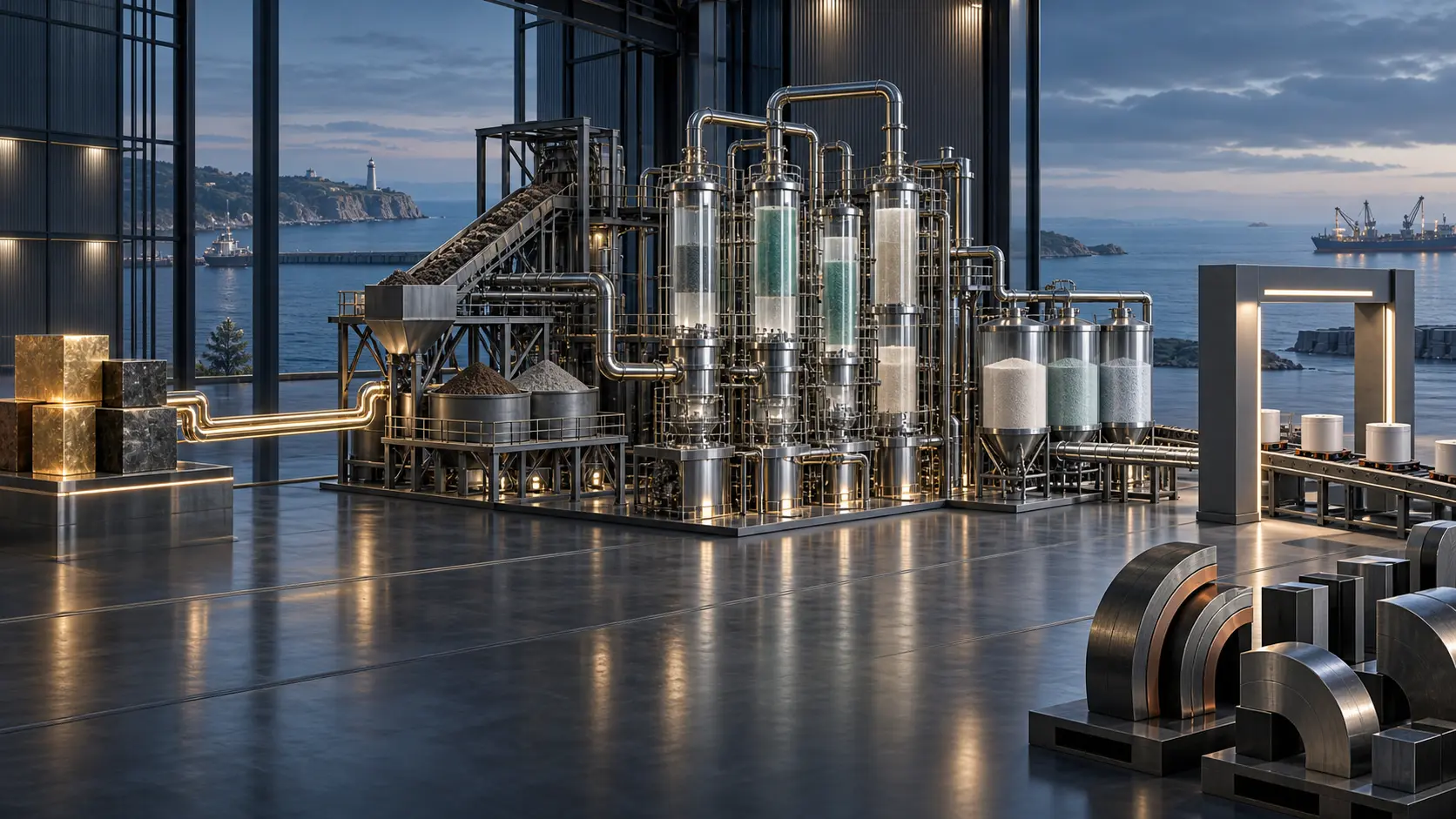
La Rochelle is not a concept awaiting its first piece of machinery. In April 2025, Solvay inaugurated a production line for rare-earth materials used in permanent magnets and said commercial production was beginning. The company describes the site as the largest outside China able to separate the full range of rare-earth elements. That ranking is Solvay’s claim, but the physical distinction is still useful: the site performs separation, purification and formulation rather than the entire chain from mine to finished magnet.
The programme is also explicitly phased. Solvay’s 2025 earnings roadshow places total investment between €50 million and €100 million. It lists Nd-Pr material for permanent magnets from April 2025, samarium in the second half of 2025 and Dy/Tb in 2026. It says sourcing is expected to come primarily from mining and recycling outside China.
The same presentation says La Rochelle could build capacity to capture up to 30% of European demand for permanent-magnet rare earths. “Capacity to capture” contains two gates. The equipment has to be installed, commissioned and qualified; then customers have to buy enough acceptable output. Thirty per cent is therefore neither present production nor current market share. It is an addressable capacity ambition, based on Solvay’s own demand analysis.
Solvay added another receipt in its second-quarter 2026 results. It approved €15 million to €20 million of additional investment to extend separation capacity and said the decision was supported by new customer commitments. It also expected industrial-scale separation of dysprosium and terbium to begin in autumn 2026. Those statements move the programme beyond aspiration, but they still do not disclose nameplate tonnes, qualification status, saleable yield, contracted volumes or realised sales.
Capital is only one constraint
A useful way to read a possible OneIM partnership is as a sequence of independent receipts.
The first is legal: did talks become a definitive agreement, and what exactly sits inside it? The second is financial: was capital merely committed, or was it funded and drawn? The third is procurement: did La Rochelle secure the right feedstock at an acceptable quality and price? The fourth is physical: was capacity commissioned, and what saleable output did it produce? The fifth is commercial: did customers accept that output under contracts whose price and duration support a return on capital?
Solvay has disclosed fragments of several ledgers, but not a completed chain. Its results mention a letter of intent with Viridis for material from Brazil. A letter of intent identifies a sourcing route; without volumes, specifications, binding terms and deliveries, it is not inventory in La Rochelle’s tanks. “New customer commitments” helped support the latest investment, but customer names, minimum volumes, take-or-pay obligations, prices and duration remain undisclosed.
This is why finance cannot be used as shorthand for de-risking. A partner may absorb construction or balance-sheet risk while leaving commodity-price, feedstock-quality, ramp, yield and offtake risk with the operating business. Conversely, a well-designed structure could match long-dated capital with phased equipment and make it easier to sign suppliers and customers. The contract will decide which reading is valid.
The group balance sheet gives scale, not a funding-gap answer
Solvay’s latest numbers explain why outside capital could be attractive without proving that it is necessary. In the second quarter of 2026, underlying sales were €1.031 billion and underlying EBITDA was €187 million. First-half free cash flow was €15 million, including negative €11 million in the second quarter; first-half capital expenditure was €141 million. Underlying net debt stood at €1.8 billion, or 2.3 times leverage.
For the full year, Solvay guided to at least €200 million of free cash flow and about €300 million of capital expenditure. The latest €15 million to €20 million La Rochelle approval is equivalent to 5.0% to 6.7% of that annual capex guide. The €50 million to €100 million full-project range equals 16.7% to 33.3%. Those ratios show materiality, but the denominator is group-wide and the rare-earth programme runs in phases over an undisclosed period. They do not reveal an unfunded hole.
External capital may instead serve a strategic purpose: isolate project economics, share ramp risk, preserve group cash for other plants, or attach specialist governance to a politically important asset. Those objectives can be rational even if Solvay could finance the programme itself. The eventual instrument—and its priority over future cash flows—matters more than the headline identity of the partner.
Europe’s benchmark is a chain, not a single plant
The EU Critical Raw Materials Act sets different 2030 benchmarks for extraction, processing and recycling: at least 10%, 40% and 25% of annual EU consumption respectively. It also aims to keep dependence on any single third country below 65% for a strategic raw material. The Commission expects European rare-earth-metal demand to increase six-fold by 2030.
La Rochelle principally addresses the processing layer. Its value depends on material arriving from mines or recycling streams, then moving onward into qualified applications and permanent-magnet supply. A financing partnership at the separator can strengthen an important middle link. It cannot, by itself, satisfy extraction, recycling, diversification and downstream manufacturing goals.
That distinction protects the analysis from sovereignty theatre. Strategic relevance can improve permitting, policy support, customer attention and access to finance. It does not suspend plant economics. The separator still needs dependable feedstock, competitive conversion costs, acceptable environmental performance, qualified products and customers willing to pay.
The OneIM talks therefore matter before they become a deal, but only as a signal about how Solvay may allocate capital and control. The next disclosure must tell the market whether the partner is buying exposure to an existing business, funding new assets, lending against cash flows or sharing the whole ramp. Until then, Europe has a potentially important negotiation beside a real plant—not a financed 30% share of demand flowing through it.
Member Briefing
Deeper Profile Context
Sign in with the right membership level to unlock the full briefing and source notes.
Only for Strategic Circle
Strategic Circle
Open to all readers. Unlock profile briefings after joining and signing in.
Join Strategic CircleOnly for Leadership Alliance
Leadership Alliance
For qualified IP-asset owners and management; sign in to unlock alliance briefings.
Join Leadership Alliance