
Summary
- Solaris announced the Omega acquisition on 2 September, adding civil construction, early site work and substation-development capabilities.
- Consideration includes about US$101 million of net cash, US$28 million of assumed debt and leases, and about 3.6 million Class A shares; the cash figure is not the full price.
- July’s GESA acquisition supplies another execution layer, from installation and commissioning to operations, maintenance and repair.
- Expanded customer agreements already require more complete power plants. Owning more of the delivery chain does not establish that those plants have been commissioned.
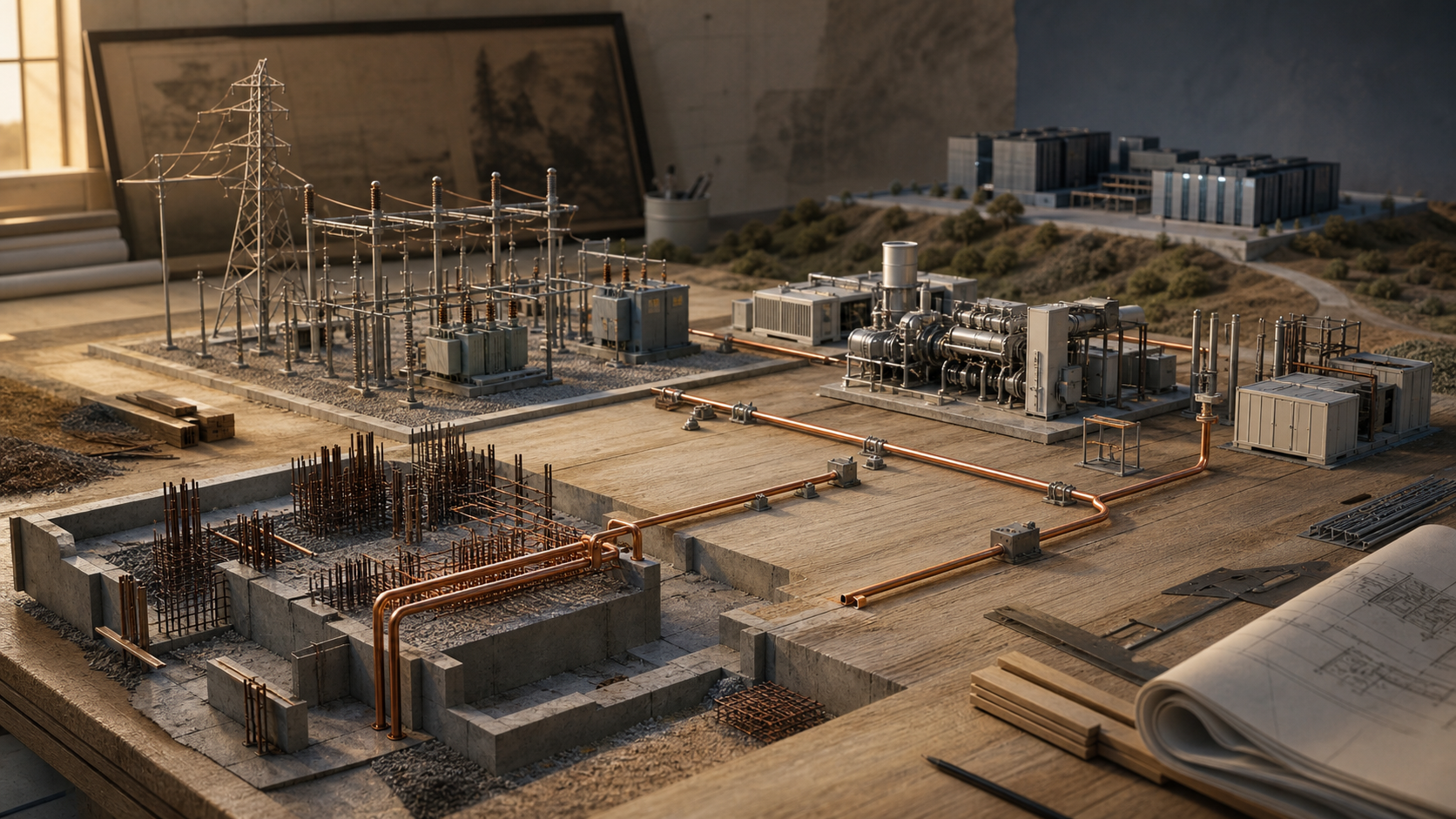
A turbine delivery and an operational power plant are different products. Between them sit foundations, electrical connections, installation, commissioning and the coordination of several specialist teams. Solaris is buying more influence over that interval.
Its 2 September announcement says Omega Foundation Services brings heavy civil construction and specialised engineering, procurement and construction expertise into the group. Early site services and electrical substation development sit alongside front-end installation and commissioning in the enlarged offering. Management says the companies have worked together for two years at multiple locations. That is evidence of a prior working relationship, not an independently measured record of faster completion.
The commercial logic is concrete. When construction is supplied by an outside firm, some staffing and scheduling questions are negotiated across a corporate boundary. With the contractor inside the group, more of those choices can be settled through internal resource allocation. That is an analytical implication of the acquisition, not a claim that Solaris now controls every dependency on a project.
The customer promise was already getting larger
The June-quarter filing describes a July amendment converting the Hatchbo capacity agreement into a final operating agreement for an approximately 660MW turnkey plant. Its scope includes balance-of-plant equipment, batteries and energy-management systems designed for AI workloads. The term is ten years with an eight-year extension option—not eighteen years of unconditional committed revenue. Deployments and revenue recognition were expected to begin in the first quarter of 2027 and scale through 2028.
A separate agreement signed in April covers about 640MW for an affiliate of an unnamed global technology company. July agreements added balance-of-plant assets, storage and natural-gas management on a cost-plus basis. Its initial ten-year rental term has a five-year extension option; deployments were scheduled to start in late 2026 and scale through 2028.
These are separate customer arrangements with separate timing and scope. The Omega announcement does not assign the acquired team a specific package on either project, accelerate either timetable or identify a new power order. What it does reveal is a more extensive in-house capability set beside an already widening customer promise.
A second acquisition around the equipment
Solaris completed its purchase of Global Energy Services Alliance, or GESA, on 1 July. GESA combines Baseload Power and Pro-Per Energy Services. Their expertise covers installation, commissioning, long-term operations, maintenance and repair across several generator and turbine technologies.
Omega adds particular strength earlier in the physical sequence: the site, civil works and substations. There is some overlap in installation and commissioning, so this should not be portrayed as a perfectly non-overlapping assembly line. The important development is that Solaris can coordinate more of the interfaces itself, from preparing the ground to maintaining a generating asset.
The acquisitions also open work beyond Solaris’ own fleet. Omega’s announcement points to third-party projects in data centres, LNG, industry and government. GESA likewise brought external-service ambitions. Those are opportunities, not a disclosed new backlog. They also create an allocation question: which customer gets a scarce crew when internal and external schedules compete?
The price buys capability, not a delivery certificate
Omega’s disclosed consideration comprises approximately US$101 million in net cash, US$28 million in debt and lease assumption, and roughly 3.6 million Class A shares. Treating US$101 million as the acquisition price drops both assumed obligations and equity from the description. The release does not provide the shares’ value or a complete accounting purchase-price calculation.
Management expects immediate accretion to earnings and free cash flow per share. It gives no quantified contribution, Omega earnings base or realised post-deal result. Its own cautionary language names integration, retention of personnel and customers, and unexpected costs or liabilities. Bringing expertise inside the business makes those execution risks more directly a management concern; it does not make them disappear.
The operating baseline offers useful scale without proving an acquisition return. Solaris reported about 950MW of average revenue-earning capacity in the second quarter, versus roughly 910MW in the first. Power Solutions revenue rose about 23% sequentially to approximately US$158 million. These are historical activity and segment-revenue measures, not megawatts or sales acquired with Omega.
Nor is the June balance sheet a construction-completion register. Equipment held for lease included US$1,138.8 million of construction in progress. The filing says that category includes deposits, progress payments and accrued billings for turbines and equipment not yet delivered. It cannot all be counted as built sites, Omega’s future workload or capacity about to begin earning revenue.
Where control still ends
A larger internal delivery team can improve coordination. Equipment arrivals, permits, inspections, fuel arrangements, energisation and customer acceptance still require their own evidence. The existing commercial agreements retain specifications and terms dealing with delivery, inspection and performance failure; buying a contractor does not itself amend them.
The next useful result is therefore an operating receipt: a delivered package, an accepted installation, a commissioning milestone or a disclosed change in schedule and cost. Omega changes who can make more of the intervening decisions. Whether that change produces a better project outcome remains to be demonstrated.
Sources
Member Briefing
Deeper Profile Context
Sign in with the right membership level to unlock the full briefing and source notes.
Only for Strategic Circle
Strategic Circle
Open to all readers. Unlock profile briefings after joining and signing in.
Join Strategic CircleOnly for Leadership Alliance
Leadership Alliance
For qualified IP-asset owners and management; sign in to unlock alliance briefings.
Join Leadership Alliance