
Summary
- What it says: Skyrunner is a regional broadband provider whose economics are easier to understand from a roofline than from a national broadband average.
- Main topic: Regional ISP economics; Network-resource evidence; Local support labour; Telecom spectrum and security
- Context: market / company research report / United States / North America
The bill starts on the roof
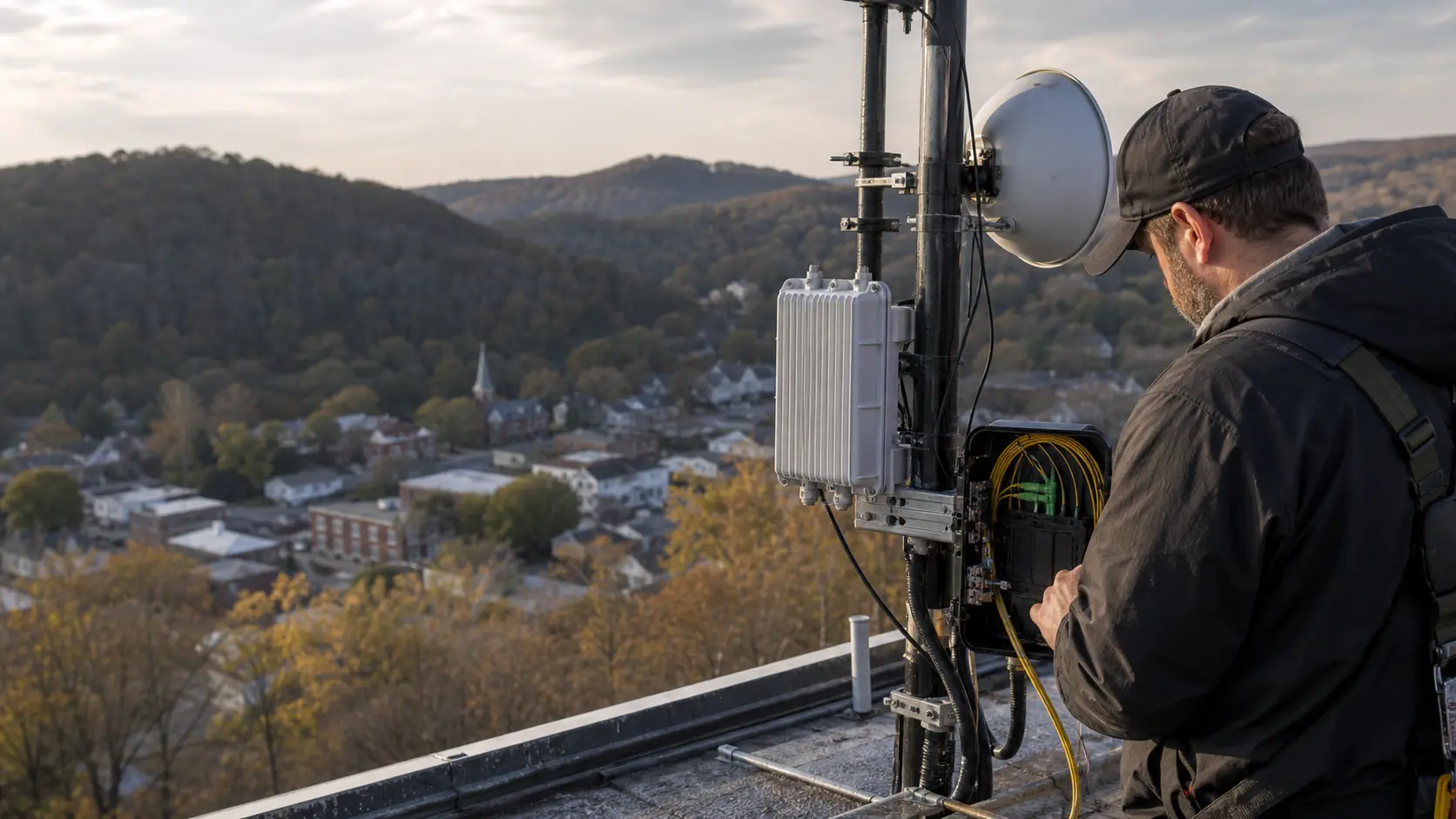
A semi-rural household outside Asheville does not buy internet from a spreadsheet. It buys from the ridge, the trees, the pole line, the driveway, the power cut, the repair appointment and the person who answers the phone. One neighbor may have cable from an incumbent provider but complain that the line disappears after a storm. Another may have mobile home broadband that works until the tower is crowded or the household sits behind a fold in the terrain. A third may have satellite that can be ordered quickly but carries its own equipment cost, weather and latency compromises.
The customer asking whether Skyrunner is available is really asking a narrower economic question: can a local provider see the roof, reach it, install cleanly, backhaul the traffic and answer when the service fails?
Skyrunner's own plan labels make that choice concrete. On the fixed wireless side, a lower-tier SkyCruiser plan shows 5 Mbps down and 5 Mbps up with 150 GB of data for $45 a month, a $149 standard installation charge and $0.50 per extra gigabyte. A 10 Mbps down, 5 Mbps up SkyRunner unlimited plan is listed at $115 a month with the same $149 standard installation charge. A 25 Mbps down, 5 Mbps up SkySprinter unlimited plan is listed at $135 a month. Separate Wave labels show symmetrical 100 Mbps for $85, 200 Mbps for $119 and 500 Mbps for $135, with a $199 standard installation fee. Fiber labels show symmetrical 60 Mbps for $75, 500 Mbps for $99 and 1 Gbps for $155, with a $149 fiber activation charge. The labels say the prices are not introductory, do not require a monthly contract, carry no early termination fee and include unlimited data on the fiber and Wave plans cited here (https://skyrunner.net/planinformation.html).
That bill is the economic anchor. The customer is not simply comparing "fiber" with "wireless" or "local" with "national." The customer is comparing a one-time installation charge, the probability of a successful line-of-sight survey, the monthly price for a specific speed and data profile, and the value of local repair. For the provider, the measurable constraint is equally plain: a fixed wireless subscriber must be reachable from an access point with enough signal quality, enough backhaul and enough field labor to justify the installation.
A fiber subscriber must sit on or near a build that can absorb drop construction, activation, splicing and maintenance. In a mountain market, the cost of the last few hundred feet can matter as much as the advertised speed.
Skyrunner's residential page says the company serves North Carolina, South Carolina and Tennessee, has in-house fiber construction crews, and uses hundreds of fixed wireless access points in the region to provide service where customers are not yet connected by its fiber network (https://skyrunner.net/residential/). The same page describes fixed wireless as radio-frequency access to a single location and says Skyrunner was among the first US internet providers to offer fixed wireless broadband. Its home page says Skyrunner serves more than 10,000 homes and businesses across North Carolina, South Carolina and Tennessee using fiber and fixed wireless, and lists 24/7/365 technical support, local support staff, backup connections, enterprise voice and a 99.9% network uptime claim (https://skyrunner.net/). The company's about page dates its regional service roots to 1997, lists a team of engineers, tower climbers, network analysts, technicians and customer service representatives, and names JJ Boyd as President/CEO (https://skyrunner.net/whoweare/).
Those statements should not be read as audited subscriber counts. Skyrunner's pages contain different scale markers: more than 10,000 homes and businesses on the home page, more than 7,000 homes and businesses on the residential fixed wireless explanation, and "thousands" in a 2021 Rumbling Bald community notice. The useful conclusion is more cautious. Skyrunner is not a hobby network or a tiny reseller; it is a locally staffed regional provider with enough customers, access points, fiber activity and public routing to matter in Western North Carolina connectivity.
It is also small enough that each hill, subdivision, grant area and support reputation can still move the business case.
The first customer decision therefore contains the whole company. If Skyrunner can reach the property with a stable radio path or a fiber drop, the provider can offer something the national average hides: a local route through terrain that has repeatedly made broadband investment hard. If it cannot reach the property, the brand promise becomes a polite no. If it reaches the property but field service is slow, trees block line of sight, upstreams congest, or repair cost surprises the customer, the local advantage erodes. Skyrunner's market is not defined by national broadband demand.
It is defined by the cost of converting a difficult location into a dependable monthly invoice.
Identity: an Asheville access operator, not a routing abstraction
Skyrunner's public identity is unusually visible for a small regional provider. The contact page lists headquarters at 779 Dogwood Road, Asheville, North Carolina 28806, with the phone number 828-258-8562 and helpdesk@skyrunner.net, and says technical support is open 24/7 while accounting and new-service inquiries run Monday through Saturday (https://skyrunner.net/contact/). The about page lists named executives, engineers, project managers, outside-plant staff, broadband technicians, fiber drop crew and customer support representatives. For a local ISP, that human inventory matters. The product is not only bandwidth; it is survey, installation, tower work, fiber drops, dispatch and support.
ARIN registry evidence supports the same company anchor from the network side. ARIN RDAP for AS53274 lists SKYRUNNER-INC, start and end autnum 53274, registration on June 10, 2014, last changed on March 18, 2022, and a registrant entity for Skyrunner, Inc. at 779 Dogwood Road in Asheville (https://rdap.arin.net/registry/autnum/53274). BGP.Tools also shows Skyrunner, Inc. as AS53274, registered in June 2014, active under ARIN, with the same Asheville address in the whois excerpt it displays (https://bgp.tools/as/53274). These records should be used as infrastructure evidence, not as separate directory entities. They show that Skyrunner controls an autonomous system and public address resources consistent with a real ISP operation.
PeeringDB lists Skyrunner, long name Skyrunner, Inc., website https://skyrunner.net, ASN 53274, IRR as-set AS-53274, regional scope, IPv6 support and a peering policy URL. It also lists two Asheville facility presences: ERC Broadband and DartPoints Asheville, NC - AVL1. No public exchange points appear in the PeeringDB record at retrieval (https://www.peeringdb.com/net/26150). The absence of a public exchange fabric listing is not fatal for a regional ISP; it simply narrows the inference. Skyrunner's public network evidence points to regional access, Asheville facility anchoring and upstream dependence, not to a large national peering platform.
BGP.Tools provides the current routing shape. It identifies AS53274 as an eyeball network with 24 IPv4 and four IPv6 originated prefixes, 16 /24s of IPv4 addresses, and a visible set of upstreams: Conterra, Spirit Communications, Verizon formerly Frontier, and PANGAEA. It also shows five peers and one downstream, Mars Hill University (https://bgp.tools/as/53274). IPinfo summarizes the same AS as Skyrunner, Inc., country United States, ASN type ISP, ARIN registry, allocated June 10, 2014, with 4,096 IPv4 addresses, and marks activity as consistent with a consumer ISP pattern (https://ipinfo.io/AS53274). RIPEstat's AS overview says AS53274 is announced and held by SKYRUNNER-INC - Skyrunner, Inc. (https://stat.ripe.net/data/as-overview/data.json?resource=AS53274).
The routing evidence is important because it separates Skyrunner from a simple sales agent. A broadband reseller can sell a bill without operating a visible autonomous system. Skyrunner has public routing, registered resources and regional facilities. But the routing evidence also keeps the scale disciplined. This is not the footprint of a national backbone or a large cable company. It is the signature of a regional eyeball network that must buy or arrange upstream connectivity, protect enough redundancy for local reliability, and convert local access construction into traffic that can reach the wider internet.
The business model: access first, trust second, bundle where it fits
Skyrunner's business model begins with residential and small-business access. The residential page offers fiber and fixed wireless, asks the customer to check service by location, and explicitly says availability depends on fiber or line of sight. The first step is assessing the location; the second is a technician visit for either physical fiber or hybrid fixed wireless connection (https://skyrunner.net/residential/). This is a different sale from a mass-market cable sign-up. It is less automated. It needs geography, installation labor and a credibility loop between customer service and field crews.
The company also sells business and enterprise services. The customer service guide lists fiber optic internet, fixed wireless internet, Wi-Fi, voice, managed services, building-to-building wireless links and complete networking solutions (https://skyrunner.net/documents/serviceguide.pdf). The home page lists enterprise voice, backup connections and custom plans. The about page describes engineers, network analysts, tower climbers and technicians extending the network. These service lines indicate a rational small-operator strategy: start with access, then sell adjacent reliability and networking work to customers that value a local accountable supplier.
The strongest customer proposition is local accountability. A national provider may have lower marginal cost in dense neighborhoods, but it often struggles to translate a mountain driveway, a ridge shadow or a storm-damaged access path into a quick and human answer. Skyrunner's public copy leans into 24/7 support and local staff. Its service guide says customers can contact the company anytime by phone or helpdesk email and that planned maintenance, upgrades or unplanned outages will be notified by phone, text or email where possible. It also narrows responsibility: advertised speeds are delivered to the property, while Wi-Fi hardware, devices and current household use can affect measured speed (https://skyrunner.net/documents/serviceguide.pdf).
That responsibility boundary is commercially important. The provider sells reliability, but it cannot become responsible for every router, laptop, virus, streaming device or interior wall. The service guide charges $125 per hour plus hardware for optional internal networking hardware beyond the first router or access point configuration, and $125 per hour plus replacement hardware for repairs to out-of-warranty or third-party internal hardware. Those charges make the hidden cost base visible. A local ISP cannot survive if every home Wi-Fi problem becomes a free truck roll.
The margin depends on distinguishing network faults from customer-premises work without making the customer feel abandoned.
In practical terms, Skyrunner is selling four products at once. The first is access: fiber where it has built, fixed wireless where line of sight and backhaul allow, and custom plans in selected locations. The second is local field work: site survey, installation, tower and rooftop labor, fiber drops, splicing and service calls. The third is support: the phone number, helpdesk and local staff who can explain what is available and what has failed. The fourth is resilience or specialization: backup connections, enterprise voice, managed networking and building-to-building links for customers that need more than commodity access.
The more a customer buys the latter three, the less Skyrunner competes only on headline speed.
Pricing says the hard locations are expensive
Skyrunner's public broadband labels are a rare view into the revenue logic of a local access provider. On fixed wireless, the cheapest visible label is not a modern high-speed plan. It is 5 Mbps down and 5 Mbps up with a 150 GB data allowance at $45 a month. Moving to 500 GB raises the same speed tier to $65, and unlimited raises it to $95. At 10 Mbps down and 5 Mbps up, the 150 GB, 500 GB and unlimited labels are $65, $85 and $115. At 25 Mbps down and 5 Mbps up, the same data tiers are $85, $105 and $135. Extra data is $0.50 per GB on the capped plans, and standard installation is $149 (https://skyrunner.net/planinformation.html).
This structure shows that Skyrunner prices scarcity in two ways: speed and capacity. The data caps on lower fixed wireless tiers do not look like the economics of a fiber-rich urban provider. They look like the economics of a radio access network where spectrum, tower sector capacity, backhaul and support load matter. A customer who wants unlimited service pays materially more. That does not make the plan unfair; it explains the operating constraint. Fixed wireless can be a powerful solution in terrain where running fiber to every premise is slow or uneconomic, but shared radio capacity must be managed.
The fiber labels tell a different story. Symmetrical 60 Mbps is listed at $75, symmetrical 500 Mbps at $99 and symmetrical 1 Gbps at $155, each with unlimited data and a $149 fiber activation charge. The Wave labels, which show symmetrical 100 Mbps, 200 Mbps and 500 Mbps at $85, $119 and $135 with a $199 installation fee, sit between classic low-tier fixed wireless and fiber-like performance (https://skyrunner.net/planinformation.html). The segmentation suggests a provider moving from older fixed wireless economics toward higher-capacity hybrid and fiber economics where build density allows.
For a national customer accustomed to promotional cable pricing, some of these rates look expensive. A 25/5 unlimited fixed wireless plan at $135 a month is not a bargain if a reliable fiber or cable alternative is available. But many of Skyrunner's target locations are not defined by abundant alternatives. In rural and mountain pockets, the actual comparison may be slow DSL, a cable network with weak resilience, mobile broadband with uncertain indoor reception, satellite equipment and subscription cost, or no reliable wireline service at all. In that setting, the price includes terrain conversion.
The service guide reinforces that revenue cannot be reduced to monthly ARPU. Skyrunner says it does not charge for repairs caused by technician error, loss of line of sight for fixed wireless customers, age-related failure of its antenna or fiber transceiver and manufacturer defects. But fixed wireless customers without the $5 per month hardware protection plan may be charged for lightning damage, human error, domestic or wild animals, customer-caused line-of-sight loss, equipment upgrades needed to restore line of sight, power damage and cable damage. The minimum fixed wireless repair cost is $90 per hour, and antenna replacement is $125. Fiber damage outside Skyrunner's control can lead to a $200 basic splice repair charge, with more complex repairs billed at $90 per hour plus materials (https://skyrunner.net/documents/serviceguide.pdf).
Those numbers are small compared with national infrastructure budgets, but they are central to local ISP economics. A storm, a fallen branch, a moved antenna, a damaged cable or a failed customer router can destroy the economics of a low-margin account if the provider absorbs every visit. Skyrunner's terms allocate risk: it owns failures in its own installation and normal equipment aging, but it tries to price avoidable or external damage. For customers, this is the fine print behind the local-support promise. For investors or market observers, it is a sign that field service, not bandwidth alone, determines margin.
The cost base is terrain, labor and backhaul
The customer sees a monthly line item. Skyrunner sees a map of costs. A fixed wireless subscriber needs an access point, tower or high site, licensed or unlicensed radio planning, customer-premises equipment, rooftop or exterior mounting, power, cabling, a technician, a truck, signal testing and backhaul from the site. A fiber subscriber needs construction, make-ready where poles are involved, conduit or aerial access, drop cable, splicing, optical equipment, activation and repair capacity. Both need billing, support, routing, upstream transit and a local staff that can keep failures from turning into churn.
The terrain makes that map harder. Western North Carolina is not a flat suburban grid. Ridges create coverage shadows. Forest canopy matters. Storms damage access roads, power and pole lines. A property can be near a town and still be expensive to connect. This is why line of sight appears so often in local customer chatter about Skyrunner. A 2025 Asheville forum discussion includes residents recommending Skyrunner if available, while noting that service depends on line-of-sight radio rather than satellite, and that availability is not universal (https://www.reddit.com/r/asheville/comments/1lyux9l/whats_the_best_internet_asheville/). A much older thread contains the same durable pattern: users reported solid service when they had direct sight to a tower, warned about bandwidth caps and overage charges, and said coverage could fail in areas such as Swannanoa or lower valleys (https://www.reddit.com/r/asheville/comments/ica8z/does_anyone_here_have_any_experience_with_the/).
Forum posts are not audited service evidence. They are useful because they repeat the same constraint the company itself describes. The fixed wireless sale is won or lost at line of sight. The customer who has a clear ridge view can become highly satisfied; the customer in the wrong hollow may never be eligible. This creates a patchwork market. Skyrunner can be the best answer for one address and irrelevant for the next. Its cost base therefore does not scale like a national cable footprint. It scales by high-site quality, radio capacity, fiber depth, crew productivity, local reputation and the ability to choose build targets.
Backhaul and upstream dependence are the second cost layer. BGP.Tools lists Conterra, Spirit Communications, Verizon formerly Frontier, and PANGAEA as Skyrunner upstreams, with peers including those networks and Mars Hill University, and one downstream also shown as Mars Hill University (https://bgp.tools/as/53274). PeeringDB shows Asheville facility presence but no public exchange points at retrieval (https://www.peeringdb.com/net/26150). The inference is not that Skyrunner is fragile; a regional ISP can run a sound network through private and wholesale arrangements. The inference is that supplier terms, facility access and upstream resilience matter. Skyrunner's customers may buy local support, but their traffic still depends on a set of upstream and facility choices beyond the last mile.
Upstream dependence can cut both ways. A smaller provider with several upstreams can avoid total dependence on one carrier and build a resilient regional routing posture. It can also face higher unit costs than national networks with deep peering and owned transport. If a wholesale provider changes pricing, if an Asheville facility has constraints, if a carrier outage affects a path, or if storm damage hits transport, the local provider absorbs the customer's frustration even when it does not own every input. The value of local support is greatest when it can explain and mitigate such events.
It is weakest when the answer is simply that a larger supplier has failed.
Subsidy awards reveal the public-interest edge
Skyrunner's market is not only commercial. North Carolina broadband policy shows where local providers become part of public investment. In July 2023, the governor's office announced nearly $80 million in GREAT grants for broadband infrastructure, with Skyrunner Inc. listed for Buncombe County. The announcement said grants would be awarded to providers based on households and businesses proposed, average cost to serve, speeds offered and other criteria, and that applicants had to provide high-speed service of at least 100 Mbps down and 20 Mbps up, scalable to symmetrical 100 Mbps by December 31, 2026 (https://governor.nc.gov/news/press-releases/2023/07/06/nc-awards-nearly-80-million-give-more-north-carolinians-high-speed-internet-access-gov-cooper).
In June 2024, the North Carolina Department of Information Technology announced $67 million in Completing Access to Broadband awards for 15 counties, with Haywood County and McDowell County both listing Skyrunner Inc. The projects were funded by federal American Rescue Plan money, county funds and provider contributions, and awardees had to provide service reliably meeting or exceeding 100 Mbps down and 100 Mbps up (https://www.ncbroadband.gov/news/press-releases/2024/06/17/ncdit-announces-67-million-completing-access-broadband-awards-expand-internet-access-15-counties). In July 2024, NCDIT announced another $112 million in county projects; Polk County listed Skyrunner, Inc. for high-speed access to 2,680 locations, or 92% of the county's 2,919 eligible locations (https://www.ncbroadband.gov/news/press-releases/2024/07/01/nineteen-more-counties-receive-expanded-internet-access-through-ncdits-completing-access-broadband).
The most direct Skyrunner award detail came in March 2025. NCDIT announced a $1.2 million CAB fiber project in Haywood County to connect 359 households and businesses. The project included more than $850,000 from federal American Rescue Plan funds and nearly $365,000 from Skyrunner, Inc., and represented 27.24% of the county's 1,318 eligible locations. NCDIT again specified that CAB awardees must provide high-speed service that reliably meets or exceeds 100 Mbps down and 100 Mbps up (https://www.ncbroadband.gov/news/press-releases/2025/03/19/359-homes-and-businesses-haywood-county-receive-high-speed-internet).
These awards matter because they change the economic threshold for difficult builds. A local provider may know how to reach a road or valley but cannot justify the capital from retail revenue alone. Public grants and county partnership can bridge the gap if the provider contributes capital and meets build obligations. The subsidy does not remove execution risk. It changes who shares the risk. Skyrunner's own contribution in the Haywood award shows that public money is not simply a gift; the provider must put private money and operational capacity into the build.
Local reporting adds the politics of eligibility. A Carolina Public Press story on Buncombe County broadband described how provider protests can remove locations from grant applications when another provider claims to serve an area. Buncombe had worked with Frontier, AT&T, Spectrum, Skyrunner Internet and French Broad Electric Membership Corp. on applications, including two from Skyrunner, but other providers protested about 3,800 households that were then disqualified from proposed projects (https://carolinapublicpress.org/56637/broadband-boost-planned-for-1000-buncombe-county-homes/). This is not only a policy story. It is a market story: the value of a local provider's build plan can be reshaped by maps, incumbent claims and the difference between theoretical availability and household experience.
Local projects show the fiber transition
Skyrunner's history is rooted in fixed wireless, but its future depends heavily on selective fiber. The Rumbling Bald project in Lake Lure is an instructive example. A 2021 project notice said Rumbling Bald had considered fixed wireless, cellular, DSL, satellite and broadband cable, but that terrain and location made reliable internet difficult. The contract was awarded to local Asheville company Skyrunner Internet to provide a fiber optic solution to every property in the community. The notice described base service at 200 Mbps down and 200 Mbps up with no data caps, fixed monthly billing for three years, a one-time installation fee per building, and an optional service for property owners. An update in September 2022 said the project was completed and service was available to all property-owner association properties within Rumbling Bald (https://rumblingbald.com/high-speed-internet-coming-to-rumbling-bald/).
The same notice's "About Skyrunner" section described Skyrunner, Inc. as a North Carolina corporation headquartered in Asheville, said it had installed some of the first wide-area wireless internet links in the Southeast, served thousands of customers in 18 Western North Carolina and upstate South Carolina counties, and had begun its first fiber-to-the-premises deployment in 2015 for a 100-home East Asheville development (https://rumblingbald.com/high-speed-internet-coming-to-rumbling-bald/). This is a third-party project page, not audited company history, but it supports the strategic evolution: fixed wireless expertise gives a provider local reach, while fiber projects create higher-capacity, lower-churn customer clusters where density and contracts justify construction.
The economics differ sharply between opportunistic fiber and universal fiber. Fiber to every premise is capital intensive, but it can support symmetrical speeds, lower radio capacity constraints and stronger customer retention. Fixed wireless is faster to deploy in many hard-to-wire areas, but it faces line-of-sight, sector capacity and weather or obstruction issues. Skyrunner's portfolio suggests a hybrid answer: use fixed wireless to reach difficult or scattered premises, build fiber in selected neighborhoods, communities and grant areas, and keep local support as the differentiator across both.
This hybrid model is attractive but complex. A pure fixed wireless provider can focus on radio planning and high sites. A pure fiber provider can focus on outside plant. A hybrid provider must manage both. It needs tower climbers and fiber drop crews, radio engineers and splicers, roof work and trench or pole work, customer-premises devices and optical equipment, wireless repair terms and fiber splice repair terms. Skyrunner's public staff list reflects this mixed burden: roles include OSP manager, network infrastructure engineer for fiber, tower and solar, broadband techs for wireless and fiber, and fiber drop crew (https://skyrunner.net/whoweare/).
The revenue upside is that Skyrunner can avoid a one-size-fits-all offer. If a community can support fiber, it can sell higher speeds and stronger performance. If a house cannot yet justify a fiber drop, fixed wireless can provide access and keep the customer inside Skyrunner's local relationship. If a business needs redundancy, Skyrunner can combine access paths or sell backup connections. But the operating risk is that each service type adds inventory, training, scheduling and support complexity. The company must be good enough at both to keep the brand promise coherent.
Customer dependence: local help is valuable because failure is personal
Broadband failure in a mountain community is not an abstract inconvenience. It can stop remote work, telehealth, school, credit-card terminals, reservations, weather information and family communication. The Carolina Public Press story about Buncombe County did not concern Skyrunner's own award, but it captured the customer problem in the region: a household in the Blue Ridge Mountains lacked fiber, trees blocked cellular data, satellite was expensive, and the remaining option was spotty phone-line service (https://carolinapublicpress.org/56637/broadband-boost-planned-for-1000-buncombe-county-homes/). That is the market pain local providers monetize.
Skyrunner's public support promise has to be read against that pain. The service guide says support is available 24/7, and the contact page says technical support is open 24/7. The guide says customers will be notified of planned maintenance, upgrades or unplanned outages by phone, text or email when possible. It also says service can be shut off automatically 10 days after an unpaid invoice's due date, with a 5% late fee applied five days after the due date (https://skyrunner.net/documents/serviceguide.pdf). This is a normal billing discipline, but it is also a reminder that local providers must manage cash tightly. The goodwill of local support does not remove the economics of overdue accounts.
Non-official signals show why support can become a competitive advantage. In an Asheville Reddit thread during the Hurricane Helene recovery period, residents compared AT&T, Spectrum, Starlink and other options. One user reported that Skyrunner was working near Fairview while Spectrum was still down; another said Skyrunner was also working out west (https://www.reddit.com/r/asheville/comments/1g1z5yw/how_is_your_internet_holding_up/). This is not proof of overall storm performance. It is a signal that in a disaster-affected market, customers noticed which access paths were alive at specific locations.
Other forum chatter is more mixed. A thread asking about alternatives to Spectrum includes a recommendation for Skyrunner if the household has line of sight to a tower, calling the connection historically solid while reporting mixed customer service hearsay (https://www.reddit.com/r/asheville/comments/1g1znss/switching_from_spectrum_any_options/). A 2025 thread includes residents praising Skyrunner's support and reliability, while noting speed limits and availability constraints. One user corrected another to say Skyrunner's fixed wireless is line-of-sight radio to towers, not satellite (https://www.reddit.com/r/asheville/comments/1lyux9l/whats_the_best_internet_asheville/). Older forum comments warned about data caps and overage charges, which is consistent with Skyrunner's current label structure for some fixed wireless tiers.
The correct treatment of this chatter is narrow. It should not be used as an audited customer satisfaction score. It should be used as field evidence of the customer decision. Skyrunner's moat, if it has one, is not simply that it is local. It is that local customers believe availability, line of sight, support and storm recovery can differ by provider and by address. A local provider wins when customers feel that tradeoff is worth a higher monthly price or a more modest speed tier. It loses when the national alternative becomes good enough, cheaper and easier.
Competition is no longer just cable
Skyrunner's competition comes from several directions. Incumbent cable and fiber providers compete on speed, bundled pricing and availability in denser areas. AT&T Fiber, Spectrum, Optimum, Frontier-related facilities, Brightspeed and other regional buildouts can change the address-by-address calculus. Mobile home internet from T-Mobile, Verizon or other wireless carriers competes where capacity is available and indoor signal is adequate. Satellite, especially low-earth-orbit satellite, competes for homes where terrestrial options are weak. Electric cooperatives and local fiber providers can change specific pockets.
Public subsidy awards can bring new fiber to areas where older options were tolerated only because nothing better existed.
Third-party coverage aggregators illustrate the competitive field but should be handled cautiously. HighSpeedInternet.com says Skyrunner serves two states, estimates 436,203 people and 194,400 households served, and identifies 25 Mbps as the most common advertised download speed (https://www.highspeedinternet.com/providers/skyrunner-inc). ISPReports says Skyrunner's service area is less than 1% of the US, with fixed wireless making up nearly all covered locations and fiber a much smaller share; it lists availability in cities such as Asheville, Hendersonville, Candler, Marion, Weaverville, Waynesville, Franklin, Forest City and Rutherfordton, and says customers in Skyrunner's area have about 5.5 alternative ISP options on average (https://ispreports.org/internet-service-providers/skyrunner-internet-availability/). InMyArea lists fixed wireless availability for an estimated 472,002 homes and fiber for 4,544 households, and reproduces some Skyrunner plan pricing (https://www.inmyarea.com/provider/skyrunner).
Those aggregator numbers may derive from public broadband data and site methodology that can lag reality. They are still useful as directional signals: Skyrunner is geographically concentrated, fixed wireless remains central, and alternatives are increasingly present. The economic implication is that Skyrunner cannot rely forever on being the only option. It must either be the only feasible provider at hard addresses, the most trusted local provider where alternatives exist, or the best hybrid provider in specific communities and grant areas.
Mobile home broadband is especially important because it attacks the low-friction side of the market. A customer who can get adequate T-Mobile or Verizon home internet may avoid an installation appointment, rooftop equipment and a higher bill. Forum chatter around Asheville shows residents considering T-Mobile as a Spectrum alternative, but also noting capacity limits and address restrictions in some areas (https://www.reddit.com/r/asheville/comments/1g1znss/switching_from_spectrum_any_options/). This is exactly the competitive threat: mobile broadband does not have to beat Skyrunner everywhere. It only has to be good enough at enough homes to reduce the pool of customers willing to pay for a local fixed install.
Satellite creates a different pressure. It can reach remote homes beyond line of sight or fiber economics, and during disasters it may remain useful when terrestrial networks are damaged. But satellite has equipment, power, obstruction and subscription tradeoffs. Skyrunner's advantage against satellite is local integration: a technician can install, align, troubleshoot, build a fiber drop, support Wi-Fi and provide business networking. Satellite's advantage is universal-ish reach.
In the hardest locations, Skyrunner must either prove local access is more reliable and better supported or accept that some customers will choose the sky over the tower.
What would change the judgement
The current judgement is cautiously positive but conditional. Skyrunner appears to be a real, locally staffed regional ISP with public routing, visible pricing, service terms, fiber and fixed wireless operations, named leadership, public support channels and subsidy-backed expansion. Its economics make sense where terrain, service quality and local accountability matter more than national price comparisons. The risk is that the same terrain and labor that create the opportunity can also cap margin, while subsidized fiber, mobile broadband and satellite reduce the number of captive hard-to-serve customers.
Several facts would materially improve the view. The first is build performance on awarded projects: on-time completion, actual connected locations, take-up rates, cost per passing, customer churn and service quality after the Haywood, Polk, Buncombe and McDowell awards. NCDIT award announcements confirm the public commitments, but they do not show final operating economics. A project that passes 359 eligible Haywood locations is valuable only if enough customers subscribe and the network performs at the promised standard.
The second is capacity evidence. Public broadband labels show the retail offer, but they do not show tower-sector utilization, oversubscription, backhaul headroom, packet loss, outage minutes or peak-hour throughput by area. BGP and PeeringDB show public network existence; they do not show local access congestion. A fixed wireless network can look healthy in routing data while customers in one sector suffer slow evenings. Conversely, a small operator can run an excellent local network without publishing deep performance metrics.
The third is customer economics. The key private numbers are installation cost by access type, truck-roll rate, repair mix, average revenue per user, data overage revenue, bad debt, subsidy contribution, customer acquisition cost, churn and upgrade rate from wireless to fiber. Skyrunner's pricing labels and service guide allow partial inference, but not enough to quantify margin. If churn is low and repair visits are disciplined, the model is stronger. If high-tier wireless customers leave when cable, fiber or mobile alternatives arrive, the model weakens.
The fourth is upstream and resilience evidence. Skyrunner has multiple visible upstreams, but public records do not show contracted capacity, path diversity, power resilience, generator coverage, transport routes or storm hardening. Hurricane Helene-era chatter suggests some Skyrunner customers had working service when other providers were down, but isolated social posts cannot prove network-wide resilience. For a mountain ISP, disaster performance is not a public-relations detail. It is part of the economic product.
The fifth is competitive overbuild. If AT&T, Spectrum, Brightspeed, county projects, electric cooperatives, mobile home broadband and satellite collectively cover Skyrunner's best-paying areas, Skyrunner must win on support, local trust and specialty service rather than scarcity. If instead the hardest terrain remains poorly served and subsidy programs support fiber extensions, Skyrunner retains a durable role as a local access specialist.
The investment case is operational, not glamorous
Skyrunner is not a glamorous telecom story. It is not a hyperscale platform, a national fiber roll-up or a software-defined cloud provider. Its value is operational. It knows local terrain, has public routing, runs fiber and fixed wireless, maintains visible support, participates in state broadband programs and prices the costs of hard access more transparently than many small providers. The company's public documents show a business that must balance goodwill with field-service discipline, affordability with the high cost of difficult locations, and local trust with dependence on upstream suppliers and public funding.
That makes Skyrunner a useful indicator for US local broadband economics. National maps can say whether an area is served. They rarely say whether a household behind trees can work from home after a storm, whether the provider will answer the phone, whether a line-of-sight repair will cost $90 per hour, whether a grant-funded fiber build will reach enough addresses, or whether a $135 fixed wireless plan is expensive or rational given the alternatives. Skyrunner's business lives in those details.
The strongest public evidence supports a clear thesis: Skyrunner matters because it converts difficult Appalachian access problems into a portfolio of monthly bills, installations, repairs, public projects and support obligations. The opportunity is that customers in hard locations value a provider that can actually reach them and explain the tradeoffs. The danger is that every hard location remains hard after the sale. Terrain does not disappear when the invoice starts. Trees grow, storms arrive, upstreams fail, grants carry obligations, and customers compare the next alternative.
Skyrunner's margin is the price of staying local after the first installation.
Evidence register
Skyrunner's core identity, service claims, local support and contact details are anchored in its home, residential, about, contact, technical support, service guide and broadband-label pages: https://skyrunner.net/, https://skyrunner.net/residential/, https://skyrunner.net/whoweare/, https://skyrunner.net/contact/, https://skyrunner.net/techsupport/, https://skyrunner.net/documents/serviceguide.pdf and https://skyrunner.net/planinformation.html.
The routing and registry anchors are ARIN RDAP for AS53274, PeeringDB net 26150, BGP.Tools for AS53274, RIPEstat AS overview and IPinfo AS53274: https://rdap.arin.net/registry/autnum/53274, https://www.peeringdb.com/net/26150, https://bgp.tools/as/53274, https://stat.ripe.net/data/as-overview/data.json?resource=AS53274 and https://ipinfo.io/AS53274. AS numbers, prefixes, facilities and handles are evidence only, not directory entities.
The public-funding anchors are the July 2023 North Carolina GREAT grant announcement, the June 2024 CAB awards, the July 2024 CAB awards and the March 2025 Haywood County CAB project: https://governor.nc.gov/news/press-releases/2023/07/06/nc-awards-nearly-80-million-give-more-north-carolinians-high-speed-internet-access-gov-cooper, https://www.ncbroadband.gov/news/press-releases/2024/06/17/ncdit-announces-67-million-completing-access-broadband-awards-expand-internet-access-15-counties, https://www.ncbroadband.gov/news/press-releases/2024/07/01/nineteen-more-counties-receive-expanded-internet-access-through-ncdits-completing-access-broadband and https://www.ncbroadband.gov/news/press-releases/2025/03/19/359-homes-and-businesses-haywood-county-receive-high-speed-internet.
The local project and market-friction anchors are Rumbling Bald's completed fiber project notice, Carolina Public Press reporting on Buncombe County broadband grants and provider protests, and forum discussions from Asheville residents about line of sight, customer support, storm recovery and alternatives: https://rumblingbald.com/high-speed-internet-coming-to-rumbling-bald/, https://carolinapublicpress.org/56637/broadband-boost-planned-for-1000-buncombe-county-homes/, https://www.reddit.com/r/asheville/comments/1g1z5yw/how_is_your_internet_holding_up/, https://www.reddit.com/r/asheville/comments/1g1znss/switching_from_spectrum_any_options/, https://www.reddit.com/r/asheville/comments/1lyux9l/whats_the_best_internet_asheville/ and https://www.reddit.com/r/asheville/comments/ica8z/does_anyone_here_have_any_experience_with_the/.
The coverage and competitor context uses third-party availability pages from HighSpeedInternet.com, ISPReports and InMyArea as directional market signals rather than audited coverage truth: https://www.highspeedinternet.com/providers/skyrunner-inc, https://ispreports.org/internet-service-providers/skyrunner-internet-availability/ and https://www.inmyarea.com/provider/skyrunner.