
Summary
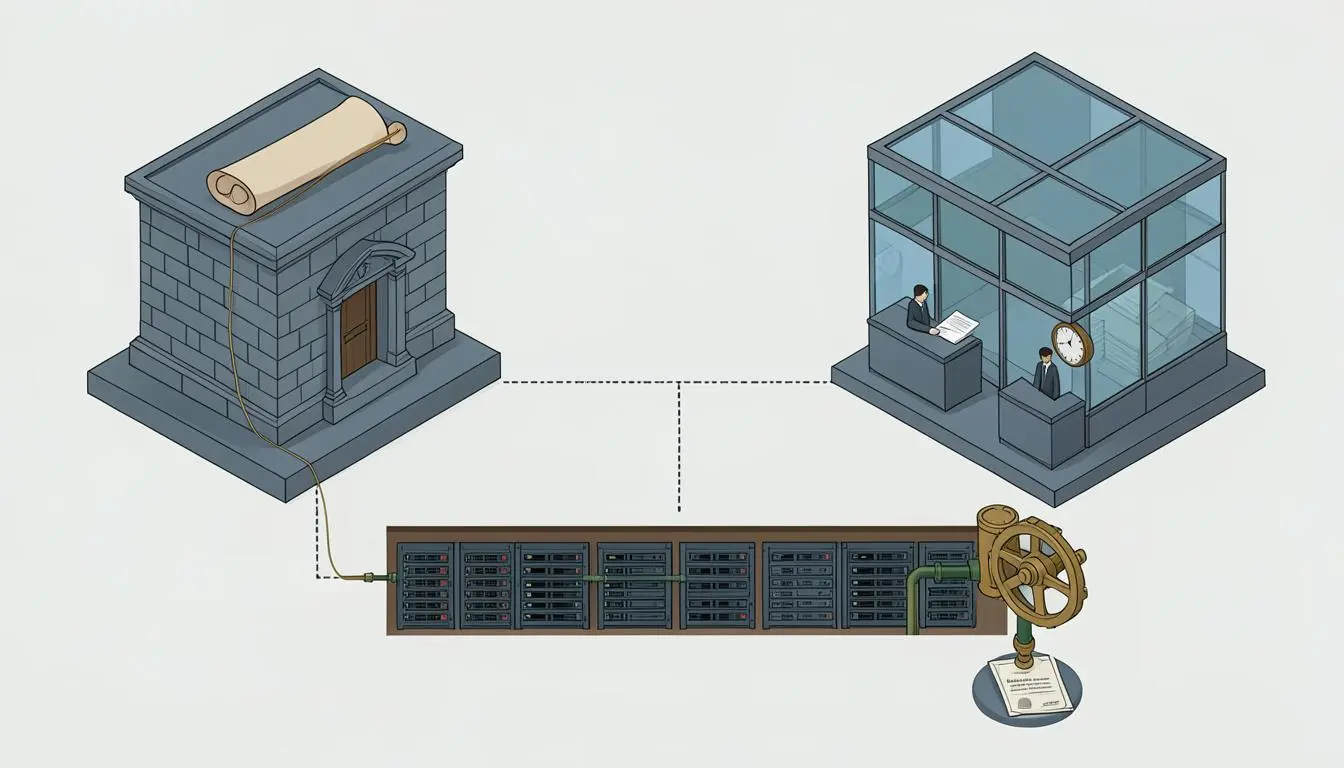
- The public interest in .nl is written down and enforceable: a covenant of 21 November 2022 between SIDN and the Minister of Economische Zaken en Klimaat makes its arrangements binding in court, names the civil court in The Hague, and runs seven years to November 2029.
- Every clause a .nl holder or registrar is bound by is concluded with SIDN B.V., a different legal person the covenant clauses read do not name — and the foundation's supervisory board appoints its own members, appoints the board by three quarters and amends the articles by three quarters.
What the covenant actually says
It is a covenant, not a statute, and short enough to read in one sitting. Its parties are Stichting Internet Domeinregistratie Nederland — abbreviated SIDN in its own articles and seated in Arnhem (art. 1) — and the Minister of Economische Zaken en Klimaat, who signed in The Hague on 21 November 2022 through a director-general (covenant).
The preamble recognises. EZK recognises that SIDN is the registry for .nl. SIDN recognises that the Dutch government has a special interest in the continuity and stability of the domain. Clause 2 records EZK's conclusion that SIDN safeguards that continuity within its sphere of influence. Clause 4 obliges SIDN to keep .nl durably connected with Dutch society and to remain, for .nl services, statutorily and factually established in the Netherlands and subject to Dutch law. Clause 7 commits the State to help where concrete risks fall outside that sphere. Clause 8 keeps self-regulation by SIDN as the starting point.
Then the machinery. Clause 9 makes the arrangements binding and enforceable in court. Clause 10 routes a dispute through consultation between the ministry's director-general and SIDN's board, then mediation, then the civil court in The Hague. Clause 12 allows amendment only with both parties' written consent, published in substance in the Staatscourant, and clause 13 excludes unilateral termination during the term. Clause 15 fixes seven years from the day after signature — so November 2029, not calendar year-end, which makes the 2022–2029 in the file title approximate — with continuation only by agreement.
Clause 16 adds that termination neither creates nor destroys powers that existed before.
Both the covenant and the addendum below were retrieved as OCR extractions with visible damage, so they are described by clause number rather than quoted; the annexes clause 3 refers to, and the earlier covenants of 2008 and 2015, were not examined. Absences here are counts over clauses 1 to 16.
Two legal persons
On 1 January 2023 SIDN moved its operation into a private company and left the delegation where it was. Its own account is explicit (SIDN, 10 January 2023): the .nl delegation stays with the original foundation; the operation goes into SIDN B.V.; the foundation indirectly holds every share through SIDN Groep B.V.; and the existing holder and registrar agreements transferred by split-off without a new agreement being needed. The published reason, which SIDN gives for itself, was to spread entrepreneurial risk so that claims can be brought only against SIDN B.V., leaving the delegation and the resilience reserve with the foundation.
Read the instruments side by side and the seam shows. The defined term SIDN in the covenant is the foundation; clauses 1 to 16 as retrieved name no subsidiary, group company or third-party beneficiary, and Addendum nr. 1 repeats the same two parties. Whether the covenant is ever concluded with, or extended to, SIDN B.V. was not established here. The company that holds the contracts is not, in the clauses read, the company that carries the duty.
SIDN B.V. is no shell. Its articles print 29 July 2024, seat it in Arnhem, and repeat in article 3.2 the duty to draw up public, transparent and non-discriminatory conditions and to register through parties that have concluded an agreement to that effect (SIDN B.V. articles). The retrieved text stops inside article 9, so nothing is claimed here about its governance.
The paper a holder accepts
A .nl holder signs with SIDN B.V. The holder terms carry 1 October 2023 (holder terms). Article 3.1 requires the holder to appoint a registrar to represent it, treats the registrar's acts as for the holder's account and risk, and has SIDN execute the registrar's instructions without further investigation. Article 3.2 requires representation at all times and a new registrar within 30 days if the relationship ends. Article 6.1 has SIDN charge the registrar and leaves the registrar free to set the holder's price; article 6.2 lets non-payment by the registrar end its agreement, with at least 30 days for holders to move. Articles 10.1 and 10.2 allow a change of registrar and provide that the transfer does not touch the holder's contract with its registrar unless that contract says otherwise.
The registrar side runs the same way, marked 01-10-2023 and concluded with SIDN B.V. (registrar terms). An EU legal person may apply (art. 1.1) and becomes a registrar only on written confirmation (art. 1.2). The registrar must have the applicant conclude a registration agreement declaring the holder terms then current applicable (art. 3.1 sub a), carries a continuing duty of care on data correctness and holder traceability (art. 3.2), must not register a name for another in its own, a reseller's or a privacy service's name save a narrow temporary exception (art. 3.4), retains records two years past the subscription (art. 4.3), and holds an agreement of indefinite duration (art. 8.1) terminable immediately on the grounds listed in article 8.3.
The asymmetry is scope, not secrecy. The instrument with the court, the ministry and the clock reaches the foundation; the instrument a holder actually accepts reaches the company. Whether a holder or registrar could enforce the covenant is not answered by the text read: clause 9 names no beneficiary.
One specimen belongs here. The foundation's articles page prints no version at all; 29 July 2024 exists only in a separate notice announcing the amendment, which records that the changes were mainly legal-technical, aligned with the Wet bestuur en toezicht rechtspersonen, and that the objects and the registrars' rights were not substantively changed (SIDN, 9 September 2024).
The State's one hard lever
Where the State holds a sharp written power over .nl, it is over infrastructure. Addendum nr. 1 of 16 January 2025 inserts article 4a (Tweede Kamer, 2025D01628): SIDN must submit to the ministry, for approval, its choice of party where it will place the database from which the zonefile is generated, the generation and signing of the zonefile, and the publication on the hidden primary .nl DNS server, now and in the future. The ministry may refuse where an unacceptable risk arises or threatens for the autonomous and sovereign functioning of the .nl DNS chain. It enters into force the day after signature, and its parties are again the foundation and the minister.
That is a real veto, narrowly drawn. It reaches the zonefile pipeline. It does not reach the composition of the supervisory board, the appointment of the board, the amendment of the articles, or a single clause of the holder terms. The State's leverage over what a holder accepts runs through consultation, not an approval stamp.
Who fills the seats
The articles describe a body that completes itself. The raad van toezicht has six to nine members (art. 4 lid 2) and appoints its own members (art. 5 lid 1), against a profile it sets after giving the registrars of article 24 lid 3 the chance to advise (art. 5 lid 2) (articles). Suspension and dismissal sit with the same body, on three quarters of the votes with a three-quarters quorum and the member concerned excluded; a suspension lapses by operation of law if dismissal does not follow within one month (art. 7). A member retires at the latest three years after appointment, is twice reappointable and may be reappointed once more for at most two years on weighty grounds recorded in the annual report (art. 8) — an extra term SIDN's own notice says had already been used for two members, for one and two years. The board has two and at most three members (art. 15 lid 1) and the supervisory board appoints, suspends and dismisses them by three quarters (art. 15 lid 3). Amendment of the articles is also a supervisory-board resolution: at least three quarters of the votes cast, three quarters of the members present, a two-thirds fallback at a second meeting, the word-for-word proposal with the convening notice, and a notarial deed any single supervisory or board member may execute (art. 26 lid 1 to lid 3).
No ministerial approval appears in article 26 as retrieved, and that sentence needs its boundary: the page elided parts of articles 10 to 13, 15 to 22 and 25, so what can be said is that no such right appears in the articles read.
Outside input exists, and it is one seat. Registrars are involved in appointing one member with demonstrable knowledge of their commercial position (art. 24 lid 2), and article 24 lid 3 prints three modes of that involvement without choosing: a nomination the board may appoint or reject, an appointment only after a positive registrar advice, or a reasoned advice on reappointment the board may depart from only with reasons. Which mode is live was not established here. Article 24 lid 1 protects the advisory right against amendment without registrar consent — a floor, not a widening.
A body that fills its own vacancies, appoints the executive by three quarters and amends the articles by three quarters is not under external instruction. It is a design, with compensations: a profile, a three-quarters dismissal threshold, three-year terms, one registrar-linked seat among six to nine. Whether the compensations are adequate is the reader's judgement, not a finding about anyone in the seats.
The second public net
A second instrument exists and it is not a covenant. SIDN states that the Wet beveiliging netwerk- en informatiesystemen entered into force on 9 November 2018 and that SIDN was designated a provider of essential services at that moment, under Agentschap Telecom, now Rijksinspectie Digitale Infrastructuur (SIDN). The designation was extended by regulation of 13 February 2023, number WJZ/26234325, published in Staatscourant 2023, 5316 on 20 February 2023, which designates providers of authoritative DNS services for more than 400,000 registered .nl names, with aggregation for linked undertakings, and entered into force on 1 July 2023; its explanatory note says all .nl names are registered with SIDN and that SIDN is the authoritative DNS provider for .nl (Staatscourant 2023, 5316).
That is a duty-and-supervision net — a statutory duty of care, an incident notification duty, an inspectorate — not a route by which terms are reviewed or a seat is filled. Whether it has produced any published finding about the .nl chain was not established here.
What the record adds up to
Two instruments, one name. A covenant binding a foundation, enforceable by a minister in The Hague, running to November 2029. A pair of contract documents binding holders and registrars to a private company the covenant's clauses read do not name. The public interest in .nl has a written duty, a court and a clock, and — in the clauses read — no single document in which the party owing the duty and the party holding the holder's contract are the same person. Nothing in this record says anyone failed, was captured or acted in bad faith. The finding concerns where the paper sits, and who can pick it up.
One open item belongs in the text rather than a footnote. SIDN's own committee regulations cite article 27 of the statutes as the basis for adopting regulations, while in the 29 July 2024 articles that power sits at article 28 and article 27 is dissolution. The regulation itself was not opened, so this stays an open item: a citation pointing at the wrong article, recorded, not adjudicated.
The clock is the practical part. Clause 15 makes continuation a matter of agreement, and clause 12 makes scope a matter of agreement too. Between now and November 2029, the cheapest moment to ask whether the company holding every .nl contract should also carry the duty is the moment the parties are already at the table.
Member Briefing
Read the full trend briefing
Members read the full briefing with the source notes behind every finding.
Strategic Circle
A daily briefing in your language, built from changes we have verified.
Join for USD 20/monthCancel anytime.
Members also get the full research library, a daily briefing on the networks they follow and the private forum.




