
Summary
- Public ownership of a satellite terminal does not by itself confer control of the account, service line, authorised location, licensed network or replacement path.
- Buyers should accept a publicly funded terminal estate only after a live transfer or failover drill proves who can restore service, on what authority, in how much time and at whose cost.
The asset that remains after the connection leaves
Imagine the handover meeting at a rural clinic. The terminal is still fixed to the roof. Its serial number appears on an asset register and the public authority can point to an invoice showing that the equipment was purchased. Yet the contractor who managed the account has gone, the original service line has ended, and no current officer can activate the kit at the site. The state owns the object. It does not control the connection.
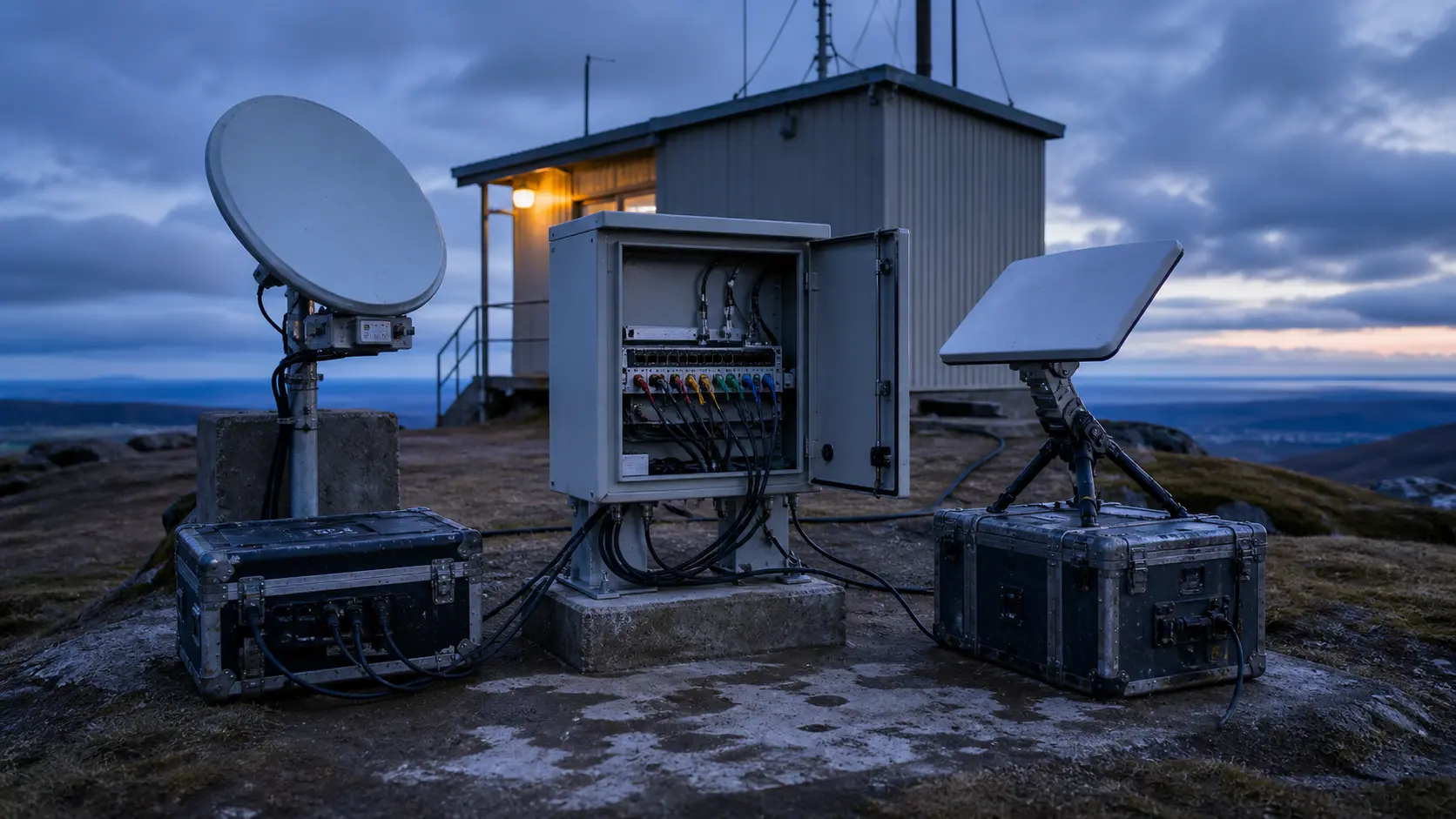
This is not a hypothetical category error. Satellite broadband divides control across several institutions. A customer may own the hardware while the operator controls the account workflow, capacity assignment and software. A national regulator authorises a particular network or gateway. A service plan may restrict location or mobility. A local contractor controls the power, Ethernet, routing and Wi-Fi that turn the satellite link into a usable public service. A replacement constellation may require a different terminal altogether.
Calling all of that “the dish” makes procurement look simpler than it is. It also rewards the wrong milestone. Installation can be counted on the day of delivery. Re-provisioning is discovered only after staff turnover, contract expiry, relocation, regulatory change or crisis.
What the Ukraine terminal record actually shows
The 2025 inspection by the USAID Office of Inspector General provides an unusually concrete view of a large public terminal transfer. USAID delivered 5,175 Starlink terminals to Ukraine. It purchased 1,508 of them; the purchased units included three months of unlimited satellite service. The equipment helped sustain civilian communications during the invasion, including connectivity for hospitals, clinics, schools and public-support centres.
The inspection's more durable lesson is about the chain of control after delivery. USAID did not establish a monitoring system for the whole estate after responsibility passed to the Ukrainian government. A draft transfer agreement had proposed safeguards and written assurances from downstream recipients, but the final documents did not contain all of those conditions. Ukraine's communications authority transferred 4,738 of 5,000 terminals to other recipients. The inspector general also found that location restrictions contained in the vendor's terms were not carried into the relevant request letter and transfer document.
War changes the acceptable risk calculation. Rapid deployment in 2022 cannot fairly be judged as if it were an ordinary broadband tender. But the record still establishes a general proposition: a transfer of title or responsibility can lose the operational terms that determine where equipment may be used, who may use it and who can observe the estate. Possession and control can separate at the moment an agency most wants to treat the procurement as complete.
A purchased kit is not an unconditional service right
Starlink's general customer terms make the distinction explicit. Title to a purchased kit passes at delivery; a rented kit remains Starlink property. But transfer of a purchased kit or its service is conditional. The account must be paid in full and in good standing, capacity must exist under the requested plan, and a timing threshold applies. The company's support instructions add country-certification and activation steps and require the old account to release the device.
Government and enterprise agreements may negotiate different rights. That uncertainty strengthens rather than weakens the procurement question. A public buyer should not infer its rights from the box arriving at the site. It should record the exact contract, account and activation rights that survive a change of contractor or recipient.
The phrase “terminal portability” is therefore too loose for a tender. At least five different capabilities have to be separated.
- Asset portability: can the buyer identify, move and lawfully transfer each terminal, router, mount, cable and spare?
- Account portability: does the public principal control the administrator identity, service line, billing status, support entitlement and device-release process?
- Location and authority portability: can the unit be activated at the intended site and country under the current plan, certification and spectrum authorisation?
- Site portability: can another terminal use the same documented power, Ethernet, routing, Wi-Fi and mobile handoff without rebuilding the whole installation?
- Service portability: is there a priced successor service, replacement terminal, logistics plan and cutover window?
Only the first two may involve moving the same physical kit. The fifth can require replacement equipment. Pretending otherwise turns a useful exit requirement into a technically false promise of universal antennas.
Spectrum authority sits outside the asset register
Ofcom's NGSO framework shows why the regulatory layer matters. It distinguishes a network licence covering user terminals from gateway authorisation. A gateway generally communicates with a satellite system that holds the relevant network authority, or with a system whose terminals fall under an exemption. Licensees must coordinate with other systems, and significant network or gateway changes can require regulatory action.
The exact legal structure differs by country. The operating point is broader: a buyer cannot create a lawful satellite service merely by possessing radio equipment. The supplier's licensed network, filings, gateways and coexistence duties remain part of the service chain. An exit plan that lists only hardware and subscriptions omits a control surface capable of stopping activation entirely.
The British trials reveal the right engineering level
The UK's Very Hard to Reach programme tested low-Earth-orbit satellite connections at more than a dozen remote sites and reported speeds of up to 200 Mbps. The programme used a mixture of OneWeb and Starlink equipment. That diversity is useful, but the public record does not say that one provider's terminal was reused on the other provider's constellation.
A later UK-backed Nomadic Multi-orbit User Terminal Demonstrator frames the challenge more accurately. Its brief asks suppliers to integrate LEO and GEO terminals, or create a low-cost dual-mode terminal, and to switch traffic according to performance, latency, signal strength and resilience. It also asks for portable power, rapid deployment, terrestrial Wi-Fi and mobile interfaces, and evidence about operating cost.
That is portability at the system boundary. The site can be designed to accept more than one bearer even if the radio terminals remain proprietary. Power connectors, local network handoff, configuration records, monitoring and mounting can be made replaceable. Traffic can fail over above the radio layer. Spare equipment and subscriptions can be priced before an emergency. Public control does not require pretending that incompatible hardware is compatible.
The European Union's IRIS2 programme points in the same direction at a larger scale: a multi-orbit architecture, reduced external dependence and development of 5G Non-Terrestrial Network standards. It is a programme objective, not proof of delivered interchangeable terminals. Its significance here is institutional. Dependence is now being treated as an architectural choice rather than an unavoidable property of satellite service.
Public support needs an exit test as well as an entry test
The FCC's RDOF record offers a different warning. SpaceX was the winning bidder for $885.5 million over ten years to serve 642,925 locations, but the company was later not authorised to receive the support after the Bureau concluded that the application had not demonstrated the technical and financial ability to serve the winning areas. No inference should be made that hundreds of thousands of terminals were installed and stranded; the record says the support was not authorised.
What the episode demonstrates is that auction success and public obligation are not the same state. Public programmes already test whether a bidder can enter. They should apply the same discipline to exit: can a site remain connected if the original account, contractor, plan or network is no longer available?
UK public-technology policy already tells departments to consider lock-in and estimate exit and migration cost at the start of a project. Satellite procurement should adapt that principle without abusing it. Open data and interface standards can preserve configuration, monitoring and site integration. They cannot make a proprietary phased-array terminal speak to a rival constellation.
Acceptance should include a failed handover
The useful procurement document is not a clause saying “portable.” It is an exit pack that another operator can execute.
The pack should contain a reconciled asset register; purchase or rental status; serials and terminal identifiers; named public administrators; account-recovery procedures; service-line and billing status; country and location restrictions; the network and gateway authorisation owner; exportable configuration and monitoring records; documented power and local-network interfaces; replacement-equipment lead times; and a budget for freight, installation and overlapping subscriptions.
Then the buyer should test it. Select a representative site. Remove the incumbent contractor from the exercise. Transfer a purchased kit between authorised account holders, or install and activate the designated replacement. Restore routing and local access. Measure the outage. Reconcile the new account, location and asset records. Record which steps still required discretionary help from the incumbent.
The result will be less flattering than an installation photograph and more valuable than one. It tells the public authority whether it owns durable connectivity or only the equipment left behind when connectivity ends.
Evidence limits
No source in this packet provides a comparative dataset of exit costs or failure rates across constellations. The USAID case reflects wartime urgency. General customer terms may differ from negotiated public contracts. Licensing rules vary by jurisdiction. The British multi-orbit brief states desired capabilities, not delivered economics. Most importantly, the record does not establish that any current commercial dish can operate on a rival constellation.
Those limits are not reasons to abandon the exit test. They define it. Procurement should pay for facts that are currently missing: time to transfer, time to replace, lawful locations, incumbent dependencies and the full cost of a successor connection.
Sources
- USAID Office of Inspector General, Ukraine Response: USAID Did Not Fully Mitigate the Risk of Misuse of the Starlink Satellite Terminals It Delivered to Ukraine: https://oig.usaid.gov/node/7845
- UK Department for Science, Innovation and Technology, Very Hard to Reach premises: alpha trials: https://www.gov.uk/government/publications/very-hard-to-reach-premises-alpha-trials
- UK Department for Science, Innovation and Technology, Project Gigabit progress update, June 2023: https://www.gov.uk/government/publications/project-gigabit-progress-update-june-2023/project-gigabit-progress-update-june-2023
- UK Department for Science, Innovation and Technology and ESA, Nomadic Multi-orbit User Terminal Demonstrator: https://www.gov.uk/government/publications/artes-call-for-innovative-hybrid-network-solutions/nomadic-multi-orbit-user-terminal-demonstrator-project-brief-and-assessment-criteria
- Ofcom, NGSO satellite earth station authorisations — Updated Guidance for Applicants and Licensees: https://www.ofcom.org.uk/siteassets/resources/documents/manage-your-licence/satellite-earth-stations/guidance/ngso-guidance.pdf?v=414937
- Starlink, Terms of Service, 17 March 2025: https://starlink.com/public-files/Starlink_ToS_3.17.25.pdf
- Starlink Help Center, How do I transfer ownership of my Starlink hardware?: https://starlink.com/ss/support/article/f3cad923-ed28-f957-365c-787f8fe2e4a2
- Federal Communications Commission, DA 24-883: https://docs.fcc.gov/public/attachments/DA-24-883A1.pdf
- European Commission Joint Research Centre, IRIS2 — Europe's space-based secure connectivity system: https://joint-research-centre.ec.europa.eu/projects-and-activities/iris2-europes-space-based-secure-connectivity-system_en
- UK Cabinet Office, Open Standards Principles: https://www.gov.uk/government/publications/open-standards-principles/open-standards-principles
Member Briefing
Deeper Profile Context
Sign in with the right membership level to unlock the full briefing and source notes.
Only for Strategic Circle
Strategic Circle
Open to all readers. Unlock profile briefings after joining and signing in.
Join Strategic CircleOnly for Leadership Alliance
Leadership Alliance
For qualified IP-asset owners and management; sign in to unlock alliance briefings.
Join Leadership Alliance