Summary
- Sangha Renewables reports conditional Base Load classification for its 110.4 MW Texas campus and has named Marathon Capital as exclusive financial adviser for a strategic process.
- The site's history is bitcoin mining behind a 150 MW solar farm, firmed by TotalEnergies. The new disclosure names no AI tenant, no transaction value and no supply terms for the 90.5 MW expansion.
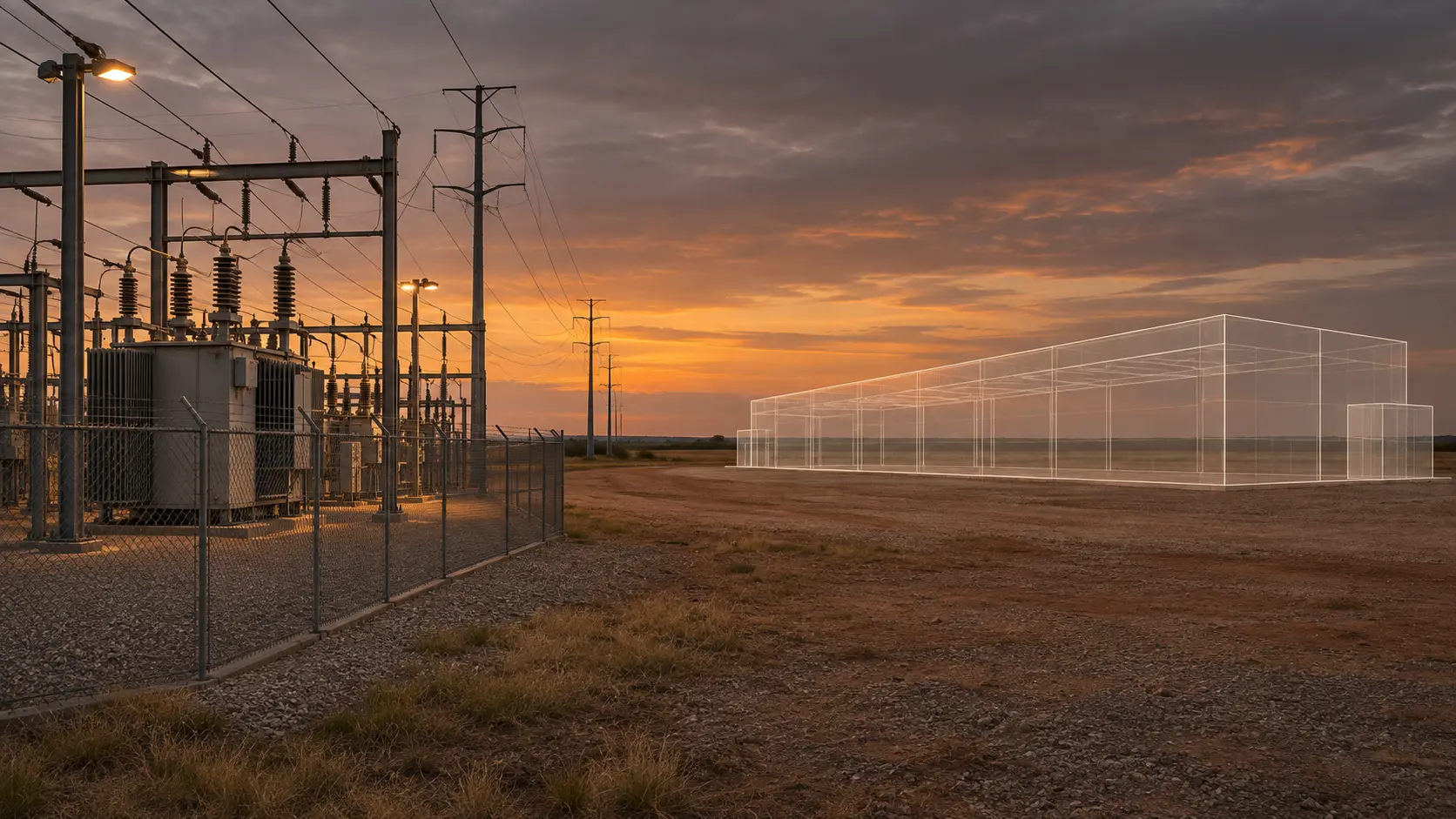
The most revealing line in Sangha Renewables' September 11 announcement is not a megawatt figure. It is a banker's name. Marathon Capital is advising exclusively on a strategic process for a Texas development pitched at AI, cloud, inference and high-performance computing demand — which is a polite way of saying a company built to monetise power through bitcoin mining is now shopping a site to customers with very different appetites. The issuer's announcement
The release says the 110.4 MW Project Genesis campus has won conditional Base Load classification in ERCOT's Batch Zero process. It describes about 19.9 MW of available power and expansion rights for another 90.5 MW, expected in May 2028. Neither the classification nor that 2028 date tells a buyer what it is buying: powered land, a finished building and a continuing service are three different products with three different contracts. No buyer, tenant, transaction value or completed financing is named.
What ERCOT's stamp does — and does not — mean
ERCOT's administrative position is a separate piece of evidence, and a thinner one than the headline implies. Its September 3 notice describes conditional classifications subject to verification, modelling or eligibility conditions. ERCOT's classification notice Those are not findings against Sangha. Its September 9 notice says successful verification is required for inclusion in Batch Zero, and that incomplete or late responses can lead to exclusion. ERCOT's verification notice The public record does not show a Sangha-specific request or deadline. A conditional classification is a place in the queue, not a signed customer.
The solar farm, the bitcoin mine, and the firming
The earlier operating model is what makes the distinction worth drawing. In December 2025, Sangha announced energisation of a 19.9 MW bitcoin-mining project in Ector County, behind the meter on a 150 MW solar farm. Sangha was to own and operate the mining facility and supply hardware and load management; Links Genco handled energy structuring and grid compliance. The historical project announcement
This was never a claim that sunshine alone keeps the lights on. The same release handed TotalEnergies balancing services, supplemental grid supply during non-solar hours and structured power products; TotalEnergies called its role supplying firm power. Those arrangements matter far more to a compute customer than the word “solar” on a slide deck. They also cannot be assumed to stretch across the future 90.5 MW or an unnamed tenant.
Flexibility has an owner and a price
In a mining-led arrangement, control over when to consume power is part of the site's economics — the load bends to the grid, not the other way round. A different customer's service commitment may preserve that flexibility, restrict it, or demand compensation elsewhere. The workload's label does not settle it; the agreement does.
That makes transferability the real question. A buyer of powered land needs to know which electricity rights travel with it, what needs a counterparty's signature, and who eats the loss when supply and consumption diverge. Existing balancing services prove the past was priced; they do not prove the future is.
Commit to a tenant before the expanded supply and risk split are settled, and the option gets expensive to honour. Allocate the risk cleanly, and a less spectacular capacity number becomes commercially useful. Sangha's strategic process is best read as a test of that package — not a hunt for a fancier workload to bolt onto a solar farm.
The disclosures that would define the offer
A transaction description would show whether Sangha is selling rights, buildings or a service. A named tenant and a disclosed supply scope would reveal which load profile is actually being bought. Verification completion and expansion milestones would sharpen the timing. These are different signals, and one should not be swapped for another: a fresh administrative milestone is not evidence of customer obligations, and the old supply deal is not a new contract.
The announcement brings a development opportunity and a transaction adviser into view. What it does not yet show is the thing that matters: a power bargain, a building and a demand, all contracted for the next use. Until then, Sangha has 110 megawatts, a banker, and an open question.
Member Briefing
Read the full trend briefing
Members read the full briefing with the source notes behind every finding.
Strategic Circle
A daily briefing in your language, built from changes we have verified.
Join for USD 20/monthCancel anytime.
Members also get the full research library, a daily briefing on the networks they follow and the private forum.