
Summary
- Weil developed Ceph as part of a collaborative research programme at UC Santa Cruz and completed his doctorate in 2007, after the foundational Ceph and CRUSH papers were published in 2006.
- CRUSH calculates placement from maps, weights, topology and rules; RADOS distributes entities, replicas, failure detection and recovery across monitors and OSDs.
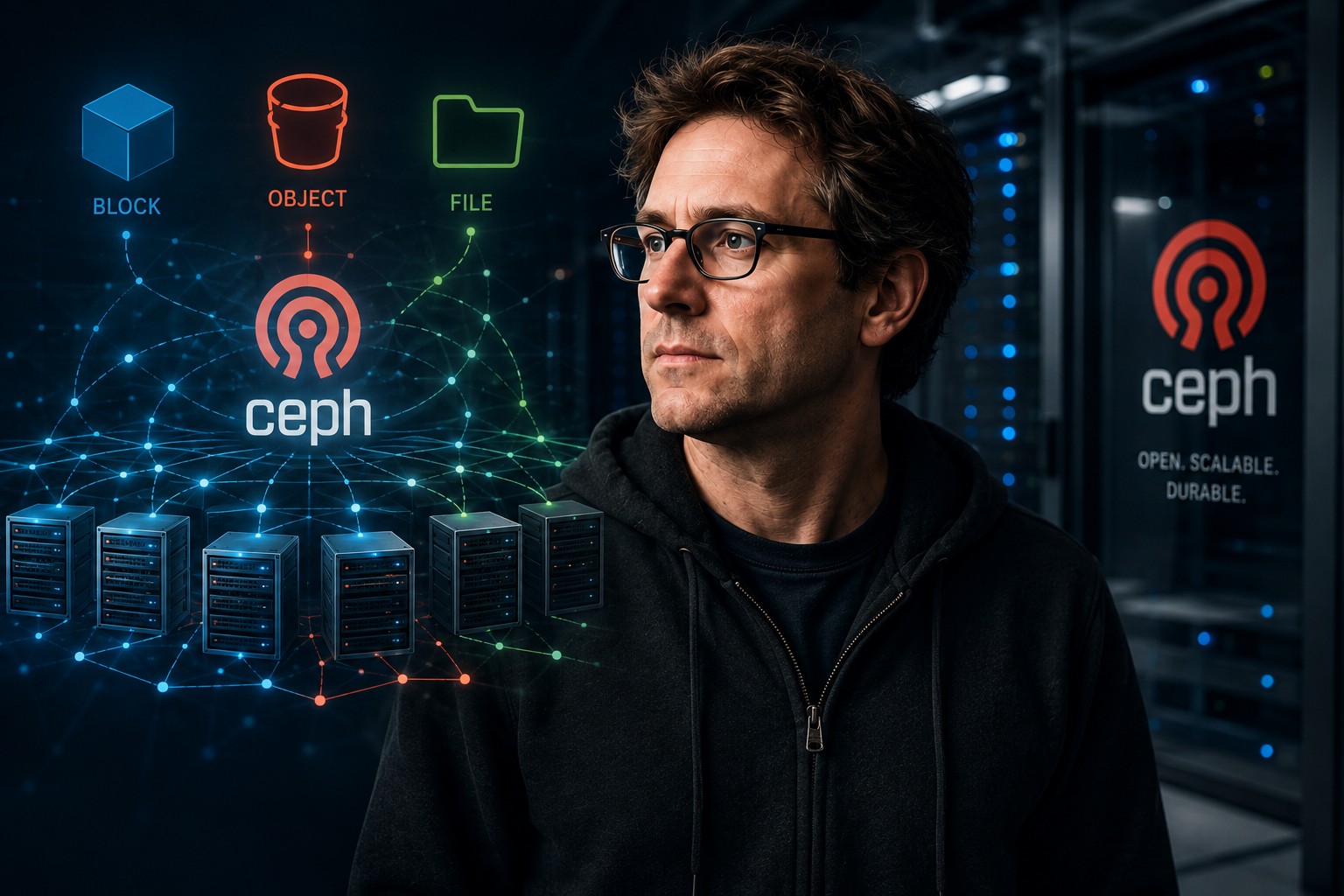
- Ceph provides block storage through RBD, object storage through RGW and a POSIX-style filesystem through CephFS, all on the same foundation but with different operational paths.
- Weil co-founded Inktank in 2012, and Red Hat announced on 30 April 2014 that it would acquire the company for approximately $175 million.
- Weil stepped away from day-to-day work on Ceph and now leads Civic Media. Current authority rests with maintainers and contemporary governance structures, not the historical founder.
The storage array that became an algorithm
Ceph removed a central placement table from the normal data path. CRUSH calculates devices from a map and a rule, while OSDs store data in RADOS, exchange state, replicate and recover under authoritative maps maintained by monitors. The work is distributed, but authority does not disappear.
The result depends on weights, hierarchy and real failure domains. An outdated map reproduces poor placement with precision. The algorithm reduces lookups and unnecessary movement, but the operator must represent the physical world correctly.
A research group, not a lone inventor
Ceph originated at the Storage Systems Research Center at UC Santa Cruz. Weil was a central designer and builder, but supervisors, co-authors, students, funding and testing environments shaped the project. The 2006 papers carry multiple names, including Scott Brandt, Ethan Miller, Carlos Maltzahn and Darrell Long, depending on the paper.
Collective attribution does not diminish Weil’s role; it explains how a thesis became infrastructure. Others had to understand, criticise and maintain the system for it to outlive its creator.
CRUSH: calculating where data belongs
CRUSH uses hierarchical buckets, weights and rules to select an ordered list of devices. A rule can require replicas in different racks or select a class of storage media. When the cluster changes, a proportion of entities is reassigned instead of relying on a central table for every entity.
The rules are executable policy. An incorrect weight or an unrepresented rack distorts distribution and recovery. Before making a change, operators should simulate data movement, inspect free capacity and understand the network load.
RADOS and the decision to distribute repair
RADOS turns a large number of OSDs into a single foundation. Monitors maintain quorum and maps, while OSDs store entities, compare state, replicate and repair. Recovery occurs close to the components that know the data instead of through a single controller for every transfer.
A widespread failure can produce a rebuilding storm that competes with clients for network and disk resources. Availability depends on headroom, throttling, device health and the time taken to remove an OSD from service. Distribution does not make recovery free or automatic.
One entity store and three storage interfaces
RBD provides block volumes, RGW supplies entity APIs, and CephFS builds a POSIX-style filesystem with metadata servers. The interfaces share RADOS and its placement and recovery mechanisms.
The bottlenecks differ, however. RGW adds identity and gateways, CephFS adds a metadata layer, and RBD depends on clients and caches. Success with one access pattern does not prove that another is suitable.
Placement groups, recovery and the cost of failure
Placement groups collect entities so that placement, peering and recovery remain manageable. Their distribution determines balance and the work required after a failure. When an OSD is lost, the cluster reassigns and rebuilds data according to policy.
Limited public evidence free space or incorrect topology prolongs a degraded state. Operators must monitor unclean entities, backfill, latency, bandwidth and recovery time. Replication is not a substitute for backup against logical deletion or corruption.
From doctoral code to Linux infrastructure
The transition from a thesis to Linux and OpenStack required years of packaging, compatibility work, documentation, upgrade testing and failure correction. Kernel and distribution integration brought Ceph into clouds and products. The unglamorous operational work mattered as much as the academic papers.
Openness enabled hardware choice and created multiple offerings, but it also multiplied combinations of networks, devices, kernels and versions. The upstream project publishes a branch; the integrator and operator are responsible for the actual configuration.
Inktank, Red Hat and commercial responsibility
Inktank was founded in 2012, sold support and brought engineering work together. Red Hat announced the acquisition on 30 April 2014 for approximately $175 million, bringing Ceph into a major open-source company and its cloud business.
Funding supported maintenance and expansion, but it also concentrated employment. The licence and community limited exclusive control. Customers still had to distinguish between the public project, the Red Hat product and a specific distribution, each with its own roadmap and support boundaries.
The project learns to live without its founder
Weil later left full-time work on Ceph and founded Civic Media. His biography explains the project’s origins, but it does not determine current release decisions. Attributing every present success or incident to the founder erases the work of today’s maintainers, packagers and operators.
Continuing without him is part of the project’s success. Succession requires structures that resolve disputes, publish patches and maintain subsystems. Historical authority deserves recognition, not a permanent right to lead.
Member Briefing
Deeper Profile Context
Sign in with the right membership level to unlock the full briefing and source notes.
Only for Strategic Circle
Strategic Circle
Open to all readers. Unlock profile briefings after joining and signing in.
Join Strategic CircleOnly for Leadership Alliance
Leadership Alliance
For qualified IP-asset owners and management; sign in to unlock alliance briefings.
Join Leadership Alliance