
Summary
- S3’s public materials support the existence of a Bogotá-based communications business selling corporate internet, data transport, local networking, managed support and hosted services, but they do not identify the last-mile carrier, building entrance or metro route behind any specific customer circuit.
- AS52330 is active with 12 announced IPv4 /24s, one announced IPv6 /32, four observed upstream-side neighbours, a fifth uncertain adjacency and a declared 10 Gbps NAP Colombia connection; these are meaningful network signals, not proof of physically independent access or of usable failover capacity.
- A resilient S3 purchase therefore requires evidence at the circuit level: distinct entrances, ducts or radio paths, access suppliers, aggregation sites, upstreams, power domains, spare capacity, fault ownership and tested restoration authority.
The two-circuit illusion starts in the riser
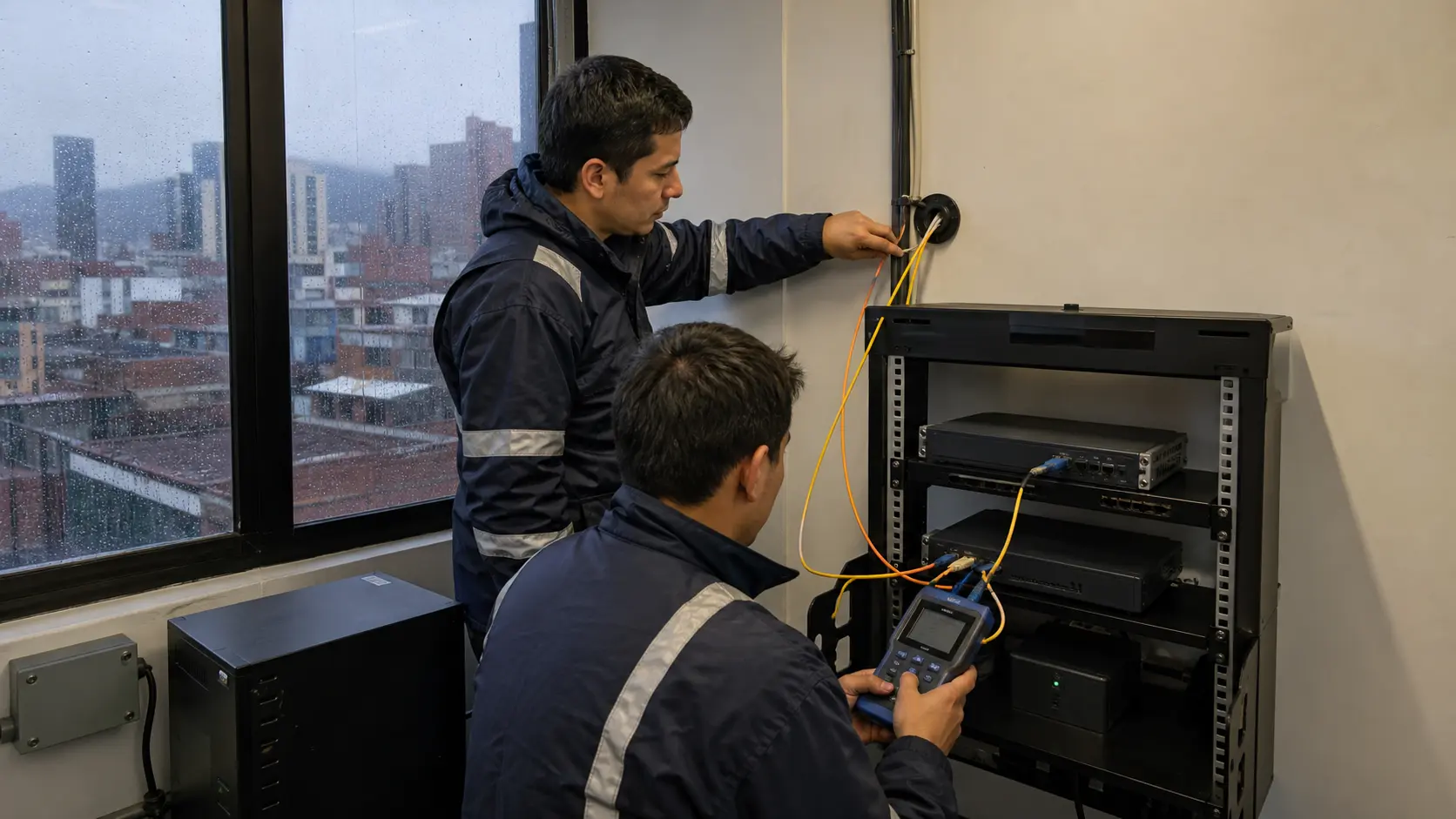
Picture a wet Bogotá afternoon and an enterprise equipment room several floors above the street. Two fibre handoffs terminate in separate edge routers. The contracts call one service primary and the other backup. The routers have different serial numbers, the optical interfaces show light, and the customer has paid for a design intended to survive failure. Yet both fibres disappear into the same vertical riser, pass through the same basement sleeve and may leave the building through the same chamber.
If a contractor severs that chamber, if a fire closes the riser, or if a utility fault removes power from the shared access equipment, the logical distinction between the circuits collapses.
That is the right place to begin an examination of S3. The company’s communications page advertises stable corporate internet with national coverage, private data transport in point-to-point and point-to-multipoint configurations, and professional work on routers, switches, firewalls and radio equipment. Its homepage presents a broader proposition: experienced staff, standardised response, a project manager and a combination of business infrastructure, technology and communications. Those claims describe a provider that is willing to take responsibility for more than an internet port. They do not show how any particular port reaches the customer.
The distinction matters because enterprise resilience is often sold and evaluated at the wrong layer. A second IP address is not a second cable. A second router is not a second building entrance. A second upstream contract is not necessarily a second metro trench. Even a circuit delivered under a different commercial name may ride the same wholesaler’s access ring. The first question is therefore not whether S3 can configure failover. It is whether the two end-to-end paths stop sharing physical and operational dependencies early enough to survive the failure the buyer is trying to insure against.
S3’s public record gives no circuit-level answer. There is no published route drawing that carries a customer connection from a demarcation point through the building, street, aggregation node and interconnection facility. There is no public list of access carriers by city, no statement that primary and backup services use separate entrances, and no restoration matrix showing who can dispatch a crew when the break sits in another company’s plant. Absence of that material is not proof that diversity does not exist. It means the resilience claim must be verified per address rather than inferred from the provider’s network presence.
This is also why an availability percentage is a weak opening question. A figure calculated across a network or over a long period can coexist with a severe common-mode risk at one building. What matters in the equipment room is the failure domain: riser, entrance, duct, pole line, rooftop radio path, access carrier, aggregation router, metro span, facility, upstream, customer-edge power and the people authorised to restore each one. Unless those domains are identified, “two circuits” describes inventory, not survivability.
One operating business, three public names
The directory name, S3WIRELESS COLOMBIA S.A, is a real historical and network identity, but it is not the clearest expression of the company’s current legal name. A publicly posted Bogotá Chamber of Commerce certificate records the sequence. S3 Wireless Colombia S.A. was constituted in 2003; it changed form and name to S3 Wireless Colombia S.A.S. in 2012; and in 2017 it became S3 Simple Smart Speedy S.A.S. The certificate identifies NIT 830.120.215-2 and a Bogotá domicile. This is continuity through corporate changes, not evidence of three separate operators.
The internet registry has not fully followed that naming history. LACNIC’s AS52330 registration remains under S3WIRELESS COLOMBIA S.A, with a registration event in June 2011 and a last-change event in December 2011. The same record’s contact data refers to the newer “Simple Smart Speedy” identity. This combination makes the autonomous system a strong bridge between the old legal name and the current trading company, while also warning against treating a registry label as a current corporate certificate.
S3’s own about page uses S3 SIMPLE SMART SPEEDY S.A.S. and describes the company as designing, commercialising, implementing and supporting information and communications services. Its contact page gives Carrera 49A No. 86-40 in Bogotá, the same address shown on several certification documents and in the commerce record. The shared domain, address, phone pattern and service description support identity continuity. They do not establish which legal name appears on every legacy network agreement, property lease or customer contract.
The certification record adds useful, bounded evidence. An ISO 9001 certificate names S3 Simple Smart Speedy S.A.S., covers design, commercialisation, implementation and support across service desk, connectivity, communications, data centre and cloud activities, and shows validity through September 2026 subject to surveillance. An ISO/IEC 20000-1 certificate covers a similar service-management scope through September 2026. An ISO 45001 certificate addresses occupational health and safety over the same broad activity set. The posted ISO/IEC 27001 certificate, however, displays an end date in October 2025, so the posted file should not be represented as evidence of a current certificate without a newer document.
Certifications speak to management systems and defined scopes. They do not certify the physical diversity of a particular link, the capacity remaining on a backup path, or the independence of a building entrance. They are relevant because disciplined service, change and safety practices shape recovery. They are not substitutes for circuit records.
The naming history has a practical procurement consequence. A buyer should reconcile four identifiers before signing or renewing: the current contracting party and NIT; the name on the telecom registration; the entity controlling AS52330 and its address resources; and the party that owns or subcontracts each access circuit. If the service is invoiced by S3 Simple Smart Speedy S.A.S. while a network record or older route agreement uses S3 Wireless Colombia, the contract should state the continuity explicitly.
That removes ambiguity when a carrier must authorise work, when an insurance claim is made, or when an escalation reaches a facility that recognises only one of the names.
What S3 actually promises
S3 is not presenting itself as a narrow transit reseller. Its public offer combines the customer’s local network, the wide-area service, computing, support and communications applications. The Simple Business page describes structured cabling, wireless local networks, equipment, Wi-Fi zones, traffic monitoring, a service desk and on-site support. The Smart Technology page advertises dedicated computing, hosting, colocation and a data-centre environment, alongside claims about high availability and on-site maintenance. The communications offer then adds internet access, IP data transport, radio equipment and unified communications.
That breadth can be valuable. A provider responsible for the LAN, customer-edge router, access service and help desk has fewer excuses for bouncing a fault between vendors. It can also create a concentrated dependency. If the same service centre, change process, remote-management platform or field team supports both “independent” circuits, an operational error can affect both even when the fibres are separate. A resilience review must therefore test organisational diversity as well as cable diversity.
The most revealing language appears on S3’s coverage and quotation page. It says displayed values are monthly, exclude tax and installation, are subject to an on-site study, apply only to populations offered in the selector, and are subject to capacity availability. That qualification is more useful than a broad availability slogan. It acknowledges that saleability depends on location, engineering work and capacity at the time of order. It also means a map or national-coverage statement cannot be read as a guarantee that a second independent path exists at one address.
Three different capacity concepts need to stay separate. “Installed” capacity is what the ports, radios, fibres and upstream contracts could carry under defined conditions. “Provisioned” capacity is what S3 has configured and committed to a customer. “Usable failover” capacity is what remains on the surviving end-to-end path during the same event that removed the primary. Public materials do not disclose those values by node or route. A 1 Gbps backup service can be installed and provisioned yet deliver much less during a regional failure if many customers reconverge onto the same surviving uplink.
The hosted-services claims add another boundary. A corporate internet customer may buy only connectivity, or it may depend on S3 for a virtual server, hosted application, voice platform and support. If the hosted environment and the customer’s backup circuit meet at the same facility or upstream edge, a single event can remove both access and the service the access was intended to reach. Conversely, a well-designed hosted service could provide an alternate destination during a site failure. The public pages do not provide enough topology, contracted capacity or recovery data to decide which design applies.
S3’s homepage claims 1,383 satisfied customers and more than 12 years of experience. Those are company statements rather than audited operating statistics, and the page does not state the measurement date or definition of “customer.” They do indicate that the offer is aimed at an established operating base rather than a speculative network. The due-diligence task is not to dismiss that history. It is to translate broad service language into a per-site bill of materials, route description, capacity reservation and fault-responsibility schedule.
A map of nodes, not a map of ownership
S3 has published unusually specific geographic material for a small regional operator. Its coverage-node PDF contains entries numbered through 167 and associates municipalities with named nodes and, for many nodes, coordinates. The listed surface extends from Bogotá and Cundinamarca into Boyacá, Cauca, Meta, Nariño and Valle del Cauca. Repeated node names such as Manjuí, Quinini, Suba, Tibitoc and Tres Cruces suggest aggregation from multiple municipalities toward common high points or urban sites.
That document is evidence of a designed coverage concept. It is not a current asset register. The file carries no obvious effective date in its extracted content, while its web location sits under a 2019 upload path. Some municipality and department labels are inconsistent, some coordinates are absent, and a single coordinate is repeated for many served places. The safe reading is that S3 publicly associated those areas with its network at the time the document was prepared. It does not show whether S3 owns each tower, fibre, rooftop, radio, power system or backhaul.
The pattern matters for resilience. A radio access route can avoid a street excavation and still converge with a fibre service at the same hilltop node, power feed or downstream handoff. Two municipalities attached to one named site share that site’s weather, access and maintenance risk. A customer served from a rooftop or mountain node also depends on line of sight, mounting rights, power, grounding, spare radios and a crew able to reach the location. None of those dependencies is captured by the word “coverage.”
S3’s case-studies page says it supplied connectivity to municipal and educational sites, including Wi-Fi deployments in Zipaquirá and Tocancipá, and interconnection or rural connectivity for private customers. Its education page describes long-running technology and support work for universities. Its government page names connectivity, cloud, security and support work involving public institutions and municipalities. These pages support the proposition that S3 has delivered beyond a single Bogotá office and that service labour is part of the product.
They are not current contract registers. The pages generally omit contract dates, circuit quantities, access suppliers, exact sites, route designs and current status. S3’s private-sector page is particularly weak as proof because several different customer names are followed by nearly identical municipality-and-school connectivity text. That repetition may reflect an old publishing error. It makes the page unsuitable for verifying the scope of any named customer relationship without a contract, customer statement or procurement record.
The physical map that an enterprise needs is different from a marketing coverage list. It should begin at the customer demarcation point and name the medium, entrance, duct or radio endpoint, first active node, aggregation site, metro route, interconnection building and upstream handoff. Ownership should be marked at every transition. A route delivered by S3 over another carrier’s fibre is not inherently inferior, but the repair authority and common-route exposure must be known. A radio path is not inherently independent, but its high point, backhaul and power must be compared with the fibre path.
The public evidence therefore supports a broad Colombian service footprint with a strong Bogotá-Cundinamarca centre and historical extensions into other regions. It does not support a claim that every listed municipality is currently on owned plant, that all named nodes remain active, or that S3 can provide two physically independent local loops at any listed location. Those are site-survey questions, exactly as the company’s own quotation page implies.
The routed footprint is real—and tells us less than it seems
AS52330 is not a decorative registration. LACNIC records two IPv4 allocations associated with the organisation: 190.184.200.0 through 190.184.207.255, a /21 comprising 2,048 addresses, and 168.227.104.0 through 168.227.107.255, a /22 comprising 1,024. It also records the 2803:8340::/32 IPv6 allocation. Allocation establishes registered control of address space. It says nothing about how many customer circuits are installed or what bandwidth those circuits can sustain.
RIPEstat’s announced-prefix history showed 13 prefixes over the two weeks ending 17 July 2026: the 12 IPv4 /24s that exactly subdivide the two registered IPv4 blocks, plus the IPv6 /32. The AS overview marked AS52330 as announced on that date. The routing-status view counted 3,072 announced IPv4 addresses, one IPv6 prefix and visibility from nearly all of the RIPE Routing Information Service peers in its snapshot.
This is strong evidence that S3 maintains a globally visible routed footprint. It does not reveal how the prefixes are distributed among customers, infrastructure and hosted services. It does not show last-mile media, router throughput, congestion, packet loss, spare interface capacity or the number of subscribers. Dividing addresses by customers would be meaningless; private addressing, carrier-grade translation, infrastructure assignments and unused space all break that arithmetic.
Route-origin authorisation is another real but bounded control. RIPEstat returned “valid” for sampled announcements from the 190.184.200.0/21 family, the 168.227.104.0/22 family and the 2803:8340::/32 IPv6 block. That reduces one category of route-origin error for those examples. It does not prevent a fibre cut, an overloaded backup, a bad customer-edge change or an outage inside an authorised origin network.
The BGP-state data contains thousands of collector observations and multiple paths to S3’s prefixes. Collector diversity is useful for confirming reachability from different parts of the internet. It must not be converted into a count of physical routes. Many observed paths can share the same S3 border router, carrier facility, metro cable or international system before they diverge elsewhere.
This is the central installed-versus-usable lesson. Address space is installed administrative capacity. A live BGP announcement is evidence that a route is being originated and observed. Neither establishes forwarding capacity under failure. To measure usable capacity, a reviewer would need interface speeds, committed and peak load, oversubscription, headroom on each surviving upstream, policy during failure, DDoS controls, customer traffic profiles and test results. None of those appears in the public routing data.
The routed footprint still matters. It indicates that S3 can originate its own prefixes, select among external paths and present a consistent network identity rather than placing every customer directly behind a single retail connection. That capability can improve operational control. The remaining question is where that control begins. If the customer-to-S3 access segment is wholesale, S3’s routing authority starts only after a dependency it may monitor and escalate but cannot physically repair.
Four observed upstreams are not four independent roads
RIPEstat’s neighbour view observed four ASNs on the upstream side of AS52330 on 16 July 2026 and a fifth adjacency classified as uncertain. Separate overview records identify the four as Internexa, AS18678, Liberty Networks de Colombia, AS262191, SAMM Tecnologia e Telecomunicações, AS262589 and EdgeUno, AS7195. The uncertain neighbour is identified as GlobeNet Cabos Submarinos Colombia, AS52320.
Four upstream-side observations are materially better evidence than a claim of “multiple carriers” with no routing trace. They show that S3’s prefixes can appear behind several external networks. They do not prove four simultaneously contracted transits, four border routers or four physical exits. A route collector infers adjacency from AS paths. It cannot see whether two carriers arrive over separate ducts, lease capacity on the same metro provider, terminate in the same room, share a cross-connect corridor or depend on the same utility supply.
PeeringDB adds a useful operator-contributed view. Its network record for S3 reports an open peering policy, a South American scope, a self-reported traffic band of 10–20 Gbps and support for IPv4 and IPv6. The exchange record lists an operational 10,000 Mbps connection at NAP Colombia, with both IPv4 and IPv6 addresses. This is evidence of a declared 10 Gbps exchange port, not a measurement of traffic and not the total capacity of the network.
The numbers must not be added together. A 10 Gbps exchange interface and a 10–20 Gbps network traffic band measure different things. Transit links may carry traffic that never crosses NAP Colombia. The traffic band is self-reported and broad. The port speed is a nominal interface ceiling before protocol overhead and does not show the share already used. During an upstream failure, traffic that normally uses transit may shift toward another transit rather than the exchange, while an exchange failure may leave international reachability unchanged. Only utilisation and routing-policy data can show the available margin.
PeeringDB’s facility associations place S3 at Equinix BG1 in Bogotá, Internexa’s Bogotá World Business Port and ODATA DC BG01 in Cota. Three facility listings create plausible options for site and carrier diversity. They do not confirm that S3 has active equipment at all three today, that the entries are connected by independent metro paths, or that each can carry the production load of another. PeeringDB entries are maintained by participating organisations and should be verified with current letters of authorisation, cross-connect records and service orders.
The most defensible conclusion is therefore narrow. S3 has meaningful interconnection signals: multiple observed external neighbours, a declared NAP Colombia port and three listed facilities. That supports a network with more than one external relationship. Physical resilience remains unproven because the public record stops at logical adjacency and facility presence. The gap can be closed, but only with route-specific documents and a failure test that shifts real traffic while measuring loss, latency and capacity.
The unnamed last mile is the decisive contract
S3’s corporate-internet language promises national reach but does not name the access provider or ownership model behind each service area. The company may use owned fibre, owned or leased radio sites, partner networks, wholesale local loops, or combinations of them. Its public node document makes some direct radio or regional infrastructure plausible. Its national-support language makes third-party access plausible. Neither proposition should be promoted to fact for a particular circuit without an order record.
Colombia’s regulator provides important market context. A CRC study announcement on interconnection and open access says smaller internet providers reported dependence on few transport-capacity suppliers, concerns about national fibre quality, passive-infrastructure costs and network security. The accompanying technical study examines internet exchanges and open-access arrangements. These are market findings, not evidence that S3 uses a named wholesaler.
The wholesale boundary has become more explicit. In June 2026 the CRC described new rules for wholesale local FTTH access, including operational information and continuity in relationships between wholesale and retail providers. The measure confirms that a retail internet service can legitimately ride a third party’s local fibre. It also illustrates why the customer’s visible provider and the party able to open a street chamber may be different organisations. The announcement does not establish that S3’s corporate circuits are FTTH or fall within that particular arrangement.
Regulatory standing is another separate question. MinTIC’s description of the national TIC register explains that providers of telecom networks or services must register and that the process formalises general authorisation. Registration is evidence of permission to operate as a provider. It is not a title deed for ducts, towers or fibre, and it does not prove that a registered provider performs every physical task with its own employees.
For a customer, the last-mile contract should answer five things. First, who owns the medium from the building to the first S3-controlled node? Second, who can grant access to that medium after hours? Third, which organisation detects the fault, which dispatches it and which holds spares? Fourth, what restoration target binds the wholesaler to S3, rather than merely binding S3 to the customer? Fifth, can the backup be ordered from a genuinely different physical supplier and entrance?
The words “different carrier” are still insufficient. Two brands may buy from the same infrastructure owner. Two access owners may share a municipal duct or bridge. Fibre and microwave may converge at the same aggregation site. The order should name route diversity in positive terms: separate building sleeves, separate street directions, no shared access node before a stated point, distinct aggregation facilities, and disclosed exceptions. Where exact routes are security-sensitive, an independent engineer can attest to separation without giving the customer a public map.
S3’s value in a wholesale design would come from selection, integration, monitoring, routing and escalation. Those are real functions. The risk appears when the integrator sells the appearance of diversity without enough contractual visibility into the plant below it. The current public record cannot tell which condition applies. It makes the wholesale boundary the first due-diligence item, not an accusation.
Power and facilities can recombine separate links
Route diversity fails quietly when both paths depend on one electrical domain. In the Bogotá equipment room, separate routers may share one power strip, one UPS bypass or one untested generator circuit. In the building basement, two optical network terminals may share a small enclosure with no backup. At a hilltop radio node, diverse frequencies still disappear when batteries are exhausted. At a carrier facility, separate upstream ports can sit behind a common rack power distribution unit or a maintenance procedure that takes both down.
S3’s data-centre page claims a Tier III environment, high availability and continuous on-site maintenance. Those claims on the Smart Technology service page describe intended service characteristics; the page does not identify the facility, certification scope, utility topology, generator runtime, fuel arrangements or usable capacity. The PeeringDB facility list shows where S3 says it interconnects, not where the advertised hosted environment is located or who controls its power plant.
S3’s own 2025 management report offers a more candid view of operational management. It includes business and service continuity among associated processes, describes evaluation of critical suppliers, and reports internal audit findings across the service centre, data-centre and cloud, network and communications, and information-security functions. It says the network-and-communications process had closed 11 of 14 tracked findings while three remained in progress; the broader report also records a substantial body of open actions.
That disclosure should not be read as an outage log or proof of unsafe operation. Organisations with functioning management systems identify corrective actions. It is valuable because it shows that service quality depends on processes and suppliers as well as equipment. It also leaves the customer without the specific evidence needed for resilience: continuity-test dates, achieved recovery times, generator autonomy, battery condition, network spare levels, simultaneous-failure scenarios and closure evidence for actions relevant to the purchased service.
Power needs to be traced across at least four boundaries. The customer controls power to its routers and often the building riser equipment. A building owner may control the main and emergency distribution. S3 or its access partner controls power at the first network node. A facility operator controls utility feeds, generators, cooling and access at interconnection sites. A contract that says only “customer must provide protected power” addresses the first boundary and leaves the other three opaque.
Usable failover capacity also depends on power. A backup radio with eight hours of battery is not a 24-hour alternative during a regional blackout. A generator does not create resilience if fuel replenishment cannot reach the site. A second facility does not help if the control and monitoring platform is available only through the failed primary site. These are not claims about S3’s present design; they are the tests the public evidence does not answer.
An enterprise should request a power-domain schedule alongside the route drawing. It should state backup type and tested autonomy at the customer edge, access nodes and S3-controlled aggregation sites; facility responsibilities; alarm visibility; refuelling arrangements; and the restoration authority for third-party locations. The schedule should identify which values are measured, which are design targets and which are simply supplier commitments. That is how a broad management-system promise becomes a service that can survive a specific failure.
Failure moves across organisational boundaries
Consider a fibre cut outside the customer building. The edge router detects loss of light. If the backup path is independent and has capacity, traffic reconverges. S3’s service centre opens a ticket, determines whether the fault sits in customer cabling, S3 equipment or a wholesale loop, and dispatches or escalates. The customer may see only a short routing event. Behind that event, several clocks begin: detection, diagnosis, site access, carrier acceptance, crew travel, permit or building access, cable location, repair, optical testing and service validation.
Now change one fact: both links share the same entrance. The second router also loses light, so routing policy cannot help. Change another: the backup uses a separate entrance but reaches the same metro aggregation node, which has lost power. Again, logical diversity is irrelevant. Change a third: the access routes and nodes are separate, but the surviving upstream is already heavily loaded. The service remains technically “up” while the applications that justified redundancy become unusable.
The recovery authority changes at every boundary. S3 may be able to replace customer-edge equipment immediately. A building manager may have to unlock a riser. A wholesale carrier may control the splice crew. A municipality may control street access. A facility may require an authorised visitor. An upstream may decide when to reroute or replace optics. Resilience depends not just on who is responsible in the commercial contract, but on who has the physical right, trained labour and spare material to act.
S3’s Simple Business page says its service desk is a single point of contact and advertises on-site support with national coverage. Its homepage says a project manager will administer the customer’s project. Those are positive recovery features if escalation paths are current and staffed. The pages do not publish response-time distributions, crew locations, after-hours access arrangements, spare-stock locations or the service levels S3 receives from access suppliers. A customer should ask for evidence of performance, not merely the escalation ladder.
Colombia’s consumer framework recognises continuity as a service outcome. The compiled CRC Resolution 5050 provides for automatic compensation when internet or telephone service is unavailable under the applicable conditions. Enterprise contracts can have different terms and remedies, and compensation after an outage is not resilience. The regulatory principle is still instructive: availability is measured at the user’s service, not by whether the provider’s ASN remains visible.
A credible restoration plan should therefore contain a fault tree. For loss of optical signal, it should distinguish CPE, patching, riser, entrance and outside plant. For packet loss with light present, it should distinguish congestion, errors, routing, security filtering and upstream performance. For total site loss, it should address power, building access and alternate work locations. Each branch needs an owner, evidence source, escalation target, response time and validation step.
The final validation is not “the light came back.” It is that both routes have returned to their intended physical and routing state, no temporary common path remains, capacity is restored, monitoring is clean and the cause is recorded. Otherwise a rapid repair can leave the customer unknowingly single-homed until the next incident.
Who bears the outage and the recovery bill
S3’s customer claims point toward organisations for which connectivity is operational infrastructure rather than a convenience. The company describes work for universities, municipal education sites, public agencies, health-related organisations and multi-site businesses. Even if every historical case is not current, the service categories reveal the affected user groups: students and administrators reaching academic systems, public servants using cloud applications, call-centre agents handling voice and customer records, branches reaching central systems, and hosted-service users whose access and computing may share one provider.
Their losses do not follow the carrier invoice. A school connection that fails can interrupt classes across many devices. A municipal site may lose citizen services and internal communications. A health administrator may retain local power but lose access to central applications. A business with a backup circuit that cannot carry normal traffic may face a degraded service rather than a clean outage, making diagnosis and contractual remedies harder. Local staff then become part of the recovery system even when they do not control the network.
National performance statistics cannot answer this resilience question. The CRC’s January 2026 fixed-internet report reported rising median speeds through June 2025 and strong results for Bogotá. Those measurements describe user experience across a market and selected operators. They do not measure S3 specifically, enterprise last-mile diversity, or the capacity of a backup route during a failure.
The economics help explain why evidence may be incomplete. Bespoke diverse access is expensive. It can require a second survey, new construction, building permission, a different carrier, additional cross-connects and reserved upstream headroom. A cheaper “backup” may instead be a second logical service over available plant. Both products can be rational if described accurately. The first is insurance against physical and operational failure; the second mainly protects against a router, configuration or single service-instance fault.
The buyer should price them differently. A basic second circuit can be judged by normal throughput and restoration terms. A physically diverse service should include route verification, change control that preserves diversity, notice when a wholesaler or path changes, and a remedy when the service no longer meets the agreed design. Reserved failover capacity should be explicit; otherwise the buyer may be paying for a port whose performance depends on whatever capacity remains during the same event that drives everyone onto it.
Recovery labour also needs a price and location. S3 markets local support as part of its value. The relevant questions are how many appropriately skilled people can be dispatched simultaneously, where spares are held, which areas depend on subcontractors, how tower or rooftop access is arranged, and what happens during a regional event with several open faults. A single excellent engineer cannot restore five remote nodes at once. Staffing resilience is capacity just as surely as an uplink is.
The people affected rarely see these distinctions. They see applications that stop, calls that fail and a help-desk ticket. The purpose of route and recovery evidence is to make the hidden dependencies governable before an incident. It allows the customer and S3 to agree which risks are being transferred, which remain with the building or wholesaler, and what restoration performance the price actually buys.
The questions an enterprise buyer should make answerable
The public evidence supports a medium-confidence picture. S3 Simple Smart Speedy S.A.S. is the current name of the business that began as S3 Wireless Colombia S.A.; it operates the identity associated with AS52330, advertises a substantial managed-technology portfolio, publishes a historical multi-region coverage surface, originates registered IPv4 and IPv6 resources, appears behind several external networks and declares interconnection at NAP Colombia and three facilities. That is considerably more than a name and a website.
The evidence does not close the physical path. No public document identifies the access carrier for a specific corporate circuit, proves separate building entrances, maps metro ducts, measures spare failover capacity, states power autonomy at network nodes, or assigns repair authority across every supplier. No current public contract connects the broad service claims to a named customer address. The correct conclusion is uncertainty, not assumed weakness and not assumed resilience.
Before treating two S3 services as redundant, a buyer should require a written answer to the following:
- The current contracting entity, NIT, telecom-registration identity and AS operator should be reconciled, including the historical S3 Wireless names that remain in network records.
- Each circuit should identify its access owner, medium, demarcation, building entrance, first active node, aggregation facility, metro path and S3 control point.
- Shared elements should be listed explicitly: risers, chambers, poles, rooftops, towers, access rings, aggregation routers, facilities, power systems, monitoring systems and field teams.
- Installed port and radio rates should be separated from committed bandwidth, normal utilisation, oversubscription and the capacity guaranteed after the primary path fails.
- The four observed upstream-side relationships and the NAP connection should be mapped to border routers, facilities and physical carrier paths, with current status verified rather than inferred from public databases.
- Customer-edge, access-node and facility power should have measured backup autonomy, test dates, alarm ownership and refuelling or replacement plans.
- The fault schedule should name who detects, diagnoses, dispatches, grants access, repairs and validates at every physical and organisational boundary, including after hours.
- Diversity should survive change. The contract should require notice and revalidation if S3 or a wholesaler reroutes, migrates or consolidates either service.
- A controlled failover test should measure convergence, loss, latency and sustained throughput under a representative load, followed by a test of restoration to the intended diverse state.
- Any point that cannot be disclosed for security reasons should receive an attestation from an independent engineer with a dated scope and stated exceptions.
Those questions do not demand that S3 own every metre of plant. Regional providers often create value by combining their network identity, local engineering and service desk with wholesale infrastructure. The questions demand that the combination be visible enough to govern. A customer should know whether it bought a second configuration, a second commercial circuit or a second physical path.
The image in the Bogotá equipment room is therefore a useful final test. Two routers can demonstrate technical competence. Two fibres can demonstrate provisioning. Only a traced and tested path can demonstrate resilience. S3’s public record shows that there is a real network behind the promise. It stops just before the point where the promise becomes specific to the building—and that is precisely where an enterprise’s outage will begin.