
Summary
- ROVNER & MOORE S.R.L is a live Romanian company with a current public website, Bucharest contact details, more than 20 years of operating history under the wider company line, and public pages describing IT consulting, IaaS project references and turnkey containerized data-centre design and production.
- The network identity is real but not currently routed in the public evidence reviewed for this article: RIPEstat's AS overview for AS47319 marks the ASN as not announced at the July 12, 2026 sample, while RIPEstat routing status shows zero IPv4 prefixes, zero IPv6 prefixes and zero observed neighbours.
- The main risk is that registered resources and infrastructure-project language can be mistaken for ready hosted capacity. Customers need written proof of the exact facility, route, upstream, hardware stock, support escalation, backup location and export path before relying on any ROVNER & MOORE S.R.L service as production infrastructure.
The company is visible; the routed capacity is not
ROVNER & MOORE S.R.L is not a ghost name in a routing registry. Its current public presence is easy to find, and the company presents itself as an active Romanian consultancy with infrastructure and IT work in its portfolio. The company website at www.rovnermoore.ro lists services in strategic planning, studies and analysis, sustainability, IT innovation, containerized data-centre design and production, public procurement and project management. The same homepage gives Bucharest Sector 6 contact details and uses the uniques.ro email identity, which ties the current brand back to the older Unique Solutions naming that still appears in network-maintenance handles and company records.
The stronger caution sits beside that visibility. ROVNER & MOORE S.R.L has an assigned autonomous system, AS47319, and a provider-independent IPv4 block, 193.203.114.0/23. Those are durable network objects. They are not, by themselves, evidence that the company is carrying customer traffic today. RIPEstat's current overview identifies the holder as ROVNER-MOORE-AS ROVNER & MOORE S.R.L but reports the ASN as not announced. RIPEstat announced-prefixes returns an empty list for the two-week window ending July 12, 2026. RIPEstat neighbours shows no observed neighbours at the July 12 sample. In practical terms, the public route table does not currently show AS47319 serving as the live edge of a cloud, hosting or transit service.
That distinction should shape the whole reading of the company. ROVNER & MOORE S.R.L can be active as an IT and infrastructure-project company without operating a live public hosting ASN. It can design data-centre containers without originating its historical address block. It can advise on IaaS projects or list past IaaS operation references without selling retail virtual servers from its own advertised prefix today. The company may have private project capacity, customer-specific deployments, third-party hosting arrangements or non-public infrastructure that public route monitors cannot see.
The public record simply does not support treating AS47319 as live routed hosted capacity at the publication date.
This is the useful article thesis. A buyer does not need to decide that ROVNER & MOORE S.R.L is inactive or risky in every respect. A buyer needs to decide which claim is being purchased. If the service is consulting, project management or design of a data-centre container, the live website and public company records support a current professional-services business. If the service is hosted compute, address use, bare-metal capacity, rack space, managed IaaS or an Internet-facing continuity promise, the buyer needs more than a registered ASN. It needs current route evidence, a facility boundary, a support route and a recovery plan.
The public company record points to a small specialist, not a hyperscale cloud
Public company-record mirrors reinforce the small-specialist reading. Termene's public profile identifies ROVNER & MOORE S.R.L by Romanian registration number 16025125, lists the Bucharest registration reference J2019004307404, gives a founding date of December 23, 2003, reports the main activity as IT consultancy, and shows 2024 turnover of 6,751,006 RON with four employees. RisCo's profile reports earlier names including Unique Solutions, identifies the Bucharest Sector 6 address, and shows 2025 turnover of 5,183,908 RON with five employees. The exact financial year presented differs by source and update date, but both public profiles describe a small firm, not a large multi-facility cloud operator.
That matters because hosted-capacity risk scales differently in a specialist company than in a commodity cloud. A small firm can offer deep project knowledge, direct senior attention and custom engineering. It can also have narrower bench depth, fewer spares, fewer independent sites and more dependence on specific partners. In ROVNER & MOORE S.R.L's case, the public website leans toward consulting and project execution: public-sector strategy, public procurement, sustainability reporting, enterprise architecture, middleware integration, digital forensics and infrastructure engineering.
It is not a simple catalogue of VPS sizes, bare-metal SKUs, traffic plans and service credits.
The current website's IT page is still relevant to cloud-service dependency because it mentions real infrastructure work. On the IT innovations and solutions page, the company lists Big Data, IoT and smart metering, AI, data-transmission technologies, civil and military critical infrastructure, digital forensics and open-source intelligence. It also claims references for designing, implementing and operating IaaS infrastructure for large Big Data projects in energy and utilities, including E.On and CEZ, along with integrated communications for ISU Dolj and enterprise architecture work for CEZ Romania. Those are meaningful claims, but they are project references rather than proof of a current open hosting platform.
The containerized data-centre page is even more physical. It says the company has spent more than five years designing and executing turnkey containerized data-centre solutions for civil or military use, with ISO 688-20 compliance and infrastructure adapted to customer requirements. That is not abstract cloud language. It is a promise about containers, power, cooling, mechanical fit-out, logistics, customer requirements and deployment context. A containerized data centre can host servers, storage and network gear, but it still depends on site power, external connectivity, maintenance access, environmental controls, spares and operating staff.
The result is not a negative finding about the company. It is a calibration. ROVNER & MOORE S.R.L appears to be a small Romanian IT consultancy with a substantial infrastructure-project vocabulary and historical network resources. That is a different procurement category from a provider that advertises immediate self-service compute in multiple live regions. A customer evaluating it for hosted capacity should therefore ask whether the service is a custom project, a managed deployment, a third-party-hosted arrangement, a private customer environment, a containerized facility build or a revived public-ASN service.
Each answer has a different failure path.
AS47319 is assigned, but current public BGP does not show service
The cleanest current network fact is negative. RIPEstat routing status for AS47319, sampled for July 12, 2026, shows zero visible IPv4 prefixes, zero visible IPv6 prefixes and zero observed neighbours. It records the first seen route for 193.203.114.0/23 originated by AS47319 on July 3, 2008 and the last seen route on February 24, 2023. RIPEstat prefix overview for 193.203.114.0/23 also marks the prefix as not announced at the current sample and lists no current origin ASNs.
Other public routing views support the same practical conclusion. IPinfo's AS47319 page identifies the ASN as ROVNER & MOORE S.R.L in Romania, associates the legacy uniques.ro domain, marks the network type as inactive, and lists zero hosted domains, zero IPv4 addresses and zero IPv6 addresses. PeeringDB's network API lookup for ASN 47319 returns no network entity. Absence from PeeringDB is not proof of no network, but it gives no support for public peering or exchange presence.
The older registry record explains why the ASN still matters. RIPEstat WHOIS for AS47319 shows ROVNER-MOORE-AS, organisation ORG-USS6-RIPE, status ASSIGNED, maintainer UNIQUES-MNT, creation in June 2008 and listed import/export policy toward AS8708 and AS42143. The RIPE REST aut-num object carries the same import and export lines. Those policy lines are historical operating intent: they say the ASN was set up to receive full routes or default-like upstream service from two networks and to announce AS47319 to them. They do not prove those sessions are active now.
The address block tells the same story. RIPEstat WHOIS for 193.203.114.0/23 lists the netname ROVNER-and-MOORE-SRL, country ro, organisation ORG-USS6-RIPE, status ASSIGNED PI, route object origin AS47319 and maintainer UNIQUES-MNT. RIPE REST for the inetnum confirms the same allocation structure. It is real address space. But RIPEstat routing status for the prefix shows no current origins, no less-specifics and no more-specifics at the current sample.
For hosted-capacity due diligence, that is decisive. A buyer should not count 193.203.114.0/23 as usable public customer capacity unless ROVNER & MOORE S.R.L or a named upstream can show a current route plan, current ROA or route-authorisation status if used, current transit acceptance, current abuse and routing contacts, and a tested path from the intended customer region. The block may be valuable as a reserve asset, a dormant historical resource, or a resource that could be reactivated with the right upstream and route policy. It is not visible as a live service edge in the public evidence reviewed here.
Registered address space is not installed capacity
The difference between registered address space and installed capacity is the heart of the matter. Provider-independent IPv4 space can be assigned to an organisation for years while the actual servers, racks, upstream sessions or customer services change. A route object can remain in a registry after a BGP session goes quiet. An ASN can remain assigned after a provider stops originating prefixes. A company can keep technical identifiers because they are useful, scarce or tied to past projects, even when the public Internet no longer sees them.
That makes AS47319 a useful audit handle rather than a live-service guarantee. If a customer is offered a service involving ROVNER & MOORE S.R.L address space, the first question should be whether that service will use AS47319, a partner ASN, a cloud provider address, a private network, a customer's own address block or some mix of those options. If AS47319 is part of the answer, the customer should ask when the prefix will be re-announced, through which upstreams, from which location, with what route security, with which support contacts and with what cutover test.
If AS47319 is not part of the answer, the customer should ask whose network actually carries the traffic.
The same logic applies to capacity. A company can design a containerized data centre without owning a filled rack fleet. It can build a data-centre module for a customer while the customer owns the servers. It can operate IaaS for a specific utility project without selling public cloud instances to unrelated customers. It can perform system integration and project management around infrastructure owned by a ministry, utility, prime contractor or facility partner. None of those modes is wrong. But none should be mistaken for immediate public hosted capacity.
Installed capacity has to be evidenced by physical facts: where the racks are, who owns the hardware, who controls access, how power is backed up, where cooling redundancy sits, how many spare drives and power supplies are on site, which transit carriers accept the routes, where backups live, and how customers recover if a container, room, router, upstream, support contact or billing relationship fails. Those facts do not appear in the public BGP table for AS47319 today. They may exist in customer contracts or project documents. The public buyer cannot assume them from the network identifiers alone.
This is why the article keeps the planned hosted-capacity frame while narrowing its claim. ROVNER & MOORE S.R.L has the ingredients that often sit around hosted capacity: IT consultancy, IaaS references, data-centre-container work, an ASN, a historical IPv4 block and a Romanian operating base. But the visible capacity must be treated as unproven until a specific service order shows the operational chain. In infrastructure, labels are cheap and recovery is expensive. The difference is in the runbook, the route table and the spare parts.
Containerized data centres make the physical dependency explicit
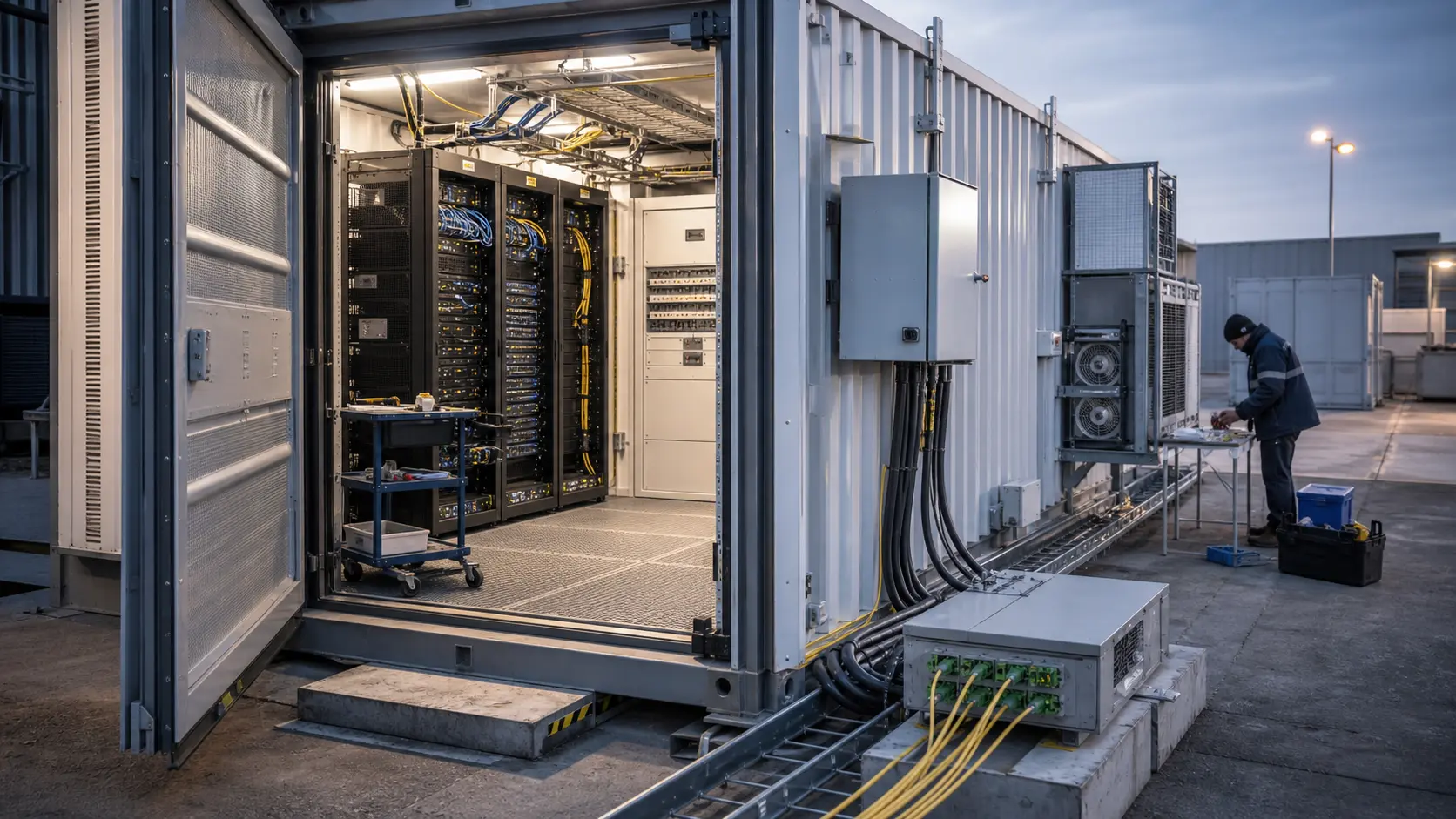
The most subject-specific part of ROVNER & MOORE S.R.L's current public offer is containerized data-centre design and production. A containerized data centre is a compact, relocatable or site-adapted physical enclosure for compute and network infrastructure. It can be valuable for civil, military, emergency, edge, remote-site or rapid-deployment projects. It can also compress many failure modes into one box: input power, cooling, fire detection, physical access, cable entry, generator support, environmental protection, monitoring, spare parts and road or site logistics.
The company says on its containerized data-centre service page that it designs and executes turnkey containerized data centres, including civil or military uses, and adapts projects and infrastructure to customer requirements. The public wording is short, so buyers should not read too much into it. It does not publish a sample bill of materials, electrical design, cooling design, rack density, battery autonomy, generator assumptions, carrier entry design, fire-suppression type, maintenance window, site survey method, factory acceptance test or field acceptance test. Those details are the difference between a useful infrastructure module and a fragile container full of servers.
For hosted-capacity risk, containerized infrastructure changes the failure path. In a conventional colocation facility, the customer asks about the data hall, room power, meet-me room, cross-connects, loading dock and remote hands. In a containerized site, the customer also asks about site preparation, pad or shelter, environmental exposure, fuel logistics, cable entry, grounding, weather, physical perimeter, spare equipment storage and who is allowed to open the enclosure. If the container sits at a military or public-safety site, access rules may matter as much as the technical design.
If it sits near an industrial or utility site, power and fibre continuity may depend on the customer's own campus.
The public website's mention of ISO 688-20 is useful but not a reliability proof. ISO container dimensions and construction context help with transport and mechanical fit, but the customer's uptime depends on the electrical, cooling, fire, network and operating design built inside and around the container. A buyer should ask for the exact standard applied, the certification evidence if certification is claimed, the inspection and acceptance steps, and the maintenance responsibility split after handover. "Turnkey" should mean that someone has written down what is included and what remains customer-owned.
This matters especially if the container becomes part of cloud or IaaS service delivery. Customers often think of cloud as a software control surface. A containerized cloud node is much more concrete. If a cooling unit fails, a rack overheats. If a router loses power, routes vanish. If a fibre path is cut, customer access depends on alternate carrier entry. If a technician cannot enter the site, a disk replacement waits. The word "cloud" does not remove the container; it only hides it from users who do not ask.
IaaS references are not the same as a public cloud catalogue
ROVNER & MOORE S.R.L's IT innovations page includes a notable phrase: design, implementation and operation of infrastructure in IaaS form for large Big Data projects in energy and utilities. That is a serious reference if it describes completed work. It suggests experience with virtualized or managed infrastructure, large project customers, operational responsibility and data-intensive workloads. It also needs to be interpreted in context.
IaaS can mean several things. It can mean a public self-service cloud where any customer orders virtual machines and storage. It can mean a private IaaS environment delivered for one enterprise. It can mean a managed virtualization stack at a customer facility. It can mean operating infrastructure on behalf of a utility project. It can mean integration work around a larger provider's platform. The public page does not specify which pattern applied to the E.On and CEZ references, what years they covered, whether ROVNER & MOORE S.R.L owned the hardware, whether AS47319 carried any traffic, or whether the service remains active.
The public route evidence points away from treating AS47319 as the current public IaaS edge. If a customer wants a ROVNER & MOORE S.R.L-hosted environment today, the useful question is not "have you done IaaS before?" It is "where will this workload run now?" The answer should identify the facility or customer site, the operating entity, the support hours, the public addressing plan, the upstream carrier, the backup location, the control-panel or management access method, the service boundary and the export path. Past project references show capability. They do not settle current capacity.
That is also where hosting economics enter. A small specialist can be a rational alternative to buying from a hyperscale provider if the customer needs local language, Romanian public-sector familiarity, custom engineering, containerized deployment or hands-on project management. But a specialist cannot win on illusion. The economics work only if the buyer is clear about which risks are bundled and which remain with the customer. If the customer wants low-cost virtual servers, it needs route, facility and restore evidence.
If the customer wants a project team to design and build a facility, it needs engineering, acceptance and maintenance evidence. If the customer wants a managed private environment, it needs both.
The worst procurement mistake would be to buy a custom infrastructure project as though it were a commodity cloud or buy a commodity cloud expectation from a custom infrastructure specialist. The better reading of ROVNER & MOORE S.R.L is that it may be strongest where the job is specific: public-sector context, infrastructure design, Big Data project support, containerized sites, communications systems and project management. That is not the same as a promise that any hosted workload will survive an upstream or rack failure without additional design.
Location and sovereignty need a real map
The public record ties ROVNER & MOORE S.R.L to Romania. The company website gives a Bucharest Sector 6 contact point. Termene and RisCo list Bucharest company details. RIPE registry entries for the ASN and IPv4 block identify Romania. The assigned prefix is a Romanian resource in the RIPE view, and RIPEstat's country view for 193.203.114.0/23 locates the resource in RO. That is enough to treat Romania as the service-area anchor for public discussion.
It is not enough to treat every workload as Romanian-resident. Data sovereignty and locality require a map of compute, storage, backup, administration, support access and traffic routing. If ROVNER & MOORE S.R.L builds or operates infrastructure at a customer site, the data may remain under the customer's facility control. If it uses a partner data centre, the customer needs the partner name, address, security boundary and contract chain. If it uses a public cloud or third-party hosting platform, the customer needs the provider region and data-transfer terms.
If it revives AS47319 or uses another ASN, the customer needs the route path and the addresses actually assigned.
The old uniques.ro identity adds another small but useful signal. IPinfo associates uniques.ro with AS47319, and the current ROVNER & MOORE S.R.L website still uses [email protected] as its contact email. DNS checks show www.rovnermoore.ro resolving through Google-hosted site infrastructure and www.uniques.ro through Cloudflare addresses, while the bare uniques.ro name did not resolve in the local DNS check performed for this article. Those domain facts do not prove anything about customer hosting. They show that the company's own web presence depends on third-party web and DNS infrastructure rather than on a visible AS47319-hosted public site.
That should be normal for a small consultancy. Many credible infrastructure companies host their own websites on Google, Cloudflare, managed web platforms or other third-party services. The point is not hypocrisy. The point is boundary clarity. If a company website does not sit on the company's own ASN, a customer should not assume that the company's public web reachability reflects the resilience of any customer hosting service. The website proves contactability and public presentation. It does not prove customer compute capacity.
For regulated or public-sector workloads, the locality questions need to be precise. Where is the primary processing site? Where is backup storage? Who administers the system? Which staff or subcontractors have access? What logs leave the site? What happens during remote support? Which public addresses are used? Which routes carry inbound and outbound traffic? Which party can terminate or suspend service? If the answer involves a containerized data centre, the map should include the physical site and the carrier entry. If it involves revived public routing, it should include AS47319 or the alternate ASN and every upstream route.
Transit and upstream declarations need current proof
The AS47319 registry object lists import from AS8708 and AS42143 and export to those ASNs. That is useful history, but public monitors show no current neighbours. A registered import/export line can remain after a session stops, after a provider relationship changes, or after a prefix stops being announced. The customer-facing question is therefore not which upstreams were written into the older registry object. It is which upstreams will carry the service now.
If ROVNER & MOORE S.R.L offers any Internet-facing hosted service tied to its own ASN, the customer should ask for a live looking-glass result, route collector evidence, test prefixes or a staged announcement. The customer should verify that the intended prefix is accepted by both upstreams if two upstreams are promised. It should confirm IPv4 and IPv6 separately. It should ask whether route security is configured. It should ask what happens if one upstream filters the prefix or changes policy. It should ask who opens the ticket with the carrier and what escalation time applies.
If the service is not tied to AS47319, the upstream question remains. A containerized data centre at a customer site may rely on local carriers or government network arrangements. A managed private environment may use the customer's MPLS, internet access, SD-WAN, fibre ring or radio backup. A third-party cloud arrangement may use the cloud provider's public addresses and private connectivity. The routing responsibility changes with the service pattern. Customers should not let that responsibility disappear into the word "managed."
The current zero-route state can be an advantage if handled honestly. It forces a fresh design conversation. Rather than inheriting unknown old transit assumptions, the buyer can require a current route plan, current contracts and a test before launch. That is better than discovering after go-live that an old route object exists but no carrier accepts the prefix. It also allows the customer to decide whether it needs provider-owned addressing at all. For some private IaaS or containerized deployments, customer-owned addressing or a partner network may be cleaner.
The failure path is simple. If the service depends on one upstream, that upstream is a single point of public reachability. If it depends on two, the failover still needs to be tested. If it depends on customer-site connectivity, the site operator may own the outage. If it depends on third-party cloud addresses, the third-party provider's policy and availability terms matter. ROVNER & MOORE S.R.L's responsibility cannot be evaluated without knowing which of those patterns applies.
Hardware stock and repair windows matter more than labels
The article assignment asks about racks, transit and repair windows because those are where hosted capacity becomes real. ROVNER & MOORE S.R.L's current public pages do not present a retail server inventory, but the containerized data-centre and infrastructure-project claims still require hardware diligence. A buyer should ask what is prebuilt, what is custom-built, what is ordered per project, what is customer-owned, what is partner-supplied and what is held as spare stock.
For a containerized data-centre project, hardware stock begins before servers. It includes the container or enclosure, racks, UPS units, cooling units, power distribution, fire detection, access control, sensors, network cabinets, patch panels, cable trays, routers, switches and monitoring. If the project includes hosted compute, it also includes servers, storage devices, network interface cards, drives, memory, power supplies and backup media. If the project is military or critical-infrastructure oriented, it may include environmental hardening, electromagnetic or physical security requirements, and stricter acceptance tests.
Repair windows depend on ownership. If ROVNER & MOORE S.R.L owns the hardware and sells a managed service, it should define replacement targets. If the customer owns the hardware inside a container that ROVNER & MOORE S.R.L designed, the support obligation may be engineering support rather than full replacement. If a third-party facility or cloud provider owns the equipment, ROVNER & MOORE S.R.L may coordinate but not control every repair. Each arrangement can be acceptable. The problem is only when the customer assumes the strongest arrangement without seeing it in writing.
The public company scale makes this question practical. A firm with four or five recent employees in public financial mirrors can still deliver serious projects through partners, subcontractors and specialist engineers. But it is unlikely to behave like a large hosting provider with deep on-site spare pools in many regions. If a customer needs 24/7 hardware replacement within a short window, it should ask who is physically available, which spares are stored where, how after-hours access works, and whether the replacement clock excludes site access, travel, customs, customer approvals or partner response time.
Backups and restore are part of the same hardware reality. A virtual machine is recoverable only if its data is copied somewhere usable. A containerized site is recoverable only if configuration, images, secrets and storage can be restored after local failure. A public-address plan is recoverable only if the prefix can be moved or the service can tolerate new addresses. A project reference is reassuring only when paired with a current restore exercise. Customers should ask for the last tested restore, not only the backup frequency.
Support, billing and project authority are uptime controls
ROVNER & MOORE S.R.L's public website emphasizes consulting quality, project management and public procurement capability. The public procurement and project management page says the team supports procurement processes and project execution, and references beneficiaries such as Cluj-Napoca municipality, the Romanian Naval Authority, judicial bodies, CEZ Romania and the Ministry of National Defence. The page is not a hosting service agreement, but it signals a company used to formal project processes and institutional customers.
That can be valuable in infrastructure. Many outages are not caused by exotic technology. They are caused by unclear authority: nobody knows who can approve an emergency spend, who can access the site, who can open the carrier ticket, who owns DNS, who can authorize a restore, who can speak to the facility, who can replace a disk, who can change firewall rules, who can stop a bad migration, or who can decide that a failover is necessary. A project-management-oriented provider may be better at those boundaries than a cheap unmanaged host. The customer still has to ask.
The support path should be matched to the service. For consulting, the support path is milestone delivery, document review, implementation support and acceptance. For a containerized data-centre build, it is warranty, maintenance, spare parts, remote support, site visits and documentation. For managed hosted capacity, it is incident response, monitoring, change control, escalation and recovery. Public pages do not publish a 24/7 hosting escalation path for AS47319. If the service sold to a customer requires that path, it should be explicit in the contract.
Billing continuity is also part of uptime. If a service relies on a partner carrier, facility, cloud provider, domain, DNS provider, certificate authority or hardware-maintenance vendor, an unpaid invoice or contract dispute can produce a technical outage. If ROVNER & MOORE S.R.L is the integrator rather than the ultimate facility or network owner, the customer needs to know which contracts sit behind the service and what happens if one of those contracts changes. That is not suspicion; it is operational mapping.
For public-sector or regulated customers, procurement rules can slow emergency fixes. If a replacement part, carrier upgrade or service expansion needs a formal order, the recovery plan should account for that. A custom infrastructure project can be more resilient than commodity hosting when designed well, but it can also be slower to change if every change requires formal approval. The customer should decide in advance which emergency actions are pre-authorized and which require a new approval path.
Who is affected if the system fails
The affected users depend on the service pattern. If ROVNER & MOORE S.R.L is advising on strategy or procurement, failure affects project timelines, documentation quality, compliance and implementation decisions. If it is designing or producing a containerized data centre, failure affects the customer that will run workloads inside that physical infrastructure. If it is operating private IaaS for a utility, public-sector body or enterprise, failure affects internal applications, data processing, field operations and user-facing services tied to that project.
If it revives public hosted capacity, failure affects whoever uses the assigned compute or addresses.
The public website references energy and utility work, emergency-service communications, enterprise architecture, digital forensics, public institutions and military-adjacent containerized data-centre uses. Those are not casual workloads. They can involve public administration, critical infrastructure, field operations, reporting, investigations or regulated data. That does not mean every referenced project is currently active or that every project carries high criticality. It means buyers should not evaluate the company only as a cheap hosting provider.
Its strongest public claims sit in sectors where project governance and failure handling matter.
If the failure is route-related, the currently observed public answer is simple: AS47319 has no public routes to fail at the moment. The risk arises if a future service reuses those resources without a tested route design. A prefix reactivation failure could strand services during launch, make a migration harder, or leave customers dependent on alternate addressing. If the failure is container-related, affected users may be those at the customer site. If the failure is support-related, affected users may wait while ROVNER & MOORE S.R.L, the customer, carriers and hardware vendors determine responsibility.
Unofficial market signals should be handled modestly. Public profiles such as Termene and RisCo suggest a small, established firm with a few employees and multi-million-RON turnover. Those signals support the specialist-company interpretation, but they do not prove operational quality. Routing monitors support the zero-current-BGP conclusion, but they do not see private networks, customer-site deployments or partner-hosted infrastructure. The right operational posture is conditional: current public routes are absent; current professional-services activity is visible; current hosted capacity must be verified per service.
This is especially important for customers who need data portability. If a project fails, can the customer export VM images, application data stores, logs, configurations, DNS zones, certificates and documentation? If a containerized facility fails, can workloads move to another site? If public addresses are not portable, can the customer tolerate new addresses? If the customer owns the hardware, can another integrator maintain it? If the provider owns the design, does the customer receive enough documentation to avoid lock-in? Those questions determine who is harmed and how quickly they recover.
What would settle the hard questions
The hard questions are straightforward because the public evidence is already divided. To prove current hosted capacity, ROVNER & MOORE S.R.L or a buyer would need to show the current facility or site, the current addressing plan, the current upstreams, the current hardware boundary, the current support path and the current restore path. A revived AS47319 service would need current BGP evidence. A partner-hosted service would need the partner and contract boundary. A containerized deployment would need design, acceptance and maintenance evidence. A private IaaS deployment would need proof of where the platform runs and who operates it.
For the ASN, the settling evidence would include a live announcement of 193.203.114.0/23 or a documented replacement prefix, visible in route collectors, accepted by upstreams, and paired with clear route-authorisation and abuse-contact handling. For transit diversity, it would include at least two working paths for the customer's prefix or a written explanation that the service is single-homed and priced accordingly. For data locality, it would include the physical compute site, backup site, support-access rules and any third-party processing locations. For recovery, it would include restore-time targets and the last successful test.
For containerized data-centre projects, the settling evidence would be different. A buyer should ask for a design package, power and cooling assumptions, rack load, environmental limits, carrier entry, monitoring plan, maintenance access, spares list, warranty and acceptance results. It should also ask who operates the facility after handover. A container built by ROVNER & MOORE S.R.L but operated by a customer has a different risk boundary than a container operated as a managed service. If the customer wants hosted capacity, not merely a container, it needs the operating contract in addition to the build contract.
For consulting and public-sector project work, the evidence would be references, delivery history, staffing, deliverables and acceptance. The public website already lists multiple reference categories. That supports the company as a project actor. It does not remove the need for infrastructure proof if the customer's purchase depends on servers staying online. Project capability and hosted-capacity reliability are related but not interchangeable.
The buyer's most useful test is a small paid pilot. Ask ROVNER & MOORE S.R.L to identify the exact service boundary, assign a test environment, document the addresses, demonstrate support response, show backup and restore, explain exit steps and identify every third party. If public routing is part of the service, record the route before and after a controlled change. If a containerized deployment is part of the service, inspect the physical acceptance documents. If a partner platform is part of the service, review that partner's terms. The pilot turns broad capability into observable behaviour.
The bottom line
ROVNER & MOORE S.R.L is best understood as a small Romanian IT and infrastructure-project company with historical network resources, not as a currently visible public hosting ASN. Its current website supports activity in consulting, IT projects, IaaS-related references and containerized data-centre design. RIPE and public BGP evidence support the existence of AS47319 and 193.203.114.0/23, but they do not show those resources carrying live public routes on July 12, 2026. That split is the article's operating warning.
The company may be a rational partner for custom infrastructure, public-sector project work, private IaaS design, containerized data-centre delivery or systems integration. It should not be treated as ready hosted capacity merely because an ASN and PI block exist. Registered network identifiers are ingredients. Hosted capacity is the working combination of racks, power, cooling, upstreams, support, hardware stock, backup, billing continuity and a tested recovery path.
For customers, the due-diligence rule is simple. If the purchase is professional advice, evaluate references, scope and deliverables. If the purchase is a data-centre container, evaluate physical engineering and maintenance. If the purchase is managed IaaS or hosted capacity, demand current route evidence, a facility map, a hardware and spare-parts plan, clear support escalation, data-locality commitments and an exit path. ROVNER & MOORE S.R.L's public record gives enough to ask serious questions. It does not give enough to skip them.