
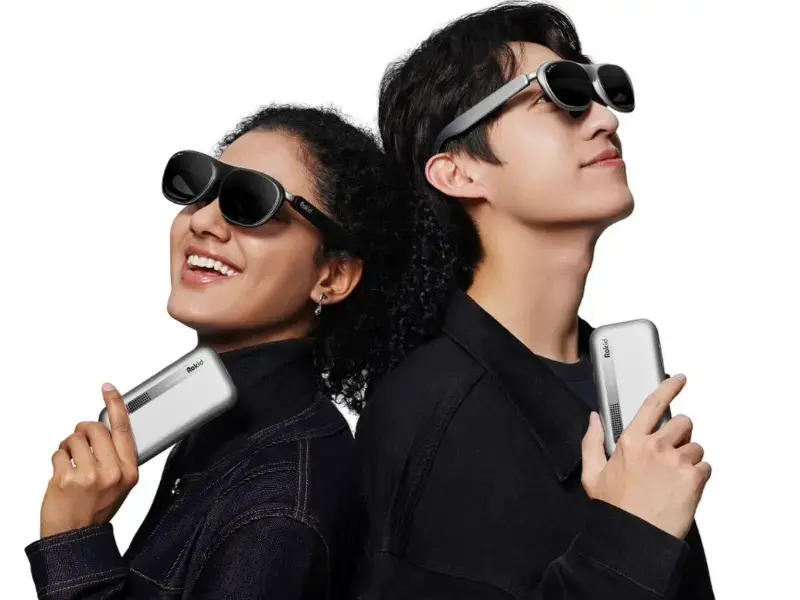
- Rokid unveils the AR Lite spatial computing suite: Rokid Max 2 glasses paired with the Rokid Station 2 host unit.
- Qualcomm's Snapdragon platform does the heavy lifting, driving graphics rendering and on-device AI compute.
- Hainan Airlines, Loong Air, Alibaba Cloud, Yinxiang Biji and Qualcomm Technologies are signed on to push smart glasses out of the demo booth and into real industries.
Rokid has a theory about why smart glasses keep dying on ordinary faces: nobody ever made a pair light enough to forget. The Chinese mixed-reality and artificial-intelligence company's answer is the AR Lite spatial computing suite — Rokid Max 2 glasses tethered to a Rokid Station 2 host unit, running the company's own YodaOS-Master spatial operating system — and the number it wants you to remember is not a chip, a resolution, or a launch partner. It is 75 grams.
That is the whole thesis. Everything else in the AR Lite is a supporting argument.
The 75-gram bet: comfort is the product
The AR Lite device weighs just 75 grams, wrapped in a compact aluminium alloy frame. That sounds like a spec. It is actually a business model. Headsets fail in the field for brutally unglamorous reasons — heat, weight, and the slow rebellion of the neck — and a device that disappears on your face is a device that survives past the first week of novelty.
Rokid is betting that the winning wearable will not be the one with the loudest datasheet, but the one you stop noticing. It is a boring sentence that has quietly decided more hardware wars than any processor roadmap.
Station 2: the puck that carries the weight
The trick is separation of duties. The glasses stay light because the thinking happens elsewhere — in the Rokid Station 2, powered by Qualcomm's Snapdragon platform. Graphics rendering and AI compute live in the host unit, which means the frames on your nose are optics and comfort, not a furnace.
Leveraging Station 2 technology and the Snapdragon Platform, Rokid promises seamless computing performance across extended usage scenarios — the long sessions where spatial computing either earns its place in a workflow or quietly becomes an expensive paperweight.
Also read: Meta to integrate AI into Ray-Ban smart glasses
5000mAh, fast charging, and the ergonomics nobody puts on a poster
A 5000mAh battery with fast charging support gives the AR Lite the endurance for long workflows and entertainment streaming — the two use cases that actually justify wearing a screen.
Then come the details that never make the keynote but decide whether you keep the device: intelligent interpupillary distance adjustment, non-destructive diopter adjustment, and ultra-light air nose pads. Translation for anyone who has worn glasses for a living: the AR Lite is designed to fit the human face you actually have, rather than the averaged, hypothetical face of a render. Comfort over prolonged use is not a luxury feature here — it is the load-bearing wall.
Killing the button: touch, ray pointer and three-dimensional intent
Rokid has stripped the physical buttons off the Station 2 and replaced them with intuitive touch controls, paired with a spatial ray pointer that lets you interact with three-dimensional content at genuine precision. It is a small design decision with a large philosophical payload: if spatial computing needs a row of plastic switches to operate, it is not spatial computing — it is a monitor with ambitions.
On the software side, the quality-of-life upgrades read like a list of things users complained about until someone fixed them: Multi Screen Mode, Motion Mode, and Spatial Screen Casting. Together they push the AR Lite toward the emerging use cases that matter — immersive workflows, expanded desktop real estate, and connectivity that does not require you to sit still.
The partner list is the real announcement
Hardware launches are cheap. Distribution is not. Rokid's strategic collaborations with Hainan Airlines, Loong Air, Alibaba Cloud, Yinxiang Biji and Qualcomm Technologies are the part of this announcement worth reading twice — because they sketch the map where smart glasses stop being a gadget and start being infrastructure.
Airlines mean captive, seat-bound audiences with hours to fill and no second screen to reach for. Alibaba Cloud means compute and content behind the glass. Yinxiang Biji means productivity software that people already open every day. Qualcomm Technologies means the silicon roadmap keeps moving in the same direction. That is not a product launch. That is a supply chain and a customer list arriving in the same press release.
Also read: Meta Unveils Exciting New AI Features: From Smart Glasses to AI-Generated Stickers
The verdict on Rokid's AR Lite
The spatial computing industry has spent a decade selling the future and shipping the migraine. Rokid's AR Lite makes a narrower, sharper, more honest pitch: 75 grams, a puck in your pocket, a battery that lasts, and a fit that does not require a tolerance for discomfort.
The glasses that win will not be the ones that shout the loudest. They will be the ones you forget you are wearing — right up until the day you cannot work without them.




