
Summary
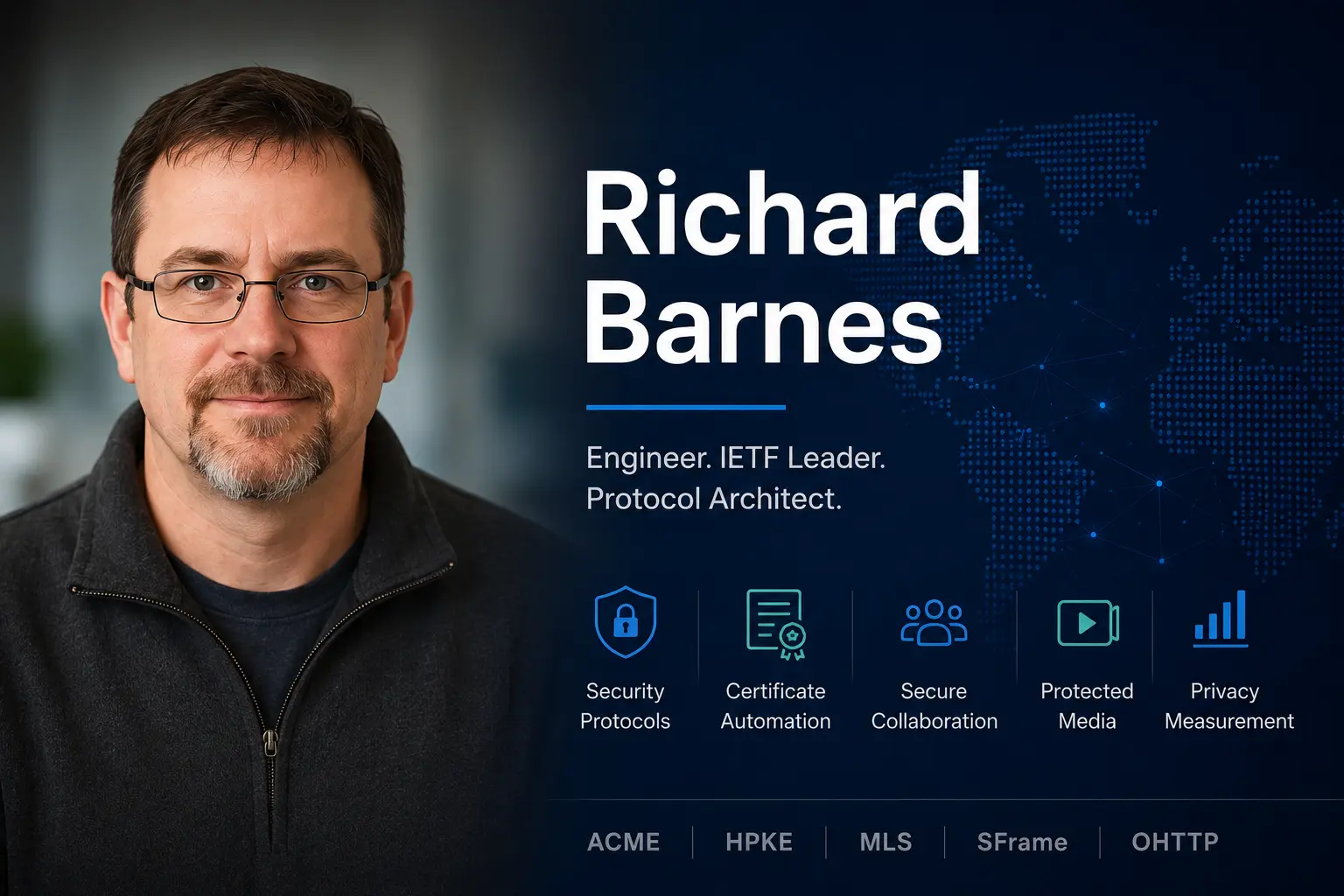
- Richard Barnes is a Cisco Distinguished Engineer and IETF Security Directorate reviewer whose work spans certificate automation, hybrid encryption, group messaging, secure media and privacy-preserving measurement.
- ISRG credits him with writing the first Boulder implementation, while the current Let’s Encrypt service and codebase are collective systems maintained by a larger organisation and community.
- ACME, HPKE, MLS and SFrame address different trust layers—certificate lifecycle, recipient encryption, changing group state and protected media—without supplying complete endpoint or service security.
- Barnes’ record shows standards distributing authority among authors, working groups, reviewers, implementers, vendors and operators who decide what is accepted, deployed and maintained.
Boulder turned certificate issuance into an operational system
The Internet Security Research Group, the nonprofit behind Let’s Encrypt, says Barnes wrote the first version of Boulder after discussions with the founding team at an IETF meeting. Boulder is the Go codebase used for the certificate authority’s core operations. The original implementation mattered because it turned the idea of automated issuance into executable architecture.
Writing the first version is not the same as owning or authoring the present system alone. Let’s Encrypt grew into a large public service with engineers, site reliability work, security reviews, databases, hardware security modules, validation infrastructure and incident procedures. The current Boulder repository contains years of contributions. Barnes’ role is a concrete origin point within a collective operational history.
A public certificate authority receives untrusted requests continuously. It interacts with DNS and web servers, stores account and order state and can cause certificates to be signed by keys whose compromise would be severe. Automation raises volume and removes manual checkpoints. The software architecture must compensate with strict boundaries.
Boulder’s design evolved around separate components and narrow responsibilities. Validation services determine whether a challenge succeeded. Registration and order systems track client state. Certificate issuance and signing paths are protected. Rate limiting and policy services constrain use. Databases and queues preserve workflow across failures. The exact present architecture has changed since the first implementation, but the principle is durable: the component that parses a public request should not automatically possess signing authority.
This separation also improves audit. An operator can ask which validation result authorised an issuance, which account requested it and which component acted. Logs and durable state matter because certificate errors may be discovered after the transaction. A stateless API without a coherent record would be simpler and less accountable.
Automation creates failure at fleet speed. A malformed request from one client can repeat across thousands of hosts. A validation bug can authorise the wrong name. A database or queue issue can delay orders until certificates approach expiry. Rate limits can protect the service and block legitimate recovery. Boulder and ACME need operational tooling that distinguishes abuse from mass remediation.
The architecture is also dependent on external systems. DNS answers can vary. HTTP challenge paths can be intercepted or misconfigured. Time affects certificate validity. Browser and operating-system trust stores determine whether the result is useful. The CA controls issuance but not the whole trust experience.
The early code also provided a proving ground for the protocol that became ACME. Implementation exposes ambiguities that a draft can conceal. How does a client recover after a network interruption? What happens when DNS changes during validation? How are authorisations reused? Which errors are safe to retry? How does the authority signal that a nonce or account state is no longer valid? These questions become visible when real clients and a real service interact.
Barnes’ first version supplied an executable starting point for this division of labour. Later engineers hardened, expanded and operated it. The correct historical claim is not that one coder built today’s Let’s Encrypt service, but that the initial code helped make an automated authority concrete enough for the protocol and organisation to develop together.
The distinction also protects the standards story. ACME is not a Let’s Encrypt-only interface. The service helped prove the model, while an IETF standard allowed other certificate authorities and private PKIs to implement the lifecycle. Code created the operational evidence; standardisation made the mechanism portable.
The broader lesson is relevant to every automated trust service. Removing manual work is not equivalent to removing governance. It requires clearer machine-enforced permissions, better records and tested recovery because mistakes move faster.
Browser security taught Barnes that trust depends on operations
Public-key infrastructure is often described through algorithms and certificate chains. For a browser user, its reliability depends on a far larger operating system. Certificate authorities validate control of names, issue credentials and revoke them. Server operators generate keys, request certificates, deploy them, renew them and avoid exposing them. Browsers maintain trust stores and enforce policy. Time, DNS, network reachability and account security can all affect the outcome.
Before automation became common, many of those tasks were manual. An administrator might buy a certificate, copy files between systems, schedule a reminder and repeat the process a year later. The workflow was expensive enough that small sites sometimes used no transport encryption. It was also error prone. An expired certificate could cause an outage. A private key could be placed on the wrong host. A renewal might succeed at the authority and fail at deployment.
Richard Barnes worked in browser security before the Let’s Encrypt era, including service as Firefox Security Lead. That experience placed him close to the mismatch between cryptographic design and deployable security. A browser can support strong protocols and still connect to a web full of sites that lack valid certificates because issuance and maintenance are too difficult.
The problem was not solved by weakening validation. It required turning certificate lifecycle into a protocol that machines could execute. A server needed a way to create an account with a certificate authority, demonstrate control over a domain, request a certificate, receive it and renew it before expiry. The authority needed auditable rules and protection against abuse. Clients and authorities needed a common language rather than a collection of vendor-specific scripts.
This background helps explain Barnes’ later portfolio. ACME automates public certificate lifecycle. HPKE packages a reusable form of recipient encryption. MLS manages cryptographic state as group membership changes. SFrame protects media objects while conferencing infrastructure forwards them. Oblivious HTTP separates network metadata from application requests under defined non-collusion assumptions. The systems differ, but each turns a fragile security ceremony into a composable protocol.
Automation does not remove trust. It relocates it into accounts, keys, policy, software and recovery. The achievement is that those dependencies become explicit enough to test and implement across organisations. Barnes’ work is best read through that operational lens rather than as a list of cryptographic acronyms.
Location and emergency communications made privacy an architectural requirement
Barnes’ standards record before Let’s Encrypt included work on network location, emergency communications and the handling of sensitive metadata. These areas are easy to treat as a prelude, but they established a recurring problem in his later security designs: a system may need enough information to perform a public function without allowing every participant to learn everything about the user.
Emergency services need reliable location and routing. Networks, devices and applications may each possess different pieces of the answer. A location object can save time when a person needs help, yet it can also reveal movement or identity if copied or retained without control. The protocol must specify accuracy, provenance and access while recognising that policy differs across jurisdictions and operators.
This kind of work forces engineers to distinguish content from metadata. Encrypting a message does not hide who contacted whom, when, from which network or with what device. A service can follow the transport standard perfectly while building a detailed behavioural record. The later OHTTP and privacy-measurement designs make the same distinction more explicit by separating roles or shares.
It also teaches caution about endpoints. A protocol can protect information in transit, but the originating device and receiving authority must see enough plaintext to act. If either endpoint is compromised, network cryptography cannot restore secrecy. Recovery, authentication and logging become part of the system.
Barnes’ movement from location standards to browser security and collaboration protocols therefore has more continuity than a product list suggests. The object being protected changes, but the question remains: which party should be trusted with which claim? A secure design is not one that hides all information. It is one that makes disclosure necessary, bounded and reviewable.
That approach helps explain why his later protocols are composable rather than monolithic. A location format, certificate lifecycle, key-establishment primitive and media-protection format each solve a defined problem. Applications combine them with policy. The separation can feel incomplete to users seeking one guarantee, but it prevents a standards document from quietly claiming authority over identity, law and product operation it cannot control.
ACME made certificate issuance a client-managed state machine
The Automated Certificate Management Environment, published as RFC 8555, defines interactions between a client and a certificate authority. A client creates or uses an account. It places an order for identifiers such as domain names. The authority supplies authorisations and challenges. The client demonstrates control through a supported method. After validation, the client submits a certificate signing request and retrieves the issued certificate.
The sequence matters because certificate issuance is not one request. It is a stateful process with failure and retry. A DNS challenge may require time to propagate. An HTTP challenge depends on routing and server configuration. The client can lose connectivity after validation but before finalisation. The authority needs to prevent replay and bind messages to the right account and order.
ACME uses signed requests and anti-replay nonces. The protocol gives clients machine-readable status and error information. It supports automation without requiring the authority to expose its private signing process. The final certificate remains part of the wider Web PKI, subject to trust-store and policy rules outside ACME.
The operational effect was large because it changed renewal from an annual project into a continuous service. Shorter certificate lifetimes become practical when clients can renew automatically. Infrastructure-as-code systems can request credentials during deployment. Internal PKIs can use the same lifecycle pattern. Operators can monitor expiry and failure as ordinary system health.
Automation also creates correlated risk. A client bug can fail renewal across a fleet. Account credentials can authorise many orders. A DNS provider outage can block validation. Rate limits intended to prevent abuse can frustrate recovery after mass reinstallation. A certificate authority incident can affect automated clients at scale. The protocol provides states and messages; resilient deployment requires testing and fallback.
ACME does not decide whether a domain should be trusted by users. It proves a defined form of control and obtains a certificate under the authority’s policy. A valid certificate does not certify that a website is honest or secure. It binds a public key to names within a trust framework. This boundary is central to responsible explanation.
Barnes’ contribution as a co-author sits within the IETF process. Co-authors drafted and revised text. Working-group participants challenged assumptions. Security reviewers and the Internet Engineering Steering Group evaluated the document. Implementers supplied feedback. No author could declare the protocol a standard alone.
Renewal made failure recovery the real test of automation
Issuing the first certificate attracts attention, but renewal determines whether automation becomes infrastructure. A server may run for years. Its certificate may be replaced many times. Keys may rotate, domains may move and validation methods may change. The operator should not need to repeat a manual ceremony for each cycle.
An ACME client normally begins renewal before expiry, leaving time for retry. It must store account credentials securely, choose an appropriate challenge and deploy the new certificate to the correct service. In a load-balanced system, the certificate may need to reach many nodes. A successful order that remains on one management host does not prevent an outage.
Recovery paths need deliberate design. If a DNS API credential expires, can the organisation use another challenge? If an account key is lost, how are new orders authorised? If a CA is unavailable, can clients switch to another issuer without changing application architecture? If rate limits are reached during a fleet rebuild, who can coordinate an exception? These questions sit outside the happy-path protocol exchange while determining operational resilience.
Shorter certificate lifetimes improve security by limiting exposure and encouraging automation, but they reduce the time available to notice broken renewal. Monitoring should track the next expiry, last successful order, validation failure and deployment state. An alarm that fires only when the certificate has expired is evidence that the lifecycle remains manual in practice.
ACME’s portability can reduce dependence on one CA if clients, account configuration and trust policy are designed accordingly. Many deployments still bind themselves to a managed platform whose internal ACME use is invisible. The protocol may be open while the operator has no practical migration path.
This lifecycle perspective explains why ACME was more consequential than a cheaper certificate. It changed the operating model from periodic procurement to continuous machine management. The same change appears in later Barnes protocols: group keys update when membership changes, media keys follow sessions and privacy systems rotate cryptographic state. Security becomes a service that must survive renewal, not an artefact installed once.
The IETF turned one service’s solution into shared infrastructure
An implementation can move quickly because one team controls its code. An internet standard has a different objective: several independent organisations should be able to implement the mechanism and interoperate without asking one vendor for permission. That requires precision, public review and willingness to narrow ambitions.
Barnes has held several IETF leadership roles, including area-director and working-group chair positions, and currently serves as a Security Directorate reviewer. Those roles are influential but distributed. An area director can sponsor documents, identify unresolved issues and participate in IESG decisions. A chair manages process and consensus. A directorate reviewer examines security properties. Working groups, other reviewers, implementers and appeals constrain each role.
This governance model resists the idea of unilateral protocol design. A successful RFC is a negotiated technical artefact. Authors may originate an idea and defend choices, but they must respond to review and implementation evidence. Some drafts expire. Some are replaced. Some publish and see little adoption. RFC status is not a command to the market.
The IETF process also makes trade-offs visible. ACME had to define a general lifecycle without specifying every certificate-authority business rule. MLS needed a cryptographic group model without becoming a complete messaging application. SFrame had to protect media while allowing infrastructure to forward frames. A standard becomes useful partly by refusing to own adjacent problems.
Barnes’ career demonstrates the advantage of moving between standards and product environments. Cisco’s Collaboration CTO office exposes constraints from enterprise communications. Browser and Let’s Encrypt work exposed public-infrastructure realities. Standards work requires those experiences to be abstracted without turning one product’s architecture into a universal rule.
The process can be slow and difficult for newcomers. Employer support gives some participants more time and influence. Consensus can preserve complexity or delay urgently needed mechanisms. Yet the open record and independent implementation requirement provide a check that proprietary protocol development lacks.
For Barnes, leadership is best measured by repeated participation in this acceptance system. He has helped move several security mechanisms from code or research into reviewed specifications. The authority remains institutional, not personal.
Certificate automation changed the economics of encryption
The cost of a certificate was never only the fee charged by an issuer. Organisations spent time generating requests, proving control, moving keys, installing files and recovering from expiry. The burden fell especially heavily on small sites and on large fleets where one missed host could cause an incident. Let’s Encrypt removed the purchase price for its certificates, while ACME addressed the labour model across issuers.
Once lifecycle became programmable, encryption could be the default for services that would not justify a manual process. Development environments, short-lived infrastructure and internal systems could obtain certificates as part of deployment. Operators could use shorter lifetimes because renewal was expected to occur automatically. The security improvement came from economics and workflow as much as cryptography.
The saving was not the disappearance of work. Certificate-authority operations, client maintenance, DNS APIs, monitoring and incident response still cost money. The work moved into shared software and services. A nonprofit such as ISRG could fund public infrastructure through donations, sponsorship and related support rather than charging each site for a manual transaction. Commercial authorities could offer automation as part of managed PKI.
This shift created a common infrastructure dependency. A popular ACME client or CA can affect many organisations. Cloud platforms can hide certificate management behind a service interface, reducing operator effort and visibility at the same time. The protocol gives customers a theoretical path to another implementation, but practical migration depends on configuration, account and deployment architecture.
The economic lesson extends to Barnes’ later work. A group-security standard can reduce the cost of building end-to-end encryption. A reusable HPKE implementation can prevent each product from hiring a team to design a bespoke construction. SFrame can let conferencing systems preserve their forwarding infrastructure rather than rebuild the service around fully trusted media servers. Shared standards concentrate review and amortise engineering.
The risk is underfunded common maintenance. Once a protocol or library becomes routine, buyers may regard it as free plumbing. Security review, test infrastructure and standards participation remain specialist labour. Employers and nonprofits decide whether to support it. Barnes’ career depends on institutions willing to fund work whose value appears across an ecosystem rather than on one product’s revenue line.
HPKE packages recipient encryption without becoming an application protocol
Hybrid Public Key Encryption, published as RFC 9180, provides a standard way to combine key establishment and symmetric authenticated encryption. A sender uses the recipient’s public key and an agreed ciphersuite to establish a shared secret, then encrypts data efficiently. The construction packages cryptographic choices and context binding so that applications do not invent a new hybrid scheme for each use.
The word “hybrid” in this context refers to combining public-key and symmetric operations, not necessarily to post-quantum hybridisation, though later work can combine classical and post-quantum key-encapsulation mechanisms. The recipient’s private key remains critical. The application still needs an authentic public key and a policy for rotation, compromise and identity.
HPKE is valuable because many privacy and messaging protocols need the same primitive. Oblivious HTTP can encrypt an application request for a gateway while a relay sees the client address. Messaging systems can encrypt to recipients or group components. Rather than define bespoke wire formats and key derivation repeatedly, protocols can reference a reviewed building block.
Composition reduces duplication but does not make misuse impossible. Applications must select modes and ciphersuites correctly, bind the intended context and avoid nonce or key reuse. Metadata such as message timing and size remains outside the encrypted content. Endpoint compromise exposes plaintext. Implementations need side-channel resistance and secure randomness.
Post-quantum transition increases the value and complexity of such abstraction. A protocol can define new KEM combinations without rewriting every application layer, but larger keys, different failure behaviour and younger implementations create operational risk. Drafts should not be presented as completed deployment.
Barnes co-authored HPKE with other cryptographic protocol designers. The RFC’s importance belongs to that collective work and the implementers that adopted it. His portfolio becomes coherent because HPKE serves as connective tissue among later privacy and collaboration systems.
MLS must preserve one group history as membership changes
A two-party encrypted session has a relatively simple membership model. A group chat or conference can contain many participants who join and leave over time. The system needs to update keys efficiently, prevent a removed member from reading future messages and limit the effect of a compromised earlier state. Sending a fresh secret individually to every participant for every change becomes expensive at scale.
Messaging Layer Security, published as RFC 9420, defines a group-state protocol built around a tree of cryptographic relationships. Members maintain a shared view of the group and progress through epochs. A proposal can add, remove or update a member. A commit applies changes and derives new secrets. Messages are protected under the current epoch. Tree structure allows updates without pairwise work across the whole group each time.
The protocol aims for forward secrecy and post-compromise security under defined assumptions. Forward secrecy limits what later key compromise reveals about earlier messages. Post-compromise mechanisms allow a group to recover security after a member updates fresh key material, provided the adversary no longer controls the relevant endpoint.
MLS is not a complete messaging service. It does not determine user identity, account recovery, spam policy, moderation, message storage or delivery fairness. A service can withhold or reorder messages. A compromised endpoint can read plaintext. The application must connect cryptographic credentials to people or devices and manage backups. These boundaries are design choices, not missing footnotes.
Interoperability also requires more than agreement on the RFC. Implementations need compatible ciphersuites, extensions and credential formats. Products may profile the standard differently. Federation work such as MIMI seeks to address adjacent cross-service questions, but current drafts can change.
Barnes’ role in MLS is substantial and collective. He is one of several authors and contributors. The protocol emerged through a working group and implementation community. Describing him as the sole creator would contradict the very governance model that made the standard credible.
The strategic value lies in separating group cryptography from one vendor’s application. If several platforms can implement the same security core, organisations gain a path toward interoperable secure groups. Whether that path becomes widely deployed depends on product identity, user experience and business incentives outside the protocol.
The tree structure in MLS solves only part of the group-security problem. Participants also need a consistent view of which membership changes have been committed and which epoch protects a message. Networks delay and reorder traffic. Devices go offline. A user may have several devices. The service can withhold a proposal or deliver commits unevenly.
MLS represents changes explicitly. Proposals describe additions, removals or updates. A commit applies a set of proposals and moves the group to a new epoch with new secrets. Members need the prior state and authenticated group context to process the transition. If a device misses too much history, it may require a state transfer or rejoin procedure defined by the application.
The protocol’s security goals depend on these transitions. Removing a member should prevent access to future epochs. Updating a compromised member with fresh key material can restore security only after the adversary loses endpoint access and the update is accepted. Forward secrecy protects earlier secrets under defined compromise assumptions; it does not erase plaintext already stored on devices or servers.
Concurrency creates difficult cases. Two members may propose changes at the same time. The service delivering messages may choose an order. The group needs rules that produce one accepted state rather than permanent forks. An implementation can be cryptographically correct and still create poor user experience if devices repeatedly fall out of sync.
Identity remains outside the tree. A credential binds a cryptographic member to an application identity under some authority. The protocol does not decide whether that authority verified a person, organisation or device correctly. A malicious service can add an identity that policy accepts. Moderation and account recovery are separate systems.
This separation is a strength because different applications can use MLS. It is also why an “MLS secured” label tells only part of the story. Buyers need to examine credential issuance, device management, backups, delivery behaviour and endpoint hardening. The protocol supplies a rigorous group-state engine; the product supplies the social and operational meaning.
Barnes’ co-authorship places him in the design of that engine. Its deployment record belongs to the wider working group, implementers and services that integrate it.
SFrame protects media while conferencing infrastructure still routes it
Real-time conferencing poses a different problem from group messaging. Media streams are large, continuous and often handled by selective forwarding units that choose which participant streams to send to others. Traditional transport encryption can protect traffic between a client and the forwarding service while allowing the service to decrypt the media. End-to-end confidentiality requires protection that survives that intermediate hop.
SFrame, published as RFC 9605, encrypts individual media frames above the transport layer. A forwarding unit can inspect the information needed to route or adapt streams without possessing the content keys. Participants holding the appropriate keys can decrypt the media. The design separates media-object protection from the network transport used to carry it.
Key distribution is an adjacent function. MLS can help a changing conference group derive shared secrets, but products may use other mechanisms. Identity and membership decisions remain with the application. A conference service still knows participants and connection metadata in many deployments. Timing, packet size and traffic patterns may remain visible. End-to-end content encryption is not anonymity.
The design also constrains media processing. A service that cannot decrypt frames may be unable to perform some server-side transformations, recording or moderation functions. Products must decide which operations occur at endpoints and how users understand the security mode. Recovery and multi-device use add complexity.
SFrame’s value is architectural clarity. It allows a conferencing system to retain scalable forwarding while reducing the amount of infrastructure trusted with plaintext. The result still relies on endpoint security, group keys and correct implementation. Barnes’ co-authorship again sits inside a larger community and product ecosystem.
The progression from MLS to SFrame shows why one “secure messaging protocol” is an inadequate description. Group state and media objects are different layers. Standards become composable when they state which layer they protect and which risks remain visible.
Oblivious HTTP separates who sees the client from who sees the request
Content encryption hides a request from network observers but not necessarily from the service receiving it. The service can often see the client’s network address and the application content. Oblivious HTTP divides those views between a relay and a gateway. The relay sees the client connection but carries an encrypted request. The gateway can decrypt and forward the application request but should not see the original client address.
The privacy property depends on the relay and gateway not colluding. Cryptography enforces separation of content in transit; institutional independence enforces separation of knowledge. Timing correlation, traffic size and application accounts can still identify users. The mechanism is not universal anonymity.
This design has practical uses in privacy-sensitive telemetry, queries and service access. It also introduces more infrastructure and failure modes. Relays need capacity and abuse controls. Gateways need key management. Applications need a way to handle retries and errors without leaking linkable information. Operators must explain which organisations hold each role.
Barnes’ work in this area connects HPKE with network architecture. The encryption primitive protects the request. The relay arrangement changes metadata exposure. Neither alone achieves the intended privacy property. The system is secure only when technical and organisational assumptions align.
The lesson is applicable beyond OHTTP. Privacy often fails because a design protects payloads while ignoring metadata or concentrates supposedly separated functions in one company. Open standards can specify roles and wire formats, but deployment determines whether separation is meaningful.
Privacy-preserving measurement still leaves metadata and institutional power
Operational services want data about performance, security or product use. Collecting every individual event in plaintext creates privacy and breach risk. Distributed aggregation systems such as VDAF and DAP-related work seek to let multiple aggregators validate contributions and produce totals without any one party seeing each raw measurement under the intended threat model.
A client encodes a measurement. Shares go to separate aggregators. Cryptographic verification checks that inputs are well formed and within allowed bounds. The aggregators combine results to produce an aggregate. The privacy property depends on limits to collusion and on the design of queries.
Aggregate output can still reveal people when groups are small or queries are repeated strategically. Differential privacy is a separate mechanism that may be needed to limit inference. Metadata about timing and participation can remain. Malicious clients can attempt to poison results. Implementations must manage keys, epochs and availability.
Barnes’ current draft work in privacy-preserving measurement shows a continuation of the same approach: decompose trust so that one service need not hold all information. The work remains partly in draft form, and active Internet-Drafts should not be described as final standards. Their presence demonstrates current direction rather than guaranteed adoption.
The shift from certificates to aggregate telemetry may appear broad, but the architectural question is consistent. Which party needs which information to perform its job, and can the protocol prevent it from learning more? The answer always includes assumptions about implementation and institutional independence.
HPKE, MLS, SFrame and Oblivious HTTP address different exposure points. None makes communication invisible. Servers may still see account identity, message timing, group membership, destination or traffic volume. Relays can separate some views without eliminating them.
This matters because metadata can be operationally necessary and personally revealing. A conferencing service needs to route media and manage membership. A privacy-preserving request system needs abuse controls. The design question is which intermediary learns which fact and whether two intermediaries can combine their views.
Barnes’s protocol work is strongest when the separation is explicit. SFrame can keep media contents protected from a forwarding service while allowing that service to switch packets. OHTTP can prevent one party from seeing both the client address and request content under a non-collusion assumption. MLS protects group messages and does not hide that a group exists from every system around it.
A product should describe the metadata boundary with the same precision as the encryption algorithm. “End-to-end encrypted” is a content claim, not a complete privacy model.
Post-quantum migration tests the protocols’ promised modularity
Public-key algorithms embedded in protocols may remain deployed longer than their designers expect. Post-quantum transition requires systems to introduce new key-establishment and signature schemes without breaking communication with older peers or trusting immature implementations blindly. Barnes’ active work on post-quantum HPKE, MLS ciphersuites and related drafts sits in this migration phase.
A hybrid approach can combine classical and post-quantum secrets so that an attacker must break both to recover the session under the intended construction. The method reduces dependence on a new algorithm’s untested security while preserving protection against a future quantum attack if the post-quantum component remains sound. It increases message size, computation and implementation complexity.
Protocol modularity helps because HPKE already separates KEM, key derivation and authenticated encryption choices. MLS can negotiate ciphersuites. Applications do not need to redesign every message format from the beginning. The same flexibility creates downgrade and interoperability questions. Peers must agree on combinations, reject weak fallbacks and manage credentials with different sizes and lifetimes.
Draft status is crucial. An active Internet-Draft can contain serious engineering and multiple implementations while remaining subject to change. Products that deploy early may carry compatibility debt. Products that wait may face a compressed migration later. Standards leaders need test vectors, cryptographic review and transition guidance, not only new algorithm identifiers.
Hardware and constrained endpoints add another boundary. Larger keys and signatures affect bandwidth and storage. A conferencing system with many group members amplifies overhead. A certificate authority or browser trust ecosystem may migrate on a different schedule from a messaging service. “Post-quantum ready” is useful only when tied to the exact function and negotiated behaviour.
Barnes’ current portfolio makes the migration visible at several layers. HPKE packages key establishment. MLS manages group state. ACME and certificate systems may carry new public keys or signatures. The standards can coordinate change, but no author controls the implementation schedule of every vendor. The transition will test whether composability reduces disruption or multiplies profiles.
Several protocols associated with Barnes rely on public-key mechanisms whose long-term assumptions are being revisited. The immediate question is not whether every current deployment is suddenly unsafe. It is how systems can introduce post-quantum algorithms without breaking interoperability, performance or the security proofs that justify composition.
Hybrid approaches combine established and post-quantum mechanisms so that an attacker would need to defeat both. They can reduce transition risk, but they enlarge messages, code and test matrices. HPKE suites must specify how keys and ciphertexts are encoded. MLS groups must negotiate capabilities among members that may update at different times. Media and messaging applications must account for mobile devices, constrained networks and years of software diversity.
The standards process must also distinguish a draft from an operational guarantee. Barnes’s active work on post-quantum HPKE and related group-messaging mechanisms shows the direction of travel. Until documents are final and interoperable implementations exist, they are proposals under review. Even a published standard does not show that products have migrated their identity, storage and backup systems safely.
The transition reinforces the value of small protocols. A composable primitive can be replaced or extended more readily than a monolithic proprietary design, provided its interfaces and assumptions were explicit. It also reveals the cost of composition: every dependent layer must understand the change. The test of Barnes’s approach is not simply whether new algorithms enter an RFC. It is whether applications can change the cryptographic foundation without losing the automation and interoperability that made the original standards useful.
Interoperability is where open specifications meet incompatible assumptions
An RFC defines behaviour, but implementers discover whether two readings of the text produce the same messages and state. Open-source libraries and test suites make those differences easier to expose. Boulder did this for ACME. MLS, HPKE and SFrame likewise depend on multiple implementations, vectors and interop events.
A successful exchange proves a defined case, not universal compatibility. Implementations may support different ciphersuites or extensions. Error handling and recovery can diverge. One library may reject an input another accepts. Products can wrap a standard core in proprietary identity or control APIs that prevent substitution.
Reference code is valuable because it lowers the cost of experimentation and gives reviewers an executable interpretation. It can become de facto authority even when the standard allows alternatives. Maintainer concentration and security response therefore matter. A widely reused library bug can propagate across vendors that believed they had independent products.
Conformance testing should include negative cases and state transitions, not only a successful handshake. ACME clients need invalid-nonce and failed-challenge behaviour. MLS implementations need out-of-order commits, removal and rejoin. SFrame needs key changes and malformed frames. HPKE needs context and suite mismatch. These tests reveal whether the operational protocol is as portable as the wire format.
Vendors may resist publishing complete test results or product architecture. The IETF cannot force disclosure. Procurement teams can still require supported versions, interop evidence and a vulnerability process. Standards participation should create questions for products, not immunity from them.
Barnes’ movement between code, specifications and product environments gives his work practical weight. The record’s central lesson is that trust becomes routine only after the same idea survives several independent implementations and their failures.
A protocol can be cryptographically sound and still fail to change practice. Implementers must agree on the same interpretation, administrators must be able to deploy it, and old systems must continue operating during migration. Barnes’s standards career is notable because it repeatedly sits at this boundary.
ACME succeeded partly because the operational problem was visible and repetitive. Certificate issuance and renewal imposed labour on almost every public service. The protocol offered a narrow exchange that certificate authorities, clients and web servers could implement independently. Even then, deployment depended on challenge methods, account recovery, rate limits, DNS providers and reliable automation. The standard reduced friction; it did not remove the certificate ecosystem.
MLS faces a different migration problem. Secure group messaging involves application state, membership changes, identity systems and user experience. Two implementations can follow the same cryptographic protocol while presenting incompatible expectations about devices, history and recovery. Interoperability requires test vectors, shared libraries, careful version negotiation and products willing to expose compatible behaviour. The RFC is a foundation, not a global group-chat service.
SFrame and HPKE have similar limits. A conferencing system may support SFrame while using a proprietary key-distribution service. An application may use HPKE correctly inside a larger design that authenticates recipients badly. Standards authors can specify inputs, outputs and security properties. Product teams must preserve those properties across storage, identity, user interface and incident response.
The IETF process is slow partly because these edge cases are where security fails. Working-group review, security directorate comments, implementation reports and interoperability events force assumptions into the open. Delay can frustrate vendors that need a feature. Premature consensus can freeze a mistake into deployed infrastructure. Barnes’s movement between Mozilla, Cisco, ISRG and the IETF gives him a view of both pressures: the need to ship and the cost of a trust primitive that cannot be repaired quietly.
Authorship should therefore not be confused with command. An RFC editor or co-author can frame choices and resolve text. A working group, reviewers and the Internet Engineering Steering Group decide whether the document advances. Independent implementers determine whether it becomes real. Operators decide whether it is reliable enough to keep. The standard’s authority is distributed across those stages.
Deprecation is the security work that begins after success
A protocol becomes infrastructure when old implementations remain in use long after authors and product teams have moved on. Algorithms weaken, certificates change, wire formats acquire extensions and operational shortcuts become dependencies. Removing an unsafe option can be harder than adding a secure one.
Barnes’s standards portfolio makes this lifecycle visible. ACME clients and certificate authorities must negotiate evolving challenge and account behaviour. HPKE suites need clear registries and transition rules. MLS groups may contain devices that update at different times. A media system cannot assume every participant supports a new SFrame mode on the same day.
Deprecation requires evidence about actual use. Removing an algorithm too quickly can strand devices and services. Leaving it indefinitely gives attackers a downgrade target. Standards can define “must not” and “should not” language; implementers and operators decide when the words become enforced reality.
Recovery complicates the choice. A user with an old device may need temporary access to migrate credentials. An emergency communications system may prefer degraded compatibility to complete loss of service. The exception needs scope and an end date or it becomes the permanent path.
Open protocols improve the process because several implementers can test migration and challenge one vendor’s preferred timetable. They do not create a central authority able to remove every unsafe deployment. The work is distributed among registries, libraries, products, administrators and users.
Security profiles should therefore be treated as living operational contracts. Teams need inventories of algorithms and protocol versions, interoperability tests and a plan for rollback when a supposedly compatible change fails. A standard’s long-term quality is measured partly by how safely its ecosystem can stop doing what the original version allowed.
This is an understated part of Barnes’s composable approach. Small protocols can evolve at defined interfaces. The advantage is realised only when the ecosystem is willing to manage the old interface as carefully as the new one.
Titles, board service and authorship confer different kinds of influence
Barnes currently works as a Distinguished Engineer in Cisco’s Collaboration CTO office. That role connects standards work with real-time communications, enterprise security and product architecture. The public evidence does not provide a complete map of which Cisco products implement each RFC or draft, and the public record does not support such an inference.
Product environments impose constraints that standards discussions can understate. Enterprises need identity integration, compliance, recording, key recovery, migration and support. Endpoints vary in performance. Conferences include legacy participants. Security features must interact with user experience. A protocol that is sound in isolation can fail commercially if it cannot be deployed incrementally.
The product connection can improve standards because implementers identify ambiguity and cost. It can also create concerns about vendor influence. The IETF’s open process and independent implementations are important checks. A company-employed author should not be treated as writing private product requirements into the internet by default, nor should employer interests be ignored.
Barnes’ influence is clearest when the two settings remain separate. Cisco provides employment and product context. The IETF governs standards through consensus. Let’s Encrypt and ISRG operate nonprofit certificate infrastructure. Open-source projects maintain code. No one of those institutions gives him authority over the others.
Barnes served on the ISRG board from 2017 through at least 2025 according to organisational material. He is absent from the live board page at the August 2026 cutoff. No public departure announcement or reason was identified. The responsible current description is former or recent director, not present board member.
The distinction is small in biographical terms and important in evidentiary terms. Standards and nonprofit roles change. An older profile may remain accurate historically while misleading in the present tense. Current institutional pages should carry more weight for current authority.
The same rule applies to IETF positions. Barnes has served as an area director and working-group chair. His current Datatracker role is Security Directorate reviewer. Past leadership demonstrates experience; it does not confer continuing decision rights.
The transition does not diminish his role in Let’s Encrypt history. The first Boulder implementation and years of board service remain material. It simply prevents historical authority from being converted into a current governance claim.
Person profiles in infrastructure often fail at this boundary because roles accumulate in biographies. A reader sees founder, director, author and engineer and assumes one continuous sphere of control. Barnes’ career instead crosses several institutions with separate checks. Accuracy requires dating each title and identifying what it allowed him to do.
Barnes’ biography contains roles that sound similar to a general reader and operate very differently. A company Distinguished Engineer can shape architecture inside an employer. An IETF author proposes text and responds to consensus. An area director participates in standards management and review. A nonprofit director carries governance duties for an organisation. Writing an initial codebase establishes technical authorship without granting permanent control.
Treating these roles as one continuous authority would misdescribe the institutions. Cisco can assign Barnes product responsibilities but cannot order the IETF to publish a standard. The IETF can define an RFC but cannot compel Cisco or another vendor to deploy it. The ISRG board could govern the nonprofit but did not personally approve every certificate order or Boulder patch. Current maintainers can change code Barnes originally wrote.
The separation is a resilience mechanism. It prevents one individual from becoming the sole gatekeeper for certificate automation or group security. It also makes influence difficult to measure. An author may shape a field without holding a current title. A reviewer may stop a dangerous design without appearing on the final RFC. An implementation can establish practice before the standard is complete.
The practical rule is to date and qualify every role. Barnes served on the ISRG board through at least 2025 but is absent from the current page. He previously served in IETF management and currently has a reviewer role. He wrote the first Boulder version; the current project is collective. These formulations preserve significance without inventing control.
They also reveal the institutional thesis of his career. Secure infrastructure is stronger when authorship, review, implementation and operation can challenge one another. The work becomes slower and more distributed. It becomes harder to compress the work into a simple hero story. That complexity is the mechanism by which open trust avoids becoming one person’s private system.
Open protocols distribute trust rather than making it disappear
ACME reduced manual certificate work and helped make encrypted web deployment routine. HPKE gave protocols a reusable encryption component. MLS created a scalable model for changing groups. SFrame protected media while preserving forwarding. OHTTP and aggregate measurement designs separated information among parties.
Each mechanism reduces dependence on a proprietary monolith at one layer. Each also creates new operational dependencies. ACME clients depend on account keys, DNS or HTTP validation and certificate-authority availability. HPKE depends on authentic recipient keys. MLS depends on endpoint state and identity. SFrame depends on key distribution and client processing. OHTTP depends on non-collusion. Aggregate measurement depends on query policy and aggregator separation.
The standards do not fail because these dependencies remain. Their value is that the dependencies are explicit enough for independent implementations and review. Organisations can choose providers, build private systems or test interoperability. A defect or policy dispute can be discussed against a public specification rather than only a vendor’s behaviour.
Barnes’ career shows how this form of openness becomes operational. Code demonstrates a workflow. A working group generalises it. Products and services implement profiles. Operators discover failure. New drafts extend or correct the model. Authority moves among institutions rather than resting with the original author.
That is a less heroic story than solitary invention and a more useful one. Modern communications security is maintained through composable protocols and continuing governance. The work is never finished because membership, algorithms, platforms and threats change. Barnes’ contribution is the repeated design of interfaces through which that change can be automated without giving one system every secret.
Member Briefing
Deeper Profile Context
Sign in with the right membership level to unlock the full briefing and source notes.
Only for Strategic Circle
Strategic Circle
Open to all readers. Unlock profile briefings after joining and signing in.
Join Strategic CircleOnly for Leadership Alliance
Leadership Alliance
For qualified IP-asset owners and management; sign in to unlock alliance briefings.
Join Leadership Alliance