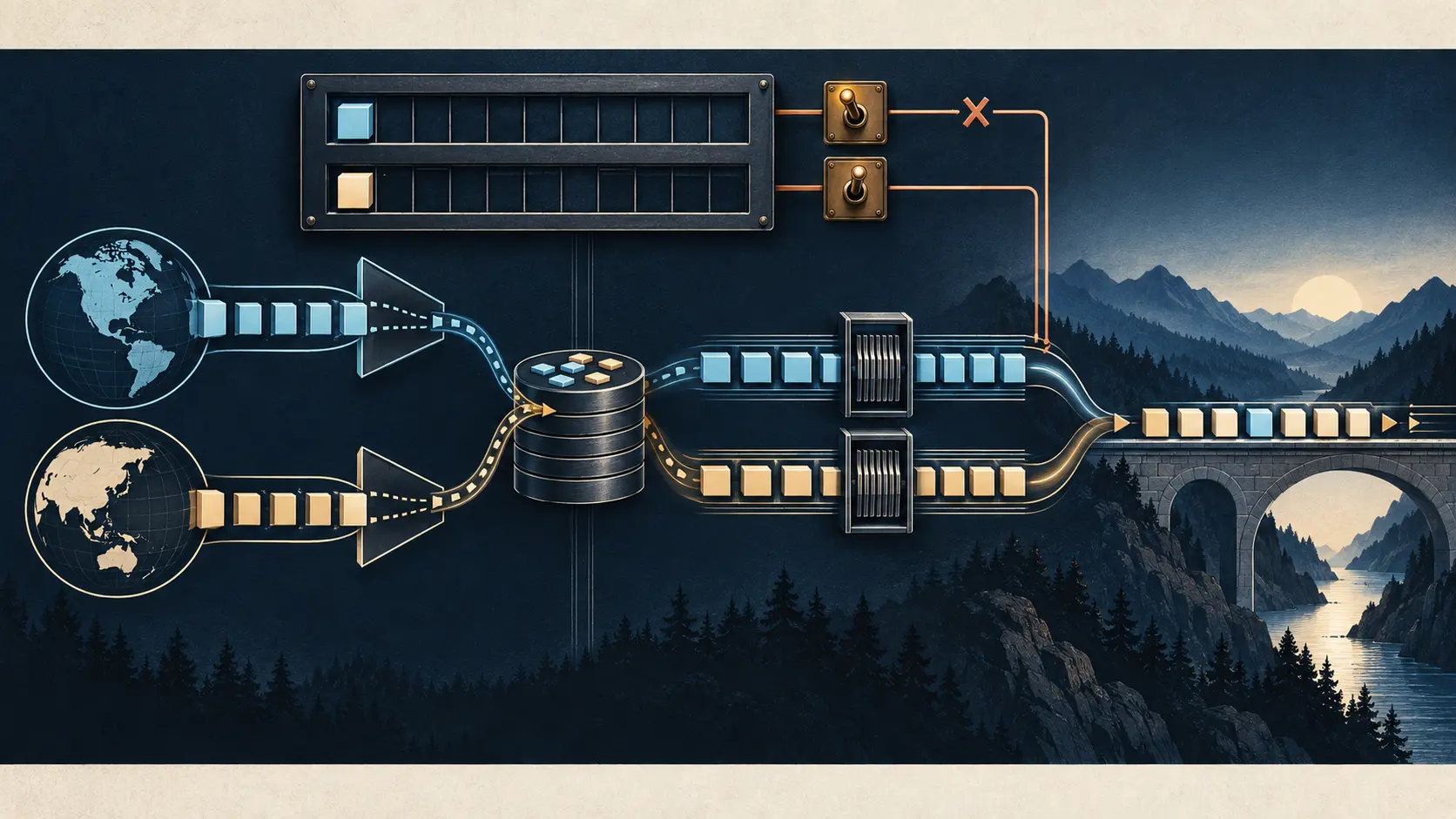
Summary
- RFC 2037 let one SNMP agent describe several logical entities and a tree of physical components; the same index could name different things in different scopes.
- Its containment, logical-to-physical and alias tables made identity reconstructible, but did not prove ownership, locality, completeness or agreement between agents.
The dangerous number in a management system is often not a wrong number. It is a number whose scope has been discarded.
RFC 2037 began with a device that did not fit the convenient equation “one agent equals one system.” A router could participate in two autonomous systems, each with an OSPF backbone area numbered 0.0.0.0. A chassis could contain several logical repeaters, bridges or routers while exposing them through one management endpoint. In either case, an object identifier and an integer index could be perfectly valid and still be ambiguous outside the context in which the agent returned them.
The Entity MIB did not solve that ambiguity by inventing a global identifier. It documented the joins needed to interpret a local one.
A naming scope made the index meaningful
RFC 2037 called the management information reachable in one operation, with one unique identifier space, a naming scope. For SNMPv1 and SNMPv2c, entLogicalCommunity identified the community used to access a logical entity's scope.
That distinction is easy to lose in an export. Suppose two logical routers each return ifIndex.5. The matching suffix does not establish a shared interface. The values are drawn from different identifier spaces unless a mapping says otherwise. The defensible record is not “interface 5”; it is “interface 5, returned by this agent, in this logical scope, at this time.”
RFC 2037 also limited what the logical table could say. Two logical entities represented by the same community string had no implied administrative relationship. A logical entry did not tell the reader whether the entity ran inside the local chassis or was reached through a proxy. And the MIB did not manage the naming scopes themselves. The community identified a route to information; it did not prove who governed the route.
The chassis was a tree, and an empty slot was still a fact
The physical table started with an overall entity and used entPhysicalContainedIn to describe immediate containment. Following those links upward eventually reached zero. A chassis could contain slots; slots could contain modules; modules could contain ports.
RFC 2037 required containers to be represented whether empty or full. That made a vacant slot materially different from an unmodelled slot. One is an explicit place with no installed child. The other may reflect incomplete support, a stale view or an agent that chose not to expose that part of the machine.
The distinction is useful, but it has a boundary. The table is the agent's physical model, not a signed warehouse inventory or proof of a technician's inspection. A missing row does not, by itself, prove physical absence.
Logical and physical did not form a one-to-one marriage
entLPMappingTable connected logical entities to the physical components that supported them. The relation was deliberately many-to-many. One logical router could use several modules and ports. Several logical entities could share a backplane or other component.
This was an operational support map, not a title register. A mapping did not establish exclusive ownership, administrative control, tenancy, budget responsibility or legal accountability. Nor did the table explain every association. RFC 2037 expected the nature of the relationship to be inferred from the logical entity's own MIB information.
The document's examples also resisted convenient compression. In a port-switchable hub, mapping individual ports could remain necessary even when they currently belonged to one repeater. Replacing those edges with one module-level edge would hide the actual control surface: the ports could be reassigned independently.
An alias completed the three-part address
The alias table bound a logical entity, a physical component and an identifier from another MIB. It could say that an ifIndex, repeater port or comparable external object referred to this physical part under this logical scope.
The join mattered more than the number. ifIndex.5 became useful physical evidence only after the logical index selected the naming scope and the physical index selected the component. Logical index zero provided a wildcard mapping for logical entities without a more specific row, but it was a default inside one agent's model—not a declaration of universal identity.
A physical component could also have no alias rows. That meant no alias was exposed. It did not prove there was no operational association elsewhere.
Another agent could tell a different, valid story
RFC 2037 allowed multiple agents to expose overlapping parts of the same system. Their Entity MIB instances did not have to be equivalent or mutually consistent. Arbitrary indices could differ. Vendor identifiers could differ. Each agent could represent a different subset.
Cross-agent reconciliation therefore could not use a matching index as identity, or a differing description as automatic error. It needed separate evidence: serial information, topology, operator records or another validated join. Even then, the result described the strength of that join, not a guarantee supplied by the Entity MIB.
The same caution applies over time. Change indications can tell a manager that the exposed configuration changed, but they do not establish why it changed, who authorized it or whether the inventory is complete.
Read-only did not mean omniscient
In RFC 2037, every accessible object instance defined by the module had MAX-ACCESS read-only; the structural index objects were not accessible. The MIB observed and related entities. It did not make the reader an administrator of them.
A successful read proved that one agent returned one value under one scope. It did not prove current deployment intent, live reachability, physical inspection, business impact or authority. The RFC's security section warned that some of this information could be sensitive and suggested access-control views. That warning did not prove any deployment had configured those controls correctly.
The revision history reinforces the date boundary. RFC 2737 later added SNMPv3 context fields and writable administrative identifiers; RFC 4133 followed, and RFC 6933 now stands at the end of the succession chain. Those later facilities show that context remained central. They are not features that can be retrofitted into the 1996 text.
Sources
Member Briefing
Deeper Profile Context
Sign in with the right membership level to unlock the full briefing and source notes.
Only for Strategic Circle
Strategic Circle
Open to all readers. Unlock profile briefings after joining and signing in.
Join Strategic CircleOnly for Leadership Alliance
Leadership Alliance
For qualified IP-asset owners and management; sign in to unlock alliance briefings.
Join Leadership Alliance