
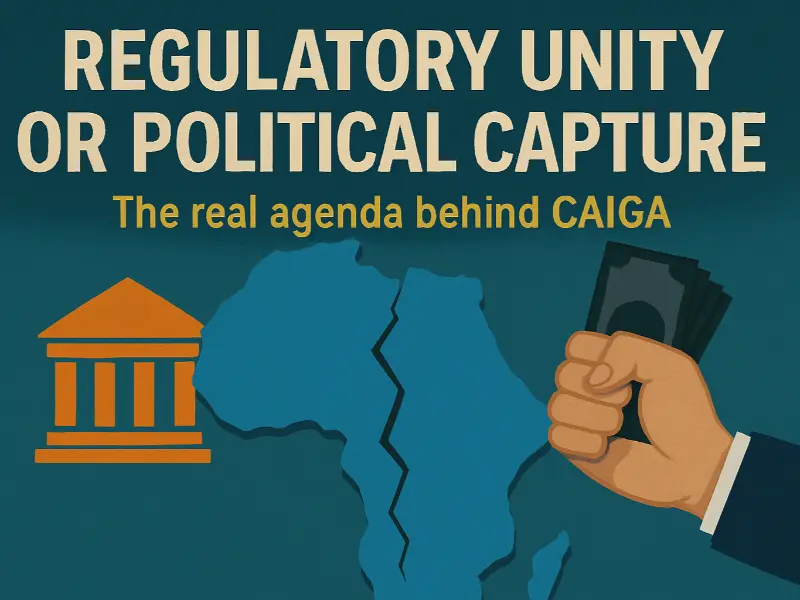
Regulatory unity or political capture? The real agenda behind CAIGA is a public record based on article evidence, entity context, event links, and relationship context.
Claims that CAIGA could harmonise Africa’s fragmented digital regulatory landscape are increasingly being challenged, as critics warn the initiative risks entrenching political control rather than repairing broken governance systems. There is growing concern that Smart Africa, with ICANN’s backing, is advancing a governance model that prioritises top-down authority while marginalising the technical communities responsible for operating and sustaining Africa’s internet.
A harmonisation narrative built on weak foundations Africa’s digital regulatory environment is indeed uneven, shaped by divergent national approaches to data protection, cybersecurity and digital services. But critics argue that invoking regulatory fragmentation has become a convenient justification for expanding political oversight, rather than a serious attempt to address governance failures at their source. The Continental Africa Internet Governance Architecture (CAIGA) is presented as a continental framework capable of unifying disparate rules.
Yet the proposal lacks clarity on how policies would be developed, who would hold decision-making authority, and what safeguards would prevent political interference. There is little evidence that technical operators, civil society or regional internet communities would play a decisive role under this structure. Rather than emerging from consensus, CAIGA risks enforcing standards designed by a narrow political circle, detached from operational realities and local conditions. In this context, “harmonisation” appears less a technical objective than a mechanism for consolidating authority.
Also Read: What role will regional internet communities play in CAIGA Centralisation over diversity CAIGA’s architecture places governments at the centre of regulatory alignment, displacing the multistakeholder model that has underpinned global internet governance for decades. Regional operators warn that technical requirements could be subordinated to political agendas, producing regulations that restrict innovation, slow deployment and limit digital freedoms. Africa’s regulatory diversity reflects real differences in infrastructure maturity, legal systems and social priorities.
Imposing uniform rules through a centralised, politically driven framework risks erasing necessary flexibility and creating standards ill-suited to local ecosystems. Rather than reducing fragmentation, CAIGA may introduce new conflicts—particularly if continental authority begins to override national or community-led processes. Also Read: Understanding CAIGA’s proposed policy framework ICANN’s involvement deepens the credibility gap ICANN ’s funding and participation in Smart Africa ’s governance blueprint has intensified scepticism.
An organisation that publicly defends bottom-up governance is now associated with a framework that enables state-led oversight. Stakeholders question why Africa is being exposed to a governance experiment that would be unacceptable in other regions. Without transparency, accountability and genuine community authority, CAIGA risks becoming a vehicle for political consolidation—not a solution to Africa’s regulatory challenges.
Member Briefing
Deeper Trend Context
Sign in with the right membership level to unlock the full briefing and source notes.
Only for Strategic Circle
Strategic Circle
Open to all readers. Unlock trend briefings after joining and signing in.
Join Strategic CircleOnly for Leadership Alliance
Leadership Alliance
For operators, investors, and policy teams that need relationship evidence, failure paths, and source notes. Sign in to unlock.
Join Leadership AllianceSnapshot
Category
Global Cloud Services TrendsRegulatory unity or political capture? The real agenda behind CAIGA is covered for governance relevance.
Region
AfricaSignal Focus
GovernanceContent Type
EventPrimary Domain
MarketTopic
GovernanceImpact
MediumConfidence
Good confidence (80%)Confidence score guide
Published reporting