
Summary
- Rednet Group is a registered Colombian telecommunications provider that advertises FTTH and rural wireless service across named Santander municipalities, but its public materials do not identify fibre routes, radio sites, upstream facilities, power reserves, subscriber counts or installed aggregate capacity.
- Four prefixes were visible from AS273102 on 17 July 2026 through three immediate external neighbours, yet route diversity cannot establish physical diversity: the disclosed evidence does not show whether those paths share a building, carrier circuit, pole corridor, road approach, electrical supply or field-repair team.
- The decisive resilience evidence would be a paired physical and operational map showing every access segment, relay, splitter, aggregation site, power boundary and carrier handoff, followed by busy-hour, battery-runtime, failover and restoration tests that distinguish installed resources from capacity customers can actually use during a disruption.
The road closure that tests both access networks
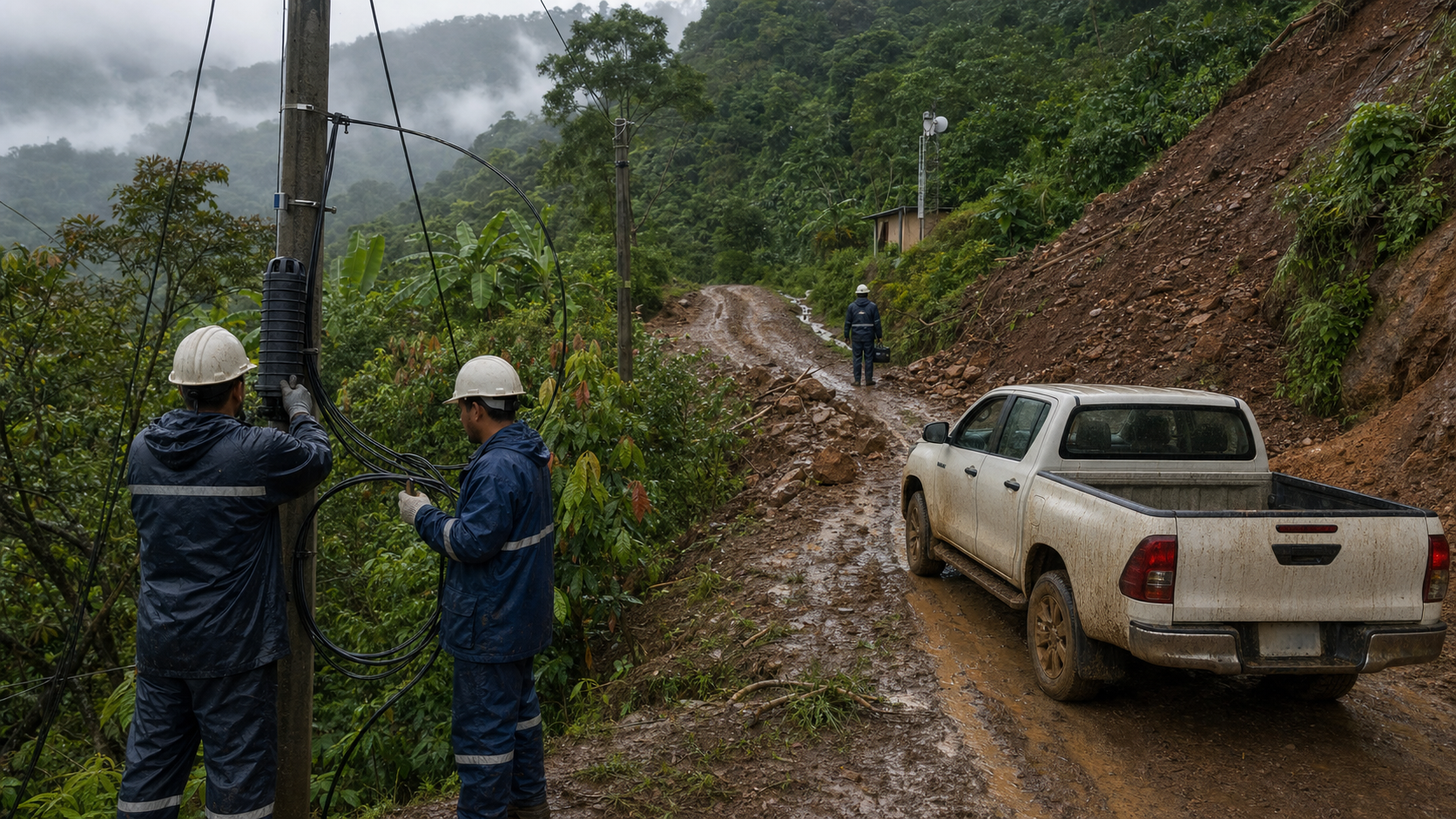
The rain has not proved anything about Rednet's own plant. No public incident notice ties the company to the imagined closure, and no claim should be built on that scene as if it did. What the scene does is place two real statements beside a real regional hazard. Rednet says it serves Santander through both wireless technologies and FTTH networks on its company profile. Colombia's national disaster-risk service, meanwhile, carried a high landslide forecast for San Vicente de Chucurí in July 2026, citing prolonged or intense rainfall and terrain susceptibility. The combination creates a legitimate resilience question without supplying an answer.
A fibre access network and a rural radio network fail differently at the customer edge. A buried fibre can survive wind and surface debris but be severed by slope movement, drainage work or an excavator. An aerial fibre can avoid trench damage but remain exposed to fallen vegetation, displaced poles and vehicles. A radio link can leap over a broken road and avoid a continuous cable route, but the customer antenna still points to another powered site, often on elevated ground. Someone must reach that far-end site when a mount shifts, a radio fails, a battery expires or vegetation obstructs the path.
Different transmission media do not automatically create different access routes for repair.
Santander's own historical road reports show why the distinction is practical. On the Lisboa–San Vicente corridor, the departmental government described rain-triggered slides at El Tablazo, Hacienda La Fe and Pujamanes and the use of heavy machinery to restore passage. A separate report records work on the alternate route between San Vicente and El Carmen de Chucurí, including critical rural points used by dispersed communities. These are not Rednet incident records. They are evidence that access to the territory can be constrained at the same time connectivity is most valuable.
The recovery question therefore begins before any packet reaches the wider internet. Which roads approach the company's cabinets, relay points and aggregation rooms? Which sites can be reached from a second direction? Which spans share bridges, culverts or unstable slopes? Does an alternate radio path end at a site that depends on the same blocked road as the failed fibre? Can a local technician isolate a damaged section, or must a specialist and spare equipment travel from Bucaramanga? The public record does not answer any of these questions.
This is the first analytical boundary: Rednet's two access technologies are established, and the region's landslide exposure is established, but shared recovery dependence is an inference that still needs a site-level map. Treating that inference as a fact would overstate the evidence. Ignoring it because fibre and wireless have different names would understate the operational risk.
The company is identifiable; the asset boundary is not
Rednet's legal identity is unusually clear for a small regional provider. A telecommunications registration certificate linked from the company's regulatory page identifies REDNET GROUP S.A.S, NIT 900966730-9, as a provider of internet access over a mixed network. The underlying TIC registration certificate records registration number 96003207, an initial registration date of 18 May 2016, a Bucaramanga address, and Edinson Serrano Alfonso as legal representative. That document was issued in April 2019. It establishes authorisation and identity at that date; it is not a current inventory of plant.
The age and wording of the certificate require care. It records that the company did not use or intend to use radio spectrum in the response captured then, while the current website markets rural wireless connectivity. Those statements are not necessarily contradictory. The registration snapshot may predate later deployments, and wireless access can use licence-exempt bands under applicable rules. The public evidence does not identify the bands, licences, site authorisations or later amendments involved, so none should be presumed.
The safe conclusion is narrower: the provider was registered for mixed-network internet service, and present-day commercial pages describe wireless and fibre products.
The internet-numbering boundary is also identifiable. LACNIC's registration for AS273102 assigns the autonomous-system number directly to REDNET GROUP SAS, with an October 2023 registration date and contacts in San Vicente de Chucurí. LACNIC separately records 2803:b050::/32 as an active IPv6 allocation to the same organisation. These records establish control of an autonomous-system identity and a large IPv6 allocation. They say nothing about where routers are installed, how they are linked, how many customers use them or how much traffic their connections can carry.
Between legal identity and routing identity lies a wide physical boundary that remains unmarked. Rednet's own ducts, poles, towers, radios, fibre, cabinets and rooms are not enumerated. Nor are leased assets: dark fibre, lit circuits, tower space, data-centre racks, shared poles, wholesale access networks or managed upstream equipment. A claim such as “own network” can be commercially meaningful while still combining owned last-mile equipment with leased transport and third-party facilities. Resilience analysis needs each responsibility boundary, because repair authority changes at it.
The same problem appears in IPv4. On 17 July, the prefix 38.191.217.0/24 was observed with AS273102 as origin in RIPE NCC's network information view. Yet ARIN's registration view for the containing space identifies an assignment to TV&MAS S.A.S rather than an allocation to Rednet. This may reflect a legitimate commercial arrangement, customer assignment or delegated use. The records do not disclose the contract, duration, routing authority or restoration responsibility, so the prefix should be described as currently originated by Rednet, not owned by it.
That distinction is not paperwork for its own sake. If an outage concerns a Rednet-owned radio, its staff may have direct authority to replace it. If it concerns a pole, building or circuit controlled by another party, access and escalation may require coordination. If it concerns address space supplied through another company, route correction may require a different technical and contractual chain. A useful asset boundary would name the owner, operator, maintainer, access authority and escalation contact for every material segment.
Public evidence thus supports a durable conclusion about the company but only a provisional one about the network. REDNET GROUP S.A.S is the legal provider linked to AS273102 and its IPv6 allocation. The physical and contractual surface carrying customer traffic remains partly owned, partly leased or shared, and largely undisclosed.
A sales footprint is not a physical network map
Rednet's quotation page gives the clearest public account of where it sells. It lists San Vicente de Chucurí, Yarima, El Carmen de Chucurí and El Playón, plus rural locations around Piedecuesta and Girón including Guatiguará, Palogordo, Chocoita and Chocoa. It also separates residential fibre, enterprise fibre and rural internet as quote categories. This is valuable commercial evidence. It is not a route map, a promise of immediate service at every address or proof that every named place has all three products.
The company's residential page advertises plans from 5 to 30 Mbps, while its rural internet page advertises 2, 4 and 10 Mbps. The repeated locality list suggests a common commercial territory, but the pages do not allocate individual communities to a particular tower, fibre feeder, splitter area or aggregation point. A customer in a named municipality might be within a fibre build, reachable only by radio, served through a reseller arrangement or outside technical feasibility at a particular address. Coverage language cannot resolve those alternatives.
The territorial challenge is visible in official geography. An Agrarian Agency municipal characterization of San Vicente de Chucurí describes a municipality about 85 kilometres from Bucaramanga, divided among dozens of rural districts and settlements and crossed by rivers, streams and a hierarchy of main and tertiary roads. That physical dispersion is consistent with a mixed fibre-and-wireless strategy. It also means a municipality name conceals very different reach, travel time and terrain.
Population data give scale without revealing market share. A national rural-planning municipal annex reports 2024 populations of 36,697 for San Vicente de Chucurí and 22,596 for El Carmen de Chucurí, with rural shares of about 60 percent and 82 percent respectively. Together that is 59,293 people, of whom roughly 40,077 were rural. These figures cover whole municipalities, not Rednet's service footprint. They must not be converted into subscribers, premises passed or potential demand without address-level coverage and take-up data.
A physical map would answer a different set of questions from the sales list. For fibre, it would show feeder routes, aerial and buried sections, cabinets, splitter locations, crossing points, spare strands, pole ownership and the path back to aggregation. For wireless, it would show each access sector, relay hop, antenna height, frequency band, path clearance, power source and the number of customers behind the site. For both, it would show where traffic first combines and where it leaves Rednet's direct control.
The company's payment-point page adds another layer: counters or agents in San Vicente, El Carmen, El Playón, Palogordo or Chocoita, and Yarima. Those locations are evidence of local commercial presence and may help customers pay or seek assistance. They are not necessarily network sites, spare stores or dispatch bases. Equating a storefront with an aggregation node would create a false map.
This separation between commerce and plant is essential when judging expansion. A new fibre offer may represent a feeder and distribution build owned by Rednet, a leased route into a local access area, or retail service delivered over another operator's last mile. Colombia's communications regulator has discussed shared wholesale access to local FTTH networks, illustrating that the company selling service need not own every fibre segment. That policy proposal does not establish that Rednet uses shared FTTH. It establishes why ownership cannot be inferred from a retail product name.
The evidence therefore supports a sales footprint with named municipalities and service classes. It does not yet support a line on a map labelled “Rednet fibre,” a count of homes passed, or a claim that a wireless and fibre customer have independent paths. Those require asset-level disclosure or field verification.
Fibre changes the last mile, not every dependency
FTTH can materially improve the access layer. Fibre is not subject to radio interference, can support higher access rates, and can be expanded by changing optics or active equipment when the passive plant has been designed with sufficient margin. It can also remove a customer's dependence on a clear radio path. Rednet's move toward FTTH is therefore a meaningful technical change. It is not, by itself, evidence of end-to-end diversity.
The company's public plan structure remains modest. The quotation form offers residential fibre up to 30 Mbps and enterprise fibre up to 100 Mbps. Those retail rates may reflect market positioning, upstream cost, contention policy, access equipment or historical page maintenance; they do not reveal the optical standard or the physical ceiling. The International Telecommunication Union's XGS-PON recommendation, for example, describes a point-to-multipoint architecture in which an optical line terminal serves multiple customer units through a passive distribution network. Rednet does not publicly say it uses XGS-PON, GPON, active Ethernet or another design. The recommendation is useful only to show why the access product name “fibre” does not identify the sharing and failure structure.
In a passive optical network, many customer drops can converge through splitters onto one feeder and one port. A cut before a splitter may isolate a small branch; a feeder cut or optical-line-terminal failure can affect a much larger group. In active Ethernet, aggregation switches and their power supplies create different concentration points. A leased wholesale connection introduces still other responsibilities. Without the architecture and split ratios, one cannot turn plan speeds into installed capacity or estimate how many customers share a fault domain.
Route choice matters as much as optics. Fibre attached to electrical poles can follow the same road used by technicians and the same corridor exposed to vehicle impacts, slope failure and pole replacement. Fibre buried beside a road can share culverts, bridges and drainage works. A nominal “ring” can contain two logical directions that occupy the same duct for part of the route. A second carrier can enter through the same building or cross the same bridge. True physical diversity requires separation at every segment whose failure could remove both paths, not merely two interface names on a router.
Beyond the local network, Rednet's enterprise page makes broad transport claims. It says the company uses strategic providers, has multiple access to submarine networks and the NAP of the Americas, and a robust connection to NAP Colombia on its enterprise service page. These are self-published descriptions, not circuit records. They do not name carriers, facilities, port rates, path separation or protected configurations. The NAP Colombia technical policies describe a principal node at Bogotá's World Trade Center and an alternate node, and make a participant responsible for last-mile connectivity. That document does not prove Rednet's participation or show its route. It demonstrates why “connection to NAP Colombia” still leaves the member-side circuit and facility path to be established.
Fibre can improve customer experience and reduce dependence on local radio conditions. It can even provide a diverse route if it was deliberately built away from the wireless backhaul and supplied through separate power and upstream facilities. The missing map prevents that stronger conclusion. The correct statement is that FTTH changes one segment of Rednet's access surface; the common dependencies beyond that segment remain unresolved.
Wireless avoids trenching but not terrain
Wireless access is particularly useful where the cost and delay of continuous fibre construction are difficult to justify. Rednet's wireless-link page markets point-to-point and point-to-multipoint links and says feasibility analysis can support links over long distances. The page mentions distances of up to 80 kilometres. That is a capability claim, not evidence that Rednet has an 80-kilometre installed hop. No public path profile, frequency, antenna size or site pair accompanies it.
The engineering distinction is important in Santander. A radio link needs more than a visible mountaintop. The ITU's terrestrial line-of-sight guidance treats path clearance, diffraction, multipath, precipitation, antenna characteristics, outage probability and diversity as design concerns. Vegetation growth or a small antenna movement can reduce margin. Heavy rain affects some frequency bands more than others. A long hop may work well with proper engineering, but it concentrates more distance behind two sites whose power, access and alignment must remain intact.
Point-to-multipoint access also introduces shared resources. Multiple customer radios may contend for airtime on a sector. Interference can reduce usable throughput without taking the sector fully offline. A relay can aggregate several sectors, making its backhaul and power supply a larger fault domain than any customer sees. Rednet does not publish sector capacity, channel widths, frequency reuse, modulation under degraded conditions, oversubscription or relay topology. Its rural plans show what a subscriber can buy, not what the radio network can deliver to all subscribers simultaneously.
The website's “own nodes” wording and a reference to links up to 15 kilometres with line of sight on the enterprise page add another clue, but not a map. “Node” could mean a tower, rooftop, relay, cabinet, router location or commercial point of presence. The statement does not give coordinates, ownership, tenancy, backhaul or power. Nor does it establish that every advertised municipality is reached from a Rednet-owned node. Care is needed not to translate a marketing noun into an asset inventory.
Terrain can make wireless and fibre both complementary and correlated. A radio hop may cross a river or valley without following the road, remaining live after a cable beside that road is cut. That is genuine medium and route diversity for the crossed segment. Yet if both endpoints receive power from the same regional circuit, or if the far-end relay backhauls over the damaged fibre, the benefit stops there. If the only technician and spare radio approach the relay on the blocked road, restoration remains correlated even though the live radio path crosses open air.
General rural-network guidance from the ITU notes the recurring problems of backhaul cost and irregular power in sparsely served areas. That global guidance is not evidence of Rednet's site conditions. It identifies the questions a local disclosure should resolve: which sites use grid power, which have batteries or generation, how much autonomy is available at normal load, how alarms reach staff, and what backhaul remains after a primary transport failure.
The balanced conclusion is that Rednet's rural radio service plausibly reduces construction dependence and can cross obstacles that constrain fibre. It does not escape terrain, weather, site access, power, shared backhaul or finite airtime. Whether it supplies a truly separate recovery route is a property of particular endpoints and paths, not of the word “wireless.”
Four live routes do not make four escape paths
Public routing data offer the strongest measurable view of Rednet's current internet edge, but they must be read at the right level. RIPE NCC's announced-prefix history for AS273102 showed five prefixes at some point in the two weeks ending 17 July 2026. Only four remained visible at the latest observation: the IPv4 block 38.191.217.0/24 and three IPv6 /38s within Rednet's 2803:b050::/32 allocation. The fifth, 38.191.190.0/24, had ceased to appear under AS273102 earlier in the period.
RIPE NCC's routing-status snapshot counted one visible IPv4 prefix covering 256 addresses and three visible IPv6 prefixes corresponding to 3,072 /48-equivalent units. The units are address-space measures, not bandwidth, customer counts or equipment capacity. High visibility among route collectors indicates that routes were broadly observed. It does not show that customer traffic was flowing, that a backup path worked, or that an access site remained powered.
The external adjacency is more informative but still logical. RIPE NCC's neighbour summary showed three neighbours on the provider-facing side—AS262186 for IPv4 and AS273103 plus AS52468 for IPv6—and AS273168 on the other side for IPv6. The last should not be counted as a fourth upstream merely because it is adjacent. Direction in observed paths suggests a different relationship, while the contracts themselves remain private.
The BGP state view further showed 38.191.217.0/24 immediately behind AS262186 in collected IPv4 paths, 2803:b050:400::/38 and 2803:b050:800::/38 behind AS273103, and 2803:b050:1000::/38 behind AS52468. This demonstrates that different advertised prefixes reached collectors through different immediate neighbours at that moment. It does not demonstrate that any single customer prefix could switch between them, that the circuits enter at separate facilities, or that they occupy different fibre and power routes.
The IPv6 origin authorisations are a positive control-plane signal. RIPE NCC reported valid origin validation for 2803:b050:400::/38, valid status for 2803:b050:800::/38, and valid status for 2803:b050:1000::/38. All sit beneath the registered /32 and were covered by an authorisation permitting AS273102 to originate more-specific routes. That alignment improves route legitimacy. It does not add a second cable, router, generator or field crew.
The retired fifth prefix illustrates why historical and current counts must be separated. ARIN's registration view for 38.191.190.0/24 identifies the containing assignment with NOVACOM TIC S.A.S. RIPE NCC's current network information showed AS273174 as origin, not Rednet, and an origin-validation query for AS273102 returned an invalid-origin result against the authorisation for AS273174. That does not prove malicious routing or a customer outage. It establishes a transient inconsistency that had ended by the current snapshot and deserves operator explanation before anyone counts the block as Rednet's available address resource.
Logical diversity becomes resilience only when the missing layers are supplied: circuit identifiers, capacity commitments, termination facilities, entrance paths, router ports, power feeds, routing policies, failure detection and tested convergence. Three provider-facing neighbours across address families are useful evidence of external connectivity. They are not four physical escape paths, and they do not establish dual-homing for every prefix.
Published megabits are sold capacity, not survivable capacity
Rednet publishes several numbers that look like capacity but answer narrower questions. Residential plans range from 5 to 30 Mbps, rural plans from 2 to 10 Mbps, and enterprise plans from 5 to 100 Mbps. The enterprise page also states 99.8 percent availability and a reuse ratio of 1:6. These are retail offers and a self-described service characteristic. They do not disclose how many customers share an access sector, optical port, aggregation link or internet transit connection.
The difference between installed, sold, usable and survivable capacity is central. Installed capacity is what ports, optics, radios, switching fabric and transport circuits can carry under stated conditions. Sold capacity is the sum or profile of customer products, usually much larger because not every customer uses the maximum simultaneously. Usable capacity is what remains after protocol overhead, signal conditions, contention and operational limits. Survivable capacity is the smaller amount that can still reach customers after a specified failure.
None can be derived reliably from the retail plan table. Fifty rural customers buying 10 Mbps might share a sector with ample headroom, or they might encounter congestion at the busy hour; the customer count and sector rate are unknown. A 100 Mbps enterprise plan might ride a gigabit handoff or a much larger one; the circuit rate and commitments are unknown. A fibre port may have substantial optical capacity but feed through a constrained aggregation or upstream link. Conversely, conservative retail tiers do not prove that the physical network is small.
Availability also needs a measurement boundary. A 99.8 percent annual figure corresponds arithmetically to about 17.5 hours of unavailability if measured continuously, but that does not reveal what the company counts. The clock might stop at the customer radio, the access node or the internet edge. Planned maintenance may be excluded. The figure may apply to a particular enterprise product rather than the whole network. No public measurement period, sample, credits or audited result accompanies the claim, so it should not be presented as observed performance.
The reuse ratio is similarly incomplete. A 1:6 label could refer to a commercial contention policy, but the page does not identify the resource being shared or the conditions under which the ratio applies. Six subscriptions per committed unit at one layer do not reveal contention at another. A network can honour an access-level ratio and still concentrate traffic through a shared upstream circuit; it can also maintain more headroom than the label implies.
Control-plane address quantities provide no substitute. A /24 contains 256 IPv4 addresses and an IPv6 /32 can support an enormous addressing plan, but address space does not transmit traffic. Route collectors can see every advertised prefix while the underlying circuit is congested or a local access area is down. Likewise, multiple route neighbours do not state port speed, committed information rate, burst allowance or failover headroom.
A defensible capacity account would use a layered table. Each access sector or optical port would show installed rate, active customers, peak utilisation and degradation threshold. Each aggregation link would show protected and unprotected capacity. Each upstream circuit would show port rate, commitment, normal peak, latency and the load it must absorb when another circuit fails. Power capacity would be expressed as measured runtime at actual load, not merely battery nameplate energy. Spare capacity would be associated with a specific failure scenario.
The distinction also protects the company from unfair inference. Lack of published aggregate capacity does not show that Rednet is congested or underbuilt. It shows that an external reader cannot assess headroom. The published megabits are useful for understanding product tiers. They are not a measure of installed plant, and they cannot support a claim about service remaining after a tower, feeder, aggregation site or upstream circuit fails.
Power can remove fibre and radio together
Connectivity discussions often treat power as a background utility, but in Santander it is part of the route. ESSA announced a planned day-long maintenance window in San Vicente de Chucurí to replace poles, structures and electrical cable in urban and rural sectors. That record does not identify any Rednet site or prove a telecommunications interruption. It establishes that local electrical distribution requires field work on physical corridors that may also be relevant to customer premises and communications equipment.
ESSA also described an emergency on the Caneyes–Zapatoca 34.5 kV line that interrupted service in urban and rural San Vicente while technicians responded. Again, this is not a Rednet outage report. It is evidence that a regional supply event can affect a broad area and that restoration time depends on access and field conditions.
Every Rednet service has powered endpoints. A residential fibre customer needs an optical terminal and router. A wireless customer needs outdoor or indoor radio equipment and a router. A relay, tower sector, aggregation switch and edge router need power at company or host sites. A passive fibre splitter may continue passing light without local power, but that provides no service if the transmitting or receiving equipment is dark. The resilience chain therefore includes both customer-side and provider-side electricity.
Customer equipment is often the first hidden limit. A central site could run through an outage on batteries or generation while homes lose power immediately. Customers may report “internet down” even when the network remains available to powered devices. Businesses with uninterruptible supplies can remain connected longer, but their runtime and load differ. An operator's availability statistics need to say whether loss of customer power is excluded and whether support can distinguish it remotely.
Provider sites create the more concentrated risk. A radio relay may serve many customers, and an aggregation room may combine fibre and wireless traffic. Batteries can bridge short events but degrade with age, temperature and repeated cycling. A generator requires fuel, maintenance, a safe installation and access for refuelling. A shared host site may divide responsibilities between landlord, tower company and operator. Rednet's public pages do not disclose which sites have backup power, how long it lasts at current load, whether generators exist, or how recently transfer and runtime were tested.
Power diversity is also physical. Two electrical feeds can originate from one substation or share poles before separating. A separate battery string may still power one router chassis. A fibre headend and radio backhaul in the same room may share a distribution panel. A road slide can cut commercial power, damage communications plant and block the crew that would refuel a generator. Calling fibre and radio independent while leaving this common power layer unexamined would miss a major failure mode.
The company's contact page publishes customer-service hours from Monday through Saturday, 7 a.m. to 8 p.m., and technical-support hours from Monday through Saturday, 8 a.m. to 6 p.m. Elsewhere, generic service text refers to continuous monitoring or specialist availability. Public information does not reconcile automated alarms, after-hours remote response and physical dispatch. During an evening or Sunday power event, the distinction between detecting a failure, answering a customer and reaching a site becomes important.
A credible power account would identify normal and maximum load, autonomy, generation, fuel, alarm path, maintenance owner and access time for every critical site. It would also test the customer experience after local power loss and define which essential locations have their own backup. Until those facts are available, power remains a plausible common cause capable of removing both Rednet access technologies together.
The users are known by class, not by count
Rednet's public materials identify who it intends to serve more clearly than how many it serves. The product pages distinguish households, rural users and enterprises. The locality and payment-point lists show an operator oriented toward communities beyond a single metropolitan centre. The registration and routing records show a real provider with its own autonomous-system identity. None of the public sources gives active subscribers, premises passed, sector loading, churn, revenue concentration or the distribution of customers among fibre and wireless access.
This is more than a market-size gap. Customer distribution determines the impact of a failure. A fibre feeder serving a dense urban neighbourhood can affect many households at once. A wireless relay may reach fewer premises spread across a wide rural area, making each repair more travel-intensive. An enterprise circuit may carry a large share of local economic activity even if it is only one account. A municipal office, health post or school can be socially important without being a large source of revenue.
Rednet's geographic pages permit only cautious user categories. San Vicente and El Carmen have large rural populations, and the company names rural districts around Girón and Piedecuesta. That supports the relevance of farms, households and small businesses outside urban cores. It does not prove that they subscribe to Rednet. Nor does the presence of a payment counter prove that the surrounding community is served through a particular medium.
The national statistical office's 2024 household quality-of-life bulletin reported a substantial national gap between household internet access overall and in rural population centres and dispersed areas. National figures cannot be assigned to Rednet's footprint or customers. They supply context for why a regional mixed-access provider may matter: connectivity options are generally thinner outside major urban areas, so one local network can have an outsized practical role.
Impact also changes with duration and time of day. A short evening interruption may inconvenience households while leaving daytime commerce largely untouched. A weekday outage can stop payment terminals, remote work and administrative services. A long disruption after heavy rain can coincide with transport uncertainty, increasing the value of messaging and coordination. Degraded service may be preferable to complete loss if the operator can prioritise low-bandwidth essential traffic, but no public continuity policy or priority class is described.
Customer concentration needs to be mapped onto infrastructure. For every fibre splitter, feeder, wireless sector, relay, aggregation node and upstream path, the operator should know the count and type of users behind it. That does not require publishing personal information. Aggregated counts can reveal whether one site is a disproportionate dependency and whether temporary capacity could support the affected group.
Communication is part of impact management. Customers need a way to distinguish local power loss, damaged home equipment, area access failure and wider transport trouble. They need realistic restoration estimates and an explanation when roads or third parties constrain repair. Rednet's local commercial presence could be an advantage here, because payment locations and regional staff can sustain trust. Yet the public pages do not describe an outage channel, status page, mass notification method or priority-contact arrangement.
No responsible estimate of Rednet's subscriber base can be made from population, advertised coverage, address resources or plan lists. The evidence establishes user classes and a territory where service can be consequential. It leaves the magnitude and distribution of exposure unresolved. That is why a resilience assessment should report both infrastructure concentration and affected-user counts, rather than treating a municipality's population as a proxy for customers.
Recovery authority crosses roads, poles and carrier handoffs
Failure is physical, but recovery is organisational. A field technician may confirm that a fibre span is down and still be unable to replace it without pole access, traffic control, a property owner's permission or another utility's work. A radio specialist may identify a failed far-end unit but lack safe access to the roof or tower. A network engineer may change a route while waiting for an upstream carrier to restore the circuit beneath it. Each boundary adds diagnosis, contact and travel time.
Rednet's public identity and local presence suggest that some of those functions are close to the service area. The company describes a local workforce and publishes contact channels and payment points. That can shorten customer intake and initial dispatch. It does not reveal crew size, shift coverage, spare stock, climbing capability, fibre-splicing resources or mutual-aid arrangements. Local support labour is an operational asset only to the extent that the right person, access permission and replacement part are available for the failed segment.
Road authority is a separate dependency. A slide may require the municipality or department to assess safety and clear material before a communications crew can enter. The road itself can carry poles, buried fibre or the only approach to a relay. Restoration priorities may place life safety and transport before telecommunications plant. An operator that has mapped alternate access, pre-positioned spares and established emergency contacts can work within that constraint more effectively, but cannot ignore it.
Pole and electrical work can be similarly coupled. If a damaged support carries both power and fibre, the electrical utility may need to make the location safe before a fibre crew begins. Replacing a pole can require moving several operators' cables in sequence. If Rednet leases attachment space, it may not control the schedule. If the fibre is owned by a wholesale provider, Rednet may communicate with customers while another company performs the physical repair.
Carrier handoffs extend the chain beyond Santander. A local access network can be healthy while a leased transport circuit, distant facility or internet upstream is unavailable. Routing changes may reduce the effect if another path has capacity and the affected prefixes can move. Yet the observed external neighbours do not disclose escalation terms or physical entry points. A route seen through Bogotá or another exchange location can still depend on a single regional transport path before it reaches that facility.
Recovery should therefore be timed as a sequence, not reported as one number. Detection begins when monitoring or customers reveal the loss. Localisation identifies whether the problem is customer equipment, access, power, aggregation, transport or routing. Authority establishes who may act. Mobilisation brings staff and spares to the site. Repair restores the component. Validation confirms reachability, performance and service to all affected branches. Customer communication closes the event. A delay at any stage can dominate the total.
The path back to service may also differ from the path to full repair. A temporary radio could restore a fibre-fed area at reduced capacity. A generator could revive a relay while grid work continues. Traffic could shift to another provider if routes and headroom permit. A damaged branch could be isolated while the feeder returns. These options count as resilience only if they are feasible for the exact site, have enough usable capacity, and have been exercised.
The public record establishes several parties that may matter—Rednet, electrical and road authorities, asset hosts and external network neighbours—but it does not allocate restoration duties among them. A durable recovery plan would make those handoffs explicit, keep contacts current, define escalation deadlines and rehearse the highest-impact failures. Without that evidence, the local support promise remains credible as intent but unmeasured as recovery performance.
What would prove genuine diversity
The strongest next disclosure would be a physical dependency map designed for operations rather than marketing. It need not expose customer addresses or security-sensitive coordinates to the public. An independently reviewed version could aggregate locations while preserving the relationships that matter: which fibre branches and radio sectors converge, which roads and pole corridors they follow, which sites share power, and where each upstream circuit enters and terminates.
The map should begin at the customer edge. Fibre areas should identify the access architecture, feeder and distribution routes, split or switching points, aerial and buried segments, pole or duct ownership and spare paths. Wireless areas should identify access sectors, relay hops, frequencies or licence classes, line-of-sight constraints, customer concentration and backhaul. Each site should carry an owner, maintainer, access authority, normal power source, backup runtime and alternate approach.
Next comes capacity. For each installed component, the company should record its physical or configured ceiling and the portion available at the busy hour. For each failure scenario, it should calculate what survives. If one upstream circuit fails, can the other carry normal peak demand without severe loss? If a relay is bypassed, how many customers fit on the temporary path? If a fibre feeder is cut, can wireless restoration reach the area, and at what rate? Installed equipment that cannot be powered, reached or rerouted during the event should not be counted as survivable capacity.
External connectivity needs the same specificity. The current public view shows four live prefixes and three provider-facing neighbours split across IPv4 and IPv6. A diversity claim would require proof that important prefixes can use more than one neighbour, that circuits terminate in separate facilities, that local entrances and long-haul paths do not reconverge, and that the alternate has measured headroom. Regular controlled failovers should record convergence, loss, latency and customer reachability rather than stopping when a route appears in a table.
Power tests should run at real load. Battery labels are not enough; runtime should be measured after ageing and under the equipment actually connected. Generator starts, transfer equipment, fuel access and alarms should be exercised. The test should include a period when commercial power and the primary communications path are both unavailable, because correlated events are the central concern.
Recovery evidence should include timed exercises for a feeder cut, failed radio relay, aggregation-site power loss and upstream-circuit loss. Each exercise should record detection, diagnosis, authority, departure, travel, site entry, temporary restoration, permanent repair and customer notice. A road-blocked scenario should test alternate access and determine which spare materials must already be positioned on the far side.
There is also a smaller transparency test Rednet could pass immediately. It could reconcile support hours with any round-the-clock monitoring claim; explain whether published availability is a target or measured result; identify which product and boundary it covers; state the current number of originated prefixes; and clarify the temporary appearance of 38.191.190.0/24. None requires revealing commercially sensitive traffic or customer data.
Until such evidence exists, Rednet should be understood as a real regional provider with two useful access technologies, a documented legal and routing identity, and a commercially described footprint in challenging terrain. The evidence does not show that fibre and wireless are fully separate networks, nor that either can carry the other's load after a shared road, power or transport failure. The unanswered repair map is not a verdict of fragility. It is the missing proof between a plausible resilience story and a demonstrated one.