Summary
- Ray Bellis’s benchmark posts specify the hardware, the kernel build, the run length, the run count and the warm-up protocol, and print every operand a stranger would need to repeat them.
- His network-facing measurements do not always return the favour: the F-root latency study and the 2008 router test count what they count without printing the share of the sample that answered.
The kernel string is not the interesting part. It is the tell.
On 16 January 2018, writing about what the Meltdown fix cost BIND 9, Bellis tells you the machines are two twelve-core Dell R430s on Fedora 27, and then he tells you the kernel: 4.14.11-300.fc27.x86_64. The runs are thirty seconds of dnsperf with offered load climbing from 10,000 to 360,000 queries per second. Fifteen ramp-up tests for each combination of two fixed flow-hash seeds and KPTI enabled or disabled, with a reboot after every fifth test. Do the arithmetic he left lying around: sixty warm-up runs and twelve restarts, itemised, for a post about a CPU bug’s tax on a name server (ISC Meltdown post). Then comes the sentence that does the real work — the conclusions hold for the test environment.
Anyone who has ever watched a benchmark wobble knows what that sentence is worth. It is a perimeter drawn in public, by the man who drew the sample.
Two more rig posts hold the same line. In 2015 he built a minimal DNS echo server on two machines with dnsperf 2.0.0, ran ten thirty-second rounds per data point, and showed client-side tuning lifting maximum throughput from 239,000 to 348,000 queries per second — 45.6%, which he rounds to roughly 45% (benchmarking post). In the Performance Lab write-up of 28 April 2016, each configuration got thirty thirty-second runs with the first thrown away, across workloads of a thousand small zones, a million small zones, and single zones holding a million records or delegations; adaptive read/write locks in BIND 9.11.0a1 came out 11% ahead on recursion (Performance Lab). Run length, run count, what the code was doing. Nothing left to trust, because nothing needed trusting.
Then the population stops being his.
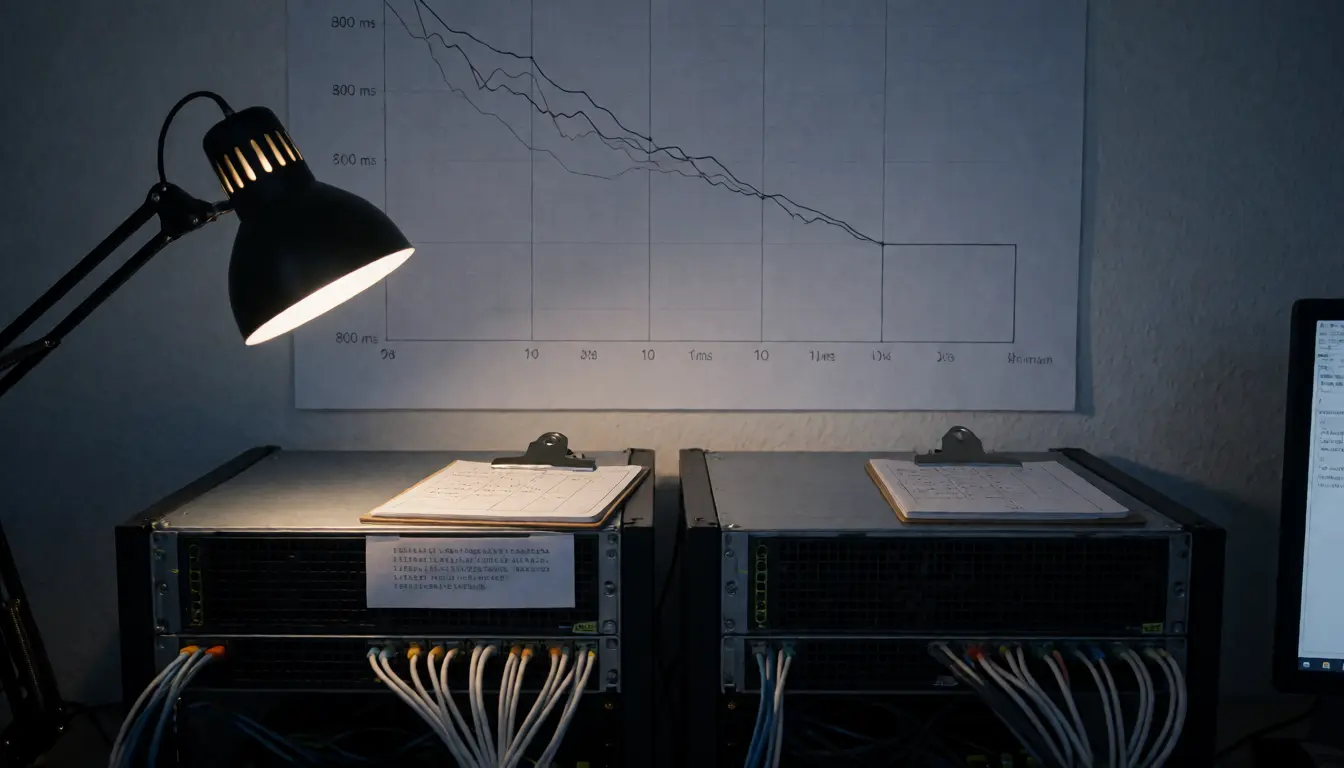
On 14 October 2015 the F-root question arrived with different physics. RIPE Atlas DNS measurements ran every four minutes across 59 F-root instances, five of which deliberately exported routes globally, and fixing one routing announcement took affected European probes from about 800 ms to 10 ms (RIPE Labs). The result is real and the instrument is his. What the post does not hand you is how many probes sat in the affected set, or what fraction of the sampled probes answered at all. Fifty-nine is a count of instances chosen. It is not a denominator of measurement, and the two are not the same number.
SAC 035, the DNSSEC router test he wrote with Lisa Phifer for Nominet UK and Core Competence, published September 2008 and shelved with ICANN’s SSAC reports (SAC 035), gets closer. Through July and August of 2008 the pair drove 24 residential routers and small-office firewalls selected to cover commonly deployed US and UK products. Sixteen of 22 DNS proxies — 72.7%, printed as about 73% — could pass a DNSSEC request and return a complete response carrying authentic data; six of the 24 devices were fully compatible on factory defaults. That is nearly a full census: a counted numerator, a stated sample, a defined window. It still prints no single snapshot day and no aggregate response rate across the set. The bench finished in August, the report appeared in September. The window is the measurement; the publication date is not.
The man who builds the counters also wrote the document about not counting.
draft-ietf-dnsop-no-response-issue-23 with Mark Andrews, dated 16 April 2020 and later RFC 8906, argues that a missing DNS answer cannot be distinguished from packet loss without analysing query-response patterns (no-response draft). That is the honest heart of this material: an unanswered query is not a fact about the world, it is a fact about the query. And draft-ietf-dnsop-qdcount-is-one-01 with Joe Abley, 23 October 2023, later RFC 9619, is a clarification read out of the specifications rather than a survey of anything (QDCOUNT draft).
His tools carry the same signature. ISC’s DNS Checker post of 15 February 2017, bylined Vicky Risk rather than Bellis, credits him with the DNS Checker utility that puts recursive servers through protocol conformance, EDNS(0) under RFC 6891 included (DNS Checker). ISC’s note on contributions, also under Risk’s byline, dated 14 December 2015, records that he developed evldns while at Nominet, with APNIC’s DNSSEC experiments as a contemporary use (ISC contributions). The repositories are visible — perflab, evldns (perflab, evldns) — and both are undated, so neither acquires a date it does not state.
What holds the record together is thinner than a biography.
The ISC posts are bylined Ray Bellis. The RIPE Labs piece sits under a ray_bellis author page. SAC 035 names Ray Bellis of Nominet UK, and ISC’s 2015 note places him at Nominet before the ISC bylines begin. That is a printed affiliation, not a documented career; no source in this chain states a continuous one. It is the weakest joint in the chain and it is load-bearing, so it belongs on the page rather than in a footnote.
Six operands decide whose fact a figure is.
What was actually scanned, and how it was chosen. When the snapshot was taken, and whether the printed value is one observation or an average over a window. Whether the thing counted exists, answers, or is merely delegated. The response rate, and what became of the non-respondents. Whether the counted unit is a server, a zone, an address or a query. And whether the method prints the denominator or only the result.
The rig posts clear all six without effort, because the rig is the population. The network posts clear three and leave the reached fraction unsaid. Recompute what the printed cells permit and the arithmetic is trivial: 16 of 22 is 72.7%; 239,000 to 348,000 is a 45.6% lift; fifteen warm-ups across four condition-pairs is sixty runs and twelve reboots. None of that arithmetic says who was listening.
So name the missing operand. The share of the space that was reachable at all — the fraction of sampled probes, resolvers or devices that answered. With it, ten milliseconds is a property of the network. Without it, ten milliseconds is a property of the probes that happened to reply, and the number travels on a byline instead of an argument.
Lu Heng’s case for running-code primacy is an argument about ordering: the code runs first, the argument arrives second, and authority belongs to whatever can be checked without asking permission (running-code primacy). A measurement is the same bargain in miniature. A count is durable exactly as far as the reality it is tied to (why BTW exists). Bellis ties his rigs down to the kernel build. The internet gets a sentence.
Member Briefing
Read the full trend briefing
Members read the full briefing with the source notes behind every finding.
Strategic Circle
A daily briefing in your language, built from changes we have verified.
Join for USD 20/monthCancel anytime.
Members also get the full research library, a daily briefing on the networks they follow and the private forum.